The Israeli-American Council (IAC) hosted a celebration of Israel’s 70th anniversary on April 17 with over 60 members of Congress from both sides of the aisle in Washington D.C.
According to a press release from the IAC, attendees included Speaker of the House Paul Ryan (R-WI), Senate Majority Leader Mitch McConnell (R-KY), Senate Minority Leader Chuck Schumer (D-NY) and Sen. Robert Menendez (D-NY). Menendez spoke at the event and hailed the Israeli-American community for being “a living bridge between people in the United States and in one of our closest allies, Israel.”
“I am grateful for all that they do to communicate to fellow Americans and fellow Israelis the importance of a strong, vibrant partnership,” Menendez said.
Another senator who spoke at the event, Sen. Lindsey Graham (R-SC), echoed Menendez in stating that Israeli-Americans are “a critical link in our special relationship with Israel.”
It has been a big year for the IAC, given the recent passage of the Taylor Force Act, scores of anti-Boycott, Divestment and Sanctions (BDS) bills being passed in various states, raising over $16.5 million at their March gala.
“As we see from the incredible crowd of Democratic and Republican elected leaders here this afternoon, America’s alliance with Israel is an issue that can bring us together across party lines,” IAC chairman Adam Milstein said at the event.
Other notable attendees at the event included Sheldon and Miriam Adelson, who donated $13 million to the IAC at the March gala.
Every Shabbat, a group of 20 senior citizens in Palm Desert gathers to make blessings over electric candles, grape juice, challah, chili, hamburgers and Frosties at their local Wendy’s restaurant. Now, these seniors are the subject of a documentary titled “Wendy’s Shabbat,” which will screen at this year’s Los Angeles Jewish Film Festival, opening on April 25.
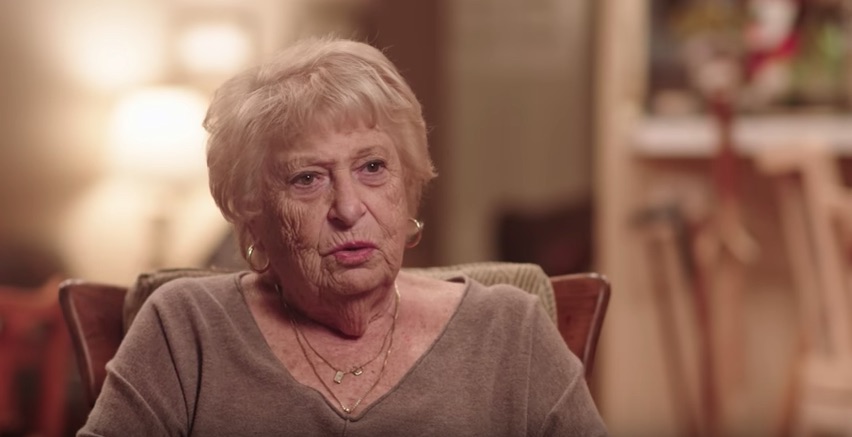
The short documentary by Los Angeles resident Rachel Myers, focuses on her 88-year-old grandmother, Roberta Mahler, as she celebrates the Sabbath every week with the Friday night fast-food meal.
Mahler, a widow, resides in Sun Desert with her 13-year-old dog. She previously lived in Los Angeles and used to attend Valley Beth Shalom. In a phone interview with the Journal, Mahler said she’s been going to the Wendy’s Shabbat for four years.
“I go to be with my friends because being out here in the desert is lonely,” Mahler said. “At Wendy’s, it’s a gathering and you feel like you’re with the family. It gives you a nice warm feeling and a feeling of belonging.”
The seniors of Wendy’s Shabbat, many of whom used to live in Los Angeles and were members of Stephen S. Wise Temple, started the group eight years ago. They sit at a long table, say the traditional Friday night prayers together and then schmooze for an hour or so before heading home to their gated communities in their golf carts.
When Myers attended one of their dinners, she decided she had to document it. She brought her mother — Mahler’s daughter — Abby Myers, on board to produce.
“There is a lot of isolation that happens in our modern world, and I find the seniors in our film inspiring in how they connect to celebrate their religion and friendships at a fast-food restaurant,” said Rachel, who is making her directorial debut with the documentary. “In a way it is essential, because it illustrates how people make a forum in many different circumstances to reach out to one another and build community.”
“Wendy’s Shabbat” took two days to shoot. After she completed the film, Rachel promoted it by uploading trailers to Vimeo and YouTube. Her effort paid off. The trailers have been viewed nearly 200,000 times, and the film is among 55 out of 4,754 submissions accepted to the Tribeca Film Festival, under the “Home Sweet Home” shorts section.
“It is so interesting to see how this film is resonating with people,” Abby said. “I think the film provides a ‘feel good’ reflective moment of what is important in life. Being part of something, recognizing ritual in one’s life, friends, family [and] purpose [are] all told with a very authentic voice to the film.”
The idea behind the Wendy’s Shabbat is also spreading, according to Rachel, who said there are now groups in Toronto, Tennessee and Boca Raton, Fla., “who, after seeing the film, were inspired to make a Shabbat gathering at a restaurant. It’s so amazing that sharing this one senior group’s story would be inspiration to others.”
Representatives of Wendy’s also saw the trailers and contacted Rachel. “They were very touched by it” and sent a letter and gifts to the seniors to thank them, she said.
“When Rachel thought to document Wendy’s Shabbat, she came with a full crew, with lights and cameras,” said Mahler, who will be going to the Tribeca festival with her family for the film’s debut on April 21. “I thought, ‘This is sweet.’ I never thought it would grow like this. Whoever thought it would go so viral? It’s really amazing to me.”
For more about the “Wendy’s Shabbat” documentary, visit wendysshabbat.com.
Heading to your first Jewish wedding? Whether it’s Reform or strictly Orthodox, there are Jewish wedding traditions that you definitely will see.
Some may sound familiar, but knowing what to expect (and being versed in the meaning behind what you are watching) will make you even more prepared to celebrate.
10 Jewish wedding traditions:
1. Fasting
The wedding day is considered a day of forgiveness. Some couples choose to fast the day of their wedding, just as they would on Yom Kippur. The couple’s fast will last until their first meal together after the wedding ceremony.
2. Bedeken
Before the ceremony, the groom approaches the bride for the bedeken, or veiling. He looks at her and then veils her face. This signifies that his love for her is for her inner beauty, and also that the two are distinct individuals even after marriage. It also is a tradition stemming from the Torah, wherein Jacob was tricked into marrying the sister of the woman he loved because the sister was veiled. If the groom does the veiling himself, such trickery can never happen.
3. Ketubah signing
The ketubah is a Jewish prenuptial agreement that outlines the groom’s responsibilities to his bride. It dictates the conditions he will provide in the marriage, the bride’s protections and rights, and the framework should the couple choose to divorce. Ketubahs aren’t actually religious documents, but are part of Jewish civil law — so there’s no mention of God blessing the union. The ketubah is signed by the couple and two witnesses before the ceremony takes place, then is read to the guests during the ceremony.
4. The walk to the chuppah
Traditionally, both of the groom’s parents walk him down the aisle to the chuppah, the altar beneath which the couple exchanges vows. Then the bride and her parents follow.
5. Vows under the chuppah
A chuppah has four corners and a covered roof to symbolize the new home they are building together. In some ceremonies, the four posts of the chuppah are held up by friends or family members, supporting the life the couple is building together. In other instances, it may be a freestanding structure decorated with flowers. The canopy is often made of a tallit, or prayer shawl, belonging to a member of the couple or their families.
6. Circling
The bride traditionally circles her groom either three or seven times under the chuppah. Some people believe this is to create a magical wall of protection from evil spirits, temptation and the glances of other women. Others believe the bride is symbolically creating a new family circle.
7. Sheva Brachot: Seven Blessings
The Sheva Brachot come from ancient teachings. They often are read in Hebrew and English, and shared by a variety of family members or friends. The blessings focus on joy, celebration and the power of love.
8. Breaking of the glass
As the ceremony comes to an end, the groom is invited to step on a glass inside a cloth bag to shatter it. The breaking of the glass holds multiple meanings. Some say it represents the destruction of the Holy Temple. Others say it demonstrates that marriage holds sorrow as well as joy and is a representation of the commitment to stand by each other even in hard times.
9. Mazel tov!
Shouting “Mazel tov!” is one of the best-known wedding rituals. After the ceremony is over and the glass is broken, you will hear guests cheer, “Mazel tov!” Mazel tov means “good luck” or “congratulations.”
10. Yichud
After the ceremony, tradition dictates that couples spend 18 minutes in yichud (seclusion). This wedding custom allows the newly married couple to reflect privately on their new relationship and allows them precious time alone to bond and rejoice.
When a group of rabbis from across the spectrum recently were asked if Jews believe in adoption, they were unanimous in their endorsement. A survey of Jewish households has shown that 5 percent are raising at least one adopted child, double the American average in non-Jewish homes. Here are the responses of two rabbis advocating adoption.
Conservative View
by Carl Perkins
Adoption has a long and honorable place in the Jewish tradition.
Beautiful statements in the Talmud and elsewhere demonstrate our tradition’s respect for adoptive parents. The Talmud teaches us that those who raise children born to others are regarded, according to Scripture, as though they themselves had sired or given birth to them.
Put another way, “the one who brings up a child is to be called its father (or mother).”
We have wonderful examples of adoption in our tradition. Consider Moses. The Bible tells us that Pharaoh’s daughter adopted Moses and raised him as her own child — and even gave him the name by which he would be known for the rest of his life.
You may find this an awkward example because Moses later identified with his family of origin and ultimately led a revolt against his adoptive family’s dynasty.
But our tradition has nothing but praise for the manner in which Moses was raised in Pharaoh’s daughter’s household.
There is also the great Jewish heroine Esther. She was adopted by her cousin Mordecai after the death of her biological mother and father. We even have a case recounted in the Bible of a child, Oded, being adopted by his grandmother Naomi.
Of course, adoption today isn’t identical to what it was in the biblical or talmudic eras, but the point still holds: Judaism has long recognized, valued and believed in adoption — and it still does.
Generally, when a child is adopted, unless it is certain that his or her birth mother is Jewish, the child is converted to Judaism at that time under the authority of a beit din (Jewish court).
It is worth noting (and celebrating) in this day and age in which children are adopted from all over the globe that, partly because of adoption, Jews now come in all colors.
Carl Perkins is a Conservative rabbi.
Orthodox View
by Stuart Grant
Adoption is a complicated issue in Jewish law.
Ethically, we consider raising someone else’s child as a great mitzvah of tzedakah (righteous charity).
We hold by the rabbinic dictum that the teacher of a child is also viewed as the child’s parent with all the respect that implies.
The problem arises as to whom one should adopt.
If one adopts a child not born from a Jewish mother, one converts the child as early as possible with a mikveh (ritual immersion) and, if a male, circumcision.
In Orthodox tradition, one sends the child to a Jewish school, and at the age of bar or bat mitzvah, one asks the child if he or she wishes to remain Jewish.
With the child saying “yes,” the conversion process is complete.
Nothing else is necessary.
Needless to say, such a process of questioning can be traumatic for the young teen.
It is crucial to know who the birth parents are so that, as an adult, the child does not unwittingly marry a prohibited relative.
There is perhaps a greater problem in adopting a Jewish child than in adopting a non-Jewish child because the Jewish community is relatively small compared to the non-Jewish community.
Furthermore, there is also the concern that the Jewish child might be the product of a prohibited marriage where the mother did not receive a get, a religious divorce, from her first husband, and the child is a product of her second marriage.
Therefore, although I believe Judaism encourages adoption as a great mitzvah, adoption needs to be done with the greatest care for the child’s development and adult life.
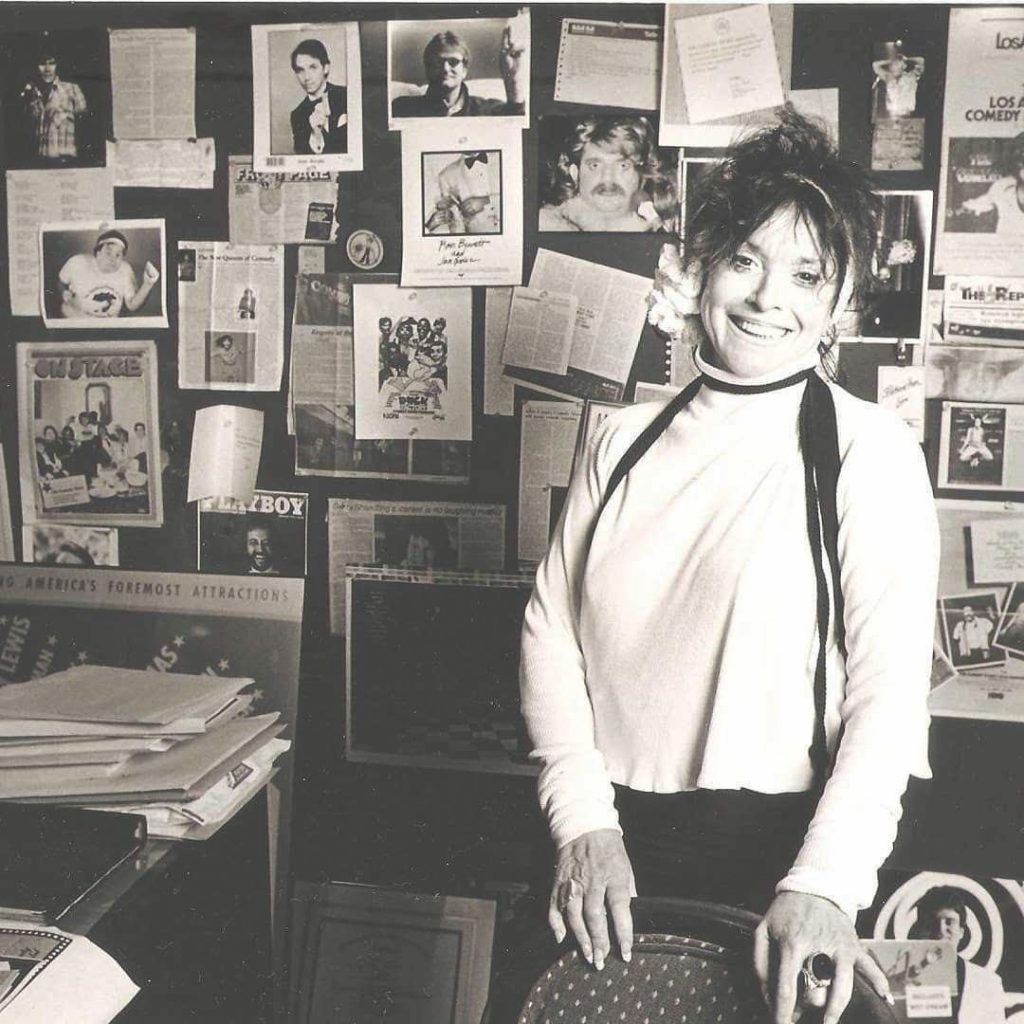
Mitzi Shore, who for decades ran The Comedy Store, the legendary club on the Sunset Strip, died on April 11 following a long battle with Parkinson’s disease. She was 87.
“It is with great sadness and very heavy hearts that we report the passing of Mitzi Shore yesterday morning,” The Comedy Store said in an April 12 statement. “Mitzi was an extraordinary woman and leader who identified, cultivated and celebrated comedy’s best performers. She helped change the face of comedy and leaves behind an indelible mark and legacy in the entertainment industry and stand-up community. We will all miss her dearly.”
Shore was born Mitzi Lee Saidel on July 25, 1930, in Menominee, Mich., and raised in Green Bay, Wis. She attended the University of Wisconsin but dropped out to marry comedian Sammy Shore, whom she met while working at a Wisconsin resort one summer. In the 1950s, through her marriage, Shore met Rodney Dangerfield, Don Rickles, Shelley Berman and Buddy Hackett, and she became a mother figure to the comedians.
On April 7, 1972, Sammy opened The Comedy Store — Mitzi came up with the name — with comedy writer Rudy De Luca. It was the world’s first all-stand-up-comedy nightclub. Two years later, the Shores divorced and Mitzi received control of the club in their divorce settlement.
According to veteran journalist William Knoedelseder, author of “I’m Dying Up Here,” Shore deserves partial credit for transforming the 1970s into the golden era of comedy. Shore nurtured many talented young comedians, including David Letterman, Jay Leno, Robin Williams, Bob Saget, Richard Lewis, Garry Shandling and Elayne Boosler. Working behind a sign on her desk that read, “It is a Sin to Encourage Mediocre Talent,” Shore pushed those she saw as having that special spark to perform, allowed them on her stage and encouraged authenticity in their comedy.
In 1976, she expanded the 99-seat nightclub to a multistage venue, featuring three rooms: the Original Room, the Main Room and the Belly Room. She operated The Comedy Store as an artists’ colony, where comedians could tinker and work out their material before fellow comedians, comedy lovers and entertainment industry professionals. However, Shore did not pay her comedians until 1979, when performers began picketing outside the club.
“Looking back on my mom’s life, the one word that comes to mind is giver. She gave her heart, her soul, and her stages.” — Pauly Shore
Shore eventually opened additional Comedy Store locations, including in La Jolla, Calif., Las Vegas and Honolulu.
In the late 1990s, Shore’s Parkinson’s became so severe that her hands shook when she wrote the lineup sheets for each evening’s show. Two of her four children, including actor-comedian Pauly Shore, took control over the operation of the club. Shore spent her final days in hospice care.
On Twitter, Pauly said his mother’s legacy was her compassion for her performers.
“Looking back on my mom’s life, the one word that comes to mind is giver,” he wrote. “She gave her heart, her soul, and her stages.”
Saget and other comedians also posted tributes on Twitter.
“Mitzi Shore started my career when I was 21 by believing in me,” Saget wrote. “I will forever be indebted to her and love her and always knew that she loved me.”
The Comedy Store closed on April 11 to honor Shore, only the ninth night in its 46 years that the club closed.
Shore’s funeral was held on April 13. She is survived by her four children — Pauly, Peter, Scott and Sandy.
The Motion Picture & Television Fund’s Comedian’s Assistance Fund is accepting donations in Shore’s memory.
The biography of God has been written many times, starting in the Torah and continuing over the millennia that have passed since the words “In the beginning” — or, more precisely, the Hebrew word that is transliterated into English as b’reshit — were first written with a quill pen on a sheet of parchment. And the Bible is not the only best-seller whose hero is the Almighty.
Yet Reza Aslan, a distinguished scholar of religions, has succeeded in showing us a provocative new way of thinking and talking about God in “God: A Human History” (Random House). At the core of his book is a simple but powerful insight — we have no choice but to conceive of God in human terms, and not merely because the Bible depicts the Almighty as creating Adam “in our image, after our likeness.”
“It turns out this compulsion to humanize the divine is hardwired in our brains, which is why it has become a central feature in almost every religious tradition the world has known,” writes Aslan, who comes from a Muslim background but briefly converted to Christianity. “In fact, the entire history of human spirituality can be viewed as one long, interconnected, ever-evolving, and remarkably cohesive effort to make sense of the divine by giving it our emotions and our personalities, by ascribing to it our traits and our desires, by providing it with our strengths and our weaknesses, even our own bodies — in short, by making God us.”
Aslan’s intellectual honesty is on display in the paragraph just quoted from “God: A Human History.” When he refers to “the divine,” he uses the pronoun “it” rather than any of the other names of the deity.
Aslan is one media-savvy scholar who does not confine himself to the ivory tower. He appeared frequently on CNN as a commentator on world affairs and as the host of the “Believer” series until a visceral tweet about the 45th president prompted the network to cancel his show. He put his expertise to good use as a consultant on HBO’s series about the end times, “The Leftovers.” And “Zealot,” his revisionist biography of Jesus of Nazereth, topped The New York Times best-seller list.
So Aslan is not afraid of controversy, but he is also careful about what he is and is not arguing in the pages of his new book. “This is not to claim that there is no such thing as God, or that what we call God is a wholly human invention,” he writes. “Both of the statements may very well be true, but that is not the concern of this book.” In fact, he readily affirms that he is among those who “choose to believe that there is something beyond the material realm — something real, something knowable.” But he also warns that “[f]aith is a choice,” and he insists that “anyone who says otherwise is trying to you convert you.”
But he also insists that if there is one thing that all religions share in common, it is what he calls “the humanized God,” that is, a deity whose characteristics are like our own. “The Mesopotamians, the Egyptians, the Greeks, the Romans, the Indians, the Persians, the Hebrews, the Arabs, all devised their theistic systems in human terms and with human imagery,” he writes. Even when psychologists and other scientists inquire into the beliefs of devoutly religious people, they find that true believers “overwhelmingly treat God as though they were talking about some person they might have met on the street.”
“Religion is first and foremost a neurological phenomenon.” — Reza Aslan
Inevitably, Aslan looks far beyond the Bible to show us how the divine has been perceived and depicted by human beings, starting in the distant past and continuing to our own times. He argues that the single oldest image of God, which is found in a cave painting that dates to as early as 18,000 B.C.E., is a humanoid form with “the legs and feet of a human being, but the ears of a stag and the eyes of an owl,” an example of deity known to science as “the Lord of the Beasts.” But he insists that the very first image of God can be linked to the deity that we find in the Tanakh: “Even the Hebrew god Yahweh is occasionally presented as the Lord of the Beasts in the Bible,” he writes, citing a passage in the Book of Job in which God boasts of his authority over the animal kingdom.
But Aslan drills down just as deeply into the inner workings of the human brain to explain why not only the Lord of the Beasts but the very idea of the divine entered human civilization. “Religion is first and foremost a neurological phenomenon,” he explains. And it arises from a specific brain function that “encourages us to use ourselves as the primary model for how we conceive of everyone else.”
Thus he conjures a moment in pre-history when a real-world version of the biblical Eve notices a tree in the forest with a trunk that has grown into a shape that resembles a human face. “She transforms the tree into a totem: an object of worship,” Aslan writes. “She may bring it offerings. She may even start praying to it for help in netting her prey. Thus religion is born, albeit by accident.”
The Jewish contribution to the human history of God, as Aslan sees it, can be found in the writings that were brought back from the Babylonian Exile, that is, the compilation of older texts was eventually canonized several centuries later as the Hebrew Bible. And Aslan judges it to be “an extraordinary development in the history of religions,” an idea of divinity that represented a quantum leap from the primitive monotheism that was briefly practiced in ancient Egypt.
“This was a new kind of God, both singular and personal,” he writes. “A solitary God with no human form who nevertheless made humans in his image. An eternal, indivisible God who exhibits the full range of human emotions and qualities, good and bad.”
Aslan proves himself to be a benign controversialist. After conducting us on a wholly fascinating tour through the history of religion — and after smashing more than a few icons — he ultimately defers to our own free will. “Believe in God or not,” he concludes. “You need not fear God. You are God.”
Reza Aslan will discuss “God: A Human History” with Jewish Journal book editor Jonathan Kirsch on April 22 at the Los Angeles Times Festival of Books. Visit events.latimes.com/festivalofbooks for tickets and information.
Jonathan Kirsch, author and publishing attorney, is the book editor of the Jewish Journal.
Playwright Joshua Harmon’s darkly funny “Bad Jews” has been produced all over the world since its New York premiere in 2012, and was last staged in Los Angeles at the Geffen Playhouse in 2015. A new production, opening at the Odyssey Theatre on April 21, will run through mid-July.
In the story, grandchildren fight over their late grandpa’s chai necklace, with the religious, self-righteous Daphna on one side, her volatile cousin Liam (who has a shiksa girlfriend and his own plans for the heirloom) on the other, and Liam’s brother Jonah unhappily caught in the middle. Themes of loyalty and betrayal, honoring tradition, and what defines a good Jew and a bad one are explored.
“The beauty of the play is you can find good arguments in every character,” Noah James, who portrays Liam, said after a rehearsal. “It’s not just black or white. Liam doesn’t understand why Daphna wants him and all Jews to live a certain way, but he does understand her argument about preserving Judaism.”
James, the son of an Israeli father and an American mother, had a grandfather who was very active in the Jewish community. Judaism was a secular, cultural experience for his family. “But there is something nice about being able to connect to your ancestors by doing rituals Jews have done for thousands of years,” he said. “I think [‘Bad Jews’] is an exploration of what it means to be Jewish, but also [about] cultural identity and how you hold onto it.”
Jewish actress Jeanette Deutsch, who plays the holier-than-thou Daphna, is not religious but has Hebrew school, Jewish camps, a bat mitzvah and trips to Israel in her past. She regularly hosts holiday celebrations, like the recent seder the cast attended. She understands why some people, especially older Jews, might express concern over the play’s title.
“If we could be a little less vicious to each other and judge a bit less, we’d be better Jews.” — Dana Resnick
“I know it pushes buttons with people, but I think it’s funny,” she said. “People get offended without knowing that the play is a comedy and comes from a place of fun and love and art.” She and James have jokingly used the play’s title to describe themselves and others.
So has director Dana Resnick, who grew up in a kosher home, attended Hebrew school, became a bat mitzvah, and spent time in Jewish camps and Israel. Her Yiddish-speaking grandparents were Orthodox and owned a kosher bakery. “We call ourselves bad Jews, that’s what Jews do [when] we don’t fast on Yom Kippur or our children don’t know Hebrew,” she said.
Resnick was playwright Harmon’s classmate in the master’s of fine arts program at Carnegie Mellon University. She’s directed “Bad Jews” before and said that having two Jews in the cast “makes my job easier. There’s a certain inflection and an understanding of the Holocaust that’s ingrained in a Jewish person.”
Austin Rogers, who plays Jonah, isn’t Jewish, but he has been taking an Introduction to Judaism class at the American Jewish University. Learning about Jewish history and rituals has been very helpful research, he said. He finds the play’s topics particularly relevant. “The idea of finding value in both sides of the argument speaks to the political climate we’re in,” he said. “It’s very timely.”
Resnick believes the play’s visceral emotions will move theatergoers and make them think about their treatment of others. “If we could be a little less vicious to each other and judge a bit less,” she said, “we’d be better Jews.”
“Bad Jews” runs April 21-July 17 at the Odyssey Theatre. Visit odysseytheatre.com for tickets and information.
The 13th annual Los Angeles Jewish Film Festival launches April 25 with more than two dozen feature, documentary and short film selections celebrating Jewish experience, tradition and culture.
“It’s our bar mitzvah, and we want to celebrate it,” said the festival’s executive director, Hilary Helstein. “It’s extraordinary to see something we started 13 years ago become an anticipated annual event. With the support of community organizations, consulates, individuals, council members, family foundations and the Jewish Journal, we’re proud to have made it to 13 years.”
The festival will take place at 14 venues in and around the city, including theaters, synagogues and community centers. “We deliver films to every part of the community,” Helstein said. “People don’t have to go farther than their neighborhood.”
The opening-night gala features the Los Angeles premiere of the documentary “Sammy Davis Jr.: I’ve Gotta Be Me,” which will air on PBS’ “American Masters” later this year. “We wanted something uplifting for opening night, and nothing could be better than paying tribute to this iconic, legendary entertainer,” Helstein said. Davis’ son, Manny, and friends including producer George Schlatter and comedian Tom Dreesen will be in attendance. “Since it is a bar mitzvah, we want to have all these people do aliyahs and say something about Sammy.”
The festival has several themes. “For Israel’s 70th birthday, we have documentaries focused on what America has done for Israel,” Helstein said. In “The Land of Milk and Funny,” stand-up comic Avi Liberman takes fellow comedians to Israel to perform and see the sights, and Jewish Americans play baseball for Team Israel in “Heading Home.”
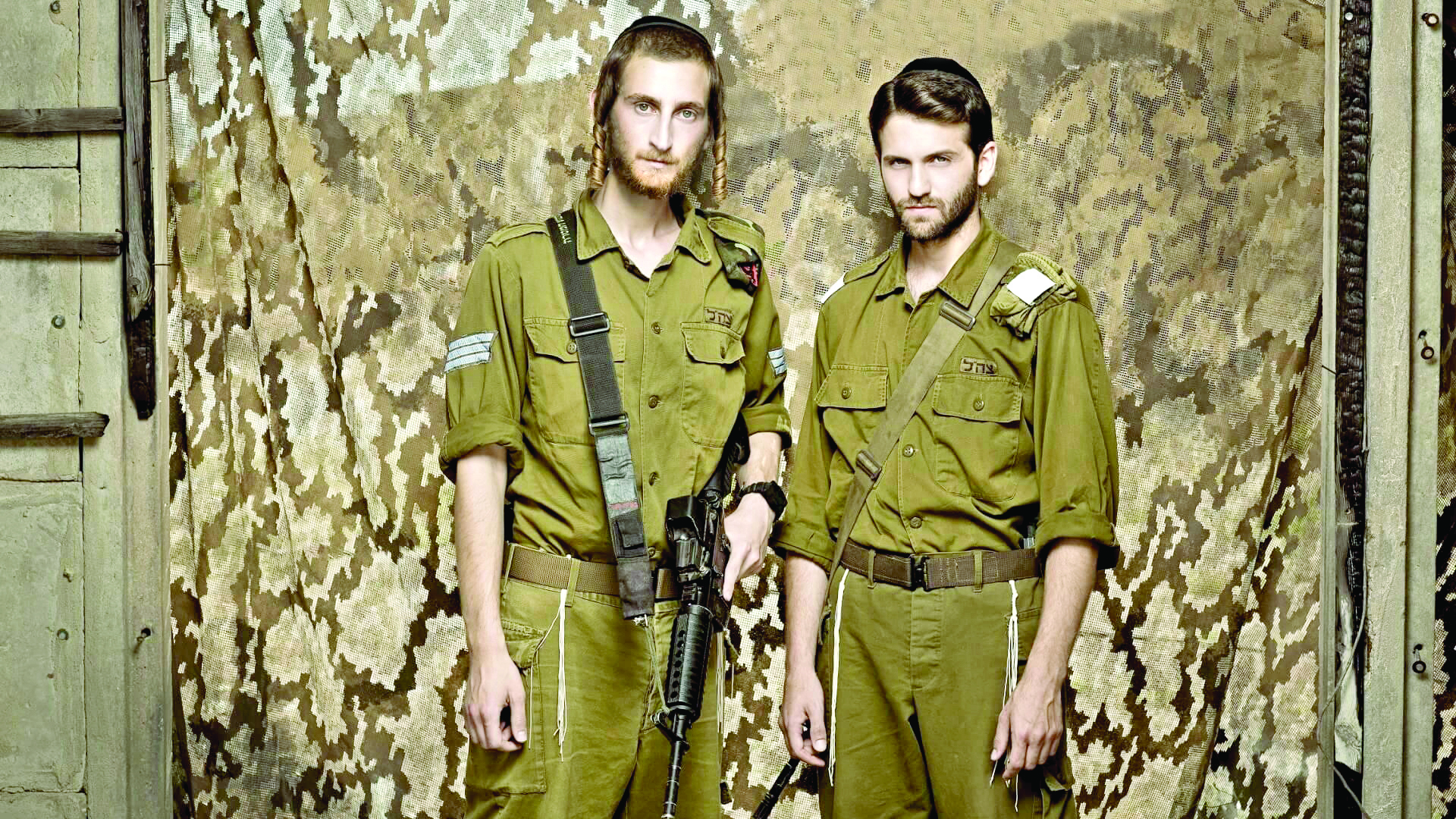
Audiences will get to see the first two episodes of the Israeli series “Kipat Barzel” (“Commandments”), about Charedi soldiers in the Israel Defense Forces. “It addresses such a timely issue,” Helstein said. The series focuses on how secular Jews resent the ultra-Orthodox for not serving in the military, but when they do serve — against the wishes of the Charedi community — they’re not welcome. “It’s a really important show and will trigger a tremendous amount of discussion,” Helstein said.
Jewish Journal Publisher and Editor-in-Chief David Suissa will moderate a Q-and-A after the screening and receive the Visionary Award for his contributions to the Jewish community.
Dolev Mesika and Roy Nik in “Commandments.” Photo courtesy of LAJFF.
Helstein emphasized the importance of including Holocaust-related films, and there are nine this year. “The Last Suit” is an Argentine feature about a Holocaust survivor on a mission to find the friend who saved his life in Poland. It’s paired with “The Driver Is Red,” an animated short about the manhunt for Nazi war criminal Adolf Eichmann.
The German feature film “The Last Supper,” a world premiere, takes place at the Glickstein family dinner in Berlin on the day Hitler comes to power. With the patriarch insisting the Fuhrer won’t last, and his equally misguided young son ready to join the Brown Shirts, the only voice of reason is the Palestine-bound daughter’s.
“Above the Drowning Sea” chronicles the experience of Jews who escaped Europe and found refuge in Shanghai, thanks to a Chinese diplomat. Each of the documentary shorts “Dieu Merci: The Story of Michele Rodri,” “116 Cameras” and “A Call to Remember” tells a personal story of survival and will be screened together, followed by a Q-and-A led by the latter’s producer, Michael Berenbaum.
The screening of “Reinventing Rosalee,” a world premiere documentary, in which Lillian Glass chronicles the remarkable life of her Holocaust-survivor mother, will feature a Q-and-A with both women.
The festival’s centerpiece program is “The Samuel Project,” about a teenager whose school project forces his grandfather, a Holocaust survivor, to confront the past he hasn’t spoken about in 75 years. A world premiere, the family-friendly feature stars Hal Linden, who will receive the festival’s Martin Paige Hollywood Legacy Award.
Also this year, Helstein said, “We have a focus on women’s stories: feminism, activism, ageism, sexism — all very current themes.” The biographical documentaries “Heather Booth: Changing the World,” about a community organizer and activist, and “Seeing Allred,” about women’s rights lawyer Gloria Allred, address these issues. Allred and the filmmakers will participate in a post-screening Q-and-A session.
In conjunction with the Austrian consulate, the 1935 film version of Shakespeare’s “A Midsummer Night’s Dream” will be shown as a tribute to Jewish émigré and director-producer Max Reinhardt, commemorating the 75th anniversary of his death. “Rising Sons,” a documentary about efforts to break the cycle of rape and violence in the war-torn Congo, will be shown in association with Jewish World Watch, with a discussion to follow.
Other notable selections include the shorts “Stitchers: Tapestry of Spirit,” about a project to re-create the entire Torah in needlepoint; “Heaven Is a Traffic Jam on the 405,” which won the Oscar for best documentary short this year; and “Tzeva Adom: Color Red,” a tense story about a fateful encounter at the border between an Israeli soldier and a Palestinian boy. Filmmakers and cast members will attend.
The festival’s closing-night presentation is “If You’re Not in the Obit, Eat Breakfast,” a lighthearted documentary featuring Carl Reiner and his nonagenarian and centenarian friends — Mel Brooks, Norman Lear and composer Alan Bergman among them — sharing their insights on life and longevity. A Q-and-A with Bergman and the filmmakers will follow.
“We’re paying homage to these Hollywood guys who are still working and vital and who have created so much in our L.A. community,” Helstein said. “It’s an uplifting, lovely film about keeping going through the aches and pains.”
The Los Angeles Jewish Film Festival runs April 25-May 2. Visit lajfilmfest.org for the screening schedule and more information.
In the summer of 1939, one month before Germany invaded Poland, two Belgian families vacationing in Ostende met and developed a friendship. The couples’ children, including 11-year-old Alice Weit Gerstel and 7-year-old Simon Gronowski, also quickly became friends.
Alice’s father, Herman, was in the diamond business in Antwerp, while Gronowski’s father, Leon, was in the leather business in Brussels.
When the Nazis invaded Belgium in 1940, Herman Gerstel foresaw more serious danger and planned for his family to get out of Belgium. In October 1941, he and Alice’s 16-year-old brother, Zoltan — who had developed a relationship with Simon’s older sister, Ita — went on a scouting trip to find a safe place for the family. Accompanied by a hired smuggler, and defying the 8 p.m. curfew, they set out in darkness.
Herman simultaneously sent his wife, Frida, and their three other children, including Alice, to stay with the Gronowski family in Brussels. The family left in the morning, wearing diamonds under their clothes.
The Gronowskis hid five people on the floor above the family’s leather business: Alice, her siblings Ita and Armand, Frida, and Frida’s mother, Blanche. Ten days later, the smuggler’s wife arrived to take the Gerstels out of Belgium.
“The train goes too fast.” They were the last words Simon heard his mother say before he jumped from the train bound for Auschwitz.
When the two families bade farewell, they had no idea it would be the last time they would see each other. The Gerstel family set off for France, eventually making their way to Cuba, while the Gronowskis’ route to liberation was laced with loss.
On April 19, 1943, Simon and his mother, Chana, were among the Belgian Jews awaiting deportation from Menchelen, a transit camp midway between Antwerp and Brussels. Three members of the Belgian Jewish Underground stopped the train with a red light that forced the driver to hit the brakes. As the train slowed to a halt, the resistance fighters opened up a car and many escaped. When the train started up again, passengers in Simon’s boxcar managed to pry open a door. Grabbing her son by the shoulders of his jacket, Chana lowered Simon onto a running board several feet below the moving car.
“The train goes too fast,” Chana said. They were the last words Simon heard his mother say. When the train slowed down, Simon jumped onto the tracks. Chana was gassed upon arrival in Auschwitz. A separate convoy transported Ita to Auschwitz. She also died there.
After jumping from the train, Simon ran into the woods. A Belgian police officer — later declared a Righteous Gentile — saved his life, putting him on a train back to Brussels, where he met a Catholic family that took him in until the Allies liberated Belgium in September 1944. A different Catholic family also hid Simon’s father, Leon. The two were reunited after the war. Leon, however, died at the age of 46 when Simon was just 13.
After the war, Alice heard that the entire Gronowski family, including Simon, had died. However, last year, her son, Dann Netter, a Los Angeles television producer, discovered Simon’s autobiography, “The Child of the 20th Convoy” which described the Gronowskis’ friendship with the Gerstels. Subsequently, Alice and her son tracked down Simon, who today is 86 years old, lives in Belgium and is an attorney.
On April 15, Simon and Alice, who lives in Westwood, reunited for the first time since their separation 76 years ago.
The two shared their story at Pan Pacific Park at the Los Angeles Museum of the Holocaust’s Yom HaShoah ceremony. Their rapport with each other was easy and familial. Both had vivid recollections from their time on the beach in Ostende.
Speaking in heavily accented English, Simon told the Journal what he thought about people coming together to mark the Holocaust. He said that every day for him is Yom HaShoah. Every day he remembers.
“Since the 1950s, Holocaust survivors have taken on two simultaneous missions: shaping and preserving the memory of the Shoah on the one hand, and constructive social action on the other.”
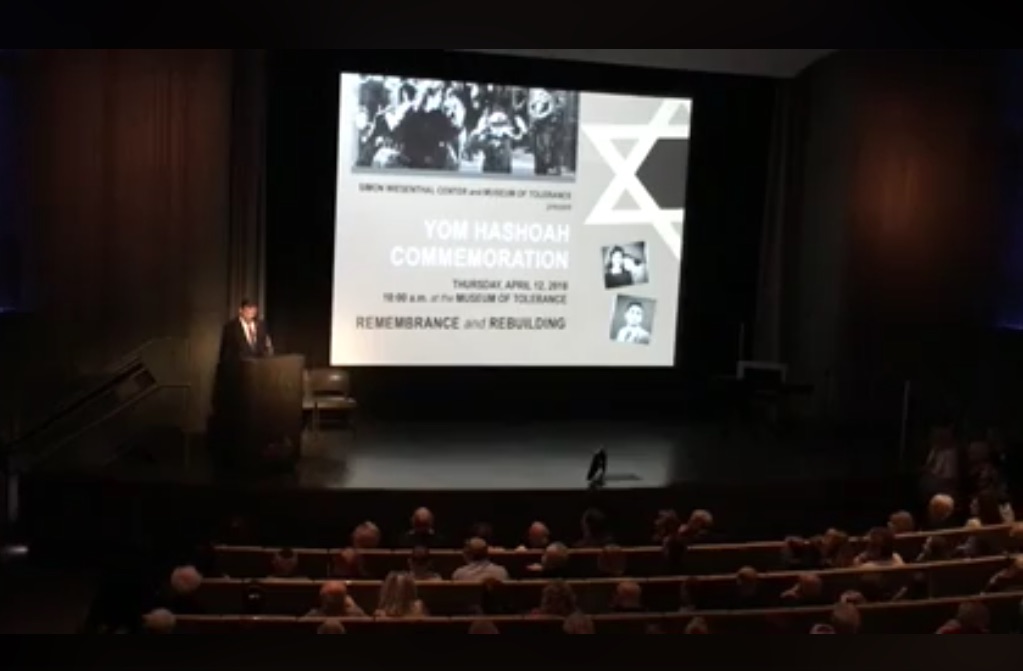
Those were the opening remarks by Museum of Tolerance Director Liebe Geft, emcee at the annual Yom HaShoah commemoration event on April 12 at the museum, part of the Simon Wiesenthal Center.
The event’s standing-room-only crowd included dignitaries and guests from more than 15 countries, along with speakers, students and survivors.
As attendees entered the hall before the official ceremony, images of survivors, along with their birthdates, birthplaces and Holocaust stories unfurled onscreen with the Simon Wiesenthal quote: “Hope lives when people remember.”
The quote aptly highlighted the fact that, throughout the year, Holocaust survivors speak at the Museum of Tolerance four or five times a day to share their experiences and life lessons. However, with the number of survivors dwindling, it also emphasized the importance of continuing education and commemorating the solemn anniversary.
“You are truly an inspiration to us all,” said Consulate General of the State of Israel Sam Grundwerg, himself a grandson of Holocaust survivors and the great grandson of those who perished.
“Today we fulfill our sacred obligation to remember the 6 million Jews who were murdered,” he continued. “The sacred obligation is not merely to remember the past, it’s an obligation to learn its lessons, and most importantly to apply them to the present in order to secure the future of our people.
“Let us pay tribute to the heroes that contributed substantially to the State of Israel and the rebuilding of Jewish families and communities throughout the world. And also let us be grateful and proud that the Jews are once again a sovereign nation.”
“If there is a flourishing Jewish state in 2018, it is because of the sacrifice of our survivors, who clawed their way out of despair to fight in the War of Independence in 1948.” — Rabbi Abraham Cooper
A high point of the event was the emotional reunion of Alice Weit (nee Gerstel) and Simon Gronowski, two Belgian Holocaust survivors who hadn’t seen each other in 76 years. (After Weit discovered her maiden name mentioned in Gronowski’s book, they connected online and via phone, and finally met in L.A.) Gronowski’s mother, Hannah, hid the Gerstels, and later helped Gronowski, who was 10 at the time. He was the only one in his family to survive.
Belgian Consul General Henri Vantieghem said it was important for Belgium to keep alive the memory of the Holocaust, to promote equality between people and tolerance among the population. He referred to Gronowski’s story as one of love, hope and humanity. “Thank you for [showing] happiness can triumph over disaster,” he said.
Perhaps the most impassioned remarks came from Rabbi Abraham Cooper, associate dean of the Simon Wiesenthal Center. He shared anti-Semitic memes and images, and talked about the mainstreaming of Holocaust denial, last month’s brutal murder of Holocaust survivor Mireille Knoll in Paris, and other horrors around the world.
“The Nazis had two goals: murder all Jewish lives and eradicate Jewish life,” he said. “If there is a flourishing Jewish state in 2018, it is because of the sacrifice of our survivors, who clawed their way out of despair to fight in the War of Independence in 1948, married and brought children into the world, rebuilt Jewish life in Israel and across the globe, despite the horrors and losses they experienced.”
The program closed with the singing of Psalm 22 by Cantor Arik Wollheim of Beth Jacob Congregation in Beverly Hills.
After the event, attendees were on hand for the reopening of Pulitzer Prize-
winning photographer Marissa Roth’s “Witness to Truth,” a permanent exhibit of portraits of survivors who serve as the museum’s docents.