fbpx

February 28, 2018

Why Study Our History?

Why in the world would anyone want to study Jewish history? This was the question addressed by David N. Myers at a Feb. 13 book talk in Royce Hall at UCLA, sponsored by the UCLA Alan D. Leve Center for Jewish Studies.

The event focused on Myers’ two recently published books. The first, “Jewish History: A Very Short Introduction,” offers a concise account of the entire course of Jewish history in 100 pages. The second, “The Stakes of History: On the Use and Abuse of Jewish History,” is an argument for the study of history, and especially Jewish history, as an anchor of memory and indispensable ingredient for informed civic engagement. The dialogue dealt with the intersecting themes of the two books, which together reveal the pleasures and payoff for studying Jewish history.

Myers is the incoming president and CEO of the Center for Jewish History in New York and also the Sady and Ludwig Kahn Professor of Jewish history at UCLA. His previous books include “Between Jew & Arab: The Lost Voice of Simon Rawidowicz” and “Resisting History: Historicism and Its Discontents in German-Jewish Thought.” Myers also is completing a book with Nomi Stolzenberg on the Satmar Chasidic community of Kiryas Yoel, N.Y.

Jewish history also can serve to disrupt historic narratives, achieve a measure of justice or retribution, provide empathy…

Myers’ two respondents at the event included Deborah Hertz, the Herman Wouk Chair in Modern Jewish Studies and a professor in the Department of History at UC San Diego; and Sarah Abrevaya Stein, professor of history and the Maurice Amado Chair in Sephardic Studies at UCLA. The program was moderated by Todd Presner, professor of Germanic languages, comparative literature and Jewish studies at UCLA, as well as the Sady and Ludwig Kahn Director of the UCLA Center for Jewish Studies.

“Studying Jewish history is ceaselessly fascinating,” began Myers, who was inspired 32 years ago by his great teacher and mentor, Yosef Hayim Yerushalmi, author of the book “Zakhor: Jewish History and Jewish Memory.” In fact, Myers’ book “Jewish History: A Very Short Introduction” is an homage to Yerushalmi, who inspired in Myers a love and passion for Jewish history, enabling Myers for the first time to view it as “polychromatic rather than black and white.”
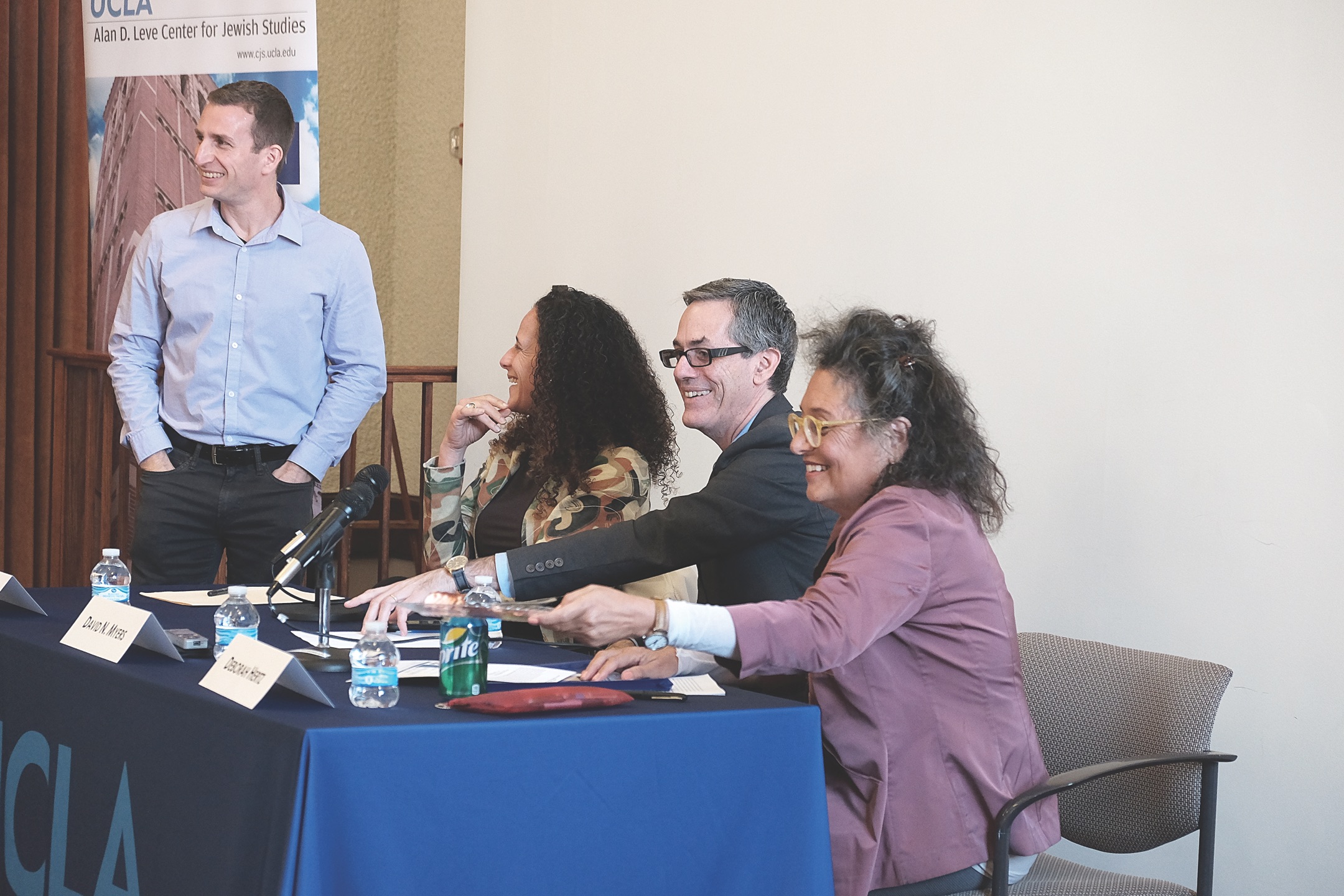
From left: Todd Presner, Sarah Abrevaya Stein, David N. Myers and Deborah Hertz take part in the “Why Study Jewish History?” book talk at UCLA.

Myers’ objective in the book was to answer the questions of how and why the Jews managed to survive. He came up with two explanations: anti-Semitism on one hand and assimilation on the other. The hatred of anti-Semitism tended to confirm the identity of Jewish separateness. Over and over again, assimilation flexed the cultural muscle of Judaism.

Beyond its value as a mere accumulation of facts, Jewish history further serves as a witness to events and movements. While history serving life is not unique to Jews, Myers finds Jewish history to be a meaningful guide to life, providing enjoyment, edification, and a predictive capacity by observing patterns from the past that shape blueprints for the future.

Jewish history, as Myers stated, also can serve to disrupt historic narratives, achieve a measure of justice or retribution, provide empathy, and recover lost voices that have been extinguished. “It is an essential repository of discarded ideas which may offer us new ways out of our current quagmires. To me, then, it is a moral imperative to study the past, not just a professional obligation.”

Myers concluded his presentation with a look at history’s future. “History is going to be compelled to adopt new modes of communication in order to be heard — op-ed writing, podcasts, short-form journalism, etc.” He also offered that, “Culture is the lifeblood of Jewish history.” And in terms of the responsibility of the historian: “I’m a historian who believes I have a moral obligation to act and write based on my historical creed.”

The event’s sponsor, the UCLA Alan D. Leve Center for Jewish Studies, is dedicated to advancing scholarship in all areas of Jewish culture and history, educating the next generation about the role of Judaism in world civilization, and serving as an exceptional public resource for Jewish life and learning.


Mark Miller is a humorist and journalist who has performed stand-up comedy on TV and written for a number of sitcoms.

Why Study Our History? Read More »

Serving the People at Yossi’s Place

Yossi Shitrit’s Israeliness is so archetypal, it’s as if he’s a living, breathing stereotype of the Israeli male. His cockiness, his accent, his irreverence, his ambition, his total lack of fear, his doelike blue eyes and carefully groomed stubble, his tattoos, his confidence — he’s sexy, and he knows it.

Yossef (Yossi) Shitrit is the 34-year-old co-owner and chef, along with partner David (Dudu) Almakias, of David and Yossef, a wildly popular Tel Aviv dining destination with a “downtown” vibe. Luxury cars more at home in Beverly Hills than Tel Aviv’s Rothschild neighborhood pull up outside the restaurant on Montefiore Street. Since opening nine years ago, David and Yossef has attracted Israel’s fashionistas, politicians, high-tech entrepreneurs, glamourati and a lot of gorgeous young women. But although they may come to “see and be seen,” the majority of the restaurant’s returning clientele come back for the food — and for Dudu and Yossi.

Born in Haifa, Shitrit has a love for the Israeli kitchen almost as old as he is. He remembers his grandmother, of Iraqi descent, holding him as a baby while she cooked in her kitchen. And while he loves his mother’s sambusak and red rice, when asked what he likes best about his grandmother’s cooking, he replied: “Everything. I worship her cooking.” The Israeli stereotype deepens as Shitrit goes on about his grandmother: “She has magic in her hands.”

As much respect as Shitrit has for the “fancy, nice, high-end” food on his menu, the food, it seems, is just a conduit. Shitrit’s dining dogma is more holistic. “It’s not about cooking; it’s about people,” he said. “I like to host people. Connect with new people, make new relationships. Cooking is the way to connect, to sit around the table and talk.”

“I like to host people. Connect with new people, make new relationships. Cooking is the way to connect.” — Yossi Shitrit

The graffiti on the main wall of the restaurant intentionally tries to break down the barrier between the haute cuisine and the fun, casual vibe.

“The atmosphere is our atmosphere,” Shitrit said. We’re not trying to be like a Michelin three-star restaurant. We just want to see people having fun.”

David and Yossef opened after the two chefs met while working in the kitchen of one of the city’s more established fine dining restaurants. They instantly connected and decided to do something for themselves. This drive became the first David and Yossef, a 250-square-foot restaurant in a former sandwich bar in Tel Aviv’s old north neighborhood. From the start, the eatery was packed. When asked why they have been so successful in the increasingly competitive Tel Aviv dining scene for close to a decade, Yossi said adamantly: “We are hosting people in our home. We are here all day, every day.”

It’s the combination of sophistication and lack of pretense that continues to draw crowds. When asked about his favorite dish, Shitrit doesn’t choose the foie gras or the perfect egg, the tuna sashimi or the popcorn shrimp. He chooses, like the typical Israeli he is, the local dish: the shawarma. “The dish has been with us since the minute we started; it’s been on every menu we’ve had,” he said. “Nine years: the same dish, the same recipe, the same pita. The shawarma is us. The spices, the meat — it’s us, it’s our country, our neighborhood. Our story is in this dish.”

But he doesn’t want to talk about any of this, really. It’s history. He’s focused on the future: two new restaurants in Russia — Moscow and St. Petersburg. But what gets him the most excited is the medical cannabis vaporizer company in which he is a partner. Because, of course, any Israeli male archetype must also have a startup.

Serving the People at Yossi’s Place Read More »

My Sabbatical Journey: Feeling the Drumbeat of Life

I feel the drumbeat of life — pulsating more palpably than ever before.

This feeling is due, in part, to my recent sabbatical, during which I focused on studying Chasidic texts and immersing myself in meditation while wondering about the nexus between mindfulness and Torah. As part of my inquiry I completed a retreat on Holy Isle, at a center run by a Tibetan Buddhist order off the west coast of Scotland, as well as one in Goa, India, exploring the practice as it developed in the Indian subcontinent with Hindu influences.

When we meditate, we don’t surrender the tone in our muscles. If we do that, we also surrender the tone of our mind. The Tibetan Buddhist approach asks that we work hard to achieve a rest that is both peaceful but also percolating. As we meditate, something is happening. My teacher, Sue, referred to this as “poised rest.”

This approach reminds me of prayer, of tefilah, at least as it ought to be. Not a mindless, numb recitation of syllables, but a pause from the drumbeat of one’s own life in order to be awakened to the drumbeat of all life. Putting forth effort in order to experience and harness some effortlessness. Trying to transform the familiar.

Vaishnavi, my teacher in India, practices Hinduism. Each day, she would lead us through a series of yoga poses, which, for me, took enormous effort. I felt awkward trying to mimic her stance, and yet she kept enjoining me to smile — a spiritual inversion of “no pain, no gain.” Involve each muscle of the body of which you are aware, for each pose, and not just the one that seems to be the focus of that asana. And then, once there, through effort, breathe into the effortlessness of it, the meditation that can be experienced through it.

Smile through it. Enjoy it. Use it.

After yoga, Vaishnavi would transition into meditation, intoning the phrase “repose in yourself.” Within those three simple words are the puzzle, challenge and beauty of artful and meaningful meditation.

Repose. In. Yourself.

Belying Hollywood fantasies of a yogi transported like — spoiler alert! — Luke Skywalker in “Star Wars: The Last Jedi,” the “where” of meditation is within you. True to you. Inhabiting you. Using you. You meditate not to escape self, but to rest, in a poised way, within self. So that self can be transformed and, just maybe, have the power to transform.

There is a delicious paradox here, articulated by another of the transitions of Vaishnavi’s utterances. She would say, as we tried to clear our minds and focus on our breathing, “There is nothing to do. There is nothing to see. There is nothing to want.”

These were spiritual steps into the emptiness of our mind’s eye, which of course is also quite full. Meditation is quietude, but not utter quiet. Your mind is full, no matter how much you try to empty it.

The religious person emerges from meditation aware that because there is brokenness to see, everywhere, and because there is healing to want and desire, for all, there is an enormous amount to do.

Here is where Torah holds and helps resolve the paradox. Thank goodness that when you get to a quiet space, you hear the loudness of your mind. For there is work to do in this world! Torah would say, and hasidut would say, that if your aloneness, your hitbodedut, is an end to itself, it is indulgent — perhaps even obscene. You might use, as steps into a pose, the notions that there is nothing to do this second. Nothing to see right now. Nothing to want immediately. But the religious person emerges from meditation aware that because there is brokenness to see, everywhere, and because there is healing to want and desire, for all, there is an enormous amount to do.

And so, part of repose in yourself is to repose … in … you, activating the you that has a task, an endless set of them. The task is to enter prayer or yoga or meditation or study so that you can emerge from it yet more ready, more poised, more present. Can it really be that our Jewish concept of prayer is that it is over when we finish the amidah? That if our davening is really good that day, we get a prize for having done it? Or is not prayer only the beginning of worship, the start of a spiritual moment, naked and insufficient on its own?

In the modern era, hasidut has sort of folded into itself as a sort of undifferentiated ultra-orthodoxy, but not, itself, singularly dynamic. To my great delight, the original sources and the dynamism and bold activism that course through them are extant and eminently accessible. They still provide important fodder for those of us who want to mine Judaism for its fully layered and activated meaning.

Rabbi Levi Yitzhak of Berditchev, in his collection called “Kedushat Levi,” reads into a verse within Exodus 12, during which we not only gain liberation but entry into Jewish time: Hachodesh hazeh lachem. This month will be for you the first of the months — a commandment which ensconced Jewish time within the lunar rhythms. That’s the pshat, the simplest meaning of that first post-Exodus commandment.

But by the time Yitzhak got to the verse, adding his layer to inherited textual archaeology, the words exploded with meaning way beyond the notion of a calendar. To him, the word lachem means not just “for you,” but through you and “for your benefit.” And hachodesh meant not “month” but a more primal sense of the word — renewal, refreshing, a restart. He links this phrase to its sibling phrase in the 31st chapter of Exodus, where Shabbat is described as kodesh hi lachem. Shabbat is holy/holiness, for you. That is how it is translated. But the words themselves mean holiness is through you, for you.

What it means there is that holiness itself, the Holy One, God, is active for you, through you, for your benefit. Shabbat and God, both of which are inanimate and ephemeral, can be active and activated for real and tangible benefit, to us and to the world. So too, says Yitzhak, can chodesh. The sanctity of chodesh — of new moons, of passing time, of renewal itself — is what you can do through it. How you can activate God, and yourself, through it. How you take the utterly intangible and make it real. How you can repose in yourself, and then go do something holy as an outgrowth of that poised rest.

Tomorrow is not guaranteed, neither our breathing through it, nor what we breathe into it. If prayer and sacred gathering and sabbatical do not transform, they are hardly worth engaging in. If you approach rest as raw slouch and lethargy, then Yitzhak might say that you failed to use hiddush, what is new and renewable. And Vaishnavi would say that you reposed too indulgently in self, and stayed there, inert. Sue would say, “You rested. That’s all. With insufficient poise. For too long.”

It is not so simple or even accurate or religiously aware to say you are what you are. Rather, this experience has reinforced in me that you are what you could be. And therefore, the world is not what it is. The world stands poised, ready to be what it could be, relying on you to be how you can be.

The meditative pose, the Chasidic stance and the wisdom of sabbatical is that we are all unlimited, incompletely tapped potential, with divinity within us, ready to make our impact on those around us and the world entirely. Ready to connect with the drumbeat of all life.

I encourage you, and I join with you. Repose in you. You are a vessel. You deserve and need poised rest. And the world deserves the output of your alert renewal. You are the only direct tool you have to make an impact on the world. The Buddhist nun knows that. The Chasidic rebbe knows that. The Hindu yogi knows that. I certainly know that more than I ever did before.


Rabbi Adam Kligfeld is senior rabbi of Temple Beth Am.

My Sabbatical Journey: Feeling the Drumbeat of Life Read More »

Darshan’s ‘Raza’: An Innovative Musical Adaptation of Kabbalat Shabbat

What happens when two Jewish musicians shaped by different life experiences come together to create a 21st-century take on Kabbalat Shabbat?

The result is “Raza,” a recording released digitally in November and on CD this month, that transforms traditional Friday night prayers and poetry — Psalms, Song of Songs, “L’Cha Dodi,” “Yedid Nefesh” — into an album that can be enjoyed for its cutting-edge musicality as well as its elements of traditional sacredness.

Basya Schechter, a vocalist and instrumentalist, has teamed up with Eden Pearlstein, a hip-hop rapper, to form a group called Darshan — seeker, in Hebrew. Schechter’s ancient Hebrew and Aramaic chants on “Raza” are haunting, and her soulful cantorial singing is juxtaposed with Pearlstein’s urban-inflected English rap lyrics, roughly based on traditional liturgy.

“The lyrics are not translations or even paraphrases of traditional poems and prayers sung during Kabbalat Shabbat, but instead offer a conversation with these venerable texts, reimagining their original spirit in a modern poetic idiom,” Pearlstein told the Journal.

Pearlstein’s rap lyrics are high-speed and sometimes obscure, as poetry often is. To absorb them, they need to be heard more than once, and each subsequent listen yields more meaning.

Schechter was born into an ultra-Orthodox family in Borough Park, Brooklyn. As a young adult, she was sent to a Jerusalem yeshiva for a year, in her words, “to become even more frum.”

It didn’t work out that way.

“We were both stirring the pot with the raw materials of the text, but just as important, we were both receiving aha! moments from the text and from each other.” — Eden Pearlstein

Jumping headlong into Israel’s secular attractions, Schechter crossed the yeshiva’s red lines and was expelled. She then journeyed widely in the Middle East, Africa, Latin America and Europe. Upon her return to New York, she integrated into her music the multicultural inspiration she had absorbed and enriched her captivating voice.

In subsequent years, she recorded avant-garde music under the name Pharaoh’s Daughter, reconnected with Judaism via Reb Zalman Schachter-Shalomi’s Renewal movement, and became an ordained cantor, which she still is.

The other creative force behind Darshan, Pearlstein, is in his late 30s and was born into a Reform family in Phoenix. After his bar mitzvah, he had little interest in Judaism. He attended college in Olympia, Wash., where he remained for years, becoming a popular underground hip-hop artist by the name of EPrhyme — pronounced e-prime. Looking to deepen his rap style, he delved into prayers and songs by 16th-century Kabbalists and fell in love with their mystical writings. The experience also led to Pearlstein’s return to Judaism.

One day, while sifting through CDs at a music store, Pearlstein came across the songs of Pharaoh’s Daughter and was enthralled by Schechter’s vocalizations. Pearlstein realized that Jewish songs and prayers, whether from the Bible, the Zohar, or composed by 16th-century mystics, could be blended with his hip-hop lyrics and cutting-edge sounds.

Years later, after Pearlstein had moved to New York, he went to a Jewish retreat center in Connecticut and was delighted to learn that one of the musicians offering workshops, in Jewish music and songwriting, was Schechter. He sat in on a group and met the woman whose singing and song-writing had shown him the nexus between his art and Judaism.

“I ended up driving her to the train station after the retreat,” Pearlstein said.

Their connection continued in New York, where they talked about writing songs together. They gravitated to Kabbalat Shabbat as a source for their creativity because Pearlstein had become Orthodox and Schechter had become a cantor at Romemu, a Renewal synagogue in Manhattan’s Upper West Side, and at Fire Island Synagogue.

“Kabbalat Shabbat is a good fit for us,” Pearlstein said. “It just so happened that [Basya] had a summer job as a cantor in Fire Island, and she invited me and my wife out there. So we went. And Basya said, ‘OK, I invited you as a friend, but we can’t have you out here in Fire Island and not use you at all — you have to do something with the community.’ So, we decided upon using the liturgy of Kabbalat Shabbat.

“[Basya] had the melody for one of the songs picked out, a melody she had already composed. So she starts playing it over and over, and I just start rapping, and by the time the sun was going down and it was time for services, we’d finished the first draft of a song.

“We went directly into the shul and performed it in its rough state, and shared it with the community. It felt wonderful, the community loved it. … And we ended up writing the whole album that way. Every song, except one, was written on Fire Island over the course of two years.”

“As soon as Eden would arrive [at Fire Island] on Fridays,” Schechter told the Journal, “we’d start working. I’d sing melodies and he’d rap his new commentaries. And then we’d go into the shul and the congregation would respond.”

Pearlstein said he and Schechter would “sit with the text and study it together, sometimes for hours. … We’d look at the commentaries and midrashes and have our own discussions. We’d look at kabbalistic teachings, anything we had at our disposal, and just imbibe the text. Then we’d go right into composition and writing. So we were both stirring the pot with the raw materials of the text, but just as important, we were both receiving aha! moments from the text and from each other, so by the time we got to our creative process, we were on fire.”

During the production of “Raza,” Schechter and Pearlstein brought the album’s producer to Fire Island and recorded there, using the Fire Island Synagogue’s choir, which gives the album “its collaborative, communal roots,” Pearlstein said.

It’s easy to imagine, while listening to the richly produced and beautifully played songs on “Raza,” that Schechter and Pearlstein were just as spiritually intoxicated as their 16th-century counterparts, those mystics and poets who composed “L’Cha Dodi” and “Yedid Nefesh.”

Darshan’s ‘Raza’: An Innovative Musical Adaptation of Kabbalat Shabbat Read More »

Where is the Israeli Government’s Compassion for Refugees?

The following was written by Mattityahu Sperber, a leader in Israel’s Reform movement, and a resident at Kibbutz Yahel. He writes with passion and urgency.

A mitzvah repeated more times in the Torah than any other is “Do not mistreat or oppress a foreigner, for you were foreigners in Egypt.” [Exodus 22:20]

Today there are 38,000 refugee seekers from Eritrea and Sudan and another 7,000 of their children still in Israel. In what can only described as a Purimesque absurdity, the government has decided that even though the flow of refugee seekers into Israel has been reduced to zero, these foreigners must be expelled out of fear that the “Jewish State” will be destroyed if we were to accept an additional half a percent of non-Jewish blacks to our population. (Once they have been deported, we will bring in foreign workers from other countries to take their place in the workforce.)  So, in a secret agreement with two African countries, Israel has begun to expel these refugee seekers.

Stage one of the process is to issue deportation notices to all men who have no children and who do not have an unanswered request to be recognized as refugees made before 31/12/17. Out of the 15,000 requests for refugee status that have been made to date, only 12 were granted. The government seems determined to ignore who these people are and what they have been through. The government position is that these people, who escaped from brutal dictatorships, and many from an unending army service that can only be described as a form of slavery, are only people seeking employment and a higher standard of living. The government says they are to leave “voluntarily” or to be imprisoned until they agree to volunteer. The fact that virtually none of the thousands who have so far “volunteered” to go to these “safe” African countries have found there a home that was open to absorb them and to provide them with the minimum of a legal opportunity to work and to support themselves and their families does not affect the government’s position. So what if virtually all continued on to country number two or three and from there tried to make it somehow to Europe, where refugees are still being accepted? Israel will continue to pay the secret countries to temporarily accept these deportees and to pretend that it has found a humane solution for their very real and personal problem.

Today, I met Yamane on the line to his deportation interview. He came to Israel from Eritrea, through Sudan and Egypt, in 2009. Yamane had received assistance from the Hotline for Refugees and Emigrants in preparing a document which presented his case for receiving an exemption from his slated deportation. As a representative of HIAS, I was allowed to accompany him in his deportation interview. Unfortunately, all of his arguments were rejected as not reaching the accepted criteria for such an exemption.

  1. Yamane had made his refugee status request on 5/2/2018 after months of being unable to get into the office in southern Tel Aviv where hundreds of people waited on line daily. Too late – not before 31/12/2017.
  2. Yamane married in Israel five years ago and his wife was with him today. They have no children and his wife is today unable to work and to support herself after having been hospitalized and operated on. No children – no exemption. Having to support an ill and recovering wife – not relevant.
  3. Yamane himself has been ill with tuberculosis and is required to see the doctor for care at least every 6 months. Israeli medical care vs. African – not relevant.
  4. Yamane has made a request for refugee status in Canada. His wife has family there and they are waiting for a response from them. No official Canadian document acknowledging that they are being processed for possible Refugee status there – not relevant.

Two weeks ago, Judge Elad Azar, sitting as the head of an immigration panel court, ruled against blanket denials of refugee status for Eritreans whose asylum requests were based on army desertion and their fears that the Eritrean authorities would persecute them if they returned. Yamane served in the Eritrean army for 7 years, until he was tortured and imprisoned after requesting the opportunity to visit his family. After 6 months in prison he managed to escape. Over a course of months, he managed to make his way to Ethiopia, Sudan and Egypt on his trek to Israel. It is difficult for me to imagine how his case might not be seen as that of a legitimate refugee.

When asked whether he accepted the government’s demand that he volunteer to be deported to a friendly African nation, Yamane said no. He explained that all of the information that he has received from friends and acquaintances who had gone to this country made clear to him that this would not be safe for him or for his ill wife. He would rather go to jail permanently in Israel.

Today’s interview ended with my making a plea to see that the above arguments, even if each individually does not answer the government’s defined criteria, when taken together, form a strong case for making an exception. I requested that Yamane’s deportation be delayed, at least until he has received a response to his refugee asylum request. The interviewer asked to consult with his supervisor. When he returned, he presented himself as generously deciding to make no decision today. The decision will only be made on the 8/4/2018, when Yamane returns to renew his temporary visa. Perhaps by then Yamane will have a refugee asylum request interview or even receive an answer to his request. Perhaps by then, he will have an answer from Canada which can demonstrate that he is officially in their refugee asylum process. Or perhaps, as I heard from Laura that her “client” had received the exact same non-answer, they will use that opportunity to arrest him and send him to prison or to forcibly deport him.

I am known by friends and family as the eternal optimist. I think that tonight I will have to drink much wine to maintain that optimism and to believe there will be a solution for Yamane that is worthy of the Jewish State that I hope I live in.”


Where is the Israeli Government’s Compassion for Refugees? Read More »

Salmon Cakes with Nothing Fake

I’m perpetually trying to cook with minimal ingredients on the weekends because I’m a chef who usually has an empty fridge by Sunday. Trying to figure out how to put together a delicious meal from the meager ingredients left in my pantry, fridge and garden without venturing out to the store has become a “ ‘Chopped’ challenge” every weekend. (“Chopped” is the Food Network reality show in which cooks must create dishes using often unlikely ingredients provided by the show.)

Recently, there were especially slim pickings, but I knew I could rely on an old standby.

I had canned salmon, leftover steamed broccoli, Parmesan cheese, some pickled jalapeno peppers and a jar of tahini. I always keep Israeli tahini in the fridge because, if push comes to shove, I know I can make a sauce, dip or salad dressing out of it with little more than some lemon and garlic.

Cooking in a professional kitchen is physically demanding, a labor of love and much akin to running a marathon every day. It’s not that I don’t enjoy rice and pasta, but when I eat these highly processed foods, it’s difficult to muster up the energy to do my job. I know that if I don’t eat nourishing food, I’m doomed and won’t have enough power to make it through Monday, much less the rest of the week. I was reminded of this recently when on a trip to the States, I was eating out a lot, not minding nutrition as well as I should have, and noticed a marked decrease in my energy levels and even a little bit of emotional distress.

I know it sounds hypocritical of me as a restaurateur to say, but restaurant food is always full of stuff you don’t necessarily want to consume on a regular basis. In my café in Uganda, I have no choice but to make real food. My options for faking it with processed food are practically nonexistent. There is no Costco or Sam’s Club in the middle of the African continent, no Amazon Prime delivery, for better and for worse.

I’m sure that my experience running restaurants in Africa has been a far cry from the experience of chefs in the West. Although I can’t rely on convenience foods or pre-made sauces, I can’t imagine that with my family background I would cook much differently in a Western kitchen because the most packaged thing we ever ate at my house while I was growing up was Rice-A-Roni.

There were always vegetables drenched in olive oil at our table, roasted peppers were a must, as was Bulgarian feta and plain yogurt. I remember after a sleepover at a friend’s house when I was a teenager, being shocked to see a breakfast table covered with doughnuts, pancakes, bacon, cereal and pitchers of milk and orange juice. I watched as my skinny friend picked up a glazed doughnut and spread butter on it. I remember being jealous that she was built like a thin boy and eating the unthinkable for breakfast.

Later in life, I realized that the Israeli-style eating at my house set me up for a lifetime of healthier habits and taste buds that didn’t crave sugar all the time. And what a blessing that is because I suspect it’s your habits overall that matter, not the once-in-a-while order of McDonald’s french fries or the occasional Chips Ahoy craving that undoes you.  Perhaps, it’s the day-to-day presence or lack of real, nutrient-dense food that you consume daily that creates a foundation for good — or not so good — health.

In my restaurant, although I do bake decadent desserts and sugary treats, they are not meant to be regularly consumed. My menus reflect my love of home-style cooking and tasty, fresh salads influenced by the Mediterranean style of eating and my love of the Israeli food of my childhood.

This salmon cake recipe is one I often make, changing it up according to what I have in the house with the priority being grocery store avoidance at all costs. Of course, you can make this with fresh salmon if you have it, but in Uganda, I’m hundreds of miles from the nearest coast and the best I can do is canned salmon. Note that I don’t use breadcrumbs, matzo meal or flour in this recipe. I prefer the salty kick of Parmesan cheese and the texture of leftover cooked vegetables to provide just enough “glue” to hold together these delicious cakes.

Start to finish, this recipe is a worthwhile investment of 30 minutes. If I know I have a hard week ahead, I’ll double it so I have extra to eat hot or cold throughout the week. Pair with a salad, roasted vegetables, a side of tahini or yogurt and cucumber dip, and you have a quick and nutritious meal that will leave you feeling satisfied and virtuous. Make them on the small side if you have last-minute guests and want to serve as canapes or portion them into larger cakes and serve as salmon burgers. My only caveat: Try to find wild-caught salmon because it tastes so much better than farmed and is probably better for you.

SPICY SALMON CAKES
1 15-ounce can of wild-caught pink
or red salmon, drained well
½ cup freshly grated Parmesan
3 tablespoons mayonnaise
1/2 cup leftover steamed or roasted
broccoli, cauliflower or zucchini,
finely chopped
1/4 cup green onion, finely chopped
1/8 cup chopped pickled jalapeno
peppers or capers (optional)
1/4 cup mixed fresh herbs of your
choice (I use parsley, cilantro and
basil), minced
Zest of 1 lemon
1/2 teaspoon each of salt, pepper, hot
or sweet paprika, or to taste
1 egg, beaten
2 tablespoons of extra-virgin olive oil
Lemon wedges for serving

Drain the salmon well and break up any large pieces with a fork. I leave in the bones because they are soft and are an excellent source of calcium.

Add remaining ingredients except for egg and oil, then taste the mixture. It should taste like a delicious salmon salad. Adjust your seasonings, then mix in beaten egg. Cover with cling film and let rest in the refrigerator for 15 minutes while you preheat the oven to 350 F.

Line a baking tray with parchment paper or a silicone mat and brush on two tablespoons of olive oil. Remove salmon mixture from refrigerator and form patties of the desired size, compacting and flattening the patties with wet fingers. Place patties on a tray with oil and turn them over in the oil a few times to coat.

Bake for about 20 minutes, flipping once halfway through cooking or until they are golden brown on both sides.

Garnish with lemon wedges, if desired.

Makes 4 burger-size salmon patties or about 12 appetizer-size patties.


Yamit Behar Wood, an Israeli-American food and travel writer, is the executive chef at the U.S. Embassy in Kampala, Uganda, and founder of the New York Kitchen Catering Co.

Salmon Cakes with Nothing Fake Read More »

I’ll Meet You There

Where the rain sinks deep into the soil
and rises to the heights of a tree’s crown.

Where the breath blows dandelion seeds
into the sun, mouth merging with the wind.

There, I will meet you.

Where a mother’s lullaby finds its way
into the heart of a crying child; her song
somehow mimicking the motions of silence.

Where the clock upon the wall
that has been there since your grandfather’s
first breath, begins slowing, slowing, slowing,
more space between ticks till stillness falls
into the arms of eternity.

There, too, I will meet you.

Where a blanket is being woven high upon a hill
overlooking a valley of cream and green,
and the weaving woman stitches her sight
into the seams, the pulse of the skies set into the fabric.

Where, come winter, the weaving woman wraps
her chilled toes with a warm summer sky.

There, too.

Where the wind sends a well-read book’s water-stained pages
with the breeze and into nature’s ever-open palms,
waiting for a stranger to grab hold.

Where all at once becomes one with all,
and we rise to the heights of heights as we fall.
Where there becomes here
and our present moments merge.

Here, too, I will meet you.


Hannah Arin is a junior at Pitzer College pursuing a double major in religious studies and philosophy.

I’ll Meet You There Read More »

The Truth of Deir Yassin

Eliezer Tauber is an Israeli academic who specializes in the modern history of the Middle East. In the past decade, he dedicated a lot of time to writing a book about the so-called “massacre of Deir Yassin.” The result was a book arguing that there was no massacre in Deir Yassin. A detailed account of a fateful day, minute by minute, hour by hour. A convincing account. I’d be surprised to find any scholar whose familiarity with this event is more intimate. Tauber knows the names of everybody, he knows the time and the place where everybody was fighting, or hiding, or wounded, or killed.

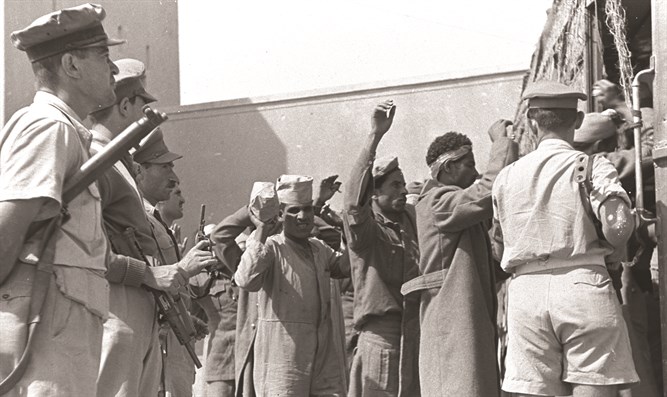
What happened in Deir Yassin in April 9, 1948, became a seminal event of Israel’s War of Independence. This Palestinian village was located to the west of Jerusalem, and was attacked by Jewish fighters of the Irgun, one of Israel’s pre-state underground forces (the main force, Haganah, was the established force; Irgun was an opposition force, under the leadership of Menachem Begin).

The battle was bloody and many Arabs were killed, including women and children. It was followed by a propaganda campaign, claiming that what happened in Deir Yassin was a massacre. This campaign was very much responsible for the decision by many thousands of Arabs to flee their homes. Their decedents are today’s Palestinian “refugees.”

What really happened in Deir Yassin? Tauber is not the first scholar to argue that the large-scale massacre story is a myth. Professor Yoav Gelber, in “Palestine 1948: War, Escape and the Emergence of the Palestinian Refugee Problem,” makes a similar claim. Still, Tauber was more thorough than all of his predecessors in looking into this specific day of carnage. The result is a gripping narrative.

Was the massacre a myth? That depends on one’s definition of massacre.

Deir Yassin in Tauber’s account doesn’t depict a day of poorly organized battle, with confusion playing a role in making a bad day even worse. He counts one clear case of unjustified shooting. An Arab family evacuated a house in surrender. An Irgun fighter opened fire while his commander was shouting at him, “What are you doing? Stop it!” This incident, Tauber believes, gave credence to later overblown stories of larger-scale massacre, rape, mutilation and barbarity.

But the myth was perpetrated not because of confusion. It was a deliberate attempt by the Palestinian leadership to force the Arab militaries of surrounding countries to intervene in the battle over Palestine. The leaders of the Palestinians sowed a wind and reaped a whirlwind. More than convincing the Arab states to intervene (they eventually did), they convinced their fellow Palestinians to flee.

Why am I telling you this story? Because there is no other way for you — Americans — to know about it. Professor Tauber believed that his story would be of great interest to American publishers. He contacted university presses in the United States, and their response left him stunned. A representative of an elite university wrote back: “While everyone agreed on the book’s many strengths, in the end the consensus was that the book would only inflame a debate where positions have hardened.” Another one wrote: “We could sell well to the right-wing community here but we would end up with a terrible reputation.” Apparently, a book questioning the Palestinian narrative is not a book that American universities feel comfortable publishing.

One American media outlet found Tauber’s account worthy of a review: the online Mosaic magazine. The review rightly included the sober conclusion: “It’s hard to believe that Tauber’s book will put an end to the use of Deir Yassin for propaganda and political purposes. Myths take on a life of their own and historical facts are but background sets for them.” If you need any proof of that, just look at what an American publisher had to say about that review: “Of course Mosaic loved it, they tend to be to the right of Attila …”

Maybe.

Maybe Mosaic is to the “right of Attila.” Maybe Tauber is a right-wing hack. But what about his argument — the facts, the research? Is this a worthy contribution to the debate that will never end about Deir Yassin? As a reader of Tauber, and of all the many responses to his book and of many other books describing this event, I have no doubt that it is. Was the massacre a myth? That depends on one’s definition of massacre, and on having all the facts set straight. The facts that no one provides with as much detail as does Tauber (and yes, he is still looking for an American publisher).


Shmuel Rosner is senior political editor. For more analysis of Israeli and international politics, visit Rosner’s Domain at jewishjournal.com/rosnersdomain.

The Truth of Deir Yassin Read More »

Jerusalem Filtered Through a German Museum

A German and an American watched the same clip shown toward the end of the “Welcome to Jerusalem” exhibition that opened at the Jewish Museum Berlin in December, coincidentally the same week U.S. President Donald Trump recognized Jerusalem as the capital of Israel.

At the museum, videos screening on monitors mounted back-to-back told stories of Jerusalem residents via footage from a German documentary titled “24h Jerusalem.” One pair told the story of Zeruya Shalev and her survival of the Jerusalem No. 19 bus suicide bombing, and of Mahmoud from Shuafat, who hasn’t gone to school for several years.

In the video, Mahmoud complains about the “wall” that cuts into the land where he used to fly kites. He and a friend taunt the Israeli guard by flying a kite across the security barrier.

“The pigs and dogs would chase us,” he says in the film, referring to Israelis and suggesting they should throw rocks.

He slammed the museum for alleged anti-Israel bias as reflected in city ads featuring the Islamic crescent as the only religious ornament.

After watching it, the German woman, in her 70s, shook her head in dismay.

When asked why she disapproved, she said, “I don’t like what Israel is doing to the Palestinians,” and pointed to another vignette in which an elderly Arab longs for the home he lost in 1948, still holding the house key.

It didn’t bother her that Mahmoud referred to Israeli soldiers as “pigs and dogs” or that he threatened to throw rocks.

“They’re frustrated and have no weapons.” Like the German government, she’s displeased with Trump’s Jerusalem decision.

Then came Jake from Montana, a 20-something on a vacation break in Berlin.

“I’m not sure what to think,” he said, asking for more context. Was Mahmoud a high school dropout? Was he cut off from his school or home?

“What about his threat to throw rocks?” this reporter asked.

“I didn’t like it,” he replied. “That only brings more violence.”

Jake preferred not to comment on Trump, who was the subject of ridicule during his European travels. But he said he loves America.

Although the exhibition portrays itself as examining Jerusalem from the perspective of three monotheistic religions, the story it tells is really one of two sides: a showdown between Judaism and Islam, Israelis and Palestinians, Jews and Arabs, and these days, inadvertently, Trump and Germany.

In an interview with the Journal before my visit, museum director Peter Schäfer said the exhibition seeks to impose no political position and instead hopes to offer visitors enough information to reach their own conclusions.

“Having said that, of course, we have our opinions about this, and I have my own opinions about this, and my personal decision is that it’s not a wise decision by Mr. Trump, and that the status of Jerusalem can only be decided at the end of the negotiations in which all parties involved take part and come to discussion and compromise,” he said.

The Jewish Museum Berlin is a public museum with a largely non-Jewish staff. Schäfer is Catholic, having studied at Hebrew University in the 1960s. The exhibition was curated by Margret Kampmeyer, a German of Christian faith and an art historian, and Cilly Kugelmann, a German-born Jew and former museum executive who served in an advisory role. Kampmeyer first visited Jerusalem two years ago for research.

“Welcome to Jerusalem” serves as the main attraction while the museum remodels its permanent exhibition on German-Jewish history, and it features replicas, maps, photographs and artwork of prominent Jerusalem iconography. The topic was chosen because the museum often seeks to address themes of interfaith importance.

“One of our goals with the exhibition, if at all possible, is to address not just Judaism but also, if possible, Islam and Christianity,” Schäfer said, citing recent exhibitions on religious head coverings and on the binding of Isaac as examples.

Jerusalem fits this goal perfectly, but Eldad Beck, the Berlin correspondent for the Israel daily newspaper Israel Hayom, has publicly taken the museum to task for its extensive focus on interreligious themes at the expense of Jewish narratives. He slammed the museum for alleged anti-Israel bias as reflected in city ads featuring the Islamic crescent as the only religious ornament. Schäfer, in defense, told the Journal that the ad was the first of a series.

“If you ask me why did we start with the Islamic crescent, I cannot tell, but of course, the idea you could see easily,” he said. “The idea, of course, is to allude to the Dome of the Rock.” As the religious symbol topping this contentious landmark, he believes it is among the more recognizable Jerusalem icons.

But the same image also appears as the brochure cover, and Beck’s criticism goes further. In his book “Germany at Odds,” Beck dedicates a chapter to the museum, outlining Kugelmann’s affiliation with the “Israelkritik” movement in Germany, which largely blames Israel for the Palestinian-Israeli conflict.

“It’s very typical of the German position, and they’re just using this museum to promote their distorted view of Judaism,” Beck said. “A country with such a history of the Jews should not be allowed to do it.”

He was particularly incensed by the exhibition climax: a short film titled “Conflict.”

“This is amazing because they took out almost everything that has to do with Arab-Muslim violence and put only the Jewish and Zionist violence,” Beck said. “Later on, during the Second Intifada, you have some mentioning of the bombings, but it’s so minor that the overall impression that you get from this film is that the Jews came, took the land, took the city, and the poor Arabs are there to suffer.”

Sympathizers with Israel’s claim to Jerusalem may be bothered by more than just the exhibition’s apparent bias. The portrayal of the Holy City lacks soul, coming across as a chore, a lecture, a collection of clichés — or worse, propaganda.

In my opinion, rather than exacerbate tensions by focusing on conflict, why not dramatize the beauty, depth and liveliness of a modern city that people of all faiths call home? Let’s see Jews and Arabs peacefully coexist. Let us enter the colorful Arab shuk or the happening Machane Yehuda Market. Let us sit at the cafes, bars or walk the rose-lined golden streets. And most of all, let us pray, hope and dream. Because what’s worse than leaving with the impression that Israel is the aggressor is leaving with: “What are they even fighting for?”


Orit Arfa is an author and journalist based in Berlin. For more on the exhibition, go to her blog on jewishjournal.com.

Jerusalem Filtered Through a German Museum Read More »

ARTIST OF THE WEEK: Laura Ben-David

Laura Ben-David

“SOLDIER PRAYING,” 2014

An Israel Defense Forces soldier stands in the Judean Hills during his morning prayers. “Soldier Praying” is part of the international exhibition “Passage to Israel,” which opens March 8 at the Sagamore Hotel in the South Beach area of Miami Beach, as part of a three-month “Peace 70” initiative (passagetoisrael.org).

ARTIST OF THE WEEK: Laura Ben-David Read More »