fbpx

February 7, 2018

Male Hysteria

At a recent Shabbat dinner, my host launched into a diatribe over a “two-page story” in The New York Times which allegedly argues that Picasso’s art should be ripped from museum walls due to his treatment of women.

“That’s censorship!” my host declaimed.

He mixed in other metaphors to describe his feelings about the #MeToo movement, equating it to “burning down forests and cities.”

I’m not sure how a few men losing their jobs is the same thing as a forest fire, but I got the subtext of his symbolism: He’s panicked.

We’re only a few months into probably the most significant public reckoning over sexual misconduct in history and already we’ve heard alarms bells ring over a female-driven “sex panic.” More and more we hear people cautioning that the #MeToo movement has gone too far, even though few of the predatory and powerful men who have been outed and ousted from their positions of public honor have actually been charged with a crime.

Nevertheless, all these angry, vengeful women are steering society into very dangerous waters: I mean, censor Picasso?

“That’s what the worst communist and fascist regimes in history did to the art of their day,” my host said. “Is that what you want?”

When a newspaper article about one of the prevalent social issues of the decade provokes comparisons to Stalinist communism, I’d say such a reaction is a sign of male panic.

After dinner, I tried to look up the article in question, but couldn’t find it. “Picasso + New York Times” yielded a story about the portraitist Chuck Close, whose show at the National Gallery of Art in Washington was recently postponed due to sexual harassment allegations. That piece explored the question of what to do about the artwork of artists who have behaved badly — including Caravaggio, who was accused of murder.

But the article my friend was referring to —  “Shock of the Nude” by Holland Cotter — wasn’t an article about Picasso at all (which explains why I couldn’t find it) but an art review of the career retrospective of artist Carolee Schneemann.

In it, there are about five lines relevant to Picasso (his name is mentioned only once) in which Cotter muses:

“Which modern misogynist will be yanked from museums next? Gauguin? Picasso? I say, sure, why not? Let’s set them aside for awhile, give them a rest, make room for what we never see, which means art by almost any woman you can name.”

The rest of the article is devoted solely to Schneemann’s work, but let’s discuss that first paragraph: “Set them aside for awhile” is hardly a declaration of censorship. Rather, Cotter is suggesting we take a break from the artists we’ve worshipped for forever in order to make room for artists we’ve been unable or unwilling to see.

Without having read the article, I suggested as much at dinner but my host couldn’t hear it. His hysteria over the changing tide caused by the #MeToo movement blinds him to the truths being revealed.

The only reason there isn’t a female Picasso is because she was ignored, spurned, ridiculed, marginalized, not given the opportunities of her peers and relegated to the dust bin of (art) history. As Amanda Hess wrote in a different article for the Times, “[Male artists’] offenses have affected the paths of other artists, determining which rise to prominence and which are harassed or shamed out of work.”

While it is true some outstanding female artists managed to break through in that man’s world — including Frida Kahlo, Mary Cassatt, Louise Bourgeois, Marlene Dumas and, indeed, Carolee Schneemann — far too many more lived, and continue to live, in obscurity.

It is mostly the art of men that adorns the walls of the world’s great museums — from the Louvre to the Prado to the Uffizi — even as the bodies of women are splashed onto their canvases and offered for the viewer’s pleasure.

These realizations don’t have to be threatening. No one is saying, “Burn Picasso’s paintings.” They’re saying, let’s use this unique moment to take a break from our patriarchal myopia to see and celebrate something new.

And I say, sure, why not?

Male Hysteria Read More »

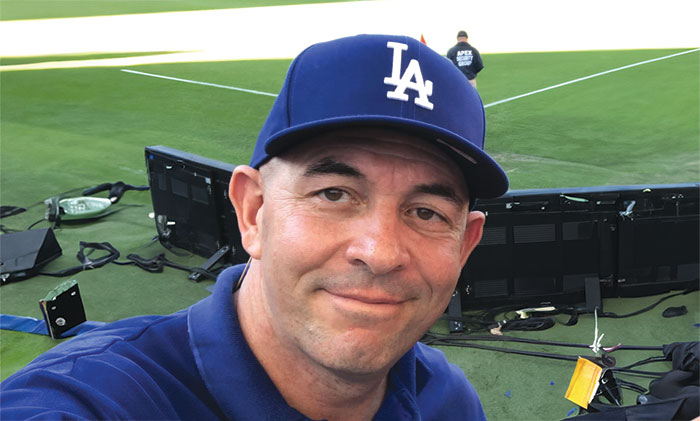
Super Bowl With the Homeless

Two weeks ago, I received a crazy call.

“We’re putting together a Super Bowl Party for the Homeless. Last year’s video went viral, so now we’re expanding. Can you host the L.A. party?”

The caller was Meir Kay, a social media personality with more than 1 million followers, known for his infectious positivity. In his first viral video, he danced around New York City high-fiving people who were hailing cabs.

I have a million followers, too, but at Accidental Talmudist I’m on a mission to increase the peace by sharing Jewish wisdom with all people. In a video that caught Meir’s eye, I brought two Chasidic musicians downtown on Christmas night to see what would happen. We ended up jamming with a homeless guy named Antonio. Later, we passed the hat for him online and raised more than $600.

At Beth Am, I found that some of the maybes had actually showed up.

Meir told me we’d need a venue, food, a big-screen TV, dignity kits, volunteers, a film crew and homeless guests.

“Meir, this is a great idea. You should’ve called me a month ago.”

“Dude! Last year, I pulled it together in 24 hours!”

Respect. That video was pretty good. The New England Patriots even reposted it.

“How many homeless guys did you have?”

“Six.”

“It looked way busier than that.”

“Yeah, I brought them to a party at a bar. But a bar isn’t a good idea for these guys. Plus, the owner doesn’t want them back.”

I bet. So we had two weeks to pull it off. Walking away was obviously the right move. My soul said stay.

I called Rabbi Adam Kligfeld at Temple Beth Am. He agreed on the spot, and so did his staff. Lia Mandelbaum, director of programming, Shawn Gatewood, director of facilities, and all their personnel brought a problem-solving attitude.

So we had a venue. Then Dovid Leider of Leider’s Catering donated food for 50. Boom! This thing was coming together. My wife, Nina, recruited volunteers. Chasids from Hancock Park, whole families from Temple Beth Am, and non-Jews from our Facebook audience all got into the spirit.

Two days before the game, my cameraman bailed because of a family emergency. Then, Marty Markovits appeared, a documentarian with a great eye.

Sunday dawned.

“Hi! Would you like to attend a Super Bowl Party and have a great meal?”

The first invitee said yes. She spends her days by the 7-Eleven next door to the synagogue and was thrilled to go inside. The next 10 people we approached, however, all said no. They wanted to be left alone. Then a few maybes. I called Nina.

The diversity among homeless people is immense. Some wouldn’t attract a second glance at Coffee Bean. Others are alarmingly challenged regarding mental health and hygiene. Nina found two of the latter and drove them to the synagogue, God bless her.

I headed downtown. We found an encampment of eight. They told us to scram, but one fellow, Michael, said, “Hell, yeah, me and my wife are coming!” That convinced the others. I summoned a Lyft van.

At Beth Am, I found that some of the maybes had showed up. Our Lyft group became the boisterous nucleus of two dozen guests, plus an equal number of volunteers.

I’m a Giants fan, so I was rooting for the Eagles to beat the Patriots. This became the general consensus. Spirits rose. Plates were piled high with tasty wings and pastrami.

Real conversations were happening all around the room. I learned Ed was a 10-year veteran of the Air Force. Uncle Ray was just rooting for a good game.

When the Eagles scored, we erupted in “Yaaahs!” and high-fived like old pals, and we groaned every time the Patriots made a good play. In the end, we brought it home: an Eagles victory for the faithful!

The real triumph, however, came from Brandon after I shared Torah with him.

“Who is strong? One who controls himself. I like that. I’m in a halfway house now, getting it together. I don’t trust no one but God to help me, but I would like to volunteer for this temple. Mow the lawn or whatever. Thank you for doing a great thing for us.”


Salvador Litvak shares his love of Judaism with a million followers every day at
accidentaltalmudist.org.

Super Bowl With the Homeless Read More »

How Cheap Is Jewish Blood?

This week, The Guardian, one of the most left-wing newspapers in Great Britain, published a 2,300-word piece describing the problem of terrorism in cities across the world. It name-checked London, Berlin, Manchester, Paris, Nice, Brussels, and Barcelona; it mentioned Algeria, Italy, Brazil, Kuwait, Lebanon, Afghanistan, Nairobi and Oklahoma City. It mentioned Israel but once — and only in order to mention the Irgun’s bombing of the King David Hotel in Jerusalem in 1946. As Yair Rosenberg notes, not a single terrorist attack against Israelis made the article.

All of which raises a question: Why is it that whenever Western leaders talk about terrorism, they seem to leave terrorism against Jews off the list?

This isn’t a rarity. It’s regular and it’s predictable. When President Barack Obama spoke about the Charlie Hebdo massacre in Paris, for example, he brushed off the simultaneous attack on a Jewish supermarket as “random” (he later backed down). When President George W. Bush spoke about global terrorism, he rarely mentioned terrorism inside Israel. When the media list terror attacks against Western targets, Jerusalem never earns a mention.

There’s no true excuse for leaving dead Israelis off the list of terror victims.

Why?

There are two possible explanations. Neither is good enough.

First, there are those who claim that terrorism against Israelis is part of a broader political conflict — that such terrorism isn’t religious in nature, but rather a tactic in a territorial war. That’s absolute nonsense. This week, 29-year-old Itamar Ben Gal, a teacher at a yeshiva in Ariel, was stabbed to death by a Palestinian terrorist while waiting by the roadside; he left four children behind. That follows the murder of Rabbi Raziel Shevach, a father of six, in the same area, as he drove along the highway. These are civilian, not military targets. These were family men murdered for no reason other than their Judaism.

And no, this isn’t about settlements. In 2017, Israel saw a wave of terror attacks across Israel; most of those attacks were perpetrated inside so-called Green Line Israel: stabbings on the streets, truck attacks on civilian crowds. The Palestinian leadership celebrates such killings and offers the families of terrorists financial incentives to pursue them. And the Palestinian leadership is clear about the rationale for such killings. That rationale is the same as the al-Qaida rationale or the ISIS rationale: a radical Islamic political viewpoint that sees the slaughter of non-Muslim innocents as a tool in the jihad against the infidel. Palestinian Authority President Mahmoud Abbas isn’t a “moderate” leader seeking peace; he’s a radical who stated openly just weeks ago that “Israel is a colonialist project that has nothing to do with the Jews.”

Then there’s the second explanation for why the world would downplay terrorist attacks against Jews: an anti-Semitic attempt to separate off the Jews from the West. That’s certainly the tendency in Europe, where it’s convenient to view anti-Semitic attacks inside the continent by radical Muslims not as attacks on European citizens but as internecine warfare between two outsider groups. That’s convenient because it allows Europe to treat the rise in anti-Semitic crime as an aberration rather than a serious internal problem. But it also reinforces the lie that Jews cannot be full citizens of the West.

There’s no true excuse for leaving dead Israelis off the list of terror victims. But those who do it don’t need an excuse. They’ll keep on doing it so long as the Jewish community remains silent about the omission. And so long as that omission remains the rule rather than the exception, the West will continue to ignore a basic, simple truth: The Jews of Israel are the canary in the coalmine in radical Islam’s war against the West, not an outlier nation that can be cast aside for political convenience. What starts on the streets of Jerusalem usually finds its way to the streets of London. The non-Israeli West would be smart to recognize that fact, if only to protect itself.


Ben Shapiro is a best-selling author, editor-in-chief at The Daily Wire and host of the podcast “The Ben Shapiro Show.”

How Cheap Is Jewish Blood? Read More »

Week of Feb. 9, 2018

Week of Feb. 9, 2018 Read More »

Women, Sex and Power

This address was delivered by Karen Lehrman Bloch at the Cedars-Sinai Women’s Guild Symposium 2018: “21st Century Woman.”

So who is the “21st Century woman”? I think she’s strong, independent and spirited; unafraid of both her femininity and her sexuality; fiercely brave, confident and, of course, feminist.

But wait, how can she be both feminine and brave? Sexual and remain a feminist?

The truth is, those words were never meant to be contradictory. They became contradictory because of an essential misunderstanding of the original meaning of feminism.

What I’d like to do today is briefly touch on this misunderstanding and offer a vision for a deeper, more authentic feminism — a feminism that honors the original meaning.

I also think women will be a lot happier when we begin to understand that we don’t have to give up parts of ourselves for feminism. That, in fact, those parts are what make us stronger.

So let’s start over. Let’s talk about what feminism really is and how it was supposed to empower women. And let’s deal in the realms of facts and reality.

Feminism is not about following a set of rules or politics imposed by other women.

Feminism is not about voting for a woman just because she’s a woman.

Feminism is not about legislating equal numbers of judges or CEOs.

Feminism is not about exploiting your sexuality when it’s useful.

Feminism is not about destroying a man’s career because of a compliment.

Feminism is not about empowering women through victimhood — or shutting down voices of disagreement.

What is feminism?

I. Feminism can be summed up in three words: freedom, responsibility and individuality.

Freedom for women to vote, be educated, have careers — or stay home with our children. Freedom for women to wear miniskirts if we want, freedom to flirt, both in the office and out, to get involved with a co-worker — or to abstain from all sexual relations until marriage.

Freedom for women to become the unique individuals that we are.

Third Wave feminism, which began in the ’80s, was, in my opinion, a huge setback for women. Third Wave feminists actually restricted women’s freedom by adding onto feminism a set of politics, a list of behaviors, even fashion choices. Third Wave feminist leaders attempted to tell women what to think, how to behave, who to vote for.

None of this was part of the original meaning of feminism.

Now we have a Fourth Wave of feminism. Intersectional feminists are adding onto feminism another layer of do’s and don’ts.

Women, say intersectional feminists, must hate masculinity, privilege victimhood and, most important for many, continuously attack Israel. How interesting that a movement that started out 100 years ago as a way to free women from societal restrictions became a movement that urges women to hate Israel, one of the most feminist countries in the world.

II. Feminism also means personal responsibility — taking control of your life.

For feminist leaders in the past three decades, “personal responsibility” were dirty words. Why? Because focusing on a woman’s responsibility, they said, would take the focus off “the patriarchy.”

But just like with true liberalism, you can’t have freedom without responsibility. Why? Well, who else should take responsibility for our lives? The government? Our husbands? Our dates?

I think we’ve had some rather bizarre #MeToo moments precisely because of the lack of emphasis on women’s responsibility. Like “Grace,” the young woman who publicly humiliated Aziz Ansari because … why? She didn’t like the way the date was going but made no effort to tell him that? Or to simply go home?

In fact, the underlying premise of many of the non-assault #MeToo cases is actually quite unfeminist: It is based on the false notion that all women become helpless in difficult situations.

Sadly, many women do. But that’s not the fault of “the patriarchy.” It is largely the fault of the feminist establishment for, essentially, ignoring women’s personal growth.

Real assault cases are, of course, horrific, and right now we’re watching one of the worst: Dr. Larry Nassar, the doctor to the young gymnasts. This is a case of complete institutional failure and, as a result, at least 265 victims were subjected to pure evil.

But denying that sexual tension, even in the workplace, is not complex, that women don’t have responsibilities — that life isn’t perfect — doesn’t serve anyone’s interests.

Right now, any woman can destroy a man within seconds by merely describing an awkward pass. Is this empowerment  or is it the same passive-aggressiveness we’ve spent a half-century trying to overcome?

III. We don’t live in a patriarchy.

Anyone who seriously thinks we still live in a patriarchy — where men control and oppress us — needs to visit countries like Iran or Saudi Arabia.

Indeed, this is another great irony of today’s feminist leaders: They have virtually ignored the women in Iran who have been protesting the wearing of compulsory hijab.

So far, 30 Iranian women have been arrested and tortured for this. This should be at the top of Western feminists’ priority list. Instead, it hardly gets mentioned.

But we do have oppressors here — what I have come to call the Gender Industrial Complex. The Gender Industrial Complex tells women who to vote for, which careers are preferable, who to like, who to hate, which ideas to regurgitate, what color to wear, which pronouns to use, which films to see, which films not to see — and most important of all: how to shut down anyone who disagrees with you.

The Gender Industrial Complex is our new oppressor. And if you call yourself a feminist, you need to fight back against it, just as our grandmothers fought against the patriarchy.

Real feminists don’t follow orders — even from other women.

IV. Women are different from men.

Contrary to “gender theory,” this stems mostly from biology, not culture. More important, it’s actually a positive, producing things like babies and making life much more fun and interesting.

Women and men are not the same, and we also don’t exist along a gender spectrum. Social scientists use bell curves to show our biologically based differences. Take aggression. The bell curves for males and females look very different. But there will always be a small group of women who are naturally more aggressive than a small group of men.

What else does this mean? It should be assumed that women think about sex differently from men. This doesn’t mean that women don’t think about sex. This doesn’t mean that women don’t love sex as much as men do. What it means is that women are evolutionarily built to connect our emotions to sex.

Probably the worst thing that feminist academics did in the past three decades was to make women feel ashamed of our femininity and sexuality.

So, while many women have no problem with today’s hook-up culture — where sex is typically expected — many other women, as hard as they try, can’t do it without feeling lousy afterward. Instead of seeing this as a special aspect of being a woman, feminists today blame this lousy feeling on men — either on a particular man or again on “the patriarchy.”

Many of today’s non-assault #MeToo cases could have been avoided, in fact, if feminists had explained all of this to women. If they had taught women that we each need to know what works for us and act accordingly.

V. Femininity and sexuality.

Probably the worst thing that feminist academics did in the past three decades was to make women feel ashamed of our femininity and sexuality — to neuter women. Leaving aside the fact that feminism had no interest in neutering women, a neutered woman is by definition a less empowered woman.

Being at one with our femininity and sexuality is an integral aspect of our strength and self-esteem. Just look at Gal Gadot.

Gal is so unabashedly feminine and sexy that when “Wonder Woman” first came out, some feminists went ballistic. They had been taught that showing our femininity or sexuality was a sign of weakness.

A hundred years ago, that was true. But we went through this thing called the sexual revolution in the ’60s, and one of the positives was that women took ownership of their sexuality.

And by taking ownership — by feeling it and knowing that it doesn’t undermine our ability to run a company or fly a plane — women were made whole in a way that we hadn’t been since hunter-gatherer times.

But it’s a responsible sexuality: It’s not about sleeping our way to the top; going to a man’s hotel room and then claiming victimhood; wearing scanty clothes at inappropriate times.

Sexuality, true sexuality, comes from within.

VI. Beauty.

Being at one with our femininity and sexuality also helps with the other issue Third Wave feminists got wrong: beauty. Beauty is not a myth; it’s not a cultural construct. It’s a harsh reality that only gets harsher with age. But as French and Israeli women know better than anyone: When you’re feeling at one with your sexuality, when you truly own it, it doesn’t matter how old you are.

VII. What about men?

Don’t men have any responsibility here?

Of course. Just because we don’t live in a patriarchy doesn’t mean that men, as individuals, don’t have a lot of work to do. I’m always amused when I read conservatives talk about returning to the ’50s and the Era of the Gentleman.

Sure, many men in the ’50s had good manners in public, and I would love to see those manners return. But we are all too aware of what often went on inside the home or inside the office.

We want men to treat women with respect — not just to keep up appearances. We want men to treat women with respect because it’s the right thing to do.

But here’s the thing: We don’t need to dump masculinity to make this happen. Masculinity is not toxic. Uncivilized masculinity is toxic. Civilized masculinity ends wars. Civilized masculinity moves mountains. Civilized masculinity is, well, sexy.

Another great irony of today’s feminism: the effort to defeminize women and feminize men. So that we’re all gender-neutral robots. No thanks, and again, this was never the intent of the original feminists.

But how do we make sure masculinity is civilized? Parents, especially fathers, need to teach their sons to be proud of their strengths and abilities — but to always have manners and respect. It’s not easy (I have a high-testosterone 8-year-old son; I am well aware). But it’s doable. All of us know men who are both gentlemen and quite masculine.

But also, women — as friends, girlfriends and wives — have a role here. We have the not particularly fun job of helping to civilize men. Actually, I take that back. Imagine how Gal had civilized her early boyfriends. I have no doubt she had a great deal of fun and success — or they were out the door very quickly.

VIII. So what’s the bottom line?

The goal of feminism was to unshackle women, to be able to engage in the world as strong, fully formed adults who know what works for us and what doesn’t.

It’s time to teach women again that we are fully in control of our bodies and our destinies — to reach deep inside of ourselves to find our unique identities.

And so I propose the beginning of a new, Fifth Wave of feminism. We can call it rational feminism or independent feminism or noncomformist feminism. Or, we can just call it feminism, because it would be bringing feminism back to its original meaning.

The key components again would be freedom, personal responsibility and individuality. Taking back our lives from those who wish to control us, both women and men.

That, and only that, is the true meaning of feminism and empowerment. That is the 21st century woman.


Karen Lehrman Bloch is a cultural critic and author of “The Lipstick Proviso: Women, Sex & Power in the Real World” (Doubleday). Her writing has appeared in The New York Times, The New Republic, The Wall Street Journal and Metropolis, among others.

Women, Sex and Power Read More »

Avram Hershko Talks Cancer Research, Winning the Nobel and His Grandchildren

Prominent American and Israeli cancer scientists convened in November at City of Hope’s Duarte campus for a symposium to network, take part in lectures and share groundbreaking research. Through the Jacki and Bruce Barron Cancer Research Scholars’ Program, scientists funded by City of Hope and the Israel Cancer Research Fund (ICRF) work together regularly to combine forces in the fight against cancer.

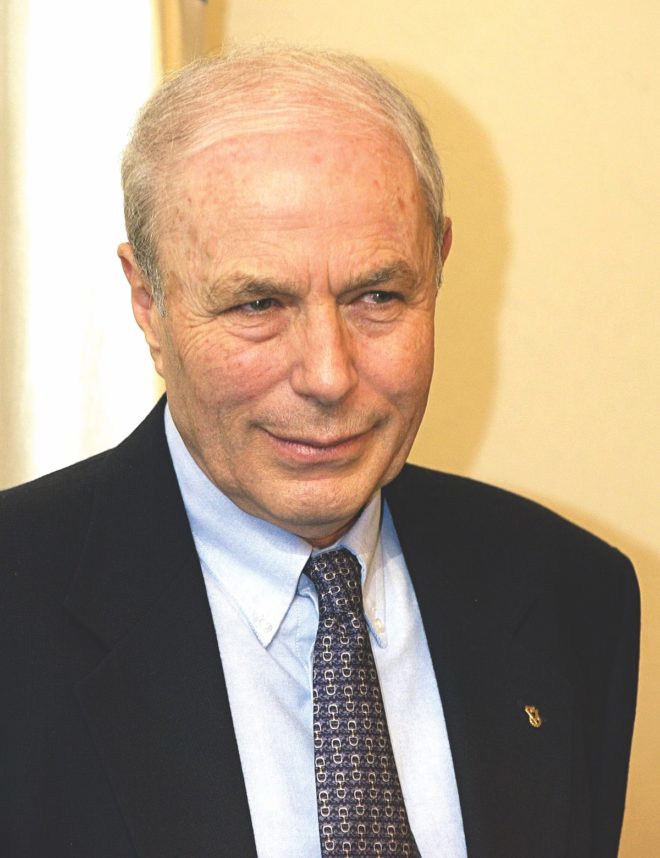
Among the featured lecturers was Avram Hershko, 79, an Israeli Nobel laureate in Chemistry whose breakthroughs in the field of cell division have helped the medical community treat certain forms of cancer. The Journal spoke with Hershko about his research and its applications, and the value of international collaboration in the field of cancer research.

Jewish Journal: How did your research help with understanding cancer?

Avram Hershko: I was working on a basic science problem, which is how proteins degrade in cells. It turned out to be very important in understanding health and cancer because proteins control cell division and cancer is actually uncontrolled cell division. So if protein degradation is not working well, then cell division is not working, or working too well. That’s what cancer is.

JJ: What about the drug Velcade?

AH: It was not developed by me, but developed by the pharmaceutical industry. But it was based on our research. This drug inhibits a certain enzyme in the protein degradation system called the ubiquitin system. It’s very effective in fighting some cancers, like multiple myeloma and bone marrow cancer. It made a huge change in the treatment for those cancers. Now, many people can have many more years of good-quality life.

“Remember, cancer is not one disease. It’s thousands of different diseases.”

JJ: Why did you want to come to this symposium?

AH: There are collaborations happening between City of Hope scientists and Israeli scientists, and I was very curious to hear about everything they are doing. It’s always good in science to have interaction. Science is very international. That’s how science progresses, like we have here with City of Hope scientists working with Israeli scientists promoted by the ICRF. Also, I wanted to see Los Angeles again. It’s always nice to come back here.

JJ: Are you still performing research?

AH: I’m still doing research and being supported by ICRF. I have an active laboratory at the Technion medical school. I’m not retired, which is an achievement in and of its own. I like to do experiments myself. I do a couple every week. I have a research group of students and technicians who help me in my research. I’m still working mostly on the role of the ubiquitin system and its controls on cell division.

JJ: Many call Technion the MIT of the Middle East. So, Technion or MIT?

AH: Well, the Technion is better than MIT because it has a medical school. Otherwise, MIT is quite good. It’s OK.

JJ: Moving forward, what’s the next big step in your field of research? What are you working toward?

AH: Remember, cancer is not one disease. It’s thousands of different diseases. But they have a common denominator and that is uncontrolled cell division. If I go after more knowledge in cell division, it may lead in the future to some common treatments for many cancers. That is my idea, anyway.

JJ: What was it like winning the Nobel Prize?

AH: Normally, I’m not one for ceremonies, but it’s the highest recognition of achievement in science. It was very pleasant. People in Israel watched it on live television. That was a very proud moment for Israel and for my family. It was very nice to share it with my wife, three kids and all my grandchildren.

JJ: What do you do for fun when you’re not in the laboratory?

AH: I spend time with my six grandchildren. I won’t tell you about them because if I start I won’t stop.

Avram Hershko Talks Cancer Research, Winning the Nobel and His Grandchildren Read More »

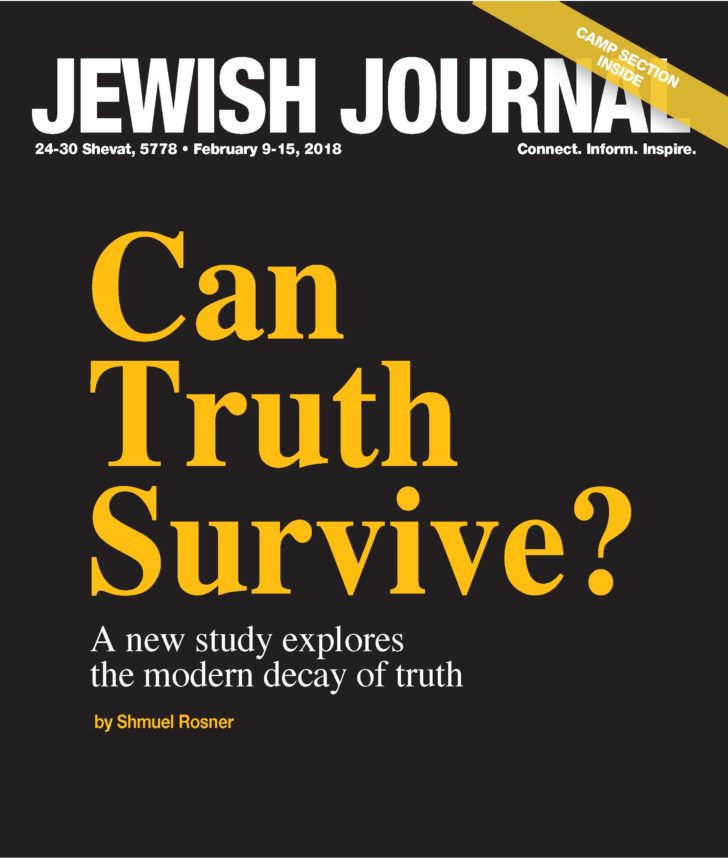
TRUTH DECAY: Should you believe a study that documents the fast erosion of Americans’ belief in documented studies?

There is an irony inherent to a scholarly attempt to convince you that we live in an era of “Truth Decay.” The phrase is the catchy title of a new Rand Corp. study that delves into “an initial exploration of the diminishing role of facts and analysis in American public life.”

The paradox is that the thesis — that we no longer trust facts — undermines the means — a study built on facts.

If this, as the study suggests, is an era in which “Americans are placing less faith in institutions that were once trusted sources of information,” then why would the same Americans trust the Rand Corp. and its findings?

If this is, as the authors argue, an era in which there is “increasing disagreement about facts and analytical interpretations of facts and data,” then why would they expect the readers to accept their interpretations of facts and data?

The authors, Jennifer Kavanagh and Michael D. Rich, clearly do have such expectations, maybe because they understand that there is no alternative to data and analysis. They also acknowledge that, alongside this decay, there is a tendency “in many areas of American society” to rely on “facts and data” today more than ever.

In other words, this is a time of both fake news and big data. It is a time of growing reliance on populist punditry “and opinion-based news,” but also a time in which “even baseball, football, and basketball teams increasingly rely on data to determine which players to draft.”

So, is Truth Decay just a polite way to describe the era of Donald Trump, whose long list of misstatements includes repeating more than 50 times the falsehood that his tax cut was the biggest ever (even after Treasury Department data showed it ranked eighth)?

It is and it isn’t. Complaints about the weakening of truth in public life intensified with the rise of Trump, and are clearly linked to it. But Trump is a result of this trend as much as its instigator.

There is hardly a shortage of articles lamenting the end of a supposed era of truth. Roger Cohen, writing in The New York Times two years ago, dated the beginning of this era to 2014, and to Russia’s invasion and annexation of Crimea. Russian President Vladimir Putin, he wrote, “a pure Soviet product, traffics in lies.” Putin was there before Trump, so “Trump is not alone. There is a global movement of minds,” Cohen wrote.

And Cohen was not alone. Last March, the cover of Time magazine presented the question “Is Truth Dead?” At about the same time, the magazine Democracy held a symposium to consider the question: “Can truth survive Trump?” No wonder that just last week, a political fact-checking website crashed during Trump’s State of the Union address.

The scholars of the Rand Corp. are clearly worried. It is hard not to agree with them that “Truth Decay and its many manifestations pose a direct threat to democracy and have real costs and consequences — economic, political, and diplomatic.”

In analyzing this situation, they identify four trends that together contribute to this time of decay: increasing disagreement about facts and analytical interpretations of facts and data; a blurring of the line between opinion and fact; the increasing relative volume, and resulting influence, of opinion and personal experience over fact; and declining trust in formerly respected sources of factual information.

Trump is a result of this trend as much as its instigator.

Some of these trends hardly need to be proven. A brief glance at the polls reveals the public’s growing distrust in institutions. And just watch cable news for a few hours and you’ll see how much time is filled with conversations that blur the line between opinion and fact.

Of course, this trend of mistrust in the media and nonstop punditry did not begin with Trump. Rather, it made Trump a credible presidential candidate. And now it haunts him. He is both an instigator and a victim of American’s distrust.

Other trends are more difficult to pinpoint. But the authors still make a decent effort to prove their case — by showing, for example, “the recent rise in skepticism about the safety of vaccines.”

The vaccine case reminded me of “The Influential Mind,” a book published in 2017 by Tali Sharot, a professor of cognitive neuroscience. (Full disclosure: I was the editor overseeing the Hebrew edition.) Sharot describes the September 2015 Republican presidential primary debate in which the moderator challenged then-candidate Trump’s assertions — contrary to scientific evidence — that childhood vaccines were linked to autism.

Ben Carson, the neurosurgeon who was then a candidate (now Trump’s secretary of Housing and Urban Development), replied that numerous studies “have not demonstrated that there is any correlation between vaccinations and autism.”

Not hesitating to respond, Trump asserted that, “Autism has become an epidemic … it has gotten totally out of control. … You take this little beautiful baby, and you pump — I mean, it looks just like it’s meant for a horse, not for a child.” He went on to describe a colleague’s young child who became ill after being vaccinated, and, he alleged, “now is autistic.”

Sharot writes about this moment with a sense of awe. “My response was immediate and visceral. An image of a nurse inserting a horse-sized syringe into my tiny baby emerged inside my head and would not fade away. It did not matter that I knew perfectly well that the syringe used for immunization was a normal size — I panicked.”

She recounts this moment to make a point she illustrates time and again in her book: Evidence does not work. In fact, as she later explains, “presenting people with information that contradicts their opinion can cause them to come up with altogether new counterarguments that further strengthen their original view.”

Sharot is not listed as a source in “Truth Decay,” but her sobering argument should serve as a warning. The Rand scholars portray our current era as different from previous times: Once, we were more prone to listen to evidence; now, we are less prone to do this. But is that really true? Were people really more rational in the past, making decisions based on evidence more than we do today?

The authors do not argue that today’s trend is unprecedented. In a chapter on past Truth Decays, they count three earlier periods in which truth diminished to make room for non-truths: the 1880s-90s, the 1920s-30s, and the 1960s-70s. Their aim is to provide these parallels to help explain what we see today.

In all three examples, the authors note, the media were changing. Yellow Journalism thrived in the Gilded Age; radio and tabloids emerged in the ’20s and ’30s; and New Journalism and the era of television were hallmarks of the ’60s and ’70s. As they compare these three periods to today’s supposed Truth Decay period, they carefully conclude: “Perhaps the clearest similarity across the four periods is that each offers examples of the erosion of the line between opinion and fact and of ways in which the relative volume, and resulting influence, of opinion over fact seems to have increased.”

And yet, historical parallels are a tricky tool, and the authors readily admit that “although each of the periods … exhibited a significant rise in disagreement over social, economic, and political policies and norms, there is little evidence that agreement about the veracity and legitimacy of basic facts declined in previous eras.”

What are “basic facts”? Americans, by and large, agree that the earth is spherical, that the sun rises in the east, and that water boils at a certain temperature. They disagree — and this is nothing new — on evolution, on global warming, on UFOs. In 2008, not all of them were convinced that Barack Obama was an American citizen. That was years before Trump’s election, and before Russia’s invasion of the Crimea.

Watch cable news for a few hours and you’ll see how much time is filled with conversations that blur the line between opinion and fact.

Today, they can’t agree on the facts — or “facts” — detailed in the memo released last week by Rep. Devin Nunes (R-Calif.). Was the FBI trying to assist Hillary Clinton? Was it trying to sabotage the election of Trump? The memo contains some facts that are indisputable and some that mean little without context. The context is often what makes facts more elusive than the Rand report tends to admit.

In analyzing the factors behind Truth Decay, the authors, to their credit, attempt to put these causes on a scale of those having more and less impact on how people debate truth and facts. Their conclusion: It is Facebook, Twitter and the other social media phenomena that make us easy prey for falsehoods: “Changes in the information system play an outsize role in the challenges presented by Truth Decay because those changes affect the supply of both fact-based information and disinformation.”

It’s not an earth-shattering conclusion, but it is an interesting comment on the human condition and on the human ability to process information.

Yes, our leaders tend to lie from time to time — some more than others. Yes, the current leader of the United States is especially flexible with the facts and especially bold in making unfounded statements. This boldness, it is worth saying, occasionally also gives him the ability to cut through vagueness and expose simple truths.

But leaving Trump aside for a moment, and reading carefully through the long Rand study, one realizes that Truth Decay — if you accept this analysis, and look at the historical parallels — is as much about too much information as too little. In other words, it stems not just from evildoers who deliberately hide the truth from us, but also from do-gooders who drown us in so much information that we no longer know what’s true and what’s not.


Shmuel Rosner is senior political editor. For more analysis of Israeli and international politics, visit Rosner’s Domain at jewishjournal.com/rosnersdomain.

TRUTH DECAY: Should you believe a study that documents the fast erosion of Americans’ belief in documented studies? Read More »

The Israeli Way

There is something different about making energy and water policy when 100,000 rockets are pointed at your family.

I went to Israel last month to exchange strategies on water and clean energy. I came home with an entirely new perspective on lawmaking.

In 2014, California and Israel signed a Memorandum of Understanding to collaborate on energy and water innovation. The mission of our California delegation to Israel was to put muscle behind the memo with funding and technical expertise.

Just as we were getting started in our clean energy lab at the Milken Innovation Center at the Jerusalem Institute, in a room packed with some of the top energy minds in Israel, a news alert sounded on my phone: “BREAKING: HAMAS TERROR TUNNEL EGYPT-ISRAEL DESTROYED.”

Israel Defense Forces had struck a tunnel only a short distance away by California standards. The news shook me silent. My mind went blank. I looked around the room for guidance.

This is what Israel does, day after day. No paralysis. It  just moves forward.

The Israelis at the conference didn’t skip a beat. People looked down at their phones for a moment. Nodded. And dived right back into the work at hand.

Every conversation in Israel is under the Iron Dome. In the fierce urgency that necessarily, although quietly, weaves itself into the texture of daily life, of relationships, of governing, one cannot help but be humbled by Israel’s fortitude.

Where did this strength come from? I would submit that its origins are ancient. And that it lives in all Jews. As the Midrash relates, when the Jews made the Exodus from Egypt, their faith was shaken at the shores of the Red Sea, where they were trapped like sitting ducks, bracing for the oncoming Egyptian army, with no water and a range of bad options.

As some Jews attempted to micromanage Moses, one group suggested they turn and fight. Another thought to simply surrender and return to slavery. A third argued that ending it all would be more just, and they should just hurl themselves into the sea and die. And a fourth disagreed with all the others; the answer to their quandary was to pray for salvation from God.

Moses rose above his stutter, as he did in these moments, to deliver to the Jews a message from God: Let’s just go through the sea, faithful, unafraid, eyes on Mount Sinai. Rather than anticipate, plan or resist the seemingly impossible challenge ahead, the Jews just went through it.

This is what Israel does, day after day, no matter how many tunnels are discovered or rockets are stockpiled. No paralysis. It just moves forward.

And move forward we must. Energy and water are not just critical environmental challenges. They impact the security of Israel and California, and our respective states’ abilities to compete economically on a global stage, where self-reliance and sustainability are rewarded. Israel’s energy strategy currently relies heavily on fossil fuels — only 2 percent of its grid is renewable.

California, on the other hand, has a cleaner grid but a sea to cross when it comes to water. Israelis capture and recycle about 85 percent of the water they use. California wastes about 85 percent of all stormwater, failing, unlike Israel, to capture this valuable resource before it dumps into our coastal waters.

Israel is a nation at constant risk. Yet, Israel’s leaders find a way to diligently proceed with the work to modernize their nation.

Our joint efforts to secure a cleaner, more sustainable energy and water future for Israel and California must proceed, with California imagination and market power, and that deep fortitude that is ancient in origin, and alive and well in Israel today.


State Sen. Henry Stern (D-Canoga Park) is an environmental attorney and educator. He represents the 27th District, which includes parts of Los Angeles and Ventura counties.

The Israeli Way Read More »

Seeing the Whole Community

This is my 18th issue of the Jewish Journal as editor-in-chief, and, I have to say, these past few months have been exhilarating. One, I’ve never worked harder, and two, the reaction throughout the community has been incredible —  better than I could have imagined. Everywhere I’ve gone, I’ve heard a similar refrain, “I love what you’re doing with the Jewish Journal.”

Of course, when I hear that, I have to say (as I wrote about last week), “poo, poo, poo.” But I also like to ask: “What is it that you like?” I’ve done this countless times with readers from across the spectrum — religious, secular, left wing, right wing, young, old, Jewish, non-Jewish, everyone.

So, in honor of our “chai” issue, I thought I’d recap the thinking behind the reimagining of your community paper, a paper I have always loved and am working to build upon.

First, we’re here to cover the whole community. That means I can’t allow content biases to get in the way. This easily can happen in publishing. If an editor-in-chief, for example, favors religion and spirituality, you’ll see too much of it. If the editor favors news and opinion, or culture and the arts, or community reporting, or Israel and political coverage, same thing — you may see too much of it.

The challenge is to balance everything to honor the diversity of the community and the diversity of Judaism.

The challenge is to balance everything to honor the diversity of the community and the diversity of Judaism. If we’re going to live up to our promise to “connect, inform and inspire” the whole community, we must keep everyone in mind and cover as much of the Jewish buffet as possible. If we focused more on the news, we would mostly inform; if we focused more on religion, we would mostly inspire; and if we focused more on the local community, we would mostly connect.

We must do all three equally. That’s why you see such a broad diversity of coverage.

You may see a pro-and-con debate on abortion, gun control or the Iran nuclear deal, but also a spiritual poem on the Garden of Eden.

You’ll see a dark story on neo-Nazis or the rise in anti-Semitism in the United States, but also one on the uplifting message of Hanukkah.

You’ll see reporting on Jewish outreach at the Sundance Film Festival, but also a cri de coeur from a Mexican “Dreamer” afraid of being separated from her family.

You’ll see hard coverage of the Harvey Weinstein scandal and the #MeToo movement, but also a dialogue between a Reform and Orthodox rabbi on the true meaning of tikkun olam.

In other words, it is diversity, above all, that is imperative.

Does every page in the paper appeal to everybody? Of course not.

Some people like our ethereal poem page, others prefer our political analysis and commentary. Some like reading about the local Persian gay community, others prefer a story on how the Jews of Puerto Rico fared during the hurricane.

Some people like our Israel coverage, others are just tired of anything Israel and prefer local stories. Some like to see coverage of a new film, others prefer a commentary on how that film connects to Jewish values.

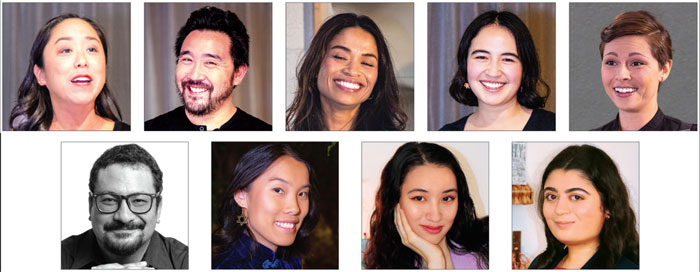
Our mission, then, is to reach everyone in a meaningful way. That also means a great diversity of voices. Over the past few months, we have added more than a dozen women’s voices, many of them local rabbis who contribute to our Table for Five page. We’ve gone out of our way to add more Sephardic and millennial voices. With op-eds, we look for opinion pieces that provoke thought, not anger.

But diversity is not enough if you don’t enjoy reading the paper. That’s why we’ve redesigned the paper to make it more visually engaging. We’ve also added a few special sections like “Image of the Week” and “20 (or 30) Years Ago in Jewish Journal.”

Online, we’ve increased our coverage of daily news on our website and launched the global newsletter “Roundtable,” which provides “fresh takes on hot issues” every morning.

Over the past few months, we have added more than a dozen women’s voices, many of them local rabbis who contribute to our Table for Five page.

In recent months, we’ve produced more than 20 online videos, ranging from interviews with Jewish leaders to light-hearted clips on the Jewish holidays. We’re now in the process of building a sound studio in our offices to produce a podcast network.

While we’re excited about all the new things we’re doing online, we never forget that the community paper is our pride and joy. There’s no substitute for a paper you can pick up at a local synagogue or café. You can feel the whole community as you flip through the pages. It’s hard to capture that feeling on an iPhone screen.

One comment I’ve been getting consistently is that the paper “looks great.” Why is that important? Because in publishing, beauty is more than skin deep. Clean, attractive layouts engage the readers with your content. This is smart business: If we make the content more visually appealing, you’ll be more likely to read the articles, and we’ll be more likely to connect, inform and inspire you.

Poo, poo, poo.

Seeing the Whole Community Read More »

Israeli Arab Murders Rabbi In Stabbing Attack

An Israeli Arab stabbed a rabbi to death on Feb. 5 and has yet to be apprehended.

According to Israel’s newspaper Haaretz, the victim, 29-year-old Rabbi Itamar Ben Gal, a middle school teacher, was waiting at a bus stop outside of the Ariel settlement in the West Bank when the suspected assailant, identified by the Israel Defense Forces (IDF) as 19-year-old Jaffa resident Abed al-Hakim Asi, emerged from a taxi cab and stabbed Ben Gal. According to Israeli media network Arutz Sheva, Ben Gal then reportedly ran to a bus and banged on the doors, pleading for help before losing consciousness. Ben Gal was then taken to a hospital, where he succumbed to the wounds.

An IDF officer who witnessed the stabbing tried to strike Asi with his car but Asi was able to evade capture.

“We send condolences to the family,” Israeli Prime Minister Benjamin Netanyahu said during a Likud faction meeting on Feb. 5. “IDF forces are in pursuit and we will employ the full extent of the law with them. We always do. I place my trust in security forces, who are doing excellent work.”

Hamas praised the stabbing as a way of protesting President Trump’s Jerusalem move, as one of their spokesmen said the stabbing showed “the intifada is continuing.” Islamic Jihad also praised the attack, while the Palestinian Authority has yet to say anything about it.

The funeral for Ben Gal was held on Feb. 6 in the Har Brakha settlement in the West Bank, where Ben Gal resided, the Jerusalem Post reported.

“I wish I had died instead of you,” Ben Gal’s father, Daniel Ben Gal, said in his eulogy. “We have no idea how we will continue without you, without your smile and your good face that was always radiant.”

Ben Gal is survived by his wife, Miriam, and four children.

Israeli Arab Murders Rabbi In Stabbing Attack Read More »