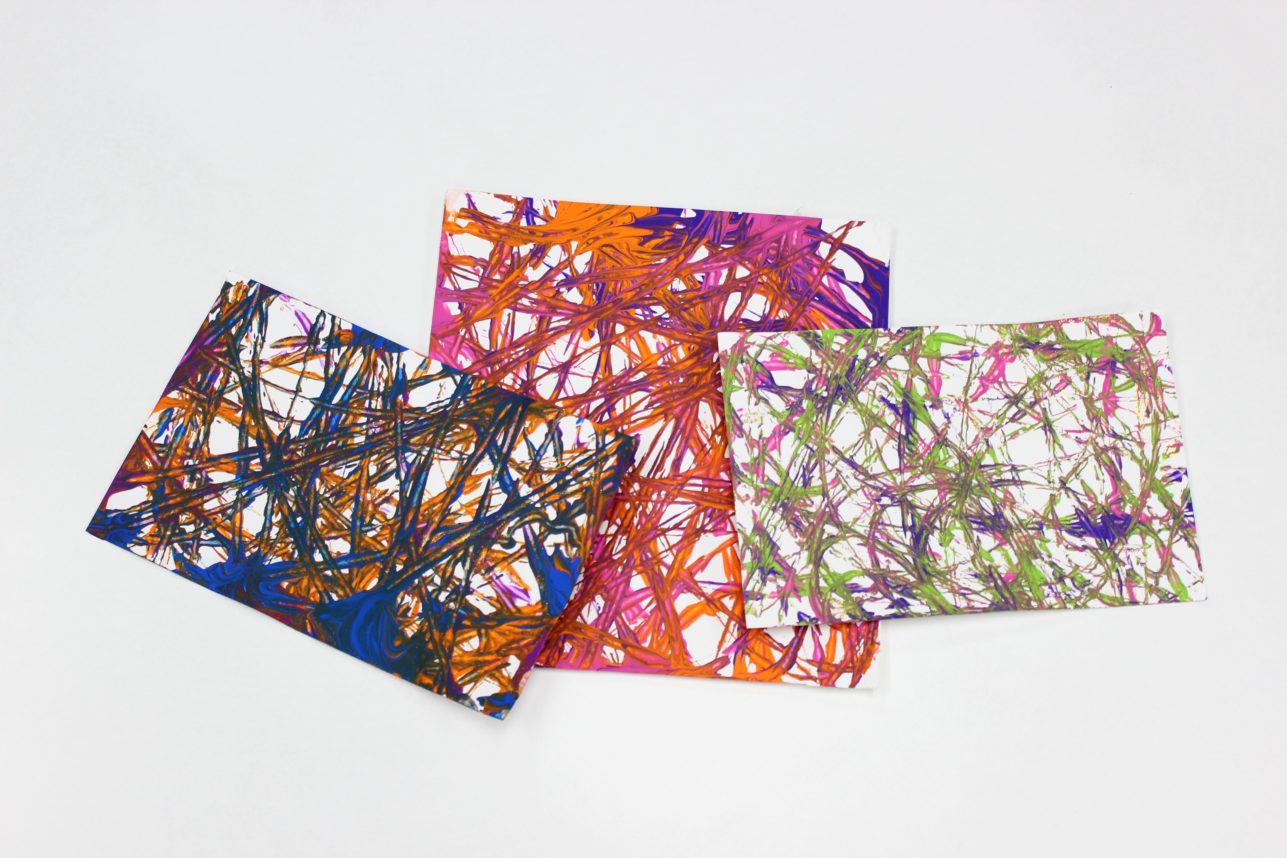
If you’ve ever stood in front of a piece of modern art in a museum and said, “I could do that,” then this is the art project for you. Using a fun technique with glass marbles, you can create a whiz-bang abstract painting that would make Jackson Pollock proud. It’s also a great activity to share with kids to give them an appreciation for art. Today, marbles. Tomorrow, the Louvre.
What you’ll need:
Cardboard box
Aluminum foil
Paper
Masking tape
Acrylic paint
Glass marbles
1.
1. Start with a shallow cardboard box, whatever size you wish. (You also can use a plastic rectangular food container.) Then line the box with aluminum foil. The foil enables you to reuse the box, and it makes cleanup a snap.
2.
2. Cut a piece of paper so that it’s smaller than the dimensions of the box. Tape the paper to the middle of the box, leaving about 2 inches on all sides. I like to use cardstock, because it’s thicker and will hold the paint better.
3.
3. Squeezes dollops of paint on the foil surrounding the paper, trying not to get any on the paper yet. Use as many colors as your inner Picasso desires. You can buy small squeeze bottles of acrylic paint at the crafts store for as little as 70 cents each.
4.
4. Now here’s the fun part. Place three to five marbles in the box, and shake it left to right and up and down to move the marbles. The marbles will catch the paint and roll over the surface of the paper, creating random patterns. When you’re happy with the painting, remove the tape, lift the paper and set it on newspapers to dry.
Jonathan Fong is the author of “Walls That Wow,” “Flowers That Wow” and “Parties That Wow,” and host of “Style With a Smile” on YouTube. You can see more of his do-it-yourself projects at jonathanfongstyle.com.
January 27th, the anniversary of the Soviet liberation of Auschwitz, is the day designated by the United Nations as International Holocaust Remembrance Day. Observed at the UN headquarters and in countries throughout the world, it is not the only Holocaust memorial day. Some countries observe dates that relate directly to their own Holocaust history. Jews throughout the world observe the 27th of Nissan in the Hebrew calendar — just after Passover and in proximity to the Warsaw Ghetto Uprising of 1943 — as Yom HaShoah .
It’s a fitting time to ask: Why should the world remember the Holocaust, which began more than 75 years ago and enveloped almost all of Europe?
Because it happened, we must understand the evil — systematic evil, state-sponsored evil, industrialized killing, mass murders — that was the essence of the Holocaust. We must understand its emblematic invention, the death camp and the people who served in these camps. Their assignment: mass murder.
Some were sadists and criminals – people unlike us – but many more were ordinary men trying to do their best, to fulfill their obligations. Some were even professionals, lawyers and doctors, ministers and economists who used the skills they had learned to become more efficient killers. Some were enthusiastic, others more reluctant. All became killers.
Because it happened, we must understand the circumstances of the victims, who had to make choiceless choices between the impossible and the horrific, and who faced conditions of such utter powerlessness that they could do little to determine their fates. Yet even though they were powerlessness, they were far from passive. Resistance took many forms, courage manifest itself in many ways; taking up arms was but a last stand.
And we must understand the indifference of neutrality. In the struggle between powerless victims and an overwhelmingly powerful killing machine, neutrality is anything but neutral. Indifference is a death sentence. The bystander is also an enabler.
We can learn so much about evil in studying the Holocaust that it leaves us numb, that despair overtakes us, that we sense our own helplessness. Indeed, the Holocaust was an atrocity, senseless and anguishing. But there were a few — a precious few — men, women and even children who opened their homes and their hearts and provided havens for the victims, a place to sleep, a crust of bread, a kind word, a hiding place. What makes such goodness possible? Why were some people immune to the infection of evil? We call them Upstanders. These are the people whose deeds we may wish to emulate, who can serve as models for how we want to behave and what we want to become.
The Holocaust began slowly. Age-old prejudice led to discrimination, discrimination to persecution, persecution to incarceration, incarceration to annihilation. Mass murder, which culminated with the killing of six million Jews, did not begin with the Jews nor did it encompass only the Jews. The violations of one groups’ rights are seldom contained only to that group. Scholars have identified stages of the Holocaust; it is far easier to stop a genocide in its early stages of persecution and discrimination before dehumanization and mass murder ensue.
We must understand the fragility of democracy: however precarious, it is ever more precious. Yet it can be undermined when leaders show a little commitment to democratic rule; when political opponents become enemies, denied all legitimacy; when violence in tolerated and ultimately employed to quash dissent; when civil liberties and freedom of the press are restricted and when democratic institutions are weakened.
Sadly, the issues raised by the Holocaust are not consigned to our past. Genocide, a word invented to give voice to the fate of the Armenians in World War I and the Jews in World War II, a crime outlawed by the United Nations, has recurred since 1945, even today. Refugees fleeing oppression and near certain death are still unwanted in most places on the globe. Inter- religious hatred flourishes; so too, intra-religious conflict.
The study of the Holocaust is not easy, emotionally or intellectually.
To understand this event, we have to confront death, yet the study of these deaths is in the service of life. The study of this evil is intended to strengthen decency and goodness.
The Holocaust shatters faith — faith in God, secular faith in human decency and faith in the inevitability of progress and even in Rev. Martin Luther King, Jr.’s teaching that the arc of the moral universe bends toward justice. The Holocaust provides few answers, but raises many questions — questions that invite moral struggle against that evil.
The call from the victims — from the world of the dead — was to remember. Today we hear from those who were there and those who were not, the urgency of memory, its agony and anguish, the presence of meaning and its absence. To live in our age, one must face that absence as well as that haunting presence.
Michael Berenbaum is a professor of Jewish studies and director of the Sigi Ziering Institute at American Jewish University.
SAT JAN 27
“WHAT WE TALK ABOUT WHEN WE TALK ABOUT INTERMARRIAGE”
In 1993, Rabbi Adina Lewittes became the first Canadian woman to be ordained as a Conservative rabbi, but she later left the movement because of her support for interfaith weddings. She delivers an inclusive, text-based and communal conversation on the controversial topic during IKAR’s Saturday morning services and luncheon as part of the Lisa and Maury Friedman Foundation guest speaker series. 9:15 a.m. to noon. Free. Shalhevet High School, 910 S. Fairfax Ave., Los Angeles. (323) 634-1870. ikar-la.org.
HOOTENANNY COMMUNITY JAM SESSION & POTLUCK
Calling all musicians and lovers of good times! Bring a dish to share and an instrument to play at this potluck get-together. The Silverlake Independent Jewish Community Center (SIJCC) will provide the space and songbook. All ages welcome. Park in the lot, bike or take public transportation. $10 suggested donation. 3-6 p.m. The Box at SIJCC, 1110 Bates Ave., Los Angeles. (323) 663-2255. sijcc.net.
SUN JAN 28
AUTHOR JENNIFER TAITZ BOOK SIGNING
Jennifer Taitz
Clinical psychologist and author Jennifer Taitz discusses and signs “How to Be Single and Happy: Science-Based Strategies for Keeping Your Sanity While Looking for a Soul Mate,” an evidence-based guide for single women on how to navigate the stressful world of modern dating. 3 p.m. Free; book, $16. Diesel, A Bookstore, 225 26th St., Santa Monica. (310) 576-9960. dieselbookstore.com.
FREE MUSEUM DAY
Skirball Cultural Center
Dozens of Southern California institutions are offering free admission, with the goal of whetting the public’s appetite for visiting museums and galleries year round. The event is organized by a group called SoCal Museums, comprising representatives from museums across the L.A. region. Free admission will be offered at the Skirball Cultural Center, 2701 N. Sepulveda Blvd., Los Angeles, (310) 440-4500, skirball.org; the Museum of Tolerance, 9786 W. Pico Blvd., Los Angeles, (310) 772-2505, museumoftolerance.com; and the Zimmer Children’s Museum, 6505 Wilshire Blvd., No. 100, Los Angeles, (323) 761-8984, zimmermuseum.org.
MON JAN 29
“MYSTERIES OF LIFE: DARWINISM VS. INTELLIGENT DESIGN”
A film screening and discussion with Kehillat Ma’arav Rabbi Michael Gottlieb takes place at 7 p.m. $5 donation requested. Kehillat Ma’arav, 1715 21st St., Santa Monica. (310) 529-0566. km-synagogue.org.
THU FEB 1
AN EVENING WITH AUTHOR DAVID FRUM
David Frum
No conservative has been a more astute, unsparing or courageous critic of President Donald Trump than author David Frum. His upcoming book, “Trumpocracy: The Corruption of the American Republic,” is a powerful summation of the case against Trump based on a close reading of his first year in office. Frum is a senior editor at The Atlantic and the author of nine books, including The New York Times best-seller “The Right Man.” From 2001 to 2002, he served as a speechwriter and special assistant to President George W. Bush. 8 p.m. $53 reserved section seat, plus book; $43 general admission, plus book; $20 general admission.
Ann and Jerry Moss Theatre, New Roads School, Herb Alpert Educational Village, 3131 Olympic Blvd., Santa Monica. livetalksla.org.
Tu B’Shevat
SAT JAN 27
“TU B’SHEVAT IN 3-D”
Daven, drash and dine at a community seder sponsored by Kehillat Ma’arav. All welcome. Free. 9:30–10:30 a.m. Kehillat Ma’arav, 1715 21st St., Santa Monica. (310) 839-0566. km-synagogue.org.
TU B’SHEVAT HIKE
Adat Ari El Rabbi Jonathan Jaffe Bernhard and his Conservative synagogue community connect with nature and its blessings during an afternoon Tu B’Shevat hike. 2 p.m. Free. Tree People, 12601 Mulholland Drive, Beverly Hills. (818) 766-9426. adatariel.org.
SUN JAN 28
“CELEBRATE TOGETHER”: A TU B’SHEVAT EVENT
Member families from Leo Baeck Temple, Kehillat Israel and Temple Isaiah gather to celebrate and learn about Tu B’Shevat, Israel’s Arbor Day. Guests can hike, stroll, create crafts inspired by nature, learn about composting, participate in guided meditation, try creative writing and learn what Judaism says about being stewards for our planet. 9-11:30 a.m. Free. Temescal Canyon Park, 15900 Pacific Coast Highway, Pacific Palisades (enter at the intersection of Temescal Canyon and Sunset Boulevard and follow the “Celebrate Together” signs). Limited parking at site, with additional parking on Sunset Boulevard. ourki.org.
TU B’SHEVAT CELEBRATION OF THE TREES
Pico-Robertson community Young Israel of Century City (YICC) brings together its modern Orthodox families for a morning of arts and crafts, tree planting, a mini-seder and more. For parents, YICC Associate Rabbi James Proops delivers a lecture titled “Planting and Building Our Children.” 9:30-11 a.m. Free. Young Israel of Century City, 9317 W. Pico Blvd., Los Angeles. (310) 273-6954. yicc.org.
TU B’SHEVAT FAMILY FUN DAY 2018
Bring the family to celebrate the “birthday of the trees” at the Shalom Institute in Malibu. The festivities include Tu B’Shevat nature crafts, farming fun for toddlers, tree planting, rope making, outdoor pita cooking and more. Lunch will be served in the dining hall; a Tu B’Shevat singalong will put everyone in the spirit of the holiday; and a ropes course will offer a test of physical fitness. Held on 220 wooded acres, this get-together is a can’t-miss for those with little ones who want to get into the holiday spirit. 10 a.m. to 2:30 p.m. $10; kids 6 and younger, free. Shalom Institute, 34342 Mulholland Highway, Malibu. (818) 889-5500. shalominstitute.com.
ANNUAL WJCC TU B’SHEVAT FESTIVAL
The Westside Jewish Community Center welcomes guests to celebrate the “birthday of the trees.” There will be a silent auction, food, games, crafts, a bounce house, farmers market, photo booth and puppy party. Guests who live or own property in the city of Los Angeles can take home a free fruit or shade tree, courtesy of City Plants (verification by driver’s license, ID or DWP bill; trees must be planted on private property). Rain or shine. Free. 11 a.m. to 3:30 p.m. (323) 556-5250. westsidejcc.org.
WED JAN 31
KABBALISTIC TU B’SHEVAT SEDER
Many years ago in the ancient city of Tzfat, a group of kabbalists uncovered the
mystical secrets of Tu B’Shevat. They revealed these mystical secrets in a ceremony
patterned after the Passover seder and observed this ritual on the night of Tu B’Shevat, the 15th of Shevat. Join Pico Shul for a memorable excursion into the mystical
realm of the holiday through this unique seder. Rabbi Yonah Bookstein has written
text for the event based on the ancient seder recited by the kabbalists in Tzfat
centuries ago. 7–10 p.m. $18 for young professionals, $36 for general admission.
Reservations are recommended as space is limited. Pico Shul, 9116 W. Pico Blvd., Los Angeles. picoshul.org.
“As Pharaoh drew near, the Israelites caught sight of the Egyptians advancing upon them. Greatly frightened, the Israelites cried out to the Lord. And they said to Moses, ‘Was it for want of graves in Egypt that you brought us to die in the wilderness? What have you done to us, taking us out of Egypt? Is this not the very thing we told you in Egypt, saying, “Let us be, and we will serve the Egyptians, for it is better for us to serve the Egyptians than to die in the wilderness”?’ ”
Rabbi Eve Posen Congregation Neveh Shalom, Portland, Ore.
As a parent of young children, I live in a world of contradictions. I always have two simultaneous thoughts running through my head: wanting my children to remain forever in the stage they are currently in, and at the same time, wanting them to move out of this terrible phase and mature already. And it never fails: The minute they’ve reached a new milestone, I go through the same emotions again.
A popular way to examine the relationship between God and the Israelites is as that of parent and child, and the notion of stages of growth fits that comparison perfectly. When they found themselves in Egypt, naturally the Israelites were unhappy as slaves. The minute they were free, the harsh realities of that freedom made them yearn for the comfort of what was familiar.
This tendency is human at a basic level. No situation, no moment in time is going to be without its own harsh realities. In reading about this phase of the Israelites’ journey into freedom, we are reminded to take a step back and reflect as objectively as possible before proceeding. We can attempt to wish away the phase, or we can stand up and set about doing the work necessary to change the reality into something better.
Does that mean I won’t long for the days of easier airplane trips and reliable nap schedules? Of course not. But I will do so knowing I made the most of each phase to prepare myself for the next one.
Because I make my living as a comedy writer, people sometimes ask me if God has a sense of humor. My answer is that God created humor. When you look at the Torah, the clearest example of an actual written joke is when the Jews ask Moshe if he brought them to die in the desert because … “there weren’t enough graves in Egypt.”
It’s total sarcasm and, in my opinion, hilarious. Which brings us to a deeper question: Why create humor? According to the Baal Shem Tov, humor brings a person’s mind from a place of constricted consciousness to a place of expanded consciousness.
When you’re in a place of expanded consciousness, you see the totality of creation before you. You see God’s presence and goodness acting upon everything. And you realize that anything and everything that happens is an expression of HaShem’s love for us — whether we can understand that in the moment or not.
Constricted consciousness is, of course, the opposite: the understandable impulse to take things too literally, believing that events are not a part of something greater. Humor and laughter, while great in themselves, are actually subsets of a larger topic: joy. One of the surprising things I learned when I started studying Torah was the importance Judaism puts on happiness. As Rebbe Nachman put it, people are sad because nothing is going right for them. But what they don’t realize is that nothing is going right for them because they’re sad.
Rabbi Ari Lucas Temple Beth Am
In hindsight, the choice to move from slavery to freedom seems inevitable. But it rarely is. Patrick Henry famously proclaimed, “Give me liberty or give me death.” But the Israelites in this passage seem to be saying, “If liberty means death, then we’re OK with slavery.” Not exactly the romantic freedom cry one might hope for from our Israelite ancestors.
Yet their expressions of reluctance carry an important lesson — that freedom requires making an active choice to leave the comforts of the status quo. In Henry’s time, there were Tories who preferred loyalty to the British crown to revolution. Gallup polls from the early 1960s show that large portions of Americans disapproved of the actions of the Freedom Riders and others engaging in civil disobedience for racial justice.
History and Torah remind us that the path toward freedom is rarely, if ever, inevitable. We must leave behind the comforts of the status quo — the world as we knew it — for the unknown dangers of the wilderness. In fact, every one of the Israelites who left Egypt will “die in the wilderness.” But Moses had the faith and courage to recognize that even if they did not reach the Land of Israel, their children would. Progress is not inevitable. It requires leadership, faith and courage — for us, just as it did for our ancestors.
Rabbi Mordecai Finley Ohr HaTorah Synagogue, Academy for Jewish Religion, California
First take-away: Be careful of sarcasm with God. The Israelites could have said it straight: “We are afraid we are going to die here.” Instead, they belittle God (sarcasm is always belittling) and say “ … you brought us to die in the desert.” Perhaps it had not yet occurred to God that this generation should die in the desert. Through this bit of contemptuous irony, the Israelites put the idea in God’s mind. Perhaps God’s unspoken response was, “Now that you mention it … ” Nearly everyone of this generation actually does die in the desert. The Israelites put the thought in God’s mind — and divine thoughts have the tendency to become reality.
Second: What does sarcasm say about its speaker? As a form of irony, sarcasm is a version of saying something, but in a different way. Sarcasm is a punitive form of irony. The intention is to ridicule. It is a form of lashon harah, destructive use of speech, and ona’ah be’devarim, inflicting hurt through words. We know from the Talmud (Bava Metziah 59b) that God can tolerate nearly all sin — you do your time in gehinnom (purgatory) and then come up to eternal bliss. Only one category of person stays in hell — those who call people by derisive names in public. God can tolerate weakness, but not meanness through words. God does not want such folks in heaven, and apparently not in the Promised Land, either.
People think: I am angry and afraid, so I get to talk how I want. Not true.
Rabbi Sari Laufer Stephen Wise Temple
After a friend recommended that I follow @bymariandrew on Instagram, it started to seem as if Mari’s life somehow paralleled mine. Knowing nothing about her other than her illustrations, it seems that, like me, she is going through some big transitions — among them, moving. Last summer she posted an illustration showing a bunch of squiggly lines tangled together, captioned: “City Map When You First Arrive.” Next to that was a map with places labeled: Your best friend’s house. The best night of your life. Your favorite coffee shop. The caption: “How A City Map Looks When You’ve Lived There a While.”
Looking behind them in this moment, the Israelites see the city map they’ve always known. Even with its pain and fear, even with its degradation and narrowness, it is comfortable because it is known. Looking forward, the Israelites can see only the squiggly lines — the wilderness, the uncertainty … the unknown.
Kol hatchalot kashot, our rabbis teach. All beginnings are difficult. It is a teaching I have repeated often this year as my family and I started anew (back) here in Los Angeles.
It is hard to start over. It is hard to leave behind what we know, even when what we know is Egypt. It is hard to see only the squiggly, to not be able to imagine the map of a place you will come to love, a community you will come to build.
To step forward into the unknown is difficult and it is necessary. Then. Now.
The woman who symbolized the Iran protests in an iconic photo has been identified and reportedly been arrested twice.
Her name is Vida Mohaved, the 31-year-old mother of a 20-month-old child. During the Iran protests at the end of December, she threw off her hijab on Enghelab Street and waved it around on a stick:
According to a Facebook post from human rights lawyer Nasrin Sotoudeh, Mohaved was arrested once after she waved around the hijab, was subsequently released and then arrested again. Her whereabouts since have been unknown.
Iran has since stated they would no longer enforce their laws requiring women to hijabs in public; typically women who fail to wear one are subjected to the equivalent of a $12 maximum fine or face two months in prison, according to AFP.
However, Sotoudeh told AFP that before women who have broken that get a chance at a trial, the police take them to a location where they are “harshly beaten up.”
“The illegal punishment they have had to bear has always been much more than what is foreseen in the law,” said Sotoudeh.
Now that Mohaved has been identified, social media has come out in support of her with hashtags of “#Where_Is_She” and “#FreeVida”:
Mohaved’s act of defiance has been a source of inspiration worldwide, even going as far as resulting in the White Wednesday protests where Iranian women remove their hijabs in protest of the regime.
“Her gesture was seen as a symbol of resistance,” activist Masih Alinejad told Al-Monitor. “Her protest caught the imagination of Iranian women and men, feminists and non-feminists.”
The Builders of Jewish Education (BJE) culminated its 80th anniversary celebration with its 2018 gala on Jan. 16 at Sinai Temple’s Barad Hall.
The event honored Jean and Jerry Friedman, who served on the BJE board from 1982–2004, and Bennett Spiegel, who has served on the board for 16 years, for their “decades of service to Jewish education and the community,” according to the BJE website. Keren Dunn, another board member, was recognized with BJE’s prestigious Young Leadership Award.
“We believe BJE is so important, because through its programs, it facilitates both formal and informal Jewish education,” the Friedmans said in a joint statement. “That combination is the best way to preserve Jewish community.”
Spiegel expressed his respect for the “the mission of BJE to enhance the quality of, increase access to, and encourage participation in Jewish education in Los Angeles.”
Dunn’s children have participated in BJE programming. She credited the organization with giving her son “exposure to hands-on community service and tying the experience to Jewish teachings.”
Rena Slomovic, Jill Lasker and Jennifer Elad co-chaired the event. Mark Goldenberg served as the emcee. Additional attendees included BJE President Mark Berns and BJE Executive Director Gil Graff.
Established in 1937, BJE describes itself as “an independent nonprofit serving the greater Los Angeles area. BJE provides programs and activities that connect families and children to a broad range of Jewish educational opportunities.” The organization facilitates, among other things, teen experiential education, including the BJE March of the Living program, which sends delegations of Jewish teens to Poland and Israel.
“This is the 80th anniversary celebration of BJE and I am honored to play a role in that celebration,” Dunn said, “as BJE focuses on the past and future dedication of Jewish education in Los Angeles.”
Camp Ramah Executive Director Joe Menashe dedicated a sign to the firefighters who fought off the recent Thomas Fire, a disaster that prompted Ramah to remove its Torahs for safekeeping. Photo courtesy of Camp Ramah
Camp Ramah in Ojai celebrated the return of its five Torahs on Jan. 7 after they were removed for safekeeping during the recent Ventura County wildfire.
Though it wasn’t directly affected by the fire, the Conservative summer camp had a mandatory evacuation on Dec. 7.
Exactly one month later, more than 300 volunteers gathered to fill sandbags, write thank-you notes and bake cookies for firefighters, reshelve siddurim and plant trees.
“From the Ramah Beit Knesset, where we returned the Torah, we went to the area where the firefighters fought off the fire,” said Ramah Associate Director Ariella Moss Peterseil. “We dedicated a sign to them and their bravery and courage, which will remain on our campgrounds and remind us of this personal Hanukkah miracle we had in that place. It truly was the best of Ramah and Judaism: Being able to acknowledge what we are grateful for, with a Jewish ritual, and then launching into action.”
Executive Director Rabbi Joe Menashe shared a story about how a tree that has a sign that reads “ze hashar lashem tzadikim yavo uv” (This is the gate of the Lord, and the righteous shall pass through it) was only slightly burned, and that the camp had many “righteous people” in the firefighters and first responders who saved the camp.
Board chair Andrew I. Spitzer called the celebration a “true and sacred partnership between man and God.”
— Virginia Isaad, Contributing Writer
From left: TELACU President and CEO Michael Lizarraga, songwriter Melissa Manchester, journalist and television host Jackeline Cacho, U.S. Congressman Juan Vargas and Consul General of Israel in Los Angeles Sam Grundwerg attended the fifth annual Fiesta Shalom. Photo by Michal Mivzari
Jewish and Hispanic community leaders gathered on Jan. 14 at Tomayo Restaurant and Art Gallery in East Los Angeles for the Consulate General of Israel in Los Angeles’ fifth annual Fiesta Shalom celebration.
Consul General Sam Grundwerg, whose office has long been concerned with strengthening Jewish-Latino relations, hosted the festive evening along with Los Angeles Mayor Eric Garcetti and TELACU President and CEO Michael Lizarraga.
The event honored U.S. Rep. Juan Vargas (D-San Diego) and Grammy Award-winning singer and songwriter Melissa Manchester for their visionary leadership and roles as inspirational figures in their respective fields.
Jackeline Cacho, Emmy Award-winning journalist and television host, emceed the evening event, during which several members of Congress spoke, including Vargas and Reps. Judy Chu (D-Monterey Park) and Grace Napolitano (D-Norwalk). Together, they discussed the multitude of similarities, shared values and shared interests between both communities and their vast areas of cooperation.
“The family values, beliefs and rich cultures that the Latino community upholds align with the values that the Israeli people hold dear,” Grundwerg said. “In the last century, we witnessed the great and abiding friendship between the Jewish people and Spanish-speaking peoples.”
The event featured a kosher-style dinner and music performed by the salsa band Orquesta Tabaco y Ron. More than 200 guests danced, networked and celebrated the strong bonds between the communities in the United States, and the desire to maintain their distinctive and diverse cultural identities working in solidarity and support of each other.
— Ayala Or-El, Contributing Writer
Members of the third cohort of the The First 36 Project, which supports parents of children ages 0-3, attended a reception held at the headquarters of The Jewish Federation of Greater Los Angeles.
A reception was held on Jan. 18 at the headquarters of The Jewish Federation of Greater Los Angeles for its The First 36 Project.
“The First 36 Project is a groundbreaking program that connects families with Jewish community and helps them put cutting-edge development research directly into practice, precisely when experts say it matters most — from the start,” a Federation statement said. “Developed by the Simms/Mann Institute, Builders of Jewish Education (BJE) and The Jewish Federation of Greater Los Angeles, The First 36 Project provides Parent and Me facilitators at our Jewish Early Childhood Centers with an exclusive professional development opportunity designed to enhance their knowledge and amplify their ability to support parents of children ages 0–3.”
The dessert reception featured remarks by Federation CEO Jay Sanderson, BJE Associate Director Phil Liff-Grieff, and Victoria Simms, a nationally recognized child development specialist and the president of the Simms/Mann Family Foundation.
The evening event also marked the graduation of the second cohort of The First 36 Project and welcomed the third group to the program. Participants of the second cohort included, among others, Emily Glickman of Leo Baeck Temple, Wise School’s Nicole Mevorak, Debbie Myman and Jenna Pitson, and Wilshire Boulevard Temple’s Molly Mills. Other participating schools include Yeshiva Aharon Yaakov-Ohr Eliyahu, Harkham Hillel Academy and Valley Beth Shalom.
The first cohort launched in 2015-2016.
B’nai David-Judea honored (from left) Rae and Shep Drazin, Emil and Lola Sassover and Andres Terech and Nikki Sieger at its annual gala dinner. Photo courtesy of B’nai David-Judea
The B’nai David-Judea (BDJ) annual dinner on Jan. 15 honored Lola and Emil Sassover, Rae and Shep Drazin, and Nikki Sieger and Andres Terech.
The Sassovers received the Tiferet David award in recognition of “a lifetime of commitment to the Jewish community.” The Drazins, Migdal David honorees, “were honored for their commitment to men and women’s tefilah and Torah study.” Sieger and Terech, who received the Chasdei David award, “were honored for their commitment to service for the BDJ community, including organizing the Purim Mishloach Manot every year and leading the once-a-month BDJ East Minyan,” said a statement provided by BDJ executive director Adynna Swarz.
Approximately 275 people attended the event, which was held at Nessah Synagogue in Beverly Hills and coincided with Martin Luther King Jr. Day.
Among the highlights of the evening was when the Sassovers’ grandchildren read excerpts from the couple’s newly published memoir, “From Dust to Dawn, Rebuilding Our Lives After the Holocaust,” which was authored by former Jewish Journal senior writer Julie Fax.
Myron Sugerman is 80 years old and according to his biography is “the last Jewish gangster.”
For Sugerman, though, age is but a number. The New Jersey octogenarian is about to embark on a Chabad-organized Southern California tour during which he’ll speak at 10 sites over nine days.
The blurb on Sugerman’s 2017 self-published memoir, “The Chronicles of the Last Jewish Gangster: From Meyer to Myron,” states it covers the “story of his nearly 60-year career as an international outlaw in the field of slot machines and casinos.”
You can learn about Sugerman’s highly checkered career — including a 19-month stint in federal prison starting at age 57 — in his book. However, his talks in the Los Angeles area will be about his father Barney Sugerman’s work with mob figures such as Meyer Lansky, and how Sugerman was involved in helping smuggle weapons into the nascent State of Israel.
Sugerman believes that there always will be a fascination with the world of gangsters and Hollywood always will make movies about them because “you want to see movies that are authentic, about people that broke laws and danced to their own tune.” Most people, Sugerman said, “live in very quiet desperation. They don’t have lives of their own, so they live vicariously through gangster stories.”
He also believes he’s constantly in demand as a speaker because, “I’m unbelievable. I’m awesome and I’m modest at the same time.”
It’s those kind of quips that make speaking with Sugerman via telephone from his New Jersey home feel akin to stepping into a Raymond Chandler novel. With his New Jersey accent and his penchant for calling this reporter “honey” and “sweetie” (not to mention threatening to “dispatch some of my guys” to find me if I don’t attend one of his Los Angeles-area talks), Sugerman responds to tough questions lickety-split, pulls no punches and doesn’t suffer fools gladly.
“If your readers don’t come hear my speech, they’ll regret it for the rest of their lives.” — Myron Sugerman
When asked about a newspaper report alleging that after his stint in prison he became deeply religious and is now a changed man, Sugerman sputtered, “That’s bull—-!”
Nevertheless, Sugerman does have deep connections to Chabad, and reveres the late Lubavitcher Rebbe, Menachem Mendel Schneerson. And Sugerman’s son is a rabbi. Of the Rebbe, Sugerman said, “He was the greatest tzadik of our generation. That man single-handedly took the Jewish people from the ashes of the Holocaust and restored our dignity, our nobility and our pride.”
Sugerman said he’s not “a born-again Jew, but I was born a proud Jew, raised a proud Jew and I’ll die a proud Jew.”
So, how does he reconcile his Judaism with “dancing to his own tune” and living outside the law?
“I live outside man’s law,” he stated matter-of-factly. “It’s fluid and changes from day to day.” He gave the example of marijuana use: It is now legal in California but before this year, was illegal. “You reconcile by living according to your own principles and your own standard of morality. The only thing you need to reconcile is, if your conscience bothers you, don’t do something.”
He also added that despite his illicit dealings, he never hurt anybody. “I just ran an illegal gambling machine business all over the world. I was a pioneer. After I pioneered the industry, the legitimate people came in and took over.”
With six decades of dealing in the murky waters of the underworld, Sugerman said he never feared for his life. “I was dealing with hundreds and hundreds of different personalities and a sufficient percentage of those people were mental cases,” he said, “so I was always aware of that. But I always had reputation for being fair.”
Sugerman is excited about his upcoming talks. “If your readers don’t come hear my speech, they’ll regret it for the rest of their lives. They’ll be on Prozac and on their therapists’ couches regretting it.”
He might also have an ulterior motive for his West Coast jaunt. “You never know,” he quipped. “One of those famous directors might want to give me a screen test and put me in the movies. Have you seen my picture? Have you seen how handsome and charming I am?”
Sugerman finally hung up after making me raise my right hand and swear on a Bible that I’ll come and hear him speak.
Joe Frank, the acclaimed radio host and producer who created darkly comedic and philosophical narratives, died on Jan. 15 in Beverly Hills. He was 79.
Frank explored existential, spiritual and sexual themes in scripted monologues — delivered in a resonant monotone over hypnotic repeating music loops — and improvised dramatic scenes with actors.
He recorded more than 230 hours of programs for National Public Radio (NPR) and Santa Monica public radio station KCRW, and earned Peabody and Emmy awards. Stations around the country aired his boundary-pushing work. Public radio’s biggest producers, including Ira Glass, creator and host of “This American Life,” cite him as a major influence.
“He would give the actors plot points and then they would perform it over and over with him directing them,” said Glass, who worked as a production assistant for Frank in the early 1980s. “And then he himself would sit in the edit room and edit the reel-to-reel tape … and what came out of it was something that didn’t feel like radio drama but felt way more cinematic and way more alive.”
Frank was born Joseph Langermann in Strasbourg, France, in 1938. He was 1 year old when his Polish father and Austrian mother fled Nazi Germany and moved to New York. His father, a successful shoe manufacturer, died when Joe was 5.
Death was a regular theme in Frank’s work (he once called it “the shadow that hangs over me”) because he was seriously ill for much of his life. He was born with clubbed feet, for which he underwent a number of corrective surgeries and wore leg braces as a child. He was treated for severe scoliosis and kidney failure, and survived cancer three times.
“It made him more ferocious to get his work done,” said Ariana Morgenstern, a longtime KCRW staffer who had a close relationship with Frank. “His body didn’t matter to him. It was his mind that was really important to him.”
Frank died from complications after surgery for colon cancer. Michal Story, Frank’s wife and only surviving family member, chronicled Frank’s final two years of illness on a GoFundMe page that raised more than $124,000 for his medical expenses.
Jewish themes also were prevalent in his work, and his darkly absurd scenes evoked a particularly Jewish form of gallows humor.
In 1995’s “Prayer,” Frank attends the funeral of his Uncle Murray. A rabbi delivers a grandiose eulogy, while Frank remembers the man’s many flaws (“He had breath that could peel paint and pants that he would belt under the armpits.”) We later hear Murray’s wife interrupt the service to berate her dead husband and engage in a screaming match with the rabbi.
In 2000’s “Bad Karma,” Frank attends a dinner party with famous mass murderers, among them Adolf Hitler, who becomes emotional as he describes his favorite book, “Goodnight Moon.”
The spellbinding 2012 program “Dreamers” unfolds through the surreal nightmares of a young Arab suicide bomber, an ultra-Orthodox American who joined the Israeli army and renounced God, and a Christian pastor on his first trip to the Holy Land.
And in 2013’s “A Hollywood True Story,” a screenwriter finds himself at a Buddhist meditation retreat at Auschwitz in an attempt to advance his career in Hollywood.
While radio was his storytelling medium of choice, Frank had a literary pedigree. He studied at the Iowa Writers Workshop and taught literature and philosophy at Dalton, an elite Manhattan day school, for a decade.
He began his radio career in 1976 at WBAI in New York with experimental, free-form stories. Two years later, he was hired to co-host “Weekend All Things Considered” at NPR, and ended each hour with a provocative five-minute monologue that humorist and former KCRW host Harry Shearer described as “like a fist coming out of your radio.” Only three months later, Frank switched to producing radio dramas for NPR.
In 1986, Ruth Seymour, KCRW’s then-general manager, offered him a Saturday night radio show and he relocated to Los Angeles, quickly earning a cult following among listeners.
In an interview with Terry Gross on “Fresh Air” in 1989, Frank explained that creating radio programs helped him transcend his fears and insecurities.
“Whatever tragedies might befall you, you can always right away think, well, that would make a great story for radio … so that it was easier to experience whatever suffering that came my way,” he said.
We must agree to disagree about the premise of Shmuel Rosner’s questions (“The Rush to Racism,” Jan. 19). There are more than two criteria to label someone a racist.
President Donald Trump has a history of denying leases to African-Americans 40-plus years ago. He accepted, after denying he knew former KKK member David Duke, Duke’s endorsement during the campaign. His words have emboldened haters like no president before. His policy to deny people who are not white entry to United States and most recently his “shithole” comment all point to the same conclusion.
If you act/feel like a racist, you quack like a hater/racist and you call neo-Nazis “good people,” you are a racist.
Warren J. Potash, Moorpark
Trump’s Comment About ‘Developing’ Countries
I (and I suspect many other Journal readers) take umbrage at Karen Lehrman Bloch’s assertion that we are all shitholers (“We are All Shitholers,” Jan. 19).
That and similar terms aren’t ones I use. I was born in the United States. Yes, my grandparents came from Russia and Poland, as did the ancestors of many people.
And I disagree strongly with her assertion that the leftist media get hysterical over everything President Donald Trump says and does.
I’m not sure which media outlets she is referring to as leftist — does she mean legitimate news outfits like The New York Times, Los Angeles Times, Washington Post, CNN and MSNBC? Reporting on presidential outrages in word or deed is not hysterical, it’s legitimate reporting.
At least Bloch appears to understand that Trump’s bigotry is un-American. She should also point out that it violates biblical injunctions, too.
Daniel Fink, Beverly Hills
In the past few decades, I have traveled to nearly 50 countries, mostly as a negotiator on deals to sell American products in places such as China, South America and Europe but also (more recently) as a tourist.
Most of these trips were to “developing” countries that President Trump called “shitholes.”
Yes, I have been to some rough places in the world: I went to Syria to help a Texas mom whose 12-year-old daughter was kidnapped by an ex-husband and was being held near Damascus. I discovered an international criminal group in Europe on a case I was working on (that had bilked U.S. investors out of $1.5 million) and had to go “undercover” for a while.
But the only place out of 50 countries I have been to, where my life was really in jeopardy, was in the United States — in East Texas — when I was kidnapped by a white guy. Not Nigeria. Not South Africa. Not Asia. True story. All of these events are documented in my book “Better Times Ahead April Fool.”
So don’t call nations “shitholes,” Mr. Trump, because I found great people in the worst of places, and some terrible people in the “best” of places.
Michael Fjetland, via email
Zioness Organization’s Time Is Now
Thank you for your wonderful story about the Zioness organization (“Zioness Movement Joins Women’s March,” Jan. 19). This is an organization whose time is long overdue. There is a strong need on the left for this type of organization. We Jews on the left have been slammed with anti-Semitic and anti-Israel hate speech and actions. Occasionally, it comes from other Jews and Jewish organizations.
I’m writing because of an Israel-bashing Muslim woman who spoke at the Women’s March. This marred an otherwise inspirational event, and was so unnecessary. I would say that almost all people at the march had multi-ethnic and multiracial sentiments.
This Israel bashing is nothing new. It seems always to be lurking in the mass movements on the left. My first exposure to it was in the women’s movement in the 1970s. Then it was in the LGBT movement. Then it was in the anti-Iraq War movement. Now, here it is at the Women’s March. I will always be a progressive because I put people’s lives first. There’s nowhere else for me to go.
Let’s hope the Zionesses become powerful and strong!
Sue Roth via email
Jerusalem as Capital of Israel
Last month, President Donald Trump recognized Jerusalem the capital of Israel, yet I did not see any positive comment that I know of from rabbis with the exception of Rabbi Kalman Topp of Beth Jacob, who asked the members to send letters or email to thank Trump. Even though Jerusalem belonged to Israel for 2,000 years, Trump was the first president who promised and delivered. Thank you, Mr. Trump.
Benny Halfon via email
Suissa’s Hits and Misses
Thank you, David Suissa, for an outstanding column (“Abbas Fails His People — Again,” Jan. 19)!
Mahmoud Abbas and his friends appear to be the “fundamental obstacle” to peace between the Israelis and the Palestinians. He retains power by focusing on the presumed “victimhood” and the misery under which his people live, claiming Israel is the oppressor. Abbas’ argument: Israel is to blame for all the hardships Palestinians are suffering.
Prediction: Just as is happening in Iran, one day the Palestinian people will wake up and realize the truth, and get leaders who truly want to help their people to enjoy a better life. Then they will welcome Israel as a partner rather than the enemy.
Meanwhile, Abbas enjoys his share of the billions of dollars donated from around the world — just as Yasser Arafat did before him. Furthermore, he uses much of those funds to reward and encourage terrorism. And the U.N. condones it all, blaming Israel for the plight of the Palestinians. In this regard, let’s wish for lots of luck for U.N. Ambassador Nikki Haley and President Donald Trump.
George Epstein via email
The publisher and editor-in-chief of the Jewish Journal is on a trip to the land of Oz! Suissa is dreamy and nostalgic for the smells of the land that decreed Jews’ station in this land to be dhimmi: to face humiliation from birth to death (“A Hunger for Memory,” Jan. 12).
Perhaps if Suissa wasn’t daydreaming about the good old days in a country that held its Jews in humiliation and bondage, he might have remembered to speak up for the Jew Robert Levinson, who is believed to be rotting in the mullahs’ gulag. But then, how could Suissa be expected to remember Levinson when he’s dreaming about the good old days living the dhimmi. All the space in this not-for-profit Jewish weekly showing concern for the protesters in Iran and not a bloody word for the Levinson. Perhaps Levinson is in a cozy gulag in his Muslim cell.
Jerry Daniels, Marina del Rey
Why Israelis Like Trump More Than Americans Do
Shmuel Rosner clearly explained why Israeli Jews like President Donald Trump more than American Jews do (“The Trump Gap,” Jan. 19). I would like to add one more element to his explanation: What is good for America is good for Israel. The Israeli euphoria should be dampened by the fact that his erratic attempts of diplomacy have alienated him from our (and Israel’s) natural allies and greatly diminished American leadership in the Middle East. Thus, despite his rhetoric, he has lost America’s ability to act as an honest broker in future peace negotiations and give political cover in international relations.
At home, his attack on American institutions already is causing greater division and rivalry among our population. If not reversed, this can cause a weakening that will reflect in our ability to influence world affairs, and particularly support for Israel.
Relaxation and peace have never been more needed than now. There are a lot of factors stressing Canadians, and sometimes there is nothing that can be done. This is hitting the Jewish community differently from other communities, and it is worth noting.
Several Jewish communities are worried about the emboldened new group of white nationalists crawling out of the sewers of the country. The problem goes beyond communities in Canada since some therapists say that the new normal for Canada’s neighbor to the south is sadness, and the Jewish community was hit hard by this overwhelming feeling mostly due to Trump.
In short, many people within the Jewish community need to find a way to de-stress and usher in joy. This is why playing games, finding entertainment venues, and embracing fun are more important now than ever before.
The Carnival Option
Town fairs or carnivals can make a community come together and have a little fun. Communities that do not have these types of events may want to consider visiting a nearby theme park or amusement park. These locations are full of fun and really help the brain produce the serotonin you need.
Serotonin is a neurotransmitter usually associated with happiness. It is also a powerful compound that helps battle depression or sadness. This is something you need, which is why it is a good idea to visit one of these locations as a form of self-therapy. This is not to say that people should rely on theme parks or a carnival alone to provide them with this happiness, but it is a helpful tool nonetheless.
Game Away
Okay, sometimes it can be a little hard to get to a nearby amusement park, or perhaps there are no carnivals popping up in your neighborhood. Thankfully, there are a number of ways to have fun without leaving your home. For one, some people just hit the slots on the web using an online casino guide to improve their chances of winning.
Playing online games is not the only option. People are beginning to see the importance of video games and their ability to help fight depression. Yes, it seems that those games kids cannot get enough of teaches the brain the skills it needs to ward off depression. Games seem to boost confidence and analytical skills that help a person see more options, which helps the brain stop seeing an unsolvable problem but one that can be dealt with.
Those who would rather play something without electronics can set up a game night with friends to play board games or other similar tech-less games, which can be just as fun as other games.
Exciting Hobbies
Sometimes games and carnivals simply won’t do, but that does not mean there isn’t something exciting to do. There are a number of hobbies that can help a person feel happier and better during these trying times. For example, you can take up pottery classes just for fun, which should help you fight depression.
Yes, that old and forgotten art form seems to excite the brain enough to fight depression. Keep in mind that this is just one example, but there are many other hobbies that could be just as exciting such as fishing, white-water rafting, or simply reading. The idea is to find a hobby that helps you loosen up and refocus your energy so that you feel better.
Keep in mind that it is not just you feeling this way but a number of members of the Jewish community. This means that it is wise to share this information because every single person deserves a little peace. Sure, it is important to get involved in politics and try to educate people in order to fight some of the problems that the Jewish community is facing, but your peace is vital.