fbpx

November 17, 2017

Anti-Semitic Graffiti Discovered at University of Michigan

A piece of anti-Semitic graffiti appeared in a bathroom at the University of Michigan on Wednesday.

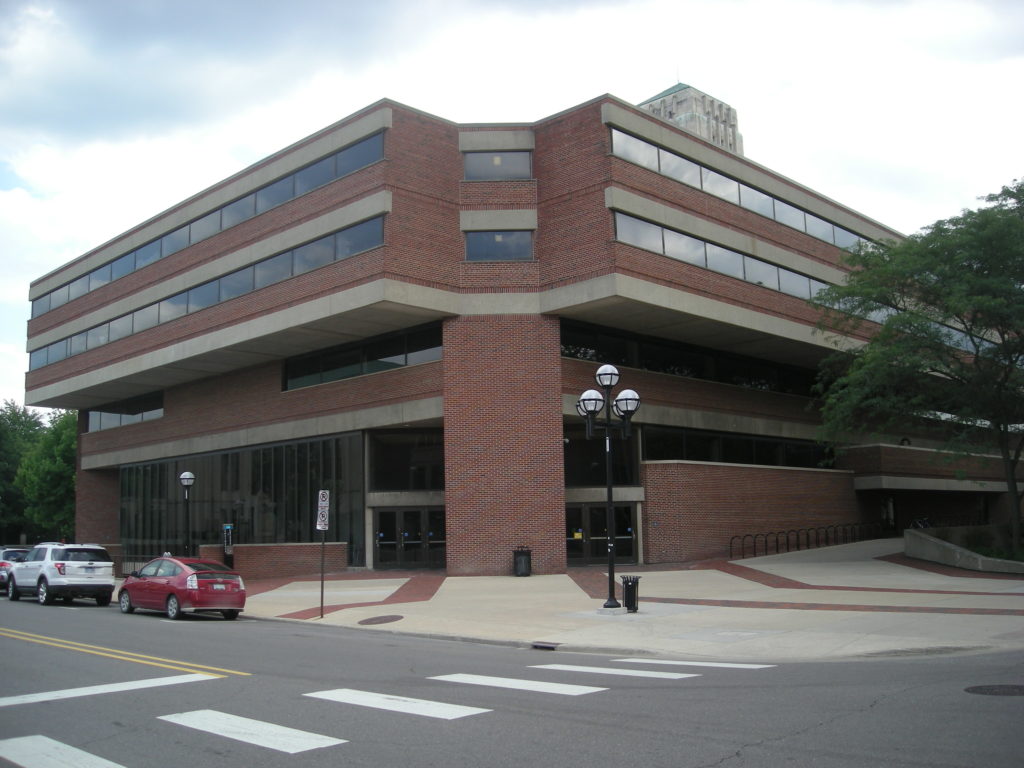
According to the Michigan Daily, two Jewish students discovered a swastika emblazoned on a bathroom stall in permanent black marker in the Modern Languages Building. One of the students, Sammy Lawrence, reported the incident to the campus Division of Public Safety and Security.

Lawrence told the Daily he “felt particularly targeted by this Nazi symbol.”

“Giving a platform and validating anti-Semites or individuals who support causes that embrace anti-Semitism makes hateful speech towards Jews acceptable,” said Lawrence. “I call on the entire (U)niversity to condemn this anti-Semitic incident, reach out to a Jewish peer and check in with them, and reflect on how we can prevent this moving forward.”

The other student, Ryan Schedit, told the Daily he “was fearful” that the swastika was connected to Michigan’s student government calling for the university to divest from companies that do business in Israel.

“If it was drawn this morning after the vote, I hope it has nothing to do with divestment, but it would scare me if it did,” said Schedit.

A university spokesperson told the Algemeiner that don’t know when the swastika was drawn and they don’t have any current suspects.

On Wednesday morning before the swastika was discovered, Michigan’s student government approved the divestment resolution by a margin of 23 in favor, 17 against and five abstaining. While the university seems to be unwilling to divest from any company, those in the Jewish community on campus criticized the resolution for being divisive and targeting Israel.

The tactic of divestment has been popularized by the Boycott, Divestment and Sanctions (BDS) movement, which has been criticized by the Anti-Defamation League (ADL) for its “anti-Semitic rhetoric.”

Anti-Semitic Graffiti Discovered at University of Michigan Read More »

Palestinian Terrorist Injures Two Israelis in West Bank

A Palestinian terrorist injured two people in the West Bank on Friday morning through the use of a vehicle.

The terrorist, who is 17 years old and has yet to be identified publicly, rammed into two Israelis at two different West Bank locations. The terrorist struck the first victim, 70-year-old David Ramati, nearby the Efrat settlement with his car going at 60 miles per hour while having “a big smile on his face.”

The second victim, 35-year-old Even Ezer Holaring, was struck at the Gush Etzion Junction. The terrorist proceeded to exit the vehicle and attempted to stab Israeli soldiers. He was eventually shot by Israeli soldiers and is currently in critical condition.

Ramati is currently hospitalized with a head injury that is not believed to be serious. Holaring is in serious condition with an intracranial hemorrhage.

“His condition is very serious and I am asking everyone to pray for him,” said Holaring’s wife in a video to the hospital.

No Israeli soldiers were harmed in the attack.

The Israel Defense Forces (IDF) responded to the attacks by establishing a checkpoint at the West Bank village of Halhul.

“IDF troops are enforcing breathing closure on Halhul village, from which the terrorist came, in order to prevent additional assailants from leaving the village,” the IDF said in a statement.

The terrorist’s family is being interrogated for more information.

Palestinian Terrorist Injures Two Israelis in West Bank Read More »

‘1945’ Examines Postwar Angst in Hungary

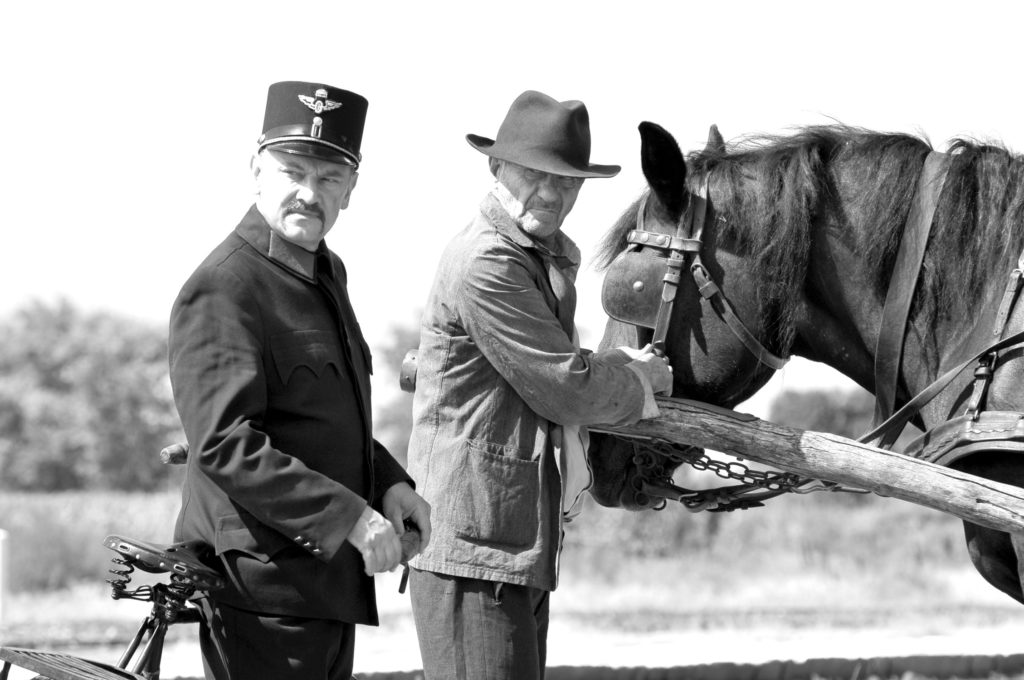
An ancient train, belching black smoke, pulls into a station near an unnamed Hungarian village and out step two Orthodox Jews. Not losing a moment, the stationmaster sounds the alarm: “The Yids are coming!”

The year — and the title of the movie — is “1945,” a time when the inhabitants of the village and the rest of their countrymen have arrived at a junction in history and are unsure which path to follow.

While Hungary’s Holocaust-themed movie “Son of Saul” won the Academy Award for foreign-language film two years ago, exhibiting the full horror of the Shoah and its concentration camps, the postwar “1945” probes the potential for greed and selfishness in every human being.

“We are the third postwar generation,” director Ferenc Torok said in a phone interview from Budapest. “And a lot of people are asking what their parents and grandparents did during the world war.”

The film takes place in the middle of summer as the villagers till their fields, smoke and drink endlessly, and prepare for the wedding of the son of a domineering town clerk to a pretty peasant girl. Nazi Germany had surrendered two months earlier, in May, and while some Soviet troops have arrived, the Communist puppet government has not yet assumed power.

The two arriving Jews — the older clad in a black coat and hat and his adult son wearing a workman’s cap and clothing — unload two large trunks and hire a horse-drawn cart and its driver to carry their load for the hourlong trip to the village, while father and son follow behind on foot.

As the odd procession wends its way through the countryside, the stationmaster’s warning stokes the villagers’ fears that the survivors among their former Jewish neighbors now will demand the return of the houses, businesses and furniture they left behind when they were deported to concentration camps. That means the town clerk would no longer own the drug store and his wife could no longer glory in the beautiful rugs, dishes and silver menorah of the previous owner.

“1945” probes the potential for greed and selfishness in every human being.

In the ensuing panic, some try to hide their ill-gotten gains, while others put their hopes in papers, signed by the pro-Nazi wartime government, “officially” transferring the abandoned homes and goods to the gentile neighbors.

When horse, cart and the “Yids” arrive at the village, women peek through shutters, the pharmacist tries to hide his tubes and bottles. Rumors spread that the trunks contain perfumes and beauty aids to sell to the village women.

Finally, the cart and two men arrive at the gates of the abandoned Jewish cemetery. The younger Jew, with a concentration camp number tattooed on his forearm, takes a key out of his pocket and opens the rusty gate, as a posse of hostile villagers gathers nearby. Inside the cemetery, father and son open the trunks and bury the unexpected contents. In the final scene, the two strangers reboard the train, their mission accomplished.

The result is a masterfully directed, acted and photographed movie, which again disproves predictions that the time of the Holocaust-themed movie has expired, even as the last eyewitnesses are dying.

Torok, who is not Jewish, said that part of the continued interest in a place like Hungary, whose Jewish population was decimated during the war, has to do with the fact that for many years while the nation was a Communist satellite, the subject of the Holocaust — and particularly the participation of many Hungarians in it — was taboo. The same applied to the collaboration of many Hungarians with Hitler’s regime, as German and Hungarian troops fought together in the invasions of Yugoslavia and the Soviet Union.

The film started as a short story by Hungarian Jewish writer Gabor T. Szanto, titled “Homecoming,” which won the Yad Vashem Avner Shalev Prize for best artistic representation of a Holocaust-related topic. Torok, relying on Szanto’s intimate knowledge of Jewish life and rituals, asked him also to write the screenplay.

In a separate phone interview, Szanto, editor of the Hungarian-Jewish magazine “Szombat” (Sabbath), made a number of observations on Hungarian Jewry, past but mostly present.

“The Holocaust is still the cornerstone of our thinking, not only for Hungary’s 80,000 Jews (compared with 450,000 before World War II) but to every other Nazi-occupied nation,” he said. “This film is really Europe’s story.”

In general, Hungarian Jews, like their American counterparts, tend to be liberals and left-leaning and they are concerned by their country’s political shift to the right, Szanto said. Among the worrisome signs is the growing strength of the nationalistic Jobbik party.

Another sign is the recent public poster campaign by the Hungarian government, depicting George Soros, a Hungarian-American and Jewish billionaire and philanthropist, as the mastermind of a massive of influx of illegal immigrants from the Middle East into Hungary.

“As a writer, I am a bit of an outsider and try to look at Hungary and its Jewish community realistically,” Szanto said. “We have many problems, but I don’t think they can be solved by ideologies. We can believe in ideals, but our solutions must be realistic. You can’t change human nature.”

“1945” begins screening on Nov. 25 at Laemmle’s Royal Theatre in West Los Angeles, Playhouse 7 in Pasadena and Town Center in Encino, as well as Westpark 8 in Irvine. On Dec. 8, the film will open at the Laemmle’s Claremont 5 in Claremont.

‘1945’ Examines Postwar Angst in Hungary Read More »

Israel Offers Aid to Iran-Iraq Earthquake Victims, Iran Rejects It

Israel offered to provide aid to the victims of Sunday’s earthquake at the Iran-Iraq border, but Iran rejected Israel’s offer for help.

Israeli Prime Minister Benjamin Netanyahu released a video on Wednesday explaining that “as a father, as an Israeli, as a Jew, I wanted to help.”

“Israel has no quarrel with the people of Iran,” said Netanyahu. “We never have. Our only quarrel is with the cruel Iranian regime, a regime that holds its people hostage, a regime that threatens our people with annihilation.”

Netanyahu added that Israel has a history of providing humanitarian aid worldwide, including “Haiti, Phillippines, Mexico” and those who have been afflicted by the Syrian civil war.

“We do all this for one reason: we do it because it’s the right thing to do,” said Netanyahu. “Too many times in my people’s history, the world failed to act when it could, the world failed to do the right thing. So we have a special sensitivity to help those in need.”

Netanyahu concluded the video by noting that Israel’s constant humanitarian aid shows the true nature of Israel.

“This is Israel,” said Netanyahu. “Compassionate. Caring. Kind.”

An anonymous official from Netanyahu’s office told the Times of Israel that Iran shot down Israel’s offer for aid.

“This shows the true face of the Iranian regime,” said the official.

Iran also rejected Israel’s offer for aid in 2003 after an earthquake killed over 26,000 people.

Sunday’s earthquake registered at a 7.3 magnitude, killing 500 people and wounding almost 8,000.

Israel Offers Aid to Iran-Iraq Earthquake Victims, Iran Rejects It Read More »

Review: ‘1945’

The Hungarian Jewish experience during WWII was unique among European countries. Until 1944, Hungarian Jews lived in relative safety despite anti-Jewish laws that existed since 1920 and pogroms in which the military participated (e.g. the 1942 Novi-Sad pogrom where 1000 Jews were murdered).

But then, in March 1944, when the Germans occupied Hungary, Adolf Eichmann implemented the “final solution” in that country and was surprised by the collaboration and great help received from the Hungarian authorities. Thus, the deportation and murder of Hungarian Jews was swift and unparalleled among any other European country – in a few months more than 600,000 Jews were identified and sent to the murder camps.

Only now, more than 70 years after, “Yad Vashem” has succeeded to identify the names of 80% of those who perished but the issue of their property and belongings has hardly been addressed.

For that reason, the new Hungarian film “1945”, currently playing in NYC theaters and soon opening across North America, is quite relevant to today. But not only because of that…

On one clear day, after the war ended, two Orthodox Jews appear in a small village in Hungary, hiring two locals to carry two trunks labeled “perfumes” for them. All they do is walk slowly, across the village, after the wagon carrying their trunks, but their appearance evokes strong feelings of guilt and remorse that slowly make the village community deteriorate.

It seems most of the villagers collaborated in extraditing the Jews that lived there up to a year before and gladly took over their property, from kitchenware to their houses.

Shot in beautiful black and white, director Ferenc Torok (who is not Jewish) interprets Gabor Szanto’s (who is Jewish) short story “Homecoming”, with vast strokes of sensitivity and a final mesmerizing emotional effect.

“1945” is a real masterpiece, heightened by the end of the film when we, the audience and the villagers, understand the real mission of these two Orthodox Jews. It’s a rare moment where one of Judaism’s most important contributions to the world, that of guilt and remorse over moral wrong doings and the sanctity of life, are presented in such a heart wrenching way on film.

What is most astonishing is that the two Jews have not travelled to this village to claim their stolen property, but the emotional effect of their silence provokes this issue out from the conscience of the villagers.

The issue of the stolen property of the Jews is still relevant today. Just recently the Polish government issued a new law which states compensation funds will be awarded only to people that are Polish citizens in the present, thus withholding compensation to the Jews and their descendants whose property was absconded in Poland during these years.

Although Germany started compensating Jewish victims in the 1950’s, most Eastern European governments are still dragging their feet on this issue.

The film “1945” is an astonishing new achievement which I highly recommend every human being to see, regardless of his/her religion.


Abraham Foxman is the national director emeritus of the Anti-Defamation League. 

Review: ‘1945’ Read More »

Don’t Shoot the Malachi - A Poem for Haftarah Toledot by Rick Lupert

Don’t Shoot the Malachi – A Poem for Haftarah Toledot by Rick Lupert

Don’t shoot the Malachi,
he’s just the messenger
and it may not have

been his name because
Malachi means my messenger.
In fact don’t shoot anyone.

It’s uncomfortable for them
and makes the news and
causes arguments about

whether instruments that
shoot should exist or not.
Just listen to the messages.

You don’t have to agree with
the messages, but hear them out.
They come from on high.

They are responses to
what you have given. So
not only should you

not shoot the Malachi, but
when it’s your turn to give
from what you have

give the best you’ve got.
Don’t give the blemished offerings
the sickly sacrifices, the calf

with the broken leg.
The One who sent the messenger
will know the difference.

Don’t shoot the messenger
for reminding you to do what
you promised you’d do.

We children of Jacob
We who came second
after a foot.

We who forever got to
go first just for a bowl of soup.
Don’t shoot the messenger.

That’s the kind of thing
that will come back to
bite you in your foot.


God Wrestler: a poem for every Torah Portion by Rick LupertLos Angeles poet Rick Lupert created the Poetry Super Highway (an online publication and resource for poets), and hosted the Cobalt Cafe weekly poetry reading for almost 21 years. He’s authored 21 collections of poetry, including “God Wrestler: A Poem for Every Torah Portion“, “I’m a Jew, Are You” (Jewish themed poems) and “Feeding Holy Cats” (Poetry written while a staff member on the first Birthright Israel trip), and most recently “Donut Famine” (Rothco Press, December 2016) and edited the anthologies “A Poet’s Siddur: Shabbat Evening“,  “Ekphrastia Gone Wild”, “A Poet’s Haggadah”, and “The Night Goes on All Night.” He writes the daily web comic “Cat and Banana” with fellow Los Angeles poet Brendan Constantine. He’s widely published and reads his poetry wherever they let him.

Don’t Shoot the Malachi – A Poem for Haftarah Toledot by Rick Lupert Read More »

Rosner’s Torah Talk: Parashat Toldot with Rabbi Adina Lewittes

Our guest this week is Rabbi Adina Lewittes of Sha’ar Communities. Rabbi Lewittes was ordained in 1993 at the Jewish Theological Seminary, the first Canadian woman to become a Conservative Rabbi. Later, at JTS, she served as the first female Assistant Dean of the Rabbinical School. Rabbi Lewittes has held various leadership positions in the wider community, in addition to founding and leading Sha’ar Communities. Recently, she was invited to become a member of the Senior Rabbinic Faculty of the Shalom Hartman Institute. She is married to Andi Lewittes and is the mother of four children and stepmother of two.

This week’s Torah portion — Parashat Toldot  (Genesis 25:19-28:9) — tells us the fascinating story of Jacob and Esau and of the selling of Esau’s birthright to Jacob. Our discussion focuses on Rivka’s controversial role in Isaac’s blessing and on the questions that the whole episode raises about ritual.

https://youtu.be/bIRvfAOMtvE


Our Past discussions of Toldot:

Rabbi Yael Saidoff on the complex relationships between the four heroes of the parasha

Rabbi Aderet Drucker on the dangers of not communicating openly and honestly

Rabbi Robert Scheinberg on the demonizing of Essau in the Jewish tradition

Maharat Ruth Balinsky Friedman on the complex family dynamic in Isaac’s family


Rosner’s Torah Talk: Parashat Toldot with Rabbi Adina Lewittes Read More »