fbpx

October 30, 2017

Netflix cancels ‘House of Cards’ amid Spacey sex allegations

The Netflix series “House of Cards” has been canceled amid sexual allegations against its star, actor Kevin Spacey. Spacey is the latest celebrity to face allegations of sexual misconduct, as actor Anthony Rapp accused Spacey of sexually assaulting him at the age of 14.

Rapp, who is well-known for his role in “Rent”, told Buzzfeed that he attended a party at Spacey’s apartment in 1986. Later in the evening, Spacey and Rapp were the only ones left in the apartment. Rapp claimed that Spacey, who seemed to be inebriated at the time, “picked me up like a groom picks up the bride over the threshold” and placed him on a bed.

Rapp said he was eventually able to escape from Spacey’s sexual advancement, but his “stomach churns” every time he sees Spacey.

Rapp decided to speak out after the allegations against Harvey Weinstein came to light in order “to shine another light on the decades of behavior that have been allowed to continue because many people, including myself, being silent.”

“I’m feeling really awake to the moment that we’re living in, and I’m hopeful that this can make a difference,” said Rapp.

Spacey addressed Rapp’s allegation on Twitter, stating he had no memory of the alleged sexual assault.

“If I did behave then as he describes, I owe him the sincerest apology for what would have been deeply inappropriate drunken behavior, and I am sorry for the feelings he describes having carried with him all those years,” Spacey wrote.

“I want to deal with this honestly and openly and that starts with examining my own behavior,” Spacey concluded.

Journalist Yashar Ali tweeted that more allegations against Spacey would be forthcoming.

Netflix cancels ‘House of Cards’ amid Spacey sex allegations Read More »

IDF Destroys Hamas Tunnel

The Israel Defense Forces (IDF) destroyed a Hamas tunnel on Monday that was still in the process of being built.

The tunnel spanned from Khan Younis in Gaza toward Kibbutz Kissufim in Israel. The IDF was able to detect it through an unspecified technological advancement and then destroyed the tunnel through a controlled explosion.

The explosion resulted in nine dead Palestinian terrorists, one of which was the senior commander of Islamic Jihad’s al-Quds Brigades, according to the Jerusalem Post.

Israeli Prime Minister Benjamin Netanyahu hailed the tunnel’s demolition as how Israel is “developing breakthrough technology to deal with the tunnel threat.”

“Today, we located a tunnel and we destroyed it, and we will continue doing so,” Netanyahu declared. “We will continue to protect Israel’s borders.”

Israeli Defense Minister Avigdor Lieberman stressed that the explosion took place on the Israeli border and that the Jewish state isn’t interested in another armed conflict with Gaza. However, Lieberman noted that “despite Palestinian unity, the Gaza Strip remains a terrorist kingdom.”

“There is no doubt Hamas, which controls Gaza, is responsible,” said Lieberman.

Hamas called the tunnel’s explosion a “Zionist crime” that “is a dangerous escalation against our people” to halt “efforts to restore Palestinian unity” in a statement.

“We affirm that resisting the occupation in all its forms and by possessing its various forms is a natural and guaranteed right of our people,” the statement read.

Iran, which funds Hamas and the Islamic Jihad, also denounced the tunnel’s destruction by referring to Israel as the “blood-sucking Zionist regime” that “wants to weaken the resolve of the oppressed Palestinian nation through the massacre of Palestinian youth.”

This is the third Hamas tunnel that has been destroyed by Israel since Hamas first started using the tunnels in the 2014 conflict. In 2016, Israel warned that Hamas digs over six miles of tunnel a month toward Israel and that they can travel through the entirety of the Gaza Strip underground through their network of tunnels. There have been some instances in which the tunnels have collapsed on Hamas members.

IDF Destroys Hamas Tunnel Read More »

Robert Mueller indicts three former Trump campaign staffers as part of Russia investigation

Robert Mueller, the independent special counsel in the investigation on Russia’s interference in the 2016 election, has handed down indictments to three former staffers in Donald Trump’s presidential campaign.

The three men who have been indicted are Trump’s former campaign chairman Paul Manafort and his former business associate Rick Gates as well former foreign policy campaign adviser George Papadopoulos. Manafort and Gates are facing charges of money laundering from a Ukrainian political party that has ties to the Russian government as well as failure to report that they were foreign agents. Both have currently been placed on home confinement; they are both pleading not guilty.

Kevin Downing, Manafort’s attorney, issued the following statement:

Papadopoulos plead guilty for lying to the FBI about his correspondences with the Russians. Emails show that Papadopoulos was in contact with the Russians about possibly securing a meeting with Trump to receive some opposition research on Hillary Clinton; the indictment alleges that Papadopoulos lied about those correspondences.

Papadopoulos’ attorneys issued a statement that they wouldn’t comment on the matter until the case reaches court:

https://twitter.com/lachlan/status/925039244653088770

Trump tweeted that the indictments didn’t reveal any evidence of collusion between his presidential campaign and Russia:

White House Press Secretary Sarah Huckabee Sanders downplayed the indictments.

“Today’s announcement has nothing to do with the President, has nothing to do with the President’s campaign or campaign activity,” said Sanders. “The real collusion scandal, as we have said several times before, has everything to do with the Clinton campaign, Fusion GPS, and Russia.”

The White House has also stated that they expect Mueller’s investigation to wrap up soon.

Robert Mueller indicts three former Trump campaign staffers as part of Russia investigation Read More »

Protesters Disrupt IDF Event in NYC

A group of anti-Israel protesters attempted to shut down an event in which Israel Defense Forces (IDF) speakers shared their experiences in Israel. While they disrupted the event, they were unable to shut it down.

The event, held by Reservists on Duty in Lincoln Square Synagogue in Manhattan on Thursday, featured Arab speakers who served in the IDF explaining how Israel is not the apartheid nation that its critics claim it to be. Toward the end of the event, a man attempted to storm the stage while yelling curse words in Arabic. He was escorted out of the synagogue.

Other anti-Israel protesters began asking questions like “What makes you kill a little kid?” during the question-and-answer session. They weren’t happy with the speakers’ answers, prompting them to start “shouting, cursing at us, making a riot at the synagogue” according to Jonathan Elkhoury, the minority coordinator of Reservists on Duty.

“Immediately the police came and tried to calm everything down, but they wouldn’t calm down so they were forced to leave,” Elkhoury told the Journal. “They tried to shut our event down but they weren’t successful doing that.”

The protesters have yet to be identified, although they did identify themselves as Palestinians living in the United States. None of the protesters were arrested.

It was the second time that week that a Reservist on Duty event was disrupted. During Tuesday’s event at the University of Minnesota, a woman who claimed to be a Palestinian- American read prepared talking points that accused Elkhoury’s father of being a “cowardly rat” for serving in the South Lebanon Army (SLA) that was allied with Israel and accused strategic IDF consultant Mohammed Kabiya, an Israeli Bedouin, of being a “war criminal.”

The woman was eventually arrested for refusing to cease her behavior.

“It hurts them to see that our voices are strong and being listened to and that we are changing minds, so they want to shut us down,” said Elkhoury. “But they are not going to be successful doing that.”

Elkhoury added that “it’s about time that we stop being afraid to say the truth about Israel.”

Earlier in October, the Journal reported on Reservist on Duty’s event at the American Jewish University in Los Angeles. The Journal’s coverage can be read here.

Protesters Disrupt IDF Event in NYC Read More »

Exhibit Opened! “Semi[te] Sweet: On Jews and Chocolate”

A tin of Barton’s Almond Kisses. A stretchy yellow pouch of Elite Gelt. Imagine the intersection of Jewish life and chocolate, and those are the markers that likely come to mind. Less likely, but no less pivotal is the liquid delicacy that Inquisition-era Sephardi Jews introduced to France. The exhibit “Semi[te] Sweet: On Jews and Chocolate” features tantalizing historical and contemporary archival materials, decorative arts and bibliographic materials that celebrate these contributions of Jews to the business of chocolate.

Bernard Museum Curator, Warren Klein, notes: “Highlights of the exhibited objects include: Albert Einstein’s childhood chocolate cup; business documents of Newport, Rhode Island chocolate trader, Aaron Lopez; and, a 19th century history of Bayonne, France, which identifies Sephardi Jews as the first chocolate makers in France.”

Chocolate migrated with Sephardi Jews in the early days of European contact with the New World food. As Spanish and Portuguese Jews sought refuge from the broad-reaching perils of the Inquisition, some packed with them new chocolate tastes, techniques, and opportunities, thereby supplying and extending chocolate to larger markets.

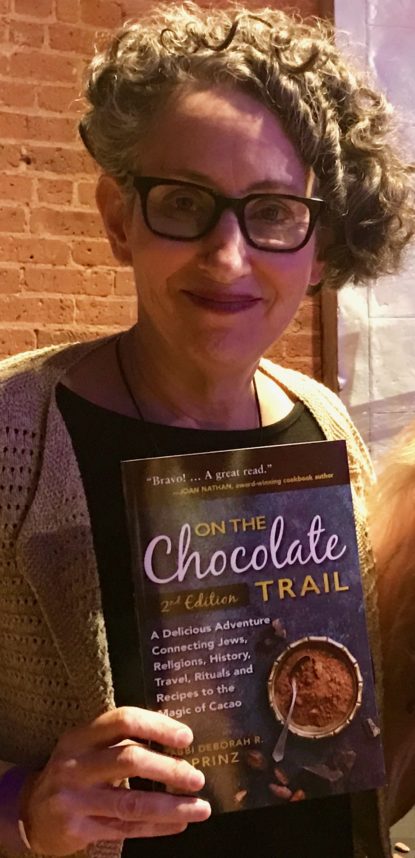
I was surprised, when researching my book, On the Chocolate Trail (2nd Edition, Jewish Lights, 2017), that Jews have had an appetite for chocolate, from generation to generation. These turn out to be stories of resilience and resourcefulness.This first-ever exhibition about Jews and chocolate is based on the best-selling book.

Later, twentieth century Jewish emigrants transferred their businesses for eating chocolate from one location to another. The background of Israel’s Elite Chocolate and the iconic chocolate company, Barton’s Bonbonniere, is also featured. Jews have had an appetite for chocolate from generation to generation.

The exhibit runs through February 25, 2018. Free admission; groups tours may be arranged by calling (212) 744-1400, ext. 313.
The Herbert & Eileen Bernard Museum of Judaica
Temple Emanu-El
One East 65th Street
New York, NY 10065
October 23, 2017 – February 25, 2018

Exhibit Souvenirs

Exhibit Opened! “Semi[te] Sweet: On Jews and Chocolate” Read More »

SUBURBICON *Movie Review*

“Suburbicon” is a film of broad-stroke social commentary that uses the concurrent experiences two families to reflect on society’s biases.

For a more in-depth examination of “Suburbicon”, take a look below:

https://www.youtube.com/watch?v=xR5XqUG_tSw&feature=youtu.be

–>Keep in touch with the author on Twitter and Instagram @realZoeHewitt.  Looking for the direct link to the video?  Click here.

All film photos are courtesy of Paramount Pictures.

SUBURBICON *Movie Review* Read More »

Episode 62 – When the World Fell Apart: 100 Years to WWI

Since 2014 the world has been commemorating 100 years for the Great War, World War I. 16.5 Million people lost their lives in that war, and its results changed the world forever.

Among many influences, the one that is most relevant to the Jewish people, is the liberation of Israel – then Palestine – from the Turkish occupation, and the beginning of the British Mandate. This November we’re also commemorating 100 years since the Balfour Declaration. Signed by the British foreign minister Balfour, that document led to the fact that we’re sitting here right now with Kobi Hubara…

Kobi Hubara has been filling up pubs and venues with his popular history lectures throughout Tel Aviv, for years. He’s a researcher of history, a writer and a publicist, and he’s with us to talk about the war we know almost nothing about, its affect on the Jewish fate and and how it reshaped the world.

Episode 62 – When the World Fell Apart: 100 Years to WWI Read More »

What do we mean when we say ‘Zionism,’ ‘Allies,’ and ‘Jerusalem’?

The Pew Research Center just released its study of “political typology” in the United States. The study, as they describe it, “divides the public into eight political groups, along with a ninth group of less politically-engaged Bystanders.” The purpose of this division is to better understand American politics and the internal values of groups that have similar political views.

A lot of it concerns the power of words and terms. Liberals want to “Take into account allies’ interests, even if it means compromising” — because they like “compromise.” Among the groups defined by Pew as Disaffected Dems, Opportunity Dems and Solid Liberals, the call for being considerate of allies is significant (64%, 94%, 97%). Among Core Conservatives and Country First Conservs there is less interest in the needs of allies (30%, 9%) and more inclination to “Follow own national interests, even when allies disagree” (64%, 76%).

Looking at the way people use words and understand their meaning is always revealing, and this is true for the political field as well. For example, 68% of the so-called Country First Conservatives (unhappy with the nation’s course, highly critical of immigrants and deeply wary of U.S. global involvement) say that it’s necessary to believe in God in order to be moral. They see an inseparable link between morality and God. But this is not true for Solid Liberals. The people who belong to these group (but not all Democratic voters) “stake out a distinctly secular point of view: Large majorities reject belief in God as a prerequisite for being a moral person.”

What is “God”? What is a “moral person”? Does the US need to speak the language of “compromise” in international affairs? In Israel, there are similar questions that have come to the fore in recent days. For example, there is now a debate about the meaning of “Zionism,” in particular in reference to the question: Is the leftist Meretz party a “Zionist” party?

Well, is it? Some of its leaders unequivocally said “no.” The right-leaning newspaper Makor Rishon investigated Meretz’s Zionism and concluded, based on some evidence, that the party is no longer Zionist. Part of this evidence was straight forward: Meretz MK’s admitted as much. Mossi Raz tweeted, “Meretz never defined itself as a Zionist party. I am a Zionist, most of the Jews in Meretz are Zionists, but a party which includes Arabs by definition cannot be a Zionist party.”

But other Meretz members disagreed. They argued that they are “Zionist” in their own way. Since there is no mandatory definition of what Zionism means, everybody can call themselves Zionist (the same way everyone in the US can call themselves “pro-Israel”). Zehava Galon, the head of the party, explained that “Meretz’s platform … never said that Meretz is a Zionist party, because we didn’t see a point in writing what is obvious.”

If defining “Zionism” is not easy for you, try defining “Jerusalem.” In recent days, two competing policy proposals came to the fore, both of which originated in cabinet members, both of which aim to strengthen Jerusalem and its Jewish majority, both of which could completely alter the meaning of “Jerusalem.”

Minister Israel Katz proposes to expand Jerusalem and add to it many of the currently-not-Jerusalem settlements nearby: If Gush Etzion and Maale Adumim are added to the city, Jerusalem will become a much larger conglomerate of neighborhoods and will include a much higher percentage of Jewish residents (currently, about a third of all Jerusalemites are Arab). Minister Zeev Elkin, a member of the same party, and a no-less hawkish politician, proposes the opposite: Shrink Jerusalem by making “several Arab neighborhoods beyond the West Bank separation barrier split off from the Jerusalem municipality and be placed under the jurisdiction of one or more new council administrations.” The demographic result would be similar: less Arabs, higher percentage of Jews in “Jerusalem.”

This is all about words: No Jew is going to move to a different apartment, and no Arab is going to leave his home. The boundaries of Jerusalem — the municipality — will change, but what we understand as “Jerusalem” does not necessarily correspond with the municipal boundaries that politicians who come and go decide to change for this or that political reason.

But the battle for or against the Katz and Elkin plans will focus on “Jerusalem” — the perception of the city. Is moving the municipal boundary a “division” of “Jerusalem”? This will be the argument against Elkin, and as we all know, the right is highly sensitive to any suggestion that could mean a “division” of the “undivided” “Jerusalem.” And what about the other plan? Currently, the US administration opposes it, because the left and the Palestinians (and thus the administration) believe that any move to strengthen “Jerusalem” — a city at the core of a “conflict” — reduces the chances for “peace.”

In this case, Israel is trapped: Since the voters of the Trump administration have less inclination to take the views of allies into account, the administration will have no problem in forcing Israel’s hand if it wants to expand the city. On the other hand, don’t expect the voters on the far left — who are inclined to be considerate of allies — to be on Israel’s side if it decides to expand the city. These voters want “compromise,” especially so when it comes to “Jerusalem.”

What do we mean when we say ‘Zionism,’ ‘Allies,’ and ‘Jerusalem’? Read More »