fbpx

October 17, 2017

Harvey Weinstein’s brother accused of sexual harassment

Bob Weinstein, the brother of Harvey Weinstein, is now facing a sexual harassment allegation from a TV producer.

Variety reports that Amanda Segel, the executive producer of “The Mist”, is claiming that Weinstein kept harassing her for three months in 2016 until she threatened to leave the show. According to the report, Segel had dinner with Weinstein to establish a working relationship with him, but Weinstein kept making suggestive remarks. He asked her to drive him to his hotel, where Segel rebuffed his request to join him in his hotel room.

After that, Segel alleges that Weinstein kept trying to establish a romantic relationship with her, which Segel continually declined. Segel eventually threatened to leave the show if Weinstein didn’t cease his actions, prompting Weinstein to launch into a tirade against Segel on a conference call over “a production issue that she says was out of her control.”

An agreement was worked between the Weinstein Co. and Segel that she would never have to be around Weinstein or talk to him over the phone and that she could leave the show after the second season.

Segel told Variety, “After ‘no,’ anybody who has asked you out should just move on. Bob kept referring to me that he wanted to have a friendship. He didn’t want a friendship. He wanted more than that. My hope is that ‘no’ is enough from now on.”

A Weinstein representative issued a statement to Variety that read, “Bob Weinstein had dinner with Ms. Segel in LA in June 2016. He denies any claims that he behaved inappropriately at or after the dinner. It is most unfortunate that any such claim has been made.”

Weinstein recently told The Hollywood Reporter that his brother Harvey at times subjected him to “physical abuse” and “avoided getting the help” he needed despite Bob Weinstein’s repeated pleas, although Weinstein claimed he didn’t know about his brother’s sordid behavior.

Harvey Weinstein’s brother accused of sexual harassment Read More »

Federal judge strikes down Trump’s latest travel ban

A federal judge in Hawaii struck down the Trump administration’s latest travel ban under the grounds that it “plainly discriminates based on nationality.”

The judge, Derrick Watson, argued in his ruling that the travel ban “suffers from precisely the same maladies as its predecessor: it lacks sufficient findings that the entry of more than 150 million nationals from six specified countries would be ‘detrimental to the interests of the United States,’ a precondition that the Ninth Circuit determined must be satisfied.”

The latest travel ban would have denied visas to those from Iran, Syria, Libya, Chad, Yemen, Venezuela and North Korea. Under Judge Watson’s ruling, only those traveling from Venezuela and North Korea could be denied entry into U.S.

The ruling comes in response to the state of Hawaii suing the latest travel ban, claiming that the ban undermined America’s “founding values of religious freedom and equality.” The Trump administration argued that the executive branch has the authority to restrict immigration. The Department of Justice is expected to appeal Watson’s ruling.

Here is a roundup of tweets gloating about the travel ban being struck down:

https://twitter.com/JeanGrey80/status/920369229899149312

And here are tweets of those lamenting the ruling:

https://twitter.com/josh_hammer/status/920368934540410880

The travel ban would have gone into effect on Wednesday had it not been for Watson’s ruling.

Federal judge strikes down Trump’s latest travel ban Read More »

WATCH: The Tunisian Jew Behind the Pretzel Challah Craze

In 2013, pastry chef Dominique Ansel invented the cronut (a donut and croissant hybrid). Little did he know, he was inspiring a pastry revolution, which would spawn a legion of hybrid spin-offs; i.e. the dookie (donut + cookie), the cruffin (croissant + muffin), the cragel (croissant + bagel). And then came the pretzel challah. There’s no fancy moniker (challetzel doesn’t really work). It’s no nonsense, straightforward and to the point.

Pretzel challah is the brainchild of Alain Cohen, owner of Got Kosher?, a Pico-Robertson establishment that serves Sephardic cuisine (including kosher charcuterie) in what is a primarily Ashkenazi juggernaut. Born in Tunisia and raised in Paris (where his father owned a popular kosher restaurant), he moved to Los Angeles in 1981 to pursue a movie career, but, in his own words, “life happened” and he landed, as fate would have it, back in the food industry. Cohen got the idea for pretzel challah when he was working at La Brea Bakery with chef Nancy Silverton. At the bakery, Silverton baked a pretzel baguette. “I was impressed by the idea of turning something very simple and making it different by mixing two traditions,” said Cohen.

The key ingredient that transforms a plain jane loaf of challah into a pretzel challah is lye. After the challah dough is braided, it is soaked in a lye bath (lye is a chemical solution that’s used to make soap) before being baked.

Pretzel challah has proved to be a pioneer in Los Angeles Jewish cuisine. Got Kosher’s? pretzel challah can be found at Trader Joe’s, Pavilions, Whole Foods, Gelson’s, Bristol Farms, and, of course, at its flagship store: Got Kosher?

To Cohen, the success of his challah “is amazing, it’s a gift from God.”

WATCH: The Tunisian Jew Behind the Pretzel Challah Craze Read More »

Educators go to head of the class: four women win prestigious Milken Family Foundation

When Yehudis Blauner was 5 or 6 years old, she lined up the dolls and teddy bears in her bedroom, set a whiteboard in front of them and wrote out the day’s agenda and lesson plan.

Three decades later, Blauner still has that whiteboard, with some of her words stained into it, a reminder of the little girl who dreamed of becoming a teacher.

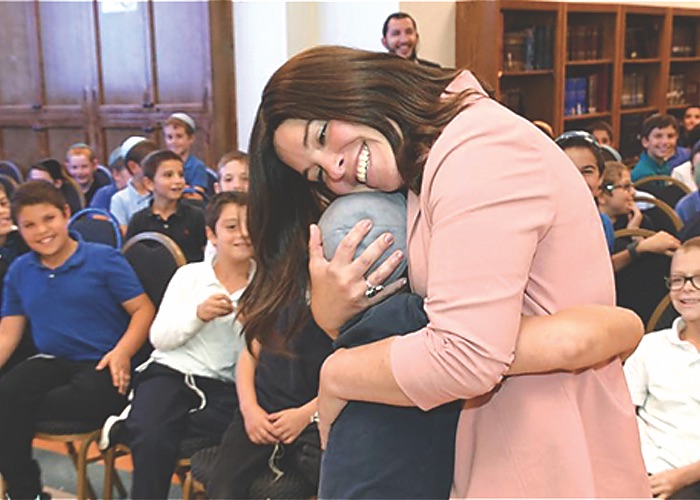
On Sept. 25, Blauner, 36, the general studies principal of Cheder Menachem, became one of four Los Angeles-area Jewish school educators to win a $15,000 Jewish Educator Award for 2017 from the Milken Family Foundation in recognition of outstanding work.

The others were Adrienne Coffield, director of academic technology at Brawerman Elementary; Melody Mansfield, a Milken Community Schools English and creative writing teacher; and Jenny Zacuto, a language arts teacher at Yavneh Hebrew Academy.


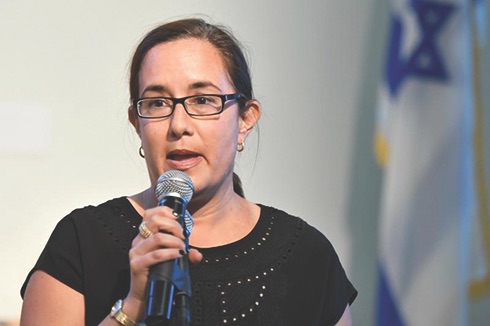
Adrienne Coffield, Brawerman Elementary School director of academic technology and a 2017 Jewish Educator Award recipient, addresses the assembly gathered in her honor.


“Oh my goodness, it’s still not real,” Blauner said in an interview several days after receiving the award. “I was very surprised. I was not expecting it at all. I work in a place where there are so many talented educators.”

What the winners have in common is a desire to prepare their students for succeeding in life beyond school.

Blauner, whose son is a third-grader at Cheder Menachem, an all-boys, kindergarten-through-eighth-grade school, said she considers her responsibilities as far more than a means to a paycheck.

“It is definitely more of a lifestyle than a job. I don’t look at it as coming in for a 9-to-5 job. I have a goal in mind,” she said. “It doesn’t end. It’s not about time frame or hours of operation; it’s more this never-ending need and desire to make sure my son and everyone’s son here have access to, I want to say, a respectable education, but it’s more than that. It’s an educational experience very meaningful to them that will help them and give them tools to do amazing things and change the world.”

Mansfield has been teaching at Milken Community Schools since 1998. She said she loves teaching about myths and sonnets and the importance of creative writing. In a phone interview, she said she hopes her winning the award will bring more attention to her work at the school.

“For me, what I hope it’s going to mean is it will bring more visibility to the creative writing program because my vision of the program is something that is helpful for all students, whether or not they are going to become writers,” she said.

Mansfield, who isn’t Jewish, has found gratification working with students whose Judaism emphasizes learning, challenging and deconstructing texts.

“The whole Jewish tradition is so welcoming and interesting to me because I am a non-Jewish person and the more I learned the more I loved being here,” she said. “The idea of God wrestling and everybody gets a voice, the idea of uniqueness of the individual, the kids are so respectful and generally so eager and, regardless of their ability level, they are all readily here. It’s just a real joy.”


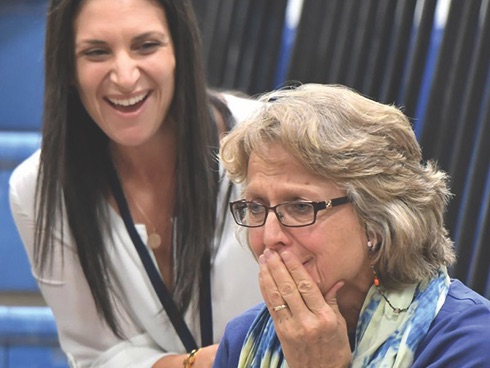
Milken Community Schools English and creative writing teacher Melody Mansfield is overwhelmed upon hearing she is a 2017 Jewish Educator Award recipient.


As a K-6 teacher at the Reform Brawerman, Coffield has used technology to teach students about Jewish immigrants on the Lower East Side of Manhattan. In accepting her award, she thanked her fellow educators.

“I work with a very talented group of teachers,” she said during a Sept. 25 school assembly. “To even be in this room among you I feel very honored.”

Coffield also has her parents to thank for inculcating in her a love of education and technology. Her mother, Donna, was a teacher at the Temple Aliyah preschool for more than 30 years, and her late father, Michael, was a genius when it came to electronics, she said. 

“There were so many stories people told me after he passed away,” Coffield said. “During the great power outage in the 1950s in New York, New York City went dark, and the way my family members tell it, [everywhere went dark] except for my father’s bedroom. I don’t know if he was a teenager at that point but he had rigged up some kind of generator and made light.”

Zacuto, whose Orthodox K-8 yeshiva-style school balances Torah learning with secular studies, said she owes her success to her students.

“I want to thank my students from the past and the present and the future because, truly, you are my greatest teachers,” she said. “You help me grow every day.”

Zacuto told the Journal she believes strongly in the power of feedback. That’s why she covers her students’ essays in comments and criticisms, both positive and negative. She has found that the more she has done so, the more students crave that kind of response. 

“I have found if you give students back papers covered in comments they, over the course of the year, start to hunger for that feedback. They want that feedback, because they realize they are changing and growing,” she said.


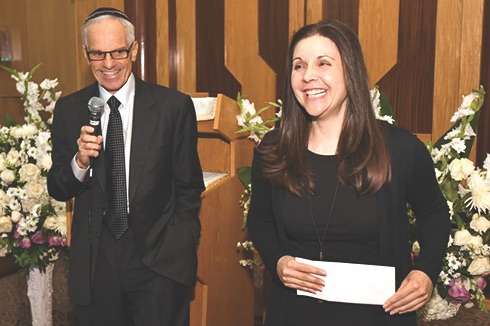
Milken Family Foundation Executive Vice President Richard Sandler names Yavneh Hebrew Academy language arts teacher Jenny Zacuto a 2017 Jewish Educator Award winner.


The Milken Family Foundation, established in 1982 by brothers Michael and Lowell Milken, created the Jewish Educator Awards in 1990 in partnership with Builders of Jewish Education (BJE), an umbrella organization for the Jewish day school community. Three years earlier, the foundation established the Milken Educator Award, which recognizes outstanding public school teachers nationwide with an unrestricted $25,000 prize. 

The Jewish Educator Award recognizes Jewish day school teachers in the Los Angeles area from kindergarten through 12th grade who teach a minimum of 15 hours per week and have taught for a minimum of seven years in a BJE-affiliated school. Winners are selected from approximately 800 eligible teachers at the 37 accredited BJE schools in the L.A. area.

Lowell Milken, chairman of the foundation, said the award recognizes the important work Jewish day school educators have done in the hopes they will continue.

“This is not a lifetime achievement award. This is a validation for all the good work they’ve done in the past but they are also receiving the award to encourage them to do their great work and achieve even higher levels,” he told the Journal.

The Jewish Educator Award differs from other initiatives in the Jewish community in its ability to bring together leaders from all of the denominations of Judaism, Milken said, pointing to the annual luncheon recognizing the winners.

“It’s one of the few events in our community where you will have all these members of the diverse Jewish community together and supporting education and supporting educators, and that’s very important because we often have differing views on different matters,” he said. “When it comes to education, we all want to join together because it is so important to students, and the financial demands are so great to send kids to Jewish day schools. Anything we can do to galvanize support for the Jewish day school is important.”

This year’s luncheon, the 28th annual, will be held Nov. 30 at the Luxe Sunset Boulevard Hotel.

Typically, a winner’s identity is kept secret until an announcement at a school assembly. Milken said the surprise is an important part of the initiative.

“The element of surprise creates drama where people have a memory of the event and it may impact them in a different type of way,” he said, adding that people are more impressed when a financial reward is attached to an honor.

“Unfortunately in America today, if you don’t say things with money, a lot of times nobody pays attention,” he said.

He added, “I think in connection with the Jewish Educator Award, I don’t view the financial award as the key element of it. It’s the recognition, the honor, celebration and the validation — the validation that all your efforts are noteworthy, have made a difference and will continue to make a difference.”

Educators go to head of the class: four women win prestigious Milken Family Foundation Read More »

Jews tackling football: Milken High takes the ball and runs with the full-contact version of the sport

As any hard-core Jewish sports fan can tell you, there is a rich history of Jews in baseball and basketball. But Jews in football? Not so much.

As Geoff Schwartz wrote in “Eat My Schwartz: Our Story of NFL Football, Food, Family, and Faith,” the 2016 book he penned with his brother, Mitchell, “When Mitch arrived in the league, we instantly accounted for at least 20 percent of all Jewish players in the NFL, or probably more.”

This helps underscore the noteworthiness of the scene that played out on a recent sunny afternoon on a borrowed field in the San Fernando Valley: 16 young men, all Jewish, working on tackling, pass routes, blocking and footwork. This is the football team from Milken Community High School, the private Jewish institution that neighbors the Skirball Cultural Center.

While there is no organization that keeps tabs of such things, according to head of school Gary Weisserman, theirs is what appears to be just a handful of Jewish high schools across the country that field a football team. Like other schools with small student bodies and a football program, Milken uses eight players on offense and defense, rather than the usual 11, and competes on a field that is 80 yards by 40 yards, compared with the full-size field that is 100 yards long and just over 53 yards wide. Milken plays against other independent schools throughout Los Angeles in games set up by the coaches. This year, the Wildcats have just seven games.

Flag football is a more common offering at area Jewish schools. Shalhevet and deToledo high schools have teams, according to their websites, as do Milken’s middle school and Abraham Joshua Heschel Day School in Northridge. The Alice and Nahum Lainer School (formerly Sinai Akiba Academy) usually fields a middle school flag football squad each fall, but this year there wasn’t enough interest among students to put together a team.

Football has been at Milken Community High School for only six years. According to Weisserman, a lot of attention is placed on safety. “We make sure we have the latest technology, in particular for helmets,” he said. “We always have a full contingent of trainers. We try to minimize the risk.”

The sport arrived at Milken one year before Weisserman, who came from one of the few other Jewish high schools with a tackle football team, Scheck Hillel Community School in Miami.

“Being a Jewish school does not mean you can’t have an outstanding athletic program,” said Weisserman, a Detroit native who admits to being a “fair weather” football fan.

“One of the things we have found, when students apply to high school in particular, they want a full high school experience,” he said. “That includes a full athletic program and other opportunities. … Football is one of those opportunities that there is still significant demand for.”

Unlike other teams at the school — which use tryouts to fill the roster, with cuts as part of the process — everyone who wanted to be on the Milken football team this year made it.

“When you’re able to offer a competitive athletic program, it goes a
long way toward school spirit and toward that school spirit culture,” Weisserman said. “Last year at the [California Interscholatic Federation basketball] championships, we had to move to another gym for the finals because we had over 2,000 people coming. That’s exciting.”

This year’s football team, which as of Oct. 6 had a record of 1-2, does face some challenges, particularly its youth. There are just two seniors on the Wildcats — co-captains Yoni Ben-Naim, 17, a running back, linebacker and strong safety, and Jordan Kalman, also 17, who plays center on offense as well as defensive end — and four juniors. The rest of the squad is made up of sophomores and freshmen. One of last year’s top players left for a school that plays 11-on-11 football, and another former player decided to focus on basketball.

The changes this season also include the Wildcats getting a new coach, Elliott Turner II, a Texas native who now calls Highland Park home.


Coach Elliott Turner II talks to players during practice.


Youth and changes aside, Kalman, an Indianapolis Colts fan, said he expects the Wildcats to do “all right” this season. Since joining the team in his freshman year, it has not had a losing record. He did concede, though, that the Wildcats have a more difficult schedule this season.

“The teams we are playing are bigger schools,” he said. “Faith Baptist is known to be an eight-man football powerhouse. They have been a top school in California for years. … But we’re going to use our minds and abilities to ‘out-mind’ our opponents.”

It’s a sentiment echoed by the
new coach.

“All these kids, they think a lot,” Turner said. “They ask a lot of questions. They see [football] like a coach, not a player. They are very heady, very smart. I feel like other teams are like little robots.”

The Milken team, he added, also has “a lot of heart and tenacity. … They just don’t quit. It’s not in their nature. Even when they make mistakes, they keep pushing. They keep working hard.”

Kalman said, “I think we all play with a chip on our shoulder.”

“It’s unique that we’re a Jewish football team,” said Ben-Naim, who splits his NFL allegiance between the Carolina Panthers and San Francisco 49ers. “A lot of people might look at us and think of us as an underdog, kind of how we’re perceived through history. They might think we don’t know what we’re doing. There’s a stereotype. … Every day [we’re] trying to prove them wrong, to break away from that stereotype.”

For Ben-Naim and Kalman, this season does have a bittersweet aspect. As much as they’d like to have a successful final campaign, according to Ben-Naim, “We’ve come to the realization that we need to be more focused on making the team self-sufficient and competitive without us next year; that is, more preparing for the years to come rather than focusing on the present.”

He added, “It’s hard from a senior perspective to say that it’s not about this year when it’s your last year. As a senior, it’s not our place to try to show our stats and score as many touchdowns as we can. It’s like l’dor v’dor, preparing the next generation for football. It’s important to us that football [at Milken] doesn’t finish in a few years. We’re a very new program. We’re more focused [on making sure] that kids know that Milken has a football team.”

Jews tackling football: Milken High takes the ball and runs with the full-contact version of the sport Read More »

Focus on Israel: The ABCs of educational apps

Whether you want to teach your kindergartner the alef-bet or have your high-schooler brush up on ancient history, there’s a plethora of smartphone and tablet apps available for students of all ages and abilities who are interested in Israel. All apps can be downloaded from either iTunes or Google Play.

Eye On Israel

Before your high-schooler spends a semester abroad in Jerusalem, have her brush up on her Old City history and geography with EYE ON ISRAEL. The free app enables users to search for important historic, cultural and religious sites by map or drop-down menu, while also providing real-time information on the area. The app for iOS and Android devices also includes other features, including a timeline and general history of Jerusalem.


Birds of Israel

Spending school breaks in Israel can be fun and educational with BIRDS OF
ISRAEL
. Nature-loving teens can use the free app for iOS devices to identify more than 529 species of Israeli birds during hikes and walks around town. Detailed descriptions of each bird accompany colorful photos that make avian identification easy.


Kids Puzzles In Hebrew: First Words


Intended for children ages 3 to 8, KIDS PUZZLES IN HEBREW: FIRST
WORDS
($1.99) for iOS devices is a collection of 48 puzzles to help nonnative speakers learn basic Hebrew words while also exercising their spatial recognition and matching skills. The beautiful illustrations and professional voice-over will help keep your child engaged while learning proper pronunciation of new vocabulary.


HebrewVision: To Count


Kids of all ages can benefit from learning numbers and basic mathematics in HEBREWVISION: TO COUNT ($1.99). Besides teaching users how to pronounce and write numbers, the app for iOS and Android devices also teaches practical application of numbers, such as counting and telling time in Hebrew. The app uses a combination of interactive animations, touch-based narration and video demonstrations.


Hebrew Bubble Bath


With more than 600 words and phrases, HEBREW BUBBLE BATH is perfect for language-learners of all ages. The free app for iOS and Android devices uses a variety of games — aural and visual — in 63 categories with multiple levels in each to help your child hone language skills before the next family trip to Israel.

Focus on Israel: The ABCs of educational apps Read More »

Hot off the presses: Shalhevet’s Boiling Point takes on big issues while teaching journalism

In the basement office of The Boiling Point, the acclaimed newspaper of Shalhevet High School, a message on a dry-erase board from faculty adviser Joelle Keene reminds everyone on the staff how to keep the paper vibrant.

It’s her “French Fry Rule,” which dictates that a news story must be absorbing enough that a reader will continue reading even if someone with French fries passes by.

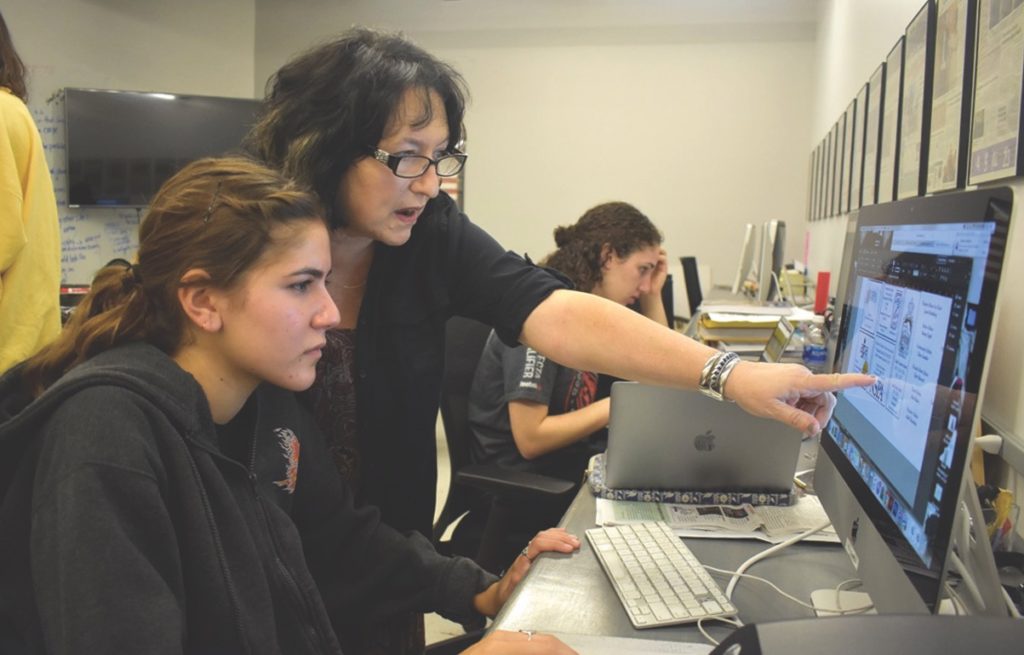
It is from this room — with her disheveled desk, walls adorned with framed front pages of the newspaper, a black leather sofa in the corner — that approximately 50 Shalhevet students every year produce an award-winning publication as writers, editors, photographers, artists and designers.

With as many as eight issues each school year, they have made The Boiling Point one of the most celebrated student newspapers in the region. For the past five years, the Columbia Scholastic Press Association has awarded it the Gold Crown in the hybrid news category, recognizing outstanding publications in print and online.

“The job of The Boiling Point is to teach journalism, which means delving into complex issues,” said Keene, a member of the school’s faculty since 2003 who also serves as the school’s choir director and music teacher.

To that end, she oversees a product unafraid to take on contentious issues and determined to cover as many topics as possible, with an online edition, shalhevetboilingpoint.com, updated with a regularity that would shame larger newspapers. Its motto is “When we know it, you’ll know it.”

The boldness is apparent in the most recent edition, which was published early in the new school year and reflects at least one issue that came to — well, a boil — last spring. A front-page story delves into a controversial issue in the Modern Orthodox school: What should students call female faculty members who have rabbinical ordination from an Orthodox institution?

The front page of the Boiling Point’s most recent issue shows the variety of stories published by its student staff.


The issue also includes a feature story, “Is Reading Being Replaced?” which investigates how much students read today outside school, and a column that speculates about the Dodgers’ World Series chances.

The driving force is Keene, a former staff writer at the Los Angeles Herald Examiner and Tacoma News-Tribune and music critic at the Seattle Times.

Besides her French Fry Rule, other Keene-isms are written on the dry-erase board: “GQUP,” an acronym for “Good Quotes Up High;” an explanation of what constitutes a “Cool Mistake” — such as writing, “People tragically died”; and what constitutes an “Un-cool Mistake,” like “saving things in the wrong place so they can’t be found during production.” There is a quote from the late New York Times media reporter David Carr, that says, “The more reporting you do, the more complicated the story gets.” A quote by Keene follows: “which is not a reason not to do it.”

A passage from Leviticus also appears on the board, saying, “Don’t be a talebearer [but] don’t stand idly by the blood of your neighbor,” which Keene said she believes encapsulates the responsibility of being a journalist who tells stories through a Jewish lens: Do not gossip, lashon harah, but don’t ignore the responsibility of speaking up when events demand it.

“Who says the Torah didn’t anticipate journalism?” Keene said.

Keene’s responsibilities include working with reporters on assignments, ensuring they meet deadlines, and meeting the challenge of running an independent paper while remaining sensitive to the school administration’s agenda and policies.

“We want everyone feeling comfortable reading The Boiling Point, but we don’t want to shy away from issues,” she said.

Rami Fink, 14, the son of Rabbi Eliyahu Fink, joined the newspaper’s staff this year. A freshman, he said he is interested in writing about politics, world news and in exploring the issue of kosher versus halal. On a recent afternoon, he sat down on the sofa and took out his laptop to work on his first story — one about a recent Shalhevet flag football game against local Modern Orthodox high school YULA Boys High School, a local Modern Orthodox school.

“I’m super excited to be working here,” he told the Journal.

The Boiling Point began as an all-opinion publication, providing an outlet for students to rant and vent—thus, its name.

“Apparently there was a lot of rage,” Keene recalled.

When Keene joined the faculty in 2003, the paper “was dormant,” she said. “Somebody at the time considered himself an editor but it had not come out for a couple of years.”

Now, it’s hyper-active, with a staff as committed as she is.

On some deadline days, students juggle homework and extracurricular activities, and stay in the newsroom until 2 a.m. finishing the paper. Keene recalled one time when some students even brought out an air mattress.

“The air mattress was not with me; I don’t remember an air mattress, but I remember getting home probably close to midnight on several production nights,” Leila Miller, an editor-in-chief emeritus, told the Journal. “I remember it was maybe the first night of Chanukah, one of the nights of Chanukah we were in the newsroom and people were kind of sad. Honestly, you want to spend Chanukah with your family, not putting out a paper, but you know we did it anyway because we had to, and because everyone wanted to see the paper come out. You make the sacrifice.”

Tobey Lee, the sports editor, said balancing the demands of the paper with his other academic responsibilities is worth it.

“It’s quite challenging, managing my time with my schoolwork and my other extracurriculars,” the 10th-grader  said. “I’m involved in a lot: the debate team; model congress; I’m in the choir; I’m on cross-country. I still have to do essays and tests like any other normal high school student but I think that when I have to do my job as sports editor and this big position of managing the sports section, this is one of my top priorities,” he said. “This is one of the most important things I am doing.”

To support the students’ efforts, The Boiling Point has an annual budget of $10,000 from the school and an additional $2,200 per year in advertising revenue, which helps pay for computers and cameras and anything needed to keep the website running and fresh, Keene said.

Keene attributed the newspaper’s success to the feeling of ownership the students have over the newspaper.

“It’s not my paper,” she said. “It’s the students’ paper.”

Hot off the presses: Shalhevet’s Boiling Point takes on big issues while teaching journalism Read More »

If you build it, they will come: Valley Beth Shalom confident its new community center will serve its synagogue, students and beyond

Valley Beth Shalom (VBS) broke ground Sept. 7 on a new addition to its Ventura Boulevard campus, a community center that will include meeting rooms, a gym, a music room and a library — all to be used by the synagogue and its adjacent day school.

The Howard and Irene Levine Community Center, set to open in fall 2018, “gives VBS a chance to be a true community center for this part of the San Fernando Valley,” said Bart Pachino, executive director of VBS.

“We expect it to be a 16-hour-a-day building that we use after school hours for adult recreation, community events and adult education,” he said.

The 18,000-square-foot building will feature meeting spaces on the basement level, along with a ground-level gym with ample court space. It will replace an outdoor play area abutting Ventura Boulevard.

Pachino said the Conservative synagogue and the attached K-6 Harold M. Schulweis Day School have not seen major upgrades to their Encino location since the early 1990s.

Plans to expand and renovate the campus began to take shape some 15 years ago. By 2011, a master plan had been approved by the city of Los Angeles, Pachino said, but construction was put on hold because of the Great Recession. In 2015, with positive trends in the synagogue’s size and demographics, its leadership decided the time had come to modernize, Pachino said.

“Despite some of the larger negative demographic trends in Conservative Judaism, our community is getting younger and our membership is even up a bit over the last several years,” he said.

The synagogue’s membership now stands at more than 1,500 families, and 750 children attend the day school, preschool and Hebrew school operated by VBS.

“We believe in the Encino community as a key location for young Jewish families to continue to live in,” said Nancy Sher Cohen, a VBS past president and co-chair of the synagogue’s building committee. “And because of our location and our size, we think we can serve as a Jewish community center for the larger Valley.”

When VBS leaders began to approach potential donors in late 2015, community members “responded overwhelmingly,” she said.

Image courtesy of Abramson Teiger Architects.


Image courtesy of Abramson Teiger Architects.


“Our community understood the idea that we are planting the future of our Jewish community here in Encino in particular and Los Angeles in general,” she said.

By the time it broke ground, VBS had raised $26 million, with further fundraising planned for a slew of future building projects. After finishing the community center, the synagogue plans to renovate its entry pavilion, as well as its chapel and main library, according to Pachino.

Many of the leading donations came from young members, Cohen said, a sign of the synagogue’s continued health.

“Our view is if you provide what families want, they will be there for you — they will be there for each other,” she said.

VBS Senior Rabbi Ed Feinstein was optimistic about the synagogue’s future.

“We’re growing younger,” he said. “And we’re seeking to build facilities that will accommodate this new gen of young members and their families.”

Feinstein attributed the synagogue’s demographic trends to the welcoming environment it provides as well as the increasing isolation amid Southern California’s urban sprawl. The new community center at VBS aims to double down on that growth.

“Life in suburbia can be kind of lonely,” Feinstein said, “And there’s something to be said for a lifetime of community affiliation, and people have a sense, they have an intuition for that.”

If you build it, they will come: Valley Beth Shalom confident its new community center will serve its synagogue, students and beyond Read More »

A need filled: Two determined moms take action to give students with special needs a Jewish education

On a recent overcast morning, Chaya Chazanow arrived with her 5-year-old son, Tzvi, at a sleepy Pico-Robertson storefront that has barred windows. Once inside, he sat quietly on the floor of a cozy classroom, playing with colorful blocks and Hebrew alphabet cards. A smiling behavioral therapist looked on.

“I toured a bunch of Jewish day schools, public schools, other nonpublic schools, and I just couldn’t find the right setting for him,” Chazanow said.

But now she has — the city’s first Jewish day school for children with special needs.

Tzvi was born with a rare genetic disorder that Chazanow declined to identify, but it resulted in physical disabilities, like trouble walking, as well as cognitive processing and executive functioning issues. Tzvi also is mostly nonverbal.

The nonprofit Friendship Circle Los Angeles (FCLA) operates out of the storefront, providing weekend and after-school Jewish and secular programming for children with special needs. Behind the unassuming facade, there’s a sprawling 17,000-square-foot facility with five classrooms, a shul and a wheelchair-accessible playground. Thanks to a Jewish Community Foundation of Los Angeles grant awarded last year, a sensory room for therapy is under construction. It will have matted floors and swingsets. Most of that space currently is rented out by a preschool.

At the moment, Tzvi and one other child are the only students in the new day school, which will be known as Learning Circle of Los Angeles. It occupies only one classroom, but there are plans to expand once the school attracts more kids. The staff is made up of a full-time behavioral therapist, a secular studies teacher, a Judaic studies teacher and other part-time therapists who pay weekly visits to the school.

FCLA’s educational director, Doonie Mishulovin, who puts together curriculum and teaches Judaic studies, has sympathy for parents like Chazanow who have trouble finding a day school for their children. 

“The pain of Jewish parents who don’t have a day school is so deep and so raw,” she said. “They’ve been kind of swept under the rug a bit by the community for a long time.”

Los Angeles has 37 accredited day schools recognized by the nonprofit Builders of Jewish Education (BJE). Not one of them specifically caters to students like Tzvi with moderate to severe disabilities. Under the federal Individuals with Disabilities Education Act, Los Angeles Unified School District schools have to provide resources that day schools don’t. But after visits and research, Chazanow concluded that those resources constitute more of a “one-size-fits-all approach.”

Besides, she wanted her son to have a Jewish education. “It’s part of our family, rooted in our belief system,” she said.

Other major cities, including New York, Miami and Boston, offer heavily funded options, such as Boston’s Gateways: Access to Jewish Education program.

“Most parents have a choice where they send their kids to school,” Chazanow said. “For us, we weren’t really given a choice.”

Sarah R’bibo, a corporate lawyer living in North Hollywood, also was left without much of a choice. She said that after sending her first three kids to Emek Hebrew Academy in Sherman Oaks, she was told by Emek administrators that they couldn’t meet the special needs of her fourth and youngest, Iva, who was born with cerebral palsy.

“I just thought my daughter deserves a Jewish education. There’s no reason why my other kids can go to a Jewish day school and she can’t,” R’bibo said. “It’s astonishing something doesn’t exist here. So, we decided to try to start something.”

Now, Iva shares a classroom with Tzvi, filling out the inaugural two-student class.

Their moms share a mission — to make sure the school succeeds. 

“We’ve wanted to do this for a long time, start a full-time school like this,” Mishulovin said. “We gave up for a while, until [Chazanow] came in here in April and said, ‘You have to do this for my son.’ Now, we’re doing it.”

R’bibo volunteers, handling legal matters and the lion’s share of fundraising. Chazanow, who also volunteers, runs the administrative side of things, while Mishulovin does a bit of everything, including teaching. 

Betty Winn, BJE’s director of its Center for Excellence in Day School Education, said she and others recognize the “tremendous need for something like this.” However, this isn’t the first attempt at having such a school, and Winn made it clear what the main obstacle will be.

“It’s challenging, mainly because it’s extremely expensive,” she said. “Facilities have to be developed. It needs a very organized initiative with heavy funding.”

So far, Chazanow, Mishulovin and R’bibo have raised $100,000 through donations. They estimate they’ll need $200,000 to cover all the costs of running the school for the first year. Beyond that, they’ve set goals to make the school unique and financially sustainable in its capacity to accommodate different special needs. They are working to compile a staff with more volunteers, teachers and therapists to form at least a 2-to-1 student-to-staff ratio; getting L.A. Unified home-school charter funding; and getting nonprofit status (currently, they are accepting tax-deductible donations at jewishspecialneedsschool.donorzen.com).

They estimate tuition will be close to $18,000 per year.

By comparison, Emek, where R’bibo’s other children go to school, charges more than $12,000 in annual tuition. The tuition at some other day schools in the area is well over $20,000.

Chazanow said there are about 10 prospective families monitoring the school’s progress. The target is mainly elementary school-age children. 

“Many parents are apprehensive about sending their kids to a new school, a new program. So it looks good to show people the program as it’s running,” she said. “It’s going fantastically well, and we’re confident we’ll have a good group next fall.”

According to the U.S. Census, roughly 1 in 5 Americans has a disability. Some, like Jennifer Mizrahi, president of the national advocacy group RespectAbility, believe the Jewish community might be hit particularly hard by disabilities. In a 2014 article published in the Journal of Jewish Communal Service, she wrote, “It is likely that the percentage of Jews with disabilities is higher than the national average,” basing her observation on genetic risks Jews carry and the fact that Jews have children later than many other demographic groups.

Still, in many of her meetings with potential donors, R’bibo has been met with responses like, “Do we need this?”

“A huge part of our mission, beyond offering these kids a Jewish education, which is fundamental, is educating these people who think there isn’t a need,” she said. “It isn’t good enough to say public schools can do this. If you want to send your kids to public school, that’s fine, but there should be an option.”

R’bibo also said the issue leads to alienating Jewish special needs children from religious engagement. Before this year, Iva was in state-subsidized preschool and wasn’t getting much Jewish education. Now, after just a few weeks at her new school, R’bibo already is noticing a huge difference.

“She came home from school for High Holy Days and knew more about the shofar, knew an apple-and-honey song. She participated in Rosh Hashanah in a most meaningful way, more than she ever has before,” R’bibo said. “It was in incredible experience for our family.”

Winn noted that the geography of Los Angeles might be a hurdle. There are day school options in every part of the city, but having only one option for special needs kids could make for some long commutes. Chazanow lives in the Fairfax neighborhood — not very far — but R’bibo commutes from North Hollywood. However, R’bibo said, it’s still preferable to the alternative, and she’s confident other parents will agree. 

“Having everything in one central location where they get a secular education, a Jewish education and therapies, that’s ideal for me and other parents,” she said. “It eliminates so much chaos and travel time. It’s an integrative approach and a really great model.”

Chazanow took several trips to the East Coast to visit special needs schools in the New York-New Jersey area. She looks to those experiences and what she found there for motivation.

“At so many of the places I visited, people told me it all started with a storefront,” she said. “They told me all it takes is one parent to get it started.”

Seated next to Mishulovin inside the otherwise empty Friends Circle shul, she looked around and shrugged.

“Well, here I am.”

A need filled: Two determined moms take action to give students with special needs a Jewish education Read More »

Mayim Bialik under fire for suggesting women should dress modestly to avoid sexual harassment

Actress Mayim Bialik has faced criticism for writing in a column that women should dress modestly to avoid sexual harassment in Hollywood.

In a New York Times op-ed published on Saturday, the Big Bang Theory star wrote that she began her career in Hollywood “as a prominent-nosed, awkward, geeky, Jewish 11-year-old” and that while she was “shocked and disgusted” by the allegations against Harvey Weinstein, she was not necessarily surprised.

“I have always had an uncomfortable relationship with being employed in an industry that profits on the objectification of women,” wrote Bialik. “Though pressure to ‘be like the pretty girls’ started long before I entered Hollywood, I quickly learned even as a preteen actress that young girls with doe eyes and pouty lips who spoke in a high register were favored for roles by the powerful men who made those decisions.”

Bialik proceeded to recall how she was the butt of jokes over her looks when she was younger, yet she’s had a successful career in Hollywood. She noted that she takes precautionary measures to avoid scenarios of sexual harassment in Hollywood.

“I have decided that my sexual self is best reserved for private situations with those I am most intimate with,” wrote Bialik. “I dress modestly. I don’t act flirtatiously with men as a policy.”

She acknowledged that engaging in that kind of behavior “might feel oppressive to many young feminists” but it’s the best course of action.

“In a perfect world, women should be free to act however they want. But our world isn’t perfect,” wrote Bialik. “Nothing — absolutely nothing — excuses men for assaulting or abusing women. But we can’t be naïve about the culture we live in.”

Bialik concluded her column with a note of encouragement to women who are “not a perfect 10.”

“There are people out there who will find you stunning, irresistible and worthy of attention, respect and love,” wrote Bialik. “The best part is you don’t have to go to a hotel room or a casting couch to find them.”

Bialik was criticized for her op-ed:

https://twitter.com/AllieImpact/status/919756204498399232

https://twitter.com/JessicaValenti/status/919279217543704576

Others were less critical:

Bialik addressed the outrage on Facebook Live with New York Times editor Bari Weiss.

“I really do regret that this became what it became, because literally I was trying to speak about a very specific experience I had in a very specific industry,” said Bialik. “I was not looking to speak about assault and rape in general.”

She then said she was “deeply hurt” if anyone thought she was “victim-blaming.”

Mayim Bialik under fire for suggesting women should dress modestly to avoid sexual harassment Read More »