I met a superstar yesterday. No, it wasn’t Justin Bieber or Oprah or George Clooney. They were there too among the dozens of celebrities who came together to appear in the recent Hand in Hand benefit for hurricane relief. But this simple rabbi is not interested in celebrity gossip (or any gossip for that matter).
I will resist telling you how starstruck I was being the same room as some of my celebrity heroes (okay, I was very starstruck to be that close to Stephen Colbert, Kerry Washington, and Stevie Wonder, but that’s not the point). Of course, the real heroes are the first responders and ordinary citizens who have done extraordinary things in recent weeks to offer support and shelter on the ground in Texas and Florida.
All of us, thank God, were dry and safe on a studio lot in sunny southern California. I had been invited there by Scooter Braun, one of the organizers of the event, to join other faith leaders in offering prayers of hope as part of the program. By simply standing alongside a pastor and an imam, I was attempting to make a silent statement of interfaith solidarity in the wake of tragedy. Natural disasters require human responses and I was there to play a very small part in trying to help those affected.
While all of the superstars who made the effort to participate in the telethon deserve praise, the superstar who I want to tell you about is someone who you wouldn’t have seen on the TV screen. Her name is Sheryl. She’s a middle-aged woman who has been a production coordinator for decades in Hollywood.
She often works behind the scenes helping to make sure massive productions, like the Oscars or blockbuster movies, run smoothly. She is kind and humble. She met me at the entrance, got me “credentialed,” and escorted me into the green room where the other superstars were gathering.
https://www.youtube.com/watch?v=1Bi5oMLSppE
Sheryl told me that she had volunteered her time that day (as everyone involved in the production had). She said that she saw the devastation in Houston and wondered how she could utilize her professional talents to help in some way. Sheryl is a superstar because she reminded me that each of us can do something to respond when disaster strikes.
Not all of us are famous, but each of us has a role to play. Without Sheryl, the shining faces of Justin Timberlake and Julia Roberts (okay, enough name-dropping) wouldn’t have been broadcast to millions of people across the country offering hope and a way to help.
Thank God for Sheryl and the many others who volunteer, are kind, take pride in their work, and make a difference – every day.
Last week, the JTA news service reported a story about a student alternative guide published by student activists at Tufts University that labels Israel a white supremacist state. The so-called “disorientation guide” also reduced the university’s Hillel to a “Zionist” organization that offers nothing of value to the private campus’ diversity or culture.
The authors of the guide might deny that, of course. But what else do you make of a guide to campus diversity that does not discuss Jewish social, cultural or religious life? And one that takes at face value complaints from an African-American organization that a Hillel-sponsored event about gun control was meant to “exploit” Black people “for their own pro-Israel agenda”?
After all, what’s a Jewish organization doing promoting liberal causes, right?
The conflation of “Jewish” and “Zionist” (and “racist” and “colonialist,” while we’re at it) is hardly a new thing on the left, although the guide was a pretty stark example of an entire minority group on campus being erased or devalued with a few taps of a keyboard by those who purport to stand up for religious and ethnic minorities. That’s why we considered it an important story, and that’s why we published it.
Still, a few things bothered me about the story — and the issue itself.
First, just because an activist group says dumb and misguided things about Jews and Israel, that doesn’t mean the campus in question is “hostile” or “uncomfortable” for Jews. Too often groups, mostly on the outside, seize on incidents like these (and articles like ours) to tar the school or administration as unfriendly or anti-Semitic. Last year, the Algemeiner Journal, a New York-based newspaper covering American and international Jewish and Israel-related news, published a list of “The 40 Worst Colleges for Jewish Students,” which was really just a list of anti-Zionist and anti-Semitic incidents at various campuses. Missing was any sense of how Jewish students actually experience Jewish life at these colleges.
As the student magazine New Voices recently put it: “If Columbia University — home of kosher dining, multiple minyans and a joint program with Jewish Theological Seminary — is the worst school for Jewish students … you’re probably defining ‘bad for Jewish students’ wrong.”
Indeed, Tufts, No. 23 on the Algemeiner list, has a student body that is 25 percent Jewish. Our article noted that it has a range of Jewish and pro-Israel clubs, including Hillel, the Tufts American Israel Alliance, Tufts Friends of Israel, J Street U, Jewish Voice for Peace, TAMID and Israeli American Council (IAC) Mishelanu. Hillel offers Reform and Conservative Shabbat services, and there’s a Chabad. The Forward, which took into account many more factors than pro-Palestinian activism when assembling its own list of top colleges, named Tufts the 13th best school for Jewish students.
That’s not to say that “Israel Apartheid Week” demonstrations, Boycott, Divestment and Sanctions resolutions and screeds like the “disorientation guide” aren’t upsetting. Or that a strong reaction isn’t called for when anti-Zionists slander Israel, Jewish groups and individual Jews.
But colleges are also places where students are supposed to encounter upsetting or uncomfortable ideas. You can’t ridicule a leftist campus like UC Berkeley when it offers counseling to students offended by a talk by a conservative like Ben Shapiro, and then demand that a university “protect” Jewish kids from a pro-Palestinian message. (I mean, you can — but just watch out who you’re calling a “snowflake.”)
On the other hand, the Tufts “disorientation guide” itself also failed the test of university-level inquiry.
There are already enough reasons to be critical of Israel, if you are so inclined, without inventing slanders like “white supremacy.” Liberal Zionists, for example, see Israel’s control of millions of noncitizen Palestinians not only as a hardship for Palestinians but a threat to Israel’s own Jewish and democratic character. Their critique — shared with a weakened but persistent left in Israel itself — is one side of a debate in which reasonable people can take part. You can disagree, but you understand that the critics are serious in their concerns and can summon a strong factual argument in their defense.
But by accusing Israel of “white supremacy,” the anti-Zionists sound like that old tongue-in-cheek definition of anti-Semitism: “disliking Jews more than is necessary.” They yank the debate into a territory where it doesn’t belong. Nothing in Zionism assumes Jews are white, and indeed Israel’s Jewish population — four-fifths of a country that includes a substantial minority of Arab citizens — includes a range of ethnic groups hailing from Europe, North Africa, the Caucasus, the Middle East, Ethiopia and India.
And the “white supremacy” gambit is shoddy scholarship and a tactical disaster. It casts the conflict as a simple case of segregation and civil rights, and not as a clash of national identities. So you can be proud of yourself as a good leftist if, in the name of intersectionality, you rally all kinds of dispossessed groups and discriminated-against people behind your anti-Israel cause, but you do nothing to bring Israelis and Palestinians any closer to peace.
Because, the Palestinians aren’t looking for equality, they are looking to fulfill their nationalist aspirations, just like the Jews. Palestinians — I am talking about those who live in the West Bank and Gaza, not Israel’s Arab citizens — don’t want to vote or serve in the Knesset. They want a country — some, a country coterminous with Israel; some separate and side-by-side. But if you delegitimize Israel — and that can be the only motivation behind calling it “white supremacist” — it can mean that you are wishing for only one outcome: the end of the idea of a Jewish homeland, and the elimination of the political sovereignty for one national group, the Jews, in favor of another, the Palestinians.
Then you would have to explain why Palestinian nationalism is any less “racist” or supremacist than the Jews’.
Anti-Zionists, selective in their nationalisms, have found an easy and fashionable metaphor into which to plug their anger at Israel and solidarity with the Palestinians. As a former colleague put it on Facebook: “They’re not really interested in doing good; they’re interested in feeling good. And forcing complicated realities into simplistic moral frameworks helps them feel good about themselves and their ‘activism.’”
What’s more, by hating Israel more than they have to, they have managed to discredit the left in ways that are spreading into the center, and handing a huge victory to a pro-Israel right that is only too happy to paint its adversaries as unserious, uninformed and anti-Semitic.
WOW air, Iceland’s low-cost transatlantic airline, just took one more excuse away from West Coast Jews who have never visited Israel. Too expensive? Not anymore.
Starting this week, the Iceland-based economy airline will begin flying to Tel Aviv from the Los Angeles via Keflavik International Airport for as little at $179.99 one-way.
The price, which is far lower than the standard coach fare, will be available for a limited time, and for a limited number of seats (50) per flight. The airline flies out of LAX to Tel Aviv one or two times each week.
The temporary super discount fares apply to other North American cities as well. Fares from Newark (EWR), Chicago (ORD), Boston (BOS), Washington, D.C. (BWI), and Pittsburgh (PIT) to Tel Aviv (TLV) via Iceland (KEF) are on sale for 139.99. Fares to Tel Aviv (TLV) from WOW air’s West Coast destinations San Francisco (SFO) via Iceland (KEF) are on sale for $179.99 as well.
In a press release, the airline said the fares are a celebration of its inaugural North American service to Tel Aviv. The first flight from the United States to Tel Aviv via Keflavik International Airport left from Newark Liberty International Airport on September 11 at 6:35 pm.
Established in November 2011 by Icelandic entrepreneur Skúli Mogensen, the purple airline flies with Airbus A320, Airbus A321 and Airbus A330 models. The average aircraft age of its fleet is 2.5 years.
When The Jewish Journal went to WOW’s web site to book a ticket, several seats at the low price were still available. As a discount carrier, WOW charges extra in economy class for checked baggage and meals. Larger seats are available in Business Class, where a one-way ticket is $861 — substantially cheaper than regular airline business class fares. For the extra, passengers receive a larger seat, one free piece of checked baggage– and a meal.
Rabbi Mendel Simons stated the problem as bluntly as he could.
“Let’s face it — shul is boring,” he said.
As the founder and director of Young Jewish Professionals (YJP) of Los Angeles, Simons is one of the Jewish leaders battling boredom, seeking to engage young people over the High Holy Days in ways that go beyond typical services.
If you get lost in the Hebrew while trying to follow along with the cantor, if your attention span doesn’t let you sit still for an entire service, or if praying just isn’t your thing, then maybe you will want to consider alternatives.
Here are seven ways to celebrate the High Holy Days without sitting through traditional services. More information about these events can be found by visiting this story at jewishjournal.com.
Do yoga with goats (Sept. 30)
Open Temple (opentemple.org) seeks to weave performance and innovative spiritualism into its services each week, and Yom Kippur is no different, said Rabbi Lori Shapiro.
Over the years, Shapiro said, she became “very frustrated going to shul and feeling it was becoming a passive performance, that people were just sitting there.” Her answer to traditional Yom Kippur services is Open Temple’s “Yom Kippur Urban Retreat,” a 25-hour experience that kicks off with Kol Nidre.
After the evening service, guests are invited to the parking lot to enter a maze designed to lead to about a half hour of contemplative walking. The next day begins with a guided imagery meditation, followed by prayers. It costs $36.
Finally, guests can join in goat yoga, a nod to the sacrificial service performed by the High Priest in the Second Temple period. An exploding national craze, goat yoga is exactly what it sounds like: Goats wander through a yoga class, brushing against people or climbing on top of them as they perform the poses. Shapiro said she first heard about the practice from a news report.
“The moment I saw it in The New York Times,” she said, “I was like, ‘Done!’ ”
Check out a humanist Jewish service (Sept. 24)
A recent study found that half of young American Jews identify as “cultural Jews” and “Jews of no religion.” For Jewish atheists or agnostics in Los Angeles who nonetheless long for spiritual community, Adat Chaverim (humanisticjudaismla.org) is the place to be.
Convening at the Tarzana Community and Cultural Center, Adat Chaverim is a “Humanistic Jewish Congregation offering a nontheistic supportive community,” according to its website. Services are heavy on music, culture and spiritualism and light on strict traditionalism and references to the divine.
If you want to commemorate the High Holy Days without the bits about God, Adat Chaverim, where services for nonmembers cost $50 for adults and $15 for kids, is a good bet. Plus, you’ll save time: the Sept. 24 service rolls Rosh Hashanah, Yom Kippur and tashlich into one convenient two-hour session.
Sip appletinis at the Jeremy Hotel (Sept 21.)
At YJP, Simons’ mission is to shift people’s framework from “You’ve got to go to the High Holy Days” to “You get to go to the High Holy Days.”
Referring to himself as “not your typical rabbi,” Simons said he alters normal holiday services by adding an a cappella group and mindfulness meditations to help people get in the zone for prayer.
After services at the newly opened Jeremy Hotel on Sunset Boulevard in West Hollywood, YJP (yjplosangeles.com) will host a mixer featuring appletinis, a nod to the tradition of eating apples and honey on the Jewish New Year. Tickets are $75; $50 for those younger than 35.
Watch a Yom Kippur improv show (Sept. 23)
Each year, Jonny Svarzbein takes Yom Kippur into his own hands. At his annual “Yom Kippur Show of Atonement,” Svarzbein plays the Crabbi — half crab, half rabbi — who passes judgment as a procession of bit characters and celebrities, played by Upright Citizens Brigade actors, confess their sins from the past year.
Svarzbein and a panel of (fictional) judges will decide at the UCB Franklin theater (franklin.ucbtheatre.com) whether contestants in the fourth-annual improv show will be absolved or condemned. The redeemed get to eat a corned beef sandwich at a Jewish deli, while the doomed are sentenced to watercooler talk with Gerald the Gentile, a mind-numbingly boring conversationalist played by the “straightest, whitest, male-est guy” Svarzbein can find.
Svarzbein wouldn’t reveal who would be up for judgment this year at the $5 event, but said in the past the persons on trial have included the price-gouging pharmaceutical baron Martin Shkreli and first son Eric Trump.
Cast your sins into the L.A. River (Sept. 23)
The Los Angeles River may not be much of a river, but it’s enough of a waterway, apparently, to carry away our sins.
That’s the idea behind the tashlich service, where pieces of bread are thrown into a body of water to symbolize one’s sins. On Sept. 23, East Side Jews will host “Down to the River,” a tashlich service in Frogtown at Marsh Park, which borders the river. Tickets cost $40.
The ceremony will include elements unique to the innovative East L.A. group, an offshoot of the Silverlake Independent Jewish Community Center (sijcc.net).
After a food and wine reception, members of East Side Jews will host an interactive installation on water conservation and a demonstration of shofar sounds on the kazoo. Another community member, award-winning storyteller Michael Kass, will entertain the crowd with a story, followed by the ceremonial unburdening of sins.
Sing Rosh Hashanah tunes at Temescal (Sept. 22)
For those whose only true temple is nature, Rosh Hashanah in Los Angeles is perhaps best spent with the roving congregation Nashuva, which gathers in Temescal Gateway Park on the second day of the Jewish New Year.
Services begin with a contemplative hike at 9 a.m., led by Nashuva member Andy Lipkis, founder of the conservation nonprofit TreePeople. Afterward, congregants gather for a musical service led by Rabbi Naomi Levy and the Nashuva Band in a grove of sycamore trees.
Dress is casual, but guests are encouraged to wear white. Services are free, with a suggested donation of $350.
Party at a Hollywood nightclub (Sept. 21)
Revelers from “Celebrate Rosh Hashanah 2016”
There are those who come to Jewish events only to check out the other young Hebrews and Shebrews in attendance. If that sounds like you, you might consider skipping services altogether and heading to “Celebrate Rosh Hashanah 2017,” a late-night Rosh Hashanah party at the Boulevard3 nightclub on Sunset Boulevard in Hollywood, beginning at 9:30 p.m. and going until 2:15 a.m. Admission is free for the first 400 to RSVP (to arrive before 10:30 p.m.) and $20 otherwise (roshhashanah2017.eventbrite.com).
The event is hosted by TLV Productions, a Van Nuys events company headed by Israeli-born Aviel Altit, who sets out to re-create all-out Tel Aviv-style parties in Los Angeles.
Altit said last year’s event drew more than 1,000 people, and he expects the same this year. In addition to the party essentials — music and booze — the event will feature Rosh Hashanah decorations, apples and honey and a sprinkling of Israeli music.
In the pea patch gardens
blossoms tilt. Dahlias,
statice, sunflower,
the brightest things
hang like smoke over a bog.
I walk my dysphoria
on a leash,
notice that poplars
etch a cobalt sky.
Ferns are zinc and don’t love
the wetness they contain.
Copper has a taste
when I bite my pennies.
Judith Skillman’s new book is “Kafka’s Shadow” (Deerbrook Editions, 2107). Visit judithskillman.com.
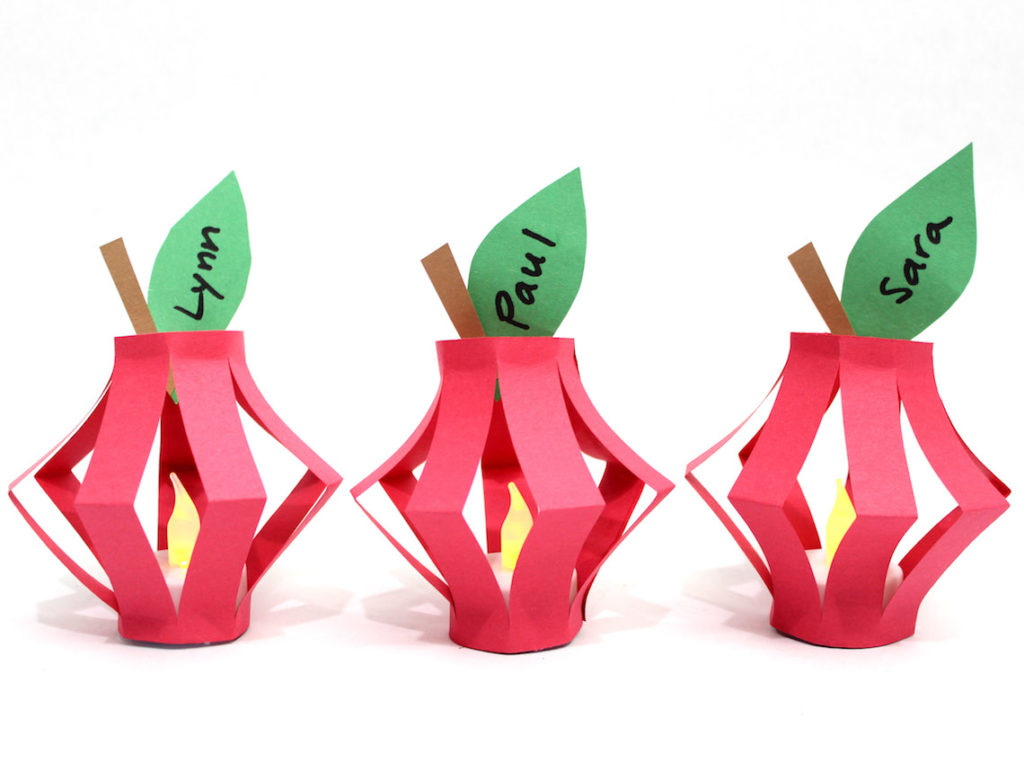
You’ll be the apple of everyone’s eye this Rosh Hashanah when you make these place cards for your holiday meal. So easy to make out of construction paper, they even hold battery-operated tea lights to add to the glow of the table. Sweet place cards, indeed.
What you’ll need:
– Red, green and brown construction paper
– Scissors
– Glue
– Battery-operated tea lights
– Pen
1.
Divide an 8 1/2-by-11-inch piece of red construction paper into four equal sections. Each section makes one apple lantern.
2.
Fold the paper lengthwise and give it a sharp crease with your fingers.
3.
With the folded edge facing you, cut seven equally spaced slits, leaving about a quarter of an inch at the end.
4.
With the slits running vertically, roll up the paper into a cylinder and overlap the edges, gluing them together.
5.
Slide the cylinder over a battery-operated tea light — it should fit perfectly — and press down on it so the sides push out.
6.
Cut a leaf shape out of green construction paper and write a name on it. Cut a stem out of brown paper. Glue them to the top of the apple.
Jonathan Fong is the author of “Walls That Wow,” “Flowers That Wow” and “Parties That Wow,” and host of “Style With a Smile” on YouTube. You can see more of his do-it-yourself projects at jonathanfongstyle.com.
Rachel Abraham died Aug. 4 at 90. Survived by daughters Jeannine, Sonia Wegge; son Shalome; 3 grandchildren; brother Aaron Sassoon; sister Tabby Joseph. Chevra Kadisha
Sol Altman died Aug. 10 at 88. Survived by wife Olga; daughter Lynn (John) Klena; sons Joel (Lisa), Paul (Jane); 6 grandchildren; brother David (Hui). Mount Sinai
Richard Angelini died Aug. 14 at 59. Survived by wife Christina; daughters Elizabeth, Kathryn (Michael) Olexiewicv; son Anthony. Hillside
Bea Wain Baruch died Aug. 19 at 100. Survived by daughter Bonnie (Mark) Barnes; son Wayne (Shelley). Mount Sinai
Linda Binder died Aug. 19 at 76. Survived by daughters Wendi (David) Wallerstein, Julee (Ken) Shapiro; son Bruce; 4 grandchildren; sister Jean Troyer. Mount Sinai
Arthur Brown died Aug. 7 at 96. Survived by daughter Sandra (John Dzus); son Gary; 2 grandchildren. Mount Sinai
Jacob Castroll died Aug. 11 at 67. Survived by wife Rody; daughters Lea (Curtis) Rookwood, Rica (Paul) Sutch; son Victor (Oria); 4 grandchildren. Mount Sinai
Shayne Coulter died Aug. 17 at 74. Survived by brother Morton. Hillside
Dorothy Franklin died Aug. 7 at 89. Survived by son Gregg (Jan); 1 grandchild. Mount Sinai
Steven Goldberg died Aug. 10 at 47. Survived by mother Gail Fisher; brother David (Lindsay). Mount Sinai
Richard Saul Greenberg died Aug. 13 at 68. Survived by sister Anne (Norman) Zaslow. Mount Sinai
Richard N. Gross died Aug. 8 at 88. Survived by wife Elaine; brother Theodore. Chevra Kadisha
Harry Gulack died Aug. 14 at 94. Survived by wife Dolores; son Jeffrey (Deborah); 3 grandchildren; 1 great-grandchild. Mount Sinai
Leona Hyams died Aug. 12 at 93. Survived by daughter Barbara; son Kenneth (Elaine). Mount Sinai
Mahin Kamran died Aug. 12 at 87. Survived by daughters Mehrzad (John) Hay, Debbie (Leon) Farahnik, Shahrzad Shamsi, Yasi (Sid) Molayem; 12 grandchildren; 10 great-grandchildren; brothers Mousa Soomkeh, Jamshid (Jacqueline) Soomkeh; sister Minou (David) Michlin. Mount Sinai
Arnold Kaplan died Aug. 11 at 91. Survived by sons Ronald (Cynthia Kaplan-Daniels), Daniel (Christi), Jack (Rena); daughter Roanne (Mike) Murphy; 6 grandchildren; 1 great grandchild. Mount Sinai
Natalie M. Kaye died Aug. 14 at 88. Survived by son Danny; daughter Lori Dumont; 3 grandchildren; 5 great-grandchildren. Mount Sinai
Daniel Jay Levy died Aug. 18 at 58. Survived by wife Sandra Manning Levy; daughters Madeline Charlotte, Chelsea Elizabeth.
Judith Lipton died Aug. 16 at 77. Survived by daughter Megan (Mario) Lipton-Inga; son Noah; 2 grandchildren. Hillside
June Loewy died Aug. 11 at 92. Survived by daughter Carolee Loewy Reed; sons Michael, Mardy; 4 grandchildren; 8 great-grandchildren; 4 great-great-grandchildren. Mount Sinai
Rosy Meiron died Aug. 17 at age 97. Survived by sons Dan (Beryl), Gad; 2 grandchildren. Mount Sinai
David Morris died Aug. 9 at 100. Survived by wife Lily Carden; daughter Beverley (Steven) Carden Miller; 1 grandchild. Mount Sinai
Meyer “Mike” Nadler died Aug. 9 at 98. Survived by daughters Joann (Michael) Schecter, Susan. Mount Sinai
Helen Perlmutter died Aug. 10 at 91. Survived by daughter Jane Diersing; son Daniel (Melodye) Warshauer. Mount Sinai
Burt Manheim Pressman died July 27 at 75. Survived by wife Ellen Kositchek Pressman; daughters Andrea (Greg) Cohen, Michelle (Ethan) Abrams; son Jeff (Jill); 7 grandchildren; brother Robert J. Kositchek Jr. Sinai Mortuary of Phoenix
Mary Tellez Rabin died Aug. 13 at 75. Survived by husband Allen. Mount Sinai
Charlotte Rokaw died Aug. 10 at 98. Survived by daughters Enid, Paula (Mel Levy), Irene (John Reese); 6 grandchildren; 6 great-grandchildren. Mount Sinai
Harriette Rosenstein died Aug. 10 at 78. Survived by husband Allen; daughter Cindy Garcia; son Stephen; 2 grandchildren; sisters Gail (Lloyd) Teran, Sandy Norian. Mount Sinai
Beverly Edyth Rubenstein died Aug. 13 at 89. Survived by daughter Randi; son Don (Vicki); 5 grandchildren. Mount Sinai
Henry Shaul died Aug. 19 at 85. Survived by wife Maureen; daughters Nicole (Billy) Burt, Leanne; son Stan (Stacy); 4 grandchildren; sister Hilda Sehayet. Mount Sinai
Naomi Shuman died Aug. 16 at 89. Survived by daughters Pamela (Kathleen Briley), Amy; 2 grandchildren; 2 great-grandchildren; brother Paul (Rose-Helene) Spreiregen. Hillside
Clifford Wolf died Aug. 15 at 98. Survived by daughter Stephanie (Benjamin) Morales; stepdaughter Wendy (Walter) Boror; son Michael; 2 grandchildren. Mount Sinai
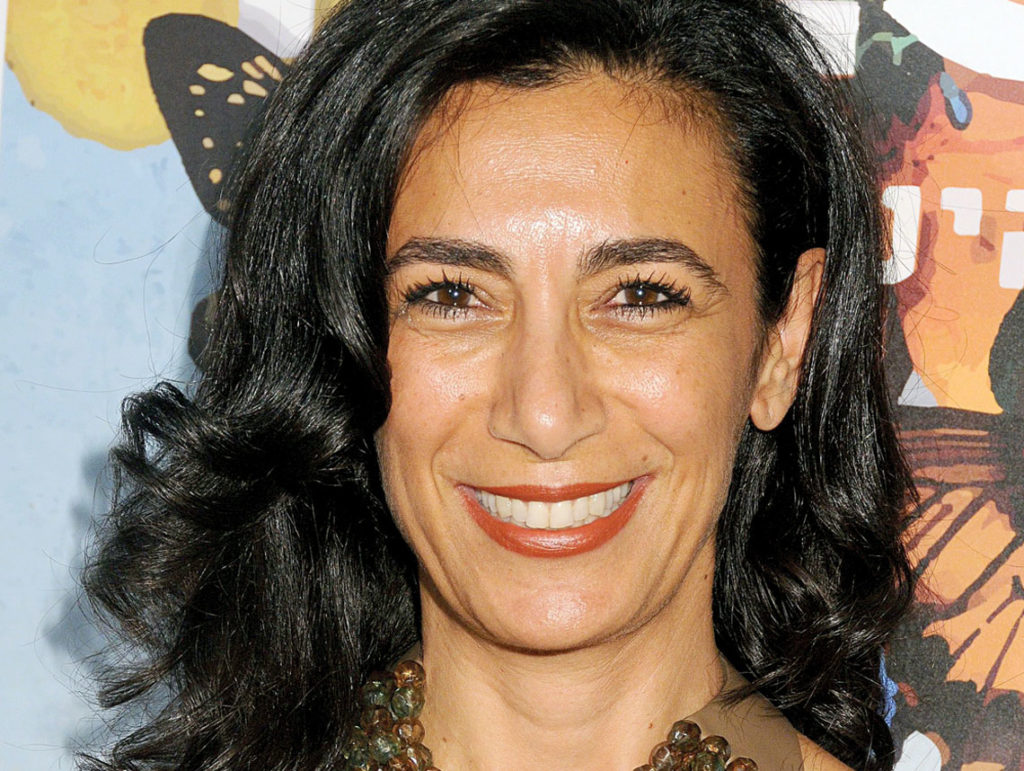
Sharon Nazarian was 10 when her family left Iran for the United States, fleeing a rising tide of Islamic fundamentalism. Growing up in Iran, she’d experienced anti-Semitism firsthand as a Jew in a country where Jews were second-class citizens.
As she assumes the post of senior vice president of international affairs for the Anti-Defamation League (ADL) — a new position in the organization — her job now is to fight for those experiencing anti-Semitism and racial hatred around the world.
By her own account, she’ll have plenty to do. In a conversation with the Journal on Sept. 6, her first day on the job, Nazarian said the forces of hatred are on the march around the world.
“It’s really a global phenomenon,” she said, “and the ADL has to look at it holistically and see where we can be most helpful to those who need us.”
After Nazarian’s family immigrated to Los Angeles in 1978, her father, Younes, built a fortune as an investor and made a name as a champion of pro-Israel causes. Sharon, now the president of the family’s charitable foundation, took up her father’s devotion to Israel, but went into academia rather than business, earning a doctorate in political science from USC. Later, at UCLA, she taught courses in political science and helped establish and lead the Younes and Soraya Nazarian Center for Israel Studies.
Nazarian serves on a number of charitable boards, including HIAS, formerly the Hebrew Immigrant Aid Society, and the UCLA Foundation. She also holds public policy posts with a focus on the Middle East; for instance, as a member of the Council on Foreign Relations.
During her interview, which has been edited for clarity and length here, she declined to provide a detailed view of her strategy at the ADL, because she said she had yet to learn the ins and outs of her new role, but spoke about her priorities and her views about the global environment in which the ADLworks.
Jewish Journal: What global trends are you keeping an eye on as you start your new role?
Sharon Nazarian: Europe has always been an important focus, but today probably more than ever. We’ve seen the shift not only in terms of anti-Semitism in Europe, but with population changes, with refugees, with changing sentiment toward refugees and immigrants. There’s much that ADL can help with, for the Jewish community and the broader community. We can partner with the Jewish communities in those countries to see how our mutual interests can be served.
We’ve seen changes in Venezuela and Argentina. There’s concern there for the Jewish communities that we’re keeping a close eye on. The International Affairs Division has been doing a great job, but at the same time, we have to continue to be very vigilant there.
JJ:We seem to hear almost daily about incidents of violent anti-Semitism in Europe. Is Jewish life there a lost cause or can ADL act to reverse that trend?
SN: ADL is doing a tremendous job of working with Jewish communities of Europe and seeing how we can be of support to them. We feel strongly that they know what’s best, they know what they need. Working in collaboration and partnership with the Jewish communities that are living their lives every day with great difficulty has been our [modus operandi] and we will continue.
The trends are very worrisome, but I think in a way it’s not unique to Europe, and it’s not unique to anti-Semitism. It’s part of social trends that we’re seeing and political trends we’re seeing toward minorities, toward multiple groups. You can see it in Russia. You can see it in Turkey. It’s really a global phenomenon. And the ADL has to look at it holistically, and see where we can be most helpful to those who need us.
JJ: Do you include America in that global trend of rising hatred?
SN: Charlottesville was definitely a wake-up call for all of us. I think ADL was already at the forefront of that, and it was probably no surprise to most of the professionals here at ADL.
I was glued to the television like the rest of us with horror and shock and dismay. I definitely don’t think we can sit back passively and think this is a blip. The vigilance that ADL brings to these global trends is exactly why I joined it.
JJ: The ADL has been vocal in its criticism of President Donald Trump. What do you say to those who feel it has become a partisan group?
SN: ADL’s hundred-year history speaks for the fact that it has always been nonpartisan and it has always spoken for groups who need protection. I won’t say more than that since it’s still Day One, but I think ADL’s actions speak for themselves. And those kind of criticisms, I would reject them.
JJ:How do you think your upbringing as a Jew in Iran affects your outlook at ADL?
SN: ADL’s mission is to protect minorities, and having been a minority in a Muslim majority country, hopefully that will inform me and the shape I give to our international affairs. I’ve spent a lot of time since then immersed in the Muslim world and the Arab world in my travels, in fact-finding missions. I traveled to Afghanistan, to Kabul, as a guest of the Department of Defense, and spending time there, looking at how our forces were helping train Afghani police, and the cultural barriers that existed. The fact that I could speak to the Afghani troops in Farsi — it was very fascinating.
JJ: Part of ADL’s mission is to support Israel, but it recently put out a statement criticizing the Israeli government’s rejection of an egalitarian prayer space at the Western Wall. When is it appropriate for ADL to criticize Israel?
SN: Israel obviously has a very special place in ADL’s heart and mind and our activities, and we protect Israel’s image around the world. When it comes down to specific policies, we will speak to ADL’s mission and priority and we’ll take it on a case-by-case basis. It is never our intention to distance ourselves from Israel. Our intention is to be a consistent voice for the mission of ADL, and that will take us where it takes us.
JJ:On the subject of Israel, where do you fall on the distinction between anti-Semitism and anti-Zionism. Can you be anti-Zionist without being anti-Semitic?
SN: For example, when the UC Regents passed the Statement of Principles Against Intolerance for the first time, I think, it nationally introduced the concept of some forms of anti-Zionist speech being anti-Semitic. That was a very important moment for us. I was thrilled as a leader of the Jewish community of Los Angeles that the UC took the stance that they took.
Often anti-Zionist speech and behavior is a cover for anti-Semitism. I am a political scientist and I do believe that we have to be nuanced about these matters to make sure that we don’t curtail free speech, that we don’t curtail criticism of policy.
There is a possibility of being very critical of Israeli policy without being an anti-Israeli. But to be a pure anti-Zionist — no, on that I would say it is a cover for anti-Semitism.
JJ: During the presidential campaign, Trump promised to cancel the nuclear agreement with Iran. Is the Iran deal on your radar as you start your new job?
SN: Iran is very much on our radar, whether the deal itself is or is not. What I’ll be more interested in is how Iran is treating its own minorities and its own vulnerable groups. I’ll be watching very closely as a former minority in Iran and now as a senior person at ADL who really cares about how vulnerable groups are treated everywhere in the world.
Sen. Bernie Sanders (I-Vt.) is sponsoring a September 19th briefing on Capitol Hill to highlight the cause of the Palestinian village, Susiya, which is designated for demolition by the Israeli Army, a Senate staffer confirmed to Jewish Insider.
While the briefing marks International Peace Day which is September 21, due to the Jewish holiday of Rosh Hashanah, it has been moved to the 19th to allow those celebrating to attend, according to a copy of the invitation. The organizer Rebuilding Alliance declined to publicize Sanders’ sponsorship in its invitation.
The California-based Rebuilding Alliance is slated to fly-in children from the West Bank villages of Susiya and Al-Aqaba along with Gaza. “It is our hope that upon hearing their presentation, members of Congress will personally make calls to the Israeli Embassy to express concern, stop the demolitions, recognize Palestinian planning rights, turn on the lights, and assure due process,” the event explains.
The Israeli Supreme Court ruled that Susiya is an illegally constructed outpost near Hebron and “are continuing to build in defiance of a court order.” Senator Dianne Feinstein (D-CA) has written multiple letters to Israeli Prime Minister Benjamin Netanyahu calling on Jerusalem not to demolish the contested village.
Earlier this year, Sanders was one of four Senators to send a letter to Secretary of State Rex Tillerson highlighting the case of Palestinian activist Issa Amro, who is charged by the Israeli military for obstructing soldiers. The Vermont lawmaker also delivered a harsh critique of Israel’s conduct in the 1948 war at the J Street conference last February. “Like our own country, the founding of Israel involved the displacement of hundreds of thousands of people already living there, the Palestinian people. Over 700,000 people were made refugees,” he said.
The September 19 briefing will be the second pro-Palestinian event on Capitol Hill this year. In June, Representative Mark Pocan (D-WI) sponsored an event titled: “50 Years of Israeli Military Occupation & Life for Palestinian Children.”