fbpx

September 13, 2017

The untold story of DACA’s Israeli recipients

Picture in your mind a “Dreamer,” an immigrant brought to the United States as a child and now living without documentation in this country. Chances are you’re not picturing an Israeli. But here in Los Angeles, young undocumented Jews from Israel are among those facing the looming threat of deportation.

President Donald Trump’s administration recently rescinded the Deferred Action for Childhood Arrivals program, known as DACA, with a six-month delay to provide time for Congress to plan a path for DACA recipients to gain permanent legal status. Whether that pronouncement sticks remains unclear. 

After a meeting with Democratic leaders and a swirl of messages out of the White House, some of them contradictory, Trump said on Sept. 14 he supports legislation to protect the Dreamers, and further consideration of a wall on the southern border would be done separately.

The policy was created during President Barack Obama’s administration in 2012 as a temporary reprieve to shield young undocumented immigrants from deportation. Trump’s Sept. 5 announcement has been roundly criticized by Democrats, many Republicans and Conservative, Reform and unaffiliated Jewish organizations.

There are an estimated 800,000 DACA recipients, the vast majority of them Latino, with 79 percent coming from Mexico. More than a quarter of the total live in California. At a Sept. 10 rally, hundreds of pro-immigration demonstrators gathered in Los Angeles’ MacArthur Park, many holding signs written in Spanish and waving Mexican flags.

Israel isn’t among the two dozen countries where most DACA recipients originate. But for various reasons — often having to do with fraudulent legal advice given to their parents — these young Jews are caught in a legal limbo, unable to receive federal student aid or travel outside the country.

While their status is identical to that of other Dreamers, they are different in subtle ways, as their individual stories suggest. For example, because the number of Latinos facing deportation is so much larger, they tend to feel more comfortable sharing their concerns and anxieties with one another.

Not so for Jewish Dreamers. For many, their status is an embarrassing stigma, something they would just as soon hide from even their closest friends. 

On the other hand, because Jews are often lighter-skinned than Latinos, they tend not to be subjected to the stares and derision from citizens who support the administration’s decision to eliminate DACA protections.

Furthermore, Jewish Dreamers tend to be better off financially than those from other countries, a distinction that provides securities — even if temporary — that others might not have.

In the end, however, all Dreamers are equal in the eyes of a government policy that would remove them unless a change is forthcoming from a Congress that is deeply divided on immigration issues.

Rep. Adam Schiff (D-Burbank), one of more than a dozen Jewish House members, is among those who favor continuing protections for all Dreamers, including those from Israel.

“The history of the Jewish people is characterized by migration in search of safety and a better future, and I believe our own experience teaches us to empathize with the Dreamers, although relatively few are Jewish or came here from places like Israel,” he said in an email to the Journal. “The administration would treat these young people as unwanted guests in the only country they know. But I view Dreamers as part of the fabric of our nation and believe Congress must act to ensure these young people can continue to live and work in the United States without fear.”

Below are stories of a few undocumented Israeli immigrants. They agreed to share details of their lives with the Journal under the condition that their last names not be used, and in some cases, that their first names be changed to protect their identities. Although the specifics of their cases differ, they share a feeling of being Americans first and foremost, and face an uncertain future.

‘I don’t even remember what Israel looks like’

Bar, a 16-year-old high school junior in the San Fernando Valley, has known for her entire life that she was undocumented.

“It did suck not to be able to go to Israel and visit when all my friends would go,” she said. “All my family is in Israel.”

A resident of Sherman Oaks, her parents arrived on a tourist visa in 2001, when she was 6 months old. Their visas expired a year after they arrived.

“We were hoping we could fix everything before becoming illegal. We had other people giving us suggestions and it was wrong … bad advice, and we didn’t have the money at that point to fix it,” her father, Ron, said.

Ron ran a clothing factory in downtown Los Angeles and insisted on manufacturing in the U.S. but had to shutter the facility because of the high cost of labor.

“We’re paying all the debts that society is asking to pay, and we’re getting zero benefit out of it,” he said.

“I’m from L.A. This is where I’ve lived my whole life. I don’t even remember what Israel looks like.” — Bar

Undocumented immigrants pay taxes but can’t collect benefits. He now runs a printing and packaging company that outsources to Mexico and China.

Bar’s mother, Karen, works for a catering business, serving and cooking food for weddings, bar and bat mitzvahs, and other big events.

Bar joined the DACA program late last year. Some of her friends know she’s undocumented and hope one day she’ll be able to join them on trips to Israel and Mexico. She took a driver education course and hopes to get a license soon but might need to apply for an AB 60 license, available for California residents regardless of immigration status, if her DACA status expires.

She’s been a member of the Tzofim movement (Israel’s scouts program) since seventh grade. Her younger sister and brother are scouts, too. They were born in the U.S. and are citizens.

Bar counsels younger kids in Tzofim. “They all tell me before summer starts, ‘We’re going to Israel,’ and I ask them how is that. Even the youngest kids tell me about their experiences in Israel and their family. I’m very excited to be able to go,” she said.

Bar works for a birthday party business where she paints little kids’ faces, dances with them and dresses up as characters from the popular Israeli children‘s show “Yuval Hamebulbal,” a dinosaur and a fire-fighting dog. After she graduates from high school, she expects to go to community college and transfer to a four-year university to study business and fashion design.

If the DACA program is canceled, putting her at risk of deportation, she said it would be “really, really upsetting.”

“I’m from L.A. This is where I’ve lived my whole life. I don’t even remember what Israel looks like,” she said.

‘This affects kids who are pretty much American in every way’

Eli grew up in Beverly Hills and describes himself as “a typical Persian-Jewish kid” in all ways but one: He’s in the country illegally. He was born in Tel Aviv and came here in 1991, when he was 8 years old. His parents overstayed their visa when their green card application was denied.

He earned a degree from UCLA, paying his tuition out of his own pocket, and hoped to go to law school but knew he wouldn’t be allowed to practice. He struggled for years with low-paying jobs.

“A soon as I got my DACA [status] in December 2013, three months later I got hired by a Fortune 500 company,” he said. “I knew I had the ability all along but I couldn’t prove it, because I didn’t have access to a real job.”

Now in his mid-30s, he owns his own business, offering “professional services” to corporate clients.

Outside of a small group of friends and his girlfriend, nobody knows about his status.

“I don’t want to jeopardize my business or do anything that can cause harm to that. In the Persian-Jewish community people talk, and I don’t want that information out,” he said.

Eli is a fitness enthusiast, spending hours a day at the gym training in Brazilian jiu jitsu. He considers himself a hard worker, a self-made entrepreneur, and can’t understand why people wouldn’t want him to be a citizen. After all, he said, he had no say in his parents’ decision to come to the U.S. and overstay their visa.

“You can’t blame somebody who didn’t commit the crime,” he said. “If you pull somebody over and their grandson is in the backseat, you don’t give the grandson in the backseat a ticket.”

He knows plenty of Iranian-American Jews who support Trump, and he doesn’t fault them for it.

“None of them go to KKK or neo-Nazi rallies or anti-immigration rallies. They’re pro-Trump mostly because of his pro-Israel stance, and they make good money and want tax breaks,” he said.

But he said he thinks a lot of them do have a racial bias.

“They look down on Mexican immigrants as low-skilled labor. They mow their lawn and garden their backyard and take care of their kids. … A lot of them probably think we should send them back to Mexico. They don’t understand this affects kids who are pretty much American in every way other than the fact that they don’t have their citizenship here, don’t have their green card.”

‘I’ll take my American education and I’ll go somewhere else’

Rebecca’s parents came to the U.S. when she was 12 years old. They planned to return to Israel after their B-2 tourist visa expired.

“When we got here, we started to feel like we wanted to stay here,” she said. They hired a lawyer who “ended up being a crook,” and their visa expired, she said.

Now 23, Rebecca has spent roughly half her life in the United States.

“My heart is in two different places. It’s hard every day to make the choice to be here. And it’s still a choice, despite all the inconveniences of being undocumented,” she said.

When she gained DACA status in 2012, “everything really changed.” The California Dream Act enabled her to receive state financial aid at UCLA, where she graduated with a double major in anthropology and Arabic.

While at UCLA, she participated in UndocuBruins, a research grant program for undocumented students and received funding to work with a South L.A. nonprofit that trains previously incarcerated people to work on urban farms in “food deserts.”

After she “decided that urban farming is really cool,” Rebecca completed a three-month fellowship at a Jewish community farm in Berkeley called Urban Adamah. Much like a kibbutz, the fellows live and farm together. This summer she worked as a garden educator at a Jewish summer camp in northern California and is now working with other UCLA grads at a startup nonprofit called COMPASS for Youth, which provides counseling for at-risk and homeless youth in Los Angeles.

Her undocumented status has inspired her to help others.

“I feel really blessed for that, because it’s opened my eyes and made me empathetic toward the stories of so many people that I wouldn’t have been able to empathize with beforehand,” she said.

“A lot of doors have been closed on me, and I had to push through a lot of doors. I got a lot of help [and] a lot of community support. … I’m grateful.”— Rebecca

While at UCLA, she was active at Hillel and in the Jewish community, but she had to navigate her place among the mostly Latino undocumented students and the feeling of guilt that accompanies a recognition of privilege.

“Ironically, my dad is also a construction worker, just like the dads of many of the undocumented folks that I know … [but] my dad’s been able to be more successful because he has resources, and he’s not Mexican, so he’s not looked at in a particular way. I look like a white person, so I don’t experience the sort of racist reality that comes with being undocumented in America.”

Rebecca’s mother is a self-published writer of poetry in Hebrew and English.

“A lot of [the poems] are about being away from home and being separated from her family. Her dad passed away while we were here, a few years into being here. So she wasn’t able to see him for the few last years of his life, and then not at his death, not at his funeral, and not now, many years later,” she said.

Rebecca was afraid of deportation, but becoming a DACA recipient “has given me breathing room,” she said. She’d rather move to Israel on her own terms than be deported, but hopes to stay here. She’s trying to make the world a better place in her own way.

“If America doesn’t want that, too bad,” she said. “I’ll take my American education and I’ll go somewhere else.”

Despite the fear that comes with being undocumented, “the immigrant experience is the best thing that’s ever happened to me,” she said.

“I was totally uprooted and I had to cope, and assimilated to something that was 100 percent foreign to me. And that was really hard,” she added. “A lot of doors have been closed on me, and I had to push through a lot of doors. I got a lot of help [and] a lot of community support. … I’m grateful.”

‘The dreams come true here’

In the heart of affluent Beverly Hills, 17-year-old Jason harbors a secret. His family came from Israel when he was 5, and someone posing as a lawyer botched their citizenship applications and disappeared. Their work permits expired, and now Jason, his parents, and his younger brother live in the shadows.

His friends don’t know. Neither did his girlfriend, whom he considered marrying in order to gain a path to legal status. His parents actually pressured him to propose even though he knew “she would freak out, like, big time” if she found out he was undocumented.

Jason became a DACA recipient in 2015.

“I had no idea what it was,” he said. In fact, until that point, his parents hadn’t told him or his younger brother about their immigration status.

“They didn’t know we were illegal because we didn’t want them to talk to their friends,” his father, Avi, said. “Only when the DACA program came out, after talking to Neil [Sheff, their immigration lawyer], only then we told the kids.”

Jason plays guitar and plans to enroll in a music program after graduating from Beverly Hills High School. But his immigration status has complicated his plans.

“I do want to travel at some point, and if I’m not documented I can’t do that,” he said.

Returning to Israel is not an option, his parents say.

“I have nothing to do in Israel,” his mother, Ravital, said. “It’s hard to live there. Here, it’s an easier life. The dreams come true here.”

Daniel, their 13-year-old son, wants to be an actor. Because he’s too young to gain DACA status, he can’t get a work permit and audition for roles.

“Now that [Trump] canceled it, it’s a lot harder. It’s impossible, unless I get married to an American girl,” Daniel said with a laugh.

Ravital owns a skin care company, and Avi works in software development. “We do everything by the book, and we find a way to pay taxes on time,” Ravital said.

“We probably pay more taxes than Trump,” Avi added.

Many of their Israeli and Orthodox Jewish friends are Trump supporters, and they fear social alienation if their immigration status is discovered. “Before you called, we closed all the windows around the house,” Avi admitted. “The stigma of people who are illegal here is very bad.”

‘Remember the stranger and the foreigner in your land’

There’s a disconnect between Jews and undocumented immigrants, says Beverly Hills immigration attorney Neil Sheff, who speaks Hebrew and Spanish fluently. About half of his clients are Israeli, and he hears a lot of rhetoric against immigration reform from his fellow Jews, even those born in other countries.

“Their responses are usually, ‘We came here the legal way.’ When many of the Jewish immigrants came here, the immigration laws were so relaxed and the process was so much easier, everyone could come here the legal way,” he said.

“Their plight isn’t really acknowledged by the greater Jewish community, especially the Orthodox Jewish community.” – Neil Sheff

Sheff believes there are many Israelis living in L.A. without documentation, as well as Jews from South Africa, Russia and an increasing number from France, looking to escape their country’s rising tide of anti-Semitism.

“Their plight isn’t really acknowledged by the greater Jewish community, especially the Orthodox Jewish community,” which supports Trump because they consider him to be pro-Israel, Sheff said.

The Torah extolls Jews 36 times to treat strangers well, “for you were strangers in the land of Egypt” (Exodus 22:21).

“It’s part and parcel of who we are as Jews to remember the stranger and the foreigner in your land,” Sheff said. “That should translate immediately to empathy for the immigrants here, whether they are immigrants who have been here for generations or just arrived.”

The untold story of DACA’s Israeli recipients Read More »

Cornell and Israel’s Technion institute open high-tech campus in NY

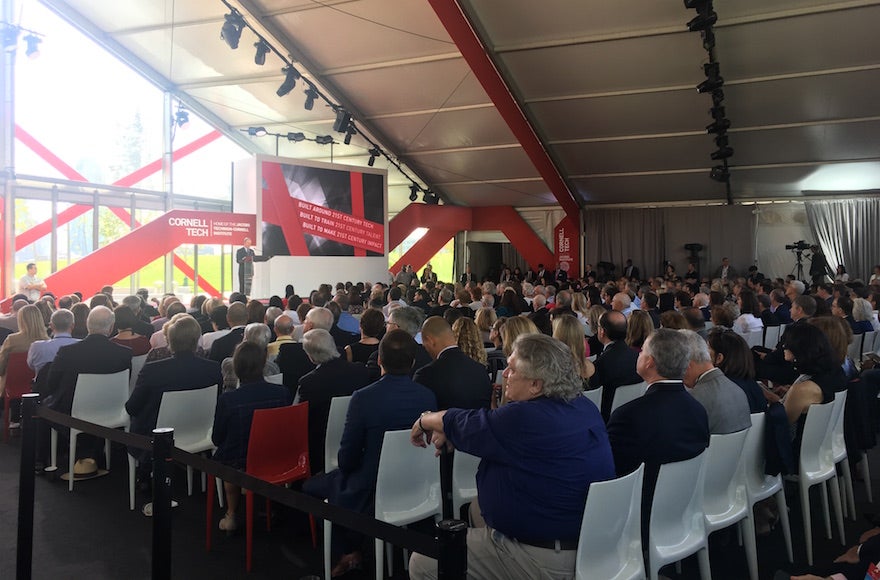
A high-tech teaching and research center born of a collaboration between Cornell University and the Technion-Israel Institute of Technology inaugurated its newly built campus on Roosevelt Island.

Over 500 people were present for the inauguration Wednesday morning of Cornell Tech and the Jacobs Technion-Cornell Institute, including Mayor Bill de Blasio, Gov. Andrew Cuomo, former Mayor Michael Bloomberg, Cornell University President Martha Pollack and Technion Institute President Peretz Lavie.

“Today we take a bold step in the tech arena with the opening of this campus,” Cuomo said prior to the ribbon-cutting ceremony. “It’s ambitious — it was almost an audacious dream when we started.”

De Blasio joked, addressing the Technion president, “In New York, Peretz, we would say this is a mitzvah.”

Bloomberg, who conceived of the $2 billion project when he was mayor and donated $100 million to it, said Cornell Tech would help re-establish New York as a technological center.

“In many ways, this project helps bring New York City back to the future,” he said, citing various technological features of the campus, such as the goal to make the main academic center one of the largest net-zero energy buildings in the world.

In 2010, Bloomberg invited top universities to submit pitches to build the campus. The winners would receive both funding and land on Roosevelt Island, a two-mile long island on the East River. In 2011, the city declared Cornell and the Technion winners, and the project opened the following year, operating out of a temporary location in Manhattan’s Chelsea neighborhood.

Former Mayor Michael Bloomberg speaking at the opening of Cornell Tech, a collaboration between Cornell University and the Technion — Israel Institute of Technology, on New York’s Roosevelt Island, Sep. 13, 2017. (Josefin Dolsten)

Cornell Tech will offer master’s and doctoral programs in fields related to technology, computer science and engineering.

De Blasio echoed Cuomo’s vision of the campus, which he said, “says to people that we will be forever a global center of technology and innovation.”

Lavie recalled thinking the Israeli institute had a slim chance of winning the bid.

“Since we have such a slim chance of winning — be wild,” he recalled telling Technion staff. “Use your imagination, think outside the box.”

Lavie referenced Cornell University’s founder in showing how Israeli startup culture plays into Cornell Tech’s technology focus.

“With this campus, Cornell and Technion are making a clear statement: practical knowledge, to paraphrase Ezra Cornell, is not inferior nor second to basic knowledge,” he said. “They are the two sides of the same coin. This concept is part of the Technion’s DNA and more broadly the State of Israel, which is known as startup nation.”

Cornell and Israel’s Technion institute open high-tech campus in NY Read More »

Letters to the Editor: DACA, Rob Eshman and shakshuka

President Obama, Congress and DACA

Rob Eshman’s column was not wrong, but it was not right either (“Replacement Theology,” Sept. 8). The problem is, an executive order, in this case, is not the law. I keep hearing — for years — that this is a country of laws. The problem is, the creation of the law is still the responsibility of Congress. President Barack Obama created the executive order [Deferred Action for Childhood Arrivals] because Congress was unable to agree on developing the immigration legislation to give to the president to sign. Congress did not do its job. Perhaps, under this new deadline pressure, some will see the wisdom in the reasoning and change their vote and finally pass a comprehensive immigration bill. Or at least pass legislation to protect the so-called “Dreamers.”

Gary M. Barnbaum, Woodland Hills

A Park’s Place in History — and Today

I teach a class on the Holocaust to middle school students, so I was fascinated to learn more about the history of German Americans in Los Angeles in the story “La Crescenta Park’s Nazi Ties Reflected in New Historical Marker” (Aug. 24). I am looking forward to sharing this history with my students, and even wondered if it would be worth a class field trip to the park, so I decided to check it out.

On that day (Sunday, Sept. 3), the fires were still blazing in La Tuna Canyon and I could see the smoke and flames as I headed deeper into the hills.

When I finally arrived at Crescenta Valley Community Regional Park, I was shocked to discover that the park had been transformed into a staging area for the rescue efforts that were happening in the hills immediately behind the park. People were handing out cold drinks and food, cheering for the firefighters, and providing shelter for anyone displaced.

I felt a little silly, chasing after a park sign amid these critically important rescue efforts, but in the end, the whole experience was made even more poignant by the juxtaposition of these two stories. Today, we are blessed to see good people being activated to help others at a time of crisis. Thank you, Jewish Journal, for keeping us informed and reminding us to make positive choices for ourselves and for others every day.

Nili Isenberg, Los Angeles

Faiths Evolving in the Modern Age

Recognizing that the Journal has primarily a Jewish readership and that Rabbi David Wolpe would not presume to offer opinions regarding other religions, the fact remains that his final paragraph applies to all other religions as well (“Technology and the Age of Broken Tablets,” Sept. 8). It is not only “the Torah that must be both adopted and adapted to this new world” of brutally confusing and fast-changing technology.

So must the New Testament, the Quran and the holy scriptures of the Buddhists, the Hindus, the Mormons and all the other God-based religions and secular beliefs — including capitalism.

To those who refuse to do so, please get out of the way. 

Jerry Beigel via email

Temple Membership and Its Leadership

Rabbi Michael Barclay’s story on membership truly disturbed me (“It’s Time to Put Aside Politics and Unite as Jews,” Sept. 8).

It seems to me that both Barclay and the congregant he mentions in his story have confused political action and talk with humanitarian action and talk. Bringing Jews closer to God and Torah means having compassion for your fellow human beings. It is incumbent upon the spiritual leader of a congregation to remind us what that means.

Norma Roberts via email

Parting Words for Journal’s Rob Eshman

I was almost sad to read that you [Rob Eshman] are leaving the Journal (Moving and Shaking,” Sept. 8). Now where will I find such an excellent intellectual sparring partner? Someone to challenge my point of view and make sure I do not succumb to one-dimensional thinking? I did discover in a recent issue of the Journal that you are married to an incredibly wonderful woman, so it’s obvious that you got one of the most important things right. But, no, I am not sad because I wish you the best of luck in your new endeavors.

Perhaps along the way, you will learn what Rabbi Ari Segal taught us in the Torah Portion (“Stand Our Ground But Build Bridges,” Sept. 1) to “go to great lengths to ‘have love in [your] heart’ … for even [your] most wicked of enemies”; and as Rabbi Dov Fischer taught us in the Aug. 4 Torah Portion, “To acquire cognition that many things that initially seem to be awful setbacks often … emerge later as having been among the greatest of blessings … ” (“Hear O Israel: The Shema’s Centrality”).

Do us proud!

Warren Scheinin, Redondo Beach

There is so much winning!

President Donald Trump’s agenda has advanced despite holdouts and setbacks in Washington, D.C. — sometimes from his own Republican caucus. Trump is achieving great things for this country and its citizenry, Jews and gentiles.

Then I found out that Editor-in-Chief Rob Eshman is leaving the Journal.

Even better news!

His hateful, slanted diatribes against our president in particular and conservatives in general were nothing but Fake News.

Arthur Christopher Schaper via email

A Proposal to Solve the North Korean Problem

An open letter to the president of the United States, Donald Trump, the commander-in-chief of the American military:

I have a wish, that you will publicly announce in a fatherly tone, succinctly so there will be no misunderstanding, that if the North Korean leader agrees to stop atomic weapons developments, you will pull all U.S. soldiers out of South Korea. Then, invite the leader to the White House.

This act in South Korea will not be viewed as a capitulation, but a monumental moment in history. You will be viewed as the No. 1 president; the United States as the No. 1 country.

I am 90 years old and I am a survivor of Auschwitz Birkenau and the death march to Dachau and Muhldorf. I am a three-war veteran in the Israeli army (1956, ’67 and ’73). I came to the United States in 1974 and am a proud father and grandfather. God Bless America.

Joshua Kaufman via email

Third Alternative for Stained Shirt

I like your column, David Suissa, (“Can a Shakshuka Stain Kill You?,” Sept. 8.) but not your two options when you write “Should I go back home and change my shirt or should I go straight to the office …?” You really always have a third option: Go to a store and buy a shirt.  

Avi Wacht via email

Letters to the Editor: DACA, Rob Eshman and shakshuka Read More »

Bold paintings for a ‘Brazen’ age

Artist Kimberly Brooks named her new show of recent oil paintings “Brazen” because of the political climate after last year’s presidential election. You won’t find overt political references in the exhibition at Zevitas Marcus Gallery in Los Angeles, but bold colors and forms tie together the abstract paintings.

“I called it ‘Brazen’ because I started making it right after the inauguration, and I felt like that was the mood of the country and the world,” she said. “Even if I wasn’t painting a specific subject in a literal way that reflected that mood, that was my feeling as I approached the work.”

“Brazen” takes cues from art history, specifically German paintings from the 18th century, which she encountered on a recent trip to Sanssouci, the summer palace of Frederick the Great, King of Prussia, in Potsdam, outside Berlin.

“The grandiosity of the way that they showed art, the palaces that they built, and what art represented in and of itself, struck me as brazen. And so a lot of the themes from the show and even some of the imagery are taken from the interiors of those palaces,” she said.

For example, “Museum Wall” shows an abstracted wall of paintings, and “Talitha” shows a woman with a Joan of Arc-style haircut and a long-necked patterned shirt, her features blurred and a cloud sitting over her shoulder, centered within an oval frame.

Brooks’ work addresses themes of family, memory, history and feminine identity. Her paintings have reflected her experiences and the people she has known. She often works from photographs, but her paintings are not photorealism.

Her 2007 solo show, “Mom’s Friends,” depicted her mother and her mother’s friends in Marin County in the late 1970s as they searched for identities outside their husbands and families. They stare confidently back at the viewer, although underlying their assured gaze is a hint of insecurity. She based the paintings on decades-old photographs, and had friends and models re-enact the photos while wearing vintage clothes. Brooks was at the time experiencing this act of emulation herself as the mother of a young girl and was thinking about how female identity is passed down through generations.

She continued to explore deeply personal subjects in her 2008 show “Technicolor Summer,” which uses sweeping California landscapes as a backdrop for portraits of a family grappling with illness and the closeness of death.

Her focus on the female subject continued with her 2010 show “The Stylist Project,” a series of portraits of renowned stylists and fashion industry insiders. These trend-makers designed the costumes for TV shows, supermodels and pop stars. Brooks had them dress themselves and pose for her, in a manner similar to Renaissance portrait artists.

Her portraits continued to move from representation toward abstraction with “Thread” in 2011 and “I Notice People Disappear” in 2014, series in which her portraits of beautiful, well-dressed subjects take on a dreamlike tone, and their faces became blurred and distorted in the style of Francis Bacon. In these series, Brooks said, “it became less about the people and more about the tracers that they left behind.”

“They’re sort of hollow vessels of suggestions of people,” she said. “You feel the people there but there’s no people.”

Over time, the colors of her paintings have softened. Earlier works used garish shades of green, blue and pink, lending the works a surreal, almost nightmarish quality. The pieces in “Brazen” share a similar color palette: muted tones of teal, peach and gray, and adornments of silver and gold leaf.

Brooks was born Kimberly Shlain in New York and grew up in Mill Valley, Calif. She studied literature at UC Berkeley and later studied painting at UCLA and Otis College of Art and Design, where she now teaches painting. She’s married to the actor Albert Brooks, and they have two teenage children, Jacob and Claire.

There is a subconscious searching at the heart of Brooks’ paintings. Sometimes, she says, she doesn’t realize what she was searching for until long after the paintings have come down from the gallery walls. In the case of “I Notice People Disappear,” she was coming to terms with the 2009 death of her father, Leonard Shlain, a surgeon and author, who had inspired her to pursue painting.

Brooks’ search for identity also has taken the form of reconnecting with long-lost family members. She traveled to Israel with her children this past spring to meet relatives who were descendants of Holocaust survivors. “We ended up finding that we have a huge amount of family in Israel and South Africa that we didn’t even know,” she said. The reunion “was really amazing.”

On her Instagram feed, Brooks recently posted a quote from novelist Jonathan Safran Foer, taken from an interview in The Guardian: “The art of the creative process is not seeking and finding, it’s bumbling.”

The quote speaks to her own process as an artist. “So much of discovery is not about being a heat-seeking missile and saying ‘I know what I want to find,’ ” she said. “I think the creative process is all about being willing to risk wasting time.”

That process includes being willing to discard paintings that don’t measure up when preparing for an exhibition.

“When I have to decide which paintings are going to be in the gallery, I form a triage unit in my studio. I divide the paintings into three categories: rock stars, orphans and rescue missions. So the rock stars are definitely making the show, and orphans are definitely not making it in the show. And then the rescue mission is where I hang the painting and I have to say, ‘Can this patient be saved?’ ”

“Brazen,” a solo exhibition of oil paintings by Kimberly Brooks, is on display through Oct. 28 at Zevitas Marcus Gallery, 2754 S. La Cienega Blvd., Los Angeles.

Photo of Kimberly Brooks in her studio by Stefanie Keenan.

Bold paintings for a ‘Brazen’ age Read More »

Getty features Jewish photographers in Argentina exhibition

During her long life, Grete Stern was recognized as an influential force in 20th century photography, not just in Argentina — where she lived for 64 years — but also internationally. She was founding director of the photography section of the Argentine Museum of Fine Arts, and her ideas and techniques helped shape several generations of South American photographers. Her work has been exhibited in many museums, including New York’s Museum of Modern Art, a 2015 show that received a glowing review in The New Yorker.

Stern (1904-99) was born in Germany and educated at the Bauhaus, the legendary German art institute that flourished between the world wars. Aware of the danger she faced as a Jew in Europe, she immigrated to Argentina in 1935. Once there, Stern didn’t wait long to make her mark. Two months after arriving, she exhibited her groundbreaking photos at the offices of a magazine whose art critic wrote that Stern had established photography as a genuine art form in Argentina. 

Stern is perhaps the most prominent among the Argentine-Jewish photographers whose work is included in an exhibit opening Sept. 16 at The Getty Center — “Photography in Argentina, 1850-2010: Contradiction and Continuity.” It’s a massive show, comprising nearly 300 photographs by 60 Argentine artists, from the dawn of photography to contemporary work. 

Two of the show’s sections, “Civilization and Barbarism” and “National Myths,” explore the gap between Buenos Aires, a city with handsome buildings and a population largely of European background, and the provinces, with their poorer and much larger indigenous population. The first two parts of the exhibit also delve into the contrast between Argentines’ iconic self-images — the gaucho, Evita and Buenos Aires as the sophisticated Paris of the Southern Hemisphere — and the realities behind their myths.

A third section, “Aesthetic and Political Gestures,” shows photographers’ responses to the turbulent second half of the 20th century, which included a Dirty War during which more than 30,000 people were “disappeared” — killed — by a military junta, as well as periodic blips of economic and political turmoil.

A fourth part, “New Democracy to Present Day,” deals with the period after the restoration of democracy in 1983 and how the works of Argentine photographers have been at least as cutting-edge as the creations from artistically related movements in Europe and North America.

“Tape Project: Sidewalk” by Jaime Davidovich (1972). Courtesy of the J. Paul Getty Museum, Los Angeles


Two other Jewish photographers in the exhibit, Jaime Davidovich and Osvaldo Romberg, were at the forefront of these avant-garde trends.

Judith Keller, senior curator of photographs at the Getty Museum and co-curator of the Argentine photography exhibit, said that Romberg and Davidovich “came out of the 1960s movement of conceptual art.” Conceptual photography is when a picture is built or posed to give visual form to an idea or concept. “The purpose of using photography this way is to point out aspects of life that are normally ignored or considered too mundane for art,” she said.

Keller said that Davidovich, who died last year at 79, was well-known for his experimental work in video, film and TV. “We hope that by exhibiting some of his photographic work, he will become better known for his photography,” she said. “He was commissioned fairly often in the 1970s to do installation art, which was becoming a new practice at that time. … What we’re exhibiting in our show are … black-and-white images of these installations.”

Davidovich’s photos are of typical sidewalks, but with white adhesive tape placed on them to create a cityscape different from what we normally see, thus challenging the viewer to look at everyday scenes as artistic installations.

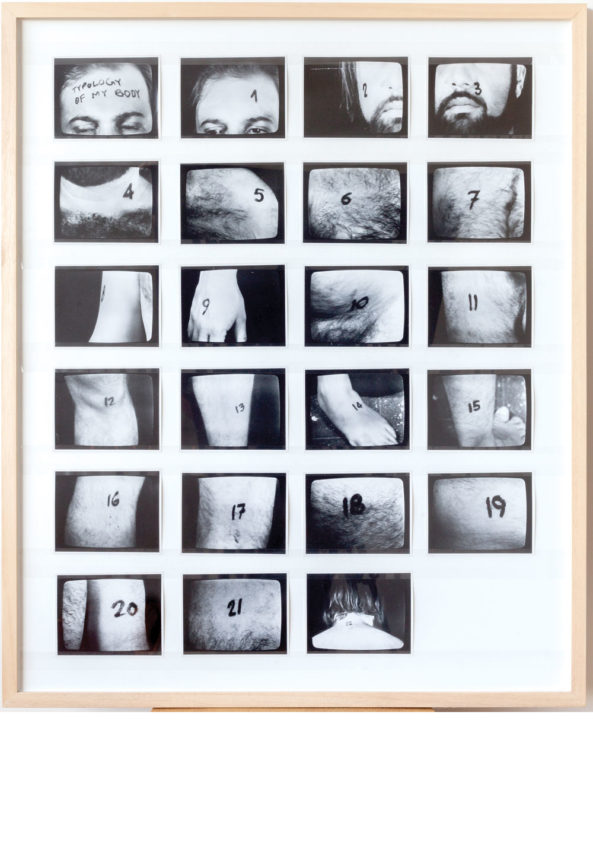
In contrast, Romberg, still artistically active at 79, creates multiple images of himself — bearded, paunchy, decidedly not a model — that ask us to look at a normal human body in a matter-of-fact manner.

“Typology of My Body” by Osvaldo Romberg (1974). Photo by Javier Agustin Rojas

Each of Romberg’s works in the exhibition consists of anywhere from three to 20 or more small photos, each showing an individual body part (neck, foot, elbow, etc.) marked with a large black number. By deconstructing the body into separate elements, the presentation smacks of a forensic display, or perhaps an odd jigsaw puzzle whose parts make a whole human.

Jews first immigrated to Argentina in the late 19th century and at first many lived and worked on farming colonies far from Buenos Aires. The old joke among Argentine Jews was that those colonists planted corn and soybeans but harvested doctors and lawyers. While there is some truth in that, subsequent generations of Argentine Jews — whether descended from farm colonists or later arrivals — have also yielded large crops of artists, writers, actors, musicians, dancers and filmmakers who have made impressive contributions to the vigorous Argentine arts scene.

Asked if any works in the show directly reflected Jewish life in Argentina, Idurre Alonso, associate curator of Latin American collections at the Getty Research Institute and the show’s co-curator, mentioned one in particular: “At the beginning of the show, the early photos, when we’re addressing the role of immigration, there’s one late 19th- or early 20th-century photo that portrays a Jewish family. That, I think, is the only clear reference to that in the show.”

“For the most part,” she said, “Argentine Jews are so blended in the community that I don’t think you can say about any of the Jewish photographers that their work in this show focuses on their being Jewish. Their work contributed to whatever artistic movement they were a part of.”

That blending-in was certainly the case with Davidovich and Romberg. And even though Stern went to Argentina to get away from the Nazis, the content of her art is not overtly Jewish either.

Stern’s life, it should be noted, had its share of pain. Her son committed suicide when he was 25; her daughter left Argentina during the Dirty War in the 1970s; and Stern herself suffered from lifelong depression. Yet, through it all she continued to produce an enormous amount of work, and was a mentor and inspiration for Argentina’s creative community for more than 60 years.

Stern’s photos in the Getty exhibit are not the surrealistic, subversively feminist photomontages of the New York MoMA exhibit, but rather the extremely moving documentary photos she took in the 1960s of indigenous people living in the Argentine countryside, far from Buenos Aires. With Stern’s ability to catch a fleeting moment that’s unassuming yet iconic, her subjects look quietly dignified as they go about their grueling, hard-scrabble lives.

Given the political madness and family tragedies she lived through, and the struggles she faced in establishing herself — as a Jew, an immigrant and a woman — quiet dignity is an attitude with which Stern probably identified.

“Photography in Argentina, 1850-2010: Contradiction and Continuity” runs from Sept. 16 to Jan. 28. It is part of the communitywide Pacific Standard Time: LA/LA, an exploration of Latin American and Latino art in dialogue with Southern California, organized and funded by the Getty Foundation.

Getty features Jewish photographers in Argentina exhibition Read More »

Say bonjour to new Jewish French Community Center

Someone walking into the grand opening of the Jewish French Community Center in Pico-Robertson on Sept. 7 could have easily mistaken the celebration for a Kiddush at a long-established synagogue.

A shirt-and-slacks crowd made a l’chaim over Tunisian fig brandy. Small children scurried around the partition separating men and women, surveying the territory. A gaggle of trend-conscious 20-somethings — were they flirting or just speaking French? — hovered near the food table. The rabbi imparted lessons from the Book. And a beaming volunteer circled with an email sign-up sheet. Bien-venue chez vous, it read — Welcome to your home.

Rabbi Tal Perez, who founded the center, said he wants to foster a unified Jewish community for a booming population of French transplants on the Westside. To that effect, he is launching a congregation, a Jewish learning institute and a Hebrew school, all at the same 1100 S. Beverly Drive address.

The crowd of about 50 at the grand opening — most of them men wearing head coverings — was a cross-section of the community Perez wants to develop: involved in Jewish life, if not necessarily observant; skewing young; and as a group, growing rapidly. For the people there, the space showed promise as a home away from homeland.

“It’s been missed,” said Ben Guez, 28, who moved to Los Angeles from Paris six years ago. “For young people, it’s not like in France, where we like to go to shul for Shabbat [because] we know we’re going to see our friends. Here, young people don’t go to shul. And I hope a center like this will bring people back.”

Guez is part of a wave of Jews who have migrated from France after several high-profile anti-Semitic attacks there in the past decade. Thousands of Parisians moving to Israel in the past few years have driven the growth of cities such as Ashdod and Netanya. The ones who come to the United States end up in Miami or Los Angeles.

Perez, a Paris native, said it seems like every week he hears about a new French-Jewish family that has arrived in Los Angeles. No exact numbers on those immigrants are available, partly because there is no organization to accept and integrate them.

The Jewish French Community Center does not figure to formally assume that role. Perez, who is a certified mohel, sofer (scribe) and dayan beit din (judge of Jewish court), envisions the center serving all of the functions of a community shul, rather than a federation.

As French Jews have poured into Los Angeles, they have stuck together, clustering at the Pinto Center on Pico Boulevard and Baba Sale Congregation on Fairfax Avenue. Perez said that while the center will have Shabbat services, he wants it to complement those shuls rather than compete with them.

“French people have a special mentality,” Perez said. “They are always together. They integrate [with the local community], but they need family — to be surrounded with French people.”

Perez came to Irvine in 2012 from Israel, where he had studied under Ovadia Yosef, the late Sephardic chief rabbi of Israel. After a stint leading a Sephardic minyan in Irvine, Perez looked for a congregation to lead in Los Angeles.

In the meantime, he developed a loyal audience, teaching all over Southern California. His following helped get the community center project off the ground.

“He’s one of the smartest people walking the streets of L.A.,” said Josh Golcheh, 27, a real estate developer who also does Jewish outreach in Los Angeles. “He has the highest credentials, but he’s so modest and he’s so humble, he doesn’t boast about it.”

The 15-minute exegesis of the week’s Torah portion that Perez delivered in French during the ceremony was typical of his energetic style, according to people who could understand what the rabbi was saying.

Although some people in the crowd were not Sabbath observant in the way American Jews might typically define it, French Jews generally follow the Orthodox tradition. A nonobservant French Jew might not go to services every week, and when he does, he might drive to get there. But he won’t be looking for a place with mixed seating in the gallery.

Perez said kiruv — bringing people closer to the faith — is one of the Center’s missions — “But in a different way,” he added. “To awaken in people the curiosity, through learning, to know more and more who we are.” Thus, education is the main focus of the center, with the rabbi leading classes every weekday for adults. “The worship is secondary,” he said.

Still, the center’s millennial cohort saw the programming as a beacon of social opportunity.

“It’s a way to meet people we don’t know, from a community we don’t get to see often,” said Aurelie Banoun, 24, who immigrated from France three years ago.

Just a stone’s throw away from Pico Boulevard, where a shul construction boom has turned a 10-block stretch into Synagogue Strip, the center’s second-floor study hall is a humble space in what used to be a real estate broker’s office. It’s about as big as a dive bar, and no more baroque.

The building has no formally dedicated banquet halls or sponsored staircases, which Perez said is in line with the inclusive ethos he wants to build in the community — although he acknowledged that a few major donors bankrolled the project.

Although the center targets a French-speaking population — most from France and others from French-speaking countries such as Tunisia and Morocco — the rabbi insisted that it is open to everyone. There is no membership fee, according to a center volunteer, and the center won’t be auctioning off aliyot (although congregants can use the honors as an opportunity to donate). The Hebrew school, called Talmud Torah, which has 15 students enrolled from ages 7 to 13, is priced to be affordable.

But Perez will deliver his sermons in French.

Dean Hattab, who moved to Los Angeles from Paris earlier this month to pursue a career in the music industry, is still searching for a place to live. But he was pleased to discover the social scene at the center.

“Everything in the Jewish community is all about family,” Hattab said. “It’s about helping each other, and finding this here, it’s reassuring.”

Say bonjour to new Jewish French Community Center Read More »

Organizers hope solidarity march starts annual interfaith tradition

Just as Jim Kaufman, emeritus rabbi at Temple Beth Hillel in Valley Village, started to speak at Our Lady of Grace Roman Catholic Church in Encino, the starting point of the first-ever San Fernando Valley Interfaith Solidarity March, an emergency alarm sounded.

So much for the opening inspirational talk.

Eventually, march organizers decided it was time for the 500 or so participants who braved triple-digit heat to get walking along the 2 1/2-mile route that would take them to Temple Judea in Tarzana and, finally, the Islamic Center of Reseda.

Forty minutes later, during a welcome stop at air-conditioned Temple Judea, Kaufman tried again.

“As I was saying…”

And, of course, everyone laughed.

The Sept. 10 event was organized by Soraya Deen, a Muslim attorney, motivational speaker and interfaith workshop leader; and Marsha Novak, a Jewish interfaith community activist. According to organizers, the goals of the march were to foster respect for all religions and to reject hate, bigotry, religious intolerance and anti-immigrant prejudice.

The peaceful marchers made up a wide variety of ages, races and faiths, and spoke several different languages. They carried banners that called for love, unity and compassion: “We Are the Caring Majority,” “We Are Not Powerless Against Hatred,” “There’s Only One Humanity.” One man wore a long, blue sash with embossed emblems of many religions over his shoulders.

At several religious institutions the marchers passed, volunteers handed them bottles of cold water. Speakers at the church, the shul and the mosque — including several rabbis, imams, priests, ministers, politicians and community activists — talked about what people have in common rather than what divides them.

Kristen Stangas, communication coordinator for the Islamic Center of Southern California, was the event’s emcee and an energetic fireball. “Diversity is what makes American great!” she proclaimed.

Temple Judea Senior Rabbi Joshua M. Aaronson told the group: “I believe that when you speak against Islam, you are anti-Semitic. I believe that when you are anti-Christian, you are anti-Semitic. If you are prejudiced against people because of the color of their skin or because of their country of origin, you are anti-Semitic. For there is no one who is against Islam or Christianity or Mexicans who is somehow for Jews.”

Other speakers included Los Angeles City Councilman Bob Blumenfield, who represents parts of the San Fernando Valley; and Henry Stern, Democratic state senator for the 27th District, which includes parts of Los Angeles and Ventura counties. 

Jewish groups among the march’s 65 co-sponsors included Temple Judea, Temple Beth Hillel, Adat Ari El, Temple Aliyah, Temple Kol Tikvah, Temple Ahavat Shalom, the Anti-Defamation League and Hebrew Union College-Jewish Institute of Religion.

Herding hundreds of people on a trek through Valley streets was not an easy task, but the event was managed efficiently. A bullhorn-toting volunteer on a truck encouraged the marchers to drink lots of water, against an amplified soundtrack with a diverse selection of tunes ranging from “He’s Got the Whole World in His Hands” to Bob Marley’s greatest hits.

A sense of kinship and good humor pervaded it all.

Muslim speakers talked about the commonality among the Abrahamic faiths: Islam, Judaism and Christianity. That sentiment was applauded, but there also were marchers who were Sikhs and Hindus, a Buddhist monk with a world peace banner, several people wearing T-shirts indicating they were Scientology followers, and one man with a sign that said “Santa Clarita Atheists and Freethinkers.” 

Discussing the genesis of this project, Novak told the Journal that she and Deen had been involved in interfaith projects together before, and one — getting Muslim and Jewish women together — had not worked out.

“Sometimes these projects start well, with good intentions, but then people retreat into their own silos,” Novak said. “The result was that there had not been a large interfaith march like this in the Valley for years.”

Novak said that when she and Deen came up with the idea for an interfaith march in the Valley, they received universal encouragement. “No one said no to us,” Novak said. “Dozens of organizations signed up to be co-sponsors of the event. Not everyone got back to us, but those that did, all agreed to take part.”

Novak said it was important to time this event to coincide with Sept. 11, since that is a date that affects all Americans, and it calls to mind how, in the wake of that disaster, the American-Muslim community was particularly vulnerable.

During one moving moment at the Islamic Center, the crowd was asked by the center’s imam, Sayed Jumaa Salam, to stand and sing “The Star-Spangled Banner.” In a way, it was a defiant act, as if saying, “We, too, are patriotic Americans.”

Novak said she was “thrilled” by the results and is determined to keep on doing what she can.

“I expect — I hope — it will become an annual event,” she said.  n

Organizers hope solidarity march starts annual interfaith tradition Read More »

Trump ‘looks forward’ to signing resolution condemning white supremacists

President Donald Trump will “absolutely” sign a congressional resolution that “rejects white nationalism, white supremacy and neo-Nazism as hateful,” his spokeswoman said.

“He looks forward to doing so as soon as he receives it,” Sarah Huckabee Sanders said Wednesday during a briefing with reporters.

With bipartisan majorities, the U.S. Senate and House of Representatives passed resolutions this week in the aftermath of the far-right rally in Charlottesville last month that reject “white nationalism, white supremacy and neo-Nazism as hateful expressions of intolerance that are contradictory to the values that define the people of the United States.”

The resolutions also urge the president and his administration “to speak out against hate groups that espouse racism, extremism, xenophobia, anti-Semitism and white supremacy, and use all resources available to the president and the president’s Cabinet to address the growing prevalence of those hate groups in the United States.”

In an unusual move, the sponsors exercised a mechanism that requires the president’s signature on the resolution even though it is nonbinding and written to reflect the sense of Congress. The aim was to address concerns that Trump had equivocated following clashes last month between white supremacists and counterprotesters in Charlottesville, Virginia, that included a deadly attack on a counterprotester carried out by an alleged white supremacist. Sponsors wanted Trump’s commitment to the idea of condemning white supremacists.

The resolution assiduously avoids blaming any other parties for the violence. The victim, 32-year-old Heather Heyer, is named and honored in the resolution.

Trump ‘looks forward’ to signing resolution condemning white supremacists Read More »

This senior care facility was damaged by Hurricane Harvey – now they are starting to rebuild

Brayes Bayou cuts through the neighborhoods of Houston where its Jewish life is concentrated — and also where some of the worst flooding from Hurricane Harvey was felt.

Among the institutions that took on water was Seven Acres Jewish Senior Care Services, an elder care facility on the north bank of the bayou.

“Many of our residents have dementia and they were unable to comprehend what was going on,” Malcolm Slatko, the CEO of Seven Acres, said in a new video produced for the Jewish Federation of Greater Houston.

The video shows the extent of the damage to the facility, where flooring on the first level and all the drywall several feet up from the ground had to be removed.

During the floods, Seven Acres staff and their families and pets took shelter at the facility, according to Slatko. Afterwards, the facility worked to accommodate residents of other elder care facilities that fared worse than it did, even as construction crews worked seven days on repairs at Seven Acres.

The flood and its aftermath, “was a tear-jerking experience,” Slatko said in the video. “Now we’re full of optimism and hope that a new seven acres a rebuilt seven acres is on the way.”

Three synagogues near Brayes Bayou — the Reform Congregation Beth Israel, the Conservative Congregation Beth Yeshurun and the United Orthodox Synagogues of Houston — also flooded during the historic storm.

Houston’s Jewish population stood at nearly 64,000 during a recent demographic survey, of which more than two-thirds lives in areas hardest hit by flooding, according to the Jewish Federation of Greater Houston.

More coverage on Hurricane Harvey:

After the flood: A tale of two synagogues in Hurricane Harvey’s wake

Hurrican Harvey: How you can help

This senior care facility was damaged by Hurricane Harvey – now they are starting to rebuild Read More »

Death, Einstein and hints of eternity

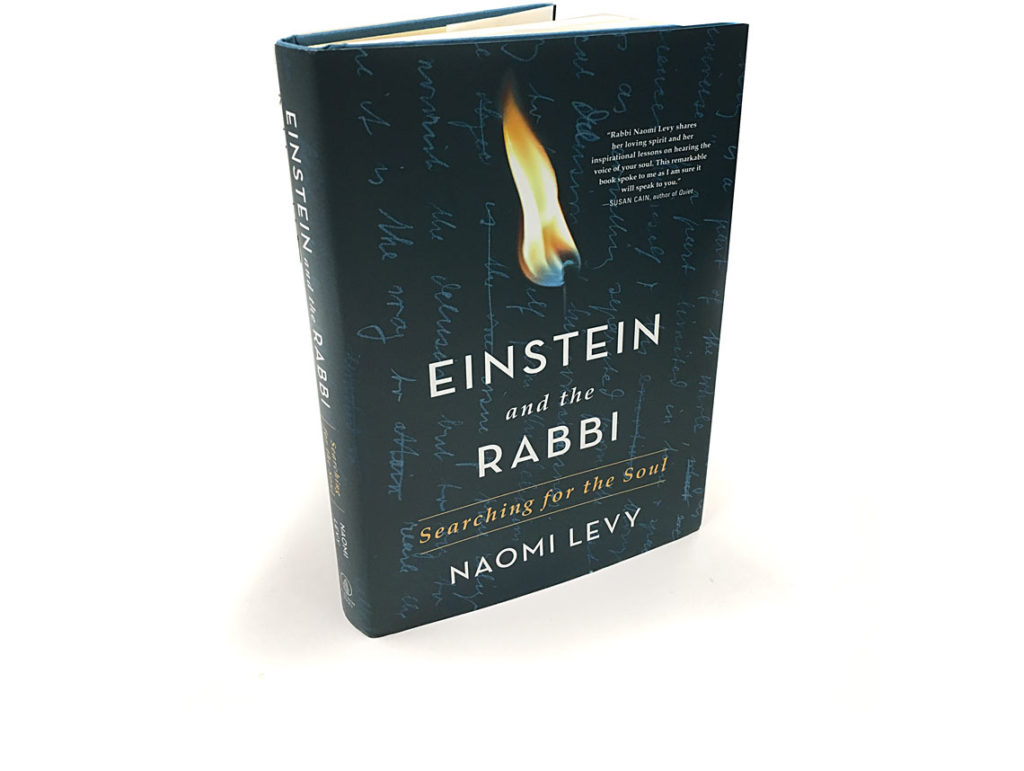
It was the anguish of a father who lost his young son to polio in 1950 that triggered the soulful journey that lies at the heart of Rabbi Naomi Levy’s new book, “Einstein and the Rabbi: Searching for the Soul.”

“His death has shattered the very structure of my existence,” the father wrote in a letter. “My very life has become an almost meaningless void — for all my dreams and aspirations were somehow associated with his future and his strivings.”

The grieving father, Rabbi Robert Marcus, was desperate for some form of consolation and meaning from his loss. He surely knew that any rabbi could console him with thoughts of the afterlife and of living memories. But he wasn’t writing to a man of God.

He was writing to Albert Einstein.

He wanted to hear how the world’s greatest scientist would respond to his despondent cries: “Am I to believe that my beautiful darling child — a blooming bud that turned its face to the sun and was cut down by an unrelenting storm — has been forever wedded into dust, that there was nothing within him which has defied the grave and transcended the power of death?”

Marcus was challenging the genius scientist about something Einstein had written that seemed to dismiss religious transcendence: “Any individual who should survive his physical death is beyond my comprehension … such notions are for the fears or absurd egoism of feeble souls.”

Einstein, then, was in a tight spot: How would he console the grieving rabbi without compromising his scientific integrity?

His enigmatic answer, which Levy discovered while doing research for a class, is what compelled her to write the book.

“Einstein’s exquisite words stopped me in my tracks,” she writes. “He was expressing everything I believed about our limited vision and about the oneness we have trouble seeing, but that we are all part of.”

The letter resonated so deeply that it triggered a three-year journey that involved, among many things, tracking down the heroic and tragic story of Rabbi Marcus’ life, the eventual discovery of his letter to Einstein and a few other surprises.

The book evolves as a sort of spiritual adventure to ferret out the meaning of Einstein’s message and connect it to how our souls can elevate and enrich our everyday lives.

But it is Einstein’s response that especially illuminates the book. The book evolves as a sort of spiritual adventure to ferret out the meaning of Einstein’s message and connect it to how our souls can elevate and enrich our everyday lives.

The letter itself is brief — 78 words. Levy writes that she meditated on it “every day for three years.” (I meditated on it myself a few months ago when I had a chance to review the manuscript.)

So, what did Time magazine’s Person of the Century have to say to a rabbi devastated by the loss of his son? I won’t give it all away, but I can say that his answer is a kind of midrash on the gaps in our consciousness.

It is an “optical delusion,” Einstein writes, to experience ourselves as something separate from the universe, as “separate from the rest.” Freeing ourselves from this delusion is “the one issue of true religion,” and trying to overcome the delusion is the way to reach the “attainable measure of peace of mind.”

An attainable measure? An optical delusion? The one issue of true religion? Those are not the words one usually hears at a shivah, but they are the words that planted themselves in Levy’s consciousness.

Einstein used rational words to express a soulful message about our cosmic interconnection. In doing so, he made science caress religion. He validated Levy’s tapestry of human connectivity which unfolds throughout her book.

Of the many stories that comprise this tapestry, the most personal is how Levy deals with the death of her father. As she chronicles this painful chapter, she sets up the spiritual thrust of the book —  “sensing the pulsating rhythm in all things … being attuned to mystery … embracing life’s magic instead of needing to control it all the time.”

This mysterious magic lies in our souls.

Throughout the book, Levy displays a gift for challenging us and empowering us at the same time. She challenges us to access the divine power of our souls to improve our lives, and she empowers us through the simple magic of human stories.

More than anything, Levy wants us to remember that, through our souls, we all are connected for eternity in God’s universe.

“I can see hints of eternity now that I had no access to then,” she writes near the end.

The little boy whose tragic death in 1950 led to a soul-stirring book in 2017 is a poignant hint of this eternity.


David Suissa is president of TRIBE Media Corp./Jewish Journal and can be reached at davids@jewishjournal.com.

Death, Einstein and hints of eternity Read More »