fbpx

August 28, 2017

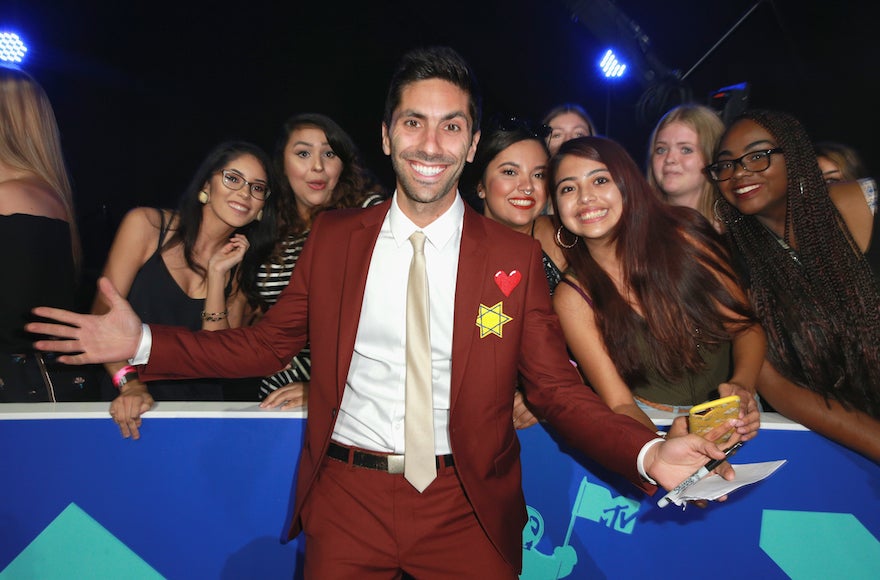
Jack Antonoff and Nev Schulman wear Jewish stars at the MTV Video Music Awards

How often do you see pop culture fixtures wearing very visible Stars of David on a big stage?

Two stars wore them, albeit for possibly different reasons, at the MTV Video Music Awards on Sunday night.

Jack Antonoff, pop music’s new “it” producer and songwriter — who is also Lena Dunham’s boyfriend, head of the band Bleachers, former guitarist in the band Fun. and a graduate of the Solomon Schechter Day School of Bergen County, New Jersey — wore his in necklace form.

Antonoff, who has become a go-to collaborator for the likes of Taylor Swift and Lorde, has worn a Star of David while performing before, including at a concert a little over a week ago in California. He performed during the VMA’s pre-show and introduced Lorde later on in the night. He also accepted the award for Best Collaboration on behalf of  Swift and Zayn Malik, the former One Direction member, as a co-writer for their song “Don’t Wanna Live Forever.”

Many thought the funniest moment of the show came when the camera caught Antonoff eating a banana in the audience.

Meanwhile, Nev Schulman, star of MTV’s “Catfish,” wore a yellow Star of David  on his suit jacket to protest the hatred on display at the white supremacist rally in Charlottesville, Virginia earlier this month. Billy Joel made headlines for wearing an identical yellow star, an illusion to the stars Jews were forced to wear under the Nazis, while performing in New York last week.

Nev Schulman

Nev Schulman with some adoring fans at 2017 MTV Video Music Awards, Aug. 27, 2017. (Rich Fury/Getty Images)


“Since the unbelievable display of anti-Semitism and also with the white supremacy in Charlottesville, there’s been an alarming rise of anti-Semitism across the country in the last few weeks,” Schulman told the New York Post. “It’s one thing to condemn the actions, but I think it’s important that we all visibly show like, ‘Hey, you might think it’s OK to speak negatively or to have hate towards one group, but you know people in that group, and even though you don’t realize it, we feel that.’”

Jack Antonoff and Nev Schulman wear Jewish stars at the MTV Video Music Awards Read More »

From Rome to Charlottesville, a statue is never just a statue

French historian Pierre Nora spent his life describing and explaining “places of memory,” sites commemorating significant moments in the history of a community that continue to resonate and transform from generation to generation.

For the French Republic, the Arc de Triomphe is one such “place of memory.” Begun by Napoleon and completed in 1836, the Arc is a place of French pride and memory, where war dead from the Revolution to the present are recalled and military triumph exalted.

Part of the power of this central place of memory resides in the architecture itself. The Arc de Triomphe is a larger version of another triumphal arch, the Arch of Titus. This arch, located on the Sacred Way in the ancient center of Imperial Rome, commemorates the victory of the Roman general Titus in the Jewish War of 66-74 C.E.

Built circa 82 C.E., its deeply carved reliefs show the general, soon emperor, parading through Rome in a triumphal procession. The spoils of the Jerusalem Temple, including its menorah, are borne aloft by Roman soldiers. Napoleon and those who came after him borrowed the design of this Roman triumphal arch, transferring the glory of Rome to the French nation.

Subsequent events have complicated the meaning of the arch, which was intended to commemorate French military prowess. French victory in World War II, for example, was hardly unequivocal. Hitler did, after all, celebrate his own victory there, and France did not exactly emerge victorious by its own power. One of the more enduring photographs of the liberation shows American troops marching under the arch.

The Arch of Titus, too, is a complex monument whose meaning shifted over time. Titus had not defeated a foreign power but put down a pesky rebellion by a small province. For Christians, the Arch became a place to celebrate Christian triumph over Judaism and the imperial power of the Catholic Church. For Jews, the arch was a symbol for their own defeat and exile, even as some took solace by claiming that its magnificence was proof that Israel had once been a “powerful nation” and formidable foe.

In modern times, the Arch of Titus became a symbol both of newfound Jewish rootedness in Europe and a place of pilgrimage where Jews, religious and not, could proclaim, “Titus you are gone, but we’re still here. Am Yisrael Chai.” Or as Freud put it, “The Jew survives it!” Where once Mussolini had celebrated the Arch as part of the heritage of fascism, Jews after the war assembled there to demand a Jewish state. Others imagined exploding the Arch and thus taking final retribution against Titus for his destruction of Jerusalem. Instead, the State of Israel took the Arch back unto itself, basing the design for its state symbol on the menorah carved into its surface.

I tell these stories of Paris, Rome and Jerusalem as parallels to debate that has been intensified following the horrible events in Charlottesville. The sculptural tributes to the Civil War, North and South, are still living places of memory. Whether in the Soldiers and Sailors Monument in Brooklyn, also modeled on the Arch of Titus, or in the thousands of statues across America, the Civil War is very much with us.

Each place and time since then has thought about and reimagined the war — “The War of the Rebellion,” to many Northerners, “The War of Northern Aggression” to some in the South —  in complex and differing ways. The meanings of these places of memory are not stable. They shift and transform as essential elements of our social fabric and civil religion from generation to generation. Conflicting visions often inhere in the same sculpture, much as Jews and Classicists often “see” very different messages in the Arch of Titus.

In a pre-civil rights era, a statue of a Confederate general was seen by many as a tribute to military bravery and regional loyalty. Today the tide has shifted, and a consensus regards them as reminders of a racist past and an ignoble cause.

Tearing down a place of memory is a serious matter. The act of iconoclasm, of tearing down or transforming a place of memory, is never neutral. The list of such events is long and includes the Maccabees’ destruction of idols in the second century BCE; the midrashic account of Abraham breaking the idols; late antique Christians and Muslims smashing Roman religious images (and burning synagogues); Orthodox Christian iconophobes destroying sacred icons during the eighth century; Protestants ravaging Church art during the Reformation; Nazis torching synagogues during Kristallnacht; the Taliban destroying giant sculptures of the Buddha; or Eastern Europeans tearing down sculptures of Lenin and Stalin after the fall of communism.

Such transformations of our visual cultures mark major transitions and often culture wars. They are attempts to change our memory by obliterating or shifting what we see and expect on our social landscapes, to change how we relate to our places of memory.

The ceremonial — the liminal — moment of removing a place of memory is always laden and significant. It is a shorthand,  a summary statement and dramatic enactment of the ways that those present understand the place and encode its memory.

The march of the neo-Nazis, the texts they recited, the torches and flags they carried, and the violence they instigated are essential to understanding who these people are and what values they see in the statue of Robert E. Lee in Charlottesville.

Reading this event, one can tease out their entire worldview — and it is horrifying.

In the meantime, each community and locale will act and respond as we play out this distressing  drama and rehearse the repercussions of this tragedy in our lives.  Some Confederate statues will come down — as in Baltimore and at the University of Texas, Austin. Some will be contextualized or moved.  Others, alas, will be left undisturbed and continue looking down on us contemptuously. These once mostly forgotten monuments are again potent and complex places of memory.

Faced with similar provocations, Talmudic rabbis would avert their eyes from Roman imperial sculpture, placed in the cities of ancient Israel as tools of control. Some would spit in their imperial faces. When they could, others would tear down the statues of the hated emperors and their colonial regime. In modern times, Jews avoided walking beneath the Arch of the Evil Titus.

Charlottesville is now a place of bloodshed. Perhaps it will begin to heal once the statue of Lee comes down. Nevertheless, the statue will continue to cast a shadow for decades, perhaps centuries, to come.

(Steven Fine is the Churgin professor of Jewish history and director of the Center for Israel Studies at Yeshiva University. He is director of the Arch of Titus Project.)

From Rome to Charlottesville, a statue is never just a statue Read More »

This is your brain on Trump

Do you ever find yourself wondering what the story is with those thrilled faces behind Donald Trump at his rallies?

Unlike us, they’re not spies in a house of horrors.

That sea of Make America Great Again hats doesn’t give them the creeps. When Trump cues them, as he did in Phoenix on Aug. 22, to jeer John McCain, no ambivalence about belittling a war hero battling brain cancer tempers their contempt. When Trump whines and whinges about the coverage his Charlottesville rant got, they realize, and don’t care, that he’s rewriting what he said — they heard him confer moral equivalence on neo-Nazis and anti-Nazis. But his act entertains them, and their complicity in his edits adds a perverse pleasure to the press hatred he rouses in them.

Who are these people?

They can’t all be the 9% of Americans who believe that holding white supremacist or neo-Nazi views is acceptable.

But there’s a decent chance they’re among the 62 percent of Trump voters who think millions of illegal votes won Hillary Clinton the popular vote; the 54 percent of his voters who say the most oppressed religious group in America is Christian; the 52 percent who believe Barack Obama was born in Kenya; the 46 percent who believe Clinton ran a satanic child-sex ring in the basement of a Washington, D.C., pizza parlor; the 45 percent who say the racial group facing the most discrimination in America is white people; and the 40 percent whose main source of news is Fox News.

I get that Trump’s base feels marginalized, left behind by a minimum-wage economy, powerless to control their futures, dissed by urban elites. I know why they’re fed up with partisan gridlock (I am, too); I see why they’d favor a business brand over a political name as president. They’re disgusted by the corruption in Washington (ditto); no wonder they’re drawn to a bull who’d break some china and a bully who’d break some heads.

But after seven months of lying, sleaziness, impulsiveness, laziness, vengeance, arrogance, ineptness, ignorance, nepotism, self-love and Putin love, how can 3 out of 4 Republican voters still be sticking with him? How come those faces I see on TV don’t see the nightmare I see? (I don’t mean that bizarre “Blacks for Trump” guy; I mean the rest of them.)

That’s what I’m wrestling with. Here’s what I got:

It’s not because they’re stupid. It’s because they’re human. It’s not because they’re so different from me. It’s because they’re so much like me.

But here’s what makes that hard to swallow: I can’t muster the humility to believe we’re both wrong, and I can’t summon the relativism to believe we’re both right. But believing that I’m right and they’re wrong, as I do, gets me laughably crosswise with everything I know about human cognition.

Homo sapiens have refined a method of study and understanding — science — that’s reaped powerful knowledge about the world. But the more we’ve used science to study ourselves, to probe the neurobiology of how we think and what we feel, the more inescapable it’s become that “rational” is too flattering a term to describe what makes humans tick, even when we’re at our best.

It’s not pretty to admit, but no matter how practiced we are at critical thinking, how hip we are to the social construction of reality, how savvy we are about manipulation and framing, we still conflate what we want to be true with what actually is true. Our minds unconsciously invent retroactive rationales — we reverse-engineer justifications — for what our bodies already have made us think, say and do. What we call reason turns out to be a byproduct of our addiction to feel-good chemicals like dopamine, serotonin and oxytocin.

Human cognition is a captive of confirmation bias: We seek out and believe information that reinforces what people like us already believe. Confronted by evidence that contradicts what we think, we double down; confronted by chance, we confect necessity. Instead of changing our minds, we tell ourselves stories and cling fast to our tribal identities. A universe that’s run by luck is terrifying, but a good narrative imposes causality on randomness, finds patterns in chaos and purpose in lives. Our hunger for knowledge isn’t as strong as our yearning to belong, to defeat fear and loneliness with affiliation and family. We may call the baskets into which we sort facts “true” and “false,” but at bottom they’re euphemisms for “us” and “other.”

And yet my awareness of the limitations of logic, my appreciation for the ways human hardwiring privileges feelings over facts — they don’t inoculate me from maintaining that Trump is objectively unfit for office. I can’t let neuroscience discount my claim to truth-value: I don’t think calling Trump a liar illustrates confirmation bias at work. The reason the people I see at Trump rallies on my TV screen believe the psychopath at the podium is telling the truth may well be their membership in Tribe Trump. That explanation may nudge my empathy for them upward, but it doesn’t dampen my conviction that I’m right and they’re wrong, and it doesn’t make their belief in the falsehoods he spews any less scary.

Science may be humbling, but humility doesn’t make me feel like a dope when I call out dopiness when I see it.


MARTY KAPLAN is the Norman Lear professor at the USC Annenberg School for Communication and Journalism. Reach him at martyk@jewishjournal.com.

This is your brain on Trump Read More »

In the middle of our national breakdown, Harvey shows up

“I have covered as many as five wars on two continents,” Houston resident and reporter Clifford Krauss wrote on Aug. 27 in The New York Times, “but nothing prepared me for when the big story collided with me and my family.”

Krauss was recounting the harrowing experience of confronting Hurricane Harvey in his leafy Houston suburb of Bellaire:

“As I write this, the home that I saved my entire career to buy is flooding fast and my wife, Paola, our 12-year-old daughter, Emilie, and I have moved to the second floor with some of our valuables, food, water, and of course our three-year-old cockapoo, Sweetie, who is now barking frantically out of fear.

“It’s only a matter of time before our piano is ruined. One of our cars looks completely flooded, and the other is blocked in the garage, so it looks like we will be staying put for a while.”

Just when the country seemed to be going into meltdown after seven of the most chaotic and divisive months in U.S. presidential history, Mother Nature shows up to remind us that Donald Trump is not the only force of nature we can’t control.

I can’t begin to imagine what it must feel like to be trapped in an epic flood– roads turning into rivers, family rooms into shallow pools, stable lives into emotional wrecks.

The first question must surely be: Are our lives in danger?

I can’t begin to imagine what it must feel like to be trapped in an epic flood– roads turning into rivers, family rooms into shallow pools, stable lives into emotional wrecks.

I remember thinking about survival a few summers ago when I was awakened one Saturday morning in my Tel Aviv hotel by a shrieking siren. It was in the middle of the Gaza War. A missile had been launched by Hamas, and a man’s voice came over the hotel’s public address system telling us to proceed immediately to the bomb shelter or the emergency stairs.

During the 30 minutes or so that I huddled with a group of other hotel guests, it was the evil of human beings that was on my mind. Those missiles were coming from human beings with hatred in their hearts and Jews in their sights.

There was something oddly comforting about fighting humans. At least we knew where they were. We could predict what they would do. We knew who to blame.

It’s much harder to blame Mother Nature. What does she know? Her earthquakes and hurricanes and monsoons and tornadoes don’t come from hatred or evil. They come from the natural order and disorder of things.

But there’s a silver lining to the hell unleashed by Mother Nature. Because we can’t blame human beings for the disaster, there is a tendency to bond with our fellow humans. In the middle of rescue missions, no one cares whether you voted for Trump or Clinton, whether you’re antifa or nationalist, whether you’re black or Hispanic or Jewish or Muslim, whether you’re transgender or redneck.

When Mother Nature attacks, we’re all created equal. We’re all neighbors.

Krauss says his family are the lucky ones: “For the moment, I don’t think we are in any danger, and the three of us are keeping calm, gaining strength from the sturdiness of our neighbors.”

In a few months, neighborly sentiments will probably take a back seat to finger pointing and politics. Harvey will take its place in Nature’s Hall of Fame of calamities, along with Katrina and many others, and we will go back to complaining about other humans.

It’s still worth noting, though, that for a brief moment at least, Harvey has brought the nation together. By storming Houston, the hurricane made us all Houstonians. It has replaced our political anger with compassion, our partisan animosity with solidarity.

Yes, it’s a shame that it takes such disasters to bring out the better angels of our nature. Maybe, then, if we want to truly honor the victims of Houston, we will allow those angels to stay awhile.


David Suissa is president of TRIBE Media Corp./Jewish Journal and can be reached at davids@jewishjournal.com.

In the middle of our national breakdown, Harvey shows up Read More »

What the Eclipse Taught Me About the High Holy Days

Every year my family and I go on a summer road trip. This year we chose to travel to Casper, Wyoming to experience the Totality of the Great American Solar Eclipse, 2 minutes and 26 seconds when the moon totally covers the sun. The temperature drops, the birds go silent, night falls, the stars come out and you have a 360 degree panorama of sunset. It is nothing less than a physical encounter with God.

We viewed the eclipse with a gathering of both veteran and amateur astronomers. These astronomers taught my family more about the universe’s planetary system in three hours than we could have otherwise learned in a lifetime.

The tension was mounting as we counted down the seconds to experience the unimaginable. With 80 percent of the sun being covered by the moon, we could feel the temperatures dropping and the wind picking up. At 90 percent we could sense the sunlight growing weaker like a winter day in the late afternoon. With a minute to go until Totality we noticed the western horizon darkening as a giant shadow raced towards us. It was impossible to see the leading edge of the 1720 mile-an-hour moon shadow as it engulfed us.

And then all at once the crowd roared “ooh” and “aah” as the moon completely covered the sun in the most spectacular sight I have ever seen in my life.

The moon, physically invisible up until now, was perfectly positioned over the sun as white wispy streams of light poured out of the entire 360° circumference of the sun beyond the edges of the darkened moon. It seemed as if it took up the whole sky.

The stars came out, along with Venus and Saturn. We were living Totality! It was the fastest and most spectacular 2 minutes and 26 seconds of my life.

We didn’t want it to end. Like the shofar blast at the end of Yom Kippur Day at the Neilah service when you just want to forever hold onto your breakthrough to God and His loving embrace.

It was a paranormal experience. Despite all my preparation for this instant, it was totally surreal. Everyone around us was in an altered state. Stunned. Euphoric. Holding onto the moment. Even the veteran eclipse chasers were overcome with awe. I felt like I was getting a glimpse of God revealing His presence on Earth.

The astronomers told us that before you go into Totality you have to have a plan. How would you make the most of the 146 seconds? What are you going to see, record, and think? Everybody had to know how to budget their time. Do we do that in life every 146 seconds? Shouldn’t we? Most of the time we don’t use our time this planned out, assuming for sure we will get another 146 seconds, hours, days or months.

I wish I could always be in this state of mind of total reality. No one was daydreaming. Smart phones were out of view.

I also made it a point of saying the Shema. I wanted to lock in this moment forever and anchor it to my relationship with God. I looked at my children and wife, Rochel. They were in their own world trying to process this.

We wanted to grab this for eternity. I will never let this moment go and will always thank God for it. But in truth God gives us Totality every second with all the blessings that fill our lives if we would just stop and consider.

Today God gave us a rare gift from on high. I hope to take it with me to Rosh Hashanah, Yom Kippur, into my Sukkah, and for the rest of my life!

I want every day to be Totality with my Creator. I want to be aware. I never want to daydream, rather to be excited by life always. I want to be striving for things that are so important and meaningful that pettiness and disappointment have no space in my mind.

The eclipse taught me that you can have the sun, moon and earth on different orbits and in a rare synchronistic moment, they create a phenomenon that seems beyond probability.

So too in our lives when we are challenged and trying to solve so many dilemmas. After much effort the moving pieces all come together in a harmonious solution that is beyond our imagination. In fact, sometimes we look back on our lives and come to realize that certain situations have resolved themselves, eclipsing the issue we were so worried about.

Isn’t that the ultimate message of the Days of Awe? At-one-moment – atonement! May you too reach Totality in your life.


Rabbi Aryeh Markman is Co-Director, The Western Wall Experience and Executive Director, Aish LA. Reprinted with permission from aish.com.


What the Eclipse Taught Me About the High Holy Days Read More »

After hosting Conan, new Israeli hotel aims to make Sea of Galilee luxury destination

Conan O’Brien is checking in this week.

Israeli Prime Minister Benjamin Netanyahu has already been a guest. So have celebrity TV show hosts Assi Azar and Rotem Sela.

“There’s nothing else close to this hotel on the Kinneret,” said Roger Attias, the Setai Sea of Galilee’s project manager, using the Hebrew name for the lake. “It’s going to be No. 1 in Israel.”

Since its “soft opening” in June, the $250-million Setai has put a new sheen on the low-key Sea of Galilee. Both the hotel’s supporters and detractors expect the hotel to help transform the area by bringing in wealthy tourists like O’Brien, who is staying while filming a special Israel episode of his TBS talk show.

The Setai, which means “south beach” in Thai, stretches along 15 acres of remote lakeside like a modern hut village. Its dozens of white wood and glass buildings are connected by winding walkways lined with grass and palm trees. At the center of the complex, sunbathers lounge around an edgeless pool with a sweeping view of the lake. Other guests feast on fine cuts of meat in the dining room, sip top shelf cocktails in the lounge or indulge in hot stone massages in the spa.

Back in their rooms, some slide into personal edgeless pools, each with a slightly different view of the lake.

Some of the rooms at the Setai Sea of Galilee, Aug. 25, 2017. (Andrew Tobin)


According to Attias, the Setai was a “dream project” for the Israeli-American Nakash brothers, who brought the brand to the Sea of Galilee from Miami, where they own the flagship hotel in an art deco tower on the beach. He said they envision the project as an investment in Israel.

“They wanted to build something that will stand for a generation,” Attias said. “Nobody else would have thought to do something like this here, on this end of the lake.”

Although a major tourist destination, the Sea of Galilee area offers little that could be considered high end, or even stylish. Most visitors stay in the biggest city, Tiberias, a working-class community of around 40,000. Others, especially Israeli vacationers, opt for bed-and-breakfasts or guesthouses in the local kibbutzim and villages. Some camp and barbecue at the public parks on the shore.

The major draws are the religious and archaeological sites and outdoor activities, especially water sports on the lake that Jesus is said to have walked on.

Despite its particularly remote location on the opposite side of the lake from Tiberias, in the Golan Heights, which Israel de facto annexed from Syria, the Setai is already attracting new, high-end tourism. Its 110 rooms, which cost approximately $500 to $900 a night, have been sold out for much of the summer and are filling up for the High Holidays.

Many of the guests, some 80 percent of whom are Israeli, come to the hotel despite turning up their noses at northern Israel, Attias said.

“These people love the lake, but they don’t come to the Kinneret for vacation. They think it’s tents and karaoke on the beach — or Tiberias, which unfortunately has a stigma,” he said.

The owner of a tennis school in Tel Aviv who was at the hotel with his wife and three young children last week said his family opted to come to the Setai over a trip to Europe. Last summer they vacationed in Vienna, Austria. Asking not to be identified to protect his privacy, he said his children loved the Sea of Galilee, but the public parks on the shore were “too loud.”

“There’s no other place like this in the North,” he said approvingly, despite some complaints about the lack of amenities on the beach. “We didn’t want something with all the people. We wanted to pay more to have more things.”

Lucy Castro and her husband traveled to the Setai from London, where they live when not in their native Paris. They made the trip because they had been impressed by a previous stay at the Setai in Miami. Although they had some issues with the service and the food, they were awed by the new Setai’s “magnifique” view and accommodations.

“The Setai in Miami is more elegant than this one, but they are making progress,” Castro said.

Attias said the Setai would not reach its full luxurious potential until the end of next year. A conference center and 47 new rooms with private pools and lake views are under construction, and the hotel has yet to win oversight of the beach it sits on. When that happens, Attias said, there are plans to bring in white sand, a helipad, a seaplane dock and facilities for windsurfing and parasailing.

In the meantime, Attias said, his main focus — and biggest challenge — has been training the hotel’s 180 employees, who mostly come from small local communities and are unfamiliar with the standards of world-class customer service.

“We have a big problem with getting all the staff to say hello to the guests,” he said. “I tell them, say good morning. What does it cost you?”

But he is optimistic.

“The service here can be even better than in the Setai in Miami,” he said. “You know why? Because my people aren’t robots. They have feelings. It’s not going to be easy, but it will happen.”

A golf cart making its way along the paths at the Setai Sea of Galilee, Aug. 25, 2017. (Andrew Tobin)


Beyond the employment it offers, government officials hope the Setai will boost economic growth across the Galilee. The region has long had relatively high unemployment, poverty and low wages. Outside of Tiberias, the residents — about half of whom are Arab — live in kibbutzim and villages.

Tiberias Mayor Yosef Ben David said the Setai is “a beautiful part of a coming change.” While the hotel is outside his municipal boundaries, he noted that four other luxury hotels are under construction in Tiberias and the Galilee. He said he is working with local and national officials to expand the kinds of tourism in the Galilee.

“Even though the Setia isn’t paying taxes to me, I’m very happy about it,” he said. “After two decades of economic stagnation, this is the start of a new dawn. It’s only the first hotel like this. We’re going to encourage more and more.”

Some locals have pushed back against the development of their area.

During the Setai’s construction, which started in 2010, protesters repeatedly gathered on the beach to demand it be preserved as a natural habitat and well-known kite surfing spot. Compromises were reached eventually, including allowing continued public access. Campers have been known to pitch a tent directly in front of the hotel’s swimming pool.

Yotam Stienberg, a resident of the nearby Maagan kibbutz who is engaged to marry the Setai’s public relations director, said he expects more of the Sea of Galilee shoreline to be developed in the coming years. While he knows that could affect the laid-back local lifestyle, he has seen bigger changes in the past three decades — like the end of communal childrearing on his kibbutz and when its dining hall was turned into an office for an insurance company.

More development could be good for his myriad family businesses, which include a pizza restaurant, a bicycle rental service and a maintenance company.

Plus, Stienberg said, “It gets boring around here sometimes.”

After hosting Conan, new Israeli hotel aims to make Sea of Galilee luxury destination Read More »

Viceroy’s House Film

I recently saw a press preview screening of the film Viceroy’s House, an excellent retelling of the story of India’s independence from Britain in 1947.  This dramatic film shows the incredible hardship the two new countries endured as a result of the partitioning of India into two nations:  India and Pakistan.  It’s also a moving  love story, with many dramatic scenes and impressive attention to detail.  The film opens on Sept. 1, and was directed by Gurinder Chadha, whose own family went through this story.  14 million refugees were created by the forming of the two counties, with repercussions that last even today.  A fascinating tale of a remarkable moment in recent history, memorably told.


Viceroy’s House Film Read More »

Patriots wide receiver Julian Edelman out for season with knee injury

New England Patriots wide receiver Julian Edelman will miss the 2017 season after sustaining a knee injury in a preseason game.

Edelman, 31, a favorite target of quarterback Tom Brady, suffered a torn anterior cruciate ligament in his right knee during the Super Bowl champions preseason win over the Detroit Lions on Friday night. The injury, which occurred without contact, was announced Saturday afternoon.

This year is Edelman’s ninth season in the National Football League. He signed a two-year, $11 million contract extension with the Patriots earlier this year.

There was some debate over whether Edelman was Jewish — the Patriots maintained that he was raised Christian, despite having a Jewish father. But Edelman identified himself as Jewish during a 2013 interview on the NFL Network.

Robert Kraft, a Jewish-American businessman, owns the Patriots and has been a leading advocate for American football in Israel.

Patriots wide receiver Julian Edelman out for season with knee injury Read More »

THE HITMAN’S BODYGUARD *Movie Review*

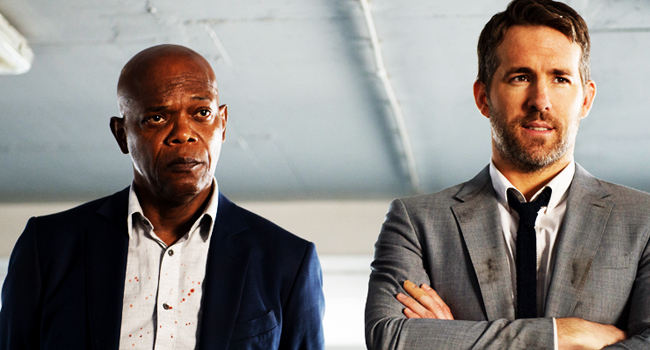
The Hitman’s Bodyguard is flying under the radar to the detriment of audiences looking for a good popcorn flick.  Prior to the heavy movies of Oscar season, this buddy comedy starring Ryan Reynolds and Samuel L Jackson is pure fun as the actors embrace roles that seem tailor-made for them.

There’s nothing new and noteworthy here and if you don’t like Samuel L Jackson in pretty much any other role he has ever played, then this isn’t the movie for you, either.  While The Hitman’s Bodyguard doesn’t reinvent the wheel, there’s enough action, comedy, camaraderie and chemistry to keep it afloat.  Salma Hayek seems to relish her role as the female baddie as well.

For more about The Hitman’s Bodyguard, including the significance of all the clocks in the movie, take a look below:

https://youtu.be/KnJYTYO-3hw

—>Keep in touch with the author on Twitter and Instagram @realZoeHewitt.  Looking for the direct link to the video?  Click here.

All photos and video are courtesy of Lionsgate.

THE HITMAN’S BODYGUARD *Movie Review* Read More »

Stephen Bannon will speak at ZOA dinner in first scheduled public appearance since firing

Stephen Bannon will speak at the Zionist Organization of America dinner in November in his first scheduled public appearance since he was fired from his post as chief strategist for President Donald Trump.

ZOA President Morton Klein confirmed to The Atlantic on Monday that Bannon will speak at the Justice Louis D. Brandeis Award Dinner on Nov. 12 at the Grand Hyatt in New York.

Among those to be honored that night, according to the ZOA website, are the U.S. ambassador to Israel, David Friedman, and former U.S. Sen. Joseph Lieberman of Vermont. Billionaire philanthropist Sheldon Adelson and his wife, Miriam, are listed as presenters. Bannon may introduce Adelson, ZOA’s top donor, at the dinner, The Atlantic reported.

Bannon was scheduled to attend the ZOA gala last year but was a no-show.

He returned to his position as executive chairman of Breitbart News after leaving the White House earlier this month.

Bannon had been feuding for months with other members of the Trump administration, including senior adviser Jared Kushner and National Security Adviser H.R. McMaster.

ZOA in attempts to depose McMaster issued a report earlier this month alleging that he is anti-Israel. The report also charged that McMaster was undermining Trump’s Middle East agenda and the U.S.-Israel relationship by firing officials supportive of the Jewish state and critical of the Iran nuclear deal.

Bannon had been under fire since he began working for the Trump campaign last year. He was criticized for calling Breitbart a platform for the “alt-right,” a far-right and white nationalist movement that includes anti-Semitic figures and followers.

Stephen Bannon will speak at ZOA dinner in first scheduled public appearance since firing Read More »