In the cascade of one major news story after another, President Donald Trump has decided somewhat quietly to send his son-in-law and close adviser, Jared Kusher, along with chief negotiator Jason Greenblatt, back to the Middle East to try to revive peace talks between Israelis and Palestinians.
While the chances of success are not high, this nonetheless is a salutary development on at least two scores: First, it reveals that the president has not given up all hope and does seem to regard the Israeli-Palestinian conflict as worth his attention; and second, in this conflict, stasis, or the perceived absence of diplomatic movement, often is a catalyst for violence.
And yet, there is a concerning element to this plan. Several weeks ago, in a talk with a group of congressional interns, Kushner reportedly said of diplomacy: “Everyone finds an issue … ‘You have to understand what they did then,’ and ‘You have to understand that they did this.’ But how does that help us get peace? Let’s not focus on that. We don’t want a history lesson. We’ve read enough books. Let’s focus on how do you come up with a conclusion to the situation.”
It is tempting to imagine that in a conflict weighed down by competing historical narratives, one can begin with a tabula rasa and then move on to a shared understanding of a peaceful future. I fear that this won’t work in the case of the Israeli-Palestinian conflict. The two sides cling tightly to their accounts of the past — and for understandable reasons. The Jewish/Zionist/Israeli story of liberation from exile and reclamation of the ancestral homeland contains a great deal of truth. But so does the Palestinian story of the flight from homeland to exile. In this sense, both historical accounts have a great deal of veracity, although they are mixed with myth and, often enough, denial of the legitimacy of the other side’s narrative.
Researchers have found that in post-conflict situations such as Northern Ireland and the Balkans, a key and difficult step toward reconciliation is to acknowledge the existence of multiple narratives and to work at all levels of society to educate toward an inclusive, rather than exclusive, view of the past. As I argue in a forthcoming book, “The Stakes of History,” history is not only not to be avoided in such settings, it can be an important tool of reconciliation between warring sides. Failing to acknowledge the history of the other will induce anger and indignation at every turn. And repressing difficult chapters from the past may be gratifying in the short term but ultimately will return with a vengeance, like a festering wound.
Recognizing the story of the other as part of the quest for diplomatic resolution is one sense in which history is important. There are other uses for history. The past, as the German-Jewish philosopher Walter Benjamin noted, is a huge repository of discarded, but interesting, ideas. The current state of affairs between Israelis and Palestinians is a stalemate. The long-regnant model of a two-state solution is increasingly undesirable to both sides; the alternative Israeli and Palestinian visions of a single state between the Jordan and the Mediterranean seem to be so divergent as to be unbridgeable. Returning to the dustbin of history can help to surface old ideas worth reconsidering in the present quagmire, even if only as interim solutions. These include, as Israeli historian Benny Morris explored in his book “One State, Two States,” confederated arrangements in which autonomous areas are joined to existing states or even a canton system that grants autonomy to different parts of the region according to ethnic, political or cultural cohesion.
There is a third way history can be of value — and this is of most direct value to Jared Kushner. American policy is far better off with a rich sense of history than an enfeebled one. Had military and political planners possessed a more refined sense of the history of ethnic and religious conflict in Iraq and the region, there might have been a greater sense of restraint before the U.S.-led invasion of 2003 — and a more realistic awareness of the challenges of governing the country after it. By extension, it would seem responsible to take a deep dive into the history of the Israeli-Palestinian conflict, as well as into the attempts to solve it, before embarking on a new diplomatic initiative.
In fact, it might be worth reviving a proposal raised by two distinguished scholars in the waning months of the Barack Obama presidency. Political scientist Graham Allison and historian Niall Ferguson called in September 2016 for the creation of a Council of History Advisers to serve a function akin to the Council of Economic Advisers. The two proposed a number of ways in which history could be of great value to policymakers, recalling the valuable recourse to history made by former Federal Reserve Board chairman Ben Bernanke in response to the 2008 economic crisis.
As in that case, so too in the present, we stand to benefit greatly from more rather than fewer history lessons.
DAVID N. MYERS is the president and CEO of the Center for Jewish History, as well as the Sady and Ludwig Kahn Professor of Jewish History at UCLA. He is the author of “Jewish History: A Very Short Introduction” (Oxford University Press).
The Palestinian Authority expects the Trump administration to commit to a peace deal endgame before the close of this month and prefers it would be the two-state solution.
“We need them to tell us where the hell they are going,” Husam Zomlot, the Palestine Liberation Organization envoy to Washington, said Thursday at a meeting in his office with reporters. “It’s about time we hear it.”
Zomlot said a high-level U.S. delegation comprising Jared Kushner, President Donald Trump’s son-in-law and his top adviser charged with Middle East peace; Jason Greenblatt, Trump’s top international negotiator; and Dina Powell, a deputy national security adviser, would meet Aug. 24 in Ramallah with Palestinian Authority President Mahmoud Abbas and the Palestinian negotiating team.
The meeting will come toward the end of a tour in which the U.S. officials also will meet with Israeli and other regional leaders, including from Egypt and Saudi Arabia.
Zomlot said that for the Palestinian Authority, the preferred outcome remained a recommitment to the two-state solution. Trump retreated soon after assuming the presidency in January from a two-state outcome, which has been U.S. policy since 2002. Israeli Prime Minister Benjamin Netanyahu, who had committed to a two-state solution in 2009, also has been silent since then about his commitment. A majority of Netanyahu’s Cabinet opposes having two states.
“A two-state solution has international equilibrium, it has regional backing and it has a global consensus,” Zomlot said. “We are saying to them, we have a starting point, and letting go of this starting point is the worst thing they can do.”
Zomlot said the Palestinian Authority wanted two states based on the 1967 borders, and wanted to hear from the Trump administration how best to deal with factors that would endanger a peaceful outcome, including Jewish settlements, the humanitarian crisis in the Gaza Strip and religious tensions at Jerusalem’s Temple Mount, which both Jews and Muslims claim as holy.
“The how is crucial,” he said.
He said that in the wake of serious negotiations, “the Palestinian consensus government will be tasked with two things: the ending of the situation in Gaza — the unprecedented situation in Gaza — and as soon as possible the convening of Palestinian national elections.”
A major obstruction to advancing peace talks has been the absence of P.A. control in the Gaza Strip, where the Hamas terrorist group is the authority. Abbas and the Palestinian Authority, along with Israel, have been squeezing Gaza by reducing basic supplies to its Hamas rulers, including electricity.
Zomlot would not say what the Palestinian Authority would do if the U.S. delegation did not lay out an endgame, but said uncertainty could lead the P.A. to return to seeking international recognition for statehood — a posture that Israel and the United States adamantly oppose — or to further Palestinian resistance against Israel. He said the resistance would be “peaceful.”
Zomlot conveyed an overall positive impression of Trump and his negotiators, saying they had carefully considered Palestinian positions, and that Trump’s commitment to an endgame rather than simply perpetuating the process was positive.
“The character of President Trump himself — we believe this is a person who could actually take the leap, who could exert pressure on all sides,” he said.
Zomlot and the Palestinian Authority appear to be relying on pressure by Trump as a means of delivering Israel on the two-state solution. Zomlot made clear that he did not believe Netanyahu had the wherewithal to advance to final status negotiations on his own.
“Netanyahu is behaving like a politician, not a statesman,” he said of the prime minister’s coalition maneuvering, in which he must deal with partners who oppose concessions. “Israel deserves better leadership.”
Zomlot expressed anger with Congress and the welter of proposed bills that would cut U.S. assistance to the Palestinian Authority and otherwise penalize it. Chief among the measures is the Taylor Force Act, named for an American stabbed to death in a 2016 terrorist attack, which would link funding to the Palestinian areas to the cessation of P.A. payments to the families of Palestinians killed in or jailed for attacks on Israelis.
He said the Palestinian Authority was ready to “revise and negotiate” its payment system, but would not submit to pressure.
“Don’t use financial pressure with us,” he said. “It does not work.”
La Crescenta, California is a long way from Charlottesville, Virginia, but both communities have recently had to deal with controversies involving Nazis, white supremacy, and the removal of a public monument that symbolized bigotry. In Charlottesville, the controversy erupted in violence and became national news. In La Crescenta, a suburb of Los Angeles, the dispute was resolved through spirited but nonviolent meetings and discussions. Not surprisingly, the La Crescenta experience generated few headlines.
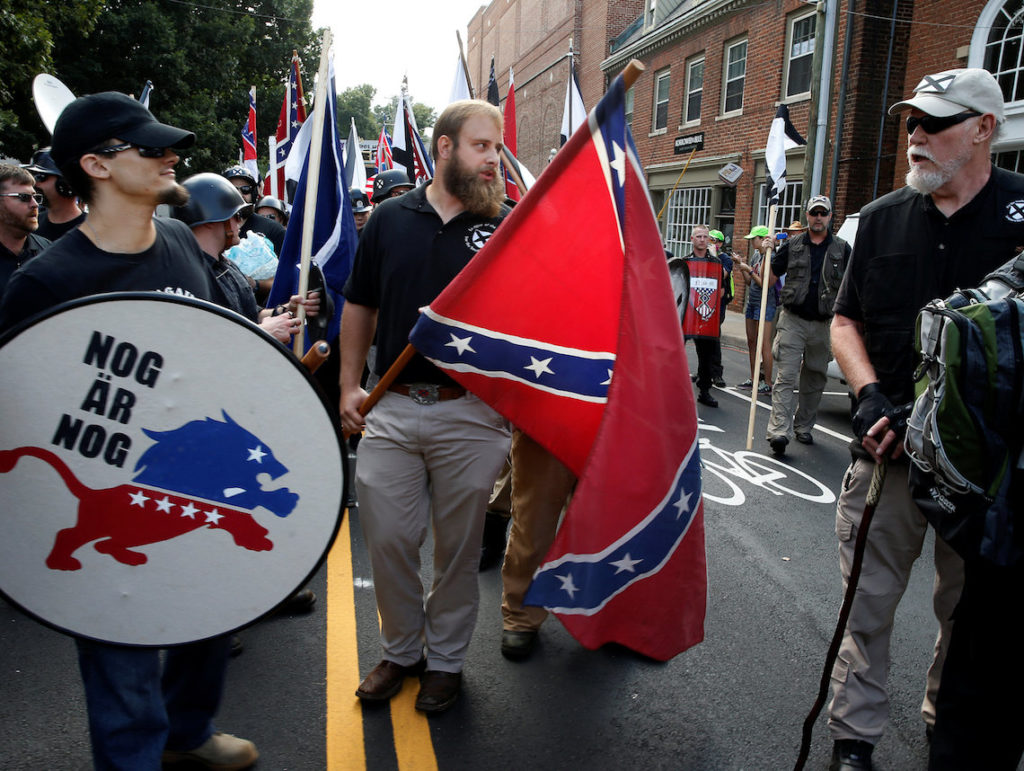
Members of Nazi, Ku Klux Klan and other white supremacist groups descended on Charlottesville last weekend purportedly to preserve a 26-foot tall statue of Robert E. Lee, a Confederal general and traitor to his country, erected in a local park that was once named after him. The statue of Lee, on his horse with hat in hand, had stood in the park since 1924, a time of resurgent white supremacy, KKK activism, and lynching. In April, the Charlottesville City Council voted to sell and remove the statue and rechristen Lee Park as Emancipation Park. Local white supremacists went to court to oppose the removal and a circuit court judge issued an injunction prohibiting any sale or removal for six months.
Stopping the removal of the Lee statue was the excuse that Nazis and other white supremacists used to organize a march and rally in Charlottesville brandishing torches, bats, and guns. One of them drove his Dodge Challenger into a crowd of counter-protesters that killed 32-year old Heather Heyer and injured 19 others. The controversy was compounded when President Donald Trump refused to forcefully condemn the white supremacists, who then celebrated Trump’s remarks as signifying support for their views and actions.
This Friday – a week after the Nazis came to Charlottesville – people will gather in Crescenta Valley Community Regional Park to celebrate a victory over hate and bigotry. A year ago, a sign at the park’s entrance said “Welcome to Hindenburg Park,” named for Paul von Hindenburg, Germany’s president from 1925 to 1934 who appointed Adolf Hitler as German chancellor in 1933. The sign was erected last year, paid for by a German-American group who claimed that it was intended to celebrate the area’s German American heritage. But the sign failed to mention the park’s ugly past as a site of Nazi rallies and a Nazi youth camp during the 1930s.
Few people knew about the six-foot sign until the Los Angeles County Department of Parks and Recreation erected it in March 2016 at the park’s entrance near the corner of Honolulu and Dunsmore avenues in La Crescenta, an unincorporated section of LA County, adjacent to Glendale.
The sign greeted visitors with the words “Willkommen zum,” written in a German typeface, followed by “Welcome to Hindenburg Park,” and below that “The Historic German Section of Crescenta Valley Park.” At the bottom of the sign was the county’s official seal and the words “Los Angeles County Department of Parks and Recreation.”
Despite the official seal, the county did not pay for the sign, which cost $2,500. The idea for the sign originated with the Tricentennial Foundation, a German heritage organization based in the North Hills section of Los Angeles. The foundation worked with the Crescenta Valley Chamber of Commerce and the Historical Society of Crescenta Valley to fund the sign. The foundation ‘s aim was to “preserve the historical integrity of the site,” Hans Eberhard, the group’s chairman, told the Glendale News-Press last year.
Some proponents of the sign argued that they heard no objections about it before the County approved it.
“That’s because hardly anyone knew about it until it was put up,” explained Jason Moss, executive director of the Jewish Federation of the Greater San Gabriel and Pomona Valleys. “If it had been a public process, I’m sure people would have opposed it. But soon after it was put up, we started voicing our concerns.”
Once it was installed, people in the area began to raise questions. After several local residents brought the issue to Moss’ attention, what appeared to be a harmless historical marker became the subject of controversy. They learned that, despite the sign, the park’s name is Crescenta Valley Community Regional Park, not Hindenburg Park, and it is owned and operated by Los Angeles County. Moss and others brought their complaints to County officials.
“I think there’s a way we can honor German-American culture, but also not forget what took place at that park,” Moss explained last year.
Civil rights, human rights, and faith-based groups mobilized a campaign to persuade County officials to take down the sign and replace it with another sign that would tell an accurate history of that site. Local residents signed petitions, contacted local elected officials, and conducted research to uncover the park’s ugly but mostly forgotten history.
In April 2016, the county’s Human Relations Commission held a public hearing on the issue that attracted at least 200 people, the vast majority of them opposed to the new sign. At the public hearing, many local residents recited versions of the famous statement by philosopher George Santayana: If we don’t learn from the past, we’re doomed to repeat it.
Under pressure from the elected County Board of Supervisors, Parks and Recreation Department officials agreed to remove the sign and to appoint a committee to create a new display that accurately represented the park’s history with texts and photos. The sign was removed last November. The new display, explaining the site’s history, will be unveiled this Friday.
Had local political officials and business groups done their research, they might have predicted that the sign would generate controversy, given the park’s history as a gathering place for American Nazis and Nazi sympathizers.
Had the park simply been a place where German Americans celebrated their rich and fascinating cultural heritage, it would hardly be contentious. But the site also has a much more troubling history.
Although the German American League may have been founded to celebrate German culture, it always had a political side. According to a 1937 article in Life magazine, the group was “the Nazi organization in the U.S.,” previously known as the Friends of the New Germany.
This country’s major pro-Nazi group was the German-American Bund, which sought to promote a favorable view of Nazi Germany and urged Americans to boycott Jewish-owned business. Its rallies not only featured Nazi flags but also American flags, claiming that its members were patriotic Americans. In fact, the Bund claimed that George Washington was “the first Fascist.”
As early as 1936, the Bund operated 19 Nazi-inspired youth camps across the United States. One of them, Camp Sutter, was located at the German-American League’s Hindenburg Park.
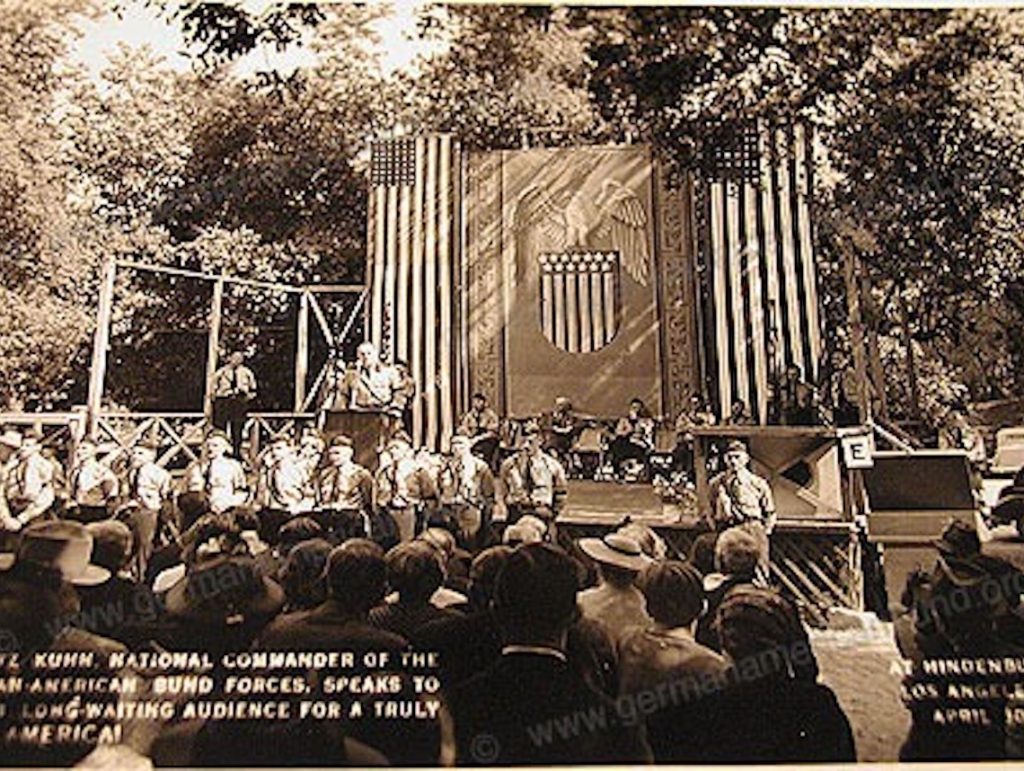
In an interview last year, Arnie Bernstein, author of the Swastika Nation: Fritz Kuhn and the Rise and Fall of the German-American Bund, explained that the purpose of these Bund youth camps was to “indoctrinate children in Nazi ideology.” Like most summer camps, the children participated in sports, hikes, arts and crafts and other activities. But they also were taught about Aryan supremacy and told to be loyal to the Bund, its leader Fritz Kuhn, and Adolph Hitler. They wore uniforms similar to those worn by the Hitler Youth group in Germany. They were forced to march around in the middle of the night carrying Bund and American flags, sing the Nazi anthem, give the Nazi salute, and shout “Sieg Heil.” As part of their camp activities, they were inculcated with Nazi propaganda. A Congressional investigation also uncovered sexual abuse between the adults and campers, Bernstein said
In February 1939, Kuhn, who was often called the “American Fuehrer,” spoke at a pro-Nazi Bund rally at Madison Square Garden in New York City that attracted over 20,000 people. There he repeatedly referred to President Franklin D. Roosevelt as “Frank D. Rosenfeld,” called his New Deal the “Jew Deal,” and stated that “the Jews are enemies of the United States.”
Bund choir group sings at Hidenburg Park in 1936.
Later that month, the Bund held another rally at its West Coast headquarters at 634 West 15th Street in Los Angeles in building known as the Deutsch Haus (German House). The building was a site for pro-Nazi meetings and also housed a restaurant and beer hall as well as the Aryan Bookstore, where one could purchase the Bund newspaper, Hitler’s manifesto Mein Kamp, and other Nazi literature. The Deutsch Haus also screened German anti-Semitic propaganda films with titles like “Kosher Slaughter.”
A few months later, on April 30, 1939, the Bund held a rally in Hindenburg Park, promoted as a celebration of Hitler’s birthday ten days later. Over 2,000 German-American Bund members came to hear Kuhn and West Coast Bund leader Herman Max Schwinn.
According to the Los Angeles Times: “Clad in a gray-and-black storm trooper uniform and flanked by a dozen uniformed guards, Kuhn spoke from a stage draped in red swastika banners.” The crowd cheered Kuhn and booed as a low-flying plane, sponsored by the Hollywood Anti-Nazi League, bombarded the park with thousands of anti-Hitler leaflets.
When it was Schwinn’s turn to speak, he read a telegram he had sent to President Franklin D. Roosevelt: “Do everything in your power to quarantine the United States against alien influences which are at work to drag the nation into war.” By “alien influences” he meant Jews, whom the Bund correctly believed were trying to get the Roosevelt administration and Congress to oppose Hitler’s efforts to take over Europe.
In an interview with the Los Angeles Times that week, Kuhn spouted typical Nazi ideas. He falsely claimed that Jews occupied 62% of the high posts in the federal government and “have plotted to get hold of almost everything, especially in New York and Hollywood.”
That event was only one of many Bund and pro-Nazi events that took place at the park. These gatherings featured speakers from other American fascist organizations – including the Silver Shirts, White Shirts, and Khaki Shirts — as well as the Bund.
California State University-Northridge hosts a website and archive called “In Our Own Backyard: Resisting Nazi Propaganda in Southern California, 1933-1945” that includes photos of Nazi rallies at Hindenburg Park. One shows members of the Bund erecting a huge swastika in the park. A two-minute clip from the documentary film “Rancho La Canada” includes footage of activities at Hindenburg Park, including the 1939 Nazi rally.
In December 1939, Kuhn was sentenced to two and a half to five years in prison for embezzlement, but the Bund briefly continued without him. Two years later, after the United States entered World War 2 against the Nazis, the Bund disappeared. In 1943, while he was serving his prison sentence, the U.S. cancelled Kuhn’s citizenship and deported him to Germany in 1945.
Historian Bernstein is quick to explain that “most German Americans weren’t Nazis or Nazi sympathizers.” Many, he said, were “ashamed of Hitler and what was going on in Germany, and strongly denounced Kuhn and his followers.”
“The Bund was a small group compared with the number of German Americans living in the United States,” he noted. “But they were loud and noisy.”
After the war, Hindenburg Park continued to be the site for German festivals. Southern California’s first Oktoberfest was held there in 1956.
While the German American League owned the park, a five-foot bust of Hindenburg adorned the grounds. In 1957, Los Angeles County purchased the land from the German-American League for $91,000, and removed the bust. The Board of Supervisors also abandoned the name Hindenburg Park and incorporated that section of the park into the larger Crescenta Valley County Park.
Over the next half-century, memories of the American Nazis’ presence at the park faded. By the start of this century, few people recalled that the Glendale area had not only been a stronghold of Nazi activism but also a breeding ground for other hate groups, including the Ku Klux Klan in the 1920s and the John Birch Society in the 1950s.
In the 1960s, Glendale was West Coast headquarters of the American Nazi Party. In 1962, when the KKK experienced a revival in response to the burgeoning civil rights movement, the Klan paraded down Glendale’s main thoroughfare, Brand Boulevard, with a horse brigade, marching band and burning cross.
As recently as 2012, a tiny hate group called the Crescenta Valley European American Society, promoting “white identity and white pride,” had a brief presence on the internet and sponsored a European American Heritage Festival at Hindenburg Park — which generated controversy at the time — but all manifestations of this group, including its website, soon disappeared.
The La Crescenta and Glendale areas are now more diverse than in earlier years, but the scars of racism, anti-Semitism, white supremacy, and other forms of bigotry never completely heal, as reflected in the upsurge of protest after the appearance of the new “Welcome to Hindenburg Park” sign last year.
Hans Eberhard, the Tri-Centennial Foundation’s chairman, seemed either naïve or willfully ignorant about the significance of the site’s Nazi past.
He told the Glendale News-Press last year that people who hoisted flags bearing swastikas in the park did so because it was the German flag at the time, not because they were Nazis.
Seeking to downplay the dispute, Eberhard explained, “This is a welcome to Hindenburg Park. There’s nothing wrong with that. It’s an indication this is a historic site.”
Steve Pierce, a Crescenta Valley Chamber of Commerce board member, told the Glendale News Press: “The sign is just recognizing the German culture that was in our community. I think that’s important. I’m very in support of that.”
Mike Lawler, former president of the Historical Society of the Crescenta Valley, who has documented the area’s history of racial, ethnic, and religious bigotry, had a somewhat more nuanced view. The park’s history, he observed last year, is part of the “simple and recurring American story of an immigrant group celebrating their heritage as they assimilate.”
But Lawler also understood why the sign triggered a protest movement. “My overall feeling is that by burying uncomfortable events in history, we risk repeating past mistakes. Obviously, I don’t have the perspective of having been the victim of a mass genocide, so I cannot relate to the Jewish Federation’s feelings of offense. But I would hope that bringing attention to the park’s history would provide an opportunity for educating future generations about the dangers of nationalism and hate groups like the Bund.”
The Department of Parks and Recreation’s six-member advisory committee spent months debating what words and photos to include on the new display and how much to focus on the park’s Nazi activities.
Through the months of discussion, “we got a vivid reminder of the fruitful collaboration that can come from listening to others with care and respect,” said committee member Mark Strunin, a consultant for nonprofit groups and former president of a nearby synagogue.
“All four of my kids frequently go to the park and I was surprised when the sign suddenly appeared,” said Sophal Ear, an elected member of the Crescenta Valley Town Council who was appointed to the advisory committee. “I had no clue as to the history of the Nazi activities in the park.”
A Cambodian refugee and a professor of diplomacy and world affairs at Occidental College, Ear said it was important to create a display that “doesn’t gloss over the past but illuminates it. It’s absolutely crucial that we learn the lessons of history.”
Mona Field, a retired political science professor at Glendale College who helped lead the campaign to remove the offensive sign, called it a “grassroots victory against those who would whitewash history.” The new display, she said, “tells the full story, good and bad, and makes clear that ideologies of hatred have no place in our community.”
The display, recounting the park’s history, mentions that in its early days the park was owned by German-American League, who used it for festivals and other events for the local German-American community. But it also explains that “it was also used for more controversial activities” including “the promotion of Nazi beliefs through political rallies and the Sutter Youth Camp.” There, the display notes, American youth were “indoctrinated into theories of Aryan superiority,” which is described as “part of Adolf Hitler’s racist ideology.” These were not simply harmless theories but, the display explains, “led to persecution and murder of European Jews and any other group or individual who opposed Hitler’s Third Reich regime.”
The display includes photos of the entrance to the park, the park caretaker’s residence in the 1930s, an Easter Sunday service in the park in 1952, a musical comedy performance in the early 1950s, and a bust of Beethoven that was erected in the park. There’s also a 1944 photo of German American bomber pilots in front of a plane. This photo has nothing to do with the park or the Glendale area. One member of the advisory committee insisted that it be part of the display, no doubt to show that German Americans were loyal patriots who served in the U.S. military during World War 2.
But the marker also includes photos of pro-Nazi activities that took place in the park in the 1930s – a German American Bund Party choral group, in front of a swastika, a gathering that includes both American and Nazi flags, and a group of children in uniforms looking at the German American Bund Party flag. It does not include a well-known photo of German-American Bund leader Fritz Kuhn speaking at a pro-Nazi rally in Hindenburg Park in April 1939. Only three of the display’s nine photos deal with the park’s Nazi past.
The display concludes with this statement: “Although the events of the 20th century may seem distant, there continues to be a need to guard against all forms of hatred, racism, and totalitarian ideologies of all types. The American ideals of justice and equal opportunity still require our vigilant support.”
When the ad hoc committee appointed by the LA County Parks and Recreation Department began deliberating over the design, photos, and wording of the new display, nobody could have anticipated that its unveiling would occur as the nation was reeling from an upsurge of neo-Nazi and white supremacist activism, emboldened by a president who failed to display moral leadership.
“The events in Charlottesville are a sad reminder that Nazism, white supremacy, anti-Semitism, and racism still exist in our country,” said the Jewish Federation’s Jason Moss. “We cannot erase our history. But the new display in the park is a reminder of past events that took place in the community, and hopefully a way to ease the pain.”
“We showed that there are ways to work together through dialogue,” observed Moss, “instead of with torches and violence.”
Peter Dreier is professor of politics and chair of the Urban & Environmental Policy Department at Occidental College. His most recent book is “The 100 Greatest American of the 20th Century: A Social Justice Hall of Fame” (Nation Books).
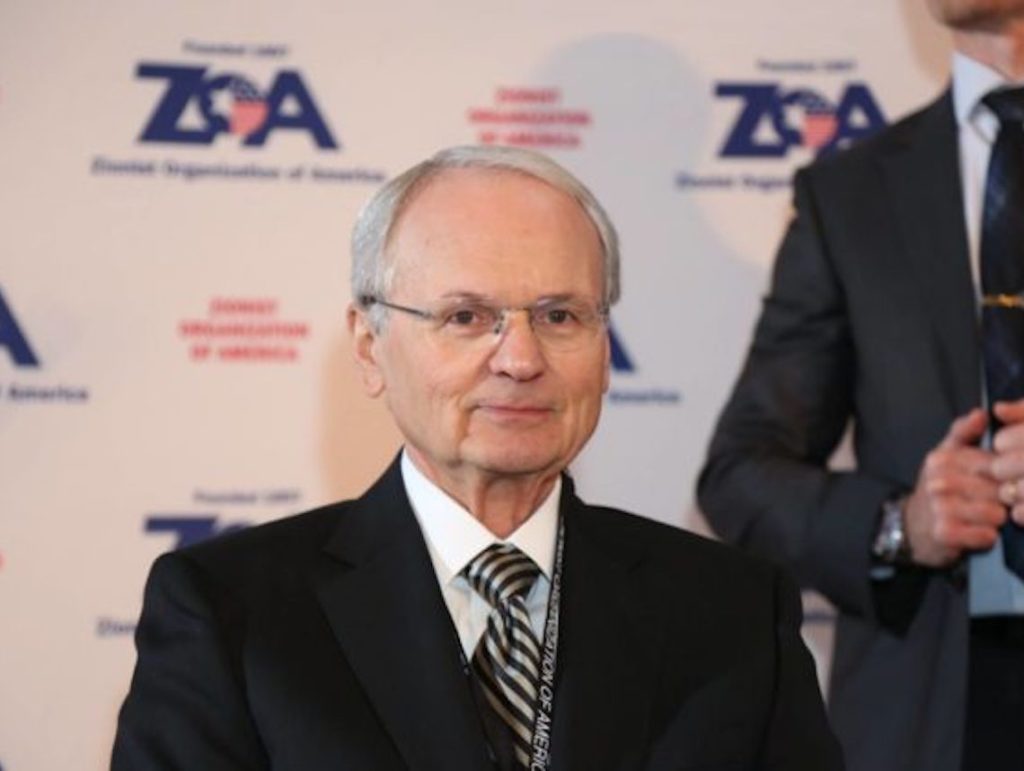
Mort Klein, President of the Zionist Organization of America, is calling reports about Sheldon Adelson disavowing his campaign against H. R. McMaster “fake news” and “rubbish.”
Klein, who is on a speaking tour in Europe, insisted in a phone conversation with Jewish Insider on Wednesday that he did not consult with Adelson before launching his aggressive campaign against McMaster and that the Vegas casino mogul has never said he supported the National Security Advisor.
“Sheldon never said he endorsed McMaster. He’s made it clear that he does not take a position about McMaster. Sheldon simply said that he did not ask ZOA to do a campaign against him, that this had nothing to do with him,” said Klein. “He did not ask us to do this campaign. I haven’t even spoken to Sheldon about this. We do many projects without asking our donors.”
Klein said that U.S. Ambassador to Israel David Friedman asked him to publicize a letter he sent to ZOA asking them to listen to his arguments in defense of McMaster, but has so far not followed up. He also insisted that he did not coordinate his attacks against McMaster with White House Chief Strategist Steve Bannon. Klein also said that he “knows for a fact that Adelson did not ask that Bannon be fired.”
Asked if he would stop his campaign against McMaster if Bannon called him to do so, Klein said he would only oblige if he’s provided with “new information that showed that he is a friend of Israel and wants to fight Iran.”
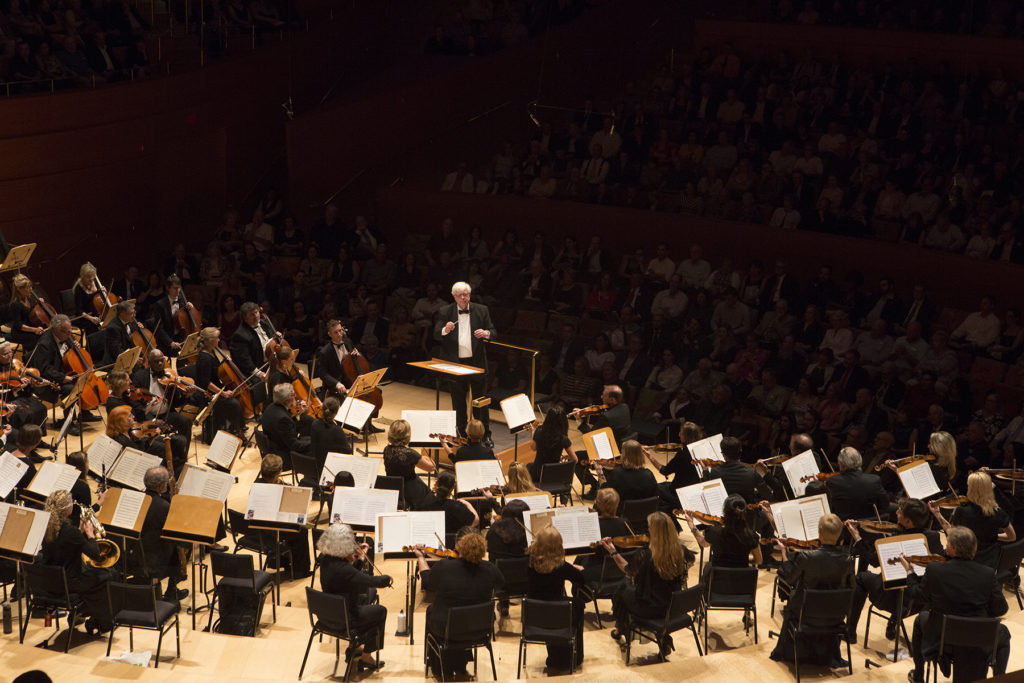
The news that conservative commentator Dennis Prager would conduct the Santa Monica Symphony was met with dissent from some of the symphony’s volunteer musicians. But at least for the duration of the Aug. 16 performance at the Walt Disney Concert Hall, the sounds of classical music drowned out any controversy that preceded the show.
“Just curious, are there any fans of Dennis here tonight?” the symphony’s music director, Guido Lamell, asked the sellout crowd, to uproarious applause from a great majority of the audience.
Prager’s conservative views, aired on his daily radio show and in his regular contributions to the Jewish Journal, put him at odds with the political mainstream in overwhelmingly liberal Santa Monica. So when a group of volunteer musicians objected to his planned appearance at the fundraising concert, encouraging their fellow players to sit it out, “I cannot say that I was shocked,” he told the Journal by email.
But for the radio host, a longtime classical music buff, the thrill of conducting a 72-piece orchestra in a world-famous venue overwhelmed any controversy, he said.
“Disney Hall is such an extraordinary honor that it wasn’t even on my bucket list,” he wrote in the email, referring to the renowned concert hall in downtown Los Angeles.
The hall is a considerable step up from the symphony’s regular venue at Santa Monica High School, where it offers free concerts to the public. In spite of that, some musicians were put off when Lamell announced in March that Prager would take the baton at the symphony’s Summer Gala Concert, its first Disney Hall appearance.
“We believe that Dennis Prager’s publicly stated positions are fundamentally at odds with our community’s values and that the proposed concert would deeply damage our orchestra’s relationship with our community,” four symphony members wrote in an open letter posted online dated March 27.
The letter cited Prager’s opposition to gay marriage and multiculturalism, and his endorsement of President Donald Trump’s travel restrictions as stances that bring him in direct conflict with members of the orchestra and its community. Their statement drew a chorus of local figures and officials in solidarity, including a Santa Monica councilmember who called Prager a “bigoted hate-monger.”
UCLA political science professor and symphony violinist Michael Chwe, who co-authored the letter, worried that Prager’s appearance would permanently damage the symphony’s reputation, especially within the liberal community that makes up its regular audience.
“If people associate the Santa Monica Symphony with right-wing bigotry, it’s hard to fix that,” he told the Journal before the concert.
Lamell said in the March email announcing Prager’s appearance that it would help the symphony address a “serious shortfall” in its budget. But the reasoning left some musicians unconvinced.
“There are just a million celebrities, all sorts of musicians,” said Jeff Schwartz, a co-author of the letter. “I can’t believe there isn’t a less offensive person who wants to pose in front of the band with a stick for half an hour.”
Prager addressed his critics in the email to the Journal, describing the incident as an example of “how the intolerant were defeated.”
“Disney Hall was sold out in large measure because people are sick of the totalitarian silencing of conservatives,” he said.
Lamell told the Journal before the performance that he had no problem mustering a group of musicians from his roster of some 700 volunteers. Lamell, a 39-year member of the Los Angeles Philharmonic, said he wanted to expose his volunteers to the venue where he makes his living.
“I wanted them to have the privilege of playing in the Walt Disney Concert Hall, and I have had far more people wishing to play than possibly can be accommodated,” he said.
He predicted that the symphonies would “overwhelm the political issues.”
“If I dare use this term, music trumps politics — absolutely,” he said.
A number of the musicians agreed.
Asked if he was endorsing Prager’s political views by playing the concert, violinist Steve Ravaglioli said, “No, absolutely not, because I don’t endorse his political views. I might endorse some of what he says, but I don’t I don’t feel like playing with him conducting is a political statement, period.”
Politics went unmentioned at the performance, where Lamell’s traditional choices of Mozart and Beethoven stood in contrast to Prager’s selection of Joseph Haydn’s Symphony No. 51, a rarely performed piece with a notoriously difficult horn passage.
Prager promoted the performance beforehand on his radio show and his online video platform, PragerU, helping to sell out the venue’s more than 2,200 seats. A Haydn enthusiast, Prager intermittently mentions his love of classical music on the air and has been asked to conduct on a volunteer basis for several local orchestras. Previously, his most notable appearance was leading the Los Angeles Philharmonic in a rendition of “The Star-Spangled Banner” at the Hollywood Bowl in 1994.
At the Aug. 16 performance, Prager led the orchestra through the four movements of the Haydn symphony before deconstructing the music, isolating each section one-by-one, first the cellos and basses, then the violins, then the horns and woodwinds, beaming with the enthusiasm of a kid with a shiny new toy. “This is awesome,” he told the audience.
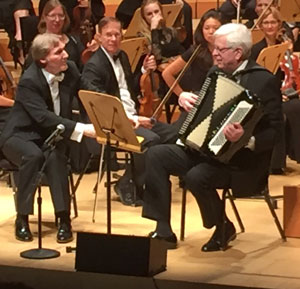
Dennis Prager surprised the audience with a rendition on his accordion of “America the Beautiful.” Guido Lamell accompanied him on the musical saw. Photo by Eitan Arom
After Lamell closed the program with Beethoven’s Symphony No. 5, Prager surprised the crowd with an encore performance of “America the Beautiful” on the accordion, with Lamell accompanying him on a musical saw.
“We figured we’d try to do something you haven’t seen too often,” Lamell said.
The audience was livelier than those who normally show up to classical concerts, unrestrained from applauding between movements and calling out to the conductor.
“Thank you for neutralizing the turbulence, Dennis,” one audience member, Kenneth Rogers, called out audibly after the Haydn piece concluded. “How could anybody remain angry?”
Rogers told the Journal afterward he was referring to the controversy that preceded Prager’s appearance, as well as the controversy Prager faces on an almost daily basis. But, Rogers, a retired Los Angeles Unified high school teacher, said, “This is a wonderful forum to break from, as I put it, all the turbulence that’s out there.
“All the conservatives are out there in the audience, but there are quite a few liberals up there among the musicians,” he said. “I was kind of wondering what would happen tonight. Can’t we set aside our differences?”
Moral clarity is an important part of political life. Thus, that the first few days after Charlottesville were dedicated to shock and indignation is understandable. Pragmatic assessment of a situation is also an important part of political life. Thus, it is time to examine Charlottesville and its consequences with clear eyes and search for its true practical meaning.
I will try doing this from a Jewish perspective.
What is the Jewish perspective?
There is a wider definition of a Jewish perspective in this case and a narrower one. The wider perspective is to argue that all elements of this crisis have something to do with a Jewish perspective. For example, according to this perspective the questions concerning the fate of Robert E. Lee statues across America – e.g., should they stay or be removed? – are Jewish questions. They are Jewish questions because Jews in America have something to say about them, and because many of these Jews will be using Jewish sources and their understanding of Jewish morals to formulate and justify their positions on this matter.
A narrower Jewish perspective is the one of Jewish survival. Of course, such an approach to Charlottesville is somewhat problematic, as Jews, rightfully, feel that they have a lot to say about the larger issues haunting America. But in other ways the narrow approach is useful. It is useful because it does not involve debatable notions about the meaning of Jewish values. It is useful because it is more focused and hence can allow a clearer analysis.
I will stick with the narrower approach.
The perspective of Jewish survival
The American Jewish community is one of the most impressive in Jewish history. It is vibrant and strong, confident and influential, self-sustaining and outward looking. It is truly a marvel, the jewel in the Jewish crown.
All Jews ought to want this community to keep thriving.
So the question about Charlottesville is as follows: was this an event that somehow threatens the continuous thriving of the American Jewish community?
To answer such questions, we need to examine the different scenarios that could potentially lead to Charlottesville becoming a watershed event in the life of the American Jewish community.
How many neo-Nazis?
Neo-Nazis are generally bad for Jewish survival. They make the lives of Jews less comfortable, they make Jewish institutions vulnerable, they impose on every Jew a dilemma: Is Judaism important enough for a Jew to take the risk of a clash with bigoted and violent people?
There were Jew haters in Charlottesville – that we know. Their numbers were not great – that we also know. According to many reports, “Hundreds of white nationalists, white supremacists, neo-Nazis, Ku Klux Klan members and others were involved, by some estimates, in what Heimbach, leader of the Traditionalist Workers Party, called the nation’s biggest such event in a decade or more.”
So, it was “hundreds.” And it was the “biggest such event in a decade.” If the biggest such event can only draw hundreds of racists, the threat to Jews does not seem significant, not if we count the sheer visible power of these groups of anti-Semites.
What is the public’s reaction?
The public has no inclination to support the type of racist rhetoric and views that we’ve seen in Charlottesville. Support for the Ku Klux Klan is 2 percent, according to a recent survey. Support for “white nationalists” is 4 percent. Only a quarter of Americans said in this poll that the response of President Trump to events in Charlottesville was “strong enough,” with a majority believing it was not strong enough – thus emphasizing that in their view condemnation of the racist demonstrators should have been stronger.
So the Jews are worried, and should worry, about a small number of neo-Nazis. But they currently have no immediate reason to worry that America is becoming less tolerant towards Jews or more supportive of racist groups. Is it likely that Charlottesville will be a watershed moment from which racist groups benefit? It is possible, but not likely.
What about the President?
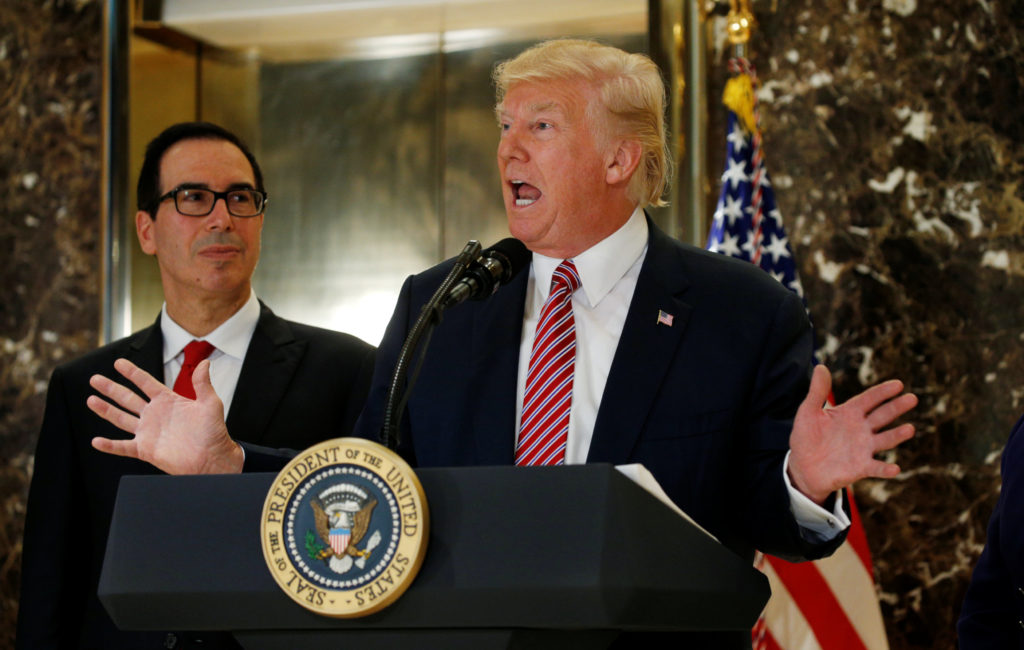
The President clearly erred in his response to Charlottesville. His press conference was hardly his finest moment.
It was not his finest moment because, yet again, he proved to be deaf to the society over which he presides. There is also context to what a president must say at a certain time. Educating Americans on the importance of heritage and of statues, or on getting all the facts before making statements, or on the perils of using clubs on demonstrators – all this has a time and place. But in the context of Charlottesville, after a woman was murdered, after demonstrators chanted abhorrent slogans against other Americans, the president failed to grasp the moment. He failed to grasp that when he spoke in the same sentence or the same paragraph about “bad people” on “both sides.” What the good people hear is him putting all bad people on the “same moral plane.”
What does this tell us about Trump? It does not tell us that he is a racist or a bigot. It does not tell us that he supports racists or bigots. It does not tell us that he puts political priorities before morality (no sane person can see him politically benefiting from the occurrences of the last few days). It tells us what we already know – that he is an undisciplined, disorganized, contrarian, immature president. It tells us bad enough things about him, without us having to attribute to him what he did not intend to say.
So what about the President?
If you accept my understanding of the President’s actions and words – admittedly, a relatively benign understanding of it – worries about the president ought to also be benign. Yes, there is reason to worry, because a key element in keeping fringe groups isolated and small is to have them delegitimized by the political system, and the president was not clear enough in doing that.
Still, because I assume that Trump is not a secret admirer of white nationalist groups, I also assume (and hope) that he will find the time to make his position clearer, and that he will instruct his administration to keep these bad people subdued.
But many Americans would not accept my understanding of the President’s actions and words. These Americans believe that the president is a supporter of white nationalist groups and their ideology. These Americans believe that Trump’s intention is to aid and abet the rise of groups with ugly ideologies.
If they are correct, there are two reasons for worry. One, support from the president gives these movements credence and prestige that they never had, and thus could gradually draw more Americans to support them. Two, support from the president means a less vigilant effort by the administration to battle against these groups. For example, it could mean a less than vigilant effort to identify and arrest Americans who act violently against Jewish institutions.
What will Jews do?
The response of Jews to Charlottesville is also important as we ponder our question: was this an event that somehow threatens the continuous thriving of the American Jewish community?
Jewish response to anti-Semitism, or to the threat of anti-Semitism, varies. But it has two main versions. One – to unite and fight. Two – to lower the profile and hide.
In Europe, where anti-Semitism is a more present problem for Jews, many of them choose to lower their profiles. As my colleague Dr. Dov Maimon of JPPI (the Jewish People Policy Institute) once described it: “the largest portion of European Jews has chosen to adopt a discrete Jewish profile, putting aside their commitment toward Judaism, Israel and their fellow Jews and often also abandoning the traditional Jewish commitment to the underdog. In other words, and to use the same categorization, they choose the INDIVIDUALIST positioning, drifting progressively toward assimilation.”
America is different. It is different because American society is welcoming of Jews. It is different because American Jews, for a long time now, have become used to having a high profile. Indeed, what we have seen in the last couple of days is proof of American Jewry’s confidence in asserting its position, coupled with its instinctive and high sensitivity to racism. What we have seen in the last few days is an American Jewish community that is being reminded of how it has a shared stake in having a tolerant America.
Is the outcome unity? Not exactly, but this is surely a moment of less division. When Jews see a common enemy, they push aside their differences, even if just for a little while,.
This is the short-term outcome of Charlottesville, but there can also be a long term, less positive outcome because of two things:
1. If the American debate on racism becomes a constant central feature of political life, this can still make many Jews decide that it is more convenient for them to lower their profile and be less visible as Jews. If the confidence of racist groups rises, and Jewish institutions are threatened, many Jews could decide that their security justifies disengagement from the community – this is something we saw earlier this year when bomb threats targeted Jewish institutions.
2. The debate over the proper way of responding to racist America can become in itself a source of tension and inner-Jewish bickering – especially so because of its political undertones. We already see signs of that in the attacks hurled at Rabbi Marvin Hier, “Trump’s rabbi.”
Jews and politics and anti-Semitism
Three days ago, I made the case against Jews portraying Trump as a bigoted anti-Semite. “It is not wise for Jewish institutions, organizations and leaders to paint President Trump as an ally of anti-Semitism because it is very unlikely he is anti-Semitic and because such accusations, when repeatedly hurled at people, tend to become self-fulfilling prophecies.”
Jews have to be vigilant in fighting against bigotry and anti-Semitism. They also have to be wise about it, and being wise means keeping anti-anti-Semitism bipartisan. Portraying all political rivals as racists and bigots and anti-Semites is the lesser policy, as it shrinks the camp of Americans that can be allies in combating against anti-Semitism. Isolating the fringe groups of racists and bigots and anti-Semites and keeping all others as allies is the better policy.
Will the Jews be wise? There is a fine line separating disappointment and frustration because of Trump’s response to Charlottesville and turning this incident into a partisan political tool with which to hammer a political party or camp. Some Jews walk this fine line delicately, and many cross over it irresponsibly.
The bottom line
Clear and harsh response to racism is justified.
Expectations for a proper presidential response are justified.
Sober assessment of the need for heightened security measures is justified.
Politicizing the fight against anti-Semitism is unwise.
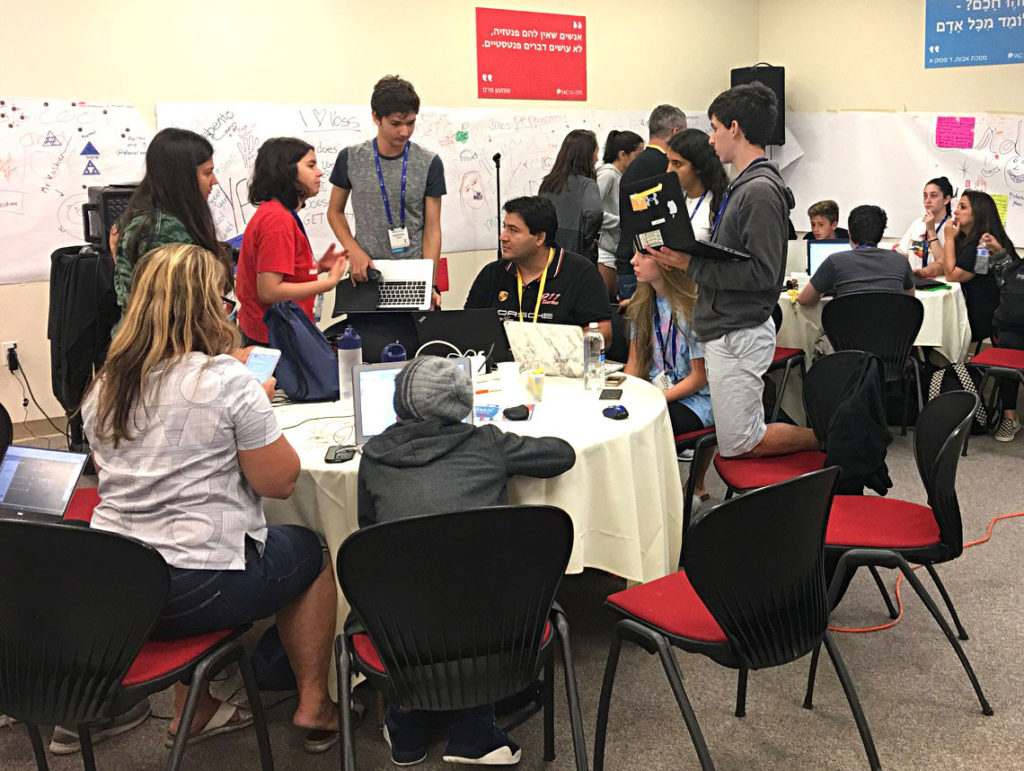
The room is a flurry of activity. At each table is a group of 10 teens working on their projects. One group has a white board filled with a to-do list, ranging from pricing its product to establishing a user base. Another group stands around a laptop, as one member works on a virtual grocery store and the others take turns offering advice and criticism.
Welcome to the Israeli American Council Eitanim Summer Hackathon, held Aug. 3 at the American Jewish University. It’s a national program that strives each year to teach students professional skills to prepare them for college while providing a connection to Israel.
This year, more than 150 teens worked in groups to create innovative ideas with the help of professional mentors, leading to Demo Day, when the final projects went before the judges: Ilana Golan of Speaking Golan Ventures, Kfir Gavrieli of Tieks and Metuka Benjamin of Milken Community Schools.
The winning group designed an app to assist in Hebrew learning in school and at home. Second place went to a group that created a virtual reality experience for learning Israeli history.
“What we do here, and what we do throughout the year is give students the opportunity to engage in project-based learning with other American Jews and Israeli-American Jews,” said Orit Mitzner, National Director of Programs for IAC Eitanim. She added, “We want to give them real experience and we want them to learn about Israel not like they usually do, but through projects and innovation. We want them to lead, and we want them to innovate. And as you’ll see tonight, they already are.”
Each of the groups around the room was structured like a real company, with one student acting as CEO and the others serving in such roles as chief financial officer or programmer. The groups work on a business idea, then flesh it out. One group worked on an education game that could help students practice Hebrew language skills.
Mentors from various fields offer advice and critique the teens as if they were operating a real business. “It’s the kind of experience that you won’t get anywhere else” said Kobi Laredo, Cloud Technical Account Manager for Amazon Web Services. Like the other 14 mentors at the Hackathon, he moved from group to group, giving advice and feedback.
“It’s amazing seeing the ideas they come up with. I’ve helped one group with a virtual reality project, another with a social media application — it’s interesting.” Laredo said. “We [the mentors] bring in experience and background. But it’s [the kids] that get to shine and show their leadership and problem-solving skills.”
Although the teens’ projects won’t be developed, Mitzner said the skills learned along the way are just as important as a finished product. “We seek to engage these kids on four levels: through the self, technology, interpersonal level and mentorship,” she said.
“It’s really hard.” said Julian Wiese, the student in charge of software development for the educational game project. “We want to make a virtual space for kids to practice their Hebrew so they’re not just doing it through a book all day. It’ll be interactive.”
“It’s been a great but tough time,” said Cassidy Dalva, a student working as the chief operating officer of that same group. “The whole project has taught me a lot about working in business. And honestly, even though it’s a lot of work, we get some time to just hang out and make friends.”
As serious a program as the Hackathon is, it also enables teens to mingle with others who have similar interests. They socialize, listen to talks from other mentors, and dance.
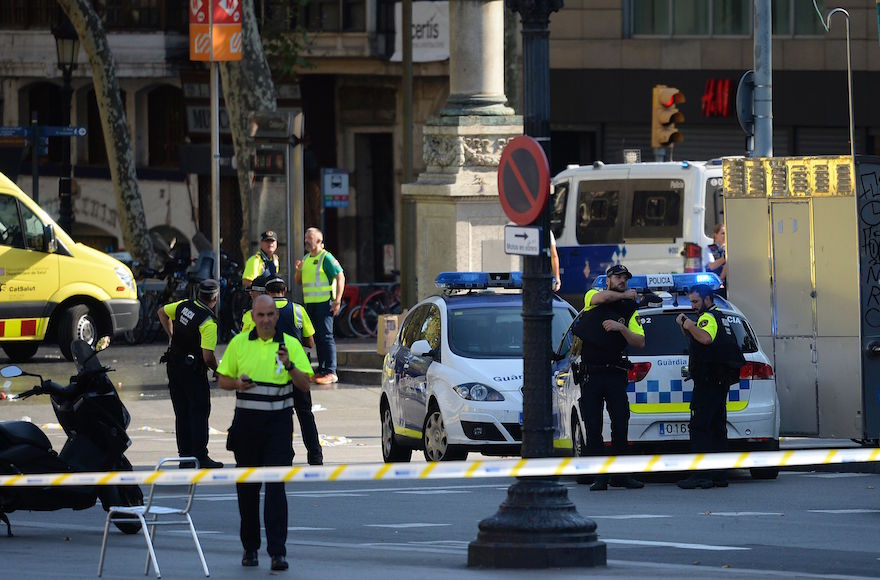
A van plowed through a crowd of people on Barcelona’s main shopping street, reportedly killing at least 13 people and injuring more than 50 others.
Police said they were treating the Thursday incident as a terrorist attack, according to the French news agency AFP.
The Catalan government’s minister of the interior announced the death toll of the the attack on Rambla avenue near the entrance to Maccabi, a kosher restaurant, CNN reported. Spanish media, including the online edition of the El Mundo daily, reported that the bulk of injuries occurred outside the FNAC department store on the same street.
Barcelona’s chief rabbi, Rabbi Meir Bar-Hen, said it did not appear the attack targeted Jews, but security forces instructed him to temporarily close Jewish institutions in the city, according to Israel’s Channel 10. The Daily Mail reported that several people were injured outside the restaurant.
This photo from Barcelona appears to show the aftermath of today's incident; the kosher restaurant, Maccabi, is visible on the right. pic.twitter.com/yWlOZA8gTU
Reports stated that local police have arrested one man in connection to the attack. Some reports have speculated that this man is Driss Oukabir, a Moroccan citizen who the Spanish-language paper El Pais identified as the van’s renter. Avi Mayer, a spokesman for the Jewish Agency for Israel, posted an item from what appears to be Oukabir’s Facebook page showing an anti-Semitic video.
Witnesses at the scene said the driver of the vehicle fled on foot and shots were fired. Shortly after the attack, two armed men entered the Turkish restaurant Luna de Estambul, according to The Associated Press. The men were holed up there as police surrounded the place, Mundo Hispanico reported.
In photos from the scene of the attack, men and women in summer clothing are seen lying on the ground, and in some cases being treated by civilians and medics.
As the car began hitting pedestrians, a stampede occurred on the street and in the FNAC store, injuring more people, according to El Mundo.
The smartest graffito I ever saw proclaimed “If I didn’t believe it with my own mind, I never would have seen it.” The converse works too: deep beliefs blind people to the obvious.
Maybe that observation explains president Donald Trump’s insistence that last weekend’s Charlottesville debacle was really about a Robert E. Lee statue, despite the ubiquitous Nazi flags, and the chants of “Jews will not replace us.”
Trump is not entirely wrong that there was violence on both sides. Many Nazis were eager for a fight, and some of the anti-fascists (who have disrupted conservative speakers on campuses in recent months) were too. But for him to equate the groups with the presidential stamp of moral equivalence does more to promote white supremacy than any other presidential act in memory.
The Nazi-like torch-lit march to the Lee statue, and the Nazi flags (let alone the Confederate ones) should have been enough to tell the president that this event wasn’t about anything other than white supremacists feeling empowered to express their belief that the only true Americans are white Americans.
Trump said he needed a couple of days to figure out what happened, but didn’t he hear the “Jews will not replace us” chant? Does he have any clue what that means?
White supremacists see themselves as biologically superior to non-whites. Yet they see America becoming a nation that will, in just a few decades, be majority non-white. They fear they are being “replaced,” but how can they be losing this battle to people they define as inferior? The explanation is that there is a hand on the scale, making them lose. It’s the Jews, and their support for immigration and civil rights for all, that are the culprits.
Jews are “replacing” whites in two ways, in their view. One is the perceived power of the Jewish community, which while small has had great success in many spheres. They also believe Jews actively seek to destroy whites by injecting “inferior races” into society. This is not a new libel. The charge that Jews secretly conspire to harm non-Jews is at the core of Nazism. It was also popular among many of the “America Firsters” of the 1930s.
The chants about Jews, the flags, the torches, were clear evidence – in their own words and actions – what the alt-right was organizing for. So how was Trump so blind and deaf?
Perhaps because he knows that to many of his supporters the slogan “Make America Great Again” means “Make America White Again.”
Perhaps because he gained the presidency by stoking fears of the “other,” the other being non-white immigrants and Muslims, while retweeting antisemitic memes.
White supremacists not only revel in Trump’s stereotyping of people they loath, they easily see the Trump double standard.
Yes, there are immigrants who commit acts of violence, and Trump holds immigrants responsible as a group. Yes there are Muslims who commit acts of terror, and Trump effectively blames all Muslims.
When white supremacists and neo-Nazis spew hatred, he says wait, there are some good people among them, you can’t tar a whole group; and as a matter of fact those who oppose the white supremacists are no better.
The double standard goes further. Imagine a Muslim man plowing a car into demonstrators. Within nanoseconds the presidential Twitter finger would have blamed “radical Islamic terrorists.” Same act by a white supremacist – where’s the tweet?
The Nazis have good reason to feel empowered. They see a president targeting non-white groups, and twisting logic like a pretzel to defend white racists. They know that others whom they seek to recruit, who might otherwise fear being associated with overt hate, see the president essentially saying it’s ok.
Symbols are powerful, and people have died for them. The rallying point for the alt-right was not Robert E. Lee as a person, but Robert E. Lee as a symbol of white supremacy. But again, Trump missed the obvious. He’s not entirely wrong that some on the left would want to remove symbols of slavery, and that by that logic Washington and Jefferson are troubling figures. I agree with him that these statues (unlike the Confederate flags over statehouses) should stay. We erase the troubling parts of our history at our peril; much better to leave them – Lee included – and surround them with explanations why they were venerated as part of an effort – that still continues – to promote the oppression of black Americans.
But Trump made no such distinction, and his statements over the last days have ensured there will be other Charlottesvilles, the white supremacists believing the president is behind them.
When this happens, policing must be better (keeping groups apart), and other political figures – as many did this past week — must condemn white supremacy in strong terms.
Local groups, including religious and human rights groups, have a key role here too.
Earlier this year, faced with a threatened, armed, neo-Nazi march in western Montana, the Justus & Karin Rosenberg Foundation partnered with the Montana Human Rights Network to launch a “project lemonade” response. People made financial pledges, so if the Nazis marched, they would donate money (up to a specified limit) tied to how long the march lasted. The money would go to things the Nazis detested, such as security for Jewish institutions, hate crime training for the police, and educational efforts against bigotry. In effect, the Nazis’ speech wasn’t free – they were helping raise money for things to defeat them and their message.
The Nazis didn’t show up in Montana, after people from around the country made Lemonade pledges.
I encourage other local groups to adopt this same strategy. It’s a way for all of us to stand together against hate, even when the president does not.
Kenneth S. Stern is the Executive Director of the Justus & Karin Rosenberg Foundation.
In a message sent to Malcolm Hoenlein, CEO of the Conference of Presidents of Major American Jewish Organizations, Israel’s President, Reuven Rivlin, expressed his support and solidarity and that of all the Israeli people, with the American Jewish community in the difficult times following the events in Charlottesville, and he asked that his message be shared with Jewish organizations and communities across the United States.
Dear Malcolm,
At this difficult time, I want to express my support and solidarity, and that of all the Israeli people with you and your communities, and ask that you kindly convey this message on my behalf to the Jewish communities across the US.
The very idea that in our time we would see a Nazi flag – perhaps the most vicious symbol of anti-Semitism – paraded in the streets of the world’s greatest democracy, and Israel’s most cherished and greatest ally is almost beyond belief.
We have seen manifestations of anti-Semitism again and again arise across the world; in Europe and the Middle East. In the face of such evil, we stand now as we did then. With faith. With faith in humanity, with faith in democracy, and with faith in justice. I know that the great nation of the United States of America and its leaders will know how to face this difficult challenge, and prove to the world the robustness and strength of democracy and freedom.
As we say Chazak, Chazak, ve’Nitchazek. Be strong, be strong, and we will be strong.