fbpx

August 1, 2017

Trump White House was involved with retracted article linking slain DNC staffer to WikiLeaks, lawsuit alleges

The Trump White House was involved with concocting a Fox News article that linked the death of a Jewish Democratic National Committee aide with WikiLeaks, according to a lawsuit filed by a private investigator who repeatedly discussed the case on Fox News.

The private investigator, Rod Wheeler, alleges in his suit, filed Tuesday, that Fox News and and Trump supporter Ed Butowsky, with the blessing of the White House, pressed ahead with the unfounded rumors about Rich’s death in order to shift public attention away from an FBI probe into the Trump administration’s ties to the Russian government.

Rich, a 27-year-old Nebraska native, was shot dead while walking home before dawn on July 10, 2016. Police have speculated that he was the victim of a robbery gone awry. Rich’s body was found about a block from his Washington, D.C., home with his wallet, watch and cellphone still in his possession.

Conspiracy theories about his death gained traction on right-wing news sites. In May, Fox published stories based on unfounded allegations that Rich was targeted because he was leaking information to WikiLeaks that would damage the DNC. The news channel removed the articles a week after publication, claiming the initial story “was not initially subjected to the high degree of editorial scrutiny we require for all our reporting.”

According to Wheeler’s suit, Butowsky, a Dallas wealth manager with ties to White House adviser Steve Bannon, met with Sean Spicer, then a White House spokesman, to inform him about the article involving Rich. The lawsuit also alleges that Butowsky, who appeared on Fox News as a Republican surrogate, bragged that President Donald Trump had looked at drafts of the article prior to its publication.

Butowsky told NPR his comments had been a joke. Spicer said he was not aware of Trump being involved with the story, according to NPR.

Wheeler also alleges that a Fox News reporter made up quotes attributed to him as part of its reporting on the Rich case.

The president of Fox News, Jay Wallace, told NPR that there was no “concrete evidence” that the network’s reporter, Malia Zimmerman, attributed false quotes to Wheeler.

In August, WikiLeaks offered a $20,000 award for information leading to the conviction of Rich’s killer. WikiLeaks founder Julian Assange in an interview on Netherlands TV suggested that Rich may have been a source for the leaks clearinghouse, reigniting conspiracy theories.

Rich’s parents have criticized conservative news outlets for airing the conspiracy theories, callingthem”baseless” and “unspeakably cruel.”

Trump White House was involved with retracted article linking slain DNC staffer to WikiLeaks, lawsuit alleges Read More »

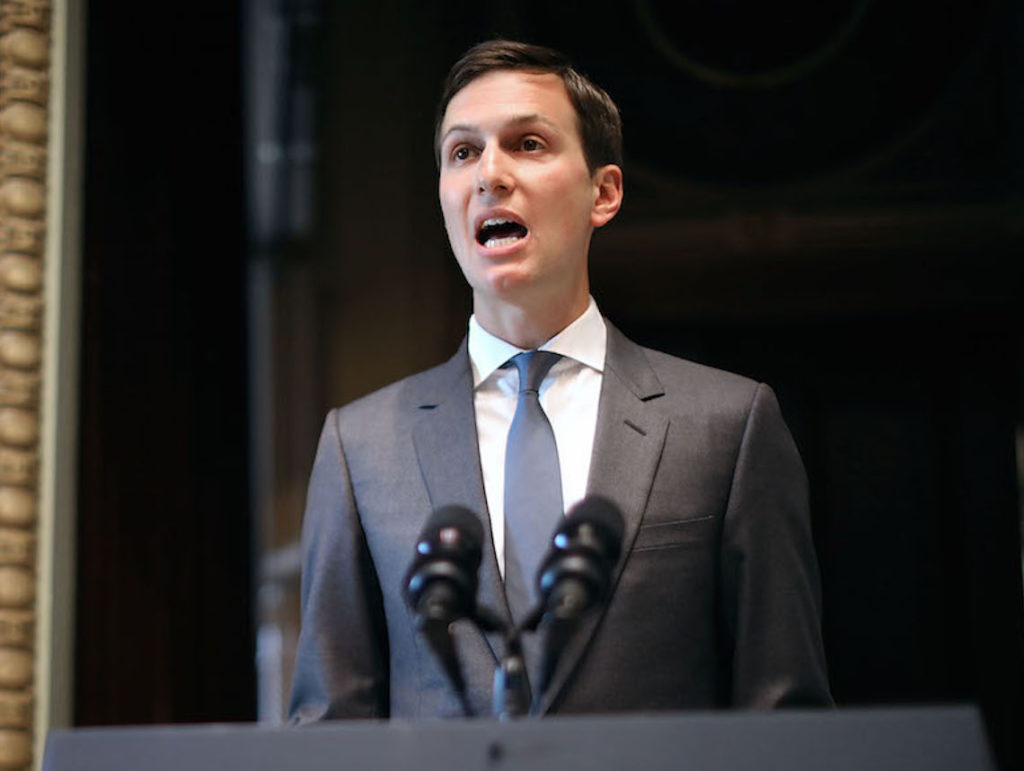
Jared Kushner on Israeli-Palestinian peace: ‘There may be no solution’

If Jared Kushner is the only person who can deliver Middle East peace — as his father-in-law Donald Trump said — he comes off as a reluctant savior.

In a speech delivered Monday to a group of congressional interns and leaked to the media, Kushner expounded on the Trump administration’s efforts to achieve Israeli-Palestinian peace. What emerged was an outlook that at once was resolutely pro-Israel and skeptical of the chances of success.

“So what do we offer that’s unique? I don’t know,” Kushner said in his seven-minute answer to an intern’s question in a recording obtained by Wired magazine. “And we’re trying to work with the parties very quietly to see if there’s a solution. And there may be no solution, but it’s one of the problem sets that the president asked us to focus on.”

Kushner traveled to the region in June along with President Trump’s chief negotiator, Jason Greenblatt, to meet with Israeli and Palestinian stakeholders and suss out the chances of reaching a peace deal. It’s among a bevy of issues that Kushner has taken on as a senior adviser to his father-in-law — including criminal justice reform, streamlining the federal government, stemming the opioid addiction crisis and more.

In the speech, Kushner sounds unenthused to be handling the peace process. He opens his answer by saying “this is one of the ones I was asked to take on,” and becomes more pessimistic from there, criticizing Israeli and Palestinian leaders for being mired in history and unable to let go of minor provocations.

“You know everyone finds an issue, that ‘you have to understand what they did then,’ and ‘you have to understand that they did this,’” Kushner said. “But how does that help us get peace? Let’s not focus on that. We don’t want a history lesson. We’ve read enough books.”

He also made some questionable claims. Kushner said that “not a whole lot has been accomplished over the last 40 or 50 years we’ve been doing this,” apparently dismissing Israeli peace pacts with Egypt and Jordan, the Israeli-Palestinian Oslo Accords and Israel’s withdrawal from Gaza. Then he said “the variables haven’t been changed much” — something that both Israeli and Palestinian officials would fiercely dispute. Israelis charge that their withdrawals from territory have been met only with terror and incitement, while the Palestinians claim growing Israeli settlements are making a Palestinian state near impossible.

Aaron David Miller, who worked on the peace process in Republican and Democratic administrations, said he appreciated Kushner’s skepticism while adding that his dismissal of history is misguided.

“If you want to have any chance of doing anything on this issue, you have to see the world the way it is, not just the way you want it to be,” Miller told JTA, adding later, “You do need a history lesson, big time, because if you don’t know where you’ve been, you don’t have a chance of figuring out where you’re going.”

Kushner did boast how the Trump administration mediated an agreement to provide Palestinians with an increase of 32 million cubic meters of fresh water. He also praised his team for helping resolve the recent Temple Mount crisis that erupted when three Arab-Israeli gunmen killed two Israeli police officers, and escalated when Israel set up metal detectors at the holy site revered by the Muslims as the Noble Sanctuary.

In describing recent events, Kushner displayed a pro-Israel stance — unsurprising given that he was raised in pro-Israel Jewish day schools and Israeli Prime Minister Benjamin Netanyahu once slept in his childhood bed. Palestinian officials have criticized Kushner for siding with Netanyahu during his June meeting with Palestinian Authority President Mahmoud Abbas.

Kushner did not speak of the two-state solution in his answer. He defended Israel’s decision to erect metal detectors as “not an irrational thing to do,” although Palestinians decried the move and said the security measures made them feel like suspects at their own holy site. He criticized a Palestinian imam for forbidding worshippers from passing through the metal detectors.

And in recounting fatalities during the weekend of violence that followed the detectors’ placement, Kushner listed only the Israelis — including three members of an Israeli family stabbed to death in their home by a Palestinian terrorist — and did not mention the Palestinians.

Miller said that while Kushner is clearly pro-Israel, he is not the first American negotiator who is partial to Israel’s interests due to longtime associations with the country.

“It’s clear that emotionally, by virtue of his background and his association with Israel and the prime minister, there’s a high degree of sensitivity” toward Israel, Miller said. “That’s hardly new in the wonderful world of peacemaking. You could have said that about any number of individuals who participated in this process over the past 20 years.”

Israeli-Palestinian peace efforts have been largely stalled for well over a decade. Four years ago, then-Secretary of State John Kerry poured his energy into starting negotiations that ultimately went nowhere. The same goes for negotiators under the George W. Bush and Clinton administrations, including Bill Clinton himself. The Oslo Accords, however, were signed during his presidency.

The difference is that those negotiators all at least sounded optimistic as they were beginning their quests. Kushner, at least in this would-be private briefing, sounded at times like he was already close to giving up hope.

“You have some people who don’t want to see and achieve an outcome of peace,” he said. “And other people sometimes thrive in the chaos … And that’s not new to politics, and it’s not new to that conflict. It’s just the way it is.”

Jared Kushner on Israeli-Palestinian peace: ‘There may be no solution’ Read More »

imam

Kill the Jews! Oops, I didn’t mean it

Was it a Jew-hating one-off or a Jew-hating pattern?

That was the question on my mind when I heard the imam at the Davis Islamic Center, Ammar Shahin, apologize a week after his Jew-hating sermon in which he preached, “Oh Allah, count them [Jews] one by one and annihilate them down to the very last one.”

During a press conference held by religious leaders, a contrite Shahin said: “I understand that speech like this can encourage others to do hateful and violent acts. For this I truly apologize.”

What spurred his apology?

According to the Los Angeles Times, “In the days following his sermon, Shahin said he discussed his statements with a number of people within and outside the Muslim community. That’s when he realized ‘the level of harm it has caused.’”

In other words, until he talked to other people, it didn’t occur to him that calling for the annihilation of every Jew might cause “harm.”

So, was the Jew-hating sermon a one-off or a pattern?

It’s clear the Islamic Center would like us to believe it was an exception. After all, it’s a lot easier to excuse an exception than a habit.

But more than that, the Center wants to do what all smart lawyers tell you to do when your back is against the wall—change the target. Here, it is trying to do that by going after the messenger.

According to the Times, the Center’s initial reaction was that the imam’s comments had been taken out of context by “Islamophobic news organizations.” How many times have we heard that? This is a well-known reaction to criticism of Islam— attack the critic as “Islamophobic.”

The problem with that strategy, in this case, is that we’re dealing with hard facts. These are real words of hate spoken in real time by a real preacher.

The group that translated and disseminated the sermon, the Middle East Media Research Institute (MEMRI), is a resource that New York Times columnist Thomas Friedman has described as “absolutely invaluable.” It’s hard to undermine a group whose sole focus is to translate.

But that doesn’t stop people from trying. Even a group that criticized Shahin’s sermon, such as the Muslim Public Affairs Council (MPAC), couldn’t resist trying to take down the messenger.

“Groups like MEMRI exacerbate political divisions on the Middle East conflict rather than aim to reconcile differences,” MPAC said in a statement.

According to a report in JTA, MPAC “expressed frustration with MEMRI, an organization that has drawn fire from Islamic groups for what they say is its tendency to cut and paste Muslim pronouncements to cast them in the worst possible light.”

How’s that for a contradiction: Yes, we admit the sermon was vile and we apologize but please don’t trust the messenger who translated the sermon.

“We hear this all the time,” MEMRI founder Yigal Carmon told me on the phone. “Whenever we expose another Muslim preacher, they accuse us of cutting and pasting, of taking things out of context. They never mention that we show the whole context, the full sermon, everything, and allow viewers to make up their mind.”

According to Carmon, it is the Islamic Center that is doing the cutting and pasting. He claims the Center took down another embarrassing sermon from its website dated July 14, because “they want us to believe the July 21 sermon was a one-time thing.”

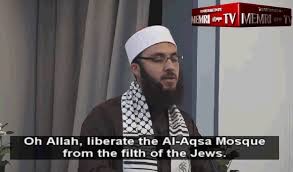
In the July 14 sermon, according to a MEMRI translation, Shahin prayed to Allah to “liberate the Al-Aqsa Mosque from the filth of the Jews” and to “destroy them and do not spare their young and their elderly.”

Carmon also says the Center took down a sermon in which Shahin called the November 2016 forest fires near Haifa “good news from Palestine” and another in which he characterized democracy and the U.S. Constitution as a form of “idolatry.”

A few hours after Carmon and I spoke, he called to let me know that the Center had taken down its Youtube account as well as all sermons from its website. When I went to check, I randomly clicked on about twenty sermons over several years and, indeed, they all said “this video is unavailable.”

So, was the Jew-hating July 21 sermon a one-off or a pattern?

You tell me.


David Suissa is president of TRIBE Media Corp./Jewish Journal and can be reached at davids@jewishjournal.com.

Kill the Jews! Oops, I didn’t mean it Read More »

Trump is thinking of breaking the Iran deal. Here’s how he could do it.

Campaigning last year for the presidency, Donald Trump said the Iran nuclear agreement was the “worst deal” he had ever seen.

It was never exactly clear, however, what he intended to do about it: Appearing at the American Israel Public Affairs Committee’s policy conference in March 2016, Trump said in the same speech that he planned to “dismantle” and “enforce” it.

As president, Trump appears to be edging toward dismantling. His administration recertified Iran’s adherence to the deal in mid-July, but it reportedly took the better part of a day for Secretary of State Rex Tillerson, Defense Secretary James Mattis and National Security Adviser H.R. McMaster to convince Trump to go along. Trump said afterward that he likely would not recertify by the next deadline, in mid-October.

And within days of recertification, Foreign Policy reported that Trump had set up a special White House team to provide him with a path out of the deal, seemingly sidelining Tillerson, a champion of recertification. Among those on the team: Trump’s top strategic adviser, Steve Bannon, and one of his deputies, Sebastian Gorka, both known for seeking to diminish America’s commitments to international alliances.

Every path out has its perils. The signatories to the 2015 deal, which trades sanctions relief for Iran’s rollback of its nuclear program, are Iran on one side and the United States, France, Britain, German, China and Russia on the other. Key to the success of any American pullout is to what degree its four partners — and other major trading partners with Iran, like South Korea and India — join in.

Should the United States walk away from the deal, the dilemma for those countries is what costs more: alienating the United States by keeping up trade with Iran, or angering domestic economic interests by going along with tough U.S. sanctions on the oil-rich country. The less persuasive the Trump administration case is for pulling out, the likelier it is that other nations would not cooperate and would continue to do business with Iran — setting the stage for increased U.S. isolation on the world stage.

“Europeans may look to contingency and fallback options if the United States unreasonably undermines the deal,” said Ellie Geranmayeh, a senior policy fellow for the Middle East and North Africa Program at the European Council on Foreign Relations.

In a conference call organized by J Street, the liberal Jewish Middle East policy group that backed the deal, Geranmayeh said European officials were planning to stage an all-out effort to keep the Trump administration from bolting.

“The challenge in the next three months is keeping the United States and the Trump character personally with keeping the deal,” she said. “In the next 90 days you’ll see a lot of activity on the Hill, in the State Department” by European diplomats.

Mark Dubowitz, who directs the Foundation for Defense of Democracies, a group that opposed the deal, said the Europeans would likely stick with the alliance, especially if the Trump administration’s aim was not to quit the deal but to reconfigure it.

“I don’t think Europeans are going to risk a transatlantic war with the administration, particularly if the administration is not looking to abrogate the deal but to improve it by addressing some of the flaws of the existing JCPOA,” he said, referring to the formal name of the pact, the Joint Comprehensive Plan of Action.

Here is a look at the possible paths out of the Iran deal for the U.S. and what the likely consequences would be.

Just walk away

U.S. assessments of Iranian adherence to the deal are governed by a law passed in 2015 with bipartisan backing, the Iran Nuclear Agreement Review Act. Under the act’s broad language, there may be room for the president to stop waiving sanctions on Iran simply because he sees the deal as inadequate. Parts of the law require Iran’s adherence with the JCPOA, but others are more fungible and depend on what the president determines are U.S. national security interests.

Under those circumstances, Trump has three options:

* Go to the joint commission governing the JCPOA and seek to have Iran declared not in compliance. The committee has eight members — the United States, Iran, Russia, Britain, France, China, Germany and the European Union, and decisions need a 5-3 vote. Obama pitched this arrangement as a guaranteed escape hatch because five partners at the time agreed on red lines: the United States, the three European countries and the EU.

Trump’s policy of distancing the United States from some aspects of the European alliance — the withdrawal from the Paris climate accord, for instance — means that comity is no longer guaranteed. He would need a substantive argument that Iran is not complying — not just that he thinks the deal is  bad one.

* Exercise the U.S. option to trigger the “snapback” of international sanctions. Under this complex mechanism, the U.S. veto on the United Nations Security Council would prevent other parties from reversing the snapback and the whole deal would effectively be dead.

Busting the deal just on Trump’s say-so could exacerbate tensions with U.S. allies, experts said, and drive the other partners to establish a separate arrangement with Iran.

“It will be difficult for the Europeans to defy Trump because of the close security and economic relations the Europeans have with the United States,” Geranmayeh said. “At the same time, I don’t think we should underestimate the European capacity to do so.”

* Stop waiving sanctions, but don’t blow up the deal. This would have the advantage of satisfying Trump’s call to exit the deal while avoiding, for now, a direct confrontation with U.S. allies, who would continue to do business with Iran under the terms of the deal. What’s uncertain is whether the United States would enforce secondary sanctions — that is, punishing companies and individuals in allied countries that do business with sanctioned Iranian entities.

Walk away, but explain why

There are signs that Trump is ready to make the case to the international community that Iran is not in compliance as a predicate to pulling out. Here are some strategies:

* Iran is not complying with the “spirit” of the deal. A day after Tillerson first recertified the deal in April, Trump said at a news conference, “They are not living up to the spirit of the agreement, I can tell you that.”

The reference was to Iran’s continued testing of ballistic missiles, its human rights abuses, its military interventionism in the region and its backing for terrorism worldwide.

The notion that Iran must abide by the deal’s “spirit” has been perpetuated for the most part by those who opposed the deal in the first place. The Obama administration, which brokered the deal, and its European partners do not see it this way: The deal, they say, was designed to remove the threat of a nuclear Iran as a means of more effectively confronting Iran in other arenas.

“Show me in black and white where there’s a definition of the ‘spirit of the deal,’” Daryl Kimball, the executive director of the Arms Control Association, a group that promoted the deal, said in an interview. “The Obama administration was crystal clear that this is a nuclear deal, this is not a deal that affects Iranian behavior in other areas.”

Another tack is to insist on more intrusive inspections of some Iranian military sites, which require Iranian consent under the deal. Getting backing among U.S. allies for this gambit would require persuasive evidence that Iran is violating the deal at these sites; that’s not necessarily a given.

* Iran is not in compliance with the letter of the deal.

This strategy was behind a letter last month by four Republican senators — Tom Cotton of Arkansas, Marco Rubio of Florida, Ted Cruz of Texas and David Perdue of Georgia — urging Tillerson to declare Iran not in compliance with provisions of the deal. The letter noted reports that Iran had exceeded the limits of heavy water — needed to enrich uranium — allowed under the deal, and was operating more enrichment centrifuges than permitted.

The excesses have been noted by the U.N. inspection agency charged with overseeing the deal, the International Atomic Energy Agency, or IAEA, but have also been deemed not significant enough to declare Iran in violation — a posture the Obama administration embraced.

Conservatives say this is typical of Iranian regime behavior, pushing the envelope as far as it can, and is dangerous.

“What would be highly imprudent is to continue the Obama-era practice of offering sheepish and fainthearted certifications as a matter of course, hoping no one takes notice,” the senators’ letter said.

One possible danger in pressing forward with such an approach: The international community, which places greater stock than the Trump administration does in international organizations, would see it as nitpicking and would side with the IAEA.

* Provoke Iran into leaving the deal.

Experts touted this strategy following Trump’s election but before he assumed office. It would involve abiding by the agreement, but increasing pressure through non-deal related sanctions, targeting Iran’s government for its missile testing and adventurism, and possibly increasing U.S. military presence in the region. According to this theory, the resulting pressure by Iranian hardliners on the government of President Hassan Rouhani, which favors the deal, would lead Iran to pull out.

The problem with this idea, said Ilan Goldenberg, a senior fellow at the Center for a New American Security and an Obama administration Middle East policy veteran, is that Trump has made it so clear he wants out of the deal that it would seem by now to be disingenuous — American allies would smell a set-up.

“Nobody believes he’s acting in good faith,” Goldenberg said.

Don’t leave the deal — but make the case it must be reconfigured

The Trump administration and Congress appear to be embracing this path for now, if only by default. Congress passed new sanctions last week targeting Iran’s non-nuclear activities, and Trump keeps tacking on sanctions by executive order.

The strategy, as described by Dubowitz of the anti-deal Foundation for Defense of Democracies, would be to make the case that Iran is effectively violating the agreement.

“You make it clear that they’ve been violating incrementally, but not egregiously — but you also make it clear the sum total ends up being egregious,” he said. “Then you waive the existing statutory sanctions but you impose very tough, economically painful non-nuclear sanctions that target Iran’s malign behavior.”

That gives the United States and partners leverage to bring Iran back to the table and address the deal’s flaws, including sunset provisions that end some of the international oversight in 15 years.

Trump is thinking of breaking the Iran deal. Here’s how he could do it. Read More »

When a Jewish camp raised a Palestinian flag

Two weeks ago, a Jewish summer camp in Washington state raised the Palestinian flag. The story went viral, and Jews around the world went berserk. Not long afterward, the flag came down and the camp administration apologized. “Jewish Camp Sorry for Raising Palestinian Flag in ‘Friendship,’ ” read a headline July 31 on the Jewish Daily Forward website.

My reaction? Deep disappointment.

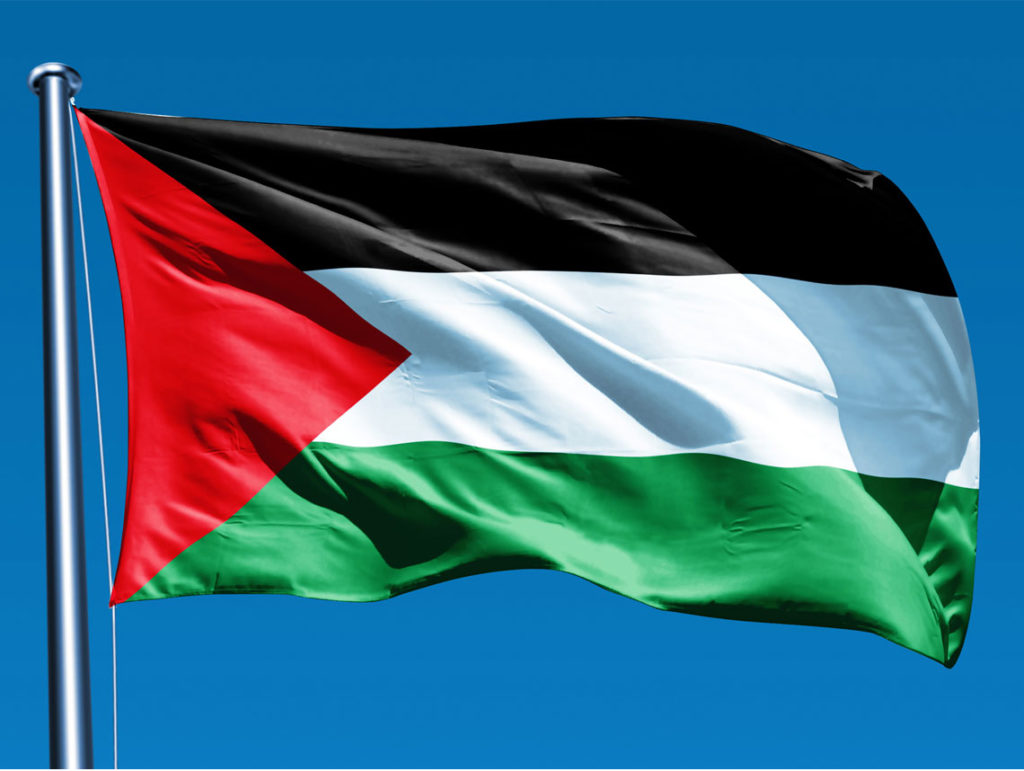
According to news reports, Camp Solomon Schechter of Olympia, Wash., had raised the red, white, black and green Palestinian flag to welcome a delegation of Palestinian youth that was visiting under the aegis of Kids4Peace, an Israeli nongovernmental organization (NGO) dedicated to “ending conflict and inspiring hope in Jerusalem and other divided societies around the world.” The predictable collective howl of disgust from the Jewish community led to an email of explanation from the camp to parents, followed soon after by an official statement of apology. And with that, an attempt at outreach had been eclipsed by an instinctive negative Jewish response to a controversial symbol.

If you check out the comments section below the story on any news site, you’ll find a fair amount of blatant anti-Palestinian racism, and some limited support for the camp, but the majority opinion is that camp officials committed an outrageous act by choosing to fly this flag. I believe this group reaction to what took place is a shame on our community.

In candor, I might have reacted in similar fashion a month ago, before I traveled with an organization called Encounter to Bethlehem, East Jerusalem, Ramallah and other areas in the Palestinian territories. Encounter assembled a group of around 30 people dedicated to ahavat Yisrael — the love of Israel that Encounter considers a core value of all its trips. These were rabbis, Jewish educators, NGO executives and other Jewish influencers chosen to go on a “listening trip.” Over an intense four days, we met a multitude of Palestinian speakers who steeped us in narratives that ran counter to those we’d grown up with — their narratives.

[David Suissa responds: Raising a Palestinian flag is not the best welcome sign]

When I’m agitated, my shoulders have a tendency to rise. And early on the first day, they were probably up over my ears. I heard words that didn’t sit well with me: “Palestine,” “occupation,” “Nakba.” And I saw symbols that distressed me: graffiti of raised knives, portraits glorifying Yasser Arafat, and yes, the Palestinian flag. But I discovered that as I opened my heart to our speakers, fellow human beings with very different viewpoints and life experiences, my shoulders reached equilibrium, I quickly got past years of knee-jerk reaction, and was able to hear and appreciate some very uncomfortable stories.

These Palestinian kids, walking into a pro-Israel Jewish camp, were reaching out across decades of conflict to make a connection. What an act of courage and hope.

Understand, I didn’t walk away having adopted every position of every speaker I was exposed to, but I got past a lot of automatic negative response, allowing myself to be open to nuance. Because for the first time in four visits to the region, I met and interacted with Palestinians, the people with whom Israelis live side by side, and with whom they will continue to live whatever the future may hold.

My four days with Encounter, which included an overnight stay with a welcoming Palestinian family in Beit Sahour, gave me a far deeper understanding of the Israeli-Palestinian conflict than the years I’ve spent reading and talking about the topic. It turns out the simple and obvious and crucial element is honest, open interaction. And that happens to be the concept to which Kids4Peace is dedicated.

I personally have no problem at all with what Camp Solomon Schechter did. These Palestinian kids, walking into a pro-Israel Jewish camp, were reaching out across decades of conflict to make a connection. What an act of courage and hope. It seems to me a quintessentially Jewish response on the camp’s part to welcome these citizens of nowhere — neither Israel nor Palestine — with a symbol familiar to them. I understand that some have a more negative gut reaction to the Palestinian flag than I do. And I believe that Camp Solomon Schechter should have anticipated the outcry and sent an email to parents ahead of time, explaining the rationale and putting the act in context.

But nowhere in the internet comment threads did I see anyone evince any interest in the actual visit. Everyone is so caught up in an emotional argument about a piece of cloth that the real story is utterly obscured. What did these Palestinian kids have to say? How did the Solomon Schechter campers respond to them? Were connections made? That’s the story; that should be our focus.

The camp directors explained to parents that their intention in flying the Palestinian flag was to offer campers a “teachable moment” about acceptance. Here’s hoping that we American-Jewish adults can use this story as a teachable moment about our own priorities as a people.


Joshua Malina is an actor best known for his roles in “The West Wing” and “Scandal.”

When a Jewish camp raised a Palestinian flag Read More »

When a Jew reaches out to an Imam

Sheikh Ammar Shahin, or the “Imam from Davis,” as he is now known, is a young Egyptian-born Imam who recently came under fire for delivering a sermon that included remarks that were anti-semitic. I came across this piece of news while scrolling through my Facebook feed. In a post, a friend of mine wrote, “This guy needs to STFU.” This caught my attention and I began to read the article posted, with the headline, “US Islamic preacher calls on Allah to annihilate the Jews.”

As I read the headline I thought, yes, this guy should keep quiet. Judging by the comments, so did many others. Yet something did not feel right and I could not help but wonder if the collective reaction to these hurtful words was unproductive. Yes, the Imam clearly used language that was wrong and inflammatory, yet was our reaction not adding fuel of confirmation bias to the Islamophobic fire that rages in parts of our community? What if instead of assuming the worst intentions, we engaged in dialogue? I sent him an email:

Subject: A Love letter from a Jew (Seriously)

Dear Sheikh Ammar,

Assalam Aleikum.

Given the words that have been published about your recent sermon in the press, I’m going to guess that you’ve received some angry responses. The truth is that I feel angry myself. As a Jew who has found a lot of beauty in the teachings of Islam, it is difficult for me to believe that you’d choose such hateful rhetoric to share with your congregation in your khutbah (friday sermon). Perhaps it is not true?

In these turbulent times, with so much hate in the world, it seems to me that faith leaders ought to be in the firefighting business. We must fight the inflammatory flames of hate with the sweet waters of love. We must fight intolerance in the world by urging our people to be more kind and more tolerant. *

With Respect and Peace,

Tuli

It did not take long for the Imam to respond:

Thank you for your respectful words as they are the first since the accusation of MEMRI, they have cut and pasted only 2 minutes of my 50 minute sermon to use against me and create hate with the Jewish community with whom I have very good relations.

The Imam continued by attaching the initial statement released by the mosque, and telling me they have an open door policy, and that I’d be most welcome any time. I thanked him for his response, but continued to challenge him on the way in which he chose to present his ideas, especially given the anti-Semitism that is all too prevalent in the Muslim world.

Again, his response did not take long:

Thank you for your comments and concerns, I will keep them in mind. As you know, when we speak with emotion, words might not be put in the right places or understood correctly.

My apology to all your community for any harm that my misinterpreted words might have caused.

In a subsequent press conference, the imam further apologized and acknowledged allowing his emotions to get the better of him.

Let me be clear: the Imam was wrong; his words were dangerous and inexcusable. Such words should not be tolerated by his community or any other. At the same time, here is a man that is not full of hate, but who simply got carried away with passion, used words that he shouldn’t have, and had them distributed to the world in a two minute “got you” sound bite.

The truth is that if it weren’t for my experience with the NewGround Fellowship, I don’t know that I would have had the courage and awareness to react this way. At NewGround, Jews and Muslims are given the opportunity to engage with one another in an open and productive way. To learn from each other and tell our stories. To ask questions from a place of curiosity and not from a place of judgement.

I am not exaggerating when I say that the NewGround model of open dialogue can save the world. Imagine what the world would look like if we’d assume the best in each other instead of the absolute worst. Imagine if instead of yelling and screaming about “that anti-semite Imam” we emailed him and asked him what he meant.  We may disagree with each other, but if we engage in respectful dialogue we will accomplish more and be a lot more productive in building bridges and bringing peace to the world.

I encourage you to try it. I think you will be pleasantly surprised.


Tuli Skaist is an activist and educator living in Los Angeles.

When a Jew reaches out to an Imam Read More »

Will Kelly last longer than Scaramucci?

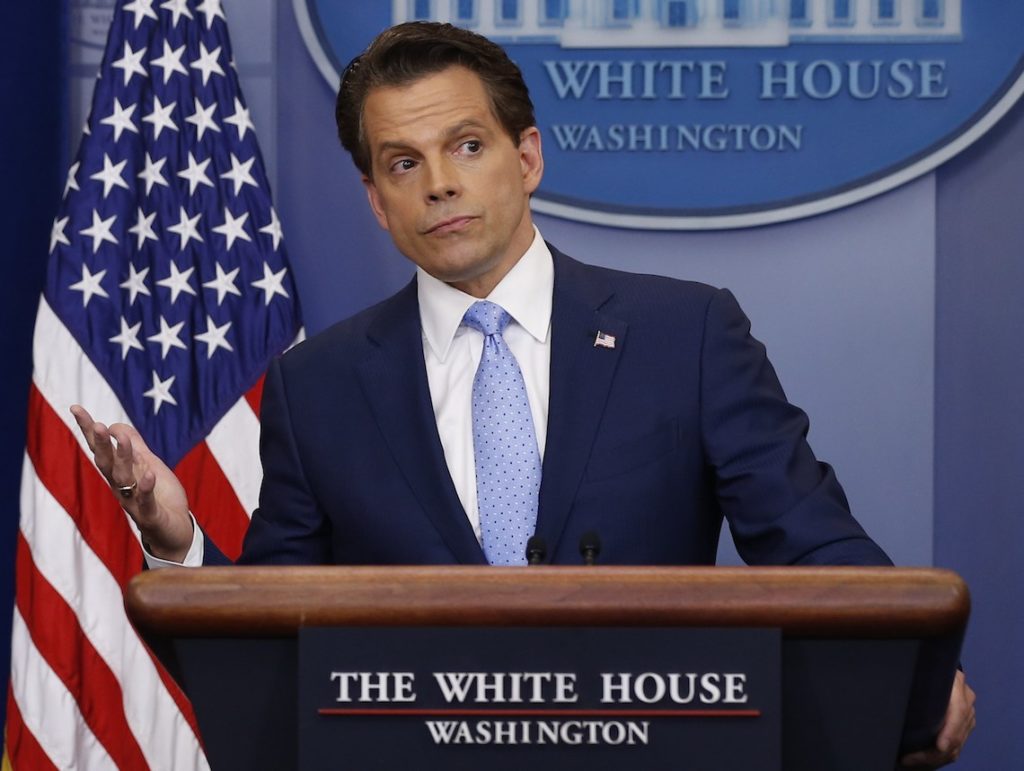
John F. Kelly’s front-stabbing Donald Trump’s new White House communications director Anthony Scaramucci only hours after Trump named the four-star Marine general his chief of staff was a sublime first move. But unlike Ivanka or Jared Kushner, Trump isn’t Dad to Kelly. How long can it be before Kelly’s service doesn’t pleasure the president anymore?

Kelly is a patriot and an honorable man. Yes, I’ve opposed some of the Trump administration policies Kelly has carried out as homeland security secretary, like the Muslim travel ban and the reranking of deportation priorities to include offenses like DUIs, but I opposed some of Barack Obama’s deportation policies, too. What I fault Kelly’s Cabinet stint for is enforcement rigidity, not xenophobia, demagoguery or constitutional recklessness.

But President Donald Trump is a poster boy for those failings, a hothead who fouls his office, flouts the law and endangers our nation. Duty may have motivated Kelly to say yes to Trump’s West Wing summons, but he’s about to find that deceit, disarray and derangement are daily specials at the White House mess.

Kelly’s patriotism inevitably will come into conflict with Trump’s narcissism. His loyalty to country will be tested by the fools he’ll have to suffer, the lies he’ll have to defend and the monarch he’ll soon discover is mad. Not angry mad, though Trump is that, too, but mad mad, King George mad, “Diagnostic and Statistical Manual of Mental Disorders” mad.

I have to believe that Kelly has a tipping point, and that resignation on principle is an option he’d consider. By principle, I don’t mean what forced Sean Spicer and Reince Priebus off the island: losing a cockfight to Scaramucci. I mean what Trump’s national security adviser, Army Lt. Gen. H.R. McMaster, wrote about in “Dereliction of Duty”: the crime of enabling a president to con the country. That book is about the complicity in high places that mired us in war in Vietnam, but it’s equally relevant to our current quagmire. It may be too much to dream that one fine day, McMaster and Kelly, disgusted by their boss, will walk, but it just may take something that big to awaken some more grown-ups in Trump’s party to their responsibility.

“We could use more loyalty, I’ll tell you that,” Trump told the Boy Scout Jamboree on July 24, in between inviting the Scouts to boo Barack Obama, boo Hillary Clinton and imagine the sexual opportunities a multimillionaire’s yacht could provide. You might think Attorney General Jeff Sessions — the first sitting U.S. senator to endorse him — could be called a Trump loyalist, but when Sessions refused Trump’s demand to fire Robert Mueller, the special counsel investigating him, Trump redefined the L word. “He was a senator,” Trump told The Wall Street Journal last week. “He looks at 40,000 people [at campaign rallies] and he probably says, ‘What do I have to lose?’ And he endorsed me. … So it’s not like a great loyal thing about the endorsement.”

When Trump says “loyalty,” he means what he demanded from FBI Director James Comey: not a pledge of allegiance to the rule of law, but an oath of omerta to the Don. When Comey broke that oath — he refused to kill the FBI’s probe of former national security adviser Michael Flynn’s ties to Russia — Trump fired Comey. Kelly has to know it’s only a matter of time until Trump tests him thuggishly, too.

When that happens, another former military man, Sen. John McCain, might inspire Kelly’s next move. I hope Kelly doesn’t mirror the McCain, who endorsed Trump in the Arizona primary to save his own political skin, even after Trump said McCain was “not a war hero. … He was a war hero because he was captured. I like people who weren’t captured.” (Trump didn’t add that McCain — putting loyalty to his fellow POWs ahead of his own freedom — refused early release from the North Vietnamese because his father was an admiral). Instead, I hope Kelly emulates the McCain who, together with Sens. Susan Collins and Lisa Murkowski — no matter how hard Senate Majority Leader Mitch McConnell, Vice President Mike Pence and Trump banged the hammer of Republican loyalty — voted a disgraceful health care bill down to defeat.

When Sarah Huckabee Sanders, who replaced Spicer as press secretary, was asked whether Sessions was on his way out, she replied with a common phrase about political appointees: “We all serve at the pleasure of the president.” Sessions, who was traveling to El Salvador while Scaramucci was trashing Steve Bannon in anatomically taxing terms, used the same words Sanders did when an AP reporter asked if he were going to quit: “I serve at the pleasure of the president.”

Two things about that idiom give me the willies. One is its feudal echo of fealty pledges. I am your obedient servant, m’lord. My loyalty is unwavering. Do with me as you wish. Something more like “at-will employee” is better suited to a democracy. It conveys the idea — they don’t need a substantive reason to let me go — but without the crypto-royalist servility.

The other thing about serving at the pleasure of the president, which didn’t give me the creeps until the present president, is its whiff of sadomasochism. Trump gets pleasure from humiliating people. Bullying turns him on. And his victims get off on their bondage. Sure, if you get power, you cling to it. But ambition alone can’t explain Spicer’s appetite for daily mortification, or the pornography of Scaramucci’s Trump-worship.

Trump has made loyalty kinky. That could be cool on Craigslist, and it may fly at Trump Tower, but the last time I looked, there’s no S&M in POTUS.


Marty Kaplan is the Norman Lear professor at the USC Annenberg School for Communication and Journalism. Reach him at martyk@jewishjournal.com.

Will Kelly last longer than Scaramucci? Read More »

Temple Mount attracts record Jewish crowd on Tisha b’Av

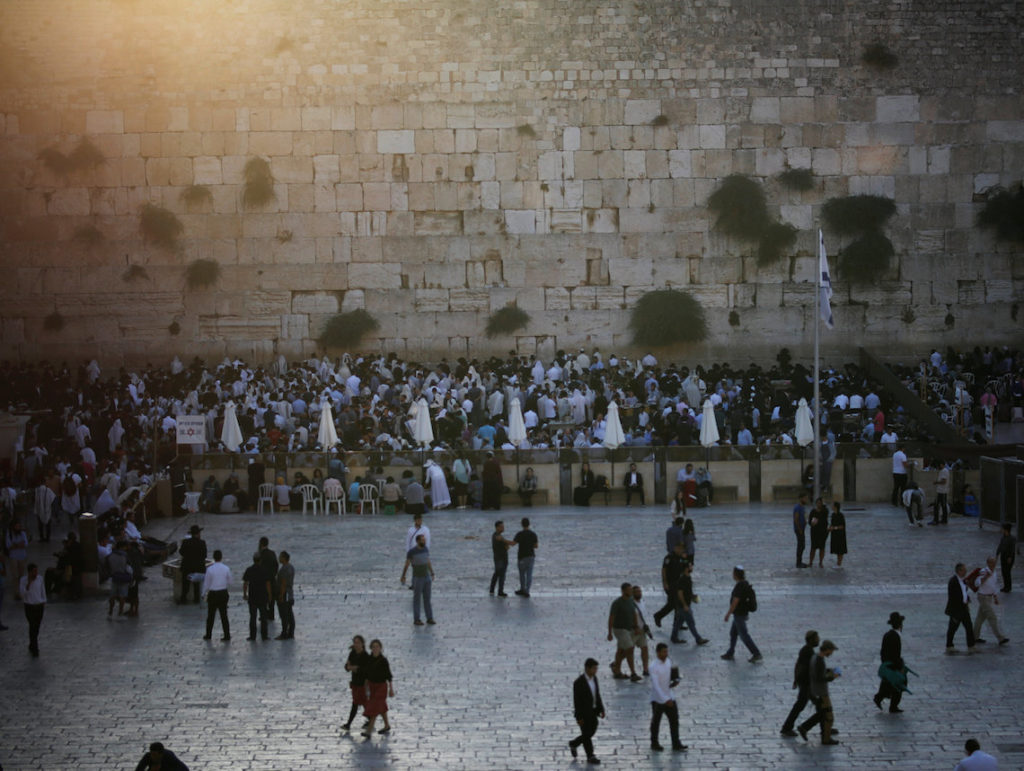
More than 1,000 Jews visited the Temple Mount on Tuesday, a new one-day record for Jewish visitors.

At least 1,046 Jews visited the site on the observance of Tisha b’Av by early afternoon. More were expected to visit later in the day when the site reopens to visitors, Haaretz reported, citing Jewish Temple Mount activists.

The fast day marks the destruction of both the First and Second Temples in Jerusalem.

On Jerusalem Day, in May, some 900 Jews visited the Temple Mount.

The visitors passed through metal detectors at the Mughrabi Gate, the only one allotted for non-Muslim visitors to the site. They were required to leave their identity cards at the gate before entering.

Seven people were detained after fighting between Jews and Muslim worshippers at the site, according to Israel Police. Six Jews were arrested after praying there, according to reports.

Tens of thousands also were expected to visit the Western Wall throughout the course of the day after thousands gathered at the site on Monday night to read the Book of Lamentations.

The mass influx of visitors comes after nearly two weeks of tensions roiled the site over increased security measures, including metal detectors, following an attack on the Temple Mount that left two Israel Police officers and their three Arab-Israeli gunmen dead.

Temple Mount attracts record Jewish crowd on Tisha b’Av Read More »

Transparent

‘Transparent’ Season 4: On to Israel

“I am going to Israel,” the transgender character Maura Pfefferman, played by Jeffrey Tambor, proclaims in the trailer for the fourth season of the Amazon Prime series “Transparent.”

The Emmy Award-winning comedy-drama about a quirky Jewish family with a transgender parent will follow the Pfeffermans as they visit the Jewish homeland on a spiritual odyssey that also will connect them to their roots. It will show the clan as they land at Ben Gurion International Airport, where they kiss the ground before a couple of Orthodox Jews practically knock them down.

“It’s like an Orthodox Jewish Disneyland,” one family member later remarks of the country. The Pfeffermans go on to float in the Dead Sea and even to pass checkpoints in the occupied territories.

“They say in Hebrew you only have one mother,” a sabra says during dinner with the Pfeffermans. “We kind of have more than one,” one of Maura’s children replies.

The trailer was released just a couple of days after President Donald Trump announced a ban on transgender people serving in the military, a fact that didn’t go unnoticed by those who work on the show.

“Sharing this work amidst President Trump’s continued assault on the transgender community is painful,” the show’s creator, Jill Soloway, and her “Transparent” colleagues wrote in a statement released to People magazine.

Later in the statement they continued, “To our trans community members serving in the military and to transgender veterans: We work in solidarity with you and will continue fighting and creating art for our community’s well-being and future. We hope that you’ll enjoy the trailer for season four because our visibility and our stories are more important than ever.”

https://www.youtube.com/watch?v=-EsXMS1YfYs


“Transparent” Season Four premieres Sept. 22 on Amazon Prime.

‘Transparent’ Season 4: On to Israel Read More »