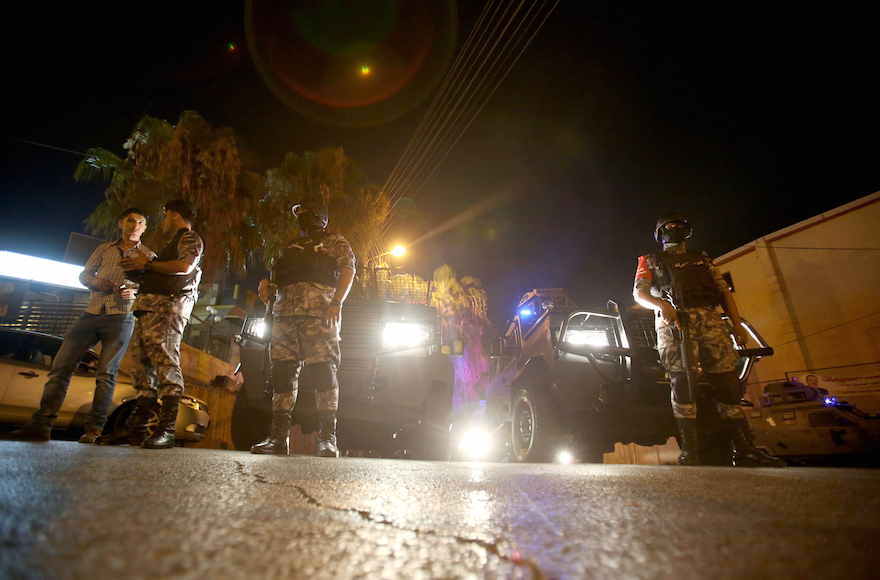
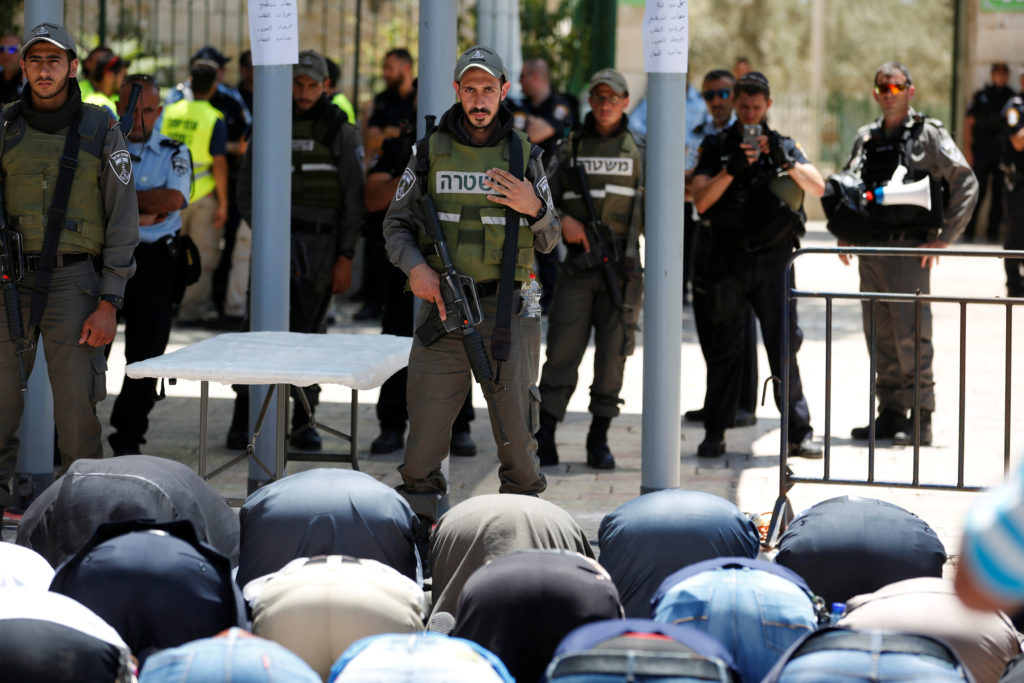
Israel’s cabinet convened last night, but it did not decide to change its Temple Mount policy. It was too busy dealing with ongoing developments in Jordan, where the Israeli embassy is under some kind of siege. It is all but certain that Israel cannot make any meaningful decisions before the crisis with Jordan – over the shooting of an attacker by an Israeli security guard – is over. Two Jordanians were killed in this incident, and the Jordanians, as I write this, refuse to let the Israeli guard leave the country (Israel wants him out and claims diplomatic immunity). The government is also waiting to see if the American emissary, Jason Greenblatt, can find a way to defuse the tension in both Jordan and Jerusalem.
As the situation is fluid and things change from day to day (and sometimes from hour to hour), here are a few points that merit attention:
1.
The conflict has three circles: Jerusalem, Israel and Palestine, and the larger Arab and Muslim world. In each of these circles there are dynamics ignited by the public and by the authorities. In each of these circles there are conflicting interests. This makes the eruption of violence complicated and potentially dramatic. The trick for all those who want to avoid a dramatic situation is to find a way that preserves the core interests of the main parties, while providing themselves with enough cover as they work to calm the public.
2.
The attack in Jordan adds fuel to fire because of several issues:
1. It puts the Jordanian government under pressure to punish Israel (both for the incident and for Jerusalem).
2. It gives Jordan a tool with which to pressure Israel (if you want your guard back, move your detectors).
3. It actively involves the third circle – the larger Arab world – with events that have thus far been contained.
3.
Israeli leaders must deal with this fluid situation while keeping in mind their goals and the risk involved in the current volatile situation.
What would be the best outcome for Israel? If it can keep the metal detectors and the eruption of violence and strife subdued. What would be the worst outcome? To have to remove the detectors, when it is clear that the removal was under pressure, and with violence focused on the Temple Mount still ongoing.
4.
The Israeli government is also not immune to the pressure of the Israeli public. It is true that many Israelis believe that the government made a mistake by climbing up a tree from which it is difficult to climb down. But following the deadly terror attack in Halamish, in which three Israelis were murdered in cold blood, the public is reminded that Palestinian violence always finds an excuse. Such attacks tend to harden the stance of Israelis – not make them more flexible. If you want proof, look at the most recent political survey of Israelis, in which the Prime Minister’s party gains more seats (32 if election were held today).
5.
Was the installment of the detectors a mistake? Right now, it does not really matter. The detectors are there. Clearly, they are no more a provocation than the detectors installed in hundreds of Mosques all over the Arab world. Clearly, they are used by Israel’s opponents as a tool with which to hammer Israel and try to humiliate it. Clearly, if Israel is forced to remove them it will be a victory for incitement and violence.
Does this mean they should not be removed? That depends. It depends on the price that Israel is willing to pay to make a point. It depends on the alternatives (on whether a solution that does not hand a victory to Israel’s opponents be found ). It depends on the ability of the leadership (Israeli and Arab), or a mediator, to be creative and responsible.
6.
What’s the real danger? As usual, it is miscalculation. If the eruption of violence will be over in two or three days – that’s one thing. If it grows bigger and engulfs the Arab world – that’s quite another.
7.
‘Don’t turn the Israeli-Palestinian conflict into a religious conflict’ – is a warning we will hear a lot in the coming days. Yes, that could be nice, but it is probably beyond Israel’s power to achieve. Religion is used by the other side as a political tool. The whole save-Temple-Mount-campaign is politics masqueraded as a call for religious war. Why can’t Israel stop it? Because the other side has discovered that it’s effective. In other words: the way to stop it is to make it no more effective than other means of war against Israel.
8.
We will also hear a lot in the coming days about the need to go back to the status quo. That’s not a possibility. The status quo was breached when Arab terrorists used the Temple Mount as a base for their attack on Israeli policemen – killing two, for those of us whose memories don’t go back as far as needed to understand why we are where we are. Then the status quo was breached again, this time by Israel – by planting metal detectors.
Restoring the status quo requires a cancelation of both these developments. Alas, to cancel the option of using the Temple Mount as a base for terrorism, the metal detectors (and other means) are needed. On the other hand, withdrawing the metal detectors probably means that the Mount will keep serving as a base for radicalism and terrorism.
9.
Also, the status quo is based on a delicate balance of keeping the façade of Israel’s control over the Temple Mount without it having to assert it. Israel cannot dismantle the detectors and keep this façade. So, the old status quo is dead. A new one, a stable one, must be established. This can happen through a costly and deadly process, or by leaders ready to compromise and be reasonable.