fbpx

July 24, 2017

Musings on the dangers of ‘the new new anti-Semitism’ and America’s current preoccupation with ‘all things Russian’

As an aging historian of anti-Semitism, I am always waiting for the other shoe to drop. Indeed, my friends sometimes caution me that I see a centipede with ever-trod shoe leather when there may be none! Even so, I am not exactly alone in my concerns.

According to a new Rasmussen poll, around two thirds of American voters consider anti-Semitism “at least a somewhat serious problem” including one fourth who believe it’s “a very serious problem.” It could just be that, in the current climate of national hyper-political polarization, ordinary Americans are on to something here!

The last time that our national angst spilled over into a spike of anti-Semitism was during and after the 2007-2008 Financial Meltdown. This was an echo of prior episodes in which Americans, both right and left, became wildly fearful over the Rothschild banking family taking over the world and America. In 2008, high-profile members of Goldman Sachs but extending to others including financier George Soros were equated with a Jewish to conspiracy to engineer a global economic collapse. Readership on line and off reached unprecedented levels of that hoary anti-Semitic hoax, propagated a century ago by the Russian secret police: The Protocols of the Elders of Zion.

Currently in 2017, no new playbook has yet emerged to galvanize a new wave of politically-inspired anti-Semitism in America. But this is not for the lack of trying by the likes former Grand Wizard David Duke and Neo-Nazi web sites like the Daily Stormer.

The first time in American history when a combined political-economic crisis sparked a national wave of political anti-Jewish conspiracy mongering was just before 1900. In 1896, during a depressed decade also marked by global economic anxieties and Middle American job losses, the Democrats nominated for the presidency William Jennings Bryan who promised to save the nation from being “crucified on a cross of gold.” Bryan and his party were by no means motivated by anti-Semitism, but Jew haters ran as fast and far as they could toward the political goal line with fiery anti-Semitic cross-of-hate imagery. The presidential election of 1896 (which Democrat Bryan lost) occurred exactly 120 years before the 2016 presidential election which Republican Donald Trump won.

Let’s look at the latest revelations about alleged collusion between the Russians and the Trump Campaign to influence the 2016 presidential election. One eye of a potentially anti-Semitic new political firestorm storm centered around British-born, Jewish tabloid journalist turned music promoter Rob Goldstone. Goldstone’s clients include Emin Agalarov, the son Aras Agalarov, a Russian-Azerbaijani oligarch closely connected to Vladimir Putin who in 2013 helped Donald Trump promote that year’s Miss Universe Pageant in Moscow. Goldstone wrote the emails to Donald Trump Jr. resulting in the invitation to the 25th Floor of Trump Tower extended to the Russian lawyer Natalia Veselnitskaya last June 2016 in the heat of the presidential campaign. The lure offered Trump Jr. to make the invitation was damaging information about Hillary Clinton from “the Russian government” that (according to Goldstone) meant to show its “support for Mr. Trump.” Responding in an email to this proffer that “I love it,” Donald Trump Jr. attended the meeting with his brother-in-law, Jared Kushner, and then campaign manager, Paul Manafort, in tow.

It will now be up to Congressional Committees and Special Counsel Robert Mueller to sort through conflicting accounts to decide what exactly happened around that ill-advised meeting and what comes of it. But David Duke and the Daily Stormer are already hawking anti-Semitic conspiracy theories featuring the flamboyant Goldstone.

As reported in the Forward, Goldstone says that he is ‘not defined’ by Judaism. ‘My mum was from a religious family, my dad less so. . . . I like the traditions and spirituality of my religion, but I am not defined by it’.”

Potentially more troubling and explosive is the Jew haters’ increasing focus on Jared Kushner, son-in-law of President Donald Trump. We can see the beginnings of a grotesque caricature of Kushner as an Arch-Jewish Conspiriarch or a modern-day Svengali (a famous fictional Jewish villain who bewitched good Christian girls) or Goldstein (the political villain manipulated by Big Brother in George Orwell’s 1984).

It is hard to imagine anti-Semites even trying to resist the temptation to accuse Kushner of “setting up” his brother-in-law Trump Jr. to also bring down his father-in-law Trump Sr. in some sort of Elders of Zion-style conspiracy. Indeed, in a bizarre Freudian twist, Jared Kushner is already being pictured as repeating at the expense of his brother-in-law, Donald Trump Jr., the Kushners’ own family tragedy. Jared Kushner’s father, Charles Kushner, went to jail for attempting to blackmail his own brother-in-law, William Schulder.

David Duke is already pillorying Jared Kushner for giving “large sums of money to Chabad Lubavich”—“a Zionist hate organization.” The Daily Stormer blames the Trumps’ woes on the “fat Jew” Goldstone and Kushner as “the ‘Missing Link’ in the Russian Kookspiracy” illustrated with this cartoon:

(https://www.dailystormer.com/tag/jared-kushner/)

The danger to be feared—and guarded against—is that warped minds will merge the odd Rob Goldstone with the controversial Jared Kushner into some sort of twenty-first century Judas stereotype. The Lord protect us if a brilliant anti-Semitic rabble rouser starts peddling an image combining Iago in Shakespeare’s Othello and Shylock in Shakespeare’s The Merchant of Venice into the core image of a new Jewish global conspiracy theory!

Unintentionally, President Trump made matters worse by offering these paternal apologetics to a gaggle of reporters on Air Force One: “When they say ‘treason’— you know what treason is? That’s Julius and Ethel Rosenberg for giving the atomic bomb, okay?” (See Gabriela Geselowitz’s recent essay in the Tablet.) Trump apologist Jeffrey Lord has also chimed in on CNN with the reminder that, in 1980, Jimmy Carter allegedly unleashed Armin Hammer to convince Soviet Ambassador Anatoly Dobrynin to get the Kremlin to release Refuseniks to emigrate to Israel in order to influence the Jewish vote in key states. The Kremlin did nothing.

The “new new anti-Semitism” meme is also being advanced, no doubt also unintentionally, by some on the left. On MSNBC, Lawrence O’Donnell devoted most of one program to what, filtered through an anti-Semitic lens not shared by O’Donnell, could be viewed as an inverted Purim narrative. King Ahasuerus figures as President Trump. His evil viceroy Haman figures as Jared Kushner. Haman’s antagonist Mordecai figures as Donald Junior—who refuses to bow down to him. All we need to complete this perverted inversion is an anti-Jewish Esther: perhaps a divorced Ivanka wising up her Dad to the nefarious ways of the Jared’s tribe!

Maybe my fears of a new-new anti-Semitic revival may seem overdrawn, but stranger things have happened in the history of anti-Semitism. It is incumbent among decent Americans of all political persuasions to unite now to make sure that current national polarization about Trump Era political scandals does not escalate into a new American tragedy scapegoating Jews.
Musings on the dangers of ‘the new new anti-Semitism’ and America’s current preoccupation with ‘all things Russian’ Read More »

Approaching the Jewish New Year

This week, as we enter the final months of the Jewish year, we begin to read the Book of Deuteronomy, the fifth and final book of the Torah. Deuteronomy is primarily devoted to Moses’ farewell address, which he delivered to the Jewish people shortly before his death and their entry into the Land of Israel. It records his words (Devarim, in Hebrew) of rebuke to the Jewish people over various incidents that took place during their 40 years of wandering in the desert, and the lessons they must learn from their mistakes.

There are, in fact, two intertwined and overlapping strata of content in Moses’ farewell address. The first comprises his exhortations to the Jewish people to remain loyal to God; the second is a review of much of the legal subject matter contained in the preceding four books. Although we might expect the first type of material to appear in a farewell address, why was it necessary to rephrase so much of the legal material that had been clearly stated before?

Another striking feature of Deuteronomy is its literary form. Unlike the preceding books, Moses now speaks in the first person. The phrase we have heard continuously in the preceding books—“And God spoke to Moses, saying…”—is almost entirely absent from Deuteronomy.

The Talmud (Megilah 31) teaches that although Moses transmitted the first four books from God verbatim and Deuteronomy “in his own name,” nevertheless, even in the latter case “the Divine Presence spoke from his mouth” (Zohar 3:232a). In other words, Deuteronomy is no less Divine than the first four books of the Torah, but whereas the first four books are God’s words transmitted directly by Moses, Deuteronomy is God’s words transmitted through Moses. But if this is the case, why the sudden change in literary form between the first four books and the final one?

The answer to both these questions hinges on the fact that this book is addressed to the generation that will enter the Land of Israel. The abrupt change in lifestyle—from a nation of nomads sustained by God’s supernatural protection into a nation of farmers who must work the land—called for a practical restatement of God’s hitherto abstract teachings. The generation of the desert had been nourished with miracles, beginning with the ten plagues and the Exodus from Egypt, through the Splitting of the Sea, to the revelation at Mount Sinai, the manna, the well of Miriam, and the protective Clouds of Glory. Their perspective on life had thus been elevated to a level quite above and beyond the ordinary; God’s normally invisible hand in nature had become a manifest reality for them. They were thus able to relate to the Torah in a concomitantly abstract, spiritual way, and that is how it was transmitted to them. All of this was about to change. God’s hand in the parameters of day-to-day life was about to become veiled in the garb of nature.

This transition was a natural and essential part of achieving God’s purpose on earth: to transform it into a spiritual place, in which not nature but God is understood to be the driving force. In order for the façade of nature to be torn away, humanity, led by the Jewish people, had to now invest itself into the natural order and, in that context, retain consciousness of God, revealing the infinite within the finite.

This is why it was necessary for the Book of Deuteronomy to be transmitted in the first person. By communicating the message of Deuteronomy via the voice of Moses, God was telling us that even while remaining faithful to the Torah’s objective truth, we must see its subjective relevance to every individual and in every generation. In this sense, the first-person narrative of Deuteronomy indicates not a lesser Divinity than the other four books but a greater one.

Thus, as we prepare to conclude the present Jewish year and embrace the coming year, the Book of Deuteronomy is a lesson in keeping the Torah alive and relevant, the means by which we can begin the yearly cycle of studying the Torah on a new level of understanding. By ensuring that the Torah remain eternally relevant, we can read it from an always deeper, fresher, newer perspective, and thereby continually deepen, freshen, and renew our relationship with God.

_______

Rabbi Chaim N. Cunin is Director and General Editor of Chabad House Publications and Associate Rabbi at the Beverly Hills Jewish Community, which meets weekly at the Beverly Hills Hotel. For more information, visit BeverlyHillsJC.org.

Adapted from the newly-released Kehot Chumash, published by Chabad House Publications and based on the teachings of the Lubavitcher Rebbe, Rabbi Menachem M. Schneerson. Available online at www.kehot.com.

Approaching the Jewish New Year Read More »

7 Haiku for Torah Portion Korach by Rick Lupert

Small beginnings, big futures: The first ordination of the Zacharias Frankel College, Berlin, Germany

The Torah portion that we read last week portrays the Children of Israel standing on the border of our Promised Land and wondering whether they could dare take the risk of entering. In a combination of courage and timidity, they assemble a group of spies to enter the Land of Canaan to see what kind of a place it might be. Who dwells there? What are the produce of the land? What are the rivers, and the walls, and the towns, and the mountains? What place has God and Moses taken them to?

They scour the land and then carry back fruit that they find in this unknown place, fruit so heavy laden that they carry them on poles on their backs and when they return to the waiting tribes, in a moment of absolute terror, they blurt out “We looked like grasshoppers to ourselves, and we must have looked that small even to them (Numbers 13:33).”

It is the very nature of beginnings to first appear small; we never know how our tentative launching will play out. So every new beginning represents an act of faith: faith in a future that is, at the moment, merely possible. Whether it will ever grow into actuality, one cannot know in advance. We simply launch and trust.

So, I want us to think about the ways in which something can appear very small from one perspective, yet entirely grand from a second perspective. What is at stake at this moment, from one perspective, is very little indeed. Will one woman become a rabbi or not? In a school that has enrolled only a handful of students and a small number of professors, that action remains relatively trivial. But from another perspective, what is at stake is nothing less than the redemption of Western civilization. Because it is the nature of history that all events have a prior cause. One action (or several coming together) causes a subsequent event, that subsequent event becomes a cause in turn for what transpires next. But the meaning of the series of events always emerges backwards. The meaning of the event is determined by what people do with it later.

Germany is not the only corner of the world that has had a bloody past. The entire planet is drenched in human blood and suffering. We, as a species, oppress each other, harm each other, and brutalize each other repeatedly. But what we are doing here today holds the promise of redeeming that past by giving it a particular context, meaning and direction. Today’s ordination asserts that the suffering that has happened in this place was not purposeless. That suffering has led to this moment, to these possibilities.

Throughout time and across the globe, civilizations have defined themselves against some “other” that is deliberately slandered, trivialized, and misunderstood. The Greeks and the Romans defined themselves against so-called “Barbarians” and their constructed their self-identity in stark contrast to the label “Barbarian” which they reserved for everyone else.

In my country, the United States, the founders and even many people today, define themselves first against the African slaves, and later against some stock notion of African Americans. Thomas Jefferson’s vision of what it means to be a free and democratic “man” was dependent on keeping an entire population enslaved, and understanding white and Black not just as racial shorthand but as moral types. Black people were not marginal to the white American vision at the any point in American history. Similarly, male self-definition problematizes and marginalizes women. Heterosexual culture marginalizes and oppresses LGBT people. The list goes on and on; it is the way we make people “others” and “objects”, and marginal for the sake of our own sense of dignity. And surely one of the people who are measured as “other” throughout European history is the Jew. If you look at the writings of Europeans throughout the millennia, their sense of themselves as free, male, Christian, white, and civilized, was at the earliest levels defined by their not being the Jew. That identity as superior and distinct was affirmed in their launching crusades that slaughtered Jews, in Inquisitions, in Pogroms, and in Holocaust.

What we have here in Berlin at this auspicious moment is the birthing of a new Europe, a Europe in which others are celebrated as ourselves. In which “other” is an invitation to explore and to get to know, not only Jews, but all of us who have a stake in this new Europe, in this new world: a world in which all of us are brothers and sisters, not because we eliminate our differences, but because we accentuate and we delight in each other’s differences. That’s really what this first Masorti Ordination is about. In our own eyes, we may be merely grasshoppers, insignificant insects in the stream of a vast history that is thousands of years old. But every one of us is here today because our vision of tomorrow’s Europe, our vision of tomorrow’s Earth, is a place in which all of us are citizens together. All of us participants of a grand commonwealth of diversity, of multiple languages, of civilizations that are no longer separate, but which flow into each other and inform each other.

We can redefine the meaning of what took place here. We can make choices in such a way that today’s ordination of Rabbi Nitzan Stein Kokin, is one more affirmation that the Barbarians who attempted to define European greatness in terms of blood, force, and hatred, no longer drive this continent, no longer drive our vision of what is civilized, or righteous, or just. We do.

On a personal note, I lost family in this land, not very long ago in the scheme of human history. I wish that they were alive today to see us ordaining a new Rabbi because the German people joined with the Jewish people to make this celebration possible. It would have felt messianic; it would have been unbelievable to see a room with brothers and sisters who are Christian, Muslim, secular, and Jewish, all coming together in common cause. To stand with people from Latin America, the Middle East, Europe, and North America, all together to make this new reality. We are tomorrow, shining a beacon of hope and joy today.

So I say to you, “Am Yisrael Chai.” The Jewish people lives!

I say to you, freedom and dignity beckon us yet.

I say to you that in each newly ordained Rabbi, humanity begins anew.

Let us aspire to, and grasp a rebirth of humanity now.


Rabbi Bradley Shavit Artson holds the Abner and Roslyn Goldstine Dean’s Chair of the Ziegler School of Rabbinic Studies at American Jewish University, and is the Dean of the Zacharias Frankel College in Germany.

Small beginnings, big futures: The first ordination of the Zacharias Frankel College, Berlin, Germany Read More »

Stories from East Jerusalem, Bethlehem and Ramallah

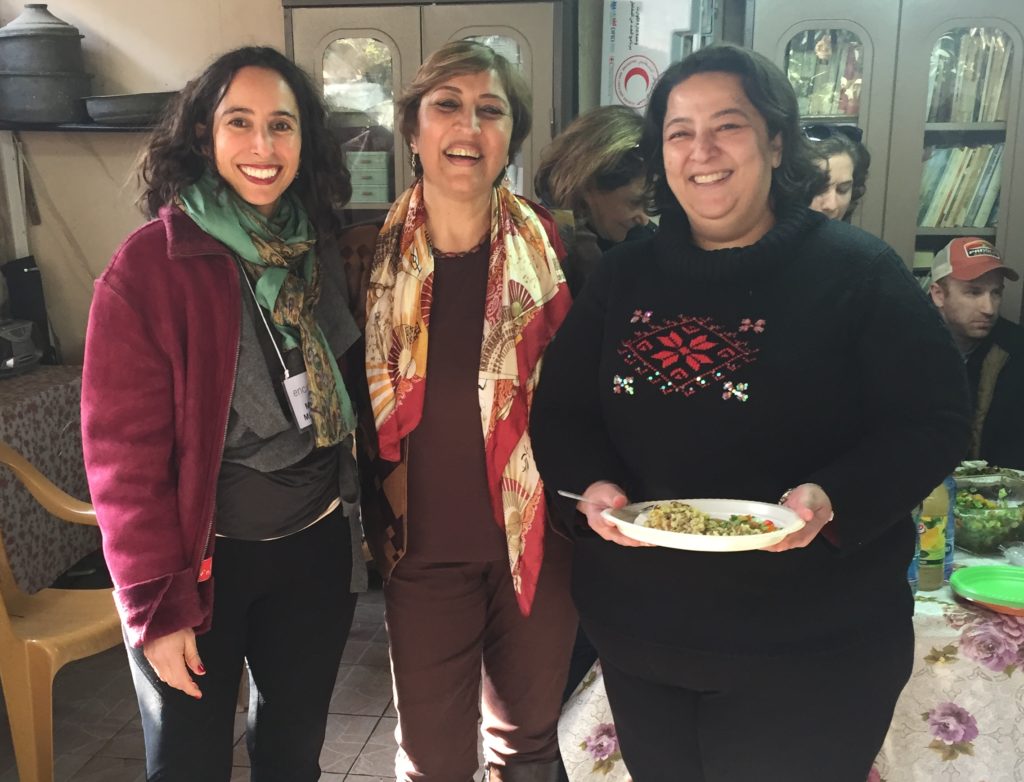
Recently, I returned from a four-day intensive trip to East Jerusalem, Bethlehem and Ramallah with 24 Jewish leaders from around North America through a program called Encounter (www.encounterprogams.org). Members of the group came from a variety of professions: congregational Rabbis (Reform, Conservative, Reconstructionist & Orthodox); Hillel leaders; media editors (The Forward, The Wall Street Journal, Bimbam.com); Israeli advocacy groups (The David Project, JCRC, Israel Action Network); The ADL; The Bronfman Foundation; The Wexner Foundation; The Shalom Hartman Institute; Federation leaders from San Francisco and Boston; philanthropists; leaders of Jewish seminaries; and a prolific writer in the Jewish world.

The stated goal of our four day trip into the West Bank was to participate in a “listening campaign” to deeply listen to, and not argue with, the stories of the Palestinian people we met. I understood this goal of listening (in Hebrew, Shema) as a challenge to honor the stories I encountered, not necessarily feel I had to agree or disagree with them. It was a given that as Jewish leaders, all of us understood that there are a variety of Jewish voices (from Israel and America) concerning the Palestinian-Israeli conflict. What many of us, including myself, don’t often have the opportunity to hear, is the range of Palestinian voices concerning the Israeli-Palestinian conflict. Our goal was to hear these Palestinian narratives, from three cities, on their turf. We didn’t meet with any Palestinians from Gaza, or from Israel itself (According to the Palestinian Central Bureau of Statistics, there are some 1.9 million Palestinians living in Gaza, 2.9 million in the West Bank and 1.75 million Israeli Arabs.)

I would like to introduce you to some of the people I met, the stories I heard, and my reactions to their stories. Please meet:

Lama Abuarquob, Hebron activist, an English teacher in Palestinian H.S. (Dar Essalaam Girls H.S.), teaching for 23 years

Lama told us that the morning we met her, she was teaching her students about antonyms. A 17-year old said: “I get it, you mean, for example: good and bad, or Palestinians and Israelis.” She stopped the conversation and said, “No, we can’t label people like that.” On the other hand, she shared that her son’s 9th grade teacher recently told her students that they should, “Use whatever force you can or else you are a non-believer.” When describing the environment at her school, she said that of the 250 girls, only 6 or 7 don’t wear head scarves, and when she and her husband sent her daughter to study for a semester in Arizona, they were criticized by their community.

Abu Ibrahim, head of the village of Khalet Zakariya

In his 70s, Abu serves as the village elder. About 650 Palestinians live in Khalet Zakariya, which is in Zone C (an area in the West Bank, fully controlled by Israel). The village is surrounded by 5 Jewish settlements. Though his village legally applied for building permits in 2005 along with a master plan, according to him, Israel has not issued building permits for his village since 1967. Often people in his village live 5 per room. They eventually give up waiting for permits and just build “illegally.” Their homes look like simple bricks with a metal roof. Abu reported that currently there are 33 demolition orders for his village. It was upsetting to see that across the road, on the nearby hill, sits a Jewish settlement with beautiful homes and a large school. In his closing words Abu said, “We have no problems with Jews, Christians, Hindus… we just want a dignified life. I wish all politicians would just say ‘enough is enough.’”

Abu Fatach, Director of the Cultural Center in Aida Refugee Camp

Abu Fatach earned his PhD in France. He was born in the Aida Refugee camp. These camps were opened by the United Nations in 1948 on rented land (99 years) to be a temporary place where Palestinians could live until the refugee problem was settled. (See UN Resolution 194). Many Palestinians have since left these camps, which are poorly run by the UN and provide sub-par health and educational services. When asked why he doesn’t leave and create a better life for himself elsewhere, like hundreds of thousands of refugees are doing around the world, Abu replied, “Being denied my right to return is infuriating. It should be up to me where I want to live or return to. I want the right to determine my situation. To ask me to get used to it [Israeli occupation of the home he feels is his in Israel] after 69 years of occupation doesn’t work for me. The UN resolution 194 said we can return and Israel is not acting legally. They [Israel] perform one injustice after another.” His closing words were, “There is no possibility of a two state solution anymore. I would like one country with equal rights for all, regardless of religion. Once we recognize each other as equals then we can probably live with each other. We don’t have the luxury of despair.”

Amal Alquasem Abuhasnah, 55 year old Palestinian woman, born and raised in Sheik Jarra (a neighborhood in East Jerusalem) and director of Women’s Forum of Sheik Jarrah

Amal shared that Sheik Jarrah was built with Jordanian money in 1948 for Palestinians who were fleeing West Jerusalem. In 1948, Jordan owned East Jerusalem and Israel owned West Jerusalem. Through a lottery, 28 families were given new homes by Jordan, and Amal’s grandfather was one of those families.

By moving to East Jerusalem, Amal and her family lost their refugee status but gained an East Jerusalem identity. (East Jerusalem identity does NOT mean she has Israeli citizenship. She could have applied for that in 1948, but did not). She does not vote in Jerusalem municipal elections, even though she could, because she believes that would be legitimizing the Israeli government. During the Six Day War (1967), Israel captured East Jerusalem, including Sheikh Jarrah. In 1972, the Sephardic Community Committee and the Knesset Yisrael Committee went to court to reclaim the property in the neighborhood.

In 1982, these Jewish groups demanded rent for this property and the Supreme Court of Israel ruled in their favor. Amal and other Palestinian tenants were allowed to remain in their homes as long as they paid rent. However they refused to pay rent. She explained that this is her home. She is now constantly scared that Israeli settlers will kick her out of her home, as they have done to two of her neighbors. A 90-year-old Palestinian woman resides across the street. Three times, her son asked for building permits to build a home in front of his mother’s home so he could move in with his family and care for her. Three times the city said no, and gave no reason. He built his small home anyway. After he and his family moved in, Jewish settlers banged on his door and forced them to leave. Now the settlers are living in the front home and the 90-year-old is living in the back home. Also, the home next door was attacked one night after midnight by settlers. They forced the family to leave their home. The next morning, settlers moved into this home. During this night raid, they also placed Jewish guards outside of every Palestinian home and intimidated them by saying that they shouldn’t dare leave their homes to help these Palestinians, because then the same thing would happen to them. In closing, Amal said, “It’s not easy to define what it means to be a Palestinian. We were once simple people. It was a quiet and golden time. After the occupation we became a different people. On the one hand, we want to keep our gentle, simple, sweetness. On the other hand, we need to be very strong and conservative. Before the occupation, we didn’t have negative feelings toward other peoples, but now we do.”


The Palestinians I spoke with are angry. They feel that the occupation equals oppression and creates an environment that lacks dignity. They feel like they are treated like animals in cages (not allowed to travel freely), they are invisible (like when they apply for building permits and are ignored), and they are disrespected (like when they have to wait in line for three hours in the morning to get through the security barrier to go to work in Israel). It is my personal belief that continuing to not give the Palestinian people their own land is bad for the Jewish soul. I feel that it is dirtying our people and our religion. The more stories I heard on my four days of listening in East Jerusalem, Bethlehem and Ramallah, the more embarrassed I felt as a Jew. I believe that fighting for a two-state solution is our only hope and that it is our obligation as Jews to treat others with dignity.

Stories from East Jerusalem, Bethlehem and Ramallah Read More »

temple mount

Learning from ‘sons of monkeys’

In a Facebook post a few hours before he stabbed three Israeli Jews to death as they were enjoying a Shabbat meal, 19-year-old Omar al-Abed made clear what he thought of Jews:

“You, sons of monkeys and pigs, if you do not open the gates of Al-Aqsa, I am sure that men will follow me and will hit you with an iron fist, I am warning you.”

A century of Arab lies, delusional swagger and Jew-hatred can be found in that one sentence.

First, the lies. The gates of Al-Aqsa were not closed. They were open. They just had metal detectors for everyone’s protection. Those detectors were installed after two Israeli security guards were killed by Arab terrorists using weapons that had been smuggled into the compound.

The hysterical and violent Arab response is very much about symbols. The metal detectors were a concrete, visible reminder to the world that Israel has ultimate sovereignty over the Temple Mount, the holiest site in Judaism, where the Al-Aqsa mosque is located and where the Jewish Temples of biblical times once stood.

Removing the detectors won’t remove the deep, 3,000-year Jewish connection to Jerusalem, which Arab leaders consistently reject. As Palestinian leader Mahmoud Abbas once put it, Jews defile the Temple Mount with their “filthy feet.”

Of course, such blatant lies and incitement against Jews have long been par for the course for Arab dictators desperate to distract attention from how they oppress and fail their own people.

Next, the delusional swagger. The killer thinks that murdering a few Jews during a Shabbat dinner will encourage an army of Muslims to hit Israel with an “iron fist.” These kind of grandiose dreams date to the very beginning of the Jewish state, when Arab armies invaded the infant state but failed to destroy it. They have been failing ever since.

Recognizing this reality — that Israel is too powerful to be destroyed — is out of the question. Better to demonize and demean the Jews as “sons of monkeys and pigs” and spin military defeats as battles in a never-ending war against the Zionist monster.

Finally, the Jew-hatred. It’s crucial to note that the Jew-hatred which permeates Arab consciousness long predates any settlements in the West Bank. Decades before anyone ever heard of an Israeli “occupation,” Jews were hated for trying to assert their sovereign rights in their ancestral homeland.

Arab countries rejected the United Nations Partition Plan for Palestine of 1947 — which allocated land for an independent Arab state and a Jewish state — because they couldn’t stomach the very idea and legitimacy of a Jewish state. For centuries, Jews were tolerated in Arab and Muslim societies only because they kept their heads down and accepted their status as second-class citizens.

Then, with the backing of the United Nations, these lowly Jews had the chutzpah to return to their biblical homeland and build their own country with universities, hospitals, roads, farming communities and a modern economy. On top of that, all of the Arab armies combined could not chase them away.

In a culture that prides honor and is repulsed by shame, can you imagine how much humiliation has been felt by failing Arab states next to the extraordinary success and power of the Jewish state?

Needless to say, there was another way. Had the Arab nations accepted the U.N. Partition Plan and started building their own state next to Israel, there never would have been an Israeli-Palestinian conflict.

Had the Palestinian Arabs looked at Jews as potential allies who could help them succeed, there would be a Gaza Riviera today that would compete with the Tel Aviv beachfront as one of the world’s hotspots.

There would be a thriving high-tech sector in Ramallah that would compete with Israel’s Startup Nation and elite Palestinian universities, research centers and a cultural scene that would be the envy of the Arab world.

But instead of partnering with the Jews, Arab nations chose to hate the Jews. Instead of taking responsibility for their future, they blamed the Jews for their misery.

As pro-Israel activist Chloe Simone Valdary wrote last week on Facebook, in a message to Palestinians: “It’s the belief that Israelis are holding you back that’s holding you back. Holding you back from letting go of all the hatred and the envy and the jealousy which is just so damn exhausting to hold on to.”

The “iron fist” that is killing Arab hope is coming from Arab leaders who demonize Jews and use excuses like metal detectors to start holy wars. What a tragic irony that if Arabs ever wanted to build a better future, it would be in their interest to learn from people they’ve been told are subhuman. 

Learning from ‘sons of monkeys’ Read More »

Western Wall heckling worse than ever for monthly service, Women of the Wall says

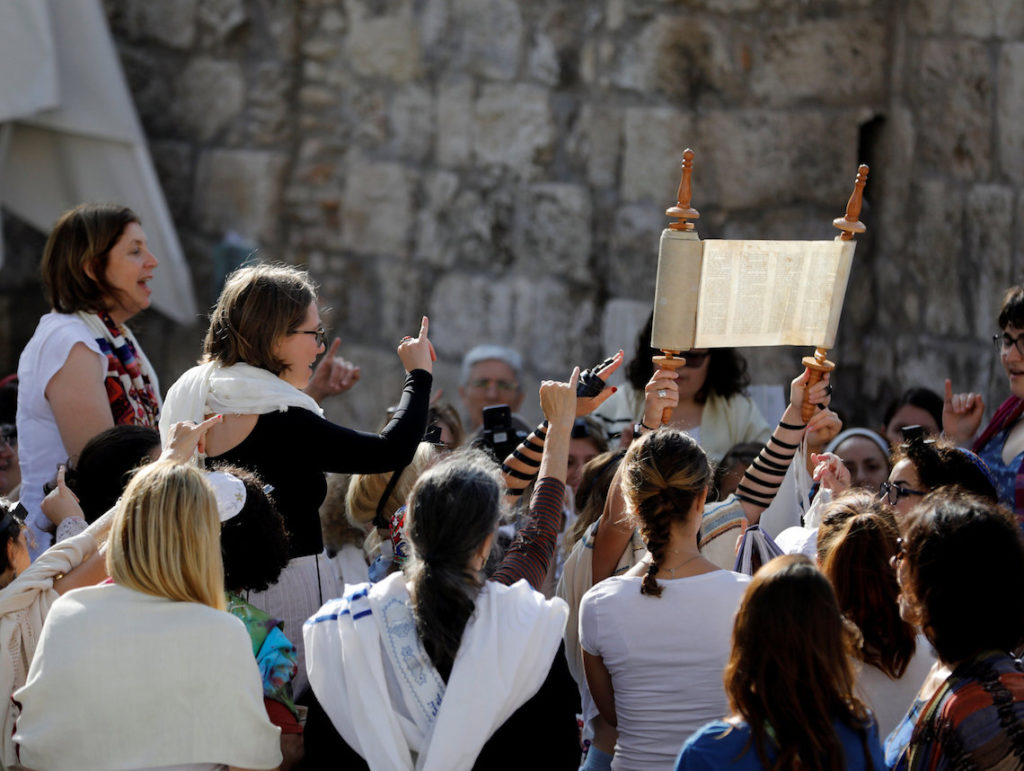
More than 100 women who assembled for the Women of the Wall’s monthly Rosh Chodesh service at the Western Wall faced more intense heckling than ever, the group said.

The women, who smuggled in a small Torah scroll for the service, were attacked verbally and physically, the group said in a statement issued Monday, hours after the service in the women’s section of the Western Wall plaza.

Young girls and women with their faces covered whistled, shouted, spit at and cursed the worshippers in an effort to shut down the service, which was held behind police barriers at the back of the women’ section. Men also chanted, jeered and yelled vulgarities to drown out the women’s prayers, shouting invective such as “Reform are worse than ISIS,” and “Reform go home,” according to the Women of the Wall. Some women also said they were shoved by security guards and had to dodge water bottles thrown at them.

The group also said that prayers from the men’s side were broadcast by a loudspeaker that is usually used only for special services such as the priestly blessing or on Tisha B’Av, and that the loudspeakers were purposely aimed at the women’s section.

“It seems like the State prefers cursing, jeering and whistling over women’s prayer,” said Women of the Wall chair Anat Hoffman. “There’s no way to explain the helplessness of security opposite a hostile and misguided minority armed with whistles and plastic trumpets, including little girls who screamed at the top of their lungs, to silence the WOW worshipers. The month of Av is traditionally an opportunity to remember that Jerusalem fell not for the might of the oppressors, but for the weakness of the people of Jerusalem, who were distracted by internal struggles.”

The group has held its monthly Rosh Chodesh prayer for the new Hebrew month in the women’s section for more than 25 years.

In January, Israel’s Supreme Court ruled in favor of women being allowed to read from the Torah in the women’s section at the Western Wall, and put a halt to security searches of the women for items such as Torah scrolls, tallitot and tefillin. The Western Wall Heritage Foundation had prevented women from bringing Torah scrolls and religious items into the women’s section.

Western Wall heckling worse than ever for monthly service, Women of the Wall says Read More »

Jordan allows Israeli Embassy employees, including guard who killed attacker, to return to Israel

The members of Israel’s diplomatic mission in Amman, Jordan, including a security guard who shot and killed his teenage assailant and a bystander, are back in Israel.

The embassy employees, who had been confined to the embassy compound all day Monday following the stabbing attack Sunday evening by a 17-year-old and subsequent shooting, returned late Monday through the Allenby Bridge.

In a statement issued shortly after 11 p.m. Monday, the Israeli Prime Minister’s Office said their return “was made possible by the close cooperation that took place in the last 24 hours between Israel and Jordan.”

The head of the Israel Security Agency, or Shin Bet, Nadav Argaman, traveled Monday to Jordan in an effort to diffuse the crisis.

Israeli Prime Minister Benjamin Netanyahu and Jordan’s King Abdullah spoke that afternoon by telephone. Abdullah told Netanyahu to remove the metal detectors placed at the entrances to the Temple Mount used by Muslim worshippers, put into place after three Arab-Israelis killed two Druze-Israeli police officers in a July 14 terrorist attack near the Al-Aqsa mosque.

Israel’s Security Cabinet met for several hours Monday evening in an effort to resolve the crisis over security measures on the Temple Mount and the escalating diplomatic crisis with Jordan.

In the attack Sunday, the assailant entered a residential building occupied by the embassy to install furniture and stabbed the Israeli guard with a screwdriver. The guard shot and killed the assailant. The building’s owner, who was standing nearby, was killed after being hit by a stray bullet.

Jordanian police had demanded to question the guard, while relatives of the stabber called for the death penalty. The embassy refused to turn the guard over to the Jordanians for questioning, saying he had immunity.

Jordanian security forces reportedly held mobs of protesters who had gathered at the embassy at bay following the incident.

The Israeli media reported that the government is considering removing the metal detectors and replacing them with high-tech security cameras, and is aiming to make the changes before Friday, the busiest day at the site for Muslim prayers.

The cameras reportedly would be located a distance away from the gates into the site, so as not to offend the worshippers, who have been protesting the metal detectors by refusing to enter the sites and holding worship services at the gates, leading to clashes with Israeli security forces that have killed at least five Muslims.

Jordan allows Israeli Embassy employees, including guard who killed attacker, to return to Israel Read More »

ZOA calls on Tillerson to quit over State Department saying Palestinian terrorism stems from ‘lack of hope’

The Zionist Organization of America called on Secretary of State Rex Tillerson to resign over the State Department terrorism report which the ZOA called “bigoted, biased, anti-Semitic, Israel-hating (and) error-ridden.”

“This Tillerson State Department Report blames Israel for Palestinian Arab terrorist attacks on innocent Jews and Americans, ignores and whitewashes the Palestinian Authority’s (PA) ‘pay to slay’ payments to Arabs to murder Jews, among other travesties,” said a ZOA statement Monday about the report, published last week.

In the report, the State Department listed as “continued drivers of violence” a “lack of hope in achieving Palestinian statehood, Israeli settlement construction in the West Bank, settler violence against Palestinians in the West Bank, the perception that the Israeli government was changing the status quo on the Haram Al Sharif/Temple Mount, and IDF tactics that the Palestinians considered overly aggressive.”

It also said that Palestinian leaders had addressed incitement.

“The PA has taken significant steps during President [Mahmoud] Abbas’ tenure (2005 to date) to ensure that official institutions in the West Bank under its control do not create or disseminate content that incites violence,” it said. “While some PA leaders have made provocative and inflammatory comments, the PA has made progress in reducing official rhetoric that could be considered incitement to violence.”

The ZOA said that the report directly contradicted multiple criticisms of the Palestinian Authority for incitement by President Donald Trump and U.S. ambassador to the United Nations, Nikki Haley.

The ZOA statement praised Rep. Pete Roskam, R-Ill., for his letter to the State Department last week seeking changes in the report.

“I strongly you encourage to modify this report to accurately characterize and hold accountable the root causes of Palestinian violence — PA leadership,” Roskam said.

ZOA calls on Tillerson to quit over State Department saying Palestinian terrorism stems from ‘lack of hope’ Read More »

Jared Kushner says Russia charges ‘ridicule’ Trump voters

In a rare public statement, Jared Kushner insisted he did not collude with Russia and said the query into suspicions of a relationship between Russia and Donald Trump’s presidential election campaign “ridiculed” Trump voters.

“Let me very clear, I did not collude with Russia, nor did I know of anyone else in the campaign who did so,” Kushner, Trump’s son-in-law and a top aide, said Monday, reading a prepared statement after appearing before the Senate Intelligence Committee in a closed session.

Kushner is in the spotlight because of revelations in recent weeks that he attended a June 9, 2016, meeting organized by his brother-in-law, Donald Trump Jr., who took the meeting believing it would be with a Russian government lawyer who had compromising intelligence on Trump’s rival, Hillary Clinton. Also under review are reports that Kushner’s family real estate business, reportedly like his father-in-law’s, owes money to Russian lenders.

“I had no improper contacts,” he said. “I have not relied on Russian funds for my businesses and I have been fully transparent in providing all requested information.”

Kushner suggested the investigation was a means of undercutting Trump’s election.

“Donald Trump had a better message and ran a smarter campaign, and that is why he won,” Kushner said. “Suggesting otherwise ridicules those who voted for him.”

The Central Intelligence Agency, the National Security Agency, the FBI and the Office of the Director of National Intelligence all have determined that Russian spies interfered in the presidential election. Special Counsel Robert S. Mueller III is leading a probe to examine whether any of the president’s advisers aided Russia’s campaign to disrupt the election.

Kushner said he remained committed to his work, citing among his many assignments bringing peace to the Middle East.

“I am so grateful for the opportunity to work on important matters such as Middle East peace and reinvigorating America’s innovative spirit,” he said.

Jared Kushner says Russia charges ‘ridicule’ Trump voters Read More »

Macron the Mensch

After all the understandable angst among Jews that the neo-fascist National Front leader, Marine Le Pen, would win the French presidency, our oldest ally has as its head of state a good and decent man, Emmanuel Macron, who with great clarity and courage, has owned up to French complicity in the Holocaust, and who has offered a spirited defense of Israel’s right to exist as a Jewish homeland.  As Henry Kissinger has noted, “The test of a leader is to get his people from where they are to where they have not been.” Macron, a true leader, is bringing France to a painful but necessary place of truth.

In his speech commemorating the 75th anniversary of the roundup of Jews in France during World War II, Macron said unequivocally that “it was indeed France that organized this.” He added that “not a single German was involved.” Rather, Macron correctly noted, it was the French police under Nazi rule and in the Vichy government of unoccupied France that did the deed.

Macron also rejected the assertions of the National Front and the French far right that the Vichy regime did not represent the French people in their policy of anti-Semitic purges and deportations to Nazi death camps. “We cannot build pride upon a lie,” Macron added.

On the subject of Israel, Macron acknowledged that “recently we have witnessed a rise of extremist forces that seek to destroy not only the Jews, but of course, the Jewish state as well, but beyond that. … The zealots of militant Islam, who seek to destroy you [the Jewish people], seek to destroy us [the French], as well.  We must stand against them together.”  Lastly, Macron paraphrased the late, great Rev. Martin Luther King Jr. in plainly stating that anti-Zionism is “a reinvented form of anti-Semitism.”

Go ahead and blink in surprise. I did. More than that, however, I shed tears of joy. As a former Justice Department prosecutor of fugitive Nazi war criminals, as a participant in the United States’ investigation of postwar American (yes, American) complicity in the escape of Gestapo officer Klaus Barbie, the “Butcher of  Lyon,” and as a lifelong pro-Israel activist, I frankly thought that I would never live to see the day when a president of France, with no holds barred, spoke truth to the power of denial.

France has long suffered from a troubled history with the real fact of the Shoah – not the fake facts that predominated much of the French posture that they were a people without any free will during World War II, and thus could not be held accountable for what happened to their Jewish friends and neighbors. The real facts are that France was a wartime country whose officials and many of whose citizens disposed of Jews as the price of doing business with the Nazis. Germany did not need to teach many (although, of course, not all) of the wartime French about anti-Semitism. All the Nazis did was to fan a fire already set.

In speaking the truth, Macron, a Catholic, has done to the conscience of France what no Jew could: He has awakened it from the peaceful slumber of denial with a swift kick to the tush.

As to his defense of Israel and his condemnation of Islamic terrorism and hatred directed at the Jewish state and his own, Macron also has done what no Jew could do: He has tied the fortunes of Israel to those of the of the West. It always has been a truth never spoken by most European governments that Israel is very much a nation in the European democratic mold:  a great if imperfect parliamentary democracy with full religious and political freedom for all of its residents regardless of their backgrounds. In its mindset and political philosophy, Israel has always looked westward. Israel may be in the Middle East, but it is decidedly not a medieval-like theocracy or autocracy as are many of its neighbors.

Macron seems to understand this in recognizing that the enemies of Israel are the enemies of France and the other Western democracies. Finally, Macron’s spirited embrace and defense of Zionism as an honorable national movement is a clear rebuttal to the persistent propaganda that Zionism is a form of racism. In just his first few weeks in office, the French president has risen to a level of inspired leadership in the defense of Western, including Jewish, civilization.

Bruce J. Einhorn is a former federal prosecutor and judge, and an adjunct professor of international human rights law at Pepperdine University.


Macron the Mensch Read More »