fbpx

July 20, 2017

Can intermarriage done correctly actually be not a curse, but a cure?

In the great new movie “The Big Sick,” Kumail Nanjiani plays a Pakistani-American stand-up comic whose traditional immigrant parents pressure him to marry a nice Pakistani girl.

Instead, he falls in love with funny blonde Emily, which sends his family into a crisis.

“Can I ask you something?” he says to his heartbroken father. “Why did you bring me to America if you don’t want me to live like an American?” 

This drama has taken place over the centuries in many American immigrant family homes — Catholic, Hindu, Muslim, Greek, Arab — and hundreds of years after the first Jew touched these shores, we still are playing it out.

Last month, it was Conservative Jewry’s turn. Two prominent rabbis, trained at the Conservative Jewish Theological Seminary and members of the movement’s Rabbinical Assembly, announced they would begin to perform intermarriages.

Rabbi Roly Matalon of B’nai Jeshurun in New York and Rabbi Amichai Lau-Lavie of New York’s Lab/Shul both decided to break with the movement’s long-held prohibition on intermarriage.

A handful of other Conservative rabbis, such as Adina Lewittes, former assistant dean at the Jewish Theological Seminary, had done the same several years before them, but the high profile of these rabbis made their decision immediate news.

“The fight over intermarriage might seem like a rabbinical squabble confined to one small corner of American Judaism,” Emma Green wrote in The Atlantic. “But what’s at stake is actually the future of Jewish identity and pluralism.”

Since only about one-fifth of American Jews identify as Conservative, that may be overstating the impact. But what’s interesting about the current debate is the rabbis who are leading it can make the argument that they are the ones doing more to strengthen Jewish life and community.

For years, Jews saw intermarriage as one of the main factors chipping away at the American Jewish community, and research tended to support that view. Surveys found that as the intermarriage rate has grown, there has been an almost 30 percent drop in the number of Jews who identify as “Jews by religion.” 

But recently, something has shifted. As Green reported, a 2017 study at Brandeis University found that “millennials born to intermarried parents were much more likely to have been raised Jewish than the children of intermarriages in previous generations.”

In other words, intermarriage does not necessarily mean a loss of Jewish identity. Indeed, these rabbis believe, it could lead to a net gain in the number of people bringing Jewish practice and values into the world.

“On the whole, I feel like the motivations I and other colleagues have been talking about, in my limited data set, they’re being borne out for me,” Lewittes told me.

I called Lewittes because even though those big-name rabbis have grabbed most of the attention, she actually has been performing intermarriages since 2015, after resigning from the Conservative movement. She has officiated at six so far, with more in the works.

Lewittes, who is now rabbi at Sha’ar Communities in New Jersey, said she is choosy about which couples she will intermarry.

“I work with people who indeed genuinely both want to have a relationship with Judaism,” she said. “Both of them want to establish a Jewish home, raise a Jewish family. I say no to more people than I say yes to.”

She engages in several premarriage counseling and learning sessions with the couple and follows up with meetings and learning.

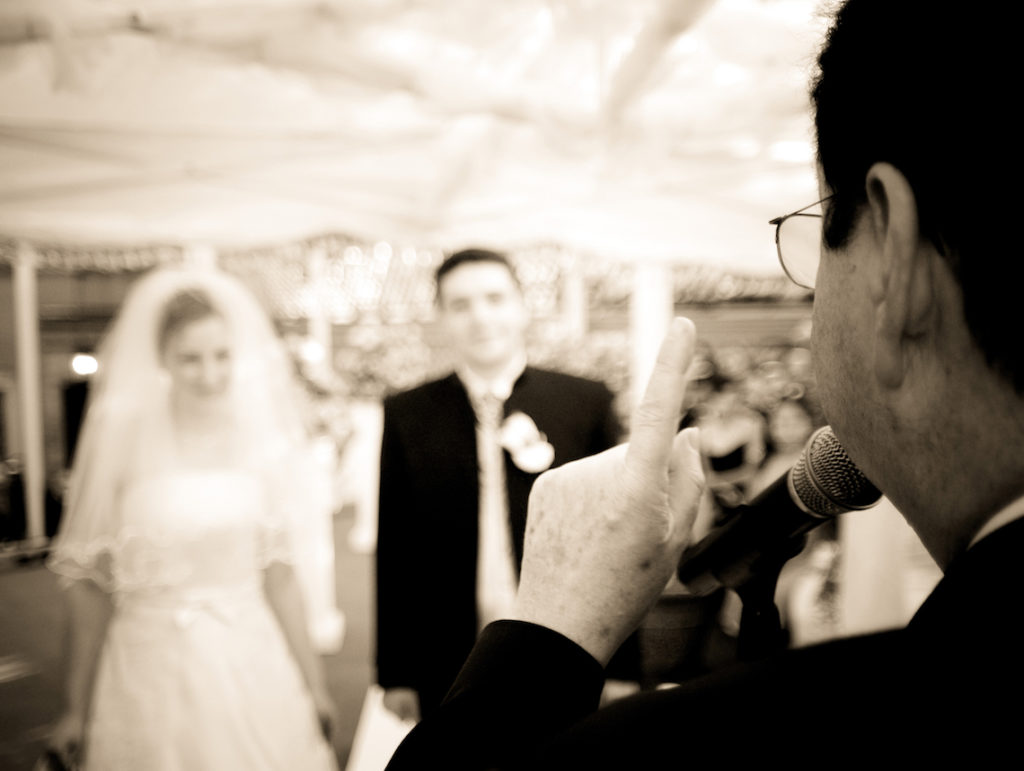
The ceremony itself is untraditional. There is no kiddushin, or ritual betrothal, and she doesn’t recite the seven blessings. Instead of a ketubah, some couples have composed a “mission statement.” There is a chuppah, or wedding canopy, and the breaking of the glass.   

Lewittes will not co-officiate with non-Jewish clergy. The ceremony, after all, also is about drawing the couple more deeply into the Jewish community.

Has it worked?

Lewittes said her admittedly small sample has been encouraging. Couples have continued to be active in her congregation. She has officiated at Jewish naming ceremonies for their children, and she has continued to teach some of them.

“The couples with whom I have worked have shown a real sense of connection to the Jewish community,” she said. “They look for ways to cultivate the seeds I was able to plant.”

Where all of this leads will be fascinating to watch. I certainly get the traditionalist argument: Marrying within your tribe is a powerful way of preserving your tribe.

But I know — we all know — too many wonderful intermarried couples. They continue to serve the community as volunteers, funders, activists. They raise children who go on to practice Judaism, embody its values and contribute to the Jewish community and the world. They succeed at being Jewish far, far better than any number of “in-married” Jewish couples who stay uncurious and uninvolved, whose biggest contribution to Jewish life was paying the rabbi who married them.

This truth puts rabbis and movements who resist intermarriage in the same bind as many were before acknowledging same-sex marriage. How do you exclude a committed, loving constituency, willing to belong and contribute to Jewish life, from meaningful Jewish rituals? Can intermarriage done correctly actually be not a curse, but a cure?

The ground has shifted on this issue, and something tells me we’re about to find the answer.


ROB ESHMAN is publisher and editor-in-chief of TRIBE Media Corp./Jewish Journal. Email
him at robe@jewishjournal.com. You can follow him on Instagram and Twitter @foodaism
and @RobEshman.

Can intermarriage done correctly actually be not a curse, but a cure? Read More »

Radiohead concert in Tel Aviv draws 47,000

Radiohead played its longest concert in 11 years for the 47,000 fans who flooded a Tel Aviv park.

“A lot of stuff was said about this. But in the end, we played some music,” frontman Thom Yorke told the crowd Wednesday in Yarkon Park before the last song of the night, a reference to calls from artists affiliated with the Boycott, Divestment and Sanctions movement for the British rock band to cancel its performance.

Radiohead, which gained popularity originally in Israel, was playing its first concert there in 17 years. The band played 27 songs, including two encores.

Guitarist Jonny Greenwood, who is married to an Israeli woman, heard some extra cheers after thanking the band’s opening act, the Israeli artist Dudu Tassa, in Hebrew.

Radiohead concert in Tel Aviv draws 47,000 Read More »

Four times John McCain went maverick with his Jewish friends

Sen. John McCain, R-Ariz. — war hero, presidential candidate, force of nature — has brain cancer, his family said Wednesday night, and he is garnering well-wishes from across the spectrum.

More than a few are from Jews: Israeli Prime Minister Benjamin Netanyahu called McCain “A hero. A fighter. A friend.”


Norm Eisen, the ethics chief under President Barack Obama who has emerged as one of President Donald Trump’s fiercest critics, has worked in the past with McCain on lobbying reform. “Sending you ammo John: our prayers.”


Some of the most heartfelt wishes came from McCain’s colleagues on the other said of the Senate aisle, a rare display of comity in a polarized Washington, including from Minority Leader Chuck Schumer of New York, and from Al Franken of Minnesota:


There was even a nod from actor Jason Alexander, the politically active alum of “Seinfeld”:


McCain, a maverick who has stubbornly resisted shifting political tides and who embraces an interventionist foreign policy rooted in an idea of America as a shining example to the world, has a natural affinity for Jews. He has been an ardent defender of Israel, visiting the country countless times, and joined pro-Israel centrists in leading opposition to the 2015 Iran nuclear deal. His 2008 campaign for the presidency was chockablock with Jewish advisers, particularly in the national security sphere.

Here are four times he has joined with Jews in bucking expectations:

McCain-Feingold, or approving the message

McCain joined with Sen. Russ Feingold of Wisconsin, then one of the most liberal Democrats, to keep corporate money out of campaign financing. Republicans hated the law — its first legal challenge was by Sen. Mitch McConnell of Kentucky who is now the majority leader — and it eventually backfired. Banned from directly funding candidates, corporations exploited a loophole that allowed funding againstcandidates — and such so-called “soft money” was even harder to track. The Supreme Court in 2010 struck down key portions of McCain-Feingold as unconstitutionally impinging on free speech.

McCain-Feingold was so bogged down in acrimony and infighting, the cartoon series “Family Guy” made it a joke in 2010, featuring the bill as a laugh line that only irredeemably boring Washington insiders would get. It has one notable legacy: The “I’m Jane Doe and I approve this message” lines that tag political ads, designed to curb vituperation among candidates.

Quixotic? Yes. But the conservative, blue-talking southwestern Episcopalian and the soft-spoken Jew from Wisconsin remain friends, and Feingold was among McCain’s well-wishers on Wednesday.


Vice President Joe Lieberman, part II

McCain’s two closest friends in the Senate have been Lindsey Graham, Republican of South Carolina and Joe Lieberman, Democrat and then Independent of Connecticut. They advanced the robust foreign policy now out of fashion with Republicans with frequent visits to conflict zones, dubbing themselves the “Three Amigos.”

That “then Independent” in Lieberman’s biography is key. Lieberman and McCain were always close — like McCain, Lieberman remained a champion of the Iraq War long after other erstwhile backers changed their minds. But Lieberman’s defeat in the 2006 Democratic primary for his seat and his subsequent win as an Independent freed him to openly back McCain in the 2008 election, although he continued to caucus with Democrats.

McCain sorely wanted Lieberman as his running mate, but the Republican establishment — in the form of Karl Rove — fiercely resisted, saying he would be guaranteed to lose the election if he took on a Democrat in all but name. (So much for that: McCain’s eventual pick, Alaska Gov. Sarah Palin, pleased the base, but also likely was critical in driving away moderates and handing the election to Barack Obama.)

Lieberman had already made history in 2000 as the first Jewish candidate on a national ticket when Democratic nominee Al Gore chose him as his running mate. Had McCain prevailed, he would have made history again, as the first vice-presidential nominee to make the ticket for both parties.


Five liberal rabbis walk into a Republican’s office

McCain bucked the George W. Bush presidency in objecting to its sanction of torture in the wake of the Sept. 11 attacks. (He also has clashed with President Donald Trump on the issue.) It was personal for McCain: As a prisoner of war in Vietnam, he had been tortured, and the notion that his beloved country would embrace the practice struck him as unconscionable.

Among his partners in his quest to ban the practice? Rabbis for Human Rights (now T’ruah), which met with him in 2005. It wasn’t a mere courtesy meeting: The group briefed McCain on Israel’s Supreme Court 1999 ban on even “moderate physical pressure,” and the fact that Israel was able to combat terrorism without torture became a talking point for the senator.

Going kosher because, why not

McCain, speaking at an Israeli embassy event in 2012 honoring Lieberman, who was wrapping up his career as a senator, shocked the room by saying he was considering converting to Judaism. Not because he loved the faith’s practices, but because he had endured enough of them traveling with Lieberman, an Orthodox Jew, that he figured he might as well.

He was joking, of course, but it was a memorable — and salty — evening, as our coverage described it atthe time:

“I’ve had for so many years had to put up with the bulls**t,” McCain said. “I might as well convert.”

He started with Shabbat elevators, whose point he never quite got: “Pushing all those buttons — and nothing!”

Then McCain got to the dining. “Why in every f**king kosher menu do we have to have salmon?” he said to peals of laughter. “I’d like to have a round of applause tonight because we don’t have salmon.” (The main dish was roast beef.)

Then there were the long walks on winter Sabbaths, accompanying Lieberman home from the Senate. And that time McCain fell asleep on a plane ride. “I hear this mumbling and I look and there’s this guy wearing a shawl — I thought maybe I’d died.”

McCain now knows what a tallit is and even cited two “Hebrew” words in his lexicon, “Mensch and Oy Vey.”

But Lieberman, in his own speech, got in a zinger of a rejoinder: “John, your entry into the covenant was a lot less painful than mine.”

Four times John McCain went maverick with his Jewish friends Read More »

More Jews mugged by the reality of intermarriage

Exactly a month ago, I wrote that “Interfaith marriage between Jews and non-Jews is back in the news.” The ending I wrote for that article prompted a few phone calls from a few rabbis, some of them relatively well-known. There were the rabbis curious about my argument, those who wanted to understand if a certain policy course is hidden between the lines, and those angry with my “surrender,” as one of them defined it. I told him he was too angry – but also that he has a point. I surrender. Mugged by reality, as one Jewish intellectual once said in a different context.

Here is what I wrote on the still-raging (see my proof further down) debate about Jews intermarrying: “the only way forward is to let this trial and error process run its course. Not because this is what the Jews need, but rather because this is what the Jews are going to do. If studies cannot give a definitive answer regarding what we ought to do, and if the Jews themselves are not willing to agree on what we ought to do, then life will be our field of experimentation. Some Jews will marry non-Jews, and some will not. Some rabbis will officiate in interfaith ceremonies, and others will not. Some scholars will argue that intermarriage is about to weaken us – and some will argue that intermarriage can strengthen us. Give it two or three or four generations, and this debate will be decided by reality.”

So a month has passed, and the Jews are still undecided, still debating. The volume of writing on Jewish interfaith marriage in America is high – while the reason for this uptick is somewhat mysterious (it clearly has to do with Conservative rabbis rebelling against their movement’s policy – but seems to have grown larger than that). In the next few paragraphs I would like to quote some of the articles I’ve read about this topic in the past month and add some comments on a few of the arguments these articles made.

In NY Jewish Week, Gerald Zelizer urged Conservative rabbis to “hold firm” – that is, refuse to perform intermarriage ceremonies. “The available information,” he writes to fellow Conservatives, “does not suggest that we Conservative rabbis should change our standard in the naive hope that standing under the chuppah will have a significant impact on the Jewishness of interfaith couples or the families they build.” He is right. The data does not support such “naïve hope.” He is also wrong: such “naïve hope” is not the main driver of change. Rabbis’ rebelling against the current policy do not do it because of false “hope” hidden in studies, they do it because of a very vivid reality. Jews will do what they do. If the rabbis don’t keep up with non-rabbinic Jews, they will be leaders with fewer and fewer followers.

In the Jewish Journal, Roberta Rosenthal Kwall suggested that the “progressive movements need to develop better marketing skills, because the Jewish religion is a wonderful product. It is a way of life that touches both the mind and the heart. We need to take more pride in our product and encourage others — particularly those who are marrying Jews — to join us as members rather than as spectators. In short, we need to actively encourage conversion.” Well, conversion is a great option. But there is a problem: if you do not perform intermarriage, non-Jews are not likely to be a part of your congregation. If they are not part of the congregation, you are not likely to be able to push them towards conversion. So first one has to answer the original question: to officiate or not to officiate?

A long Atlantic article by Emma Green (more descriptive than opinionated) argued that “the inflexible standards of Israeli Judaism exacerbate the situation in the United States and contribute to the sense among some rabbis that traditional and liberal Judaism may be irreconcilable.” Of course, the term “inflexible” does reveal a certain bias. You could make the same argument by writing the opposite biased sentence: “the lax standards of American Judaism exacerbate the situation… and contribute to the sense among some rabbis that traditional and liberal Judaism may be irreconcilable.” But, leaving that bias aside, Green puts her finger on an often-neglected point: American Jews (rightly) berate Israel when it makes decisions that impact the whole of the Jewish world without consulting them. But American Jews are currently also in a process of making dramatic decisions involving the core definition of Jewishness, and they are also going through this process without much consultation with Israel.

Paul Golin wrote in the Forward about his frustration with progressive Jews who also want “standards” for Jewishness and apply a lesser status to intermarried Jews. “The policing of Jewish observance by Jews against other Jews is disastrous regardless of who’s doing it,” he writes. And it must be said: his argument is cohesive. Golin would like the Jewish group to include all those who declare themselves to be Jewish. He praises Humanistic Judaism’s definition of every person who “identifies with the history, ethical values, culture, civilization, community, and fate of the Jewish people.” Is there a problem with this position? I think there is. It does not correspond well with the many Jews who think that Judaism is a religion, and it does not correspond well with the many Jews who think that the Jews are a people. In other words: Golin’s definition establishes a new, undefined group, of people who supposedly have similar “values” (assuming there are Jewish values we all accept), or a shared “culture” (whatever culture means in this context). He proposes a coherent definition – but creates an incoherent group.

Lastly, Ed Case, of Interfaith Family. In his organization’s blog, Case addressed the point I was making a month ago. “The problem with this incredibly non-activist approach,” he wrote about my article, “is that arguing that intermarriage weakens us is self-fulfilling. Intermarriage won’t be an opportunity to grow in numbers and vitality if the messages the Jewish community sends – like by rabbis not officiating – disapprove of interfaith couples [and] relationships”. Case is right: sending a clear and unified message might be better to achieve the desired result. But such an argument can cut both ways – and his opponents can make the exact same argument: “arguing that sticking with in-marriage weakens us is self-fulfilling. In-marriage won’t be an opportunity to grow in numbers and vitality if the messages the Jewish community sends – like by rabbis officiating – disapprove of insistence on Jewish couples and relationships.”

Thus, the debate continues, and my conclusion that we are doomed to “let this trial and error process run its course.”


More Jews mugged by the reality of intermarriage Read More »