fbpx

July 10, 2017

Who is a winner at the Southern California Journalism Awards?

Who is a winner at the Southern California Journalism awards?
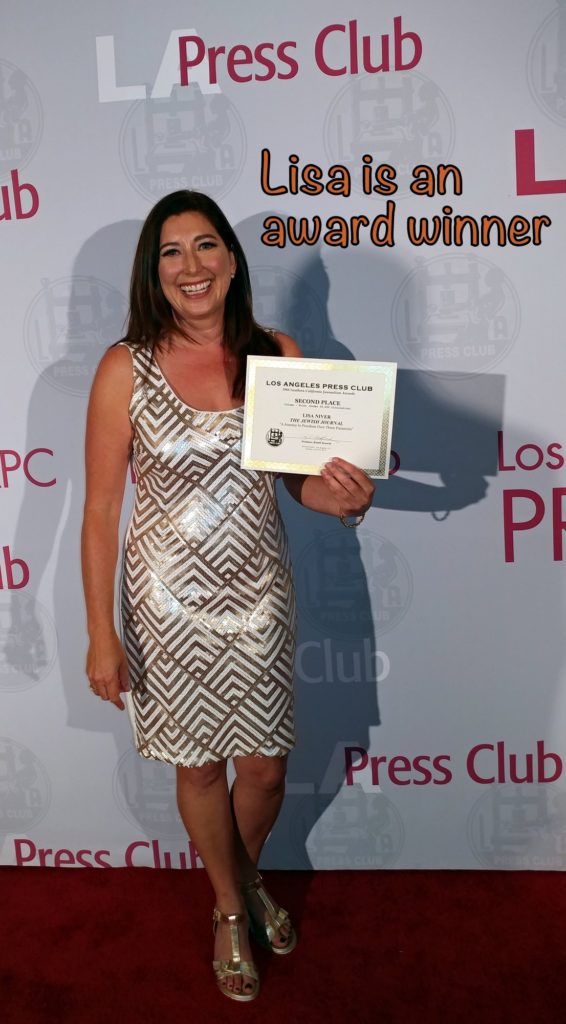
Lisa Niver, Photo by Curtis Sabir

Thank you! I was honored to be a finalist in two categories for the 59th Southern California Journalism Awards and delighted to receive second place in the Print Column category for “A Journey to Freedom Over Three Passovers.”

What awards did the Jewish Journal win?

“Jewish Journal senior writer Danielle Berrin was named Journalist of the Year by the Los Angeles Press Club at its 59th Annual Southern California Journalism Awards banquet on June 25. She won in the category for print publications with circulations of 50,000 and above.

Who is a winner at the Southern California Journalism awards?
Lisa Niver and Marty Kaplan

Other Jewish Journal winners included columnist Marty Kaplan, who won first place for “Is Campaign News Necessary?” Berrin took third place in the same category for “Huma Abedin and the Real Housewives of Politics.”

Contributing editor Tom Tugend took second place for his personality profile “Looking Back at War on Memorial Day”; contributing writer Lisa Niver won second place for her column “A Journey to Freedom Over Three Passovers”; book editor Jonathan Kirsch was awarded second place for criticism of books, art, architecture and design for “Shock Is Followed by Awe Over Foer’s New Novel”; editor-in-chief and publisher Rob Eshman won third place for food and culture criticism for “Jonathan Gold on Eating Your Entire City”; and staff writer Eitan Arom took third place for hard news for his story “The Complex, Secret Path to Becoming an Orthodox Jew.”

Who is a winner at the Southern California Journalism awards?
Lisa Niver, Jessi Berrin and Danielle Berrin, Journalist of the Year

From the Los Angeles Press Club event at the Biltmore: See all the winners and all the finalists for the 59th annual Southern California Journalism Awards.

Who is a winner at the Southern California Journalism awards?

Video: Mayor Eric Garcetti: “Thank you for being the light” 

Mayor Eric Garcetti: “The urgency of what you do in this moment is so important in this city, in this country and this world. Thank you for being the light. What you do is safeguarding this democracy. What you are doing is breathing life back in to what we stand for. I certainly am grateful for that. If you didn’t do your job I couldn’t do my job.”

Who is a winner at the Southern California Journalism awards?
Lisa Niver and Andrea Mitchell, winner of The Joseph M. Quinn Award for Lifetime Achievement
Who is a winner at the Southern California Journalism awards?
Lisa Niver and Daniel Berehulak, winner of Daniel Pearl Award for Courage and Integrity in Journalism
Who is a winner at the Southern California Journalism awards?
The Jewish Journal Table at the Southern California Journalism Awards
Who is a winner at the Southern California Journalism awards?
Lisa Niver, Kat Kramer and Diana Ljungaeus, Executive Director of the Los Angeles Press Club

Do you want to be a travel writer too? Enter the We Said Go Travel Summer Writing Competition! In honor of Lisa’s award, we extended the deadline! Next month, we will have our first ever photo competition.

Who is a winner at the Southern California Journalism Awards? Read More »

Lawyers for Jewish woman in Montana can’t find the neo-Nazi she is suing

Lawyers for a Jewish woman in Montana say they are unable to track down a neo-Nazi she is suing for launching a harassment campaign against her and her family.

Tanya Gersh of Whitefish, Montana announced in April a suit against Andrew Anglin, the founder of the white nationalist website, The Daily Stormer, for revealing her personal information and inflicting “emotional distress.” After a three-month search, Gersh’s lawyers are still trying to find Anglin to deliver the suit.

Anglin launched a campaign in December against Gersh after Sherry Spencer of Whitefish, mother of another white supremacist, Richard Spencer, posted an article on Medium targeting Gersh, a real estate agent, over a real estate dispute. The next day, Anglin made a post for his subscribers titled “Jews Targeting Richard Spencer’s Mother for Harassment and Extortion – TAKE ACTION!”

Gersh claims that anonymous internet users harassed her family after Anglin revealed her her home address and phone number, her husband’s business contact information and her son’s Twitter handle.

The suit accuses Anglin of invading Gersh’s privacy and violating a Montana anti-intimidation law. The Daily Stormer created a campaign on WeSearchr to pay for Anglin’s legal expenses, raising more than $152,000 in donations from nearly 2,000 contributors. According to The Associated Press, Anglin has yet to reveal his whereabouts to face Gersh’s claim.

Gersh’s lawyers from the Southern Poverty Law Center have said that, based off procedure, her suit must be dismissed if Anglin isn’t served a copy of it by July 17. Her team is asking the court for an extended deadline.

Lawyers for Jewish woman in Montana can’t find the neo-Nazi she is suing Read More »

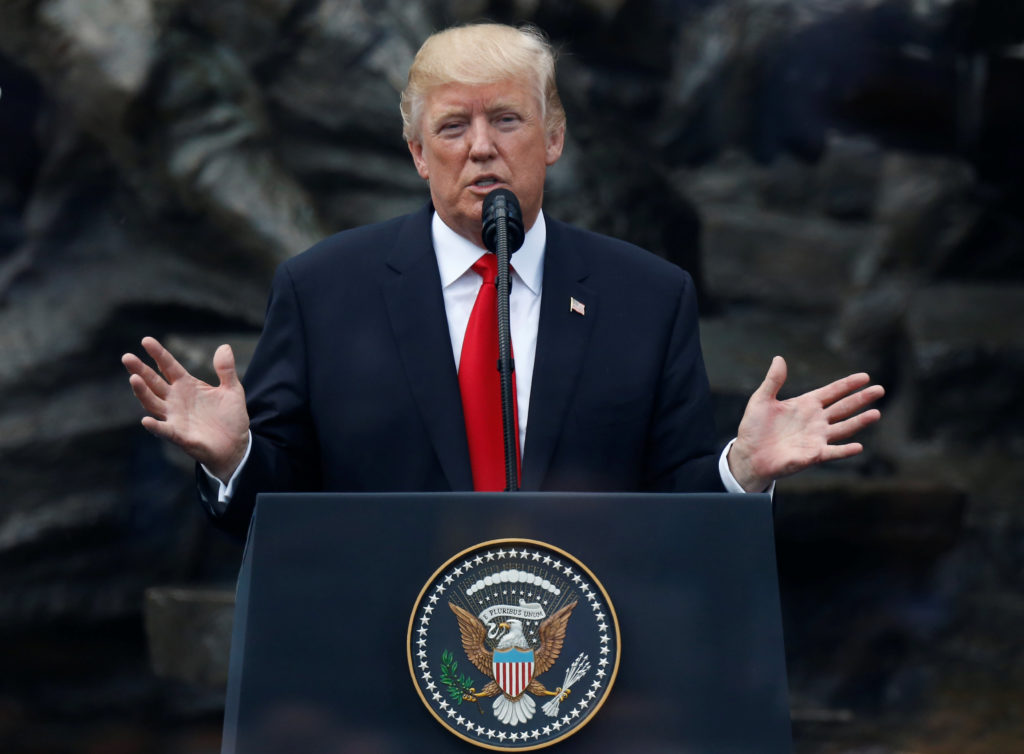
The lesson from Poland: Trump’s sentiments are Israel’s sentiments

Since the early days of the Trump administration, Israeli policy makers have been struggling with a tricky situation: on the one hand, Israel wants to have the closest possible relations with the new administration. This is not unique to Israel and Trump – for Israel, it is always a goal to have close relations with an incoming president. With some administrations it finds success, with others – the Obama administration is a recent example – its success is more limited.

On the other hand, the Trump administration has presented a different kind of challenge for several reasons. First – many of Israel’s most avid supporters, Jews and non-Jews, Democrats and hawkish Republicans, are highly suspicious of the new administration. Trump is president, but is also highly unpopular. Trump is president, but is also highly unpredictable. Trump is president, but becoming identified with Trump could pose a problem for Israel – as it will surely not help it retain its bipartisan status in America (assuming that’s still possible, at least to a certain degree).

The questions concerning Trump’s policy toward Israel are naturally a factor. But for a relatively long time, it was impossible in many ways to understand what the Trump administration’s policy is going to look like. The president was sending mixed signals, about his intent to be the greatest supporter of Israel, but also about his intent to broker a peace agreement between Israel and the Palestinians – a process that could lead to conflicts and clashes. His visit to Israel was short and successful, but his policy was still unclear – another reason for Israeli caution.

It is reasonable to argue that some of this caution can be now abandoned. That is, because of the important speech made by Trump last week, in Poland. This was one of his best speeches (the bar isn’t especially high). This was also, finally, a speech that clarifies Trump’s ideology concerning world affairs. For Israel, this speech clarifies something that will surely complicate its relations with some groups of Americans, but is nevertheless reassuring: Trump thinks about world affairs in a way similar to that of the current Israeli coalition.

What did Trump say? The Economist defined Trump’s departure from precedent in the following way: “Earlier American administrations defined ‘the West’ with reference to values such as democracy, liberty and respect for human rights. Mr Trump and many of his advisers, including the speech’s authors, Stephen Bannon and Stephen Miller, apparently see it as rooted in ethnicity, culture and religion.”

Let’s see some of the points Trump made.

He spoke positively about devotion to God – that is, about the power that a nation draws from having an active religious sentiment. Trump does not mock people who “cling to their religion,” but rather praises them.

He spoke about the values of the West – values that not all cultures and not all people share. In other words: Trump feels comfortable and confident about defending and speaking for specific, not necessarily universal, values.  “Today we’re in the West, and we have to say there are dire threats to our security and to our way of life. You see what’s happening out there. They are threats. We will confront them. We will win. But they are threats.”

What are these threats? Trump pointed fingers at the sources of the threat: “We are confronted by another oppressive ideology — one that seeks to export terrorism and extremism all around the globe…. We must stand united against these shared enemies to strip them of their territory and their funding, and their networks, and any form of ideological support that they may have.” Oh, and he is not shy about calling this threat by name: “radical Islamic terrorism.”

Trump is blunt about the measures needed to confront the threats: “While we will always welcome new citizens who share our values and love our people, our borders will always be closed to terrorism and extremism of any kind.”

But the key paragraph was this one – the paragraph in which Trump laid out a vision very much in line with Israel’s basic political instinct: What people of the West want is “individual freedom and sovereignty,” he said. He then added: “We must work together to confront forces, whether they come from inside or out, from the South or the East, that threaten over time to undermine these values and to erase the bonds of culture, faith and tradition that make us who we are.”

Here you have it: “bonds of culture, faith and tradition.” Some of Trump’s critics were quick to blame him of racism, tribalism, xenophobia, chauvinism (some writers liked his speech). Many of Israel’s critics hurl the same accusations as they consider its belief in bonds of “culture, faith and tradition” – Israel’s desire to retain its character as a Jewish State, its rejection of any formulation of a one-state solution, its insistence on demographic policies aimed at having a Jewish majority in the country. This of course does not make Trump’s future policies in the Middle east more predictable. But it does clarify a fact that many of Israel’s critics will gladly use against it: policies aside, Trump’s sentiments are Israel’s sentiments.

The lesson from Poland: Trump’s sentiments are Israel’s sentiments Read More »