fbpx

July 7, 2017

Sen. Al Franken is back to telling jokes

U.S. Senator Al Franken’s high-profile grilling of several of President Trump’s nominees earlier this year thrust him into the spotlight. His tough questioning of Supreme Court Justice Neil Gorsuch, Education Secretary Betsy DeVos and Attorney General Jeff Sessions led many in Washington to wonder whether the Minnesota Democrat and former comedian has higher aspirations, perhaps even to the White House.

A newly released memoir, cheekily titled “Al Franken: Giant of the Senate,” has only added fuel to the idea. It’s hardly the policy-heavy tome that would suggest a serious bid, but Franken, one of eight Jews in the Senate, does lay out a progressive agenda for Democrats. He also reviews his own unlikely career path, from performer of absurdist satire to longtime writer and cast member on “Saturday Night Live,” followed by a three-hour daily radio show on Air America and several bestselling books that debunk right-wing conservative statements.

In the book Franken recounts his contentious campaign against Republican Sen. Norm Coleman in 2008, an election he won by just 312 votes, and his fight for reelection in 2014. The book also covers the 2016 presidential election and Franken’s opposition to President Trump and his administration’s policies.

In an interview with the Jewish Journal before his appearance July 8 at Live Talks LA with Chelsea Handler, Franken reflected on his journey and what comes next. The interview has been edited for length and clarity.

Why did you decide to write this memoir?

After I was re-elected — and the first election was very, very close — the second one, I felt that the people of Minnesota got that I was a serious senator and a workhorse, and I felt like I could loosen up a little. And then in August of 2015 my wife and I were going to have our first vacation in years, just the two of us, at a lodge in northern Minnesota. And after that we were going to go to Africa on a Congressional Delegation trip (CODEL), which was going to be a little arduous. And I got to where the lodge was and she just said she couldn’t come because she was sick and wanted to get well for the CODEL.

So I was there at the lodge, I had five days, and I had told myself that I was going to write about all this at some point. And I thought, well, I’m going to start writing. I thought it could end up like The Shining, or it could work out. It was a lot of fun and it also helped me think about how I was approaching my job. It really just happened because my wife had a terrible cold.

Did you have any grand revelations while you were writing the book about your life and your role in the Senate?

It clarified my thinking about the role of the staff and the role of the Senator and also about what happened during the period between when I got there and when the Republicans took the majority. I was surprised when Trump won, of course, and I was about 90 percent done with the book. So I had to do a little revamping. It helped me think about my books about people lying, and my race in 2008 and being attacked for things I had written. And Trump somehow got elected, even bragging about things like sexual assault. And so it was really helpful for me to get perspective on where we are right now.

In the book you talk about how when you were deciding whether to run for Senate, you were concerned that you didn’t have the political experience. Now you see somebody like President Trump who has no political experience rising to power. In writing the book do you feel like you have a better sense of why Trump was elected?

I think that there’s been a culmination of things that I’ve been part of or witness to, or have critiqued. The books I wrote on Rush Limbaugh and Newt Gingrich and on Fox are really about how our political discourse has coarsened and also how lying became somehow acceptable, and almost normative. Especially, I think, on the right. And how we started getting parallel universes where people are getting news that confirms their bias. And so we got to this extreme point where we are today, where we have a president calling the news media fake, and we have Americans divided by where they get their information.

Given your years of charting lies among the political right, did it surprise you that Trump won?

I was surprised, but I did also have an inkling. On Election Day I went on “Morning Joe” and I remember, I was right after former Michigan governor Jennifer Granholm, and she was celebrating already. And I was going, like, no, no, no, no. I’m the poster boy for close elections. Every Democrat better get out and vote. So I was nervous. It was a sinking feeling during the whole day. I didn’t think that was going to happen, but I was nervous that it would. And here we are.

Are you worried that the Democrats are spending too much time attacking Trump and too little time offering an alternative vision that might get voters excited for the midterm elections and for 2020?

I think you can do both at the same time. We definitely have to show an alternative vision. In terms of the Trump investigation and now that we have a special prosecutor, I’m on the Judiciary Committee and we’re going to ask Jeff Sessions to come appear before us again. There’s a role we have to play and there’s a role for both intelligence committees. But we’ve got to trust the special prosecutor is going to also do his job.

Our job is to have an alternate vision to what Republicans are giving us, and I think I do that in the book. I talk about Paul Wellstone and the concept of “we all do better when we all do better.” The press seems to want to also focus on Trump and to some extent it’s hard for us to get traction with the policies that we are putting out there.

In the last few months you have become well known for asking tough questions during Senate hearings. How did you prepare for the DeVos and Sessions and Gorsuch confirmation hearings?

Well, they were each a little different. With DeVos, I had a courtesy meeting with her. Before the courtesy meeting, I had heard from a few of my colleagues that had already met with her and basically I got the word that she wasn’t very well versed on education policy. And considering she was the nominee for education secretary, I was curious about that. And when we had our meeting I was actually very surprised at how little she knew. So mainly I just prepared a question about something incredibly basic in education policy, which is the growth versus proficiency argument. This is something that every teacher, every principal, every superintendent, every school board member and most parents know about. And when I asked the question it turned out to be a viral moment because she just had no clue about this very, very basic debate within education circles on how to hold schools accountable.

On Gorsuch it was reading the cases and his opinions. He’s been preparing all his adult life but I didn’t particularly buy his presentation of himself. This whole thing about “I go to the law,” it seems like he has a lot of pre-determined ideas of what the law says. And it seems like he doesn’t really believe in precedent. And he also has some very odd rulings, for example in the truck driver case. That was incredibly bizarre as far as I was concerned and I focused on that because of the frozen truck driver.

Conservatives accused you of political grandstanding. They said that the tough line of questioning was about you advancing your career. How do you reply to those accusations?

I actually hadn’t heard that. I thought they were really good questions. With Sessions, he filled out a questionnaire that the committee had given him asking him to talk about the 10 most important cases he had been personally engaged in. And he named four civil rights cases that it turned out he wasn’t engaged in. And so I thought that was a good line of questioning. I think that every line of questioning of mine was legitimate. And I hadn’t really heard that criticism.

A lot of interviewers have asked you about your presidential ambitions, which you’ve unequivocally disavowed. But have you given it any thought?

Well, I’ve given some thought to it because everyone keeps asking me about it. But I just don’t think that that’s something I want to do. I like the job I have. I like representing the people of Minnesota. And in 2020 I expect to run for reelection.

There’s been a lot of talk of impeachment with President Trump and you’ve expressed concern about what a Pence presidency might look like. Would you prefer that we have Trump for at least the duration of his first term?

Well, that’s not up to me. I think that’s going to be more about what the special prosecutor Bob Mueller finds. And I think we should let that take care of itself. I do believe that those of us on Judiciary have a role to play. I believe that those on the Intelligence Committee in the House and the Intelligence Committee in the Senate have a role to play in the investigation. I think part of that role should be determining how we can prevent this from happening again, prevent the Russians from interfering in our elections. I think that’s the primary goal of all those committees. But the special prosecutor is the one who I think will determine whether we have a there there on prosecuting people who were in the Trump campaign or associates of Trump and whether it gets to Trump himself.

I’d rather we actually not let them do this healthcare bill. And that’s where I’m really putting a lot of my energy and focus right now. That would be a terrible, cruel move on their part to take health care from people who need it the most and give a tax cut to people who need it the least.

I imagine your constituents in Minnesota are expressing a lot of concern about that right now.

Yeah. And a lot of them live in areas that Trump did very well in. And I’m co-chair of the Rural Health Caucus so I’ve been around my state hearing from them, and this frightens them, frankly.

In your interview with Marc Maron on the podcast WTF, you said you are “very Jewish but not devout.” In what ways do you think of yourself as very Jewish?

Well I think that’s an accurate statement. I’m not devout in the sense that I observe all the holidays. You know, I observe the High Holy days. I’m a Reform Jew, what can I say.

But I culturally am extremely Jewish. I think part of it has to do with, there’s a lot of Jewish comedians, I don’t know if you’ve noticed, but it seems to be part of the culture.

I identify very much as a Jew. I had that very much pounded into my head. I was born in 1951 so not long after the Holocaust and that Jewish identity means a lot to me. I married out of the faith, I married a Catholic girl, but our kids are half Irish Catholic and half European Ashkenazi Jew. But they really see themselves as Jews. My daughter had a very Jewish wedding and she and her husband are raising their kids Jewish. My son married a woman who’s also half Jewish, and they identify themselves as a Jewish family. So it’s a bit of a cultural identity. I mean, my son lives on the Upper West Side, for god’s sake. They’re within spitting distance of Zabar’s.

You grew up in St. Louis Park, a first-ring suburb of Minneapolis.

Yeah, I grew up in the Jewish suburb of Minneapolis, St. Louis Park, which produced Tom Friedman, Norm Ornstein, the Coen brothers, and me, among others. It’s not that weird if you think about it because this is show business and journalism and academia. That’s not so odd for Jews.

Let me ask you something about your Saturday Night Live career. You’re probably best known for your character Stuart Smalley, which came out of going to Al-Anon meetings because your wife Franni and your writing partner Tom Davis were both struggling with addiction. You write in the book that Tom hated the character Stuart Smalley. What did Franni think of it?

Franni liked the character. You know AA and Al-Anon are very different. I mean they’re entirely the same but very different. There is a lot of the same language and slogans and basic thought that goes into it. It’s recovery and all 12-step programs have something in common. But she liked it a lot. She understood it and she wasn’t defensive about her addiction like Tom was. Tom didn’t like it because it was challenging to him.

Not only was she not defensive about her addiction, but she actually opened up about her struggle with alcoholism in an ad that aired during your 2008 Senate race. How did that decision come about and what impact do you think it had on the race?

Well, I write a chapter called “Franni Saves the Campaign.” So I think it made all the difference in the race. It basically was a very, very nasty campaign. As I write in the book, they took everything I had ever done in comedy and put it through the “DeHumorizer.” They made me out to be something I wasn’t, and she knew it and she wanted to talk about how I had supported her. And she did an ad that was incredibly effective. Two days after the ad aired we had a debate in a big gymnasium and it was full, with people on the floor and in the bleachers, and she got a standing ovation when she entered the room. So it made an enormous difference in terms of the way voters perceived me.

SNL is enjoying a resurgence right now because of the Trump administration. Do you still watch it and how do you feel about its portrayal of the White House?

I think they started getting their sea legs before the election. I think that the debates were really funny. Kate McKinnon’s Hillary was a very funny take on her and captured something about her. As I write in the book, we didn’t feel the job of the show was to take sides. And a good satirical show will take on the president. And this guy and the people around him, there’s a lot to work with. But I think the show has had a very good year, even taking away the political satire. I think Lorne [Michaels] made some really wise decisions about who he kept.

I think writing and performing have equal weight. The show always works best when both the writing and performing not only are strong but one doesn’t dominate. Because when the cast dominates you get a lot of the same recurring characters over and over again until you get sick of them. And when the writers dominate you get a lot of stuff that the writers find interesting, and the audience doesn’t find either interesting or funny. So I just think it’s been a good season all around. The Sean Spicer that Melissa McCarthy did was just, I saw that live and I went, oh my goodness, this is an instant classic. Hilarious. That was a spectacular moment of the show.

Will we see you on SNL anytime soon? Possibly hosting the show?

I don’t think so. I don’t think that’s in the cards.

You write often in the book about your need to bite your tongue as a senator. Do you feel like you’re able to let loose a little bit more now that you’ve put some time into the Senate?

Yeah. I felt like after my reelection, it actually turned out to be a bad year for Democrats and I won by over 10 points. And I felt like, not vindicated, but I felt like people in Minnesota got that I was very serious about the job and that I had been working very hard on their behalf. I had been very self-conscious about not being funny when I first got there because so much of the campaign had been about me as a comedian and putting my material through the “DeHumorizer.” I felt freer after the 2014 election. And this book wouldn’t have been possible, of course, in the first term.

Sen. Al Franken is back to telling jokes Read More »

ADL expresses ‘concerns’ about Jay-Z Jewish lyric

The Anti-Defamation League expressed concern about a Jay-Z lyric that “Jewish people own all the property in America,” but emphasized that it did not believe that the rapper intended to promote anti-Semitism.

“The lyric does seem to play into deep-seated anti-Semitic stereotypes about Jews and money,” said an ADL statement released Friday. “The idea that Jews ‘own all the property’ in this country and have used credit to financially get ahead are odious and false. Yet, such notions have lingered in society for decades, and we are concerned that this lyric could feed into preconceived notions about Jews and alleged Jewish ‘control’ of the banks and finance.”

The song, “The Story of O.J.,” on Jay Z’s latest album, “4:44” has attracted negative social media attention for its lyric, ““You wanna know what’s more important than throwin’ away money at a strip club? Credit/ You ever wonder why Jewish people own all the property in America? This how they did it.”

Jay Z’s defenders say the lyric is typical of his use of exaggerated stereotypes to make broader points about social problems — in this case, counseling African-American empowerment through emulation of Jewish business leaders.

“We do not believe it was Jay-Z’s intent to promote anti-Semitism,” the ADL said. “On the contrary, we know that Jay-Z is someone who has used his celebrity in the past to speak out responsibly and forcefully against the evils of racism and anti-Semitism.”

ADL expresses ‘concerns’ about Jay-Z Jewish lyric Read More »

Protest planned for Paris Holocaust memorial event during Netanyahu visit

A Muslim website called on pro-Palestinian activists to crash a Holocaust commemoration ceremony in Paris to protest Israeli Prime Minister Benjamin Netanyahu’s attendance.

On Friday, the Le Muslim Post urged readers to show up in large numbers at the July 16 state ceremony at the Vel d’Hiv former stadium, where French police in 1942 rounded up 13,000 Jews for deportation to death camps. Its article noted the Netanyahu government’s “treatment of Palestinians in camps, deprived of freedom and liberty of movement.”

Unnamed associations were organizing the protests, it said. The article did not say whether police approved the planned protest.

Netanyahu’s planned visit to attend the 75th anniversary of the deportations “a rare opportunity” by the unnamed organizations “to make their voice heard.”

The call for protest followed an assertion by the head of France’s pro-Palestinian lobby that Netanyahu should not attend the ceremony because Jews in prestate Israel did not save their brethren during the genocide.

Bertrand Heilbronn, president of the France Palestine Solidarity Association, who is Jewish, made the assertion in an op-ed published Monday on the website Mediapart that he co-authored with the French-Jewish historian Dominique Vidal.

Netanyahu, who was invited to attend the commemoration by French President Emmanuel Macron, should not be present because “Israel didn’t exist at the time and the Jewish community of Palestine, the Yishuv, that preceded Israel, did nothing to save the persecuted Jews in France or elsewhere,” Heilbronn and Vidal wrote.

The op-ed also speaks of Israel’s “attempt to paint Holocaust victims posthumously as pioneers of the state’s establishment” and describes Netanyahu as “the leader of the Israeli far-right” whose governments have “abandoned Holocaust victims to poverty.”

Inviting Netanyahu would “fuel a strange confusion between the Jewish community of France and Israel” and an “insult to the memory of the victims of the deportation,” the op-ed’s authors wrote.

The leaders of the mainstream groups of French Jewry support Zionism and Israel, with CRIF, the umbrella group of French Jewish communities, describing itself as a Zionist organization. French Jews regularly pray for the safety of Israeli soldiers in hundreds of synagogues throughout France.

Protest planned for Paris Holocaust memorial event during Netanyahu visit Read More »

UNESCO passes controversial motion calling Hebron endangered heritage site

The heritage committee of the United Nations Educational, Scientific and Cultural Organization, or UNESCO, passed a Palestinian-led motion calling Hebron’s Old City an endangered heritage site despite protests by Israel and Jewish groups.

Israel reacted with fury, with Israeli Prime Minister Benjamin Netanyahu calling the resolution “delusional.”

The resolution passed in a secret vote in Krakow, Poland on Friday with the necessary two-thirds majority. According to reports, Israel and the United States had requested the secret vote in hopes of attracting votes from countries that might otherwise have incurred Arab anger for voting against the resolution.

The resolution notably does not describe Hebron as in Palestine, although it notes that the “permanent delegation of Palestine” submitted the request. It does not mention any Muslim, Jewish or Christian claim to the city and simply determines that the site is eligible for designation as a world heritage site and also merits inclusion on UNESCO’s “in danger” list.

It “regrets” that Israel would not allow inspectors from the International Council on Monuments and Sites, which advises UNESCO on heritage designations, to access the site and acknowledges that as a result, ICOMOS was not able to “fully evaluate” whether the site “unquestionably” merits the designations.

The resolution uses two names for the city: Al Khalil, the Arabic name, and Hebron, which is used in the West and which is close to the Hebrew “Hevron.”

UNESCO’s online report of the resolution’s passage refers in its introduction to Hebron as being in Palestine.

The online report, appearing to use language in the ICOMOS report but not in the resolution, dates the Old City’s central attraction, the compound of the Cave of the Patriarchs, to the 1st Century CE, describing it as built “to protect the tombs of the patriarch Abraham / Ibrahim and his family,” again using the Arabic and Western terms for a biblical name (in Hebrew, Avraham.) It describes the cave (also known to Jews as the Cave of the Machpela) as “a site of pilgrimage for the three monotheistic religions: Judaism, Christianity and Islam.” It also notes Islamic era architectural developments in the city.

The ICOMOS report delves in some depth into the city’s origins. It notes the ancient origins of Hebron’s Jewish community and that Jews left the city “after the eruption of violence in 1929,” an allusion to the massacre of 69 Jews that year by Palestinian nationalists.

Before the vote, Israel’s foreign ministry and Jewish groups urged the members of UNESCO’s World Heritage Committee to vote against.

Subsequent to the resolution, Netanyahu called it in a Facebook posting “delusional” and said that “this time they determined that the Cave of the Machpela is Palestinian, meaning it is not Jewish.” In fact, the resolution did not mention the Cave of the Machpela, and does not designate the site as Palestinian; Netanyahu may be inferring that designation based on the committee’s decision to accept a request from the “state of Palestine.” (UNESCO is one of the only international bodies to recognize Palestine as a state.)

Netanyahu also in a statement said he would cut $1 million from Israel’s contribution to the overall U.N. budget and dedicate it to “Jewish Heritage Projects in Hebron and Kiryat Arba,” a nearby Jewish settlement. Haaretz reported that Avigdor Liberman, Israel’s defense minister, called UNESCO “anti-Semitic.”

Israeli troops heavily guard Hebron’s small Jewish community, and control access to holy sites there considered sacred by Jews, Christians and Muslims.

ICOMOS, explaining its recommendation to list the site as “in danger,” cited reports from the Palestinian Authority that Israel was preventing restoration to some of the Old Cit’s ancient structures and that it had unilaterally altered the Cave compound. Israel says its guardianship of the site is sensitive to the sensibilities of all three faiths. “It is only in those places where Israel is, such as Hebron, that freedom of religion for all is ensured,” Netanyahu said in his Facebook posting.

On Tuesday, the heritage committee of UNESCO passed a resolution submitted by the council’s Arab states rejecting Israeli sovereignty over Jerusalem. Ten countries voted for the resolution with three opposed and eight abstaining.

Calling Israel the “occupying power,” the measure said the U.N. body “regrets the failure of the Israeli occupying authorities to cease the persistent excavations, tunneling, works, projects and other illegal practices in East Jerusalem, particularly in and around the Old City of Jerusalem, which are illegal under international law.”

American Jewish groups had advocated against both resolutions. Subsequent to Friday’s Hebron resolution, the American Israel Public Affairs Committee posted on Twitter, “#UNESCO’s second anti-Israel resolution in less than a week.”

UNESCO passes controversial motion calling Hebron endangered heritage site Read More »

Time to call out activists’ anti-Semitic bigotry

A good litmus test for the strength of a society is how it perceives and treats its minorities. In the United States, there was no more effective a proponent of equal rights for all than the late Martin Luther King Jr.

King’s derived his moral power from a biblical vision of peace and justice, that in the American vernacular meant equal rights for Blacks and all minorities.

Today the struggle for that elusive level playing field in the Justice-For-All League extends to immigrant rights and especially the LGBTQ community.

In recent years, Gay Pride parades have become a fixture in major cities around the world. These events publicly promote and celebrate inclusion of all people whatever their sexual orientation and to push for maximum rights and inclusion.

In Istanbul, Turkey where 100,000 people marched in the 2014 Gay Pride parade, in 2017, police fired at the few dozen activists who tried to defy the ban imposed by President Erdogan as he continues his drive to Islamicize the once predominantly secular nation.

Tel Aviv, Israel hosted a huge parade a few weeks ago involving over 200,000 people. In the Jewish state, gays serve openly in the military and are a part of the mainstream of all aspects of society-from the arts to business, politics and diplomacy.

In Tehran, there aren’t be any Gay Pride parades. Gays who dare openly express their sexual identity in the tightly controlled society could find themselves thrown off of rooftops, hung or disappeared into prison.

And there are many other countries including Russia and Ukraine, where gays often fear for their lives.

So LGBTQ activists have their work cut out in pursuit of global rights, equality and acceptance.

But the LGBTQ movement has not been well-served by a recent ugly incident at the Chicago Dyke March. There, three Jewish women carrying the multicolored flag of the LGBTQ movement were told to leave the march because they had sewn in a Jewish Star of David. They were told that the presence of the core symbol of Jews and Judaism “made people unsafe” and that the march was “anti-Zionist” and “pro-Palestinian”.

These progressive bigots insisted they were not anti-Semitic.

Yet who else but an anti-Semite would feel threatened by the Star of David, an age-old symbol of a faith and a people? Who else would support an ideology that denies the legitimacy of the presence of over six million Jews, living in a modern Jewish state that stands on their 3,000-year-old homeland? Who else but an anti-Semite would hold collectively accountable three women in Chicago for alleged misdeeds-real and imagined- of other Jews residing thousands of miles away?

Two days after the incident, organizers of the Chicago Dyke March not only refused to apologize, they doubled down on their bigotry.

They justified throwing out the three participants displaying the Jewish symbols by declaring that “Zionism is an inherently white-supremacist ideology.”

That would be news to Israelis whose families hail from Morocco, India, Syria, Egypt, Yemen, and Libya. And it would be a real shocker to Yityish Aynaw, the first black Miss Israel and the over 100,000 other Ethiopian Jews who have returned to the Land of Israel.

As for the White Supremacist canard, it came about 75 years too late for 6 million European Jews. They were isolated, dehumanized and mass murdered by a Nazis’ White Aryan racist, genocidal regime, who apparently unaware of the “whiteness” of their Jewish victims.

Far from being an aberration, such a wholesale demonization of Israel, Zionists, and Zionism, follows on the heels of Linda Sarsour, the Palestinian-American political activist and national co-chair of the Women’s March, who in an interview in The Nationannounced that there is no room in the feminist movement for those who identify with Zionism.

And there is more from Sarsour, who just after the 4th of July, told a major Muslim conference to in effect, wage ‘jihad’ against the President of the United States…

Apparently the vision of a society based on “equality for all” isn’t enough for these self-appointed gatekeepers of America’s progressive social agenda.

The embrace of history’s oldest hate-anti-Semitism in the name of Social justice is an abomination. It helps explain the roaring silence when Gays are executed in Iran or persecuted in Arab lands. In the final analysis, such unbridled hypocrisy diminishes and degrades the cause that claims ‘equality for all’ as its ultimate goal.

What would Martin Luther King Jr, a great admirer of the Jewish state say?

I believe he would issue a warning to bigots hiding beyond their progressive slogans:

Darkness cannot drive out darkness; only light can do that. Hate cannot drive out hate; only love can do that…


Rabbi Abraham Cooper is associate dean of the Simon Wiesenthal Center and Museum of Tolerance.

Time to call out activists’ anti-Semitic bigotry Read More »

Jonathan Woocher, leader in Jewish education, dies at 70

Jonathan Woocher, former president and senior fellow of the Lippman Kanfer Foundation for Living Torah, and one of the preeminent figures in American Jewish education over the past half century, died of cancer July 7. He was 70.

A summa cum laude graduate of Yale University, Woocher studied religion at Temple University, where he received his master’s and doctorate degrees. He turned his doctoral dissertation into the book “Sacred Survival: The Civil Religion of American Jews” (1986), a volume that applied the then-developing concept of “civil religion” to American Jewish life, and coined the phrase “civil Judaism.”

Woocher went on to teach at Carleton College in Minnesota, and in what was then known as the Hornstein Program in Jewish Communal Service at Brandeis University, before being recruited to the Jewish Education Service of North America (JESNA), where he worked for 27 years, serving as its longtime president and Jewish Ideas Officer — the latter a title that bespoke his passion for ideas that could be translated into practice.

“It’s time to reinvent Jewish education,” Woocher wrote in a seminal essay on the website eJewish Philanthropy. “That isn’t because Jewish education today is bad; it’s because it can be much, much better than it is. It’s a bit like Jewish education today is using a Walkman, while the world is listening to iPods. The music is playing, but it’s a lot more cumbersome and limited than it needs to be.”

Upon JESNA’s closing in 2013, Woocher became president of the Akron, Ohio-based Lippman Kanfer Foundation for Living Torah. In addition to his many administrative accomplishments, Woocher will be remembered for his fertile mind and path-breaking articles, 49 of which are available through the Berman Jewish Policy Archive.

Woocher, who lived in New Jersey, is survived by his wife, Sherry, two children and one grandchild.

Jonathan Woocher, leader in Jewish education, dies at 70 Read More »

IsraAID—and Jewish values—on the ground in global refugee crisis

Thessaloniki, Greece — What’s a nice Jewish girl doing working with Muslim refugees in an overwhelmingly Christian country? As the North Greece Head of Mission for IsraAID, Liat Rennert has been running the Israeli NGO’s operations out of Thessaloniki for the past three months.

In Greece, secular, faith-based and interfaith groups have set aside their differences and joined forces to meet the basic needs of refugees. But Israelis and Jews, because of their history and ethics, can often add a dimension to their relief work—an acute understanding of the challenges migrants face. Many Jews working in aid organizations feel that centuries of persecution mean they can empathize with the hopeless and the desperate, and can serve as living examples of what can be achieved when the global community comes together to support those in need.

And showing a compassionate face to the world may also help boost Israel’s beleaguered public image in the world community, say international affairs experts.

IsraAID, launched in 2001 and now serving refugees in 39 countries, is itself an interfaith organization, with team members of Jewish, Christian, Muslim, Yazidi and Hindu faiths. But the organization’s co-CEO, Yotam Polizer, says Jewish values are a driving force for much of its leadership.

“The work that we’re doing is definitely inspired by Jewish values. For me, it’s something very Jewish to not only work for the stranger, but also to do something for people who would maybe be considered my enemies,” he said, referring to providing aid to Muslim refugees.

While refugees are generally grateful to any group providing assistance, some are surprised when they learn exactly where it’s coming from.

“People will say ‘I would never have thought that I would receive treatment from an Israeli doctor, or share my story with an Israeli who will empathize with what I’ve been through,’” said Tali Shaltiel, a doctor working for IsraAID, in the CBN documentary “Island of Tears.”

https://www.instagram.com/p/BSH5ID_l36x/?taken-by=zaraabrams

Working in four shelters near Thessaloniki, IsraAID responds to the gaps it identifies in services provided by other aid groups. In Greece, that means offering psychosocial support (PSS), often in the form of group therapy sessions. The group’s staff works to empower refugees whose displacement has led to a loss of drive and purpose.

“These people are depressed, discouraged—they’ve been on the road for so long and they don’t know when it’s ending. The uncertainty leads to despair,” said Rennert. “The men especially have lost their role, because they’re traditionally the breadwinners. And they tend to be overlooked by NGOs.”

In addition to providing services to women and children, IsraAID makes a point of hiring male professionals who work to reestablish a routine for men during their uncertain transition to a new country. They conduct “occupational history surveys” to match adults with work that’s both familiar and rewarding for them personally. For example, IsraAID assigned one former shop owner the role of storekeeper in a camp, and set up a former barber with a makeshift barbershop on another camp’s premises.

Rennert says mental health professionals look for creative ways to provide psychosocial support, because some cultural groups aren’t open to traditional therapy sessions. IsraAID recently acquired a number of sewing machines, which they used to start an informal chat amongst a handful of women.

“The women started talking, and we got a PSS session that was masked as something else. That kind of informal gathering is a great way of adapting to current circumstances,” said Rennert.

IsraAID is not the only primarily Jewish group helping refugees. The Hebrew Immigrant Aid Society (HIAS) also works with diverse refugee groups near Thessaloniki and around the world, though the organization originally served a different purpose. Founded in the 1881, HIAS has long supported Jewish refugees, beginning with those fleeing pogroms in Russia, but expanded its mission to include other religions and nationalities in 1980.

In Greece, HIAS provides free legal aid services such as educating refugees on their rights, helping them seek asylum and even reuniting families.

“The idea of the work we do is not because refugees themselves are Jewish, but because we’re Jewish,” said Rachel Levitan, HIAS’s associate vice president of global programs.

The organization’s work is “based on Jewish values, based on the 36 times it says in the Torah to welcome the stranger,” Levitan said. “Because we were refugees too. Because Jewish values tell us to provide welcome and support to people who are forced to flee their homes because of who they are, because of what they believe.”

Polizer, the co-CEO of IsraAID, said the Jewish history of persecution has primed his organization to make special connections with marginalized groups. In particular, one camp near Thessaloniki is home to a large population of Yazidis, a Kurdish minority group from Iraq that the Islamic State has targeted.

“The Jewish people went through the Holocaust and were able to rebuild their countries afterwards,” Polizer said. “So Yazidis have come to us for mentorship.”

https://www.instagram.com/p/BSH4X2RlHBY/?taken-by=zaraabrams

USC public diplomacy professor Nick Cull says Yazidis also acknowledge the unusual bond.

“The Kurds see Israel’s struggle for statehood as somehow anticipating the Kurdish struggle for recognition—so some of this is reflected in the bond between Israelis and Kurds,” he said.

This isn’t the first time Israel has been an early and enthusiastic responder to an international crisis. In fact, the country has established a pattern of doing so: for instance, during the 2010 earthquake in Haiti.

“The aid is clearly branded so that people know it’s Israel helping them, and it’s part of a strategy to show countries around the world that Israel cares, and that Israel is a valuable member of international community,” said Cull.

Cull says that Israel may want to “win friends” for key United Nation votes, or to simply redefine itself as a country.

“When people hear the word Israel, they hear the word crisis—whether they’re an anti-Semite or a passionate Zionist. Anything Israel can do to show that it’s just another state, for instance by providing aid abroad, will improve its image,” he said.

The choice to do so in Thessaloniki is particularly serendipitous given the city’s rich Jewish history. When thousands of Sephardic Jews were driven out of Spain in 1492, many settled in Thessaloniki, earning the city a new moniker: the Jerusalem of the Balkans. For centuries, Jews coexisted with Turkish Muslims and Greek Orthodox citizens in a rare interfaith metropolis.

Today many Jews in Thessaloniki, including volunteers who have come temporarily to help, feel a special connection to the place—but they still must navigate local antisemitism with deep roots.

“If you’re Jewish here, you have to be very careful about revealing your identity,” said Giorgios Antoniou, a historian at the Aristotle University of Thessaloniki. “You don’t see people wearing a kippah or advertising their faith, and they’re very, very discreet.”

In the Anti-Defamation League’s Global 100 survey, Greece ranks first among European countries in terms of anti-Semitism, with 69 percent of the adult population harboring anti-Semitic attitudes.

These opinions rarely translate into action. But for organizations like IsraAID and HIAS to dive headfirst into the mix, they must see potential gain in the mission.

“We’ve all been exposed to the refugee crisis, and those of us who came to help were so drawn to it we wanted to get involved,” said Rennert of IsraAID. “We’re here to stay.”


IsraAID—and Jewish values—on the ground in global refugee crisis Read More »

Here’s why Israel and India’s leaders couldn’t get enough of each other

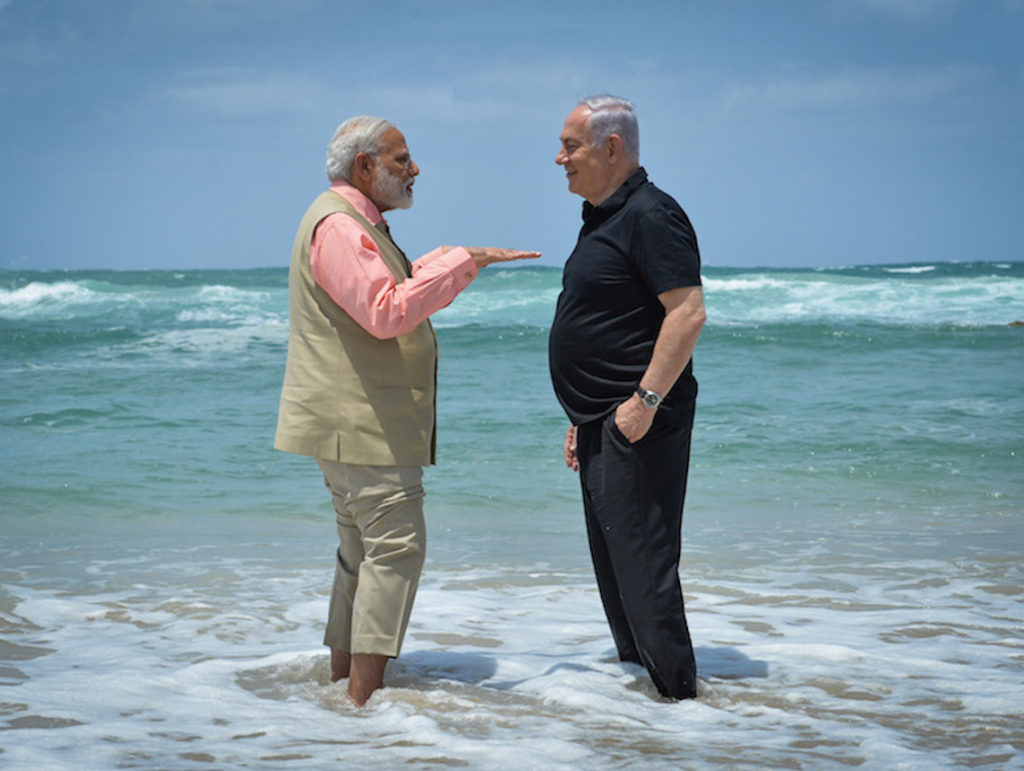
Barefoot walks on the beach, warm hugs, lots of mutual admiration, hesitant attempts to speak each other’s language. And giggles.

The bromance between Prime Ministers Narendra Modi of India and Benjamin Netanyahu of Israel — culminating this week in Modi’s historic Israel visit — played out like a young adult summer novel.

But “India and Israel” was never written in the stars: One of the world’s largest democracies kept its distance from one of its loneliest for years. India recognized Israel in 1950, and Israel soon opened a consulate in Mumbai, home to a substantial Jewish community. But it took until 1992 for India to establish full ties, and until the middle of the last decade it was slow going.

What has happened? Here’s a rundown:

The non-issue of nonalignment

India was one of the five co-founders in 1956 of the Nonaligned Movement, an attempt by emerging nations to establish a vanguard against American and Soviet influence. Israel’s first prime minister, David Ben-Gurion, was intrigued by the movement, but ultimately believed it was in Israel’s best interests to throw in with the West.

Meanwhile, India’s first prime minister, Jawaharlal Nehru, bought into the Arab narrative that Israel was instead a leftover of colonialism. That was compounded by the influence on the Nonaligned Movement of another one of its five founders: Gamal Abdel Nasser, then the president of Egypt.

“Part of the reason the distance has always been there stems from India taking leadership of the non-aligned, and concerns about colonialism and Israel” that circulated in the movement, said Richard Rossow, the Wadhwani chair in U.S.-India policy studies at the Center for Strategic and International Studies.

The justification for the existence of a nonaligned movement has ebbed since the 1991 collapse of the Soviet Union, said Clifford May, the president of the Foundation for Defense of Democracies. America is now the only major power.

“It’s 2017,” he said. “With whom are you not aligned?”

Friends in high places, and high-tech

Fresh from the U.S. success in leading the ouster from Kuwait of Saddam Hussein’s Iraqi forces, President George H. W. Bush had a message for allies and would-be allies hoping to join the post-Soviet New World Order: “In order to have a relationship with the United States in the early 1990s, you have to have a relationship with Israel,” said Jason Isaacson, the American Jewish Committee’s associate executive director for policy, who was in Israel helping to coordinate events surrounding the Modi visit.

India was one of the first to sign up, establishing full relations in 1992. At first, trade was limited more or less to diamonds, Isaacson said – Israel is a major diamond-cutting center. But as successive Indian governments encouraged market-driven economies, it expanded to the technical, agricultural and security sectors — and also Israeli arms sales to India. The trade relationship is now worth more than $4 billion annually.

Indians crave Israeli technology and Israelis crave Indian markets. The signature photo op of the Modi visit was the Indian leader and his Israeli counterpart wading into the ocean near Haifa and talking Israeli desalination techniques.

There were important markers in the emerging relationship under governments led by both of India’s major parties, the Congress Party founded by Nehru, and the more Hindu nationalist BJP, now led by Modi. In 2003, then-Israeli Prime Minister Ariel Sharon visited India, and since the beginning of the 21st century there have been multiple visits by top ministers to both countries.

BJP governments, which led the country from 1998 to 2004 and since 2014, have been prone to accelerate the relationship. David Makovsky, the Ziegler distinguished fellow at the Washington Institute for Near East Policy, said this was in part because the pro-Hindu BJP – and Modi in particular – were less sensitive to the sensibilities of the country’s huge Muslim minority.

“You have in the case of Modi someone who is identified with a kind of an India-first orientation that is not inhibited in a way previous Indian leaders may have been because of the domestic makeup of their country,” he said.

The Sunni Arab world, another force that once drove Israel’s isolation, is itself more open to dealing with Israel, primarily because of shared threats posed by Iran and radical Islamist terrorist groups.

“Some of it plays into the regional changes in the Middle East,” said Ken Jacobson, the Anti-Defamation League’s deputy national director. “The fact that the Saudis can be more open in relations with Israel” opens the way for other countries.

Band of (transactional) brothers

There’s a third party to this bromance: President Donald Trump. Netanyahu, Modi and Trump share an outlook that abjures “globalism,” or permanent international alliances advancing lofty universal goals. Instead they favor more flexible relationships based on self-interest – currently, countering the perceived threat posed by Islamists.

“All three of them seem very simpatico in their meetings with one another,” Jacobson said. “There’s a feeling of ‘I’m talking to someone who understands me.’”

It’s terrorism, stupid

May of the Foundation of Defense of Democracies recalled a meeting that Modi had a year ago with representatives of think tanks during a U.S. visit. The Indian leader asked all the representatives to say what was on their minds about the India-U.S. relationship, and an array of topics came up —  educational exchanges, trade, employment. Only May mentioned Islamist terrorism, and recalled that when Modi launched into his response, the terrorist threat constituted at least three quarters of his time.

“He was clearly concerned about threats from Islamists and jihadists in Pakistan,” May said. “That is part of the reason he would see Israel surrounded by jihadists who want to destroy it” and seek its expertise in preventing such attacks.

One of the Indian cities most afflicted by terrorist attacks in recent years has been Mumbai, and another signature moment in the Israel trip was Modi’s meeting with Moshe Holtzberg, 11, the son of Chabad emissaries who were killed in a 2008 terror attack in the city.

Speaking at the airport, Modi also cited – to a visibly moved Netanyahu – the heroism of the Israeli prime minister’s martyred brother, Yonatan, who died leading the 1976 on hijackers in Uganda.

But it’s also the Indian diaspora …

Isaacson said one of the drivers of the renewed relationship was an Indian-American community eager to forge ties with its Jewish counterpart – and a Jewish community, led by the American Jewish Committee in this particular case, eager to engage.

“It’s a sister minority faith community, with immigrant roots, dedicated to education, dedicated to the same basic values that have mobilized our community,” he said. “They’re natural partners and friends.”

Modi, perhaps more than any of his predecessors, believes in engagement with the Indian diaspora. He made a point of meeting with Indian Israelis, believed to number about 100,000, during his visit. Some 10,000 turned up.

… and its traveling Israelis.

India for decades has been a favored destination for Israelis taking a year’s break after completing army service. Bumping into Hebrew speakers in Modi’s home state of Gujarat has become commonplace. Correspondingly, tangents of Indian culture have spread throughout Israel.

An Israeli Foreign Ministry video features scenes from a mass yoga experience at an Israeli park captioned, “Indian culture continues to impact and enhance Israeli society.” Netanyahu, clapping his hands, greeted Modi with a hearty Sanskrit “Namaste.” (Modi responded by saying in fractured Hebrew that he was honored to be in Israel, to Netanyahu’s giggling delight.)

But don’t get too excited.

Makovsky said one of the factors driving Israeli enthusiasm for India is growing tensions with Europe, Israel’s traditional trading partner, over the Palestinian issue, with European countries increasingly willing to impose economic sanctions on Israel’s settlement enterprise.

“There is a jitteriness that as they put all their eggs in the European basket, that if the environment in Europe turns hostile relating to BDS and other issues, they remain vulnerable,” he said, referring to the Boycott, Divestment and Sanctions movement.

Jacobson of the ADL cautioned against any Israeli outlook that veered too sharply from its Western alliances.

“There’s a long discussion and debate among Israelis about how Israel conducts its foreign policy, its dependency on the United States,” he said. “There have always been people who say we need to diversify our support. For those of us who care deeply about Israel, there’s no substitute for America.”

India is unlikely to give up purchasing oil from Iran, or its other development projects and investments in that country, although the Islamic Republic is Israel’s enemy No. 1.

“There’s a comfort level” in the United States and Israel “with India maintaining its relationship with Iran — because they will,” said Rossow of the Center for Strategic and International Studies, citing the trade relationship and India’s vested interest in maintaining regional relationships. Only Pakistan and Afghanistan separate India from Iran, and all three countries are deeply invested in Afghanistan’s development.

“There’s no good reason for Modi to be picking a fight or getting on Iran’s bad side,” said May, whose Foundation of Defense of Democracies is one of the leading think tanks that otherwise advocates Iran’s isolation.

Here’s why Israel and India’s leaders couldn’t get enough of each other Read More »