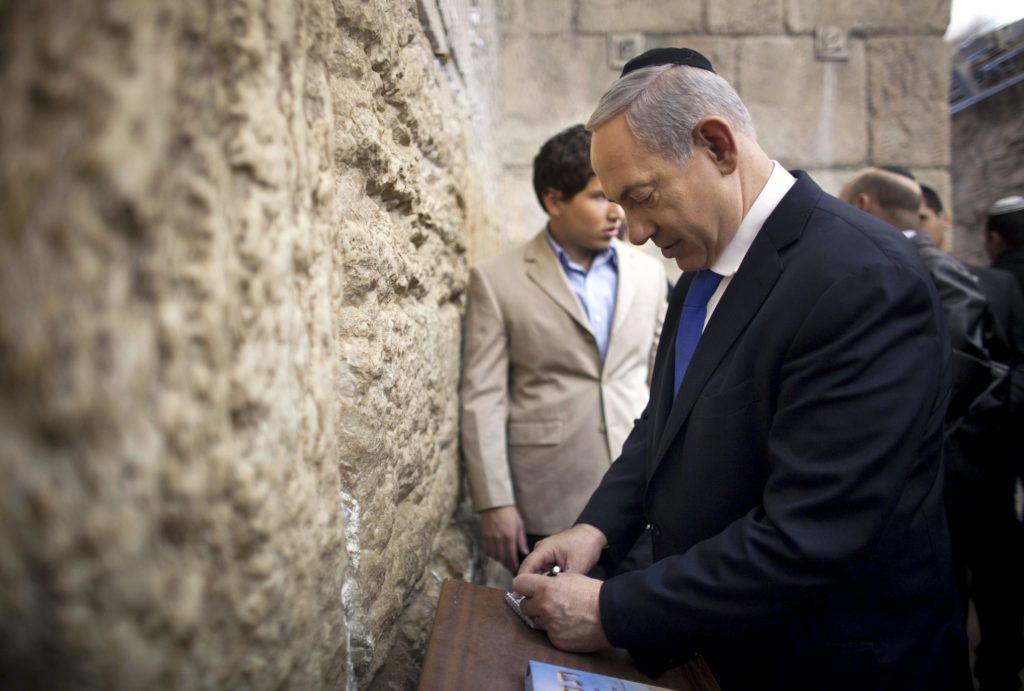
For Prime Minister of Israel Benjamin Netanyahu, the story of the Kotel compromise – the agreement that was buried by the government on Sunday – was a story of arithmetical probabilities. He had no joy in canceling the arrangement that would have given non-Orthodox Jews, the majority of the Jewish people, a small piece of real-estate near the place most holy for all Jews. He drew no satisfaction from feeling that he had to cave under Charedi pressure. And yet, his cold calculation of probabilities made him break his promise to many Jewish leaders, especially from the US. It made him pass a government decision that he does not like.
Netanyahu estimated that the probability of damage to his coalition if he does not cave justified the angering decision. He estimated that the probability of damage to Israel if he does cave did not justify angering the Charedi parties. To make it tangible: Before the decision was made, Netanyahu estimated that there’s, say, a 20% chance that the Charedi parties actually mean what they say and will quit his coalition if the deal is implemented – a 20% chance he was not willing to take.
So, the decision was made, and the compromise was canceled. But the game of probabilities is not over – it is never over. What lies ahead? Netanyahu hoped, and estimated, that he will have to absorb criticism, anger, cries of protest, but that the Israel-Diaspora relations business will soon go back to being as usual. That is, not always great, occasionally rocky, but rarely as bad as people with specific agendas want us to think. To make it tangible: before the decision Netanyahu made, he estimated that there’s, say, a 10% chance that this time the response from world Jewry will be severe and truly painful for Israel – a 10% chance he was willing to take.
Was there a 20% chance that the Charedis were serious enough to quit the coalition? Many think there wasn’t, but I must admit that Netanyahu is a better politician than most of them.
Is there only a 10% chance that Israel-Diaspora relations will not go back to business as usual? Well, that’s up to you.
But before a decision is made, it is important to understand what is the issue at stake. Let’s begin with what it’s not: this is not about a place to pray near the Kotel. Such a place exists, and the government – including both Netanyahu and Minister of Diaspora Affairs Naftali Bennet – promises to improve and expand the place for non-Orthodox practice. So, what is it about? It is about the symbolic recognition of authority. The halted compromise included elements that provided Reform and Conservative Judaism a kernel of official status. The currently proposed compromise – and the prime minister asked Minister Tzachi Hanegbi to work on it – will include everything but this kernel of official status. If US Jews want more space, they will get it. If they want a water cooler, they will have it. If they want to decorate the third Kotel platform with flowers and gold – they might even get that. The Prime Minister is willing to give them all they want – except for what he believes he cannot give. The status. In retrospect, so he and his advisors believe, the mistake was to mix the issue of place for prayer for all Jews of all stripes and denominations – something Israel can politically swallow – and the issue of legally complicated arrangements of official recognition.
This is what the prime minister is currently trying to sell to those who agree to speak with him. Yesterday, he had a tense and “unpleasant” meeting with several heads of large US Jewish Federations. Bennet has also had conversations with the leaders that gathered here for the Jewish Agency’s week of meetings. They both understand that a period of anger was to be expected. They both hope that when heads cool down a new arrangement can be found. The tougher client will be the Reform movement. The clients they hope to convince first are the leaders of the Jewish Federations.
Here are two short stories about two encounters I had with old Israeli acquaintances. On Monday, the day after the decision was made, I was invited to speak on several radio and TV shows about the crisis. In one of the studios I was sitting next to Salai Meridor, a former head of the Jewish Agency and Israeli ambassador to Washington, and an interesting exchange of words occurred. I said that the leaders of the American Jewish community ought to make Israel pay a heavy price for this decision. Meridor said that he hopes it will not come to that – but then he also said that the worse option for Israel is no reaction from US Jews, just quiet alienation. Exactly – I said – that’s why I’d like to see them respond. I’d like to see them wage a fight. Meridor smiled and nodded. I cannot say with any confidence that he agreed with me. He probably didn’t. Yet the fact of the matter is that he did not protest this call for a harsh response. I find that significant.
On Tuesday morning, I was on the radio, speaking to Avi Ratzon, whom I have known for almost thirty years. Ratzon is a populist and traditional Israeli. He is blunt, and funny, and he gives voice to Israeli populations that do not write blogs for the Times of Israel or such outlets. “Don’t threaten us!” he dared the leaders of the Reform and Conservative movements. “I do not really care what they think,” he said about the Jews of America. We had a long and friendly conversation, but I can’t say that his mind was changed. Reform Judaism seems alien to him, misguided. And he was making a point that many Israelis agree with: if they don’t live here, they have no business telling us what to do.
There are three options that the Jews of America – those who care – have as they move from their initial anger and frustration to a cooler planning of their response: they can fight – a reasonable choice that comes with a price. This choice would surely alienate many Israelis away from American Jewry, as Ratzon demonstrated. They can flee – an easier choice that also comes with a price. This choice would surely alienate many Americans away from Israel, as Meridor warned. And of course, they can accept under protest the best offer that Israel is willing to hand at this time and hope for better days.
Freezing the Kotel compromise was an “affront to Zionism,” as Deputy Minister Michael Oren, scholar Donniel Hartman, and many others have argued. Refraining from battling against this decision – preferring the convenience of a detached alienation – would also be an affront to Zionism. In many ways, the crisis over the Kotel presents the leadership of Jewish Americans with a test not much different from the one facing Netanyahu before he made his own decision. A test of probabilities: what are the odds that they can get back to the old arrangement? A test of determination: can they see this battle through? A test of leadership: if they make the call – will the masses follow? A test of dedication: do they care enough about the ties of their community to Israel to have this fight?