fbpx

June 27, 2017

I Make Wishes

“Do you pray to God

that your sports team will win?”

“That is antithetical to everything I believe in,” he says. He continues his speech in truth about the inconceivable. “What do you think, Rabbi,” he asks.

“Oh, I think God is all.”

because I walk to the north

and find blue pansies beckoning

something other than me

with the wind.


And when I find myself in the east,

I whisper with sunlit yellows,

and linger in “the found.”


“I think God is all,” I say. “things, humans, animals, smiles, all the good, all the bad.”

For in the south, I am lost in lilies

that say, “Come. I open all the way. I simply can’t help it; summer is here.”


In the movement, God is sports.

In the sinews, God is love.

and in the west,

I make wishes.

I Make Wishes Read More »

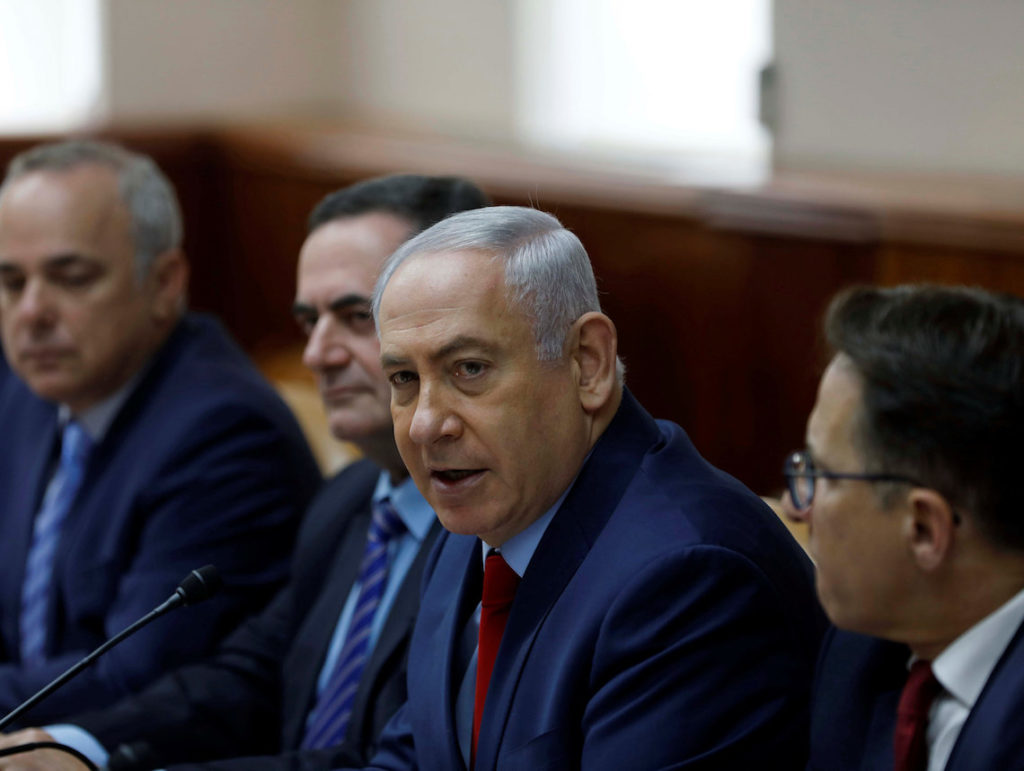
Netanyahu defends suspending the Western Wall agreement. Here’s how.

American Jewish leaders are calling it a betrayal.

They say that 17 months after achieving a historic agreement to provide a non-Orthodox space at Judaism’s holiest prayer site, Israeli Prime Minister Benjamin Netanyahu reneged in a Cabinet vote Sunday, effectively canceling the deal and caving to the interests of his Charedi Orthodox coalition partners.

Netanyahu disagrees. Far from killing the compromise, he believes the vote has given it new life. And far from betraying Diaspora Jewry, he says the vote shows his concern for Jews around the world.

In a lengthy conversation Monday with a senior Israeli official, JTA was given some insight into Netanyahu’s defense of the vote freezing the 2016 Western Wall agreement: why he did it, what the vote leaves in place and what it means moving forward.

The agreement, which was passed by the Cabinet in January 2016, has three components. First is a physical expansion and upgrade of the non-Orthodox prayer section south of the familiar Western Wall plaza. Second is the construction of a shared entrance to the Orthodox and non-Orthodox sections. Third is the creation of a government-appointed, interdenominational Jewish committee to govern the non-Orthodox section.

Sunday’s decision, the senior official said, leaves in place the physical expansion of the prayer site while suspending the creation of the interdenominational committee. Netanyahu’s haredi partners, the official said, objected to the idea that the committee amounted to state recognition of non-Orthodox Judaism.

With the controversy over the committee frozen, the official said, actual building at the site can start unhindered and will be expedited.

“The symbolic piece was holding the practical piece hostage,” the official, who wished to remain anonymous due to the sensitivity of the issue, told JTA. “What was frozen yesterday was the symbolic part. The practical part of advancing the prayer arrangements, that can now move forward. Regrettably, there are those on both sides who are spinning this as cancellation.”

However, several aspects of the project as it stands are murky. It isn’t clear whether the expansion of the site will proceed according to the dimensions outlined in the 2016 agreement. Nor is it clear whether construction will begin on the shared entrance to the site or whether the non-Orthodox space will have a staff, accessible prayer books and Torah scrolls, as promised in the agreement.

Israeli lawmaker Nachman Shai, left, and Jewish Agency Chairman Natan Sharansky at a meeting in the Knesset on June 27, 2017. Photo by Yonatan Sindel/Flash90


The official told JTA that the suspension of the deal is itself a compromise: the Charedi parties wanted to cancel the deal altogether, a step he said that Netanyahu was unwilling to take. Freezing the agreement, the official said, allows for continued negotiations to rework it. It also may provide an acceptable answer to the Supreme Court, which is considering a petition to force the government to provide an “appropriate space” for non-Orthodox prayer at the wall.

The official added that “The prime minister takes Israel’s relations with Diaspora Jewry very seriously.”

But non-Orthodox leaders were not placated by these assurances.

Rabbi Steven Wernick, CEO of the United Synagogue of Conservative Judaism, called Sunday’s vote “sleight of hand.” He is treating it as a cancellation of the agreement, given that the agreement had not been implemented nearly a year and a half after being passed.

“It’s not really a freeze, it’s a kill,” he said. “It’s already been frozen. It hasn’t been moving for 18 months. We were waiting, and assured by the prime minister that entire time that negotiations were happening and they would get back to us. That hasn’t happened.”

Jewish leaders also called the expansion of the prayer space insufficient. They noted that the shared entrance would grant the non-Orthodox space equal standing with the Orthodox section, but the current plan for expanding the space is unknown.

“The physical portion of this agreement was far more extensive, including opening the site to the main plaza, making it visible and accessible,” Rabbi Rick Jacobs, president of the Union for Reform Judaism, told JTA. “What the government is currently planning to do in no way meets the promises and the details of this agreement.”

Anat Hoffman, chairwoman of the Women of the Wall prayer group, whose activism led to negotiations over the wall, also said that any physical expansion of one of the most sensitive sites in the world would take years. Given the delays that have already plagued the process, Hoffman said she is hesitant to trust assurances from Netanyahu.

“We sat for three years in good faith, our group split over this, we paid such a price, how could I possibly believe you?” she recalls telling Tzachi Hanegbi, a government minister and Netanyahu ally, on Tuesday. “And now you’re going to compromise over the compromise?”

On Tuesday, at the conclusion of its board of governors’ meetings in Jerusalem,  Jewish Agency for Israel Chairman Natan Sharansky urged 200 employees who represent the agency abroad to prepare for criticism of the government’s suspension in the Diaspora. The night before, the Jewish Agency canceled its scheduled gala dinner with Netanyahu over the Cabinet vote.

According to a statement, Sharansky urged the emissaries to “listen to expressions of anger and criticism that are being heard in many Jewish communities and bring them to the attention of public figures and politicians in Israel.”

After meeting with the prime minister on Monday, Jerry Silverman, CEO of the Jewish Federations of North America, told The Times of Israel that American Jewish groups plan to lobby Israelis to support their concerns about religious pluralism. American Jewish leaders, he said, will also invest more in lobbying Israeli lawmakers.

But the Israeli official told JTA that trying to force change in Israeli religious policy is what leads to acrimony over these issues. Better, he said, to let the laws change gradually and quietly.

“So what you have is, you have the status quo: a set of slowly evolving, informal rules,” the official said. “Often you get into trouble when one of the sides tries to formalize something by going to court or by legislation.”

Netanyahu defends suspending the Western Wall agreement. Here’s how. Read More »

Israel and Russia only countries to view Trump more favorably than Obama, poll shows

Israel and Russia were the only two countries to have a more favorable view of President Donald Trump than his predecessor, Barack Obama, at the end of his time in office, a survey found.

The annual survey by the Pew Research Center on America’s image abroad also found that some 81 percent of Israelis have a positive view of the United States under Trump, compared with a median of 58 percent, according to the results released Tuesday.

Some 40,447 respondents in 37 countries outside the United States answered the survey from Feb. 16 to May 8.

Israel’s favorability rating of the United States has held steady over the past several surveys, including 81 percent in 2015, 84 percent in 2014, and 83 percent in 2013. In 2009, the rating was at 71 percent, the lowest since the survey was started 15 years ago.

In Russia, 41 percent have a favorable view of the United States under Trump, compared with 15 percent under Obama.

Israelis’ confidence in Trump was measured at 56 percent, compared to 49 percent for Obama at the end of his second four-year term. But the median showed 22 percent confidence in Trump and 64 percent in Obama.

The survey also found that 69 percent of Israelis surveyed said they considered Trump to be a strong leader, compared to a median of 55 percent. Some 54 percent of Israelis said Trump is well qualified to serve as president; the median was 26 percent.

Considering the border wall with Mexico, 42 percent of Israelis supported Trump’s idea, compared with 24 percent from all countries surveyed. On Trump’s decision to withdraw from the Paris climate agreement, 69 percent of Israelis were opposed, comparing to the 71 percent of the other countries surveyed.

“The sharp decline in how much global publics trust the U.S. president on the world stage is especially pronounced among some of America’s closest allies in Europe and Asia, as well as neighboring Mexico and Canada,” according to the survey.

Among close U.S. allies, in Germany, the favorability ranking for the U.S. has dropped to 11 percent under Trump from 86 under Obama; in France, 14 percent from 84 percent, and in Canada, 22 percent from 83 percent. Sweden saw a drop to 10 percent from 93 percent.

Among Middle East countries, the U.S. did not fare particularly well under either president, but again there was more confidence in Obama. Some numbers: Turkey 11 percent for Trump, 45 for Obama; Jordan, 5 percent and 14 percent, and Lebanon, 11 percent and 36 percent.

Many countries that have had poor relations with the U.S. over many years were not among those questioned, such as Syria and Iraq.

Israel and Russia only countries to view Trump more favorably than Obama, poll shows Read More »

Mitch

The human toll of the Senate health plan

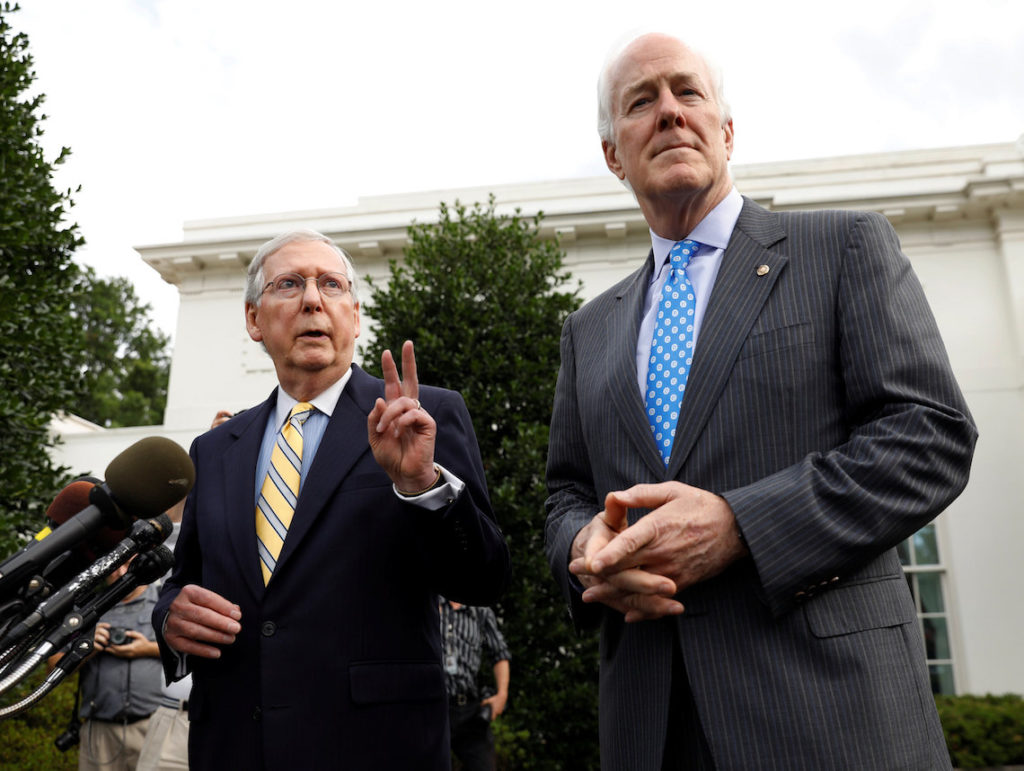
Senate Majority Leader Mitch McConnell has delayed a vote on the heath care bill that he and his colleagues negotiated in secrecy and with no public input. For that, at least, we can be thankful.

The Senate bill made the House bill even worse, with estimates that both bills would leave more than 22 million additional Americans without health care insurance because of the high cost of premiums and deductibles.

Whatever reason enough Senate Republicans gave for withholding their support for now — some said it was too harsh, others not harsh enough — the delay gives everyone time to understand the bill’s true implications. And it has delayed harm to the most vulnerable Americans — the elderly, poor, disabled and children — from the devastating effects of losing coverage and benefits they now have.

Consider Philip, who is 60 years old, and whose name has been changed for privacy. After a series of setbacks, he found himself at a low point in his life. He had to file for bankruptcy and was evicted, and he alternated between living in his car and in low cost motels. The stress impacted his health and he began experiencing severe stomach and back pain. In addition, he has only one kidney. Philip had no health insurance before the Affordable Care Act (ACA) went into effect.

Thanks to Medi-Cal expansion, Philip qualified for benefits. After months of severe pain, he was able to receive regular preventive care and support for ongoing pain relief.

Or Sara (name also changed for privacy), an 85-year-old Holocaust survivor from Romania. In 1940, when she was 12 years old, she fled to Uzbekistan. Her parents were executed. She eventually moved to the United States with her husband, but talking about her history has been very difficult.

Now a widow and frail, Sara has many medical problems, including myeloma, which necessitates ongoing chemotherapy treatments. She suffers from poor balance and coordination and has severe pain in her back and legs along with osteoarthritis and osteoporosis.

Medi-Cal (California’s Medicaid program) pays for her medical treatment, her in-home care and the social worker that keeps all of her systems coordinated.

The Senate promised a more humane bill that doesn’t perversely target seniors or children born with disabilities. Yet they didn’t seek input from the experts — doctors, hospitals, clinics, community providers, researchers or patients — and produced a plan that takes the worst pieces of the House bill and adds deeper cuts to Medicaid, which provides health coverage to nearly one-quarter of all Americans. 

As drafted, the Senate bill goes beyond undoing Medicaid expansion, which has helped millions of Americans. The Senate also is looking to remove the guarantee of a federal match in Medicaid, which has been in place for 50 years, that helps ensure the program will be in place to provide medical care to those who need it most. The Congressional Budget Office estimates the House bill would cut federal funding to Medicaid by 25 percent, both through the rollback of the Medicaid expansion and implementation of spending caps.

With lower funding, states will be forced to slash services, restrict eligibility and cut benefits for seniors, children, people with disabilities, and low-income adults. All indications are that these cuts will fall disproportionately on nursing home residents and those needing home-based care.

California, which would face a $24 billion cut to Medi-Cal, would have to limit health care services and reduce access for 14 million state residents who rely on Medicaid for safe, reliable health care. These cuts would go beyond hurting half of all California children or two-thirds of all nursing home residents who are on Medi-Cal — it would affect the entire health care system that we all rely on.

Across the country, Jewish social service agencies will be unable to offer assistance to tens of thousands of their clients and community members — Jewish and non-Jewish, alike. For providers such as Jewish Family Service of Los Angeles (JFS), the Los Angeles Jewish Home, and other local organizations that provide health care services, Medi-Cal is the major source of funding for home and community-based services and long-term care. Seniors and those with pre-existing conditions will lose much needed coverage. Older adults, the fastest-growing segment of the Jewish community, often struggle financially and are dependent on the Medi-Cal safety net. 

At JFS, we fear the proposed cuts will not impact only our elders, but will unfairly target other vulnerable populations we serve. Low-income women escaping abuse and violence rely on Medi-Cal to receive medical treatment for broken bones and bruised spirits. Holocaust survivors rely on in-home care and case management programs to remain safely in their homes and avoid unnecessary institutionalization. And children with special needs rely on Medi-Cal for lifesaving treatment that enables them to live independently.

The Senate did the right thing this week by not voting on a pernicious bill. Now, lawmakers should take the next step and start over, crafting a bill that helps — not hurts — millions of Americans like Philip and Sara.


PAUL S. CASTRO is president and CEO of Jewish Family Service of Los Angeles, a multifaceted, multi-service nonprofit organization serving individuals and families throughout Los Angeles.

The human toll of the Senate health plan Read More »

Western-Wall

L.A. clergy respond to the Kotel controversy

We have seen the selling out of the Jewish people for crass political power.  However, it isn’t usually done by a prime minister of Israel to Jews around the world. Benjamin Netanyahu’s crass political move to renege on the compromise reached with the Reform and Conservative Movements and Women of the Wall on appropriate egalitarian prayer space at the Kotel is alarming and shameful.

The plan to build egalitarian prayer space at the Western Wall was negotiated by the prime minister’s own representatives. His representatives Natan Sharansky and now-attorney general Avichai Mendelbilt were the ones who spoke for the Israeli government. It was hailed as an historic agreement by the prime minister’s own office. Netanyahu came to the U.S. and himself addressed American Jewry about the importance of this.

I sat across from the prime minister a year ago February in his office when he assured me and rabbinic leaders of the Reform Movement, “It will happen.”  Following the meeting at the annual convention of the Reform rabbinate in 2016, we held the first services in what was to eventually become the new space. It was a spiritually uplifting and moving experience to pray with my fellow rabbis next to the ancient and historical symbol of our people’s continuity, men and women together as is our authentic Jewish experience.

The prime minister, who claims to speak for all Jews, has betrayed a significant portion of the Jewish people by giving in to Charedi demands.  He is not a man of his word or a man of honor and he is leading the government of Israel to act immorally.

The sacrifices of the ancient Temple were designed to restore wholeness and holiness to individuals who have sinned and to the Jewish people. Prime Minister Netanyahu instead has sacrificed the majority of American Jews on the altar of his political expediency, reinforcing the very sin that destroyed the ancient Temple: sinat chinam, the hatred of Jew against Jew. This is the sin our Talmudic Sages teach destroyed the Temple. Netanyahu’s actions further alienate American Jews from finding a place and connection to the Jewish homeland. As a Reform rabbi I try to build up that connection and help Jews find their way home. The prime minister has increased the distance and removed the welcome mat from the doorway.

Rabbi Denise L. Eger, Congregation Kol Ami


I am saddened, of course, that things had to come to this point, and that no effective compromise was brokered that could avoid the considerable pain experienced on both sides of the divide. I cannot say that I understand what happened.

I am saddened by the hype and the untruths that are being spread. While I can understand some of the feelings of let-down in the non-Orthodox world, I cannot understand charges that this move is a repudiation of their Jewishness. It is rather, for better or worse, nothing but the affirmation and continuation of a long-standing policy recognizing the holiness of the Wall as defined by halachah. No one — no one — is barred from participating in prayer there. The leaders of the movement to carve up the Kotel were not motivated by lack of a place where they could pray according to their fashion. Robinson’s Arch would have been more than adequate. The word that they have used has been “visibility,” i.e. they wished to make a statement about the legitimacy of their beliefs in high profile. Let’s at least be honest that this is not about equal access. It is about marketing.

Mostly I am saddened that the rift between Jewish brothers and sisters has become so cavernous that people speak of “rethinking” their commitment to the State of Israel. Do we support it because of what it can do for us, or because of its centrality in Jewish thought? Could it be that lots of non-Orthodox folks in Israel sense this wavering commitment, and are therefore prepared to listen to the Orthodox position, recognizing that only a halachic tradition will be a guarantor for the Jewish future?  I suspect that the heterodox movements have lost far more through this than a place at the Southern Wall.

Rabbi Yitzchok Adlerstein, Co-founder of Cross-Currents, an online journal of Orthodox Jewish thought


This is a triumph of expediency and fear over principle and unity. We all understand the political calculation involved, and the need for the prime minister to keep his coalition happy. But as Harry Truman memorably said, sometimes you have to put your principles aside and do what’s right. This betrayal tastes bitter in the mouths of those who love our people and our land.

Rabbi David Wolpe, Sinai Temple


This move by the government of Israel reneging on the Kotel agreement and promoting the conversion bill that would disenfranchise 500,000 people in Israel and around the world is a violation of the trust of the Jewish people. Prime Minister Benjamin Netanyahu has allowed a small group of religious extremist fanatics to separate the Jewish people from the State of Israel so that he can remain Prime Minister regardless of the importance of maintaining the unity of the Jewish people.

Jews everywhere should insist that the Prime Minister withdraw the conversion bill from consideration in the Knesset and reverse his government’s decision to ignore the Kotel agreement. The Prime Minister should also apologize to Jewish Agency Chairman Natan Sharansky, who at the Prime Minister’s request five years to find a compromise agreement on the Kotel that unifies the Jewish people, did so and then Netanyahu dismissed the compromise agreement without even informing Sharansky in advance. Netanyahu’s decision humiliated one of the great heroes of the Jewish people.

Rabbi John Rosove, Temple Israel of Hollywood


In December 1988, I was a first-year rabbinic student living in Jerusalem when the first group of women naively took a Torah scroll to the women’s side of the Kotel and held a prayer service. Their heartfelt offering did not sit well with many who witnessed it. I was not among that original group, though several of them came to our living room later that afternoon to debrief and cry.

That year brought new meaning for me to the terms “hard rock” and “heavy metal,” for in the months afterwards I served the newly forming women’s group as a shomeret (a guard). The guards formed a ring around those praying, and faced the angry ones so the others could turn inward, trying to worship.

We tried, mostly unsuccessfully, to protect those praying from the vitriol, spittle, tear gas canister (thrown at us by one of the Orthodox men who picked it up after the police threw it at them), and one heavy metal chair that suddenly came flying through the air in our direction, injuring one of the women as she prayed.  It was the first year of the first Intifada, but the rocks coming over the Kotel from above made more sense to me, and were in some ways less frightening, than the weapons and words thrown by Jews at Jews.

The soldiers who protect the Jews at the Kotel were as taken aback as we were.  On a later visit a woman carried a Torah scroll on loan from the Reform Movement’s Hebrew Union College-Jewish Institute of Religion in a baby blanket through the ever-tightening security: “Oh,” laughed the guard as he peeled back the blanket, and waved us through, “beautiful baby.”

No one is laughing now.

Rabbi Lisa Edwards, Beth Chayim Chadashim


We Jews must surely be the laughing stock of the world! Even as the United Nations actively delegitimizes our connection to the Temple Mount and ancient holy sites in Jerusalem and Israel, we are busy fighting with each other as to who can pray where and how, as if any of this really matters.

Both sides in this dispute ought to be thoroughly ashamed of themselves. Do any of the protagonists really think that they are making God happy by fighting with each other? The Talmud tells us that the Temple was destroyed and the exile was decreed by God as a result of the endless pointless squabbling between Jews. And yet, almost 2,000 years later, we are still squabbling! How pathetic.

Instead of fighting each other, we need to be joining forces and together fighting our real enemies — those who wish to deny the Jewish connection to our holiest site — not the Kotel, but the Temple Mount, where our Temple once stood, and will stand again, but only if we can focus our energy on making it happen, instead of wasting energy point-scoring against each other, pointing fingers, and creating ill-feeling.

In this fight, no matter who prevails there are no winners. Instead of this nonsense, our goal must be to protect Israel from its enemies, and to create a thriving center for Jewish revival and triumph in our ancestral homeland.

Rabbi Pini Dunner, Beverly Hills Synagogue


That the Israeli governing coalition reneged on its own agreement to provide a separate, cordoned off area, discretely to the side and far from the postcard courtyard that we all think of as the Kotel can’t really be a complete surprise. Politics is politics, and all politics is local. Most Reform, Conservative, Reconstructionist, Renewal and nondenominational voices will decry this short-sighted and discriminatory decision (as do I); most Orthodox, Charedi, and Chasidic voices will support and celebrate the power to impose their monopoly. Obviously, this has a lot to do with pluralism (which some see as a threat), and with women acting with authority in public (which even more people see as threatening).

Personally, I feel the need remind us of three simple truths: First, an Israel that circles the wagons and enacts religious policies that sound like they could have been proposed in Teheran or by the Westboro Baptist Church reveals itself to be motivated by fear and considerations of power, more than by faith and wisdom. That’s not good for Israel in the long run.

Second, if we are going to make the Wall into a locus of Jewish faith, then there has to be room for us all, each in our own way, or the imposed exclusion will itself become a justification for those marginalized and slighted to walk away from Judaism and from Israel, and that’s not good for Israel in the long run.

Third, nowhere in the Torah does it suggest that God is accessible at that Wall more than anywhere else. The portability of Torah, the insight that holiness is to be found in acts of tzedek (justice), shalom (peace) and chesed (lovingkindness) remains Judaism’s greatest insight and core conviction. So, by all means, let’s fight for our space at the Wall, but let’s remember that we show real love for God and Torah, and real solidarity with Israel, when we work for a Jewish community — here and there — that observes mitzvot, loves the stranger, learns Torah, and pursues peace.

Rabbi Bradley Shavit Artson, Abner and Roslyn Goldstine Dean of the Ziegler School of Rabbinic Studies at American Jewish University


I can pray at the Kotel, but my wife cannot. I can hear the Torah read at the Kotel, but she cannot. If she dons a tallit for private prayer at the Kotel, she will be arrested. If she prays aloud, she will be shouted down or escorted away.  Her spirituality, her voice, is deemed an affront to the Kotel. The great symbol of our collective destiny has become a political token, a tool of division. And sinat hinam, unbounded rivalry, our inability to embrace one another, the very reason we lost the city twice before, burns once more.

Rabbi Ed Feinstein, Valley Beth Shalom


I have been spat and yelled at (and worse) while davening at the Kotel.  I stand behind the efforts to bring egalitarian services there.  I am a supporter of Women of the Wall.  And I am pained (but somehow not surprised) by the recent reversal by the government, which does feel like a betrayal, and which stymies admirable efforts to open the Kotel to the full array of Jewish religious expression.  And at the same time, I choose not to wring my hands or wallow today.  I choose to celebrate, and thus identify with Rabbi Akiva in the famous story from the Talmud in which his rabbinic peers tore their garments upon seeing the ruins of Jerusalem.  They see the moment frozen in time, a destruction prophesied by a particular Biblical verse. Rabbi Akiva smiles, however, reminding them that the end of that very verse also prophesies redemption.  Now that the nadir envisioned by the verse has come to pass, the eventual ascension/aliyah is also inevitable. 
 
So why do I celebrate today?  Because even though the Charedi hold on Israeli politics is at times painful and corrupt, as the Kotel fiasco attests to, for me redemption is not tied to a particular wall. I am sometimes bemused by the fact that so much focus is put on prayer at the ruin of the Temple by the very Jews who least ache for that spot to re-emerge as the center of Jewish spirituality.  For the progressive-traditional Jew, who sees rebirth of meaningful and resonant Judaism within Israel as one of Zionism’s greatest contributions and challenges, what transpires at the Kotel may be symbolically important, but pales in comparison to the evolutions transpiring throughout the land—the mash-up of secular seekers and traditional liturgy at various Kabbalat Shabbat phenomena that are growing; the strength and vitality of Masorti and Progressive synagogues and communities despite the infrastructural challenges which inhibit them; the will exhibited by myriad Israelis to reject the authority and monopoly of the rabbanut by making decisions (which, yes, they ought not have to make) to marry creatively rather than under near-theocratic conditions.  Last summer I attended a cousin’s wedding on an Orthodox kibbutz, where the officiant was female, and at which the hordes of sweaty, tzitzit-flying, tichel-wearing celebrants saw no conflict between traditional Jewish rituals and practice on the one hand, and female religious leadership and party-style mixed-dancing on the other.  This same cousin, who helped found yet another Orthodox/egalitarian minyan in the Katamon neighborhood of Jerusalem, recently posted on Facebook wishing a mazal tov on the recent wedding…of Moshe and Eran, two of his closest male friends and fellow B’nai Akiva alumni. 
 
I’d tear a tiny thread in my clothes, as I really do wish that on my next visit to the Kotel I, and my daughters, can pray in the manner we find sacred.  But this symbolic setback is dwarfed by the extraordinary successes we see playing out in spots that are, indeed, more important to the Jewish future even than those venerable stones.  I honor the leaders of WOW and wish them strength.  And yet I know we will not win every engagement.  And the perfect is the enemy of the good.  And Robinson’s Arch is a beautiful place to hold egalitarian prayer (and a bit shadier, too!).  And if we scope out beyond those square meters, and if we are witness to (and financially contribute to) the efforts to egalitarian-ize and modernize and evolution-ize the many Judaisms of modern Israel, then we can stand with Rabbi Akiva, and celebrate the burgeoning redemptions.
Rabbi Adam Kligfeld, Temple Beth Am

I stood at the Wall in 1967, having returned “home” on Aliyah with my husband, an Israeli officer. My eyes filled with tears as I approached the Wall which I could only see from the top of the Mt. Zion hotel when I was a young student in Jerusalem in 1960. I prayed and cried tears of gratitude at the open Wall.

I returned to the Wall for the Bar Mitzvah of my son in 1986. There was a mechitzah, but it was low, and no one seemed to mind when I held on to his tallit and prayed out loud, as I draped myself over the barrier from the woman’s side.

A decade later, things had changed. The mechitzah was now a wall itself and the woman’s section became smaller each year. The “Fashion Police” at the entrance to the woman’s section were more insistant, and I was chastized when I gathered my congregants near me in prayer as we visited the holy site.

By the year 2000, the Kotel area had become a war zone, not only for the intifada, but the epicenter of Jew against Jew. Rocks were thrown directly at me. On Rosh Chodesh, the catcalls and whistles grew louder and louder until the level became deafening. The Schechinah decamped elsewhere.

Robinson’s Arch was to be a worthy compromise that honored the unity of the Jewish people. I was lucky enough to lead a Shabbat servce for my congregation in the proposed Plaza area, and it was one of the holiest moments of all of our lives. Swallows flitted in and out of the crevases, the sound of the Arab call to prayer intertwined with our “mixed” daavening as the holy silence of Shabbat decended on Jerusalem.

Today, there is no holy silence. There are only tears for the pain of the Jewish people, and the opportunities we have lost.

Rabbi Judith HaLevy, Malibu Jewish Center and Synagogue


Israeli media is full of news, debates and analysis regarding the recent religion/state battles. While many of you may think that what Israelis are focusing on are the security threats from the outside and terror with Israel, you would be wrong. The war over religious freedom and equality is clearly a key component in shaping Israel’s path.

One cannot over exaggerate the serious nature of the current conflict, by just noting the fact that the Jewish Agency for Israel’s Board of Governors, convening in Jerusalem, decided to cancel a festive dinner with Prime Minister Benjamin Netanyahu at the Knesset and to replace its normal schedule with deliberations regarding the recent government decisions. It never happened before!

Understandably, the non-Orthodox movements (along with the Women of the Wall) put the emphasis on the collapse of the Kotel compromise and its underlying reason: the triumphalist threats by the Charedi parties and the Chief Rabbinate, delegitimizing Diaspora’s major Jewish streams. However, this would be both a narrow focus and a misunderstanding of the larger picture that Israel is facing as it is attempting to forge its Jewish and democratic identity. The three current battles, regarding the Kotel, conversion and Shabbat, are interrelated.

The first of these targets non-Orthodox Jews, the second widens its scope to include Modern Orthodox Judaism, and the third hits the broadest swath of Israeli society — in Tel Aviv and beyond, aimed at blocking municipal ordinances that allow for opening of convenience stores, and preventing public transportation on Shabbat. It should behoove Diaspora Jewish leadership and the streams to focus solely on the affront done to them and lose sight of the larger battle over Israel’s character.

All three initiatives are in direct opposition to the will of the overwhelming majority of Israelis, as repeatedly demonstrated in public opinion polls, such as Hiddush’s own systematic polling.

The recent actions of the government cause severe damage to Jewish unity and the fundamental values of Judaism and democracy. It is time to move beyond niceties, resolutions and verbal expressions of dismay. The time has come for American Jewish leadership to state publicly, loudly and clearly, that all Israeli politicians who vote for these reprehensible laws and policy decisions, are not welcome to your communities so long as they undermine the Jewish People and erode Jewish unity.

Rabbi Uri Regev, President of Hiddush – Freedom of Religion for Israel

L.A. clergy respond to the Kotel controversy Read More »

Daily Kickoff: Heard at the Aspen Ideas Festival | ‘End of small talk in DC’ | Mariah Carey stirs controversy in Israel | Charles Bronfman BDay

Have our people email your people. Share this sign up link with your friends 

ASPEN IDEAS FESTIVAL: What’s driving the conversation at the 2017 Aspen Ideas Festival so far? Nov. 8th, 2016. How do you explain his [Trump’s] win and who/what is to blame for it? At panels ranging from cyber security and fake news to the general divide in the country, the overall mood is one of a collective shiva, and not just from Democrats. Over 500 attendees packed an off-campus evening event at the St Regis last night to hear Bill Kristol and Ramesh Ponnuru bemoan the state and future of the Conservative movement in the Trump era. Typically known as ‘DC’s version of summer camp,’ welcome to the 2017 Aspen Ideas Festival exile edition.

Bill Kristol on 2020: “If the Republicans nominate Trump again in 2020 then it’s hard for me to justify him as a one-off fluke for the GOP… It would mean it’s a deeply problematic party.” [Pic]

Earlier, Kristol wrote that he looks forward to engaging the Aspen audiences, “Who will assume that because I’m anti-Trump I’m ‘reasonable’ on other issues. It will be fun to surprise them — and to have a chance to talk to some other presenters and guests about this unusual political moment.” [AspenTimes]

HEARD LAST NIGHT — Jeffrey Goldberg explaining how Yoni Appelbaum became The Atlantic’s politics editor: “Ta-Nehisi Coates, when he had a blog, used to have commenters at the bottom of the blog and he curated the comments so it wasn’t just dangerous, mentally ill people. And this commenter started showing up — who went by the name ‘the cynic’ — and his comments were unusually smart. Ta-Nehisi noticed and started talking back and forth with this person… and eventually Ta-Nehisi would tell people around The Atlantic, ‘I don’t know, I think this guy has like a Ph.D. or something. This is crazy.’ Finally, Ta-Nehisi figured out who it was… It was Yoni — a ‘sad’ academic in the Boston area [teaching at Harvard], who clearly needed a venue to express all the things he was thinking beyond the narrow paradigm of academia. Yoni was in a tenure track universe, but he clearly had this journalism bug. One thing led to another and, thank goodness, Yoni made the decision to join the ranks of journalism.” [Video]

Spotted at the Start-Up Nation Central tent, highlighting Israeli innovation, on the Aspen Institute campus: CEO of the Aspen Institute Walter Isaacson schmoozing with Campbell Brown, Daniel Bonner, Debbie Hochberg, and Raphael Ouzan. [Pic

Near the Facebook tent, David Brooks walking with a wiffle bat and balls [Pic]

Top Headline: “Police looking into how car landed in pond at Aspen Meadows campus” [AspenDailyNews]

Senator Chris Coons on how secular and religious communities have a common cause: “You can get to some of our most important priorities through two routes. You care about welcoming immigrants and refugees – you can get there because you care about other people as an intellectual, as a humanist, as a principled manner. Or you can get there relying on passages in Torah and Gospel about welcoming the stranger.” [YouTube]

Wendy Sherman, Richard Haass, Jane Harman and Samantha Power discussed foreign policy at a panel titled ‘Has American Grand Strategy Gone Missing?’ moderated by Rana Foroohar: “This panel may be four women and one man, but we are all card–carrying members of the swamp, and so are some of the people advising the current administration. I am ok with the swamp,” explained Jane Harman… When Foroohar asked the audience to raise their hands if they feel the US presently has a coherent strategy, no hands were raised. Samantha Power, of all panelists, interjected: “To be fair, three years ago, if you’d ask them the same thing… many wouldn’t have raised their hands.”

Power: “The elite consensus [of the past sixty years]…is unlikely to be supported by most Americans.”

Harman on making Congress work: “Obama did not invest in it, after trying it out for 10 minutes. He didn’t invest in it.”

Richard Haas on the NSC process: “You need a formal National Security process and it’s got to be the only one. You can’t afford more than one at a time… [The George H.W. Bush administration] worked extraordinarily well for lots of reasons. What was so funny is that you had more experience per square inch, per pound in that administration, and it was probably the most organized NSC process we have ever had. All I will say, without getting into individuals, we probably have less experience on foreign policy in this administration than any post-WWII administration.”

SOCIAL ANTHROPOLOGY: ‘It’s the End of Small Talk in Washington’ — by Daniel Lippman and John F. Harris: “Georgetown as LBJ thought of it, and as presidents up through Bill Clinton encountered it, is now a faint ghost, largely a historical phenomenon. But its lineal descendant is still very much around. It is that group of scene-makers and self-promoters, along with some well-intentioned people who genuinely admire public service, that journalist Mark Leibovich skewered in his 2013 book This Town. If these were normal times, the kind of people LBJ excoriated and Leibovich lampooned would be engaged right now in a familiar ritual. It would involve lunches and dinners with the new White House team, off-the-record chats about the workings of government mixed with let’s-be-friends chatter about real estate and schools and fitness routines. But these aren’t normal times. Team Trump is showing few signs so far of hungering for the sort of social intercourse with permanent Washington that usually accompanies a new administration.”

“Ivanka and Jared, who have three young children and observe Shabbat on Friday evenings, don’t get out much, either. The Trump-Kushners live a three-minute walk from Barack and Michelle Obama… But the contrast with the Obamas has been instructive. People who live near the Trump-Kushners initially didn’t receive such outreach or handwritten cards, and the oversight was noted. After published reports about how Ivanka’s neighbors were angry at the disruptions to their street—one irate Kalorama resident called it “a three-ring circus from the day that they moved in”—the first daughter showed up at several of their doors with a peace offering: two blue cupcakes baked by daughter Arabella, and an apology for the chaos her move to Tracy Place has caused.” [PoliticoMag]

“Kushner adds powerhouse lawyer Abbe Lowell to legal team” by Josh Dawsey: “Jared Kushner has hired Abbe Lowell, one of the country’s leading criminal defense lawyers, to represent him in the special counsel’s probe of potential Russian collusion with the Trump campaign and his financial dealings… But Kushner has also decided to keep Jamie Gorelick, his current lawyer and a WilmerHale partner, on his legal team… Lowell, a Democrat, has represented prominent politicians such as John Edwards and lobbyist Jack Abramoff.” [Politico

HEARD YESTERDAY — WH Press Secretary Sean Spicer asked about reported tension between the U.S. peace negotiations team and the Palestinians at the daily press briefing: “Well, first, I think the meetings were extremely productive. They’re going to make incremental movements forward, but it’s going to be a process. It’s not going to get solved in a night. And I think they made some good progress overall, and also continuing to build trust between all the parties. It’s no secret, I know, that when President Abbas was here, we discussed the payments as an issue then, and so it should be no surprise it came up. But I would argue that the relationship continues to be very strong and move forward in a positive way.”

Israeli Minister Bennett: Trump pressure on settlements disappoints: “Naftali Bennett, leader of the pro-settler Jewish Home party, says the settler movement expected a building boom after Trump’s election… “Unfortunately from our perspective, he’s sort of going down the same unsuccessful path that his predecessors did,” Bennett said in an interview Monday. “So yes, there is disappointment out there.”” [AP]

PEW SURVEY — Israel one of two countries with higher Trump favorability than Obama — by Aaron Magid: Israeli confidence in Trump is currently at 56% compared to 49% at the end of Obama’s term. At the same time, the Israeli favorability view of the United States has remained consistent at 81% from 2015-2017. Israel is the country that most strongly believes that its ties with Washington will improve during the Trump administration (65%), with only 8% thinking that relations will decline. Regarding Trump’s proposal to build a wall on the Mexican border, Israel was the country with the second highest number of backers for this proposal worldwide.

The most dramatic break with Trump was over the withdrawal from the Paris Climate Accords. 69% of Israelis opposed the administration’s decision with a mere 19% backing the initiative. Jerusalem is one of the signers of the international environment agreement. [JewishInsider]

JI INTERVIEW — Rep Brad Schneider (D-IL) discussed U.S. foreign policy, the Israeli-Palestinian peace process, his legislative priorities and his upcoming reelection bid in 2018 in an interview with JI’s Aaron Magid. “I was the first Democrat to win in 2012. I lost in 2014 and I’m back now,” he said. “It’s good to be back and pick up where I left off to have the opportunity to step into a leadership role. I am not focused on the next election. If I make sure that I stay in touch with the people I represent, I’m going to have an opportunity to make a difference in the 10th district.” Schneider will likely face Jeremy Wynes, a former AIPAC, RJC staffer, in the 2018 midterm elections.

In recent weeks, Schneider has introduced several pro-Israel billsincluding legislation that would boost funding for the Department of Defense to carry out research with Israel focused on tunnel detection technologies. Additionally, Schneider took the lead on a bipartisan bill that would strengthen Israel’s Qualitative Military Edge (QME), which is especially timely given the administration’s $110 billion arms sales deal with Saudi Arabia.

Schneider On Taylor Force Act: “US policy is clear that the Palestinians have to stop providing payments to families of terrorists. It’s important that the US continues to have its leverage and exert its influence in the region with the Palestinians. I am adamantly against these payments by the Palestinians. I am working with my colleagues here to find a way to put pressure on the Palestinians to stop it but I also understand that we need to make sure that we preserve the ability to have leverage and the Israelis to continue security cooperation with the PA.” Read the full interview here [JewishInsider]

ON THE HILL — Chairman of the Senate Foreign Relations Committee Bob Corker (R-TN) announced yesterday that he would block President Donald Trump’s weapons sales to Gulf states until the Qatar dispute is resolved. “Recent disputes among the GCC countries only serve to hurt efforts to fight ISIS and counter Iran,” Corker said. Jewish groups have expressed concern over the $110 billion arms sale to Saudi Arabia. AIPAC has questioned how this agreement would impact Israel’s Qualitative Military Edge (QME) and J Street condemned the move because of Saudi Arabia’s bombing of civilians in the ongoing Yemen crisis. However, Corker’s obstruction cited a different reason to “resolve the current dispute (with Qatar) and reunify the GCC.”

IRAN DEAL: “Trump administration welcomes financial watchdog’s Iran sanctions reprieve” by Laura Rozen: “The Financial Action Task Force (FATF) voted last week to continue suspending countermeasures on Iran indefinitely, while keeping the country on the banking advisory body’s black list. State and Treasury officials told Al-Monitor they welcomed the decision to warn about the risks of doing business with Iran… Iran, for its part, said it was encouraged that the United States joined the global agency’s decision to suspend countermeasures on Iran. Former US lawmakers affiliated with the hawkish United Against Nuclear Iran lobbied against the sanctions reprieve, to no avail.” [Al-Monitor

SPOTLIGHT: “Evidence Ties Israeli Firm To Turkish Businessman At Heart Of Flynn Scandal, Despite Denials” by Borzou Daragahi:“Orit Teicher, of the Israeli public relations and crisis-management firm Shalom Tel Aviv, told BuzzFeed News in a short email: “Ratio did not employ the services of Mr. Ekim Alptekin nor Inovo BV.” She declined to elaborate on the photographs or documents that suggest otherwise. Photos of [Kamil Ekim] Alptekin seen by BuzzFeed News show he attended an energy conference in Israel in November 2016 as a guest of Ratio. In one photo, Alptekin can be seen wearing a conference name tag showing his name and, in Hebrew, “Ratio Oil Exploration (1992) Partnership,” as his affiliation. Emails seen by BuzzFeed News also show that Ratio advisers and officials, including [Yossi] Shazar, helped organize Alptekin’s two-day trip to Israel.” [BuzzFeed]

** Good Tuesday Morning! Enjoying the Daily Kickoff? Please share us with your friends & tell them to sign up at [JI]. Have a tip, scoop, or op-ed? We’d love to hear from you. Anything from hard news and punditry to the lighter stuff, including event coverage, job transitions, or even special birthdays, is much appreciated. Email Editor@JewishInsider.com **

BUSINESS BRIEFS: As Europe Bounces Back, Activist Investors Like Loeb Pounce [Bloomberg] • Cable-X case heads to Complex Business Litigation court [JPost]  Israeli Content Recommendation Firm Outbrain Lays Off 4% of its Workforce [WSJ] • Short of IT workers at home, Israeli startups recruit elsewhere [Reuters] • Israeli cloud tech specialist Ethernity Networks in £45m AIM float [EveningStandard]

“U.S. to work with Israel, seek other ties to combat cyber attacks” by Steven Scheer: “Thomas Bossert, assistant to the president for homeland security and counter-terrorism, said a U.S.-Israeli working group will meet this week on cybersecurity issues such as protecting critical infrastructure… “These high level meetings represent the first step in strengthening bilateral ties on cyber issues following President Trump’s visit to Israel” last month, Bossert told a cybersecurity conference in Tel Aviv.” [Reuters

“Israel is still floating a plan for Gaza island. And now there’s a video” by Ruth Eglash: “The nearly three-minute animated clip says the island would provide Palestinians with “humanitarian, economic and transportation gateway to the world without endangering Israel’s security.” The island, according to [minister for intelligence Israel] Katz, would be financed, built and owned by the international community. It would sit roughly three miles of the coast of Gaza and be connected to the enclave by a bridge… A spokesman for Katz, who is known as the bulldozer of Israeli politics for not stopping until he gets what he wants, said he refuses to give up on the idea.”[WashPost]

KAFE KNESSET — The religious wars continue — by Tal Shalev and JPost’s Lahav Harkov: Two days after the controversial government decisions to suspend the Kotel agreement and promote a new conversion bill, the issue is still high on the agenda. PM Netanyahu made multiple attempt yesterday to douse the flames, meeting with Jewish Federation leaders and conducting a phone call with the Jewish Agency chairman, Natan Sharansky. But according to well-informed sources, none of these encounters went very well. “Netanyahu tried to convince Sharansky and the Federation leaders that he did not succumb to the Haredi pressure and that the suspension of the Kotel agreement is actually progress – because it will enable practical steps to develop the area easier, but they clarified that this is a crisis that is not going to go away so fast.”

Meanwhile, early this morning, Jewish Home’s Naftali Bennett woke up and realized there are some political points to be made in this debacle. Bennett immediately embarked on a vocal campaign, warning of a serious crisis with US Jewry, who, according to Bennett “received a slap in the face from the Israeli government and feel unwanted. Of course it is not true. The Jews of the United States are welcome and beloved, they are our brothers. But mistakes were made in timing and in the form of things,” he said in a Tweet storm. Bennett followed these statements with a press briefing and an on-camera statement. Bennett and his fellow party member, Justice Minister Ayelet Shaked, then invited Jewish Agency trustees, Federation leaders and Reform and Conservative representatives for a special meeting to discuss ideas to move beyond the crisis. Today, Bennett is trying to play the “responsible adult,” but on Sunday he did nothing to stop the decisions made by the government, even though the new conversion bill hurts parts of his own religious-Zionist constituency. Read today’s entire Kafe Knesset here[JewishInsider]

WH Press Secretary Sean Spicer was asked yesterday by Time’s Zeke Miller: “Prime Minister Netanyahu reversed on a deal to create a gender-neutral space on the Western Wall. And a number of American Jewish leaders are blasting the Israeli Prime Minister. Has there been any contact on this sensitive issue? And does that the White House take any position on that?”

Spicer: “I don’t have anything for you on that right now. I would probably refer you to the State Department.”
 
Abe Foxman tells us… “Netanyahu cannot have it both ways. He can’t promise American Jews time and time again to support their requests and demands for religious respect and pluralism and overnight, because of political pressure, throw them to the winds. It has worked at times before. I don’t think it will work this time. Diaspora Jewry needs to hold strong and united and say: Not again! Israel will lose future generations of American Jews, not on settlements or the ‘occupation’ but on religious respect and pluralism. But, at the same time, we also need be careful not to play the political card in reverse. I am not sure that at this time it is productive to embrace the Israeli opposition as a political party. American Jews should stand up on principle and not the politics.”

“Mariah Carey Stirs Controversy in Israel” by David Caspi: “Arriving Monday afternoon in Tel Aviv to promote a new partnership with local skincare line Premier Dead Sea Cosmetics, Mariah Carey presided over a press conference followed by select TV interviews where the topic soon turned to the pop star’s ex-fiancé, Australian billionaire James Packer and a corruption investigation involving Israeli Prime Minister Benjamin Netanyahu. “I don’t know where the motherf—er is,” Carey laughingly said in an interview with Israel’s Channel 2 News when asked about Packer’s whereabouts. “How am I supposed to know? I don’t know, for real. I really have no idea about the political stuff that goes on, I don’t pay attention to it.” [HollywoodReporter]

TALK OF THE TOWN: “Foes in high places: How de Blasio lost mayoral control” by Jimmy Vielkind and Gloria Pazmino: “At least part of the reason is that key officials… either dislike or are indifferent to Mayor Bill de Blasio… And [Senator Simcha] Felder does not get along with de Blasio. One Democratic official who knows them both described their relationship as one of “mutual hate and destruction,” dating back 15 years to their time on the New York City Council… On adjournment day, Felder made his play: he wanted armed police officers posted at the entrances of every school in the city… City Hall offered 200 additional officers, sources said, but Felder refused.” [Politico]

HAPPENING TODAY: Mayor Bill de Blasio will host the annual City Hall Jewish Heritage celebration at Gracie Mansion in the evening. Rabbi Joseph Potasnik will be this year’s honoree. “I am honored to represent the New York Board of Rabbis which is the largest interdenominational rabbinic body in the world demonstrating that we can have unity without uniformity as one people,” Potasnik told Jewish Insider. “This celebration is a reminder that we Jews must remember not only our pain but also our pride as a people.”

NEXT GEN: “Young Socialites Conjure the Ghost of Leonard Bernstein at the Dakota” by Ben Widdicombe: “Larry Milstein, 22, and his sister Toby, 24 — whose family wealth Forbes estimated at $3.1 billion in 2015 — live with their parents, Cheryl and Philip, in a park-facing apartment once occupied by the celebrated composer and conductor Leonard Bernstein. Inspired by the many artists who have called the Dakota home, and spurred by their own substantial arts philanthropy, these millennial billion-heirs have taken to hosting séances that are attended by their fashionable set of well-connected peers… At the stroke of 5 p.m., a doorbell announced the arrival of Princess Noor Pahlavi, 24, a daughter of Iran’s exiled crown prince, Reza Pahlavi, and granddaughter of the late shah. She brought cheese… “I had to get really Persian,” said the princess… “It’s just, like, so controlling to bring food.” “I think Jews can appreciate that as well,” Ms. Milstein replied.” [NYTimes]

DESSERT: “Tel Aviv’s cult pita restaurant Miznon to open in Melbourne” by Delima Shanti: “Originally from Tel Aviv, Miznon has brought its pita pockets to Paris and Vienna, and now founder Eyal Shani (a well-known Israeli chef and television personality) is bringing his cheap, veggie-centric sandwiches to Melbourne in August. Overseas, the cheap eats restaurant has cultivated a cult following – the standing-room-only Parisian branch is famous for its open kitchen heaving with locals and tourists hungry for a bread pocket stuffed with slow cooked lamb or grilled chicken and salad.” [TimeOut]

BIRTHDAYS: One of the heirs to the Bronfman family fortune, a co-founder of Taglit Birthright, the first Chairman of the United Jewish Communities (1999-2001), owner of MLB’s Montreal Expos (1968-1990), Charles Bronfman turns 86… Member of the Pennsylvania legislature: lower house (1997-2001) and Senate (2001-2009), her father is Leon Hess, founder of Hess Corporation and former owner of the New York Jets, Constance H. “Connie” Williams turns 73… Senior fellow at the Israel Democracy Institute, previously the commander of the Israeli Navy (1992-1996), head of the Shin Bet (1995-2000) and member of Knesset (2006-2009), Amihai “Ami” Ayalon turns 72… Controller at A & E Stores, Kenneth R. Blankfein turns 61… Democratic member of the Florida House of Representatives since 2010, Lori Bermanturns 59… British historian, television presenter and award-winning author of popular history books and novels, he is a great-great-nephew of Sir Moses Montefiore, Simon Sebag Montefiore turns 52… Creator of multiple TV series including “Felicity,” “Alias,” “Lost” and “Fringe,”and director and producer of many films, J.J. Abrams turns 51… Senior fellow in constitutional studies at the Cato Institute and editor-in-chief of the Cato Supreme Court Review, Ilya Shapiro turns 40… Talent Partner at the Menlo Park office of New Enterprise Associates, after holding similar positions at Khosla Ventures and Bain & Company, Holly Rose Faith… Principal of Mercazz, LLC, a boutique business development and private equity investment firm, after spending 9 years at a series of positions in the Israeli Embassy in DC, Deydra Cavazos… Meyer Roth… Susan Feldman 

Gratuity not included. We love receiving news tips but we also gladly accept tax deductible tips. 100% of your donation will go directly towards improving Jewish Insider. Thanks! [PayPal]

Daily Kickoff: Heard at the Aspen Ideas Festival | ‘End of small talk in DC’ | Mariah Carey stirs controversy in Israel | Charles Bronfman BDay Read More »

Haley vows to veto any Palestinian from serving in senior UN role

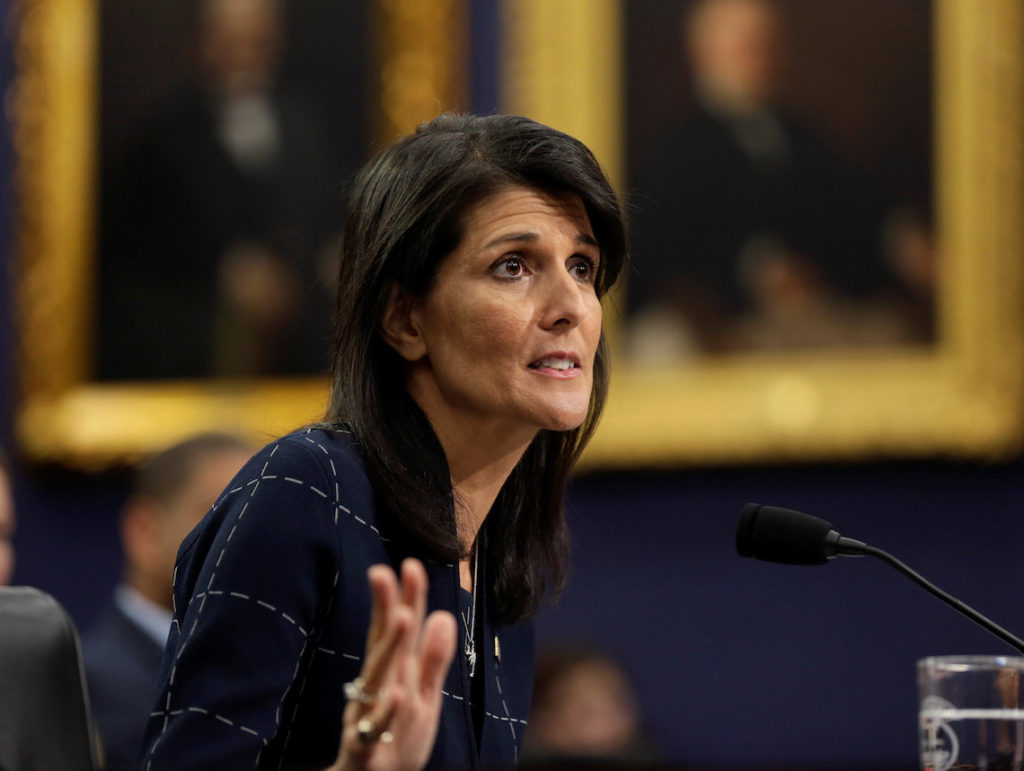
U.S. Ambassador to the United Nations Nikki Haley promised to block the appointment of any Palestinian serving in an influential UN position on Tuesday.

[This story originally appeared on jewishinsider.com]

During a hearing before the House Appropriations State and Foreign Operations Subcommittee, Haley was asked in a heated exchange by Representative David Price (D-NC) about the administration’s decision to veto the appointment of former Palestinian Prime Minister Salam Fayyad to the role of UN head of political mission to Libya in February. “Ron Dermer, Israel’s Ambassador to the U.S., called Mr. Fayyad a peace partner. The first Palestinian leader, he said, in a century who cared about the Palestinians,” Price noted. “Was Mr. Fayyad denied simply because of his nationality? Would any Palestinian have been blocked? As you know, this isn’t a state representative.”

Haley responded by acknowledging Fayyad’s credentials for the Libya role. “I will tell you that Mr. Fayyad is as you say, he’s very well qualified and is a good, decent person. I’ve heard great things about him. However, “it was not about Mr. Fayyad,” Haley explained. “It’s about the fact that the U.S. does not recognize Palestine… And because that is how he was presented, we did oppose that position.”

The North Carolina lawmaker further prodded, “Would not that reasoning exclude anybody of Palestinian nationality by virtue of their status of the Palestinian Authority, certainly something considerably short of a state? Are we just saying that no Palestinian need apply?”

Haley then confirmed that the U.S. would not support the appointment of any Palestinian individual until they are formally recognized by the U.S. as a state. “If we don’t recognize Palestine as a state, we needed to acknowledge also that we could not sit there and put a Palestinian forward until the US changed its determination on that front,” she explained.

During the hearing, Congressman Jeff Fortenberry, a Republican from Nebraska, also criticized Haley for taking this position. “I didn’t see his (Fayyad) potential representation to the Libyan issue as some sort of proxy for the declaration of the Palestinian state,” Fortenberry said. “He’s not representing that. He is, if you will, a citizen of the world and extraordinarily qualified on many fronts and deeply respected by the Israelis.”

While serving as Prime Minister of the Palestinian Authority, Fayyad was widely praised by Republican officials and officials of the George W. Bush Administration for his anti-corruption efforts and moderate positions on the peace process. Fayyad also opposed unilateral steps taken by Palestinian President Mahmoud Abbas at the United Nations because he argued that they wouldn’t advance the prospects for peace.

At the hearing, Haley used the platform to criticize the UN peacekeeping body in southern Lebanon (UNIFIL) for turning a blind eye to Hezbollah’s growing presence south of the Litani River in violation of UN Security Council Resolution 1701. She also attacked the UN Human Rights Council for its bias against Israel.

Haley vows to veto any Palestinian from serving in senior UN role Read More »

Jewish groups urge Senate to oppose health care bill

A coalition of Jewish organizations led by the Religious Action Center of Reform Judaism urged members of the U.S. Senate to oppose the bill that would repeal the Affordable Care Act, or Obamacare.

The letter sent to all 100 senators Tuesday, signed by 14 organizations, says that the Better Care Reconciliation Act of 2017 would undercut Medicaid, the federal program that currently pays for half of all births in the United States and about 62 percent of seniors who are living in nursing homes.

The Senate bill would lower government spending on Medicaid by capping the per capita cost of serving various groups, such as children, adults, people with disabilities or the elderly. According to the Congressional Budget Office, the Republican-backed bill would reduce projected Medicaid spending by $772 billion in the coming decade, and 15 million fewer people would be covered by Medicaid in 2026 than under the current law.

“Among other harmful provisions, transforming Medicaid into a per-capita cap system would not only take away health care from those who have benefited from the ACA’s Medicaid expansion, but would harm populations that have been covered by Medicaid since its inception,” according to the letter. “States will face impossible choices prioritizing among people with disabilities, low-income Americans, and children and will have no option but to slash services that are essential for the daily lives of millions.”

Signers of the letter include Bend the Arc-Jewish Action, Jewish Federations of North America, National Council of Jewish Women, the Network of Jewish Human Service Agencies, and Reform, Conservative and Reconstructionist groups.

Jewish Federations of North America estimates that the care providers affiliated with Jewish federations receive $6 billion from the Medicaid program annually.

Jewish groups urge Senate to oppose health care bill Read More »

New Jersey rabbi, wife arrested for fraud in raids on Charedi Orthodox community

A New Jersey rabbi and his wife were arrested with three other Jewish couples for underreporting their incomes to receive government benefits.

The couples, including the rabbi’s brother and wife, were arrested Monday in raids that resulted from an investigation into Lakewood, a New Jersey town that is home to a large Charedi Orthodox community. More arrests are expected, Ocean County Prosecutor Joseph Coronato said, according to The Associated Press.

The FBI and the New Jersey State Comptroller’s Office launched the probe.

By underreporting their incomes, Rabbi Zalmen Sorotzkin and his wife, Tzipporah, and the other couples defrauded state and federal assistance programs of over $1 million, according to criminal complaints, AP reported.

The Sorotzkins were charged in state court with illegally collecting more than $338,000 in benefits. They will plead not guilty, their attorney said, according to AP.

Another couple, Mordechai and Jocheved Breskin, was charged with illegally collecting $585,000.

In federal court, Zalmen Sorotzkin’s brother, Mordechai, and his wife, Rachel, were charged with another couple, Yocheved and Shimon Nussbaum, with illegally collecting benefits, including Medicaid.

“My office gave clear guidance and notice to the Lakewood community in 2015 of what is considered financial abuse of these programs,” Coronato said. “Those who choose to ignore those warnings by seeking to illegally profit on the backs of taxpayers will pay the punitive price of their actions.”

New Jersey rabbi, wife arrested for fraud in raids on Charedi Orthodox community Read More »

Bibi hits a wall

When push came to shove, when he had to pick between politics and principle, between personal power and Jewish unity, between his position and his people, Prime Minister Benjamin Netanyahu caved. He picked his position. He showed us his ultimate priority.

Surrendering to ultra-Orthodox pressure, Bibi reneged on a January 2016 agreement to ensure an official egalitarian presence at the Western Wall and, as if that weren’t enough, he supported an initiative to give total monopoly on conversions to the Chief Rabbinate. The timing couldn’t have been worse — it happened right when the Jewish Agency was having its annual conference in Jerusalem, with global representatives of the Diaspora looking on.

The moves were so insulting that the Jewish Agency did something unprecedented — it cancelled its dinner invitation to the prime minister. Meanwhile, the moves were condemned virtually across the board. You know you’ve gone too far when a beloved hero like Natan Sharansky goes against you.

Sensing that he may have overplayed his hand, Bibi has tried to do some damage control, but it’s not helping much. I think there are two main reasons for that.

First, Bibi clearly reneged on an agreement. His calls for renegotiation now ring hollow. It took years of hard negotiating, under the leadership of Sharansky, to come up with the compromise that recognized a non-Orthodox presence at Judaism’s holiest site.

As Yossi Klein Halevi wrote in The Times of Israel, “It was a noble compromise: The liberal denominations accepted with humility a secondary place at the Wall, but that at least recognized their right to be part of Israel’s public space; while the Orthodox seemed to accept an organized non-Orthodox presence at the Wall for the sake of Jewish unity.”

For those who fought so hard to obtain that agreement, the thought of going back to the drawing board must be demoralizing. As the head of the Reform movement, Rabbi Rick Jacobs, said, “To spend four more years negotiating and then not have that implemented, either, is not credible.”

The second reason Bibi will have trouble spinning away from this crisis is that he’s associating himself with an institution with little credibility — the Chief Rabbinate. In the past year alone, two former chief rabbis, Yonah Metzger and Eliyahu Bashki Doron, have been convicted of felonies. And who is the politician leading the charge on these latest moves of intolerance? None other than Interior Minister Aryeh Deri, leader of the ultra-Orthodox Shas party, who spent three years in jail for bribery, fraud and breach of trust.

Add it all up and there’s not much wiggle room for Bibi to repair the harm done to Israel-Diaspora relations. Until Bibi stands up to ultra-Orthodox forces for the sake of Jewish peoplehood and Jewish unity, they will continue to pressure him for their own divisive agenda, which puts a strict interpretation of halachah above all else.

The tragedy is that Bibi knows better. He’s a cosmopolitan Jew who understands the Diaspora and the importance of tolerance, pluralism and Jewish peoplehood. As the leader of the Jewish state, he knows he has a responsibility to make Israel a unifying force for all the Jews of the world. Once Israel becomes a divisive force that offends the majority of American Jews, what’s left? Startup Nation?

“I’m a Jew first and an Israeli second,” I remember him saying once at a Manhattan synagogue. Will he be able to say that next year at AIPAC, or at an American synagogue? Will anyone believe him? What American Jews are hearing today is that Bibi is an Israeli politician first and a Jew second. That is the price he is paying for appeasing intolerance.

What I find especially sad about this affair is that Bibi knows how to build bridges — with non-Jews. For the past few years, he has done a remarkable job opening up Israel to other countries hungry for Israeli expertise. He has traveled the world and received delegations from places like China, India, Africa and Eastern Europe in an effort to build economic and cultural bridges.

But while he built those bridges, he allowed another bridge to fray—the bridge between his government and the Jews of the world. So many of these Diaspora Jews are deeply in love with Israel and deeply attached to the Zionist miracle. I hate to think that they will now need some kind of financial “leverage” in order to be heard by the country they so love.

If the cause of Jewish unity is not enough leverage, what is?


David Suissa is president of TRIBE Media Corp./Jewish Journal and can be reached at davids@jewishjournal.com.

Bibi hits a wall Read More »