fbpx

June 19, 2017

Moving & Shaking: TEBH Ball, JVS Awards and Magen David Adom receives ambulance donation

Temple Emanuel of Beverly Hills’ (TEBH) Beverly Hills Ball on May 17 honored three couples who have dedicated their lives to making the world a better place.

At the event on the Reform synagogue’s campus, TEBH recognized Jade Mills, a Coldwell Banker real estate agent, and her husband, Adam, who builds and sells luxury homes, with the Community Spirit Award; attorneys Lilly and David Lewis with the Humanitarian Award; and longtime TEBH members Carol and Jerry Redston with the Legacy Award.

The Beverly Hills Ball is the congregation’s biggest fundraiser of the year. The annual gathering fetes esteemed community leaders.

Jade Mills is Coldwell Banker’s top-ranked global real estate agent, according to a TEBH press release. She is a board member at Cedars-Sinai Medical Center “and has also been honored by the Aviva Foundation for her ongoing support, charitable work and continuous effort to better the foundation,” the release said. She and her husband also actively support the Beverly Hills Unified School District.

Lilly and David Lewis have been members of TEBH for more than three decades and are involved with numerous philanthropic pursuits, including Venice Family Clinic, City of Hope and the Planned Parenthood Federation of America.

Lilly and David Lewis, Temple Emanuel of Beverly Hills Humanitarian Award honorees. Photo by Tara McVicar.

The Redstons have been congregants of the synagogue for more than 55 years and are involved actively in synagogue and organized Jewish life. According to TEBH, they are “the matriarch and patriarch of the many meaningful contributions of three generations of children and grandchildren to the temple.” Carol has served as president of the Beverly Hills chapter of Hadassah, and Jerry has served as president of the brotherhood at TEBH and on the synagogue’s board of directors.

Attendees at the Roaring ’20s-themed event from TEBH included Senior Rabbi Jonathan Aaron, Associate Rabbi Sarah Bassin and Cantor Lizzie Weiss; president Barry Brucker; rabbi educator Adam Lutz; and the synagogue’s executive director, Eric Reiter.


From left: JVS CEO Alan Levey; Steven Hirsh, founder of Strictly Business; Patricia Will of Belmont Village Senior Living; Claudia Finkel, JVS chief operating officer; and John Smith of AvalonBay Communities attend the Jewish Vocational Service (JVS) Strictly Business L.A. Awards. Photo courtesy of Jewish Vocational Service

During the 20th annual Jewish Vocational Service (JVS) Strictly Business L.A. Awards Luncheon on June 7, more than 400 corporate and community leaders came together at the Beverly Hilton to celebrate programs and individual leaders committed to reducing poverty.

JVS of Los Angeles, which provides job training and mentorship for people seeking employment, honored Belmont Village Senior Living and AvalonBay Communities for their support of JVS HealthWorks and ApartmentWorks, respectively. Steven Hirsh, honorary vice president of JVS and founder of Strictly Business, received the Founder’s Award.

“This is the most critical and challenging time we have lived in,” Hirsch said, “and that makes our actions and our time so very important.”

Patricia Will, co-founder and president of Belmont Village Senior Living, accepted the JVS Corporate Leadership Award on behalf of her organization. Senior Portfolio Maintenance Director John Smith accepted the JVS Partnership Award on behalf of AvalonBay Communities.

While the awards were the main part of the luncheon, Strictly Business raised $400,000 through an urgent appeal, with proceeds benefiting the work of JVS of Los Angeles. The event featured personal testimonies from JVS clients who have found success in the program and a recorded message from L.A. Mayor Eric Garcetti.

“JVS has been an extraordinary partner,” Garcetti said, “not only in making sure that we have training in the heart of the city but also looking at how we can improve workforce development.”

Attendees included Culver City Councilman Jim Clarke; Wells Fargo Executive Vice President and JVS board member Steven Sloan; JVS CEO Alan Levey; and JVS chief operating officer Claudia Finkel. NBC4 weatherman Fritz Coleman emceed the event.

— Avi Vogel, Contributing Writer


Melvin and Shandy Small donated an ambulance to Magen David Adom. Photo courtesy of American Friends of Magen David Adom

Melvin and Shandy Small of Los Angeles have donated an ambulance to Israel’s first-responder organization and blood bank, Magen David Adom.

On April 23, about 50 of the Smalls’ family and friends gathered for a dedication of the ambulance at the Skylight Gardens restaurant in Westwood.

“There was not a dry eye to be seen,” Melvin Small said. “All realized the importance that even one additional ambulance can make to the urgent need in Israel.”

The Smalls dedicated the ambulance in memory of Melvin’s late brother, Harold Leo Small, who served as a U.S. navigator and bombardier during World War II in the Pacific theater. He died in Los Angeles more than 50 years ago at the age of 37 from malignant hyperthermia.

A luncheon following the dedication ceremony celebrated Shandy’s 90th birthday.

“She was feted by her beloved Mel, children, grandchildren and great-grandchildren, and recognized as our queen,” Melvin said.

Yossi Mentz and Carolyn Kangavari of American Friends of Magen David Adom, which raises funds and awareness for the nonprofit medical-assistance organization, facilitated the donation.

Ambulances are a critical part of the work of Magen David Adom, which responds to terrorist attacks in Israel, provides disaster relief to people in need and offers blood services.
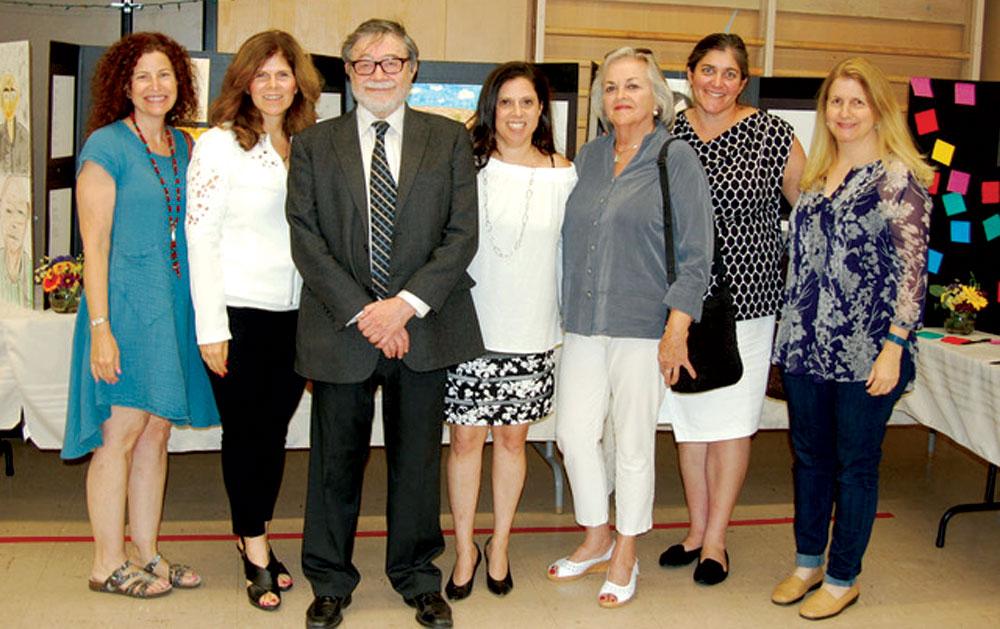

From left: David Labkovski Project board members Connie Marco and Laura Beth Sholkoff, UCLA professor Judea Pearl, project founder Leora Raikin, board member and archivist Frayda Salkin, education director Stephanie Wolfson and board member Lisa Lainer Faigan attend an exhibition at Daniel Pearl Magnet High School. Photo by courtesy of Stephanie Bien

The David Labkovski Project rounded out its second year of bringing Holocaust education to area students, Jewish and otherwise, with a June 1 student-curated art exhibition and ceremony at the Daniel Pearl Magnet High School in Lake Balboa.

The project uses the art of Holocaust survivor David Labkovski to help students explore the Holocaust. It debuted last year at the Multicultural Learning Center, an elementary school in Canoga Park. This year, it expanded to four schools, including Loyola Marymount University.

UCLA Professor Judea Pearl, father of slain journalist Daniel Pearl, after whom the school was named, opened the June 1 event by speaking about the importance of remembering the Holocaust.

Afterward, Leora Raikin, Labkovski’s grandniece and the project’s founder, accepted honors from the Los Angeles City Council, the Los Angeles Unified School District and the California State Assembly.

The David Labkovski Project allows students to curate from some 300 pieces by the late Safed-based painter, who depicted life in Vilnius, Lithuania, both before and after World War II, and his experiences later in a Soviet prison camp. After the war, Labkovski immigrated with his wife, Rivka, to Israel. He died in 1991.

Each school put a unique spin on the program. Students at the Abraham Joshua Heschel Day School created digital audio guides, while students at Loyola Marymount built an interactive website. At the Multicultural Learning Center, a bilingual charter school, students explained the artwork in Spanish and English.

The program has reached some 150 students, a large number of whom are non-Jews who heard about the Holocaust for the first time through the project.

— Eitan Arom, Staff Writer
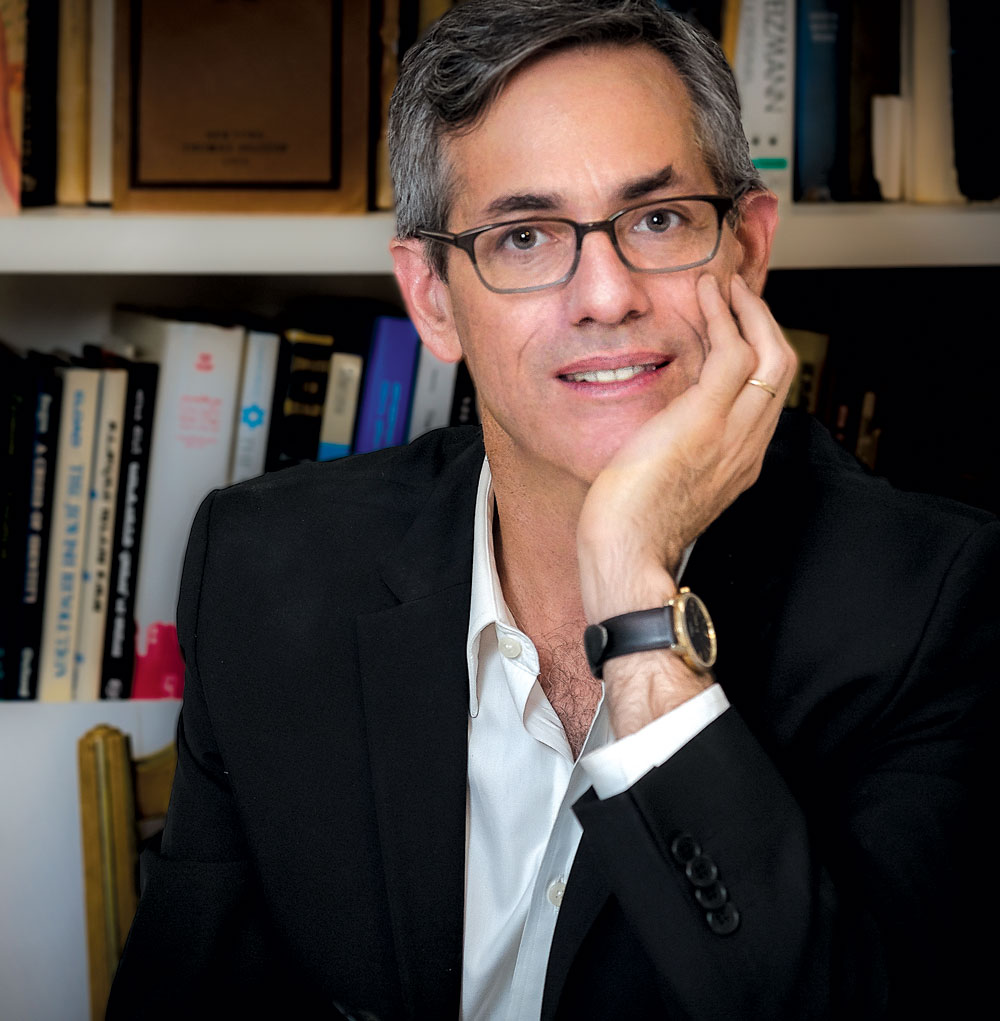

David Myers

David Myers, the Sady and Ludwig Kahn professor of Jewish history at UCLA and the inaugural director of the UCLA Luskin Center for History and Policy, has been named CEO and president of the Center for Jewish History in New York, effective July 1.

“I burn with passion to study Jewish history,” Myers said. “It’s what I love doing. I am blessed beyond imagination to be able to do this, to be able to study Jewish history, which is ceaselessly fascinating.”

At the Center for Jewish History, Myers will oversee what is the largest archive of the modern Jewish experience outside of Israel. Dedicated to history, culture and art, the museum is a collaborative home for five partner organizations: the American Jewish Historical Society, the American Sephardi Federation, the Leo Baeck Institute, the Yeshiva University Museum and the YIVO Institute for Jewish Research. 

Myers, 56, a Journal contributor, will remain on the faculty of UCLA, his academic home for 25 years. He will live in Los Angeles during the 2017-2018 academic year and then move to New York.

He has written extensively on modern Jewish intellectual and cultural history, and earned a doctorate in Jewish history from Columbia University in 1991. He began as a lecturer at UCLA the same year.

Myers and his wife, Nomi Stolzenberg, a USC law professor, live in Pico-Robertson. They are the parents of three daughters, two of whom live in New York.

Myers expressed ambivalence about leaving UCLA but said it was time for him to move on to the next chapter in his career.

“I love UCLA. It’s been an extraordinary place to be and work and grow, and I could easily have decided not to make this move,” he said. “But I find the opportunity and challenge to be so exciting, it seemed like this was the time to try something new.”

Moving & Shaking highlights events, honors and simchas. Got a tip? Email ryant@jewishjournal.com.

Moving & Shaking: TEBH Ball, JVS Awards and Magen David Adom receives ambulance donation Read More »

Israel reportedly is secretly aiding Syrian rebels along Golan border

Israel has been secretly providing aid to Syrian rebels on the border in the Golan Heights for several years, The Wall Street Journal reported.

The aid includes cash, as well as food, fuel and medical supplies, the newspaperreported in an article that first appeared on its website Sunday night. The story cited interviews with about half a dozen Syrian fighters.

The Israeli army is in regular communication with rebel groups and its financial assistance helps pay the salaries of fighters and buy ammunition and weapons, according to the report. In addition, Israel has established a military unit that oversees the support in Syria.

Rebels and the military loyal to Syrian President Bashar Assad have been fighting since 2011 in a civil war that at times has spilled over into Israeli territory with errant fire. The Israeli military has responded to the rocket and artillery fire that landed on Israel’s side of the Golan Heights.

Israel has acknowledged treating thousands of Syrians injured in the war, both on the border and in hospitals in the north of the country, as well as providing some humanitarian aid to civilians living near the border, including food and clothing.

Israel’s military neither confirmed nor denied The Wall Street Journal report, telling the newspaper that the Israel Defense Forces is “committed to securing the borders of Israel and preventing the establishment of terror cells and hostile forces … in addition to providing humanitarian aid to the Syrians living in the area.”

The fighters interviewed for the story told Journal reporters that the Quneitra-based group Fursan al-Joulan, which means Knights of the Golan, is the main rebel group coordinating with Israel, which first made contact with the Israeli military in 2013 when Israel cared for some of its fighters. Its spokesman told the Journal that “Israel stood by our side in a heroic way,” and “We wouldn’t have survived without Israel’s assistance.”

Israel, which captured and annexed the Golan Heights in 1967, reportedly is concerned about a permanent Iranian and Hezbollah presence at its border under Assad, and that Iran would transport weapons to be used against Israel to Hezbollah military bases in southern Lebanon and the Syrian side of the Golan. Israel in recent years has bombed such arms shipments, leading to accusations that it was involving itself in the civil war.

Israel reportedly is secretly aiding Syrian rebels along Golan border Read More »

Jared Kushner, Jason Greenblatt returning to Jerusalem this week

Two top advisers to President Donald Trump, including his Jewish son-in-law Jared Kushner, will return to Jerusalem this week to push for restarted peace talks between Israel and the Palestinians.

The visits to Jerusalem and Ramallah by Kushner, a senior adviser to Trump, and national security aide Jason Greenblatt were widely reported on Sunday night, all citing unnamed White House officials. The visits were first reported in The Wall Street Journal.

It will be the first major peace push by the White House since Trump visited the region last month.

Kushner, who reportedly will arrive in Israel on Wednesday, is scheduled to meet in Jerusalem with Prime Minister Benjamin Netanyahu and in Ramallah with Palestinian Authority President Mahmoud Abbas. Greenblatt is scheduled to arrive Monday in Jerusalem.

An unnamed White House official told The Wall Street Journal that no three-way talks are expected during the visits and that no major breakthroughs are anticipated. Reuters reported that the White House has been holding behind-the-scene talks since Trump’s visit at the end of May, which reportedly was planned by Kushner.

Unnamed White House officials cited by several news sources reiterated that an agreement between the Israelis and Palestinians is a priority for the Trump administration.

Kushner is currently under scrutiny as part of the investigation into whether Trump officials colluded with Russia to sway the outcome of the presidential election.

Jared Kushner, Jason Greenblatt returning to Jerusalem this week Read More »

MEGAN LEAVEY *Movie Review*

Kate Mara stars in Megan Leavey as the title character, a US Marine who serves heroically with her military service dog, Rex.  After Megan leaves the Marines, she begins petitioning to adopt Rex upon his own retirement from the Corps.  The film emphasizes themes of love, friendship and loyalty.

Megan Leavey also stars Tom Felton, Ramon Rodriguez, Common, Edie Falco, Bradley Whitford, Will Patton.  It was directed by Gabriela Cowperthwaite.

For more about the themes in Megan Leavey and what it has in common with Dirty Dancing and Grease, take a look below:


—>Keep in touch with the author on Twitter and Instagram @realZoeHewitt.  Looking for the direct link to the video?  Click here.

MEGAN LEAVEY *Movie Review* Read More »

Four questions about 14,000 Palestinian houses in the city of Qalqilya

Four questions are bothering Israel today as if they were one question. But these are not identical questions. The first question is: should Israel allow the building of 14,000 new homes for Palestinians in the city of Qalqilya in area C of the West Bank (the area controlled by Israel)? The second question is: how does the Israeli cabinet make such decisions? The third question is: who are the Prime Minister and the cabinet afraid of? And the fourth question is: do we believe the ministers of the Israeli cabinet?

The story goes as follows: last week, it was reported that Israel decided to allow the building of 14,000 new apartments on more than 600 acres in the Israeli-controlled Area C “surrounding the city.” This would more than double the size of Qalqilya’s population – currently, it’s a city of about fifty thousand Palestinians. And it would double it as it grows westward, that is, bringing it closer to the Green Line and to Israel. And it would double it while Israeli settlers who live in area C can only dream about such massive construction.

The report triggered criticism from the usual suspects on the right, especially the ministers of the Jewish Home Party, but then also by Likud ministers, some of which are members of the cabinet. Strange: were they not the ones approving this construction plan? The Prime Minister, Benjamin Netanyahu, said that yes. They did. But several ministers insisted that they do not remember ever approving such a plan. “I don’t understand who gave the Civil Administration the authority to approve such a large-scale building plan,” said Minister Gilad Erdan (Likud). The Prime Minister reassessed his response, and then changed it – no such decision was made.

No such decision? But you just said the opposite! True, there was confusion. Minister Zeev Elkin explained this morning that the cabinet did discuss a plan for Qalqilya, but not this plan for Qalqilya. Hence the confusion. The PM remembered something, and did not understand why the ministers are criticizing a plan that was under discussion and on which they voted, and only then he realized that the plan they were talking about is a much more ambitious plan than the one the cabinet voted on. The cabinet will have to reassess this plan. And it is not at all clear that the plan will get its approval. In fact, the more likely outcome is that it will not get the cabinet’s approval.

Now to the questions, beginning with the fourth: do we believe this version of what happened? An alternative version would take us to question number three: Who are the prime minister and the cabinet afraid of? This alternative version goes as follows: the cabinet approved a plan. The plan was then criticized by the settlers and their allies. Cabinet members from the Likud Party panicked, because of the settlers’ political power, which can affect the ministers’ political future. So the ministers joined the criticism, forcing the Prime Minister to follow, lest he loses points in his battle – against Naftali Bennet of the Jewish Home – for the leadership of the right.

The second question is the one I find the most troubling. Israel’s cabinet makes many decisions. Some of them, many of them, are of great importance. The cabinet votes on matters of war and peace, life and death. The cabinet ought to be a serious body – not a body whose resolutions are not clear, whose discussions not remembered, whose decisions are inconclusive. There are only two options: either the cabinet discussed the Qalqilya plan or it did not. There are only two options: either the cabinet decided on the Qalqilya plan or it did not.

If it did, and if the ministers believe this was the right decision, its members should be courageous enough to back it amid criticism – or admit that they were mistaken amid criticism. Denying that it was ever discussed is an embarrassment.

If it was not, and if someone else took the liberty of approving such plan without consultation with the cabinet – this person or body (likely, the Defense Ministry, or the office of The Coordinator of Government Activities in the Territories) should be censured by the Prime Minister and the cabinet. You do not want 14 thousand new homes built in the West Bank, in areas under Israeli control, without having the cabinet’s approval.

And this is where the first question comes into play. Israel has a policy of rewarding Palestinians cities that show a desire for economic development and do not produce terrorism and chaos. Qalqilya is apparently such a city. So giving it assistance makes a lot of sense. On the other hand, Qalqilya is very close to the Green Line, and expanding it westward might not be the best of moves as one thinks about a future of separation between Israel and the Palestinians.

The complaint of the right doesn’t focus on these two considerations. It focuses mainly on the settlers’ ability to also build in area C. If Palestinians can build, why not us? And that’s, of course, a good question for which there are also answers – for example: it will not help Israel as it negotiates the future of peace talks with the Trump administration. The cabinet has to weigh all these questions and give a coherent answer. It has to give the best answer it can give and stick by it. And it could be nice if the answer is presented in a way that would make us – Israelis – feel that we are in good hands of people who pay proper attention to the matters at hand as they ponder their consequences. The possible expansion of Qalqilya is an important matter. Having a functioning cabinet is more important.


Four questions about 14,000 Palestinian houses in the city of Qalqilya Read More »