fbpx

June 5, 2017

Aly Raisman is the most famous Jewish athlete, according to ESPN

Three Olympic gold medals. Six total. Captain of the victorious 2012 and 2016 U.S. women’s gymnastics teams.

Now Aly Raisman can add one more accolade to her list: Most famous Jewish athlete in the world.

Raisman, 23, the two-time U.S. Olympian from Massachusetts, is the only Jew on ESPN’s 2017 list of the 100 most famous athletes worldwide. She sneaked in at number 99, immediately below Aussie golfer Adam Scott (not the guy who plays Ben in “Parks and Rec”), and above Mohamed Salah, an Egyptian soccer player for the Italian team Roma.

Raisman is one of only eight women on the list, which includes her U.S. gymnastics teammate Simone Biles (#48), martial artist Ronda Rousey (#16) and tennis pros Serena Williams (#19) and Maria Sharapova (#23).

Cristiano Ronaldo, the Portuguese soccer icon, topped the list. LeBron James, the basketball superstar now gunning for another NBA championship with the Cleveland Cavaliers, was number two.

Raisman won her first Olympic golds as an 18-year-old in 2012, and won our hearts by performing her first-place floor exercise to the tune of Hava Nagila. Her adorably anxious parents, Lynn and Rick, only added to her Jewish charm.

Raisman took home two golds in 2012 — for the team win and floor exercise — as well as a bronze for the balance beam event. In 2016, she was nicknamed “grandma” for being the team’s oldest member — at 22. But age didn’t stop her. Raisman won three more medals that year: a gold for the team win, and two silvers for all-around and floor exercise.

Raisman will be 26 when the 2020 Olympics kick off in Tokyo, but she’s planning to compete again. If she wins two more medals, for a total of eight, she’ll break the all-time record for U.S. women gymnasts.

ESPN calculated the rankings by looking at endorsement money, social media following and Google search results. Raisman has a paltry $450,000 in endorsement deals (by comparison, LeBron does $55 million in endorsements), but she boasts 2.2 million followers on Instagram and nearly a million on Twitter.

She has also excelled outside of the arena. Raisman placed fourth on ABC’s “Dancing With the Stars” in 2013, and she can do a mean box jump.

Aly Raisman is the most famous Jewish athlete, according to ESPN Read More »

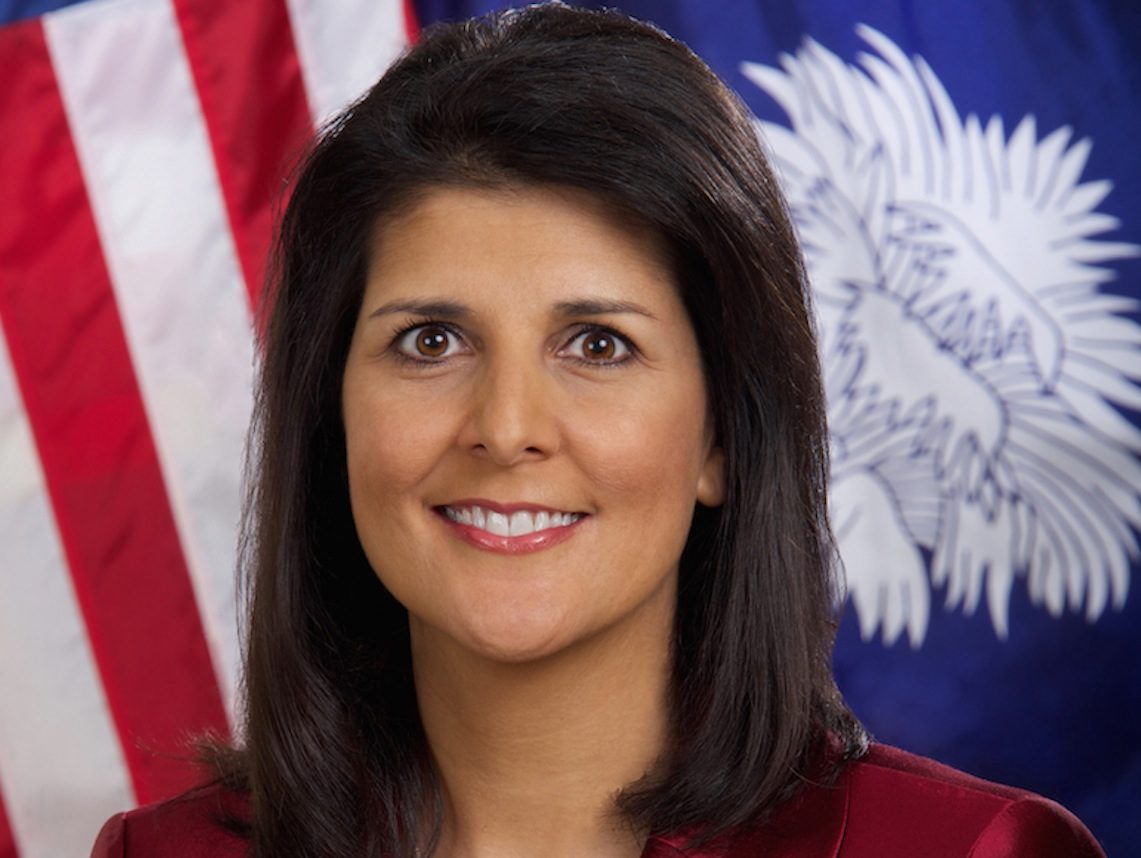
American UN Ambassador Nikki Haley to visit Israel on Wednesday

U.S. Ambassador to the United Nations Nikki Haley will visit Israel, including the Old City of Jerusalem and the Western Wall.

Haley will arrive in Israel on Wednesday, according to Israeli news reports.

She is scheduled to meet with Israeli President Reuven Rivlin and Prime Minister Benjamin Netanyahu as well as senior Palestinian officials, the Times of Israel reported.

Haley is scheduled to fly over the country’s northern and southern borders in a helicopter, visit Tel Aviv and lay a wreath at Yad Vashem, accompanied by Israel’s UN Ambassador Danny Danon. Her visit to the Old City of Jerusalem and the Western Wall are being billed as “private and religious,” however, and she will not be accompanied by Israeli officials. President Trump, in his recent visit to holy sites in Jerusalem, was also unaccompanied by Israeli political leaders.

In an interview in May with the Christian Broadcasting Network, Haley said that the Western Wall belongs to Israel and that Israel’s capital is Jerusalem. “I don’t know what the policy of the administration is, but I believe the Western Wall is part of Israel and I think that that is how we’ve always seen it and that’s how we should pursue it,” Haley said. “We’ve always thought the Western Wall was part of Israel.”

The comments came in the wake of reports that a Trump administration official, responding to a request that Israeli officials accompany the president when he visited the Western Wall, replied that the Western Wall “is not your territory, it’s part of the West Bank.”

In the interview, Haley also reiterated her support for moving the U.S. Embassy to Jerusalem from Tel Aviv.

“Obviously I believe that the capital should be Jerusalem and the embassy should be moved to Jerusalem because if you look at all their government is in Jerusalem,” she said. “So much of what goes on is in Jerusalem, and I think we have to see that for what it is.”

As a candidate, Trump promised to move the embassy. But last week, Trump signed an order renewing the six-month waiver that allows the U.S. embassy to remain in Tel Aviv. An act of Congress in 1995 required relocating the embassy to Jerusalem, but successive administrations have delayed the change with a series of six-month waivers, citing national security concerns.

American UN Ambassador Nikki Haley to visit Israel on Wednesday Read More »

Danny Lobell

I was very happy to catch Danny Lobell’s one man comedy show, Broke as a Joke last night as part of the Hollywood Fringe Festival previews.  This likeable, rising comic is genuinely funny, gentle and quirky.  He’s definitely going places.   You can find more information about his act and all the other myriad offerings of the Fringe Festival here:  hollywoodfringe.org.  The festival runs June 8th through June 25th.  Most venues are around Santa Monica Blvd. and Vine Street in Los Angeles, with a scattering of other stages nearby.  Ticket prices are quite reasonable, too.

Danny Lobell Read More »

Marilyn Hall, actress, writer, producer, philanthropist and wife of Monty Hall, dies at 90

Marilyn Hall, an actress, writer, producer, philanthropist and wife of producer and game show host Monty Hall, died June 5 at age 90.

Hall was born Marilyn Plottel on May 17, 1927, in Winnipeg, Canada. She began her career as a writer and radio ingénue for the Canadian Broadcasting Corp., writing radio dramas, as well. Hall also taught writing focused on children’s programming at Queen’s University at Kingston in Ontario.

After moving to New York with her husband, she became a published songwriter. Her song “Is It Possible That I’ve Been Gone So Long,” co-written with Helen Bilby, was recorded by famed cabaret singer Hildegarde.

Hall supported Brandeis University, the United Jewish Welfare Fund and Tel Aviv University, for which she made several documentary films. In 1972, she won an award for best documentary campaign film for “A Fragile Sleep.” Hall volunteered to write for several charities and developed programs for the Julia Ann Singer Child Care Center, Guardians of Courage, Israel Bonds, Tel Aviv University, the Jewish Home for the Aging, and particularly for Variety Clubs International, where she served as a board member while also writing and producing its International Humanitarian Award event.

Her television writing credits included “Love, American Style” and the ABC special “Lights, Camera, Monty.”

She was the executive producer of the four-part miniseries for PBS/NHK titled “The Ginger Tree”(1989), written by Christopher Hampton; associate producer of the Emmy-winning TV movie “A Woman Called Golda,” starring Ingrid Bergman and Leonard Nimoy (1982); co-executive producer of “Do You Remember Love?” an Emmy-winning TV movie starring Joanne Woodward and Richard Kiley; and associate producer of “Nadia,” a TV movie about Olympic gymnastics champion Nadia Comaneci (1984). She executive produced the 2007 feature film “The Little Traitor,” starring Alfred Molina, based on the novel “Panther in the Basement” by Amos Oz.

Hall co-wrote “The Celebrity Kosher Cookbook,” and her book reviews appeared in the Los Angeles Times.

She earned a bachelor’s degree from the University of Toronto and a master’s of fine arts from UCLA, at age 50.

She is survived by her husband of 70 years, Monty; children Joanna Gleason (Chris Sarandon), Richard Hall and Sharon Hall (Todd Ellis Kessler); five grandchildren; and sister Peggy Cooper.

In lieu of flowers, donations in her honor can be made to the Los Angeles Jewish Home (lajh.org) or Variety Clubs International, a children’s charity.


Marilyn Hall, actress, writer, producer, philanthropist and wife of Monty Hall, dies at 90 Read More »

‘Never again’ – forgotten within 22 years

Like other teenagers during May-June 1967, I was bopping to the hits of the time. While The Tremeloes sang “Silence is Golden,” with Sandie Shaw’s “Puppet on a String” in hot pursuit on the official charts, something evil was unfolding—the golden silence of the west as Israel was threatened with annihilation, just 22 years after the Holocaust.

Remember- at that time, there was no “occupation.”

In 1964, the PLO had been formed as part of the plan to annihilate Israel.

Egypt’s President Nasser repeatedly stated that the Arab world’s problem was Israel’s existence. As he thundered in 1965: “We shall enter Palestine with its soil covered in blood…we aim for the total destruction of Israel.”

In 1965, the Mossad became aware of the Arab leaders plans for war on Israel.

The Syrian army regularly shelled Israeli farms and towns.

Israel’s allies yawned.

On 15 May, Egyptian troops massed near the Israeli/Sinai border.

The following day, UN Secretary-General U Thant nonchalantly reneged on UN assurances and removed the United Nations Emergency Force (UNEF) that had been set up as a buffer between Israel and its Egyptian neighbour, who daily spewed out hate filled blood curdling threats against the Israelis.

Two days later Syria massed troops on the Golan Heights.

On 20 May, Syrian Defence Minister Hafez Assad boasted “…as a military man, I believe the time has come to enter into a battle of annihilation.”

Today, his son Bashar al Assad, uses poisonous gas against his own people, as he turns his country into a barbaric, ravaged civil war zone, which serves as a warning to Israel.

In May 1967, Israelis were digging trenches in a large city park in anticipation of mass graves.

The world once again saw photos of Jews digging mass graves, just as they had during the Holocaust, when they were forced to prepare for their impending murder.

The ‘Voice of the Arabs’ radio demanded “total war” echoing Goebbels just 24 years before, to the rousing cheers of his fellow Germans.

Once again, the west responded with little more than sympathy, the Holocaust and mass murder of Jews still echoing in their ears from the stilled voices of those killed less than a generation before.

Never again?!

On 22 May, Egypt blocked Israeli shipping access to the Straits of Tiran, cutting off most of its oil supply. Nasser goaded Israel to fight and reiterated Arab determination to destroy Israel.

Arab armies mobilized almost 500,000 troops, 2800 tanks and 800 aircraft.

The noose tightened.

The all too familiar stress, tension and terror was becoming unbearable.

Yet, President Johnson warned Israel not to strike, (just as President HW Bush would demand when Israel came under Iraqi missile attack, 1991).

The State Department announced: ”Our position is neutral in thought, word and deed.”

Neutrality usually favours the perpetrator and the bully.

Incredulously, Johnson joined France in imposing an arms embargo.

The rest is history.

Israel’s lightning victory astounded the world. If that was not enough, the unthinkable happened.

Normally the victors set post-war conditions for the defeated countries, but this time something unique occurred. Israel the victor, pleaded for peace.

The satirist, Ephraim Kishon summed it up with his caustic remark, “so sorry we won, ”directing his words not only at the Arab countries but at the west whose “never again,” slogan proved to be hollow.

Yes, Israel the victor, pleaded for peace, but the defeated countries rejected it! The Khartoum Conference of 1967, attended by eight Arab heads of state, resolved ‘no peace, no recognition, no negotiations with Israel.’ Instead, the oil rich countries would fund the rebuilding of the defeated armies in turmoil.

And so began the contentious occupation. To date, the Palestinians will not agree to recognising Israel as the nation state of the Jews.

To those who choose or profess ignorance about the occupation would do well to educate themselves about the occupation’s origins, but more importantly, why it continues.

UN Security Council Resolution 242 specifically acknowledges that Israel need not return to the pre-June 1967 cease fire lines as they are not defensible. A country with a 13 km waist where some 70% of its population resides, surrounded by genocidal neighbours cannot now return to what arch dove Abba Eban called the “Auschwitz Lines.”

Israelis are therefore in an untenable situation with the “occupation,” being damned if they do, and damned if they don’t.

Another hit song in May 1967 was Frank and Nancy Sinatra’s “Something stupid.”

It could well have referred to the mindless mantras on campus and elsewhere.

It’s not about the “occupation.”


Ron Jontof-Hutter is a Fellow at the Berlin International Center for the Study of Antisemitism and the author of the satire,”The trombone man: tales of a misogynist.”

‘Never again’ – forgotten within 22 years Read More »

Thom-Yorke

Thom Yorke calls critics of Radiohead’s Israel concert ‘offensive’

After dozens of high-profile artists signed a letter in February urging Radiohead to cancel their upcoming concert in Tel Aviv, some might have assumed that the band would not respond to the criticism. After all, the British band’s lead singer, Thom Yorke, rarely gives interviews, and the Israeli-Palestinian conflict is a particularly fraught issue to comment upon.

But oh, has Yorke responded.

In an interview with Rolling Stone’s Andy Greene published on Friday, Yorke fired back at his critics for assuming that the members of Radiohead are uninformed on the Israeli-Palestinian issue. He argued that the authors of the letter — which rehashes the principle ideas driving the Boycott, Divestment and Sanctions movement against Israel, which aims to to exert economic and political pressure on Israel due to its policies toward Palestinians — waste their energy by throwing the word “apartheid” around.

I’ll be totally honest with you: this has been extremely upsetting. There’s an awful lot of people who don’t agree with the BDS movement, including us. I don’t agree with the cultural ban at all, along with J.K. Rowling, Noam Chomsky and a long list of others.

There are people I admire [who have been critical of the concert] like [English film director] Ken Loach, who I would never dream of telling where to work or what to do or think. The kind of dialogue that they want to engage in is one that’s black or white. I have a problem with that. It’s deeply distressing that they choose to, rather than engage with us personally, throw shit at us in public. It’s deeply disrespectful to assume that we’re either being misinformed or that we’re so retarded we can’t make these decisions ourselves. I thought it was patronizing in the extreme. It’s offensive and I just can’t understand why going to play a rock show or going to lecture at a university [is a problem to them].

Yorke also pointed out that Radiohead guitarist Jonny Greenwood is married to an Arab-Israeli woman — and is subsequently uniquely informed about the nuances of the Israeli-Palestinian conflict.

The person who knows most about these things is Jonny [Greenwood]. He has both Palestinian and Israeli fans and a wife who’s an Arab-Israeli. All these people to stand there at a distance throwing stuff at us, waving flags, saying, ‘You don’t know anything about it!’ Imagine how offensive that is for Jonny. And imagine how upsetting that it’s been to have this out there. Just to assume that we know nothing about this.

Radiohead’s longtime producer Nigel Godrich also weighed in on the issue, since he also produced the latest album by Roger Waters — the former Pink Floyd frontman who co-wrote the letter to Radiohead.

I don’t believe in cultural boycotts. I don’t think they’re positive, ever. And actually, I think that it’s true to say that the people you’d be denying [the music] are the people who would agree with you and don’t necessarily agree with their government. So it’s not a good idea. Thom and Roger are two peas in a pod, really, in certain respects. They just have a disagreement about this, but they’ve never even met. I think Thom feels very protective of Jonny, which I completely get. But I’m not in the middle of Thom and Roger.

Yorke added at the end of his statement that he is not a fan of Israeli Prime Minister Benjamin Netanyahu — and that is an important point. BDS supporters believe that cultural boycotts will hurt Israel’s conservative government but, as Godrich points out, they actually end up affecting the country’s liberal citizens who critique Netanyahu and support peaceful Palestinian statehood. Radiohead can play a concert in Israel for Israeli fans and also be critical of Netanyahu’s policies.

Here’s Yorke on Netanyahu (and Trump):

All of this creates divisive energy. You’re not bringing people together. You’re not encouraging dialogue or a sense of understanding. Now if you’re talking about trying to make things progress in any society, if you create division, what do you get? You get fucking Theresa May. You get [Israeli Prime Minister Benjamin] Netanyahu, you get fucking Trump. That’s divisive.

Despite that dig at Netanyahu — or maybe precisely because of it — it seems safe to say that Radiohead will get a very warm welcome when they perform at Tel Aviv’s Hayarkon Park next month.

Thom Yorke calls critics of Radiohead’s Israel concert ‘offensive’ Read More »

‘I have a feeling the war is going to start tomorrow’: Three days in June 1967

Five days before the Six-Day War broke out in June 1967, the American reporter Abraham Rabinovich arrived in Jerusalem. When the war ended, he decided to remain and write an account of Israel’s lightning victory. Over the next two years he interviewed close to 300 soldiers and civilians. 

In this excerpt from the 50th anniversary edition of “The Battle for Jerusalem: An Unintended Conquest,”Rabinovich recounts the days leading up to the war’s start and the decisions of the Israeli politicians and generals on the ground.

(JTA) — The date for war was fixed on Friday, June 2, 1967, the day after Prime Minister Levi Eshkol relinquished the defense portfolio to Israel’s military icon, Moshe Dayan. For two weeks, Eshkol had blocked his generals’ demand for a strike against Egypt, but the signing of a defense pact between Jordan and Egypt had finally convinced him that war was inevitable.

At a meeting with Eshkol and Chief of Staff Yitzhak Rabin, Dayan said that if the cabinet on Sunday approved a preemptive strike, the air force would carry it out the following morning. He rejected as irrelevant the army’s plans for attacking the Gaza Strip and the coastal guns overlooking the Tiran Straits, which Egypt had closed to Israel-bound shipping.

The army’s primary task, he said, was the destruction of Egypt’s tank divisions, the core of  its army. The brazenness of Egyptian President Gamal Abdel Nasser in sending his army into Sinai, banishing a U.N. buffer force, and closing the straits meant that he no longer feared Israel. Therefore, Dayan argued, his challenge must be met head-on. The army would bring the Egyptian tank formations to battle and leave the Straits of Tiran and Gaza Strip for later. Rabin said that nothing would be done to provoke the Jordanians in order not to draw forces away from the Egyptian front. Jerusalem’s Old City was on no one’s agenda.

Air Force Commander Motti Hod had never revealed details of the preemptive strike to his colleagues on the general staff. Even now, at a meeting Saturday night, June 3, he revealed only one element: zero hour. The planes would strike at 7:45 a.m. Intelligence knew that the Egyptian air force mounted patrols from first light until 7 a.m. in anticipation of a possible Israeli attack out of the rising sun. At 7:45 the Egyptian pilots would be back at their bases having breakfast. Senior commanders lived off base and arrived about 8 a.m. They would still be in their cars when the planes struck. At zero hour, Israel’s armored divisions would shed camouflage netting and cross into Sinai.

Dayan, in his first press conference as defense minister that Saturday night, declared that the time for a spontaneous response to the closing of the straits had passed. A diplomatic solution, he said, would now be sought. At an English-language newspaper in Jordanian Jerusalem, skeptical journalists joked that they should run Dayan’s soothing remarks under the headline “Israel about to attack.”

Sunday morning, at the crucial cabinet meeting, several ministers asked that a decision be put off, but for the first time Eshkol came out clearly for war. Washington’s objection to an Israeli first-strike, while officially still in place, had softened,  he said, in the wake of the Jordanian-Egyptian pact. Washington had not flashed a green light, “but the light was no longer red.”

Dayan warned that if the Egyptians struck first (“to do to us what we want to do to them”), one of their first targets would be the nuclear reactor at Dimona, which the Egyptians believed was about to come on line. “Our only chance of winning the war is to initiate it and shape it,” he said. The cabinet voted 12-2 for military action.

Gen. Hod summoned his base commanders after the cabinet decision and informed them that the long-mooted attack would be launched in the morning. In the first wave, 160 planes would attack. Only 12 planes would remain behind  to guard Israel’s airspace.

Gen. Uzi Narkiss, commanding the Jordanian front, met Sunday night with his brigade commanders for a final briefing. He had been informed of the cabinet’s decision but gave no hint of it to his officers. On a wall map, an intelligence officer reviewed the Jordanian deployment. Five infantry brigades on the West Bank had been reinforced by an additional brigade, held in reserve 10 miles east of Jerusalem. Troops had been shifted in substantial numbers from rear encampments to the front line and Jordan’s two armored brigades were poised to cross the Jordan River to the West Bank. A large Iraqi force was expected to take up positions threatening  Israel’s narrow waist within a few days.

At Narkiss’ request, his brigade commanders rose in turn to outline their operational plans. The commander of the Jerusalem Brigade, Col. Eliezer Amitai, was restrained. The Jordanian army was considered the best in the Arab world. In the War of Independence, the Israeli army had failed to dislodge it from any  fortified position. The British officers who commanded the Arab Legion, as it was known then, were dismissed by Hussein a decade later and replaced by Jordanian officers but the army’s reputation remained.

Israel’s Jerusalem Brigade had more than twice as many men as the Jordanians opposite them in the city but it was a hometown unit of reservists, many of them over 30. Contingency planning called for an elite regular army unit to break through stout Jordanian defenses to relieve the 120-man garrison on Mount Scopus, a mile behind Jordanian lines, if it was threatened. But it was doubtful whether elite units could be spared for the task in a multi-front war.

At an Israeli position on Mount Zion, adjacent to the Old City, a platoon commander challenged one of his men to chess Sunday evening. There was little conversation as they concentrated on the board. Suddenly the officer looked up and said, “I have a feeling the war is going to start tomorrow.”

At Tel Nof air base, pilots were wakened at 3:45 a.m. on Monday, June 5. Filing into the briefing room, their eyes focused on the terse announcement on the blackboard: “Zero Hour 0745.” When all were seated, the squadron leader said, “Good morning. We go to war with Egypt today.”

In nearby orange groves, Col. Motta Gur’s reserve paratroop brigade had spent the night in anticipation of boarding troop carriers for a jump into Sinai. An officer rose before dawn and looked expectantly towards the air base but could see no sign of unusual activity. The troops were wakened at six, and the orchards were soon bustling. The men were making coffee when a succession of roars erupted from the airbase. As the sound intensified, planes began to rise above the tree line — dozens of them following each other into the sky like children playing tag. Low-slung with bombs and rockets, the aircraft wove themselves into formations of four and headed southwest at treetop level. At the airfield, a mechanic wept as the planes swept past him, wave after wave, glinting in the sky like a sword unsheathed. In the orchards the paratroopers watched in silence, awed by what they were seeing and by what they knew must come. They then drifted off to write postcards home. “We’re seeing the start of the war,” wrote one. “We hope it’s finished soon. We’ll do what we can to finish it soon.”

In the afternoon, Col. Gur was informed that the fast-moving tank divisions in Sinai would overrun the paratroopers’ planned target.  The brigade was being sent instead to Jerusalem to break through to Mount Scopus. No one in authority mentioned the Old City. Some, however, were beginning to think about it.


Abraham Rabinovich is a journalist born and raised in New York City. He is the author of six books, including “The Yom Kippur War,” “The Boats of Cherbourg” and “Jerusalem on Earth.” He lives in Jerusalem.

‘I have a feeling the war is going to start tomorrow’: Three days in June 1967 Read More »

6 things you didn’t know about the Six-Day War

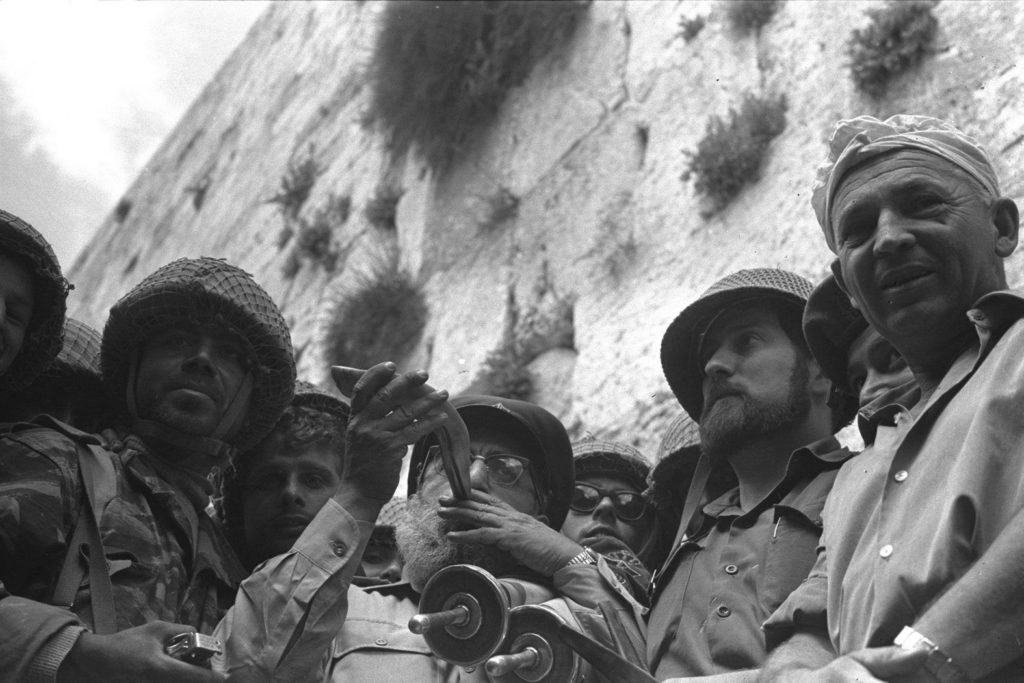
The three paratroopers casting eyes upward at the Western Wall. The troops reveling in the waters of the Suez Canal. The sweeping views of a Galilee no longer vulnerable to shelling from atop the Golan Heights.

Not to mention Naomi Shemer’s anthem “Jerusalem of Gold,” reissued after the Six-Day War with a new verse celebrating access to the Old City. Or the settlements, the Palestinians, the tensions, the violence.

These – and many others – are the images, memories and challenges that persist after 50 years of triumph, soul searching and grief.

But there are anomalies – small, telling wrinkles in what the war wrought – that, if not quite forgotten, have faded into the recesses of memory. They are worth reviving to deepen our understanding of an event that changed Jewish history.

For 20 years, Jews paid fees to a symbol of Palestinian pride.

In the wake of Jerusalem’s reunification, its mayor, Teddy Kollek, was faced with a dilemma: Jewish neighborhoods were sprouting up in the eastern part of the city. Any attempt to extend electricity to them from the electricity provider in Israel would likely elicit local and international protest because the world did not recognize Israel’s claims to the city.

Kollek’s solution: Allow the Palestinian-run Jerusalem District Electric Company, or JDEC, predating Israel’s establishment, to continue providing power in and around the Old City, including the new Jewish neighborhoods.

So until 1987, Jews living in the Old City and the new neighborhoods received electric bills that seemed a mirror image of their other utility bills: First the text was in Arabic, then in Hebrew.

The JDEC held exclusive rights to a radius of 50 kilometers, or 31 miles, around the Church of the Holy Sepulchre, the Old City site believed to be the site of Jesus’ burial.

After 1948, Israel assumed responsibility for providing electricity to western Jerusalem.

The JDEC, which had become a symbol of Palestinian aspirations for independence, was helmed by Anwar Nusseibeh, the scion of an ancient Palestinian family.

According to the 1999 book “Separate and Unequal,” about relations between Jews and Arabs in Jerusalem, even after the JDEC’s limited capacities were exhausted by the rapidly expanding demand, Israeli authorities balked at extending the Israel Electric Corp.’s reach into eastern Jerusalem. Instead, the Israeli company sold capacity to the JDEC.

In December 1987, the government finally – quietly – shifted total responsibility for the Jewish neighborhoods to the Israeli company.

“Separate and Unequal,” penned by three Israelis – Amir Cheshin and Avi Melamed, two former municipality liaisons to the city’s Palestinian population, and journalist Bill Hutman – cited the conundrum as an example of the balancing act that Israeli officials had to perform: Maintaining a Jewish claim to the entire city, while at times deferring to Palestinian nationalism, in order to keep the peace.

“Israel could not expect to wipe out an important Palestinian national symbol without a reaction, possibly a severe reaction, from the Palestinian public,” they wrote.

The JDEC still exists, albeit providing electricity only to Palestinian residents.

King Hussein longed for peace — and liked his Israeli hardware.

King Hussein

King Hussein of Jordan at London Airport, May 4, 1964. (George Stroud/Express/Getty Images)


During most of his reign, King Hussein of Jordan sought a peaceful arrangement with Israel, taking a cue from his beloved grandfather, King Abdullah I, whom he saw assassinated in Jerusalem in 1951 because he was seeking peace with Israel.

Like his grandfather, he sought peace in secret but did not escape opprobrium – and was wary of meeting Abdullah’s fate. Hussein felt he had little choice but to join President Gamal Abdel Nasser of Egypt in saber rattling against Israel in 1967 – Nasser, wildly popular in the Arab world, had already taunted the king as being subservient to Israel.

Moreover, Israel had humiliated Hussein a year earlier with a massive daylight raid into his territory to exact revenge for an attack carried out by Palestinian Fatah troops, who then operated with relative impunity from Jordanian soil.

According to historian Martin Gilbert’s “Jerusalem Illustrated History Atlas,” on June 4, 1967, Israeli Prime Minister Levi Eshkol relayed a message to Hussein: “We shall not initiate any action whatsoever against Jordan. However, should Jordan open hostilities, we shall react with all our might and (Hussein) will have to bear the full responsibility for all the consequences.”

At 8:30 a.m. the following day, Jordan started shelling western Jerusalem, and at 9:30 a.m., Hussein broadcast, “The hour of revenge has come.”

That kind of talk and the ensuing bloody battles — plus prior years that witnessed the destruction of Jewish properties in eastern Jerusalem and Hussein’s refusal for 19 years to allow Jewish access to the Western Wall — left some Israelis wondering whether Hussein truly sought peace.

The answers came over time – King Hussein drove Fatah out of Jordan in 1970 and in 1973 waited out the Yom Kippur War. In 1986, he came close to signing a peace deal with Israel.

In 1994, symbols bold and subtle made evident that Hussein had earned the trust of leading Israelis. The king was present at Israel’s Arava terminal when Israeli Prime Minister Yitzhak Rabin signed a peace treaty with his Jordanian counterpart, Abdelsalam al-Majali.

The next day Maariv, a newspaper then owned by the Nimrodi family, published a full-page photo captioned “1965, collection of Yaakov Nimrodi,” with no other comment. Nimrodi, the clan patriarch, was Israel’s leading private arms dealer.

In the photo, a smiling King Hussein is cradling an Israeli-manufactured Uzi submachine gun.

When did Israel unite Jerusalem? Did it unite Jerusalem?

Smoke rising from the Old City of Jerusalem during the Six-Day War, June 1967. (Keystone/Hulton Archive/Getty Images)


“The future belongs to the complete Jerusalem that shall never again be divided,” Prime Minister Benjamin Netanyahu said two years ago on Jerusalem Day, which marks the Hebrew calendar anniversary of Israel’s capture of eastern Jerusalem during the Six-Day War.

The adjectives vary – “complete,” “united,” “indivisible” — but the meaning is clear enough: Israel will never cede an inch of the Jerusalem it reunited.

Except when it formally reunited Jerusalem is not so clear: 1967? 1980? 2000? Ever?

On June 27, 1967, less than three weeks after the war’s end, Israel’s Knesset passed ordinances that allowed Israeli officials to extend Israeli law into areas of their designations. The next day, the Interior Ministry acted on those new ordinances, extending  Israeli law into the areas that now constitute the Jerusalem municipality. They included 28 Palestinian villages, the Old City and what had been defined by Jordan as municipal Jerusalem.

So, June 28, 1967, apparently is when Israel “united” Jerusalem. Except Ian Lustick, a professor at the University of Pennsylvania, published a widely cited paper in 1997 that showed unification was not necessarily the intention of the 1967 ordinances.

An Interior Ministry news release on June 28, 1967, said the “basic purpose” of its order was “to provide full municipal and social services to all inhabitants of the city.” Absent was any expression of political purpose.

Not long after, Abba Eban, then Israel’s foreign minister, told the United Nations that the ordinances had a practical, not a national consequence.

“The term ‘annexation’ is out of place,” he said. “The measures adopted related to the integration of Jerusalem in the administrative and municipal spheres and furnish a legal basis for the protection of the Holy Places.”

As Lustick noted, even within these parameters, anomalies persisted: For decades, Jordanian curricula prevailed in Palestinian schools in eastern Jerusalem.

In 1980, the Knesset passed a Basic Law – what passes in Israel for a constitution – declaring united Jerusalem to be Israeli. “The complete and united Jerusalem is the capital of Israel,” it said.

But left out of the law was a definition of what constituted the “complete and united” Jerusalem. It took until 2000 for the Knesset to pass an amendment to the 1980 Basic Law specifying that Jerusalem was defined by the Interior Ministry order of June 28, 1967.

So was 2000 when Israel formally set down in law what constituted the united, indivisible, complete Jerusalem?

Not exactly, according to a Haaretz analysis in 2015, which said the 1980 law is essentially declarative: Nowhere does it include the words “annexation” or “sovereignty.”

Marshall Breger and Thomas Idinopulos, in a 1998 Washington Institute for Near East Policy tract, “Jerusalem’s Holy Places and the Peace Process,” suggest that these are distinctions without a difference and say that Israeli court decisions that treat eastern Jerusalem as essentially annexed should be determinative.

The first Jewish settlement in the captured territories

There are plenty of dramatic markers in the history of the return of Jews to the areas Israel captured in the Six-Day War:

The first homes reoccupied by Jews in the Old City’s Jewish Quarter, in 1969; the Jews, led by Rabbi Moshe Levinger, who moved into a Hebron hotel to mark Passover 1968 and would not leave until the government allowed them to establish the settlement that would become Kiryat Arba; the settlers who would not leave the area of Sebastia in the northern West Bank until the government in 1975 allowed them to establish Elon Moreh.

But the first settlement? That would be Merom Golan, a kibbutz originally named Kibbutz Golan, when Israelis quietly moved in on July 14, 1967, just over a month after the war.

Why the urgency? A clue is in who founded the kibbutz: Israelis from the eastern Galilee, who had suffered potshots and shelling from Syrian troops for years.

The Israeli attachment to the West Bank and to Jerusalem has been from the outset one defined by emotion, history and identity. Occupying and settling the Golan Heights — an area traditionally not defined as within the boundaries of the biblical Land of Israel — was seen as a matter of security and practical necessity: Israel, atop the Golan, was less vulnerable.

These days, Merom Golan is a resort.

That ancient church in Gaza? It was a synagogue.

The Western Wall, Qumran, Shiloh, King Herod’s tomb – the Six-Day War was a boon for historians seeking evidence of ancient Jewish settlement in the Holy Land.

Most of these sites are in the West Bank and eastern Jerusalem. But a team of archaeologists rushed to the Gaza Strip within weeks of its capture.

Why? In 1966, Egypt’s Department of Antiquities announced the discovery of what it said was an ancient church on Gaza’s coast. Examining the pictures in the Italian antiquities journal Orientala, Israeli archaeologists immediately understood it was no church – it was a synagogue.

Visible in one photograph was a Hebrew inscription, “David,” alongside a harpist – King David.

According to an article published in 1994 in Biblical Archaeology Review, by the time the Israelis reached it a year later, the David mosaic had been damaged – evidence perhaps that the Egyptians understood that the biblical king’s depiction validated claims of ancient Jewish settlement and sought to erase it.

They set about excavating the site, which turned out to be one of the largest Byzantine-era synagogues in the region.

At the foot of one mosaic they found the following inscription: “(We) Menahem and Yeshua, sons of the late Isai (Jesse), wood traders, as a sign of respect for a most holy place, donated this mosaic in the month of Louos (the year of) 569.”

The quiet reunifications

Israeli soldiers approaching the Dome on the Rock in Jerusalem, June 7, 1967. (Newsmakers/Getty Images)


This was the myth: Between 1949 and 1967, the heart of a city identified since the beginnings of history with the Jews had been made Judenrein.

The myth was largely based in fact, but there were exceptions: Every two weeks, a convoy of Israeli troops would travel through Jordanian Jerusalem to Mount Scopus, the Hebrew University campus that remained Israel’s as part of the 1949 armistice. Intrepid non-Israeli Jews occasionally passed through the Mandelbaum Gate, the gateway between Jordanian and Israeli Jerusalem. Muriel Spark, the Scottish novelist, captured the danger in such a crossing in her 1961 novel “The Mandelbaum Gate.”

And then there were stories like this one: In 1991, the building where I owned an apartment obtained permission from the municipality to add rooms and balconies. The contractor subcontracted some of the work. One day, a gregarious Palestinian subcontractor came by to measure my balcony for the railing he would build.

But the contractor disappeared just before completing the job. I paid others to complete the work and asked around for the number of the subcontractor.

He lived in Silwan, the ancient neighborhood abutting the Old City. I called.

A woman speaking fluent Hebrew answered; this in itself was striking. It was not unusual for Palestinian men, who worked throughout Israel, to speak Hebrew, but it was a rarity at the time to encounter a Hebrew-speaking Palestinian woman. Moreover, her Hebrew was unaccented and flawless.

She was the subcontractor’s mother. Of course he would come and install the railing, it was gathering dust in their yard, and he had forgotten my exact address, she said Not only that, but I wasn’t to pay him a shekel extra, he had been paid for his work and wouldn’t hear of it.

I couldn’t resist asking her to explain her Hebrew.

She was Jewish, born and raised in Jerusalem. She had married a Palestinian Muslim before independence. And she remained in Silwan after the war. Did she reunite with family? Yes, she said, immediately after the Six-Day War, but would not elaborate.

The subcontractor came by.

“I spoke to your mother,” I said.

“Yes,” he said and smiled.

I asked the neighbors who had used the same contractor, I asked other Jerusalemites, and no one expressed surprise.

They had heard similar stories of excommunication and then tentative reunification. How many were there? No one knew. No one compiled these stories. There was no shame to the phenomenon, but neither was there a celebration of it.

It seemed unresolved, like so much else about the Six-Day War.

RELATED:

6 things you didn’t know about the Six-Day War Read More »

Trump’s post-London attack tweets are chilling — and counter-productive

In popular myth, South Florida was ground zero of the Great Email Explosion of 2008.

That was the year your great-uncle or long-lost cousin couldn’t resist passing on rumors, hoaxes and conspiracy theories about Barack Obama, Hillary Clinton, Sarah Palin, the true causes of 9/11 or the insidious nature of Islam. It wasn’t the invention of Fake News, but it provided the template for how social media users in 2016 would ignore obvious red flags to pass on bogus stories that confirmed their worldviews.

What happened to that elderly snow bird, who interrupted his nonstop viewing of Fox News only to fire off angry messages and unfounded rumors about The Other? Apparently, we elected him president.

In the hours after Saturday night’s terrorist attack in London, the president sent off a series of tweets that transformed the kind of event that usually unites the West in grief and determination into yet another episode of Trump Vs. World.

Somewhere between citing an early Drudge Report link on the London Bridge killings and calling out London’s Muslim mayor Sadiq Khan, the president used the killings to defend his travel ban, toss scorn on gun control and decry political correctness. It was a typical week of his presidential campaign boiled down to a few hours of 140-character messages.

“We need to be smart, vigilant and tough,” tweeted a president whose administration is woefully understaffed and whose top law enforcement agency lacks a director. “We need the courts to give us back our rights. We need the Travel Ban as an extra level of safety!”

This came even before he extended condolences to the victims of the London attack or offered America’s support to Britain and its leaders: “Whatever the United States can do to help out in London and the U. K., we will be there – WE ARE WITH YOU. GOD BLESS!”

That out of the way, it was back to politicizing the attacks: “We must stop being politically correct and get down to the business of security for our people. If we don’t get smart it will only get worse.”

It’s not clear what Trump had in mind other than the court case over his attempt to ban travelers from several predominately Muslim countries. That’s the problem with Twitter and, increasingly, the Trump administration: Even on points where both sides ostensibly agree — protecting citizens from terror — the president governs by slogans, not policy. Some might argue that is a good thing: If his policy-making were as impulsive as his tweeting, who knows what kind of global mischief or military disaster he might lead the country into.

But like those emails from Florida, Trump’s tweets derail serious policy discussion. The talking heads line up on cable news, the editorials get written, and we’re no closer than we were before to understanding what really needs to be done in times of stability or crisis. Instead we talk about Trump. He isn’t acting presidential! He’s using disaster to score cheap political points! He’s still campaigning!

This sounds like a partisan gripe, although for the life of me I can’t figure out which side wins when Trump gets into Cranky Grandpa mode. Even his supporters argue that the daily crises of his own making are distracting from his broader agenda.

Perhaps most disturbing of all his tweets over the weekend was his unfounded but completely characteristic attack on Khan, by all accounts a popular mayor and real mensch. “At least 7 dead and 48 wounded in terror attack and Mayor of London says there is ‘no reason to be alarmed!’” Trump tweeted Sunday morning, accusing Khan of being blase in the face of the attacks.

Perhaps Trump misunderstood what Khan had really said. The mayor, soon after the attack, told the BBC that he was “appalled and furious that these cowardly terrorists would target” innocent civilians. He vowed that “we will never let them win, nor will we allow them to cower our city.”

He then assured London residents who would see increased police presence around the city. “No reason to be alarmed. One of the things the police, all of us, need to do is make sure we’re as safe as we possibly can be,” he said. “I’m reassured that we are one of the safest global cities in the world, if not the safest global city in the world, but we always evolve and review ways to make sure that we remain as safe as we possibly can.”

In other words, “Keep calm and carry on.” If this were World War II, Trump might have accused Churchill of cowardice.

Except Churchill wasn’t a Muslim. There is no reason to give Trump the benefit of the doubt on this one. Remember the way he fired back at another Khan during the Democratic National Convention last year. When Khizr Khan, whose son died fighting for the United States in Iraq, criticized Trump’s policies and statements about Muslims, the then-candidate immediately played the religion card. Instead of defending his own policies or ignoring the remarks, Trump suggested that the dead soldier’s mother had not “been allowed” to speak at the convention, presumably for religious reasons. It was a chilling echo of a mindset that Jews find all too familiar, one that slots minorities, religious people and other “ethnics” into neat, defining categories. Muslim mom? Oppressed. A Muslim mayor? He must be soft on Islamist terror.

When Trump insists that we “must stop being politically correct,” he is defending this discredited worldview. Leaders from Paris to London to Washington, D.C. are aware that there is a radical Islam problem, and say so. The issue is not identifying the problem by name, but coming up with real-world solutions to a vicious offshoot of a vast religion. Critics of the travel ban aren’t pro-terrorism; in fact, many believe it is counterproductive precisely because it plays into ISIS’s notion of a world that hates Islam.

It has been tempting to dismiss Trump’s more Archie Bunkerish tendencies as a generational thing, just as we joked about those “Florida” emails as the work of retirees with too much time on their hands and too much Fox on their televisions. But a president has a responsibility to rise above petty prejudices and knee-jerk reactions and act — to use a by now tired word — presidential. That’s all the Jewish community was asking for during the spate of JCC bomb hoaxes and the weird Holocaust memorial contretemps, and what so many Americans are seeking in the face of the horrors in England, France and Portland, Oregon.

It’s not too much to ask for.

Trump’s post-London attack tweets are chilling — and counter-productive Read More »

WONDER WOMAN *Movie Review*

Over the past several months, I’ve eagerly anticipated “Wonder Woman” while simultaneously biting my nails considering the potential box office results.  A movie like this isn’t just about how much money Warner Bros. and DC Comics will make in a weekend, but about the future opportunities available for female actors and directors.  It sounds like an undue amount of pressure on a single movie–and it is, in ways with which male directors rarely contend.

At this point, the early polls–excuse me, box office–are in and “Wonder Woman” is a bona fide success.  The film’s domestic and international grosses are hovering near $220 million and director Patty Jenkins (Academy Award winner “Monster”) has earned the superlative of best opening domestically for a female director.  Gal Gadot, the Israeli actress/model previously best known in the United States for her roles in two of the “Fast and the Furious” franchise movies is now better known as Diana, princess of the Amazons.

In the midst of the fervor surrounding Jenkins, Gadot and “Wonder Woman” the question becomes is the movie actually good?  In fact, “Wonder Woman” is perhaps the best recent example of why gender doesn’t matter.  This is the quintessential superhero movie complete with ‘fish out of water’ jokes as Diana learns about the world outside her home island.  As with the other superheroes before her who are not of this planet or people, Diana’s charming naïveté is the basis for much of the movie’s humor.  Also like others before her, she gradually learns to harness her power and come into her own as illustrated through epic (and costly) battle sequences.  The challenges these heroes face speak to universal themes which know no gender.  In fact, it’s perhaps the most compelling explanation for their endurance in all artistic mediums.

For more about “Wonder Woman”, including how vertical movement is used as Diana comes into her own as a warrior, take a look below:

—>Keep in touch with the author on Twitter and Instagram @realZoeHewitt.  Looking for the direct link to the video?  Click here.

WONDER WOMAN *Movie Review* Read More »