fbpx

May 22, 2017

Guess what? The world needs Israel

Since its inception, Israel has been a country under siege. When it’s not attacked by terrorist forces, it’s attacked by diplomatic ones. Over the past few decades, it has been condemned mainly for its failure to make peace with the Palestinians. This conflict has dominated global consciousness like no other. Throughout the Middle East, it has been used by dictators to divert attention away from the oppression of their people.

President Donald Trump’s eagerness to make the “ultimate deal,” which he reiterated during his visit to Israel, only continues the obsession with the Israeli-Palestinian conflict. Whether we like it or not, it is the conflict, as much as anything, that has shaped Israel’s narrative throughout much of the world.

And yet, despite all that, something is changing. New winds are blowing. Slowly, quietly, a parallel narrative about Israel is beginning to emerge. And since the conflict with the Palestinians is so intractable, my sense is that this new narrative will play an increasingly greater role in shaping Israel’s future.

In essence, more and more countries are looking at Israel and saying: “Politics or no politics, these guys can help us. They’re doing things no one else is doing. They seem to have a pulse on this crazy and fast-changing new world we’re in.”

If your country, for example, has a problem with cybersecurity that can endanger your infrastructure, and you hear that Israel has unique technology that can fix the problem, are you going to pass on that solution because the Palestinian conflict is unresolved?

Similarly, if your people are running out of drinking water and you need Israel’s cutting-edge desalination technology, or if your country is under threat from Islamic terrorists and you know that Israelis have the most expertise in that area, will you let the Palestinian conflict get in the way of your core interests?

Giant nations like India and China, as well as emerging nations on the African continent, are not waiting for a peace breakthrough before engaging with Israel. Why should they? Doing business with Israel is in their interest. It boosts their economies. It strengthens their countries.

The same thing has been happening in Israel’s own backyard. In a 2012 report titled, “The Badly Kept Secret of Israel’s Trade Throughout the Muslim World,” Haaretz detailed Israel’s low-key but growing engagement with its Arab and Muslim neighbors, including the export of medical, agricultural and water technologies to the Gulf states.

In terms of security, Sunni-dominated countries like Egypt, Saudi Arabia and other Gulf states need Israel’s military might to fend off their sworn enemy, the predatory Iranian Shia regime. There’s a reason the Gulf states compiled a proposal to take “unprecedented steps toward normalization with Israel,” as reported last week in the Wall Street Journal.

They need Israel.

Sure, they had to throw in the obligatory statements about Israel making gestures to the Palestinians. But don’t kid yourself– these requests have softened with the years. They’re a sign of the shifting tides. These Arab countries are feeling vulnerable and they need help, even from Israel. Drumming up hatred for the Jewish state because of the Palestinian problem is not as good for business as it used to be.

None of this means that Israel shouldn’t make every effort to resolve its conflict with the Palestinians, regardless of the odds. A solution is strongly in Israel’s interest. And in global diplomacy, optics matter and effort counts, even if it ends in failure.

Drumming up hatred for the Jewish state because of the Palestinian problem is not as good for business as it used to be.

To its credit, though, Israel has never let the failure of peace and the presence of war demoralize the nation. While much of the world condemned the country, and hostile neighbors launched attacks, Israel kept right on innovating to meet the challenges of the modern world. Instead of being paralyzed by a siege mentality, the little Jewish state pushed relentlessly to build a thriving nation, with all of its flaws and imperfections.

And now, suddenly it seems, this tiny nation is in big demand. From medical breakthroughs to green technology to cybersecurity to digital innovation to water conservation to food security, Israel is at the forefront of creating solutions for the new century.

This is not Start-Up Nation as a tool for better hasbara, or positive propaganda. This is Start-Up Nation as a tool to better the world.

It must make Palestinian leaders sick to see the hated Zionist state start to thrive on a global scale. Maybe they were hoping that by refusing all peace offers, glorifying terror and attacking Israel’s legitimacy, they would make Israel implode. The opposite happened.

We can only hope that, one day, they too will realize that building hatred for the Jewish state is bad for peace and bad for business.


Guess what? The world needs Israel Read More »

Bibi’s Right-Wing Allies Give Him Zero Wiggle Room

President Trump’s visit today to Judaism’s sacred Western Wall was part of a 28-hour Holy Land tour meeting with both Israeli and Palestinian leaders. The president has alluded to an “ultimate deal” between the two sides, but without dramatic (and unlikely) changes to Israel’s domestic politics, the Jewish state cannot make significant compromises. So to whatever extent Trump fancies himself a peacemaker, he hasn’t got a prayer.

Given Israeli Prime Minister Benjamin Netanyahu’s well-known dislike for Trump’s predecessor, and the fact Netanyahu leads the right-of-center Likud Party, it’s easy for Americans to consider him a conservative. Which he is. But in the context of current Israeli politics, Netanyahu’s voice is decidedly centrist, at best.                                                 

The weight of gravity in Israeli politics has shifted dramatically rightward in the last two decades, probably because of Israeli disillusionment over the prospects for a land-for-peace deal given the continued violence, especially coming out of post-withdrawal Gaza.

The 2015 elections produced a coalition in Israel’s Knesset between Likud and four other parties, including the Jewish Home party. It represents the Orthodox religious Zionist sector of Israeli society – strong supporters of Israel’s settlements in the West Bank. Just as important, Netanyahu’s Likud itself contains many legislators who fiercely oppose any compromise with the Palestinians.

Their votes are off the table if Netanyahu wants to pass a Trump peace deal, and he would thus need to rely on left-of-center legislators – which would cement suspicions in his own party that he’s not really one of them. (Nor can he rely upon his coalition parties representing haredim, the non-Zionist segment of Israeli Orthodoxy).

Israelis love Trump. After his election (I’m a dual citizen living in Jerusalem) many of them, upon hearing my accent, went out of their way to praise the president-elect. But their enthusiasm, and that of many right-of-center American Zionists, seems misplaced. A peacemaker can’t declare a victory (and Trump loves victories) unless he convinces each side to abandon cherished positions.

And the large bloc of voters and legislators to Netanyahu’s right aren’t budging. In fact, many believe Israel has already compromised too much, and should actually move in the other direction. As one settlement leader told me, “The compromise is they have 22 states and we have only one.”

Perhaps their fantasies are right and the United States will force the Palestinians to accept a lopsided solution, but the signs point in the other direction. President Trump has already dropped his promise to quickly move Israel’s embassy from Tel Aviv to Jerusalem, and his vocal support for the settlement project is now barely a whisper. 

If conservative Knesset members ever expected Trump to ride into Jerusalem on a white donkey with a plan for full Israeli security and hegemony in lands captured during the 1967 war, by now they should know better. Yet several used their opportunity to greet Trump upon his arrival today as an opportunity to lobby him on the embassy, or in one case to misrepresent an early-morning traffic accident as a potential terror attack.

Israel’s far right wants to noodge President Trump even further right, when Trump will almost certainly end up noodging them leftward, given that diplomacy involves compromise.

Netanyahu can’t endorse a Trump deal his allies on the right won’t accept, and the Palestinians can’t endorse a Trump deal those same allies will accept. So where does that leave us?

 The founder of modern Zionism, Theodor Herzl, is known for his remark that if you really believe in something it’s no fairy tale. Well, no matter how intensely Israel’s rightist camp believes Trump will protect them, they’re soon going to realize the emperor has no clothes.


David Benkof is a columnist for The Daily Caller, where this essay first appeared. Follow him on Twitter (@DavidBenkof) and Muckrack.com/DavidBenkof, or E-mail him at DavidBenkof@gmail.com.

Bibi’s Right-Wing Allies Give Him Zero Wiggle Room Read More »

The trouble with Trump’s tolerance tour

Post-truth POTUS turns out to be perfect casting for tackling the One True Religion problem.

Even if it were someone else, not Donald Trump, pulling the planet’s attention to the world’s three Abrahamic religions; if it were Barack Obama or George W. Bush, say, or even Eleanor Roosevelt, making an ecumenical pilgrimage to Saudi Arabia, Israel and Vatican City, the trouble with tolerance would still be a burr under the interfaith saddle.

Pluralism is the euphemism for how we manage the mess made when the worshippers of different gods maintain that theirs is the One and only God, and when sectarian worshippers of the same God claim that their way of worship is the one and only Way.

We contend with this dilemma, as we do with other discomfiting realities, like earthquakes, mortality and incipient male-pattern baldness, by denying it. Pluralism whistles past the graveyard of religious persecutions, inquisitions, pogroms, coerced conversions, civil wars, crusades and genocide. Instead of dealing forthrightly with doctrinal warfare, we acclaim mutual respect a common value, and we declare religious diversity a feature of civilization, not a bug that’s infested human history.

As for the varieties of irreligious experience, contemporary pluralism treats nonbelievers as all in the family. Diversity extends the same welcome to atheists and agnostics that it does to everyone else. Ditto for anyone who identifies as spiritual but not religious. God is great, God is dead, God is nature, God’s a metaphor, God is you, God is me, God’s a mystery, God is now: Pluralism wraps its arms around interpretations like those with no less graciousness than it affords to God is Yahweh, God is Christ, God is Allah.

That message is beautiful, incoherent and very American. It’s the least bad answer to the tension between religions and democracy. It’s what we want our culture to depict and our politics to project – a supremely inclusive message to a world of warring faiths.

Saudi Arabia, whose Wahhabi Salafists finance Sunni warfare on Shia Muslims, is an ironic choice for President Trump to declare that his visit to “many of the holiest places in the three Abrahamic faiths” was a journey in the spirit of “tolerance and respect for followers of all faiths.” Trump himself is an improbable carrier of that message. He is the candidate who said, “I think Islam hates us”; who ran on a Muslim ban; whose simulation of Christian piety was a transparent hustle for the evangelical vote. The only One he worships is himself. Hypocrisy scarcely begins to describe his speechwriters’ paean to our kinship as children of Abraham; gall, cynicism and arrogance come to mind as well.

But one thing inadvertently equips Trump to reconcile the professions of unique truthfulness by incompatible religions: his utter indifference to the truth. Trump wouldn’t recognize a contradiction if it bit him on the butt. A fact isn’t a fact to him; it’s just a gambit, an alternative to consider. “Believe me” means “true”; “false” means “true”; “fake” means mean. Welcome to the epistemological fun house. Have a tremendous day.

If nothing is truly true, then there’s nothing to crown as the one true religion. Tolerance treats every belief as equally valid; Trump treats every belief as equally meaningless. Pluralism ties itself into pretzels trying to accommodate conflicting prophets and reconcile competing prophecies. But if prophecies are just fake news, interfaith dialogue is interfake dialogue, and the ultimate consequence of ultimate tolerance – hey, anything goes – isn’t a catastrophe, it’s Access Hollywood.

There’s a kernel of self-deception at the core of pluralism: For the sake of peaceful co-existence, we con ourselves into thinking that the truths that matter most to us don’t much matter at all. Trump, con to his core, flips that: Thinking that anything matters is the mark of a mark. Doctrine is for dummies; nihilism is bliss. Kumbaya, folks.

To solve the pluralism puzzle, there’s an alternative to Trump’s know-nothingism that appeals to me. Ken Wilber, whose work synthesizes wisdom traditions, calls it the search for the greatest common denominators, for the highest common factors, across all theologies and thought systems. For instance, the golden rule, do unto others, Kant’s categorical imperative, John Rawls’ veil of ignorance: whatever you call it, acting from that principle is what so many religions and moral philosophies exhort us to do, irrespective of their Gods or stories or paradigms. Instead of merely tolerating one another’s differences, we can actively discover ourselves in each other’s mirrors.

The Abraham narrative, which comes to me from the Hebrew Bible, has always troubled me. I know there’s commentary that makes it less fearsome than I find it, but I’m stuck in its literal meaning. When God tells Abraham to sacrifice his son Isaac, it strikes me as a cruel test of Abraham’s absolute obedience – and a warning that any failure of mine to obey the letter of God’s laws could be fatal.

I’m not comforted that I share this origin story with the other Abrahamic religions. It makes me wonder if fundamentalism – fanaticism – is what we really have in common. I’d rather connect with my spiritual cousins through Adam. His story puts the knowledge of good and evil in human hands. That got him exiled from the garden. But no one turned life after Eden into life after truth.


MARTY KAPLAN is the Norman Lear professor at the USC Annenberg School for Communication and Journalism. Reach him at martyk@jewishjournal.com.

The trouble with Trump’s tolerance tour Read More »

Netanyahu, a man in the middle, scrambles to give Trump a warm welcome

Israeli Prime Minister Benjamin Netanyahu did his best to give Donald Trump a warm welcome when he landed Monday at Ben Gurion Airport on his first trip abroad as U.S. president.

Netanyahu offered support for Trump’s stated aspiration to broker the “ultimate deal” between Israel and the Palestinians. But he also made clear his right-wing government has no plans to leave the West Bank anytime soon.

“Israel’s hand is extended in peace to all our neighbors, including the Palestinians,” the Israeli leader said. “The peace we seek is a genuine one, in which the Jewish state is recognized, security remains in Israel’s hands, and the conflict ends once and for all.”

Netanyahu has pushed his government to accommodate Trump both on his trip and in his effort to make an agreement between Israel and the Palestinians. But many Israeli ministers have signaled they are not willing to yield much more political ground.

Just getting all the ministers to show up at the airport for the welcoming ceremony reportedly took cajoling by Netanyahu. The prime minister had to angrily mandate attendance during the Cabinet meeting Sunday because several ministers had opted out upon learning they would not be included in the receiving line, according to Israeli media reports.

“It’s a four-hour wait, work hours, phone calls, mail, meetings. I have things to do in those four hours,” Culture Minister Miri Regev told Army Radio Monday ahead of Trump’s arrival. “To drag us there to stand as the scenery — that’s ugly. It’s beneath the dignity of the government of Israel and does not give any more respect to President Trump.”

In the end, Trump shook hands with all the ministers, as well as dozens of deputy ministers, religious leaders and the heads of the army, police and Mossad foreign intelligence service.

Several officials, including Education Minister Naftali Bennett, urged Trump to break with decades of U.S. policy and recognize Jerusalem as Israel’s capital.

Under pressure from his political right, Netanyahu has insisted he is applying similar pressure. Last week he went as far as to release minutes from his February meeting at the White House that he claimed proved as much. But Netanyahu has made an effort to defer to Trump in a way he did not always with his predecessor, Barack Obama.

After the reported airport ultimatum Sunday, Netanyahu got the Cabinet to OK a raft of measures designed to signal goodwill to the Palestinians. They included the development of some West Bank industrial zones, opening the Allenby Bridge crossing between the West Bank and Jordan 24 hours a day and increasing building permits for Palestinians living in Area C of the West Bank, where Israel has full control. The Prime Minister’s Office later said the measures came at Trump’s request.

Also, in April, Netanyahu won Cabinet approval for new restrictions on settlement construction in a gesture to Trump. The vaguely formulated policy is to build new West Bank housing, whenever possible, in already built-up areas of settlements.

“This is a very friendly administration and we need to be considerate of the president’s requests,” Netanyahu explained to his ministers, according to Haaretz.

Right-wing members of the governing coalition, led by Bennett, have gone along with Netanyahu. But they have made clear that their loyalty has limits.

On Sunday, Bennett and Justice Minister Ayelet Shaked, both of the pro-settlement Jewish Home party, voted against the measure to boost Palestinian building in Area C. Bennett, the party’s leader, told fellow ministers over the weekend that the move amounted to a de facto change in borders for which Israel would receive nothing in return, Army Radio reported.

Although Bennett was part of the unanimous Cabinet vote in April to restrict settlement building, he immediately criticized the policy. Several other right-wing members of the coalition, including Likud lawmaker Yehudah Glick, expressed concerns that it amounted to a settlement freeze.

Most of the fire has been directed at Netanyahu for allegedly failing to push a right-wing agenda hard enough. Attacking the United States is not considered good politics in Israel, and politicians who heaped praised on Trump in the wake of his election in November may be hesitant to turn against him. But the Trump administration has recently tried their patience, including by backing off the president’s campaign promise to move the U.S. Embassy to Israel’s contested capital, Jerusalem, from Tel Aviv and by asking Israel to stop expanding settlements — if not to stop building them entirely.

When the White House released a pre-trip promotion video last week that featured a map of Israel without any of the territory Israel captured in the 1967 Six-Day War — the West Bank and the Golan Heights — Shaked told journalists, “I hope this is a matter of ignorance and not policy.”

Netanyahu will have a chance to explain his political situation to Trump in person when they meet in Jerusalem, first for work at the King David Hotel and later for dinner with their wives at the prime minister’s residence. How that will affect the speech Trump is slated to deliver at the Israel Museum on Tuesday remains to be seen.

But Bennett has promised to push ahead with a bill to annex Maale Adumim, a large settlement on the outskirts of Jerusalem, after Trump leaves. Even Issac Herzog, the head of Israel’s political opposition and the chairman of the center-left Labor Party, visited the city last week in what he said was a symbol to Trump that it must ““remain under the sovereignty of Israel, as part of an agreement on Jerusalem that will remain a united city.”

Netanyahu, a man in the middle, scrambles to give Trump a warm welcome Read More »

Israeli Bright Lights #5 – Five Young Progressive Activists

(This is a photo is of synagogue group before visiting MKs in the Knesset)

Ever since the 2011 Social Justice Protests in Tel Aviv and other Israeli cities and towns that drew hundreds of thousands of Israelis from many socio-economic and religious backgrounds to protest the escalating rise in the cost of housing, food, health, and education, I have been particularly interested in what impact these protests have had upon the younger millennial generation of Israelis.

On our recent sojourn in Israel, I wanted my synagogue leadership to meet with young Israeli activists to find out, and so we invited five young women and men to join us for dinner in a downtown Jerusalem restaurant to talk.

The five are progressive activists ranging in age from their mid-20s to late 30s. The oldest of the group is Mikhael Manekin, a modern orthodox man who heads up a new initiative called “Israel Tomorrow.” He was a founding member of “Breaking the Silence.” Itai Gutler is a member of the Jerusalem City Council. Maya Peretz is the chief organizer of a labor organization called “Koach La-ovdim” and is an assistant to Zionist Union Knesset Member Michal Biran. Uri Keidar is a Jerusalem organizer on behalf of the American pro-Israel pro-peace group J Street. And Bar Gissim is a volunteer activist with the left-wing Zionist Meretz Party.

I asked each to introduce him/herself and explain what they do and why they do it.

The all inspired us. They are smart, well-spoken, sophisticated, politically savvy, and committed to the state of Israel not just as the nation-state of the Jewish people, but as a pluralistic, just, and free democracy serving equally all its citizens (Jew and non-Jew) and inhabitants. They are all political progressives, yet their concerns mirror those of Israeli society as a whole.

They spoke briefly about “hamatzav” (the “situation”) referring to the Israeli-Palestinian conflict. Though all advocates for a two-states for two peoples resolution of the conflict, they are not hopeful an agreement will come about soon under the leadership of Palestinian Authority President Mahmud Abbas and Israeli Prime Minister Benjamin Netanyahu who each are either incapable of leading their respective populations forward, or unwilling to do what it takes to do so.

As a founder of “Breaking the Silence,” an NGO of Israeli army veterans that has collected more than a thousand testimonies of soldiers describing their experiences in the occupied West Bank beyond the Green Line, I asked Mikhail what motivated him and those in that organization to speak out as they have (Note: “Breaking the Silence” has been targeted as an anti-Israel organization by many right-wing Members of the Knesset, though in truth these young women and men soldiers love Israel and want it to live up to the highest of moral standards and cease to be an occupying power over 1.7 million Palestinians living in the West Bank).

He said that his group believes that Israelis must confess and face the truth about IDF soldiers’ abuse of Palestinians in the territories, that this abuse defies the high moral standards set by the IDF and that such abuse compromises the moral character of the state and sullies the soul of Israel.

I asked Jerusalem city councilman Itai Gulter (a young man in his early 30s whose wife had just given birth the prior week to their second child, a daughter – he was very tired!), what he thought were the greatest challenges facing him as a Jerusalem City Councilman.

Many of Jerusalem’s challenges are similar to those in any American city (e.g. providing equal city services, transportation, housing, employment, and filling potholes, etc.), but he noted that additionally, the religious character of the city that is home to a very large and poor Haredi (ultra-Orthodox) population and a very large and poor Arab population are among the most pressing.

I asked Bar Gissim, a young graduate student and left-wing Meretz activist why she believed that Meretz has lost so many mandates in the polls (it once had 11 Knesset seats – it has 6 now). She acknowledged that the country has moved to the right politically, that the key issue on most Israeli’s minds is security and that the people crave a “strong man” as Prime Minister. I asked about the Jewish orientation of Meretz and whether its leadership may be losing a lot of Israelis because though most are not Orthodox, Israelis do identify with Jewish tradition in one way or another and that a complete lack of attention to its party as based in liberal Jewish moral values may lose many Israelis who might otherwise identify with Meretz’s political agenda. This is a criticism of Meretz I have heard for many years. Bar herself had not considered this.

Both Bar (a secular Jew) and Mikhail (an orthodox Jew), reflecting (I believe) the group as a whole, said that they do not act out of “Jewish moral values” per se, but rather out of democratic universal moral values.

I asked the group about the rising cost of living and how they themselves and young Israelis make ends meet. Though all of them live on their own and not with their families, they said that for them and middle-class Israelis, making ends meet requires most people to work more than one job and to depend upon multiple family incomes. At times, they confessed, their parents have helped subsidize them.

Our conversation continued for hours. The takeaway for us as American Reform Jews was that these young Israelis take seriously the obligations of citizenship and consider political activism and advocacy their civic and national duty. As such, they represent the best of and the hope of Israel.

We were heartened, as well, that these millennial Israelis were happy to meet with us who were so obviously interested in them, in their work, their values, their lives, what that think, believe and hope for Israel.

They are truly bright Israeli lights about which we American Jews can feel inspired and proud.


Israeli Bright Lights #5 – Five Young Progressive Activists Read More »

White House website captions Trump livestream as coming from ‘Jerusalem, Israel’

The White House captioned a live video feed of President Donald Trump and Israeli Prime Minister Benjamin Netanyahu speaking together as being broadcast from “Jerusalem, Israel,” a departure from the policies of past presidents.

The caption during Monday’s news conference at the prime minister’s residence came as Trump administration officials continue to differ over whether to describe the city as being part of Israel.

The Obama administration at least twice – in 2011 and then again last year – corrected photo captions and datelines that had read “Jerusalem, Israel” to “Jerusalem,” reflecting longstanding executive branch policy that the city should not be described as being in any country until there is a final status agreement. (Congress recognized the city as Israel’s capital in 1995.)

The George W. Bush administration also routinely captioned photos and listed the city on schedules and in news releases as simply “Jerusalem.”

Trump campaigned on a pledge of moving the U.S. Embassy to Jerusalem, Israel’s capital, but has since retreated.

His administration has delivered mixed messages on the topic. His ambassador to Israel, David Friedman, has said he would prefer to be based in Jeruslem, and his ambassador to the United Nations, Nikki Haley, has said she regards the city as being in Israel. His secretary of state, Rex Tillerson, and his national security adviser, H.R. McMaster, have both refused to say the city is in Israel when asked by reporters ahead of and during this week’s presidential Middle East tour.

Trump earlier Monday also appeared to split the difference: He visited the Western Wall in the Old City – in the city’s eastern sector, captured by Israel in 1967 – accompanied by Israeli government officials, including the rabbi of the wall. However, he would not agree to allow Netanyahu to accompany him.

White House website captions Trump livestream as coming from ‘Jerusalem, Israel’ Read More »

Netanyahu changes the news narrative, perhaps intentionally

President Trump came to Israel with an ambitious task: relaunch the peace process and get the Israelis and Palestinians to agree to certain guidelines that would help the two sides work towards a successful outcome.

[This story originally appeared on jewishinsider.com]

But just a few hours into the trip, the news narrative shifted. A story that has caused headaches for the Trump administration in recent weeks was brought to life during the President’s first overseas trip. Perhaps uncoincidentally, this shift of attention away from the White House’s push for a renewed peace process between the Israelis and Palestinians could have been just what Netanyahu was hoping for.

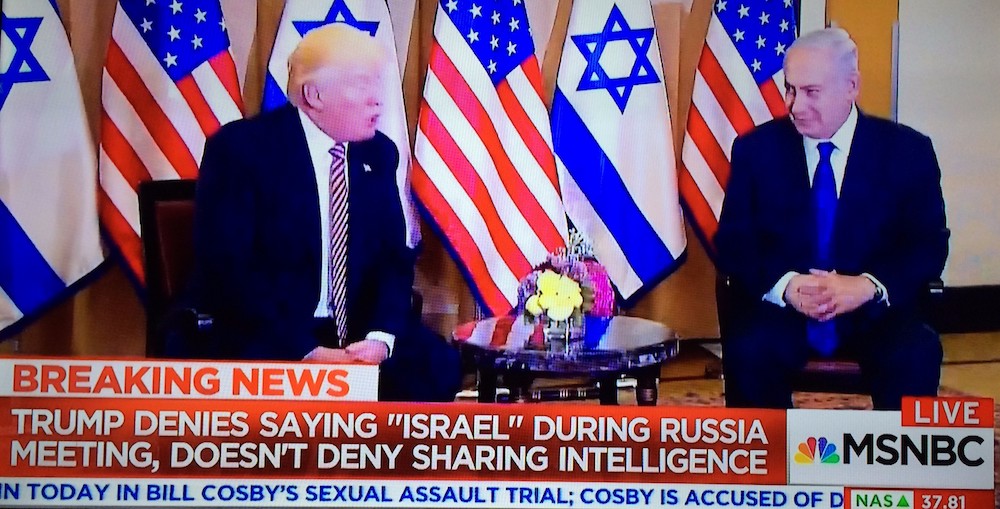
As Trump and Netanyahu wrapped up their opening statements ahead of a bilateral meeting at the King David Hotel, Bloomberg’s Margaret Talev called out a question to the two leaders asking if there was concern about the Israeli intelligence that Trump shared with the Russians in the Oval Office. Trump appeared to ignore the question and starting walking away but Netanyahu decided to answer it. “The intelligence cooperation is terrific,” he said.

At that point, Trump appeared anxious to respond and engage the cameras. “Just so you understand, I never mentioned the word or the name Israel,” Trump insisted. “Never mentioned during that conversation. They’re all saying I did, so you have another story wrong. Never mentioned the word Israel.”

Within minutes, Twitter and Cable News immediately picked up on the brief off-script moment. “His comment now brings back a story that had died down, as he protests a specific he wasn’t accused of,” Maggie Haberman, a New York Times reporter, tweeted. “Trump denies saying “Israel” during Russia meeting, doesn’t deny sharing intelligence,” the chyron on MSNBC read, playing the remarks over and over.

Screenshot from MSNBC


Screenshot from CNN


Earlier Monday, Secretary of State Rex Tillerson told reporters that the U.S. would issue no apology over Trump’s disclosure of highly classified Israeli intelligence regarding ISIS to Russia. “I don’t know that there’s anything to apologize for,” Tillerson told reporters on Air Force One en route to Tel Aviv. “To the extent the Israelis have any questions, or clarification, I’m sure we’re happy to provide that.”

In public statements during the trip, Trump reiterated his hope of brokering peace in the Middle East, emphasizing the unique opportunity that could lead to new relations between Israel and Arab states in the region.

Netanyahu changes the news narrative, perhaps intentionally Read More »

Knife-wielding Palestinian teen shot and killed in Jerusalem as Trump tours nearby

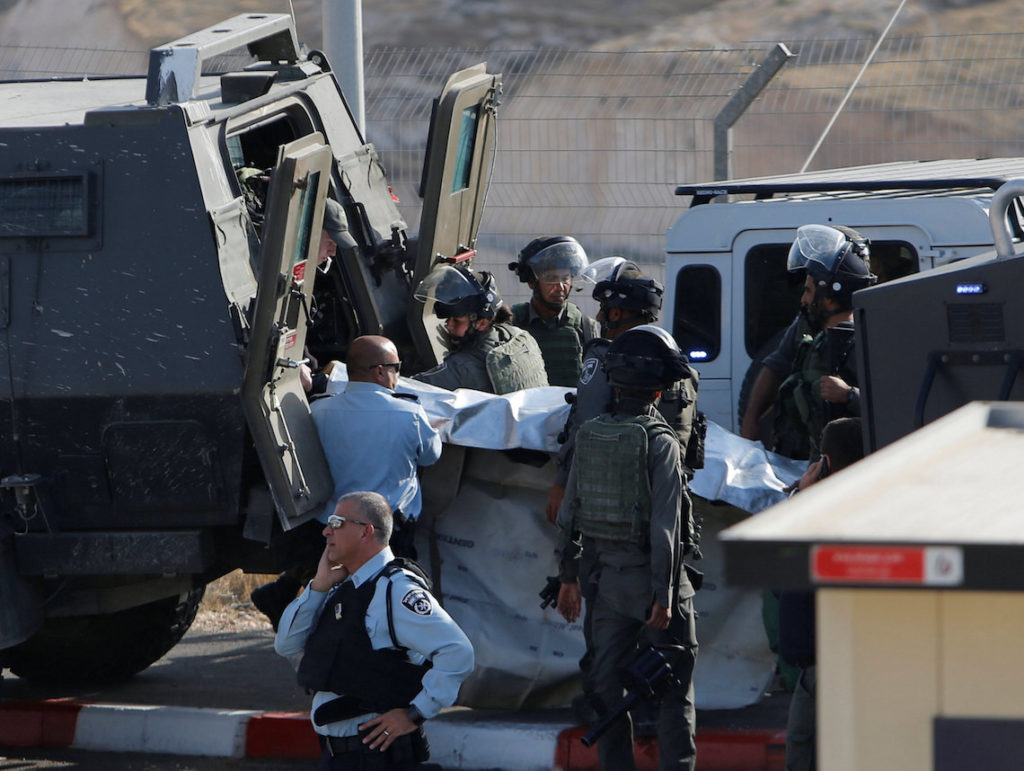
Israel Police officers shot and killed a Palestinian teenager who attempted to stab them just outside the Old City of Jerusalem as President Donald Trump was visiting holy sites in the city.

The teen, who was identified by the Palestinian Maan news agency as a 16-year-old from Bethlehem, approached the Border Police officers at a guard post in eastern Jerusalem on Monday afternoon with the knife drawn and disputed with the officers before being shot, according to the police.

No Israeli security forces were injured in the attempted attack in the town of Abu Dis.

The visit by Trump raised security in the area significantly. He is scheduled to visit Bethlehem, in the Palestinian Authority, and meet with P.A. President Mahmoud Abbas on Tuesday.

The incident also took place amid the backdrop of Palestinian protests throughout the West Bank on Monday in support of hunger-striking Palestinian prisoners seeking better prison conditions. Nearly 30 Palestinians have been injured in the protests, at least three seriously.

Knife-wielding Palestinian teen shot and killed in Jerusalem as Trump tours nearby Read More »

Trump tells Netanyahu he ‘never mentioned Israel’ in meeting with Russians

President Donald Trump told Israeli Prime Minister Benjamin Netanyahu that he “never mentioned Israel” in a meeting with Russian government officials in which he was alleged to have revealed highly classified information.

“Just so you understand, I never mentioned the word or the name Israel,” Trump said Monday at a photo op with Netanyahu at Jerusalem’s King David Hotel on the second leg of his first overseas trip as president. “Never mentioned it during the conversation, they’re all saying I did, so you had another story wrong. Never mentioned the word Israel.”

By saying “you,” the president seemed to be addressing the media, collectively.

No one had alleged that Trump mentioned Israel in the meeting two weeks ago with the Russian foreign minister and ambassador in the Oval Office.

Reports last week said that Trump revealed details of intelligence on Islamic State that could compromise an ally that had shared the intelligence with the United States. The ally was later reported to have been Israel.

There was no reporting that Trump had revealed the source of the intelligence with the Russians. Instead, the concern was that the level of detail in Trump’s account could be used to deduce sources and methods.

It was not clear from what during the photo op prompted Trump’s statement. Just before he brought up the information, Netanyahu said — apparently responding to a reporter — “The intelligence cooperation is terrific.”

There were concerns after last week’s revelations that Israel could limit its intelligence cooperation with the United States because of Trump’s alleged carelessness.

Trump tells Netanyahu he ‘never mentioned Israel’ in meeting with Russians Read More »