fbpx

May 11, 2017

homelessness

To give or not to give?

We asked experts on homelessness what to do when passing a homeless person on the street. The answers have been edited for length and clarity.


The most important thing to remember when you see a homeless person is that they, like you, are a human being.  They were given a name by their mother, they have dreams and aspirations.  As one formerly homeless woman told me, the hardest part of being homeless is the social isolation. There is nothing worse than feeling like an object thrown out into the gutter.  When you see someone who is suffering homelessness, the most important thing you can do is look them in the eye like a friend and say “Hello.”  The rest is commentary, now go and learn.

Rabbi Noah Farkas, clergy member at Valley Beth Shalom and Los Angeles Homeless Services Authority (LAHSA) commissioner

[Jewish, homeless and alone: One tale of grief on L.A.’s streets]


My best recommendation would be for someone who encounters a homeless person to try to direct them to a local shelter or service center that would provide intake and shelter and the other necessities of the person needs. Often, low-income destitute folks who panhandle would use the money they receive from friendly neighbors to attempt to purchase drugs or alcohol, and that would only prolong their problem. We basically discourage giving to panhandlers.

Rabbi Marvin Gross, former longtime CEO of Union Station Homeless Services


Because of the work I have done for 35 years and still do, I am unable to pass a single homeless person on the streets without deep feelings of anger and despair. I am angry because I know that this doesn’t have to be and that they are on the streets because we as a civil society have failed them. It’s not rocket science! So what do I do when passing a homeless person on the streets? I quite often stop to make eye contact and then give them $5 or $10, depending upon what is in my wallet at the time. Why do I do this? Do they deserve it? Will they just by drugs or alcohol? I do it because I care that they are suffering and I try to let them know by my actions that I see them and am sorry.

Tanya Tull, homelessness policy pioneer and CEO of Partnering for Change


The most important rule of thumb is that people should do what they are comfortable with, whether that is a smile, hello, water bottle, protein bar, meal or a conversation. Homelessness can feel dehumanizing, so just acknowledging a person can sometimes make a difference.

Victor Hinderliter, associate director of homeless services for LAHSA


Whether to give someone who is homeless on the street spare change or cash is a highly personal decision. There is no right or wrong answer when it comes to human compassion. The question to consider is what the purpose or motivation is for you to give money and whether doing so fulfills that motivation.

Dora Leong Gallo, CEO of A Community of Friends, a nonprofit that operates permanent supportive housing


Are you homeless or struggling? Here are some numbers to call.

Jewish Family Service Central Access (877) 275-4537

Los Angeles Homeless Services Authority (LAHSA) Emergency Response Team (213) 225-6581

LAHSA Shelter Hotline (800) 548-6047 

To give or not to give? Read More »
Toward a renewed Middle East peace process

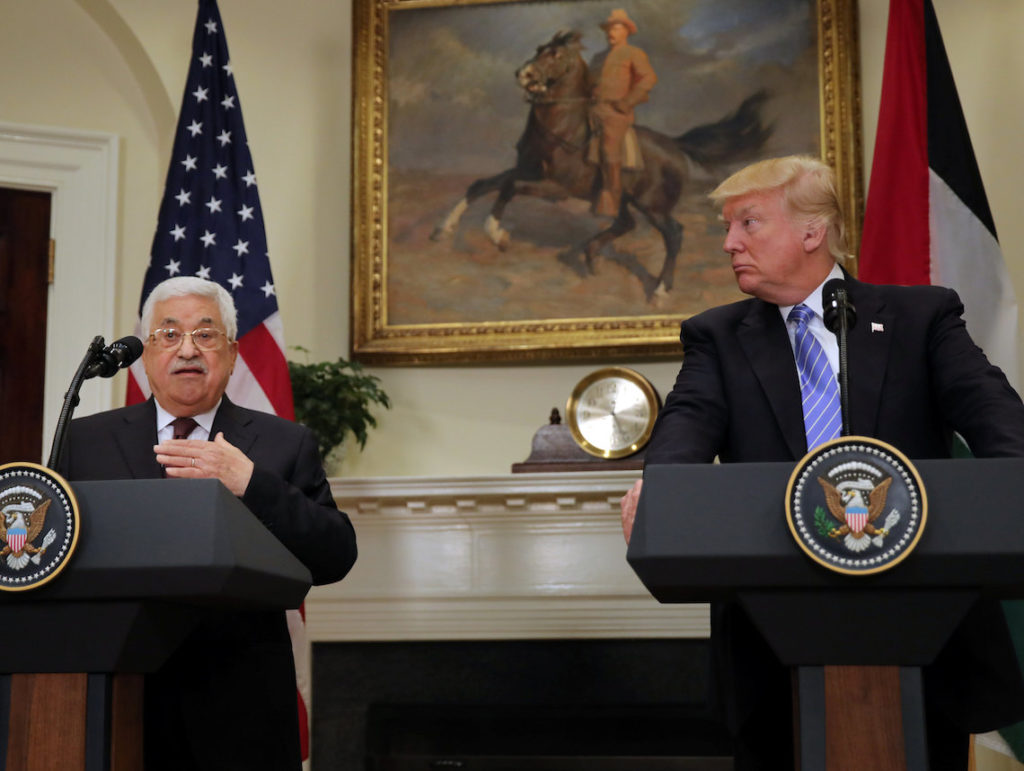
Momentum is building toward resumption of the dormant Middle East peace process. The efforts by presidential envoy Jason Greenblatt, the successful visit of Palestinian President Mahmoud Abbas to the White House last week, and President Donald Trump’s trip to Saudi Arabia, Israel and the West Bank all signal that, for now, the Trump administration is serious about promoting peace. Can it succeed where others have failed?

Optimists believe things could be different this time around. An alignment of interests between Israel and key Arab Sunni states seeking to contain Iran’s regional ambitions and to confront Islamic extremism has made these countries ready to embrace ways to put the Israeli-Palestinian conflict behind them. Pessimists warn, however, that except for the new U.S. administration, not much has changed.

The truth is probably in the middle. A changing regional setting coupled with a renewed interest in the conflict on the part of an unconventional U.S. president could open a window of opportunity. But rather than overpromising to achieve the ultimate deal, a promise that would likely backfire, the administration could take concrete steps that might pave the way toward resumption of an earnest peace process. Here are four steps that could help get there:

• The president could state a clear vision, while setting realistic benchmarks, and remain committed for the long haul. Speaking generally about “peace” and implying indifference between the two-state and one-state options may suffice for first meetings, but the Trump administration could articulate that in the absence of another feasible option, it is committed to a two-state solution that allows the peaceful existence of a Jewish democratic Israel alongside a demilitarized Palestinian state.

But promising to end the conflict in an unrealistic time frame could dim the chances for success. In this part of the world, when it’s all or nothing, it usually is nothing. It would make more sense to move forward with concrete measures and achievable goals to gradually help set the stage for a two-state solution.

In addition, Greenblatt is perceived in the region as directly executing the president’s wishes. This credibility could be crucial for regional leaders.

• Second, the administration could promote a three-pronged approach combining bilateral, multilateral and unilateral processes. Traditionally, the U.S. role in Israeli-Palestinian peace efforts focused on bringing the two sides to the negotiation table hoping that with a little help, they would reach a peace deal. Focusing solely on a bilateral approach has not worked before and it is unlikely to work now.

In parallel to resuming peace talks between Israelis and Palestinians, the U.S. could promote a multilateral approach by bringing in the Arab Sunni states to help back the Palestinians and incentivize Israel. Unilateral independent steps could include pushing Israeli and Palestinian leaders on issues that are hard for them politically at home.

Prime Minister Benjamin Netanyahu’s move to curb settlement construction in the West Bank is a welcome start, but Israel could be encouraged to do more to rein in settlement expansion.

While too sensitive to push for during a highly publicized hunger strike of Palestinian inmates in Israeli prisons, the Palestinian Authority (PA) could be prodded to stop generously paying prisoners convicted of terrorism. This could send an important signal to Israel and to the world that the Palestinians are serious about peace.

  • Third, the U.S. could continue efforts to stabilize the Gaza Strip, while at the same time seeking to help strengthen the PA. The Gaza Strip is on the verge of collapse and the winds of war are blowing again between Israel and Hamas. This administration has been following the footsteps of its predecessor in an attempt to stabilize Gaza. Building on these efforts, Trump could use his leverage to coordinate with Israel and push the Gulf States — maybe during his visit to Saudi Arabia before he heads to Israel — to follow through on their pledges to help stabilize Gaza.

Prime Minister Benjamin Netanyahu’s move to curb settlement construction in the West Bank is a welcome start, but Israel could be encouraged to do more to rein in settlement expansion.

Efforts also could focus on providing Gaza’s residents with clean drinking water, proper sanitation, a regular supply of electricity and improved freedom of movement for people and goods. It is crucial, though, that efforts in Gaza do not bolster Hamas at the expense of the PA.

Trump gave a much needed boost to the weak PA by meeting with Abbas, calling it an “honor,” tweeting about the meeting and not asking Abbas publicly to make any compromises.

• Finally, the administration could sign the waiver forestalling the relocation of the U.S. embassy to Jerusalem. Moving the embassy from Tel Aviv to Jerusalem so close to the 50th anniversary of the 1967 Six-Day War could shatter any chance of peace and risk plunging Jerusalem and the whole region into turmoil.

Such steps may not bring about the ultimate deal. Despite regional dynamics and a new energy from the White House there are still plenty of obstacles to an Israeli-Palestinian peace agreement. Without a clear, consistent plan that delivers quick, tangible results to both Israelis and Palestinians and helps restore trust between the two sides, the newly created window opportunity to addressing this conflict will close again.


Shira Efron is a policy researcher at the nonprofit, nonpartisan Rand Corp., a special adviser on Israel with Rand’s Center for Middle East Public Policy and a professor at the Pardee Rand Graduate School.

Toward a renewed Middle East peace process Read More »

Episode 37 – Nobel Prize Laureate Prof. Dan Shechtman and the discovery that changed his life

Progress entails change. However, the establishment generally rejects change. This is the challenge that pioneers face in all fields and this was the challenge that Professor Dan Shechtman faced upon his discovery of quasiperiodic crystals, or quasicrystals. Ultimately, this discovery would lead Dr. Shechtman to the Nobel Prize in Chemistry in 2011 but not before a long and often arduous journey.

Professor Dan Shechtman was kind enough to invite 2NJB to his home to talk about his life, his career and of course, the Nobel Prize.

Episode 37 – Nobel Prize Laureate Prof. Dan Shechtman and the discovery that changed his life Read More »

By firing Comey, Trump makes Israel nervous (again)

I don’t know why James Comey was fired, nor do you. I have my suspicions. I hear speculations and follow rumors. But all I know as fact is what the Trump administration says (he did a lousy job) and what Trump’s critics say (it’s all about Russia). What was the president’s real motivation? Why the decision to act now rather than, say, two weeks ago, or two weeks from now? Why choose to do it in such an abrupt manner? This is all a mystery. That is, unless you choose to believe Trump – or to attribute certainty to what is essentially speculation.

An abrupt, aggressive, misunderstood president. That’s a reason for worry, not just for Americans but also for other nations – among them one specific nation that will be hosting the president in less than two weeks. Yes, in Israel there is apprehension as the Trump visit approaches, and the more Israelis see of Trump, the more they become nervous about it. Who knows what he might do and what he has in stock for the region? Will he pull something out of his hat when he is here? Will we have to stop and wonder, as Comey had to do, if what we just heard is a prank?

Israel tended to worry about Barack Obama for somewhat similar reasons. Obama didn’t always bother to update Israel about his intentions. He occasionally chose to surprise Israel with a speech or an action. This habit made Israel less trusting, less prone to rely on American commitments, less agreeable in negotiations. Obama thought that by putting daylight between the US and Israel, and by making less of an effort to coordinate his Middle East initiatives with Israel, he would have a better chance of advancing the peace process. Obviously, he was wrong. And Donald Trump is on the path to learning a similar lesson.

Three of Trump’s qualities – all of them evident in the Comey affair – make Israeli policy makers anxious prior to his visit.

His aggressiveness – that’s his The-Apprentice-like habit of lashing out and firing people without much hesitance. Of course, the leaders in this region will not be fired by him, but they get the message: when Trump loses his patience with someone, he does not tend to be polite and tolerant.

His abruptness – that’s his tendency to surprise us with words or actions that we did not expect. Trump seems to enjoy this, and to maybe also use it as a deliberate tactic, but for an ally this is a most disturbing habit. Predictability is the key to stability in every relationship, including one between two states.

His lack of cohesiveness – that’s our inability to truly understand what Trump wants and why. Abruptness and lack of cohesiveness could seem like one quality, but they are two. The first is about timing – doing things without anyone expecting them. The second is about content – changing his mind about the issues. Trump changes his mind often. He says one thing, and then he says something else. He promises one thing, and then acts in another way. Sometimes, the change of mind is explainable. It was easy to understand why Trump was unhappy when Comey exonerated Hillary Clinton last summer in the midst of a campaign. It was even easier to understand why he was pleased with Comey when the head of the FBI served him well by reopening the investigation against Clinton just days before election day. Then again, very often his change of mind is harder to follow. Why the change of mind concerning moving the embassy to Jerusalem? Is it simply because he suddenly realized that this will complicate things for him in the region? Did he not understand this in advance? Was he just toying with his supporters as he made this promise – or did he truly believe in it until he suddenly moved in a different direction?

Israeli leaders, observers, and citizens are now processing the Trump phenomenon and learning to live with it. Some of them – like me – realize that they were fooled by a candidate whom they thought was a man of his word (I believed that the embassy will be moving). Some of them – mainly on the right – must live with disappointment. They thought that Trump would kill the two-state solution, but he seems to want to rejuvenate it. And rest assure, disappointment on the left is also coming. In the Israeli left, and among some Palestinians, there is currently hope that Trump will indeed surprise the world by becoming the peace maker no one expected him to be. It is strongly advised that they also remember that Trump can change his mind more than once. He can become a peace maker tomorrow, and a hands-off president the day after tomorrow.

It’s hard to know what he will do – because we don’t understand his motivations and policies. It’s hard to know when he will do it – because his style is one of surprises. The only thing we know is this: objecting to Trump can lead to ugly clashes. Hence, Israel will surely be the most gracious host Trump has even seen.


By firing Comey, Trump makes Israel nervous (again) Read More »