In this week’s parsha, Emor, we find out what happens when we take the Lord’s name in vain: We could be stoned to death. At least that’s what happened to “the blasphemer,” a certain fellow of the Israelite community with an Israelite mother and an Egyptian father, who was taken into custody for this crime and then executed at God’s direction to Moses.
On first reference, in Leviticus 24:11, the Torah says the problem was that he committed the blasphemy of “saying the name” (“HaShem” — literally, The Name). Then, just to make sure we are clear about what name this is referring to, in Leviticus 24:15-16 it says, “Anyone who blasphemes his God shall bear his guilt; if he also pronounces the name ‘Lord,’ he shall be put to death.” Here, the English is playing a game with us. In fact, the Hebrew doesn’t say “Lord” (Adonai); rather, it says the “Holy Name,” a word sometimes expressed using the English letters YHVH, because in Hebrew it is spelled yud hey vav hey.
You may notice that I spelled it out but didn’t attempt to suggest a pronunciation. This is a word that the Jewish world stopped saying millennia ago. It became relegated to just the priests in the Holy Temple in biblical times; when that was destroyed, all pronouncing of the “tetragrammaton” (the four-letter word) ended. We say “Adonai” when we see it in Hebrew, and “Lord” in translation. We also avoid saying “Adonai” more than we have to (once, as we read it in a prayer), moving on to further euphemisms such as HaShem or Adoshem if pressed to repeat it.
Names have a powerful control over the one we name. Some say one’s name is the sweetest sound in the world. Thus, to say God’s name is to have control over the universe. The Jewish people have long considered themselves the keepers of The Name, and also the people who are privileged to not utter it — out of respect (because we don’t know how to pronounce it correctly anymore, and we wouldn’t want to make a mistake), out of fear (remember the blasphemer!) and out of love.
Stories are told that the angels utter the Ineffable Name to zoom back up to heaven. Amulet makers in the Middle Ages would write the Holy Name on parchment to create powerful, healing magic for their customers — the founder of Chasidism was known as the “Baal Shem Tov” (master of the Holy Name) for this reason.
It is the presence of this word that makes the printed Torah on my desk a sacred book. And if the editors of this Jewish newspaper were to type these four Hebrew letters, God’s actual name, here in my column, it would turn this issue into a holy writ that could not be disposed of in the trash or allowed to lie on the floor.
Different Bibles have different approaches to printing and translating God’s name. My favorite is Everett Fox’s Schocken Bible, which uses “YHWH” in the English every time it appears in the Hebrew. How should one pronounce this when reading this book? Fox suggests that the reader replace each appearance with “The Lord.” That’s some serious mental gymnastics, and he acknowledges this: “While the visual effect of ‘YHWH’ may be jarring at first, it has the merit of approximating the situation of the Hebrew text as we now have it, and of leaving open the unsolved question of the pronunciation and meaning of God’s name.”
That is to say, God’s name, and the rules about not pronouncing it, create a conundrum that is not easily resolved. It is awkward to use a euphemistic bandage such as “Lord,” (or “HaShem,” as I prefer to avoid gender specificity), to hide the unpronounceable. It makes you “trip” and have to catch yourself, so as to remember what’s underneath. It makes you stop and look, to pause and reflect. God is so much more than we can represent in a word, spoken or written, and we never want to miss an opportunity to remember that.
A parable is told in the Jerusalem Talmud of a king who had a small key to a treasure chest. He was concerned that the key might get lost, so he attached a long chain to it. In the same way, taught Rabbi Simeon ben Lakish, quoting his teacher Rabbi Yannai, the not-pronouncing game is a gift to the Jews, a chain connecting us to the key — God’s name — that unlocks the treasure that is religious experience. Having a deliberately difficult way to call upon God helps us remember to step outside the routine of our lives when we pray, and also to stand out among the nations as a people.
It is when we remember that we are a distinct community with a distinct heritage, and a unique, personal connection to God as keepers of The Name, that we are elevated into relationship with The One.
RABBI AVIVAH W. ERLICK is a board-certified health care chaplain in private practice. She owns a referral agency for Jewish clergy (CommunityRabbis.com) and is a provider of inclusive Jewish after-death ritual (Sacred-Waters.com).
Ruth Andelson died April 6 at 97. Survived by daughter Beverly (Jonathan) Meyerson; son Michael (Rebecca); 5 grandchildren; 2 great-grandchildren; brother Daniel Kaufmann. Hillside
Edward Baizer died April 10 at 91. Survived by daughter Shelly (Michael) Kreiger; son Howard; 2 grandchildren. Hillside
Aaron Baumgarten died April 15 at 94. Survived by wife Frances; son Alan (Margaret-Anne); son-in-law Kevin Maifeld; 2 grandchildren.
Sol Bernstein died April 7 at 90. Survived by son Paul (Catherine). Mount Sinai
Lucille E. Blatt died April 3 at 98. Survived by nieces Anna Greenleaf, Allison, Jennifer, Susan, Elizabeth, Stacey; nephews Michael (Alice Fung), Gideon, David. Mount Sinai
Andrew Brent died April 6 at 42. Survived by mother Sharon; father Richard; sisters Sarah (Greg) Epstein, Kirah; grandmothers Evelyn, Adela Levine. Hillside
Paul Bronstein died April 10 at 74. Survived by wife Rosalyn; daughter Debra; son David (Flor De Liza); mother Dorothy. Mount Sinai
Karin Cohen died April 10 at 60. Survived by mother Evelyn; father Abraham; sister Amy (Chris) Hoover. Hillside
Marcia Cohen died April 6 at 78. Survived by husband Jacob; daughter Sharon; son Aaron. Mount Sinai
Debra Drust died April 5 at 61. Survived by mother Bess; brother Steven. Hillside
Sion Elghanian died April 9 at 96. Survived by wife Mahin; daughters Gilda Simkhai, Sharon Cohanim, Debbie Tabibzadeh, Jenny Darvish, Nicky Elghanian; 9 grandchildren; 10 great-grandchildren. Mount Sinai
Richard Epstein died April 10 at 71. Survived by wife Carole Frederick; daughter Lisa (David) Stark; sons Brian Frederick, Brian (Lindsay) Malloy; brother-in-law Neal Kirshner; 3 grandchildren. Hillside
Yulyan Fayuler died April 8 at 89. Survived by wife Raisa Marchenko; daughter Rimma (Edward) Shvarts; son Simon Fayuler. Mount Sinai
Eugenia Friedman died April 7 at age 91. Survived by brother Paul Wilder. Mount Sinai
Harvey Gonick died April 6 at 86. Survived by wife Gloria; daughters Teri (Yo) Hakomori, Suzanne (John) Segal, Julie (Martin) Horenstein; son Stefan (Laura); 7 grandchildren; sister Gail Stein. Hillside
Jill Kaufman Granick died April 7 at age 77. Survived by husband Richard; daughter Lori (Mark) Howell; sons Rob (Debbie), Steve (Anne); 8 grandchildren; brother Richard (Lois) Kaufman. Mount Sinai
Paul J. Green died April 7 at 91. Survived by daughter Beverly (Jeff) Freilich; son Steven (Susan); 4 grandchildren; sister Frances Katz; brothers Jack (Gilda) Green, Arthur (Sally) Green. Mount Sinai
Arthur Greenberg died April 5 at 93. Survived by daughter-in-law Francisca; 2 grandchildren. Hillside
Beverly Rifkin Gruber died April 9 at 71. Survived by daughters Jennifer (Rami) Kviatkovsky, Judi; stepson Mark; 4 grandchildren. Groman Eden
Herbert Hain died April 4 at 95. Survived by wife Eva; daughter Stephanie (Nathan) Fabian; sons Jeffrey (Randy), L. Craig, Michael (Amber), Phillip (Susan); 11 grandchildren; 2 great-grandchildren. Hillside
Ann J. Katz died April 10 at 83. Survived by sons Brian (Mary), Mark; 5 grandchildren; 4 great-grandchildren; sister Midge Evans. Mount Sinai
Helen Kaye died April 6 at 95. Survived by daughter Debbie (Howie); sons Irv, Marc; 3 grandchildren. Beth Olam
Marilyne Keith died March 28 at 85. Survived by husband Arthur; daughters Cindy Aronberg, Linda Greller; son Michael Lushing; stepdaughter Marybeth (Walt) Chenoweth; stepson Douglas (Joyce); 8 grandchildren; 6 great-grandchildren. Mount Sinai
Charlotte Kuzins died April 10 at 92. Survived by daughter Rebecca; son Matthew (Nanci); 1 grandchild; sister Rose Solomon. Mount Sinai
Ann Lipeles died April 7 at 95. Survived by daughter Laurie Sela; sons Robert (Ila Patterson), David (Yega), Gerald; 5 grandchildren; 2 great-grandchildren. Hillside
Joseph Rascoff died April 6 at 71. Survived by wife Jane; daughter Brooke; sons Spencer (Nanci), Jake; 3 grandchildren. Hillside
Ida Russ died April 8 at age 94. Survived by daughter Gina (Irving) Posalsky; sons Larry (Sunny), Isi (Liz); 3 grandchildren. Mount Sinai
Nellie Shanks died April 9 at 99. Survived by daughter Louise Russell; 3 grandchildren. Hillside
Mary Sherman died April 7 at 97. Survived by daughter Sharon (Stuart) Cogan; daughter-in-law Sandy Schwartz. Mount Sinai
Cecile Silver died April 5 at 92. Survived by daughters Kate (Peter) Rabinov, Nancy, Elizabeth, Sara White; 5 grandchildren. Mount Sinai
Michele Gail Steele died March 18 at 70. Survived by husband William; daughter Carly (Adam) Segers; son Cory; stepdaughters, Wendy (Tracy) Cadweil, Tanya (John Gray); 4 grandchildren; mother Rose Zussin. Mount Sinai
I barely noticed the woman who was sleeping on a sidewalk the other morning on Pico Boulevard. I was rushing to meet a friend for coffee, and the last thing on my mind was to delay my first caffeine intake of the day. But maybe because she was lying there so conspicuously under the bright morning sun, I couldn’t help mentioning her to my friend.
“I just saw a homeless woman sleeping,” I told him. “She was probably an adorable little girl one day, with pigtails.”
About an hour later, on the way back to my car, I saw her again, but this time she was sitting up. I hesitated, wondering whether I should talk to her. My mind was telling me to just get in the car and get on with my day, but my heart was urging me to find out who she was.
It’s true that because I write a weekly column, I’m always looking for good stories. But that awareness didn’t lessen my uneasiness. There are enough interesting stories in our community without having to feel the acute awkwardness of speaking to a homeless person.
As a kind of compromise, I walked over and handed her some money. That was easy. Giving money to a homeless person is a perfectly acceptable interaction. No need to engage any further.
But after handing her the money, I caught a glimpse of her eyes as she said, “Oh, thank you!” I guess my heart must have overpowered my mind, because at that moment I pushed myself to engage. As we began talking, I asked if I could film our conversation, and she agreed. So I pulled out my iPhone and recorded my sidewalk chat with a homeless woman named Natalie Levine.
Later, as I viewed the eight-minute clip, I was in awe at how much the film conveyed: her facial expressions, her voice, her cadence, her anxiety, her mannerisms, her eyes, even the street life as people walked by.
I hadn’t taken any notes. I didn’t have to. The human drama was all in the film, as raw as can be. There would be no need to write up a story.
As much as I love telling stories through words, it struck me that people should see and hear this woman, not just read about her. With subjects that are deeply uncomfortable, words on a page can create a safe distance.
There is no safe distance when you look into a homeless person’s eyes and feel their presence. What I felt when I looked into Natalie’s eyes was her humanity, pure and simple. Yes, there was a story behind those eyes, and I got a few glimpses — a Jewish woman in her early 30s who attended a Hebrew day school in Connecticut, lost her parents at a young age, has been homeless for years and looked like she caught all of life’s bad breaks.
Just as important, that story came with a real name: Natalie Levine. There is a special intimacy to a name, especially one that sounds so familiar. After we posted the clip on social media, people kept referring to her name. They wanted to help Natalie Levine. A few people even got on my case: Telling Natalie’s story is not enough, they said. You must do something.
So I did.
I went back to Pico the next day to track her down. Then, with the assistance of friends and volunteers who had reached out to me, I spent a week helping out any way I could. We put Natalie up in a motel to buy us time to find a longer-term solution. We gave her food for Shabbat, helped her clean up and got her new clothes. My daughter and I even took her to a park with our dog, Hank.
As I contacted shelters and experts around town, I got a taste of the complexity of the homeless problem. It’s not as simple as helping people who want to be helped. It’s compounded by issues such as mental health and personal traumas.
After we checked her out of the motel, we spent a long day looking for a shelter, with no luck. By midnight, we had found partners who placed her in a temporary facility an hour from Los Angeles, where we went to visit her during the week.
We caught a major break when I bumped into longtime local public servant Zev Yaroslavsky at an Israel event. After I told him Natalie’s story, he knew what was needed. He has spent years working on this problem. He connected me the following day to an ideal facility, and they took her case.
Natalie is certainly not out of the woods, but at least for now, she’s off the streets and under a caring umbrella. She has hope.
I’m no expert on homelessness. I don’t pretend to have a solution to this dark, complex blight on modern life.But after spending a week with Natalie Levine, I’ve learned at least one thing: When you look into a homeless person’s eyes, it becomes easier to help.
David Suissa is president of TRIBE Media Corp./Jewish Journal and can be reached at davids@jewishjournal.com.
Lag B’Omer is a minor holiday that falls on the 18th of Iyar, the 33rd day of the Omer. Tradition teaches that for 49 days between the second night of Passover and Shavuot, we are to count the Omer — a measure or sheaf of barley; in ancient times, offerings were made at the Temple in Jerusalem. The “Lag” in the name of the holiday comes from the Hebrew letters lamed and gimmel, whose numerical value is 33.
While the historical inspiration for the holiday is unclear, some say it marks the end of an ancient plague afflicting thousands of students of Rabbi Akiva in the first century C.E. because they did not treat one another with respect. To celebrate the plague’s end, this day is the only one of the 49 when weddings, haircuts and playing musical instruments are permitted.
Another explanation is that it marks the anniversary of the death of one of Rabbi Akiva’s students, Rabbi Simeon bar Yochai, who defied Roman rulers and, legend has it, fled to a cave to survive. Some say that the rabbi wrote the Zohar, the foundation of the kabbalah.
TRADITIONS
On Lag B’Omer, we light bonfires to signify the burning light of the Torah and as a symbol of Rabbi Simeon bar Yochai and the Zohar, which translates to “radiance.” Some Jews travel to the northern Israeli village of Meron, where the rabbi is buried, to sing and dance all day long. Children play with bows and arrows, some say to symbolize teaching that there were no rainbows in the sky during the sage’s life.
SPECIAL FOOD
Jews eat carobs on Lag B’Omer since Rabbi Simeon bar Yochai survived on them while he lived in the cave in exile. They also eat barbecued foods and meats around the bonfire.
SKIRBALL AFTER HOURS — “PAUL SIMON: WORDS & MUSIC”
Partake in this rare opportunity to see the exhibition “Paul Simon: Words & Music” at night. Celebrate the enduring legacy of the iconic singer-songwriter with a tour of the exhibition led by museum director Robert Kirschner, a full cash bar and local food trucks. 6 p.m. Free. Skirball Cultural Center, 2701 N. Sepulveda Blvd., Los Angeles. (310) 440-4500. skirball.org.
FRIDAY NIGHT SERVICE WITH COL. KOBI MAROM
Retired Israel Defense Forces officer Col. Kobi Marom will talk about “ISIS and the War Against the West: How to Counter What May Be the Greatest Terrorist Threat in Modern History.” 7:30 p.m. Free. Temple Etz Chaim, 1080 E. Janss Road, Thousand Oaks. (626) 773-0251. templeetzchaim.org.
SAT | MAY 13
AUTHOR ARIEL LEVY
Ariel Levy
Ariel Levy’s memoir, “The Rules Do Not Apply,” is about a woman overcoming loss and seeking reinvention. Levy leads the reader through the story of how she built her unconventional life, resistant of traditional rules, and then watched it fall apart. 4 p.m. Free. Book Soup, 8818 Sunset Blvd., West Hollywood. (310) 659-3110. booksoup.com. Levy also will lead a program at 2 p.m. Sunday, May 14, at the Skirball Cultural Center, 2701 N. Sepulveda Blvd., Los Angeles. Reservations recommended for the Skirball event. (310) 440-4500. skirball.org.
SUN | MAY 14
THE GREAT LAG B’OMER PARADE
The origins of Lag B’Omer, a minor holiday between the period of Passover and Shavuot, is the subject of many theories. No matter why it began, celebrate the day with a concert, parade and fair. There will be rides, carnival games, live music, kosher food and more. Special guests: Uncle Moishy and Eli Marcus. 10 a.m. Free. Pico Boulevard between Doheny Drive and Robertson Boulevard.(800) 242-2239. lagbomerla.blogspot.com.
WORLD’S LARGEST MOTHER’S DAY CELEBRATION
The Los Angeles Jewish Home will host the 23rd annual World’s Largest Mother’s Day Celebration, honoring the home’s mothers, grandmothers, great-grandmothers and great-great-grandmothers on the Grancell Village and Eisenberg Village campuses. Enjoy a brunch while listening — and dancing — to the Skye Michaels Orchestra. 10:30 a.m. $25 (ages 12 and older); $12 (ages 5-11). Free for Jewish Home residents and children younger than 5. The Los Angeles Jewish Home Grancell Village campus, 7150 Tampa Ave., Reseda; Eisenberg Village campus, 18855 Victory Blvd., Reseda. (818) 774-3324. denise.horowitz@jhla.org.
TUES | MAY 16
THE GUARDIANS SPRING KICKOFF PARTY
Dust off your cocktail attire and help raise money for a great cause while enjoying great company, drinks and live music. All proceeds benefit The Guardians of the Los Angeles Jewish Home. Space is limited; priority will be given at the door to members and pre-sale ticket holders. 7 p.m. $18; $30 for two; $20 per person at the door; free for members. Tickets available at eventbrite.com. The Peppermint Club, 8713 Beverly Blvd., West Hollywood. (310) 479-2468. laguardians.org/events.
WED | MAY 17
“FIFTY YEARS OF UNITED JERUSALEM?!”
Hosted by the Rosenberg Cultural Center and Rabbi Steven Silver, come explore Jerusalem. At the half-century mark of the reunited Jerusalem, what are the prospects for peace and reconciliation? What will the next 50 years bring? After lunch, enjoy a screening of “Jerusalem,” an immersive experience that will take you on a journey through the beautiful and beloved city. 11 a.m. $14; $12 for members. Temple Menorah, 1101 Camino Real, Redondo Beach. (310) 316-8444. templemenorah.org.
THURS | MAY 18
STEVE SOBOROFF
Steve Soboroff, the vice president of the Los Angeles Board of Police Commissioners, will discuss “Policing, Philanthropy, Prisons and Politics” at the Executive Speaker Series breakfast. Soboroff has a lot of experience in public policy and has much to share about his many endeavors. 7:30 a.m. $25 for members, $30 at the door; $35 for nonmembers, $40 at the door. El Caballero Country Club, 18300 Tarzana Drive, Tarzana. (818) 774-3332. theexecutives.org.
“EXAGOGE”
The Silverlake Independent Jewish Community Center (SIJCC) presents Theatre Dybbuk’s reading of “Exagoge,” which is inspired by the first recorded Jewish play that was written in the style of a Greek tragedy by Ezekiel the Poet in the second century B.C.E. Only 269 lines of the original play exist; these lines were used to create this full-length theatrical production. Rich in movement, music and poetry, “Exagoge” relates the experiences of refugees, immigrants and the disenfranchised from the 19th century to today, highlighting the inclusive nature of the Exodus narrative. All proceeds will be donated to the ACLU of Southern California. 7:30 p.m. reception; 8:30 p.m. show. $20. The Box, SIJCC, 1110 Bates Ave., Los Angeles. sijcc.net.
So sorry Ed Asner and the Jewish Film Festival became mired in the lack of civility regarding our viewpoints on the Jewish state (“Defending Ed Asner, and Israel,” May 5). Yes, Ed Asner has been a true activist for many causes all his life. Kudos to him. On the other hand, his relationship with Jewish Voice for Peace (JVP) is a far cry from Main Street’s viewpoints. This group is at war with Israel and should be treated as pariahs.
Dick Bernstein, Los Angeles
I am reading many comments and discussions about your choice to honor Ed Asner, an outstanding actor, and your defense of your decision. I must ask the following questions:
If Mr. Asner was actively, vehemently opposed to gay rights or other popular social justice causes, would you have chosen him to be honored for his skill as an actor?
As a member of JVP, an organization that actively supports boycotts of Israeli Jewish actors and artists, Asner, by association, believes in boycotting his fellow Jews. Isn’t it hypocritical for a Jewish organization to honor a Jew who supports the boycotting of Jewish Israeli actors and artists?
He may be a great actor but not such a great Jew for a Jewish organization to honor, no matter his accomplishments.
Luci Varon, Seattle
Trump and Middle East Peace
President Donald Trump needs to reflect on the fact that Israel has offered to give up a tangible land for an intangible peace, but her offers have been rejected every time (“Trump’s Jewish Fans Should Be Nervous,” May 5). Considering that the Palestinian Authority views the State of Israel as having no rightful place on Earth, it should be obvious that no agreement leading to peace can be brokered for the foreseeable future.
Julia Lutch, Davis, Calif.
What the Democratic Party Represents
Mike Hais — enough of disguised Democratic Party propaganda! (“Has Trump Split the Jewish Community? Hardly,” April 28.) The Democratic Party is not democratic, nor liberal, nor for the working man — no matter how many times you capitalize and imply that it is the “good old party.” It is leftist locally and nationally. Look at Sen. Bernie Sanders’ (I-Vt.) machinations recently, the Hillary Clinton emails and the Antonio Villaraigosa audio count of the party platform several years ago.
It is amazing to note that in the same Journal issue, Edmon Rodman correctly pointed out that Democratic President Harry Truman prohibited sending arms and material to the nascent State of Israel in its War of Independence (“With Israel’s Survival Up in the Air, Pilot Sam Lewis Went Above and Beyond”). It was again Democratic President Franklin Roosevelt who refused to take in Jewish refugees fleeing Hitler. However, it was Republican President Richard Nixon who heeded the pleas of Golda Meir in the Yom Kippur War.
A history question for Mr. Hais: Who was the lone political warrior who voted against Franklin Roosevelt’s internment order of Japanese Americans in World War II? Republican Sen. Robert A. Taft!
Rick Gascon via email
Turks and Armenians
Dennis Prager claims that because “Palestinian society is first and foremost a Muslim society … it honors suicide terrorists as the finest examples of the Palestinian people” (“Who Killed the Armenians?” May 5). He fails to mention, however, some early radical advocates of Palestinian terrorism against Israel, such as George Habash, who headed the Popular Front for the Liberation of Palestine, and Nayef Hawatmeh, who led the Democratic Front for the Liberation of Palestine, were Christian.
Barry H. Steiner, Professor of Political Science, CSU Long Beach
I think historians will differ with Dennis Prager given the series of wars between Russia and Turkey and Armenians siding with the Russians (according to the Turks). On my return from a trip to Turkey, an uncle of Greek descent reminded me that the Turks “did terrible things to the Greeks.” In that situation, the Turks would argue that the Greeks (particularly in Smyrna) were siding with the English. In wars, terrible atrocities are committed. This does not excuse the Turks nor does it excuse Prager’s simplistic explanation of past atrocities.
Theresa H. McGowan, Santa Monica
CORRECTIONS
In a story about a benefit walk for Jewish World Watch (“Community Puts Best Foot Forward at JWW’s Walk to End Genocide,” May 5), the date of the Rwandan genocide was misreported. It was 1994.
In a caption under a photograph accompanying a Moving & Shaking item about a “biblical trial” at American Jewish Univesity (April 28), Paul Goldstein, general manager of Hillside Memorial Park and Mortuary, was misidentified.
When biblical passages emerge in Hollywood products, they don’t usually provide a star turn for religion. More often than not, believers are portrayed as weird, kooky cultish types or dangerous fanatics. This trend cuts across religions: In Darren Aronofsky’s “Noah,” the man who weathered God’s flood was a lunatic who nearly killed members of his own family. In the Showtime series “Homeland,” Islam and the Quran are promotional vehicles for terrorism. And let’s not forget Mel Gibson’s “The Passion of the Christ,” one of the most brutally literal and political depictions of a biblical event in Hollywood history, portraying Jews as a bloodthirsty mob.
When Hollywood takes on religion, religion doesn’t usually look good.
“The Handmaid’s Tale,” the Margaret Atwood best-seller turned television series on Hulu, is no exception. The dystopian tale posits a future when United States democracy has capitulated to an authoritarian regime rooted in religious fanaticism. When the effects of environmental degradation cause a scourge of infertility, reproductively healthy women are enslaved as childbearing surrogates. In a form of state-sanctioned rape, women are nothing more than ovaries with legs whose sole purpose is to serve the “commanders” and their barren wives.
Where on earth did Atwood find precedent, let alone justification, for this mass oppression and rape? I hate to be the bearer of bad news: The Hebrew bible.
The passage cited in the book and the show is from Genesis, in which Jewish matriarch Rachel is suffering from barrenness and tells her husband, Jacob: “Behold my maid Bilhah, go in unto her; and she shall bear upon my knees, that I may also have children by her.”
Torah readers know that this instance of offering up a maidservant as fertility surrogate is not the only one: Rachel’s sister Leah gives Jacob her handmaid, Zilpah, who births Gad and Asher, whom Leah claims as her own. Earlier, when an aging Sarah cannot conceive, she offers Hagar to Abraham, and she births Ishmael.
Atwood’s appropriation of this ancient, uh, practice of state-sanctioned rape is disturbing for many reasons, not least for forcing a confrontation with what Bible scholar Avivah Zornberg calls “the unconscious” parts of our text. Neither in the case of Rachel nor Sarah does the Torah refer to this practice as “rape,” even as it openly acknowledges rape elsewhere, as in the rape of Dinah, the prevailing story of rape in the Bible but not the only one.
In “The Torah: A Women’s Commentary,” edited by Hebrew Union College-Jewish Institute of Religion (HUC-JIR) scholar Tamara Cohn Eskenazi and Rabbi Andrea Weiss, Rachel’s act is given spiritual embellishment through metaphor and symbolism. To move from barrenness to fertility, she must bridge an equivalent gap between herself and God; by “employing” Bilhah as her surrogate, she engages in “imitative magic,” acting like the deity herself, claiming the body of another in the hope God will fertilize her, too.
It’s a lovely flourish of literature, but of course the reality is cruel.
“It’s a moral gray area, which many, many biblical texts are,” Rabbi Rachel Adler told me.
Adler is the David Ellenson Professor of Jewish Religious Thought at the HUC-JIR campus in Los Angeles and a renowned feminist theologian. She warned against biblical literalism.
“When I read the beginning of Genesis, I don’t protest a snake speaking Hebrew, a world created in six days or two archetypal humans in a garden,” she said. “The Torah is not a science book.”
As a Reform Jew, she favors a more historical, interpretive view.
“These are texts that come out of a society very different from our own,” she said, noting that slavery was common practice in the ancient world. “In our [society], slavery is an abomination. And using a woman to beget heirs outside of the marital relationship, and without the consent of the woman whose body is being used, is morally repulsive to us. The fact that people do certain things in biblical texts does not mean that we should do them, too.”
No wonder Hollywood is having so much fun with this. Bad religion makes for great storytelling. But is Atwood’s mirroring this practice an indictment of the Bible — or us?
“Atwood is pointing out ways that people who take a rigid, fundamentalist view of the Bible in our society can combine that with a kind of authoritarianism and fascism that reduces people, especially women, to a slave-like status, and justifies it in crude religious terms,” Adler said.
“If you want a symbol of subjugation,” she added wryly, “a woman is about the oldest, most ancient one you can find.”
But what about our vaunted Jewish matriarchs — Sarah, Rachel and Leah — who participated in this caste system of culturally sanctioned oppression?
“They’re part of a system,” Adler said. “And unless a woman understands that there’s a system, she’s an unconscious part of a system. In a system, everybody takes their place; unless they are conscious that it is a system and they seize the opportunity to resist.”
The same could be said of how we read the Bible, the Quran, even the U.S. Constitution: It’s on us to become more conscious of the texts we read and believe — and whether it’s bad policy or bad ritual, to resist.
Danielle Berrin is a senior writer and columnist at the Jewish Journal.
Until this year, Rod Rosenstein was an unassuming U.S. attorney with a reputation for fairness.
Now he’s at the center of the controversy over President Donald Trump’s snap firing of James Comey, the FBI director.
Rosenstein, 52, whose appointment by Trump as deputy attorney general was confirmed only two weeks ago, wrote the memo outlining concerns with Comey’s performance, mostly related to his handling of the Hillary Clinton email investigation. Based on the memo, said the White House, Trump decided to fire Comey, delivering the surprise decision last night.
The move puts Rosenstein in a difficult position: He is the Justice Department official overseeing the FBI investigation of Russian involvement in Trump’s presidential campaign that Comey was leading. Pundits are questioning the timing of the memo, as well as asking whether it was drafted to provide cover to what was a foregone conclusion to oust Comey.
So who is Rosenstein? Here’s where he came from, his Jewish ties and what people are saying about him now.
Rosenstein was respected as a skilled, by-the-book government lawyer.
Before ascending to the deputy attorney general post, Rosenstein spent more than a decade serving as a U.S. attorney in Maryland. He is politically conservative and was appointed by President George W. Bush. But when Barack Obama took office, Rosenstein was one of only three U.S. attorneys among 93 to be kept on the job by the new president.
As U.S. attorney, Rosenstein led successful prosecutions for leaks of classified information, corruption, murders and burglaries. He was particularly effective taking on corruption within police departments, according to an essay in Vox by Thiru Vignarajah, a former colleague.
Vignarajah wrote that Rosenstein “made real strides.”
“Over his first decade as the lead federal prosecutor in Maryland, murders statewide were cut by a third, double the decline at the national level. Other violent offenses like robberies and aggravated assaults also fell faster than the national average,” he wrote.
A sign in Rosenstein’s former office read, “Don’t tell me what I want to hear. Just tell me what I NEED TO KNOW.”
The Senate voted 94-6 to confirm Rosenstein to his new post.
He played a key role investigating Bill and Hillary Clinton.
Comey was allegedly fired for mishandling his investigation of Hillary Clinton. If that’s true, he may have learned from Rosenstein, who was praised for his own Clinton probe two decades ago.
In 1995, Rosenstein joined the team of lawyers investigating the Whitewater scandal, which involved allegations of illegal real estate dealings by the Clintons. The allegations against the Clintons were ultimately unproven, but they led to the exposure of the Monica Lewinsky scandal and President Clinton’s subsequent impeachment.
Rosenstein headed one of the few successful Whitewater prosecutions, which led to the conviction of former Arkansas Gov. Jim Guy Tucker and Clinton associates James and Susan McDougal. He questioned Hillary Clinton at the White House in 1998 as part of a separate case, according to the Baltimore Sun, but she was never implicated.
He graduated from Penn and Harvard — and he’s a family man.
Rosenstein grew up in the upscale Philadelphia suburb of Huntingdon Valley. He’s a 1982 graduate of the public high school and earned a merit scholarship to the University of Pennsylvania’s prestigious Wharton School of Business — also Trump’s alma mater. He later attended Harvard Law School, joining the conservative Federalist Society, which gave him a Distinguished Alumni Award in 2006.
Rosenstein is married to Lisa Barsoomian, who also served as a U.S. attorney. The couple have two daughters, 17 and 15, and live in the Washington, D.C., suburb of Bethesda, Maryland. While Rosenstein works late nights, the Sun reported that he would often go bicycling with the family on Sundays.
He used to play sports at the local JCC.
Not much surfaces about Rosenstein’s Jewish involvement online, but he has been affiliated with Jewish institutions in the past. He was a member of Bethesda’s Reform Temple Sinai from 2008 to 2014, and of the U.S. Holocaust Memorial Museum from 2001 to 2011.
According to a questionnaire he filled out ahead of his Senate Judiciary Committee hearing this year, Rosenstein also was a member of a “Jewish Community Center Sports League” from 1993 to 2012.
Which JCC? Which sport? An ongoing JTA investigation has yet to uncover the answer.
He wrote a damning letter against Comey — but never explicitly recommended firing him.
Rosenstein didn’t hold back in a 1,000-word letter delineating Comey’s missteps. He lambasted Comey both for his July statement that Hillary Clinton would not face indictment and for Comey’s Oct. 28 letter announcing the reopening of the Clinton investigation.
“I cannot defend the Director’s handling of the conclusion of the investigation of Secretary Clinton’s emails, and I do not understand his refusal to accept the nearly universal judgment that he was mistaken,” Rosenstein wrote. “Almost everyone agrees that the Director made serious mistakes.”
But the evisceration stops just short of calling for Comey to be canned. Rosenstein does write that “the FBI is unlikely to regain public and congressional trust until it has a Director who understands the gravity of the mistakes and pledges never to repeat them. Having refused to admit his errors, the Director cannot be expected to implement the necessary corrective actions.”
But just before that, he cautioned, “Although the President has the power to remove an FBI director, the decision should not be taken lightly.” The memorandum is dated Tuesday, May 9.
Trump read Rosenstein’s letter and made the decision.
For Joe Wedner, theology is well-worn territory. God and His workings are among the trains of thought that keep Joe’s mind chugging, often in a broad and frenzied circle. At the center of that theology is a paradox that causes Joe a fair amount of strife.
Joe is 77, stooped and bearded. He’s a Jew by birth, but in practice, at least since 2013, he honors every faith — Christianity, Islam, Judaism, Buddhism, etc. — without discrimination or distinction. His face betrays the weatherworn quality of someone who has spent years living on the streets, and he carries an air of all-consuming tragedy.
“I cry a lot — so I’m sorry — but I’ve never been locked up for crying,” he told me the first time we sat down together, in January 2016 at Native Foods Café, a vegan restaurant in Westwood.
He sat in front of a heaping pile of beans, grains and vegetables, his pushcart parked next to our table. Overflowing with pieces of cardboard and extra jackets, the cart held the sum of his worldly possessions.
Vegan cuisine was Joe’s idea. He avoids processed foods and animal products, not for ethical or health reasons, but religious ones. When a waiter stopped by our table, Joe pointed to his food and asked, “Is this the most natural, unchanged-from-God whole food that we got?”
God pervades Joe’s existence.
“There is no place that God is not,” he told me. “God is everyplace. God is in every belief. God is in every emotion.”
His relationship with the Almighty is perhaps Joe’s one remaining comfort in this world, although even that relationship is not without strain. According to Joe, two activities offer him any sort of solace from the unrelenting fear and anxiety that rule his day-to-day existence: religion and sex. Since Joe is homeless and elderly, it’s not easy for him to find sexual partners, so religion is all that remains in any practical sense. Every week, when he has the time, he attends as many religious and spiritual services as he can.
But his God, he insists, is not a particularly benevolent one. The paradox at the heart of Joe’s theology is that although God is everywhere, He is a maniac.
“God can do the impossible,” he explained to me. “He can give absolute, total freedom and still prevent man from sinning and leaving Him, and therefore He can prevent suffering. Why doesn’t He prevent suffering? Because He’s mentally ill. He’s seriously mentally ill, and we are His image and likeness, and we are mentally ill.”
When it comes to his own mental illness, Joe makes no secret. In his second email to me, shortly after we first met, he wrote, “I thought you might be interested in the attached information.” It was a psychiatric report diagnosing him with bipolar disorder, for which he refuses medication. He also admits to being delusional and cripplingly paranoid.
For Joe, delusion bleeds freely into reality and vice versa. Consider his present life plan: Joe is taking UCLA Extension courses on the entertainment industry, hoping to land a high-paying job and strike it rich. The basis for his plan is his conviction that education is the key to income. Although that makes enough sense, his plan to strike it rich stretches credulity.
Yet Joe sticks to his plan doggedly, even if it means forgoing a roof over his head.
Joe has been homeless for four years, a condition that puts him in the category of “chronically homeless” — those homeless for a year or more due to debility. He is less an anomaly than a poster boy for the definition: By the latest count, 61 percent of the roughly 13,000 people who are chronically homeless in Los Angeles County are mentally ill, about 8,000 people total, according to the Los Angeles Homeless Services Authority.
If there is an anomaly to Joe, it’s his religious background.
In 2014, the Pew Research Center ranked Jews as the most financially successful religious group in America. Only 16 percent claimed a family income of less than $30,000 a year.
Tanya Tull, a homelessness policy pioneer and CEO of Partnering for Change, said in addition to Jews living on the street, many others eke out an existence in deplorable conditions in cramped apartments in poor neighborhoods like MacArthur Park and Mid-City. She cited as one example a 71-year-old retired Jewish man who spends more than 80 percent of his Social Security payments on rent in a studio apartment in Pico Union, where he experiences regular power outages and struggles to treat a chronic pulmonary condition.
Some local impoverished Jews are clients of The Jewish Federation of Greater Los Angeles and its partner organizations. Federation estimates that together, the groups help about 20,000 Jews living in poverty, providing them with free kosher meals and grant assistance for housing, paired with case management.
But that number reflects only those whom they help.
“There are more people out there — Joe is a perfect example — who are not accessing these services,” Lori Klein, Federation’s senior vice president for its Caring for Jews in Need program, told the Journal.
Federation estimated that 50,000 Jews lived in poverty in Los Angeles in 2014, the latest year for which data are available. More than 600,000 Jews live in the Greater Los Angeles area.
Klein suggested that Joe call a central access hotline of Jewish Family Service of Los Angeles, which directs people experiencing financial instability to appropriate resources.
Joe said he called in April, but found that the services it offered were more or less the same as those he already was getting from a Kaiser Permanente social worker. As for housing, Joe, it turns out, has other priorities.
I first met Joe when I showed up for an assignment at jumu’ah, the Muslim prayer service offered Friday evenings at UCLA. I was early and found Joe sitting on a metal folding chair in the hallway outside the prayer room with the demeanor of someone who didn’t have anywhere else to be.
After services, I took down his email address. Joe checks his email frequently — somewhere among the loose cardboard and plastic bags in his cart was a laptop that he’d had since 2013. (It’s since been stolen; he now returns emails via public computers at UCLA.)
It turns out that Joe has little to hide and, by his estimation, much to gain from an interview.
“The more you tell the better,” he told me at Native Foods. “My psychiatrist does not disagree that my whole problem is a girlfriend deficiency, and I’m trying to get that out there.”
It was only much later in the interview that I learned he has a wife and daughter — but that hasn’t interrupted his other plans. Joe is interested in obeying all of God’s commandments, including to “be fruitful and multiply.”
“I need a lot of girlfriends,” he said, without a hint of irony or jest. “So I want to put that out there, just in case there might be somebody like me, that also wants a lot of children, a female. Because … I’m a panhandler, and a panhandler knows if you say the same thing to enough people, no matter what it is you’re saying, if you say it to enough people, you find a few, one or a few, that’ll agree with you.”
With Joe, it’s sometimes hard to distinguish between delusion and what could be described merely as misplaced priorities. His desire to have children is motivated not just by the joy of sex but also by the conviction that children represent “eternal life and salvation from death.” But whether Joe should father a child at 77, with no means to support one, is a consideration he ignores. He remains enthusiastic in pursuing his goal.
In the middle of the conversation, a young woman approached our table to express interest in the interview. Joe’s demeanor changed instantly. His eyes lit up, and he began talking more quickly, almost frantically. It occurred to me that he was putting on a show.
“You could sit down,” he told the young woman. “You could sit down and listen to me. If you’ve gotta go — want my email address? I’m an extremely interesting person. You’ll never find anybody running around loose more mentally ill than me.”
Joseph Leo Wedner was born on Feb. 2, 1940, in Detroit.
His father was born to an Orthodox family near Sanok, Poland. His mother, an American, was what Joe called a “three-day Jew,” someone who attended synagogue approximately three days a year. They had one other son, John, since deceased.
At 13, Joe became a bar mitzvah at Congregation Shaarey Zedek, a Conservative synagogue near Detroit. He recalls his trips to his father’s shul with fondness if also with a bit of detachment, saying, “That was very nice, people talking with their creator, praying and asking to not get sick with colds or anything else.”
But even at a young age, Judaism didn’t quite do it for him. He remembers, as a 5-year-old, being beset with a paralyzing fear that his faith couldn’t extinguish. He recalled his envy when he saw a glow-in-the-dark crucifix hanging over the bed of a grade-school friend.
“I thought, ‘Man, oh, man, everybody’s lucky except me. I gotta have horrible, terrible nightmares ’cause I’m scared of school. Why can’t I go to Catholic school and have that crucifix hanging by my bed?’ ” he said.
His family life was dysfunctional, he said: “That’s what our family does, is yell at one another. Big ones yell at the little ones.”
But Joe managed to hold things together and graduate from a local college, enrolling in medical school at the University of Michigan. Soon, though, his mental health began to slip, as it would at crucial moments in his future. He described struggling with paranoia so severe that he didn’t think he could make it in medical school. When things got bad, he went to see the dean.
“I told him, ‘I’m going to flunk out anyway, I’ll never get through this, it’s too hard, and I’m afraid of the American Nazi party. I’m going to Israel,’ ” he recalled.
His experience in Habonim Labor Zionist Youth as a teen in Detroit had convinced him that a Jew could live happily only in a socially just environment in Israel. So in January 1964, he left for Israel, landing at Kibbutz Sarid in Israel’s north.
It didn’t quite play out the way he had hoped. Instead of working, he “slept and ate all day and chased the tourist girls,” he said. He was kicked out, and he fell in with some hippies — or maybe they were secret police. Joe can’t be sure.
His new friends taught him to play guitar and beg on the street. After a stint in Abu Kabir Prison in Tel Aviv on narcotics charges — “all the hippies were doing narcotics,” he said — he felt disillusioned and left the country the year after he arrived.
From there, Joe tramped through Europe and the Middle East, his first experience with vagrancy. But, in 1968, he was back in the United States, and over much of the next four decades earned a living wage subsisting on odd jobs and help from his mother as he moved from place to place, with stints in New York, California, Washington state and Hawaii. Things weren’t always great, but there was a roof over his head. And then came Josie.
It was 2004. Joe had been living in the Philippines for about a year, living off the interest from an inheritance from his mother,when his psychiatrist suggested he hire a live-in maid because he hadn’t cleaned his Manila apartment in more than a year.
Josie showed up at his door. “Right from the beginning, we fell in love,” he said.
They were married a short while later. Their daughter was born in 2006, and a year later, they moved to Loma Linda in San Bernardino County, where they lived in a “very small, but very comfortable apartment.” The marriage was a rocky one, which he blames on his own upbringing.
“My family is dysfunctional, extremely, is as dysfunctional as a family can be without actually flying apart,” he said. “It was always screaming, weeping, crying, insulting, criticizing etc., so I did that to my wife, whose family never did that.”
In 2011, they traveled to Josie’s hometown, Zamboanga City, in the Philippines, moving from apartment to apartment. Josie started a few businesses, but they all failed. By 2013, he recalls, she told him, “Get me back in the USA, I don’t like it here.” He flew to Los Angeles, with plans for her to follow later — but no plan of where to stay once he left the airport.
Even living on the street, Joe was sending money back to Josie from his Supplemental Security Income, a federal program for the elderly, blind and disabled. After a while, he couldn’t afford to continue. “I heard from her when she needed money and then, when I stopped sending her money, I haven’t heard from her,” Joe said. She last contacted him in December. I reached out to Josie through email and Facebook, but she did not respond.
Nonetheless, Joe is keen to bring his wife to the U.S. While his strategy may be a doubtful one, he persists: To earn a visa for Josie, he needs to demonstrate to Immigration and Customs Enforcement that he can support her. Thus, his coursework at UCLA.
Sevgi Cacina, a film student at UCLA Extension who is making a documentary about Joe, first approached him after she saw him pitch his skills as an actor and producer at networking events. The crowd typically doesn’t know what to make of Joe, but one thing is certain, she said: “He’s not joking.”
He’s even enlisted some help. Screenwriter Brooks Elms said Joe enrolled in an online course that Elms taught through UCLA Extension in 2015, during which Joe diligently completed each assignment. After the course concluded, the students invited Elms to lunch in Westwood.
“Joe came to that lunch, rolled his cart right there from the street, and asked how he could get a movie made,” Elms wrote in an email. “I asked why he was even spending money on a film class when he could be spending it on basic survival needs, and he was determined to learn about the film business and make something happen that way.”
Elms said he’s now helping Joe make a film about Joe’s life on the streets.
“We plan [to] post it online with hopes it will bring him some much-needed income,” Elms wrote.
Until that happens, Joe remains on the street and sleeps in a sleeping bag in Westwood. Mostly, he’s tenacious about his plan, but sometimes his resolve lapses.
“This is as close to work as I got, giving an interview for a lunch,” he said at the vegan joint, “which is extremely disconcerting to me, because now I’m afraid I’ll never get my wife and daughter back.”
Joe’s separation from his wife and daughter is “an overwhelming tragedy that pervades my being every moment. … It causes anxiety, depression and every bad feeling.” Any kind of spiritual activity, from Mass to a 12-step meeting, relieves the pain of those feelings.
One day, on a visit to the Seventh-day Adventist church in Santa Monica — which he calls “Simcha Monica” — he ran into a Chabad missionary near the church.
As a lapsed Jew with a spotty relationship to the tribe, he was nervous about allowing the rabbi to lay tefillin on him. So he thought about it, and prayed about it, and decided he’d better drop by a Chabad.
“If I’m striving for God to help me, in everything, then I got no better or worse chance at the Chabad Lubavitch synagogue than I got anyplace else, so I’ll go,” he said. “So I started going. The more I went, the more I started feeling that … if I know what’s good for me, I better add Roman Catholic and Muslim to the places I pray.”
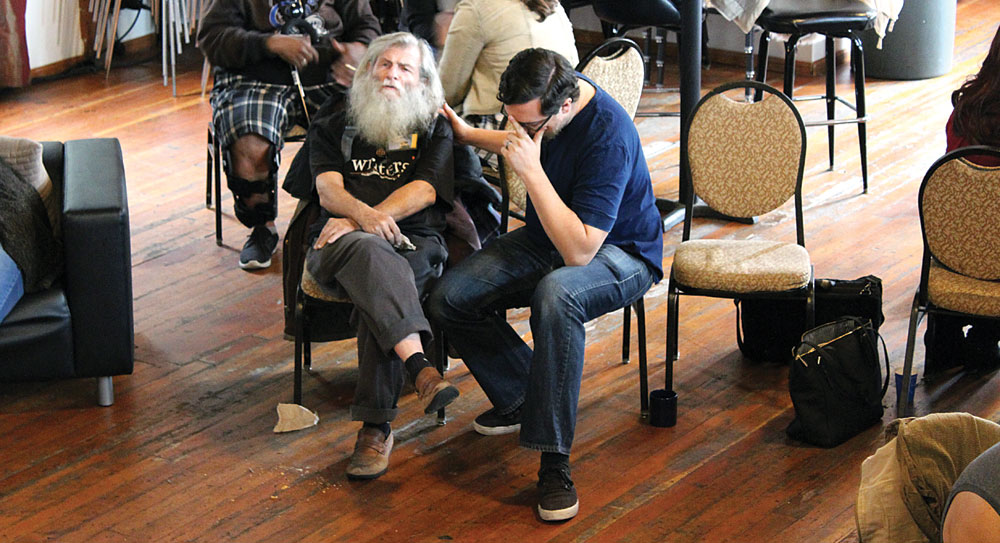
Basileia Community church elder Bill Horst bows his head and prays for Joe Wedner after a service in Hollywood.
Joe’s schedule for religious services is noncommittal and wide-ranging, though it leans Christian. Perhaps his favorite place to pray is a Christian congregation called the Basileia Community, which meets in a Baptist church in Hollywood. At one point, he was going twice a week, on Tuesdays and Sundays, while attending Roman Catholic services on Mondays and Thursdays and Chabad or Seventh-day Adventist services on Saturdays.
Lately, school has interfered with his attendance, and he’s often forced to stay around UCLA for services. One Sunday in December, I agreed to drive him to Basileia. We met on the corner of Westwood Boulevard and Le Conte Avenue with boisterous crowds of students surging by. He looked even smaller than I remembered, dressed in two coats and too-long pants that he’d rolled up at the cuff over a scuffed pair of brown loafers.
I loaded his pushcart, with its one broken wheel, into my car, and we set off for church.
On the way, I decided to raise the issue of permanent supportive housing — apartments made available by the city and county expressly for chronically homeless and mentally ill individuals like Joe. Los Angeles voters recently passed Measure HHH, a $1.2 billion bond that earmarks most of the funds precisely for building this type of housing. Joe conceded that it would be nice to have a toilet of his own, and the privacy to have company.
But “it might not be around here,” he speculated as we turned onto Wilshire Boulevard. “Then I’d have to wait for a bus and ride the bus and wait for a bus back … then it would slow down my saving up that $60,000 I need to show to get my wife over here.”
By now his foot was tapping violently enough to shake the car. The topic clearly made him anxious.
His thoughts are scattered, with a tendency to trail off or pivot wildly. On occasion, an unrelated question will reveal a heretofore-unexplored saga in Joe’s life.
By the time we reached Basileia, a question about his wife inadvertently had revealed details of the money he had inherited from his mother: Between 1984 and 2007, he said, he played the stock market, growing $250,000 into more than $800,000 at one point and living off the interest. When the market crashed 10 years ago, Joe said his bank account flat-lined.
As we walked into the church, people were schmoozing around a light buffet. Joe wasted no time in loading up a plate with fruit and breakfast rolls. It had been some time since he had been here, and several people approached him to say hello. A massive man with a kind face and a blond bun, the drummer in the congregation’s music ensemble, greeted Joe with a fist-bump.
Explaining my presence there as a Jewish Journal reporter, I mentioned that Joe was Jewish.
“I didn’t know you were Jewish, Joe!” a fellow churchgoer interjected.
I was mortified for outing him, but Joe was unfazed.
“I’m all things,” he explained.
For Joe, God is in every religion, all beliefs, indiscriminately and without exception. He likes Basileia for its inclusiveness and the kindness of his members. But it has no monopoly on his faith.
The band started to play and the hymns began to flow. “Holy Spirit, come fill this place!” the congregants sang, sitting in a semicircle under the exposed rafters of the tall, gabled roof.
The gathering was a dressed-down affair, community-oriented and progressive. The room flickered softly with the glow of candles and Christmas lights, and a plain, wooden cross overlooked the scene.
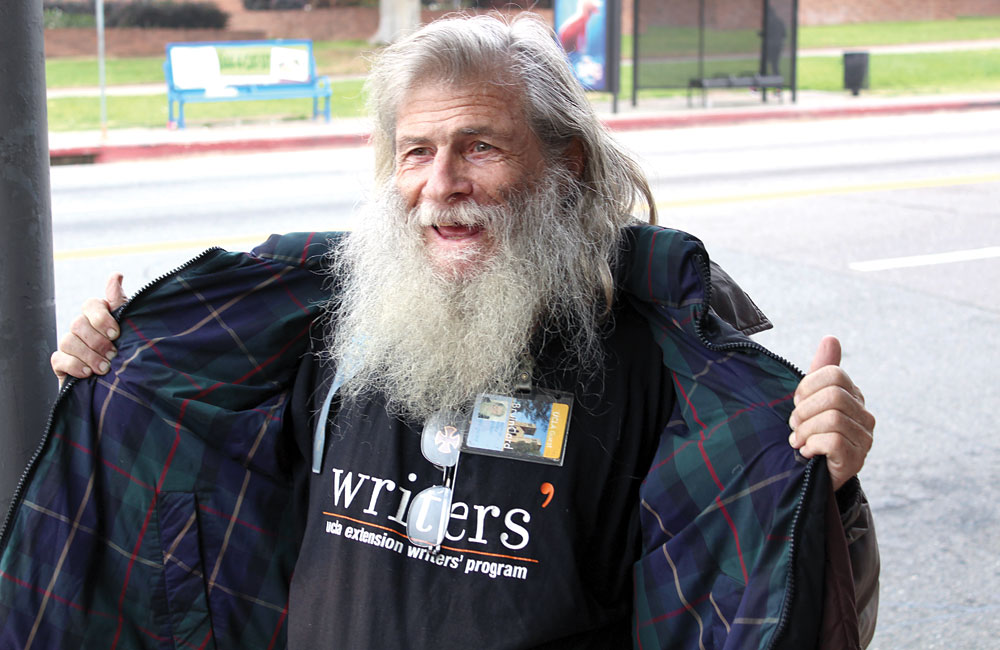
While the music played, Joe crossed his legs and tilted his head downward, staring just past his interlaced fingers, his white beard fanning out over his UCLA Extension T-shirt. The pastor, Suz Born, a bespectacled woman with a soft voice and the measured demeanor of a kindergarten teacher, kneeled next to him with her hands raised in the air.
Joe Wedner shows off a T-shirt reflecting his enrollment in UCLA Extension while standing on a corner in Westwood in December.
Soon, the music slowed to three or four chords repeated on an acoustic guitar. The frenzied foot tapping that had shaken my car had slowed to a soft, irregular beat.
When the service broke up, he stuck around to chat with friends and acquaintances, indulging them in detailed explanations of his theology. “The only reasonable conclusion is that God is mentally ill,” I overheard him saying.
He shares his theory widely, even if to awkward laughs or kind dismissals. It doesn’t earn him many friends. The Roman Catholics and Seventh-day Adventists say he’s blaspheming God. He says they’re blaspheming God by calling his truth blasphemy, since truth is God.
After services ended, church elder Bill Horst sat beside Joe to pray with him, resting his head on his hand and concentrating intensely. Later, Horst told me he prays for Joe to experience the mental soundness that often eludes him and to find a way off the streets.
Horst said that despite “packaging that’s a little tricky to get past,” Joe gets along OK at Basileia. At one point, he was making sexual overtures to single women there in a way that made them uncomfortable, Horst said — but church leaders sat him down and asked him to respect certain boundaries, and to his credit, he did.
“Someone can have a meaningful relationship with someone like Joe even if they find that difficult to imagine,” Horst told me on the phone later. “There is something real and coherent and worthwhile there if you’re willing to look for it.”
As people began to file out of the church, Joe headed to a basement room to pick up some donated food. He made a beeline for the fruits and vegetables. “There’s salad over here, boyfriend,” a homeless woman called out to him. But the salads were of the prepacked grocery store variety, and some had meat in them, so he passed over them. Even with his dietary restrictions, food is the least of his worries. Between panhandling and food banks, he has plenty. If he lacks for something, it’s not provisions but companionship.
“I need friends,” he said at Basileia. “My family is gone, so I need friends. Inshallah” — if God wills it.
Joe’s first serious brush with Christianity came during a lockup in Washington State Penitentiary in January 1978, when he was 37. He’d enrolled in a university-level accounting course in Tacoma, Wash., hoping it would set him on a path to quick riches. But he was failing and frustrated. One day, he decided somebody was driving too fast down his street, so he took out a loaded .45-caliber semiautomatic handgun and brandished it, yelling, on his porch. He was imprisoned for 25 months before his mother, an attorney, managed to get his sentence vacated on a technicality.
Prison was not a welcoming place. “The guards were unfriendly and the prisoners were even more unfriendly,” he said.
The only people who would speak with him were the missionaries.
“The Christian missionaries were there every day. I saw Jewish missionaries there once the whole 25 months I was there,” he said. “So naturally, I read the Christian Bible — a few times.”
He acquainted himself well with the text and continues to read and reread it. He keeps one in his pushcart. These days, one of Joe’s favorite verses to quote is the Man of Sorrows in Isaiah 53: “He was despised and rejected by men, a man of sorrows and acquainted with grief; and as one from whom men hide their faces he was despised, and we esteemed him not.”
It’s not hard to puzzle out why he’s so fond of the verse. On the one hand, it’s easy to imagine Joe as Isaiah’s outcast, “pierced for our transgressions … crushed for our iniquities.”
On the other hand, it’s a potent illustration of a capricious and unsparing God, doling out suffering: Why would any but a mentally ill God cause one man to suffer for all the rest?
And so, my question for Joe was, why go to such great lengths to worship a God he believes — fervently — to be insane? Joe’s theology and his delusions often are baroque, but they’re pieced together from pieces of simple, direct logic. To my spiritual question came a pragmatic answer.
On weeks he goes to prayer services and reads from the Bible, he said, “things coincidentally or not coincidentally go better. And so I just keep doing it.”