fbpx

May 2, 2017

Homeless on Pico— Natalie Levine Update: Day 6

Natalie Levine did not sleep on the street last night. We were able to place her in a temporary facility about an hour from Los Angeles. This is a reprieve that will, hopefully, buy time for a longer term solution. Lots of people and experts have reached out to help, and they are invaluable. As you might expect, the bureaucracy is just that, a bureaucracy. We experienced it first hand yesterday, when we bounced around looking for a shelter or any place that would take her.

I don’t want to sound like an easy critic of bureaucracy. The homeless problem is extremely complicated and it’s compounded by other issues, like mental health and life traumas. I got a little taste of this complexity over the past week. Maybe at some point, I will write in greater detail about it.

For now, our immediate goal was to keep Natalie off the streets, even for just a few more days. The amazing team at Cedars Sinai Hospital helped save the day—and the night.

I think one of the reasons many people in the Jewish community have rallied to Natalie’s cause is her Jewish neshama. In this short video clip, as we were waiting for a case worker, I asked her to go down her Jewish memory lane.

Homeless on Pico— Natalie Levine Update: Day 6 Read More »

Boredom and the immature elderly

Society is now one polished horde,
Formed of two mighty tribes, 

The Bores and Bored 
[Lord Byron, Don Juan, Canto XIII]

Boredom is a multi-faceted phenomenon in our day, and we may well be justified in focusing on one dimension of this destructive force.

In the old days, it was a privilege to be mature. It was something people strived for. It meant maturity of attitude, well-considered opinions, and a great amount of experience and knowledge of how to deal with the problems of life. This is no longer the case. For the most part, it is not due to the fact that younger people have become more experienced or knowledgeable, but rather that the older generation (those who used to be considered mature) has suddenly shown signs of immaturity.

This is evident in the way our older generation deals with free time. While in earlier days people used their available time to engage in creative activities, which they couldn’t do when they were working, today we find that most “mature” people spend their available time by returning to their childhoods. They often watch television, see a movie, lie in bed, or have other similar pastimes. This is exactly what they did when they were very young: watch and sleep. Passive conduct.

Passivity, then, is no longer the “privilege” of the young. It has become the preferred norm for all ages. As a result, the distinction between young and old has been blurred.

There is an unmistakable difference between a father who is involved in a creative activity – even if it is only building a chicken house – and a father sitting for hours in front of a DVD screen. In the first example he shows maturity, whereas in the second case, he reveals signs of impending immaturity. Sadly, these are the types of activities that children witness. Their parents may be university professors, but at home they return to their childhoods. This is not to deny the value of watching television. Sometimes this medium offers excellent programs. But once parents are constantly seen by their children in these passive postures, instead of engaging in creativity, joie de vivre, study, and other such activities, the parents have sold their birthright for a bowl of lentil stew.

That this results in the older generation’s loss of dignity in the eyes of the young is obvious. It doesn’t mean that the mature person admits her or his immaturity, but it does mean that the immature one, the child, considers him or herself to be mature. The children recognize that they do exactly what their parents do: nothing. And out of that negativity, they look to fill their lives with meaning. They clothe themselves with the garments of maturity that their parents have rejected.

One of the greatest contributions of the Jewish Tradition throughout the millennia is that the elderly learn, explore and interpret Torah, Mishnah, Talmud and other religious texts from their earliest childhood years. Once their experience of learning has been positive, passionate, and even fun, their love for learning increases to such a degree that when reaching retirement they can’t wait to get back to their studies, regardless of their physical circumstances. In this case, their return to “immaturity” is the greatest of blessings. Their bodies may show signs of old age but they discover unspent youth.

There is, however, another issue concerning young and old. It relates to the decline in religious consciousness. This time it is a loss of belief in an afterlife. Whatever one believes about afterlife is not the issue here. What is the issue is that in earlier days, the young had a degree of respect for the elderly, because they believed that older people were closer to Heaven and therefore to the truth. In some way, elderly people were “nearly there.” A few more years, months or days and they would enter the “real thing.” So, the elderly person sat close to the door, while the younger ones were still in the waiting room. Today, however, this is not the case. The elder is no longer seen as one “nearly there” but as one “nearly nowhere.” This has entered the communal consciousness of modern humanity. Older people have lost their grandeur, and younger people see them as having “served their time” and, therefore, as being superfluous and even a hindrance. 

This is a tragedy.

(*) This essay is inspired by the writings of the late Godfried Bomans, Holland.

Boredom and the immature elderly Read More »

Pence at Israel Independence Day event: Jerusalem embassy under ‘serious’ consideration

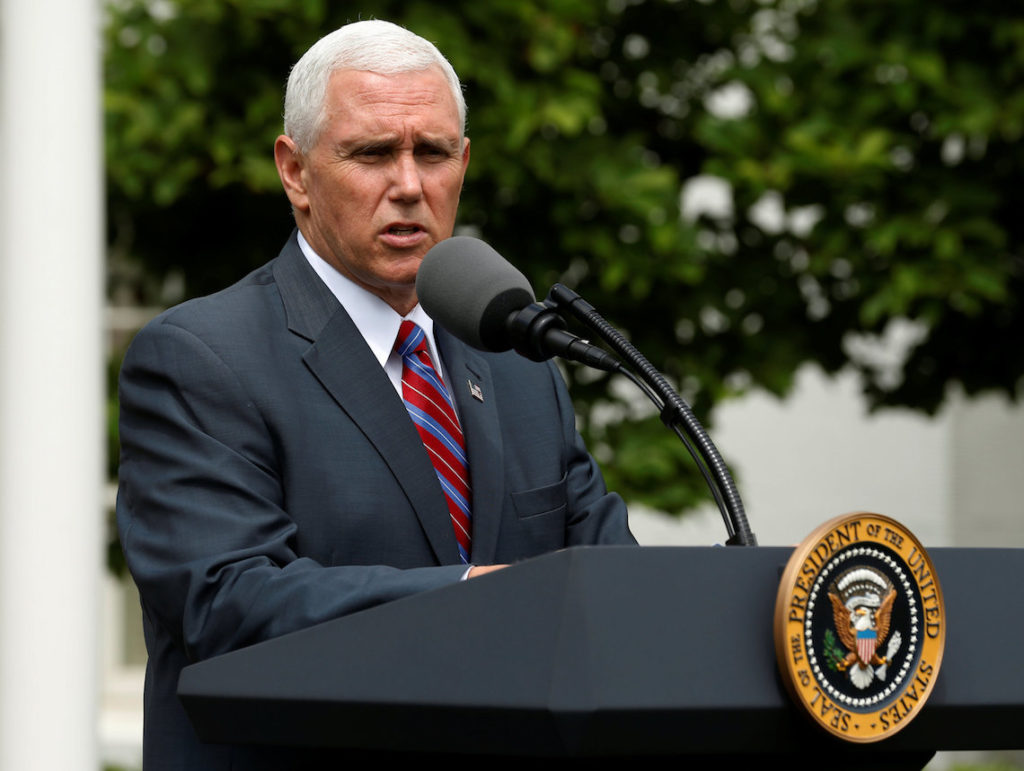
Vice President Mike Pence celebrated Israel’s independence and touted the Administration’s unapologetic support for the Jewish State at a White House reception to mark Israel’s 69th Independence Day on Tuesday.

Pence told the crowd that in a phone call a short while ago, he wished Prime Minister Benjamin Netanyahu a “Happy Independence Day.”

“Under President Trump, if the world knows nothing else, the world will know this – America stands with Israel,” Pence said to applause. “President Trump is a lifelong friend and a supporter of the State of Israel. President Donald Trump stands without apology for Israel, and he always will.”

Addressing the Israeli-Palestinian peace process amid growing “momentum” and the understanding that Israel will be required to undertake compromises, the Vice President assured the Jewish leaders, “President Donald Trump will never compromise the safety and security of the Jewish State of Israel, not now – not ever. Today, America’s support for Israel’s security is at record levels.”

Pence added that – “as we speak” – the President is “giving serious consideration to moving the U.S. Embassy from Tel Aviv to Jerusalem.”

The event took place in the Indian Treaty Room at the Eisenhower Executive Office Building. Treasury Secretary Steven Mnuchin, Israeli Ambassador Ron Dermer, Senators Orrin Hatch and Ted Cruz, Rep. Lee Zeldin as well as Democratic House Members Debbie Wasserman-Schultz, Ted Deutch and Brad Schneider attended the event, among others.

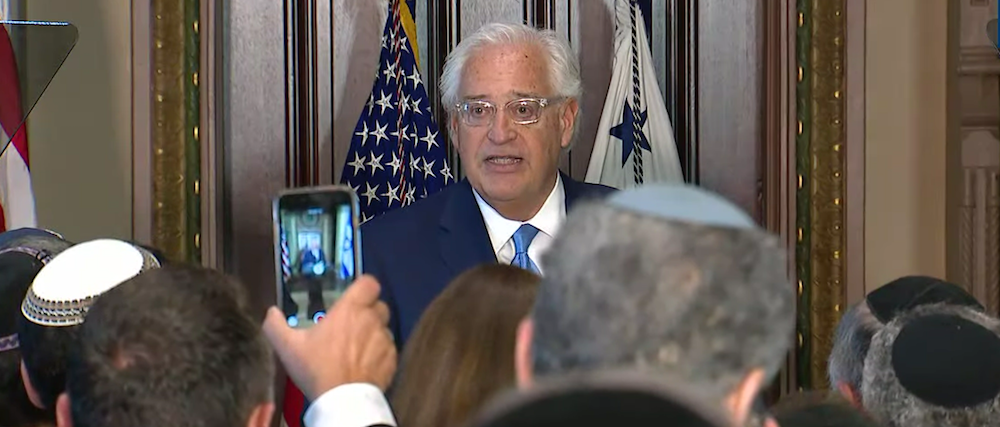
U.S. Ambassador to Israel David Friedman delivered opening remarks and served as emcee. According to Friedman, this marks the first time the White House hosted an event on Israel’s Independence Day. He thanked President Trump and Vice President Pence for “initiating what we hope will be a joyous annual event for many years to come.”

U.S. Ambassador to Israel David Friedman


President Donald Trump will host Palestinian Authority President Mahmoud Abbas at the White House tomorrow. “The President’s ultimate goal is to establish peace in the region,” WH Press Secretary Sean Spicer told reporters on Monday. “That’s obviously the goal and the discussion that he’s going to have with the head of the Palestinian Authority. But that’s going to be a relationship that he continues to work on and build with the ultimate goal that there’s peace in that region between Israel and the Palestinian Authority.”

Pence at Israel Independence Day event: Jerusalem embassy under ‘serious’ consideration Read More »

ADL head urges creation of hate crime task force in testimony to Senate committee

The national director of the Anti-Defamation League urged the establishing of a federal task force to coordinate hate crimes responses across the executive branch in testimony before the Senate Judiciary Committee.

Jonathan Greenblatt set forth a series of policy recommendations during a Tuesday hearing on an increase in religious hate crimes, according to an ADL statement.

“All of us are deeply concerned about the ongoing harassment of Jews, Muslims, Sikhs and others who are being targeted because of their religion,” Greenblatt told committee members. “The federal government has an essential leadership role to play in confronting hate crimes and in alleviating intolerance. And we need to make sure that we call out bigotry whenever it happens.”

Greenblatt recommended creating a task force that would help law enforcement agencies improve hate crimes data collection and training, enacting laws to combat hate crimes, exploring approaches to cyberhate and calling out bigotry.

On Monday, the American Jewish Committee praised members of the Senate Judiciary Committee for sending a letter to Attorney General Jeff Sessions urging him “to undertake effective action to address the increasing number of religious hate crimes in the U.S.”

“Effectively combating hate crimes demands a concerted federal government response,” said Richard Foltin, the AJC’s director of national and legislative affairs. “It is imperative that federal authorities help state and local authorities in carrying out their responsibility to monitor and prosecute hate crimes, and bring cases under federal hate crimes laws, where necessary.”

Nearly 150 JCCs and other Jewish institutions have received bomb threats and three Jewish cemeteries have been vandalized this year. In March, an Israeli-American teen was arrested in Israel on suspicion of calling in more than 100 bomb threats. Last month, the U.S. Justice Department charged the teen, Michael Kadar, with making threatening calls to JCCs in Florida, conveying false information to the police and cyberstalking.

ADL head urges creation of hate crime task force in testimony to Senate committee Read More »

55 Democratic lawmakers urge Trump to fire aide Sebastian Gorka over alleged far-right ties

Fifty-five Democratic lawmakers signed on to a letter urging President Donald Trump to dismiss Sebastian Gorka, an adviser accused of being a member of a Hungarian far-right nationalist group.

Among the nine Congress members leading the effort, five are Jewish: Reps. Eliot Engel, Nita Lowey and Jerrold Nadler of New York, Bradley Schneider of Illinois and Ted Deutch of Florida.

“As members of the U.S. Congress who care deeply about fighting anti-Semitism at home and abroad, we urge you to immediately dismiss senior White House counterterrorism advisor Sebastian Gorka,” read the letter, which was sent Tuesday.

“Based on recent revelations about Mr. Gorka’s public support for and membership in several anti-Semitic and racist groups in Hungary, he is clearly unfit to serve in any position of responsibility in the White House,” it continued, citing Gorka’s alleged ties to various far-right groups in Hungary.

News media reported over the weekend that Gorka was planning to move out of his National Security Council portfolio to another role in the administration, with some claiming his failure to obtain a security clearance was the reason for the move. Asked about the reports Monday, White House spokesman Sean Spicer said there was “no personnel announcement at the time” and he had “no belief” that Gorka was leaving the White House.”

Last month, the Forward published a 2007 recording in which Gorka said he was not opposed to the establishment of the Hungarian Guard, a nationalist militia that later was accused of racism and anti-Semitism. In 2009, a Hungarian court banned the Guard.

According to an article published in March by the Forward, Gorka, a native of Britain who is the son of Hungarian immigrants, allegedly is a member of Historical Vitézi Rend. The group is a namesake of Vitézi Rend, a defunct order of merit that had existed as a state entity for 20 years until 1944 under the rule of Miklos Horthy, Hungary’s Nazi-allied leader. Vitézi Rend was disbanded, outlawed and ceased to exist in the 1940s following the World War II defeat of Nazi Germany.

Gorka has denied being a fascist or anti-Semite. In a statement published last month by Tablet, Gorka was quoted as writing, “I have never been a member of the Vitez Rend. I have never taken an oath of loyalty to the Vitez Rend.” The statement did not mention the Historical Vitézi Rend group.

The Democrats’ letter referred to the recording and reports of Gorka’s ties to the Vitezi Rend.

In March, Nadler and three top Democratic senators voiced concern over reports of Gorka’s alleged membership in the Historical Vitezi Rand.

Nadler sent a letter to Trump, and Sens. Dick Durbin, D-Ill., Ben Cardin, D-Md., and Richard Blumenthal, D-Conn., sent one to the acting deputy attorney general, Dana Boente, and Homeland Security Secretary John Kelly, urging them to investigate the circumstances of Gorka’s path to U.S. citizenship and whether he concealed his alleged membership in the group as part of his naturalization process.

55 Democratic lawmakers urge Trump to fire aide Sebastian Gorka over alleged far-right ties Read More »

Abbas’ meeting with Trump may be his chance to shine. Does he have what it takes?

President Donald Trump wants a deal with Israel and the Palestinians. The Israeli and Palestinian leaders say they want Trump to make the deal.

What could go wrong?

For all the good cheer guaranteed when Palestinian Authority President Mahmoud Abbas meets Wednesday with Trump at the White House, it’s a question that’s going to be hanging over the proceedings, not least because of Abbas and whether he is able to make good on any deal.

“There is a huge question of who the Palestinian leadership is, can Abbas deliver? “ said Tareq Baconi, a fellow with Al-Shabaka, a Palestinian think tank and advocacy network. “The Palestinian Authority is suffering a crisis of legitimacy that is only becoming more acute with time.”

Abbas, 82, was elected in 2005 to a four-year term but has yet to step down. Now he is facing increasing restiveness. His Palestinian Authority controls only the West Bank, while his rival, Hamas, controls the Gaza Strip.

Abbas’ rivals appear to be positioning themselves to challenge his leadership. Hamas issued a new charter this week that tones down its rejectionism of the peace process and divorces itself from the Muslim Brotherhood, an apparent bid to cultivate the moderate Arab states that have backed Abbas.

Within Abbas’ Fatah party, Marwan Barghouti, serving life sentences for ordering terrorist murders during the second intifada, is leading a hunger strike in the prisons, coming across as more proactive behind Israeli bars than Abbas is as president.

Abbas is “coming and he wants to show he remains a player,” said Dennis Ross, a veteran Middle East peace negotiator under Republican and Democratic presidents.

“He has been weakened,” said Ross, a Washington Institute for Near East Policy fellow speaking on a press call organized by The Israel Project. “What the president has done is make him seem more important again.”

The dynamic that plagued the last round of talks – the profound distrust between Abbas and Israeli Prime Minister Benjamin Netanyahu that helped scuttle the Obama administration’s pass at peacemaking in 2014 – has not gone anywhere.

“Netanyahu and Abbas won’t happen by themselves,” said Eyal Ben-Reuven, a Knesset member for the opposition Zionist Union and a member of the parliament’s Foreign Relations and Security Committee. “You can sit Abbas and Netanyahu across from each other for a month, nothing will happen.”

Ben-Reuven, who was in Washington hosted by J Street and meeting with Congress members, said he was encouraged by indications that Trump wants a comprehensive peace deal involving other Arab nations.

“There is an international dimension, but it must be led by the United States,” he said.

Yet Abbas seems determined to seize the Trump moment with a vigor he has not displayed in years. Abbas, who since the collapse of the 2014 talks has attached preconditions to any renewal – principally, a demand for a settlement freeze – reversed course last month and said he is ready to meet with Netanyahu under Trump’s auspices.

“There is a real opportunity to make peace, and the international community should reinforce this opportunity and not miss it, because the region is in a state of boiling, and the occupation cannot continue in any way,” Abbas spokesman Nabil Abu Rudaineh said Monday in a release posted on Wafa, the official Palestinian news wire.

For his part Trump, mired in domestic policy frustrations, appears ready to plow ahead full steam.

“The president’s ultimate goal is to establish peace in the region,” White House spokesman Sean Spicer said Monday at the daily briefing for reporters. “That’s obviously the goal in the discussions he has with the head of the Palestinian Authority, that’s going to be a relationship that he continues to work on and build, with the ultimate goal that there is peace in that region between Israel and the Palestinian Authority.”

Ori Nir, the spokesman for Americans for Peace Now and formerly a reporter who covered Israel and the Palestinians for decades, said expectations for now should not be too high.

“This is an introductory meeting, a getting-to-know-you for both leaders, so I would advise against expectations for dramatic developments,” he said. “Trump could use the meeting to help empower Abbas, and the Palestinian leader, who will undoubtedly come to Washington with a list of requests, should be ready for some gestures that demonstrate his commitment to diplomacy and peace.”

Left open is whether Trump will reassert a commitment to the two-state solution, which Abbas emphatically favors. In his February meeting with Netanyahu, Trump was agnostic. Right-wing Republicans and some Israeli Cabinet ministers to Netanyahu’s right favor Israel’s annexation of portions of the West Bank.

Trump is scheduled to visit Israel later in May for what the Israeli media have said will be “advanced talks.” It’s not known yet whether he will also meet with Abbas at that time.

Abbas has named a new envoy to Washington, Husam Zomlot, who has gone on a charm offensive, inviting Jewish leaders – including some from right-of-center groups who have been sharp critics of the Palestinian Authority – to a gala reception on Wednesday evening, after the Trump-Abbas summit.

Jonathan Schanzer, a vice president of the Foundation for Defense of Democracies who has written extensively about the Palestinians, said Abbas had little to lose by cultivating Trump – for now. Playing along increases pressure on Netanyahu to make concessions.

“If Abbas agrees to move forward and engage in bilateral diplomacy under U.S. leadership, it all comes down to Bibi,” Schanzer said, using Netanyahu’s nickname.

It’s not clear, though, what concessions Trump wants or will be able to extract from either side. Spicer said the White House “continues to have discussions” with Netanyahu about settlements. Trump has asked Netanyahu to slow – but not stop – settlement building as a means of reviving the peace talks.

Netanyahu, meantime, has challenged Abbas to stop payment of subsidies to families of terrorists killed or jailed by Israel. Republicans in Congress want to condition funding to the Palestinian Authority on Abbas cutting off the “martyr” funds.

It’s not clear whether Trump would back such a move. Notably, the State Department is contemplating substantial cuts in assistance to the vast majority of countries funded until now – except for the Palestinian Authority, which is in for a slight increase.

Jason Greenblatt, Trump’s point man in the region trying to revive talks, is emphasizing economic recovery for the Palestinians as a building block to restarting talks; a threat of a cut in assistance could be counterproductive.

Still, an offer from Abbas to cut the assistance to the terrorists’ families could be a productive way to launch the talks, said Ross, who also advised coupling it with a recognition of the Jewish national movement – short of the recognition of Israel as a Jewish state Netanyahu demands, but enough to show good will.

“Trump has leverage” to extract those concessions, said Ross, who knows Abbas personally and uses his nickname, Abu Mazen. “The leverage he has is he can give Abu Mazen relevance at a time he desperately needs it.”

Schanzer said ending the payments to the terrorists’ families could be too steep a political price for Abbas to pay, but he was sending other signals that he was ready to stop funding terrorists – for instance, in cutting funds to the Hamas-controlled Gaza Strip.

Baconi said any concessions extracted from Abbas would have to be coupled with concrete concessions from Israel in order not to backfire and further decrease Abbas’ credibility among Palestinians, who see the United States as historically favoring Israel and sanctioning its settlement expansion.

He noted that Netanyahu already seemed emboldened by the friendlier relationship he had with Trump. In his February White House news conference with the president, Netanyahu laid down a precondition of Israel maintaining security control of the entire West Bank as part of a final status agreement. That isn’t new a position for him; what was new was advancing it in the presence of a U.S. president who did not object.

“Netanyahu was able to put forward a framework far beyond anything other presidents have accepted,” Baconi said.

Abbas’ meeting with Trump may be his chance to shine. Does he have what it takes? Read More »

Daily Kickoff: Experts downplay expectations for Trump’s Abbas meeting | Ivanka’s West Wing agenda | Wilbur Ross calls Syria strikes ‘entertainment’

Have our people email your people. Share this sign up link with your friends

HAPPENING TODAY — In public debut, F-35 jets streak over Israel for Independence Day: “Israeli F-35 stealth fighter jets soared above cities throughout Israel on Tuesday for the country’s annual Independence Day flyover, marking the first time the public got a look at the Air Force’s state-of-the-art plane. Israel is the first country outside the United States to receive the state-of-the-art F-35, which is manufactured by Lockheed Martin. In total, the country is planning to purchase 50 of the fifth-generation stealth aircraft, known in Israel as the “Adir,” or “mighty one,” and has thus far received five of them.” [ToI]

“UNESCO disavows Israeli sovereignty in Jerusalem in 22-10 vote” by Tovah Lazaroff, Herb Keinon: “Prime Minister Benjamin Netanyahu said that Tuesday’s “absurd” 22-10 UNESCO vote disavowing Israeli sovereignty in Jerusalem still represents a positive diplomatic change: more states abstained or supported Israel than voted against… According to Israeli officials, Germany was a driving force behind a deal that would see all EU states abstain in exchange for the removal of the most incendiary anti-Israel passages. But on Monday, Italy announced that it would vote against the resolution, apparently ending the effort to forge a European consensus.” [JPost; ToI]

“Why Israel Got Into a Dust-Up With Germany” by Daniel Gordis: “Most Israelis are keenly aware that without the IDF, they would not survive. Of all weeks of the year, this was certainly not the moment for a German to come to Israel to meet with an organization that most Israelis believe wants to make Jews vulnerable once again.” [Bloomberg]

“Every Senator Agrees the U.N. Must Change” by Senators Chris Coons and Marco Rubio: “As both the U.N.’s principal founding member and its largest financial contributor, the U.S. must insist on real reforms. We in Congress have a responsibility to conduct rigorous oversight of U.S. engagement at the U.N. and its use of our citizens’ tax dollars… Still, the U.N. continues to fund and maintain many standing committees that serve no purpose other than to attack Israel and inspire the anti-Israel boycott, sanctions and divestment movement. These committees must be eliminated or reformed.” [WSJ

TAYLOR FORCE ACT — “Senators Marco Rubio, Lindsey Graham and Tom Cotton write to Trump that the PA is no partner for peace with Israel as long as it’s ‘spending hundreds of millions of dollars a year funding and incentivizing terror'” [Haaretz; FreeBeacon]

DRIVING THE WEEK — White House Press Secretary Sean Spicer offered no clarity at yesterday’s press briefing about Trump’s position on the Israeli-Palestinian conflict ahead of the Trump-Abbas meeting on Wednesday. “The President’s ultimate goal is to establish peace in the region,” he asserted. “That’s obviously the goal and the discussion that he’s going to have with the head of the Palestinian Authority. But that’s going to be a relationship that he continues to work on and build with the ultimate goal that there’s peace in that region between Israel and the Palestinian Authority.”

Asked about newly announced Israeli settlement building in E. Jerusalem,Spicer said, “I’m sure that we’ll continue to have conversations with the Prime Minister and — I’m not going to — that will be something that President will continue to discuss.” [CSPANA possible announcement about moving the U.S. Embassy to Jerusalem “is still being discussed by staff,” added Spicer.

YESTERDAY IN DC — Washington Institute (WINEP) panel calls for lowering expectations from Trump-Abbas meeting — by Aaron Magid: “In spite of the sudden spate of optimism that the Trump administration can do it, I would argue no major breakthrough is available now. No lack of effort or shortage of time prevented the deal so far during the many years since Oslo,” explained Channel 2 Arab Affairs analyst Ehud Ya’ari. “[Abbas] is not the man who is going to sign the deal giving up on the return of many, many refugees. Embarking upon a final status effort is going to once again backfire. It is simply not there now. Therefore, the big question is whether the Trump administration will come to the table with a fallback, which can only be some version of a comprehensive interim (deal).”

Trump’s approach to the meeting with Abbas “needs to be in the first instance to demonstrate the difference from Obama,” argued Ambassador Dennis Ross. “The one thing that can’t be the result of this meeting is that Abbas leaves and feels it’s ok to say no to Trump. He needs to understand that when you say no to Trump, you pay a price.”

At the same time, WINEP Fellow Ghaith Omari advocated that the Trump administration adopt a nuanced approach when setting the goals for the meeting. “If President Trump asks for too much and too quickly, Abbas might shut down and he might retreat to preserve his domestic standing and nothing will come out of the meeting,” Omari said. “On the other hand, if the President asks for too little and is willing to engage on a diplomatic process with no preparation, we might end up with a very familiar story with a peace process where neither or one of the sides is willing or able to reach a deal, and we are just being strung along.” [JewishInsider]

“Can Trump Make Mideast Peace Without Gaza?” by Grant Rumley: “Any feasible peace agreement between the Israelis and Palestinians will require serious concessions from both sides. And no Palestinian leader sitting in the West Bank can compromise on the most sensitive issues in Palestinian politics – the status of Jerusalem, refugees, borders, etc. – while a rival party controls half the territory of a future Palestinian state… Rather than ignoring Hamas, the U.S. can support a political process that not only diminishes the terror group’s standing but also gives the more pragmatic (albeit flawed) Fatah-dominated Palestinian Authority a chance at re-establishing a legitimate claim to Gaza in future negotiations.” [Politico] • In Palestinian Power Struggle, Hamas Moderates Talk on Israel [NYTimes]

“What Trump’s meeting with Abbas means for the Middle East” by Aaron David Miller: “The bottom line on the Abbas meeting — like the Netanyahu visit in February — is that for now the emperor (in this case the peace process) has no clothes. It’s not yet ready for prime time. So whatever Trump’s strategy, and it’s not at all clear he has yet developed one, this meeting with Abbas and the Palestinians will be the first of many if the President is serious about involving his administration in a peacemaking effort.” [CNN]

SPOTLIGHT: “Trump’s Israel-Palestine Negotiator Isn’t Qualified — And that might be exactly why he pulls off a peace deal” by Armin Rosen: “[Jason] Greenblatt is only in the world of Middle East diplomacy because his longtime boss was elected president, but in the context of Israeli-Palestinian affairs, the appearance of favoritism might actually help him… It’s harder to stall an envoy, or to go behind the envoy’s back and appeal to other, friendlier administration officials or congressional allies, when the sides believe that the mediator is a direct extension of the president… Greenblatt is about as personally close to the president as someone in his position could be. And Trump has been remarkably and even uncharacteristically consistent on Israeli-Palestinian peace… Closeness with an engaged president is a powerful tool for an envoy — as long as there’s a policy vision and a sustained commitment from the Oval Office underlying his work.” [FP

“Rodrigo Duterte Says He May Be Too Busy for White House Visit” by Felipe Villamor: “President Rodrigo Duterte of the Philippines said on Monday that he might not accept President Trump’s invitation to visit the White House, because he was “tied up” with a busy schedule… “I’m supposed to go to Russia, I’m also supposed to go to Israel.”[NYTimes

“Trump’s warm words for strongmen set off alarms” by Annie Karni: “We’ve always had relationships with governments that are problematic, but we hold them accountable on it and we don’t lavish them with praise this way,” said Ilan Goldenberg, a former State Department official under John Kerry… “It completely undercuts our soft power our influence and our credibility as the leader of the free world… The fear of complicating relationships with the United States acts as a restraint — when Trump lavishes this praise, he implies there is no restraint.” [Politico]

“Ivanka Trump’s West Wing Agenda” by Jodi Kantor, Rachel Abrams and Maggie Haberman: “Ms. Trump is her father’s all-around West Wing confidante… The two trade thoughts from morning until late at night, according to aides. Even though she has no government or policy experience, she plans to review some executive orders before they are signed, according to White House officials. She calls cabinet officials on issues she is interested in, recently asking the United Nations ambassador, Nikki R. Haley, about getting humanitarian aid into Syria. She set up a weekly meeting with Steven Mnuchin, the Treasury secretary… Sometimes she seeks out Mr. Trump, telling other staff members, “I need 10 minutes alone with my father.” “A lot of their real interactions happen when it’s just the two of them,” Jared Kushner, Ms. Trump’s husband and fellow aide, said in a telephone interview.” [NYTimes]

“Trump Adviser Jared Kushner Didn’t Disclose Startup Stake” by Jean Eaglesham, Juliet Chung and Lisa Schwartz: “Mr. Kushner’s stake in Cadre — a tech startup that pairs investors with big real-estate projects – means the senior White House official is currently a business partner of Goldman Sachs Group Inc. and billionaires including George Soros and Peter Thiel, according to people close to the company. The Cadre stake is one of many interests — and ties to large financial institutions — that Mr. Kushner didn’t identify on his disclosure form, according to a Wall Street Journal review of securities and other filings.” [WSJ]

ON THE HILL — “Senate panel puts Russia sanctions bill on hold” by Karoun Demirjian: “The committee’s ranking Democrat, Benjamin L. Cardin (D-Md.), had hoped that the Russia sanctions bill would advance to a vote alongside compromise legislation to impose stricter sanctions against Iran over a spate of recent ballistic missile tests and the activities of the country’s Islamic Revolutionary Guard Corps… That Iran sanctions bill — compromise legislation that Corker and Cardin unveiled in March after more than eight months of wrangling — could be voted on by the full Senate later this month, Corker said… The Senate does not go on an extended break again until the week of Memorial Day, and Corker said Monday that the Iran sanctions bill “could move at the end of this work period.”” [WashPost

LongRead — FRENCH ELECTIONS: “The Future of Europe Hinges on a Face-Off in France” by Lauren Collins: “I wandered away and started talking to a woman wearing a quilted leather jacket and lots of mascara. “I adore Marine!” she said, identifying herself as Michèle… She had high hopes for the election, particularly after what had happened in America. “Bravo, bravo for Trump!” she said. She was unimpressed by Macron, whom she called “a little opportunistic asshole.” She asked if I knew that he was “a Rothschild banker” (Macron worked for the firm from 2008 to 2012, earning around a million dollars a year), invoking a slur—I heard it repeated over and over, and not just by F.N. supporters—that seemed laser-targeted toward some primal place in the French imagination, where a fondness for conspiracy theory intersected with a suspicion of high finance. “Rothschild banker” suggested, without having to say it, that Jewish influence was at work, making it all the more irresistible for the Front National.” [NewYorker

** Good Tuesday Morning! Enjoying the Daily Kickoff? Please share us with your friends & tell them to sign up at [JI]. Have a tip, scoop, or op-ed? We’d love to hear from you. Anything from hard news and punditry to the lighter stuff, including event coverage, job transitions, or even special birthdays, is much appreciated. Email Editor@JewishInsider.com **

BUSINESS BRIEFS: Interview with Mitchell Davidson, Managing Partner of Post Capital Partners [LinkedIn] • David Geffen Sells Malibu Home for Record $85 Million[THR] • Media mogul Barry Diller’s IAC to buy Angie’s list [Reuters] • Chinese tycoon who sought stake in Kushner property faces scrutiny [BostonGlobe]

HEARD AT THE MILKEN GLOBAL CONFERENCE — White House advisor Reed Cordish discussed the administration’s plans for workforce development: “We’re going to retrain America to take on the new jobs we need.” Democratic Governor Terry McAuliffe, who was also on the panel, appeared to endorse the idea. [Pic]

Via the Jewish Journal’s Ryan Torok who is covering Milken this week: At the conference, U.S. Treasury Secretary Steve Mnuchin spoke of the effectiveness of policy implementing sanctions against terrorist organizations or countries sponsoring terrorism, including Iran. “These sanctions really do work [on countries such as Syria],” he said in an interview with Maria Bartiromo of Fox Business Network. “When you cut off the money to terrorist organizations, you have a big impact and I think you saw this in the case of Iran. The only reason Iran came to the table to negotiate was because of economic sanctions on them,” he said, “and that’s what created the incentive.””

“Wilbur Ross Says Syria Missile Strike Was ‘After-Dinner Entertainment’ at Mar-a-Lago” by Gene Maddaus: “Just as dessert was being served, the president explained to Mr. Xi he had something he wanted to tell him, which was the launching of 59 missiles into Syria,” Ross said. “It was in lieu of after-dinner entertainment.” As the crowd laughed, Ross added: “The thing was, it didn’t cost the president anything to have that entertainment.” [Variety]

“Unusual Honor for U.S. Jews on Israeli Independence Day Fires Up Local Twittersphere” by Allison Kaplan Sommer: “The fact that the speeches of the torch-lighters, billionaire philanthropist Michael Steinhardt and Rabbi Marvin Hier, were in English instead of Hebrew particularly grated on some ears. “Truthfully, it would feel much more natural to me to hear Arabic spoken at the torch-lighting than English,” diplomat Shani Cooper, Israel’s deputy head of mission in Ankara, Turkey, tweeted. Channel 2’s political reporter and commentator Amit Segal went a step further, tweeting that: “The torch should only be lit by those who speak Hebrew and live in Israel. Elementary.” … Several on Twitter joked that the gesture to wealthy American Jews was necessary in order for [Minister Miri] Regev and Prime Minister Benjamin Netanyahu to raise sufficient funds for the country’s planned 70th anniversary festivities next year.” [Haaretz] • How a US billionaire’s Jewish spark became an Independence Day torch [ToI]

SPORTS BLINK — Aly Raisman teams up with T-shirt company to remind us Life is Good: “The executives at Life is Good are hoping that Aly Raisman’s gold-medal glory can rub off on the Boston apparel company. The gymnast has signed a two-year partnership with Life is Good, and she played a key role in creating a line of T-shirts being launched this spring. The new Ally Tee Collection is geared to girls and women and features three designs that emphasize kindness, authenticity, and courage.” [BostonGlobe]

DESSERT: “Israeli-born chef strikes gold with top U.S. prize” by Richard Leong: “Philadelphia chef Michael Solomonov, praised for his modern Israeli cuisine, struck gold by winning the top U.S. chef prize from the James Beard Foundation on Monday… Solomonov… turned his focus on Israeli and Jewish cooking after his younger brother David who served in the Israeli army was killed on Yom Kippur in 2003.” [Reuters]

BIRTHDAYS: Former Lord Chief Justice and President of the Courts of England and Wales, Baron Harry Kenneth Woolf turns 84… Professor of international relations and Middle Eastern studies at NYU’s Center for Global Affairs, journalist, international negotiator and private consultant, Dr. Alon Ben-Meir turns 80… Author, publisher, president of four radio stations in the Pacific Northwest, conservative political activist, gun rights advocate, Alan Merril Gottlieb turns 70… Former member of the Texas Senate (1993-2013), she was born in NYC to Holocaust survivor parents, Florence Shapiroturns 69… Former US AID contractor, imprisoned by Cuba from 2009 to 2014, Alan Gross turns 68… Shorenstein Fellow at Harvard’s Kennedy School, previously Under Secretary of State for Public Diplomacy (2014-2016) and Managing Editor of Time Magazine (2006-2013), Richard Allen “Rick” Stengel turns 62… Member of the New York State Assembly, previously a member of the NYC Council and former Deputy Superintendent of the NYS Banking Commission, David Weprin turns 61… Billionaire businesswoman, entrepreneur, civic leader, she served as US Secretary of Commerce (2013-2017), now chairman of the private investment firm she founded PSP Capital Partners, Penny Sue Pritzker turns 58… DC-based CBS News correspondent, once a K-12 student at CESJDS in Rockville, Julianna Goldman turns 36… Campaign director for the Center for American Progress Action Fund, previously the executive director of the Young Democrats of America during the 2012 election ctycle, Emily Tisch Sussmanturns 35… Communications Specialist at the NYC office of HIAS, previously a Senior Strategist at West End Strategy Team, Gabe Cahn turns 27… Founder & CEO of the Helena Group, Henry Elkus turns 22… Director of communications at the Maryland Department of Natural Resources, previously senior director of media relations at the National Retail Federation, Stephen Schatz… Rosalyn Spiegel… Susanna Fried… Israel’s best tour guide Michael Bauer

Gratuity not included. We love receiving news tips but we also gladly accept tax deductible tips. 100% of your donation will go directly towards improving Jewish Insider. Thanks! [PayPal]

Daily Kickoff: Experts downplay expectations for Trump’s Abbas meeting | Ivanka’s West Wing agenda | Wilbur Ross calls Syria strikes ‘entertainment’ Read More »

UNESCO votes to condemn Israel’s sovereignty in Jerusalem

The United Nations’ cultural agency voted to condemn Israel’s sovereignty in Jerusalem.

UNESCO — the UN Educational, Scientific and Cultural Organization — passed a resolution called “Occupied Palestine”  by a vote of 22-10, with 26 countries abstaining or absent, on Tuesday.

The resolution calls on Israel to rescind any “legislative and administrative measures and actions” it has taken to “alter the character and status” of Jerusalem. It rejects the idea of a “basic law” in Jerusalem, based off of a 1980 Knesset law, which implies that the city is one unified whole and governed solely by Israel.

Submitted by Algeria, Egypt, Lebanon, Morocco, Oman, Qatar and Sudan, the resolution also sharply criticizes Israel’s construction in eastern Jerusalem’s Old City and “deplores” the Jewish state’s “continuous” closure of the Gaza strip.

The vote was taken on Israel’s Independence Day and follows a highly controversial UNESCO resolution passed last October that ignored Jewish ties to the Western Wall and Temple Mount sites.

Hillel Neuer, who heads the watchdog group UN Watch, tweeted that despite the outcome, Israel won a “moral victory” in the voting process. He noted that the United States, Germany, the United Kingdom, Greece, Italy and the Netherlands all voted no, and that India abstained.

UNESCO votes to condemn Israel’s sovereignty in Jerusalem Read More »

Episode 36: Mai Shbeta, the Jewish-Israeli-Muslim-Palestinian peace activist

She’s a sort of “peace incarnate.” A representation of what comes of abandoning hate and sectarianism for love and unity. Mai Shbeta is the daughter of a Jewish mother and Muslim father. According to Jewish religious law, she’s a Jew. According to Islam, she’s a Muslim. However, often the members of both faiths choose to see her as an outside – they see the differences rather than the similarities.

This reality has driven Mai Shbeta to spend her time working diligently towards peace. She’s presented at the World Economic forum in Davos in 2011 and, recently completing a law degree at the Bar Ilan University, she has her eyes set on the advancement of Human Rights. Mai joins 2NJB today to talk about her life and career.

RSS Subscribe

Direct Download

Episode 36: Mai Shbeta, the Jewish-Israeli-Muslim-Palestinian peace activist Read More »