fbpx

April 30, 2017

“Work In Progress”: A New Musical Takes on High Unemployment for Adults with Disabilities

While the general unemployment rate  in California fell to a new low of 4.9% in March of 2017, for people with disabilities, an astounding 66.2% were still unable to find paid employment, according to a new study from the national advocacy group, Respectability.

This persistent problem of unemployment among adults with disabilities is at the core of a delightful new musical from The Miracle Project called, “Work in Progress, ” now playing at the Wallis Annenberg Center for Performing Arts in Beverly Hills. The large cast, ages 9-56 years, is composed of both disabled and non-disabled performers who stage an original musical that follows a group of recent “Miracle High School” graduates as they go out in into the “real world” and try to find jobs or go to college, only to find that doors are closed  before they can even get their foot in. As the lyrics to one song written by Music Director Zach Marsh poignantly say, “Give us a chance…give us a shot. Look at what’s there and not what’s not.”

The musical chronicles the journey of many of these high school graduates, showing the emotional angst and frustrations of young adults pursuing both college and non-college paths. For the college students, there are the high expectations of parents and the many stresses of being away from home for the first time. And for those looking to find paid work, no one wants to hire someone without experience, but how these students ever get experience if no one will give them the opportunities?

With a Broadway sound and texture similar to the musical “Rent”, this show is most exciting during the ensemble pieces, although there plenty of solos from the cast (many of whom have autism) that are also quite captivating. The book for the show was written by Maxell Peters, Zach Marsh, Miracle Project Founder and Artistic Director, Elaine Hall and Jeff Frymer.

The Miracle Project was created by my long-time friend Elaine Hall who was a top Hollywood acting coach before her adopted son was diagnosed with severe autism. When traditional therapies failed to help him, she developed her own innovative methodology, combining mindfulness and the expressive arts with what she learned from autism experts Dr. Stanley Greenspan, Dr. Ricki Robinson and Dr. Barry Prizant. Recently, The Miracle Project approach to working with children, teens and young adults with autism has been named as an evidence-based therapy, meaning it is clinically significant in addressing anxiety, expanding social skills and more, similar to more conventional therapies such as applied behavior analysis (ABA) or occupational therapy (OT).

One of the most interesting aspects of having an inclusive cast is that it is often impossible to tell which of the performers has disabilities and which do not, which is kind of the whole point. Now, if only we could convince more employers to feel the same way…

“Work In Progress” will be shown May 1-4 at the Lovelace Studio Theater at the Wallis Annenberg Center for the Performing Arts. Tickets can be purchased here. 1491589567_Miracle_Project_Cast_1061x601

“Work In Progress”: A New Musical Takes on High Unemployment for Adults with Disabilities Read More »

Hummus chef brings Acre to Tarzana [VIDEO]

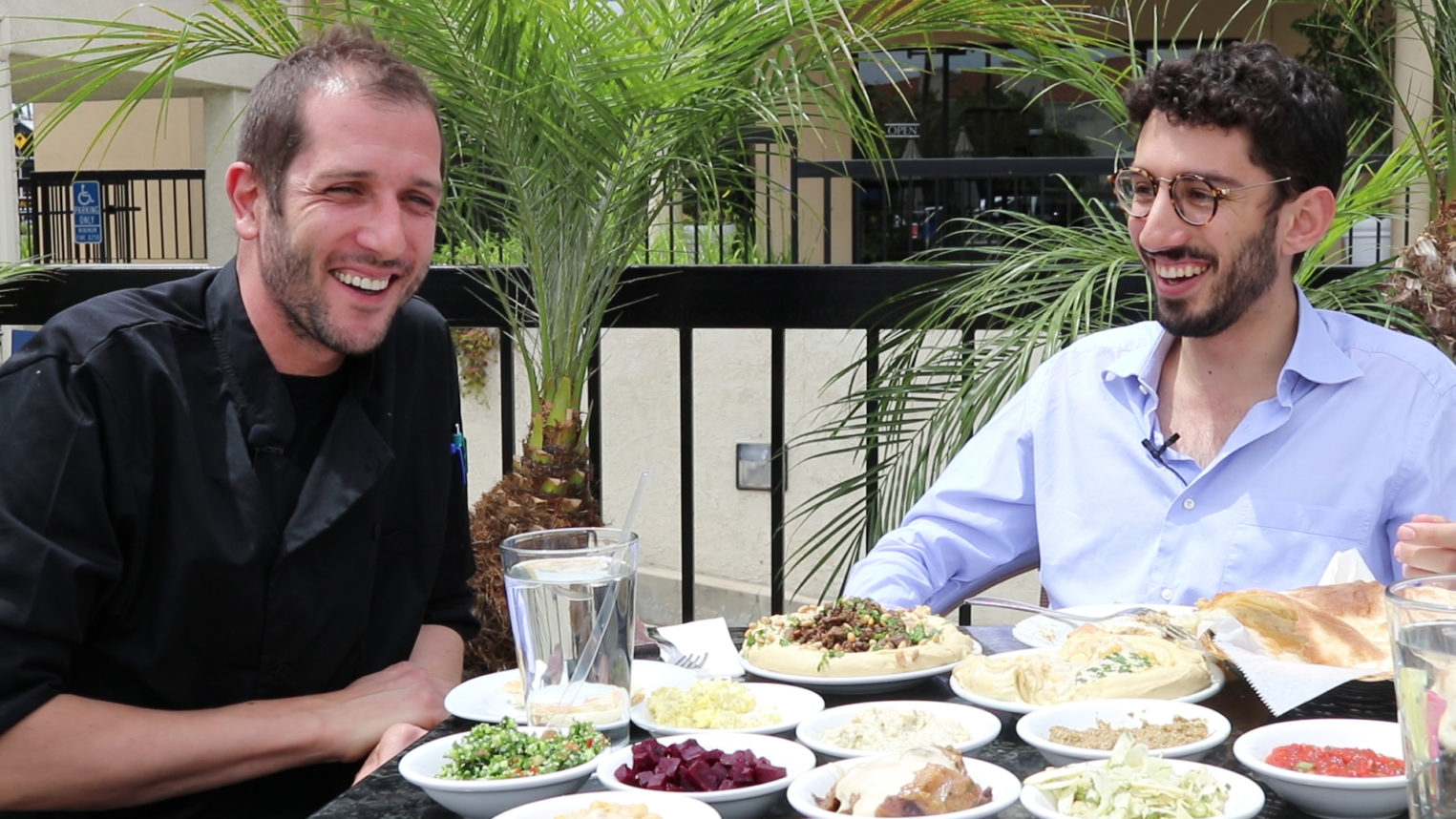
Ofir Arbel, the head chef at Hummus Bar and Grill, has a few fond memories involving hummus from his time growing up in Israel. When he and his teenage buddies would finish up a night of partying at 4 or 5 a.m., they’d often head to a hummus restaurant to eat until the booze was all soaked up and they were ready to sleep away the morning.

In general though, “I almost didn’t touch hummus,” said during a recent interview. In his Ashkenazi family, it just wasn’t a staple.


That all changed when he immigrated to the San Fernando Valley and took over the kitchens at a Tarzana hummus joint that’s become a cultural institution for the Los Angeles Israeli American community and beyond. Now, it’s hummus every morning, and on nights and weekends: Arbel tastes each batch to assure quality.

On May 2, Arbel will be interviewed on stage at Leammle’s Town Center in Encino after a screening of “Hummus! The Movie,” a film that follows the lives and journeys of several hummus restaurateurs in Israel. He’ll be joined by Mitch Julis, one of the movie’s producers, with Jewish Journal staff writer Eitan Arom moderating.

During a recent visit with a reporter and videographer from the Journal, Arbel produced plate after plate of every manner of hummus, salad and meat dish.

There was hummus with ground beef, hummus with mushrooms and hummus with whole garbanzo beans; there was creamy chopped liver, a Turkish bell pepper salad, two kinds of baba ghanoush, corn salad and more; and of course, there was red wine to wash it all down.

When this reporter protested he couldn’t possibly eat another bite, Arbel countered, “It’s really insulting — you have to try a main dish,” as if three types of hummus and about a dozen salads didn’t constitute a main dish.

Ofir summoned three plates of meat skewers, which to everybody’s surprise were quickly consumed. By the time the kanafe was finished, a desert based on shredded filo dough, the entire company was ready for a good, long nap.

Hummus Bar and Grill is located on 18743 Ventura Boulevard in Tarzana and is open daily from 11 a.m. to 12 a.m., and till 1 a.m. on Saturdays.

For more information on the film screening and interview, visit lajfilmfest.org.

Hummus chef brings Acre to Tarzana [VIDEO] Read More »

Gary Shapiro, cantor and comic, 52

Gary Shapiro, who delighted audiences both at congregations and comedy clubs across Los Angeles, died suddenly April 27. He was 52.

A comedian who infused his act with music, Shapiro trained as a cantor at Temple Emanuel of Beverly Hills, taking over as the synagogue’s cantor in 1984. He stayed on in that role for two years before stepping away from synagogue life to pursue his comedy career.

Seven years ago, he joined Congregation Beth Israel on Beverly Boulevard to co-officiate High Holidays services. He was well known and admired there, according to synagogue staff.

“He truly, honestly, was a pure, pure good soul,” said the synagogue’s director and co-cantor, Steve Walfish. “He was kind and considerate and loving.”

Rabbi Baruch Cohon, a former longtime cantor at Temple Emanuel who mentored Shapiro there, said, “He was always a very positive and talented young man,” with a great sense of humor.

Shapiro often combined his musical abilities and comic talents by performing onstage at comedy clubs with guitar in hand. He also took to YouTube with many of his satirical ballads. He had performed as recently as April 23.


His other roles included as a religious consultant on the TV shows “Six Feet Under and “Seventh Heaven,” according to a 2004 Los Angeles Times interview.

As a teen, Shapiro attended Beverly Hills public schools. His comic streak was evident even then. His high school prom date, Daryn Kagan, recalled on Facebook that he showed up for the big night in a leather tuxedo jacket with gold sequin trim.

Walfish and Cohon co-officiated a funeral at the TaNaCH Chapel of Mount Sinai Hollywood Hills at 12:30 p.m. on May 1.

Shapiro is survived by parents Judy and Aron and brother Howard.

Gary Shapiro, cantor and comic, 52 Read More »

Sunday Reads: Israel’s Gaza dilemma, How the 67 war changed the Arab world, The fate of the Vilna Jewish Cemetery

US

Former US Ambassador to Russia Michael McFaul wonders whether President Trump is learning or ad-libbing his foreign policy:

In the month of April, I found myself saying “I agree with Trump” more than anytime ever. On China, Russia, NATO and Syria, President Trump signaled radical changes in policy, nearly the complete opposite of what he said as a candidate. All were changes for the good — that is, new policy positions that advance American security, prosperity and values. The lingering question is whether these recent statements signal a fundamental change in Trump’s thinking about foreign policy or rather short-term reversals that could be reversed again. Is he learning or ad-libbing? It’s too early to tell.  

John Cassidy sees the reversal of Trump’s NAFTA position as a sign that globalist are now in charge of the White House:

Ultimately, this incident provides further evidence that the globalists in the Administration are taking charge of economic policy. The Bannon faction, which had already suffered a number of setbacks, seems to have lost another battle. And while Trump clearly still personally holds some instinctive enthusiasm for Bannon’s protectionist agenda, he’s yet to really act on it.

Israel

Shlomi Eldar takes a look at a moral and strategic dilemma facing Israel in Gaza, where alleviating a humanitarian crisis could effectively help Hamas:

Abbas has presented Israel with a major dilemma. Any move it makes to forestall a humanitarian crisis in the Strip will serve as a lifeline for Hamas. As it is, the Hamas government has already become Israel’s only option. After the 2007 revolution, Israel formulated a defense strategy that views the removal of Hamas by economic or military pressure as having graver consequences than keeping it in power. That’s why in the 2014 Operation Protective Edge, Prime Minister Benjamin Netanyahu decided on the advice of defense officials not to target the collapse of Hamas but rather to create deterrence. Deterrence was achieved, albeit at a heavy loss of life. And the cease-fire between Israel and Hamas has been maintained for the past three years, though occasionally some renegade groups manage to fire off a few rockets at Israel and disrupt the peace.

The WSJ’s Yaroslav Trofimov talks to Israelis on the border of Syria, who muse on the civil war taking place right next door:

“The Golan is still the quietest place in the whole country,” said Yoni Hirsch, chairman of the municipal council of Nov, an Israeli community of some 800 people about 2 miles from Islamic State-held areas. “But we know what is happening across the border, and we are getting ready for what may happen,” he added. “We know that in one day with the decision of one person on the other side, our lives can change.”

Middle East

Hussein Ibish writes about how the 1967 war changed the Arab world:

There was a massive and crucial reversal in generalized Arab attitudes in the aftermath of 1967. Between the 1940s until 1967, as many countries in the region won independence from colonizers, the essential Arab attitude was one of optimism, determination, international engagement and hope. Afterward, the biggest single missing element, in many cases still unrecovered, is self-confidence. The collective deflation is hard to communicate. But since then, most of the Arab world has continually lacked a fundamental belief in itself.

Robert Frisk takes a look at the plight of Christians in the Middle East:

In the British mandate of Palestine, the Christian population was 9.6 per cent of the population. By 1999, it was 2.9 per cent. Meanwhile, 35 per cent of the Christians of the West Bank and Gaza left between 1967 and 1999. And Christianity is supposed to be one of the world’s great religions.

Jewish World

Yair Rosenberg introduces a short documentary about the Vilnius Jewish cemetery, which is currently in danger:

Before the Holocaust, Jews of all ideologies and backgrounds constituted half of Vilna’s population, but today they comprise less than 1 percent of it. As the cemetery is one of the last remaining testimonies to the city’s storied Jewish past, a group of scholars and locals rose to its defense. They drafted a petition that called on the Lithuanian government to relocate the center elsewhere in Vilna. Within weeks, the letter had garnered nearly 40,000 signatures, ultimately forcing a pause in the plans for construction.

Sarah Rindner tries to find out why the bible demands that mothers atone for the ‘sin’ of childbirth:

The Bible consistently frames the commandment to bear children in positive terms, as the sacred responsibility of all of humanity. In Genesis, God blesses Adam and Eve by telling them that they will be “fruitful and multiply,” and the spirit and language of this benediction inform the rest of the Bible as well as the rabbinic understanding of childbearing. So why does the new mother, who has just fulfilled this great commandment, need to atone? Unless we are to write off the commandment as entirely absent of moral content, or as some sort of inexplicable divine decree, there must be something more at work here.


Sunday Reads: Israel’s Gaza dilemma, How the 67 war changed the Arab world, The fate of the Vilna Jewish Cemetery Read More »