Every four years, in an attempt to maximize their share of the “Jewish vote,” the major political parties include language in their national platforms expressing support for Israel as America’s truest ally and only democracy in the Middle East. Often that expression contains a pledge to move the U.S embassy in Israel from Tel Aviv to Jerusalem.
The belief that the political and even national allegiance of many Jewish Americans is driven by devotion to Israel extends beyond party politicians to a sizable share of the U.S. public. A 2016 survey conducted by the Marttila Strategies polling firm indicates that although anti-Semitism has declined significantly in the United States over the past half-century, since at least the mid-1960s, about a third of Americans have believed the anti-Semitic dual loyalty canard that Jews are “more loyal to Israel than to America.”
To what extent do psychological ties to Israel actually shape the political beliefs and behavior of American Jews? If they do not motivate the Jewish community as much as is often believed, then what does?
Undeniably, a large majority of Jewish Americans have an affinity for Israel. A 2013 Pew Research survey indicated that an overwhelming (87%) said that “caring about Israel” is an important part of being Jewish. On a more demanding measure of affiliation, about 7 in 10 Jewish Americans (69%) said they are at least somewhat “emotionally attached” to Israel.
But, that’s not the whole story. In spite of their psychological connection to Israel, most Jews ´placed greater importance on other “Jewish” values—remembering the Holocaust (73%), leading an ethical and moral life (69%), working for justice and equality (56%), and being intellectually curious (49%)—than they did on caring about Israel (43%). Beyond this, when asked if being “strongly critical of Israel” is compatible with being Jewish, a large majority (89%) said that it is.
Moreover, to borrow from Borscht Belt comics’ assertions that “where there are two Jews, there are three opinions,” Jewish Americans are not of one mind about Israel. While it is true that a sizable majority have at least some emotional connection to Israel, the extent of that link varies by denomination, generation, and political party identification. The ties are strongest among the Orthodox, those 50 years old and above, and those who identify as Republicans. This split in the opinions of Jewish Americans toward Israel and other matters runs throughout the Pew study.
If allegiance to Israel and support of its current policies is not the primary determinant of the political beliefs and behavior of Jewish Americans, what is? Pew’s research suggests the crucial factors are the very things that shape the opinions and votes of most other Americans—their party identifications, their opinions on current political issues, and their perceptions of major political figures. Pew sums those up by saying that “Jews are among the most liberal and Democratic groups in the population.”
A large majority of Jewish Americans (70%) identified with or leaned to the Democratic Party; this when 49% of the U.S general public claimed a Democratic attachment. More remarkable, nearly half of Jewish Americans (49%) said they were liberal and just 19% called themselves conservative. This was almost reverse the numbers for the general public, within which 38% said they were conservative and 19% liberal.
To confirm the trend, millenial Jews (18-29 year olds) were the most Democratic, liberal, and pro-Obama age cohort that Pew sampled. They are also the least emotionally connected to Israel and the most critical of its policies. Interestingly, Jewish millennials are as likely to have been to Israel as any other generation of Jews; suggesting that it isn’t simply indifference or ignorance that account for their disconnect from the Jewish state. Undoubtedly, the vigorous embrace of the unpopular Trump by Netanyahu compounded by Bibi’s public disdain for the ever-popular Obama may, inadvertently, be undoing the hard work that Birthright Israel undertakes when it provides free trips to Israel for the young.
These liberal and Democratic identifications were reflected in the opinions of Jewish Americans of all ages on major issues. A huge majority (82%) said that “homosexuality should be accepted by society.” A majority (54%) also preferred “a bigger government that provides more services” rather than a “smaller government that provides fewer services (38%). A majority of U.S. Jews approved of Barack Obama’s job performance (65%) at a point in his administration when 50% of the general public did.
Despite the assertions of Jewish conservatives and many Jewish organizations today, the positive perceptions of Obama carried over to his policies toward Israel and Iran even when those organizations and the Israeli government were highly critical of those actions. With the exception of the Orthodox, Jewish support for the president’s policies crossed all demographic and denominational lines. It also substantially exceeded that within the U.S. general public.
The liberal and Democratic proclivities of Jewish Americans continued in 2016 when a large majority (71%) voted for Hillary Clinton in 2016; only 23% voted for Donald Trump. The Jewish vote for Clinton was similar to what it had been for other Democrats since 1968 and may have exceeded that for Barack Obama in 2012.
The attitudes of Jews toward Donald Trump have not improved since his election. A March 2017 Gallup survey indicated that Trump’s job approval as president was only 31% among Jewish Americans, 11 percentage points below that of the electorate overall.
The data are clear. Jews remain disproportionately Democratic and highly negative about Trump. This makes it even more surprising that a number of important Jewish organizations remain reluctant to criticize the president. . Their likely rationale is that Trump will be supportive of Israel and that little good would be served by alienating a potential friend of that country, especially in light of Trump’s campaign promises to revoke the nuclear limitation treaty with Iran and move the U.S. embassy in Israel to Jerusalem.
But these leaders and organizations run the serious risk of misunderstanding and, indeed, alienating their own Jewish base on the unlikely chance (already disproven in large measure) that Trump will honor his hyperbolic campaign promises in his presidential policies. Given the high stakes, the low probability of success, and the president’s erratic behavior and elusive beliefs, it is a gamble better not taken.
*Mike Hais is an expert in market research having served for more than 22 years at Frank N. Magid Associates. He has a doctorate in political science specializing in American politics and political behavior. He is co-author with Morley Winograd of Millennial Makeover: MySpace, YouTube, and the Future of American Politics, Millennial Majority: How a New Coalition Is Remaking American Politics, and Millennial Momentum: How a New Generation is Remaking America. This op/ed was written in association with Community Advocates, Inc.
[Ed. Note: WARNING – This is not for the faint of heart or the squeamish.
This entry in our blog details some of the aspects of what may occur in what we refer to as a “Difficult Taharah”. Told from the perspective of one event at one Chevrah Kadisha, this speaks to the guiding principle of those who are members of the Chevrah Kadisha that ‘we do the best we can’ in the circumstances. Not infrequently, death is not pristine, and we are faced with unexpected or unusual situations. These events can be disturbing; they are certainly not something to be discussed lightly. I decided to publish this entry which addresses both the difficult Taharah, and the equally difficult decision to speak about it. — JB]
Background on Taharah
Taharah procedure is best conveyed by a CK participant relating their personal experience; anything else is a mere “clinical” explanation of the ritual steps and is little more than a dull iteration of tasks. The sacred aspect isn’t fully conveyed in any of the “manuals” that I’ve read. The word “spiritual” is overused and I choose to shun it. Always tending to our work carefully, it may look as if we’re helping someone get dressed for a special event which, indeed, we are. We wash and comb and pat dry and swath our meitah in fresh new garments. No lipstick and powder, no lace and perfume. Each time we follow the ritual tasks with ease and recite prayers and relevant poems yet we never think of it as being “routine”.
The Situation
Last November, our Chevrah Kadisha completed an extremely challenging and complex taharah. The funeral director had given me the name of the elderly meitah and that of her daughter but no other details. I was told that death occurred in the hospital after a long illness. “Nothing unusual,” he said. Other than the name of the meitah, there was nothing “usual” about that taharah – our ceremony was imbued with kavod hameit; every act was custom-made.
That night, I wrote the team saying that I was not thanking them for being there though, of course, it was very much like a thank you. It came to mind, but I didn’t use the “spiritual” word. I wanted to say that everybody had been brilliant but that sounded self-flattering. I finally wrote:
“S___ and I encountered a similarly complex meitah two years ago. We were a team of only two and worked for hours to do our best to serve her well. During that long night, we learned a lot of what NOT to do. Today’s taharah proved that knowing the ‘not to do’ is as important as knowing the ‘what to do.’
Today we brought four pairs of hands, four open minds and hearts, willing and determined; we took one step at a time. Your individual support and combined suggestions contributed all that was needed to complete our holy task. Together, we forged a unique and deeply affecting ceremony. We made necessary and appropriate adaptations, and devised creative substitutions that enabled us to complete a taharah full of grace.”
Stop There?
It was meaningful and rewarding to have persisted and succeeded, and I wondered whether our solutions should be shared with others? Would they be helpful or insulting? I thought about describing the details in a useful article for Expired and Inspired but then I thought our “solutions” might offend or be labeled as “Wrong. Wrong, Wrong.” I considered a “skeletal” essay but knew it would lack merit if it lacked detail. I decided to simply trust that future teams will manage to complete the ritual in ways they determine to be most fitting.
Over time, the value of the earlier challenging experience became increasingly clear and led me to recognize the importance of writing about the more recent one. I felt a certain responsibility to set it all down, to describe the actions we devised and the ways we chose to resolve each roadblock. You may see reasons to share this essay or more reasons to remain “mum.” Here is what I have written.
Navigating Uncharted Waters
The tradition of developing minhagim is our inheritance from the hundred generations of women who preceded us in this task. Their legacy affords great latitude to each Chevrah Kadisha in decision-making with regard to both the spoken and procedural content of Tahara. Over the past nine years, our Chevrah has developed its own particular set of customs, our “minhag,” In the course of a single unusual taharah last November, by virtue of our commitment and out of necessity, we added to it.
We were a team of four that day. As founding members of our Chevrah Kadisha, S___and I had worked together uncountable times; it was the sixth taharah for our third member and our final volunteer had participated only once before. Years ago, we discontinued other than “on-the-job” training… experience continues to confirm the truth in the adage to, “Participate in one and lead the next.”
We entered the Taharah room and prepared it as we always do. Donning gowns, filling buckets, setting out the tachrichim. Ready to begin our “hands-on” work, we positioned ourselves around the table and drew back the sheet to discover that the meitah was sealed in a large zippered plastic bag. There’d been no mention of any unusual condition or special need but what now lay before us was unknown and not covered in any of the manuals.
What we found
The bag was opaque and, through it, we could see some areas that were dark in color. Concerned and wanting to limit contamination, I said I would unzip the bag and asked the others to not touch it at all. Leakage of some sort had caused the dark streaks in several places on the sheet which covered the meitah. We moved the sheet to the very bottom of the bag. She was resting on a sodden blanket, swathed in additional sheets. A pinkish-stained moist cloth covered her face. I suggested that the others might want to turn away. Everyone stood fast and alert as I lifted the cloth. Her mouth was filled with bloody liquid and there had been leakage from her nose as well. Neither her face nor head showed any sign of injury though she’d clearly suffered some sort of hemorrhage.
I’d been told that she died less than 24 hours earlier, after a long illness which was unnamed, unknown. Now her belly was bloated and her lower abdomen was green-tinged, her skin appeared stretched, almost transparent; many pain patches and various lines remained attached. A red tag wired to her big toe warned that “precautions should be taken when handling.” From a prior experience, S____ and I knew that moving her, even slightly, would cause further release of those body fluids.
What to do?
Could we wash and “purify” our fragile meitah without causing further indignity or harm? We knew that she must remain encased. We cut away the blood-soiled sheets and placed them at the bottom of the bag. We removed the lines and patches that could be easily removed. Her toe nail polish was unremovable.
To clean her body, we took the softest cloths we could find and tore them into many small pieces. We dipped the cloths in the buckets filled for the taharah. Beginning at her right shoulder; we wet our cloths so we could wring out just enough water to clear away the blood and we patted her dry as we went.
The traditional pouring of nine kavim was out of the question. When the meitah was clean and fully uncovered for the taharah, cupping our hands, we scooped water from each bucket and did our best to provide an unbroken trickle; down the right, then the left and last, down the middle. “Tahorah hee, tahorah hee, tahorah hee,” we chanted throughout. We dried her gently and covered her with clean white towels to make sure the shrouds would not become soiled, and laid the tachrichimupon her, tying the customary ties. “Alef, Bet, Gimel, Daled.” We covered her face with a small towel and finally placed the veil and bonnet on her.
I went to the aron, sprinkled Jerusalem soil on the sovev and set the gartel crosswise, its ends draping over the sides. We moved her slowly, gently and carefully into the aron. We opened the bag to place the shards and sprinkle the remainder of the soil on her heart and reproductive organs. Without anything being said, we each moved the zipper part of the way until it was fully closed.
The long belt encircled the plastic bag at the place we believed to be her waist. “Alef, Bet, Gimel, Daled,” the prescribed knots were made and arranged. We closed the aron, tidied the room, offered our final words and departed. Everything felt right and we separated feeling grateful to have preserved her dignity and, due to our most unusual actions, we each knew with certainty that we had served her well.
Merle Gross says about herself: I’ve told my children what I would like etched on whatever stone marks my future grave: “She was fun while she lasted” (boldface intended). I know how serious a business Life is, and I don’t want to project an image of me as having been a party-girl, not at all. Simply put, a burial site, for me, is not where my memories of late loved ones reside. I hope that visiting my burial spot won’t feel important to my children—maintaining it? Yes; but visiting it? No. I hope their memories of me will attach to the places we’ve “experienced” together. So, maybe I’m reaching out from the grave to send a sly message, but a valid one, aimed at some passerby of the future. Perhaps someone coming to or leaving a funeral will read those words and understand that the late Me felt she had a gravely important message to convey which is, connect in “real” time with loved ones, and strangers, too. At a funeral, doesn’t every attendee hope that any sour, unpleasant memories will fade soon and be replaced with the treasured ones which, more likely, explain why we’re there?
In 2008, when our Conservative synagogue decided to establish a Chevrah Kadisha, my husband and I volunteered as “charter members”. Barry retired from law practice in 2010, I’d retired from business in 1994, when I sold my women’s clothing manufacturing company. From 1995 until today, I’ve recorded seventy oral history “interviews” as a trained volunteer in the Survivors of the Shoah Visual History Foundation Project, and I’ve had several enriching stints as guide and/or discussion facilitator for Facing History and Ourselves, and Chicago Historical Society exhibits.
Merle Kharasch Gross
______________
TASTE OF GAMLIEL
In 2017, Kavod v’Nichum and the Gamliel Institute are again sponsoring a six-part “Taste of Gamliel” webinar series. This year’s topic is From Here to Eternity: Jewish Views on Sickness and Dying.
Each 90 minute session is presented by a different scholar.
The April 23rd session is being taught by Rabbi Richard Address, well known author, teacher, and host of the Sacred Aging Podcast. www.jewishsacredaging.com. The title of his presentation is: Making Jewish Decisions As Life Ebbs.
Taste of Gamliel Webinars for this year are scheduled on January 22, February 19, March 19, April 23, May 21, and June 25. The instructors this year are: Dr. Dan Fendel, Rabbi Dayle Friedman, Rabbi Sara Paasche-Orlow, Rabbi Richard Address, Rabbi Elliot Dorff, and Dr. Laurie Zoloth.
This series of Webinar sessions is free, with a suggested minimum donation of $36 for all six sessions. These online sessions begin at 5 PM PDST (GMT-7); 8 PM EDST (GMT-4).
Those registered will be sent the information on how to connect to the sessions, and will also receive information on how to access the recordings of all six sessions.
Click the link to register and for more information. We’ll send you the directions to join the webinar no less than 12 hours before the session.
________________________
KAVOD v’NICHUM CONFERENCE
Plan to join us June 18-20, 2017 for the 15th annual Kavod v’Nchum Chevrah Kadisha and Jewish Cemetery Conference. Register, and make your hotel reservations and travel plans now!
15th Annual North American Chevrah Kadisha and Jewish Cemetery Conference At Congregation Rodef Sholom in San Rafael, California June 18-20, 2017 Registration is now open. Group discounts are available.
The conference program will include plenaries and workshops focused on Taharah, Shmirah, Chevrah Kadisha organizing, community education, gender issues, cemeteries, text study and more.
The conference is on Sunday from noon until 10pm, on Monday from 7am to 10pm, and on Tuesday from 7am to 1pm. In addition to Sunday brunch, we provide six Kosher meals. There are many direct flights to San Francisco and Oakland, with numerous options for ground transportation to the conference site.
We have negotiated a great hotel rate with Embassy Suites by Hilton. Please don’t wait to make your reservations. We also have home hospitality options. Contact us for information or to request home hospitality. 410-733-3700, info@jewish-funerals.org
____________
GAMLIEL INSTITUTE COURSES
LOOKING FORWARD:
UPCOMING COURSE
Gamliel Institute will be offering course 2, Chevrah Kadisha:Taharah & Shmirah, online, afternoons/evenings, in the Fall semester starting September 5th, 2017.
CLASSES
The course will meet on twelve Tuesdays (Thursdays in those weeks with Jewish holidays during this course). There will be an orientation session on Monday, September 4th, 2017. Register or contact us for more information.
REGISTRATION
You can register for any Gamliel Institute courses online at jewish-funerals.org/gamreg. A full description of all of the courses is found there.
Donations are always needed and most welcome. Donations support the work of Kavod v’Nichum and the Gamliel Institute, helping us to bring you the conference, offer community trainings, provide scholarships to students, refurbish and update course materials, expand our teaching, support programs such as Taste of Gamliel, provide and add to online resources, encourage and support communities in establishing, training, and improving their Chevrah Kadisha, and assist with many other programs and activities.
You can donate online at http://jewish-funerals.org/gamliel-institute-financial-support or by snail mail to: either Kavod v’Nichum, or to The Gamliel Institute, c/o David Zinner, Executive Director, Kavod v’Nichum, 8112 Sea Water Path, Columbia, MD 21045. Kavod v’Nichum [and the Gamliel Institute] is a recognized and registered 501(c)(3) organizations, and donations may be tax-deductible to the full extent provided by law. Call 410-733-3700 if you have any questions or want to know more about supporting Kavod v’Nichum or the Gamliel Institute.
If you would like to receive the periodic Kavod v’Nichum Newsletter by email, or be added to the Kavod v’Nichum Chevrah Kadisha & Jewish Cemetery email discussion list, please be in touch and let us know at info@jewish-funerals.org.
You can also be sent an email link to the Expired And Inspired blog each week by sending a message requesting to be added to the distribution list to j.blair@jewish-funerals.org.
Be sure to check out the Kavod V’Nichum website at www.jewish-funerals.org, and for information on the Gamliel Institute and student work in this field also visit the Gamliel.Institute website.
To find a list of other blogs and resources we think you, our reader, may find of interest, click on “About” on the right side of the page.There is a link at the end of that section to read more about us.
____________________
SUBMISSIONS ALWAYS WELCOME
If you have an idea for an entry you would like to submit to this blog, please be in touch. Email J.blair@jewish-funerals.org. We are always interested in original materials that would be of interest to our readers, relating to the broad topics surrounding the continuum of Jewish preparation, planning, rituals, rites, customs, practices, activities, and celebrations approaching the end of life, at the time of death, during the funeral, in the grief and mourning process, and in comforting those dying and those mourning, as well as the actions and work of those who address those needs, including those serving in Bikkur Cholim, Caring Committees, the Chevrah Kadisha, Shomrim, funeral providers, funeral homes and mortuaries, and operators and maintainers of cemeteries.
Ezra Cohen-Watnick has been in the spotlight recently following reports that he was the aide behind a White House leak to help back up President Donald Trump’s claim that Barack Obama had wiretapped him.
The New York Times reported last month that the Jewish senior director for intelligence on the National Security Council was one of two White House aides who leaked the information to Rep. Devin Nunes, R-Calif., the chairman of the House Intelligence Committee. The White House apparently hoped the intel, which suggested Trump campaign officials were incidentally swept up in foreign surveillance by American spy agencies, would vindicate Trump’s claim that Obama had eavesdropped on him. The Times article followed a Politico report that Trump had overruled a decision by his national security adviser, Lt. Gen. H.R. McMaster, in order to keep Cohen-Watnick in his current position.
Trump made the wiretapping claim, without citing evidence, on Twitter earlier last month. Intelligence and law enforcement officials, along with Democratic and Republican lawmakers, responded by saying there was no evidence to show that Obama had wiretapped Trump.
According to the Times, Cohen-Watnick started to review highly classified information after Trump posted his tweet in a bid to substantiate it. He and a colleague, Michael Ellis – formerly a staffer on the House Intelligence Committee – then contacted Nunes, who was on Trump’s transition team.
A Newsweek article published Thursday looked at Cohen-Watnick’s rise in the White House. Here are some of the interesting findings from that article as well as other recent reports.
Cohen-Watnick was involved in Republican groups from an early age.
Though Cohen-Watnick grew up in the liberal neighborhood of Chevy Chase, Md., he seems to have developed conservative political beliefs at an early age. In high school, he joined the Young Republicans Club, and during his studies at the University of Pennsylvania, he was a member of the Union League of Philadelphia, which a pro-Trump columnist for Philly.com described as the city’s “iconic bastion of GOP conservatism.” Cohen-Watnick also joined a Naval Reserve Officers Training Corps course, although he later dropped out.
Some of his family friends were bothered by his “growing anti-Muslim fervor.”
As a student at the University of Pennsylvania, Cohen-Watnick helped plan a “Terrorism Awareness Week,” originally named “Islamo-Fascism Awareness Week” together with the conservative writer David Horowitz. Such “awareness week” events on other campuses, also sponsored by Horowitz, have promoted “anti-Muslim views” and featured “events with anti-Muslim activists,” according to a 2013 report by the Anti-Defamation League. Some of Cohen-Watnick’s progressive family friends “were disturbed by his growing anti-Muslim fervor, especially when they heard him express sympathy for illegal Israeli settlements and other hard-line views. Another family friend tried to persuade the young man that the Middle East was far more complicated than he thought,” according to Newsweek.
Here's a photo of Ezra Cohen, the NSC senior director for intelligence, courtesy of a college associate pic.twitter.com/AUUnXlmvZi
His service at the Defense Intelligence Agency was less-than-stellar, according to classmates.
Cohen-Watnick didn’t earn high praises from those DIA training program classmates who spoke to Newsweek. One source said his reputation“was poor. He was allegedly not a team player and would also ‘leak’ denigrating information about his fellow trainees” to their instructors. “While we expect each student to do their own work,” the source adds, “we also demand they develop positive and healthy partnering skills.” After a training program in Virginia, Cohen-Watnick was assigned to serve in Afghanistan. Cohen-Watnick did apparently manage to impress one important person: Gen. Michael Flynn, Trump’s former national security adviser who resigned in February after acknowledging that he had misled other administration officials, including Vice President Mike Pence, about a phone call he had with the Russian ambassador before Trump assumed office.
Cohen-Watnick and Flynn were also connected through Frank Gaffney, the founder and president of a think tank that promulgates the theory that the Muslim Brotherhood has established a “Sharia-supremacist infrastructure” in the United States in the form of mosques, cultural centers and Muslim organizations. His daughter and Cohen-Watnick were close in high school, according to Newsweek. Gaffney reportedly offered Cohen-Watnick an internship at his think tank, the Center for Security Policy, although he told Newsweek that he had not spoken to Cohen-Watnick since he was in high school. Flynn, a friend of Gaffney, later brought Cohen-Watnick to the NSC.
Cohen-Watnick’s wife did PR work for Russia.
At the D.C.-office for the PR firm Ketchum, Rebecca Miller worked with Russia. In a 2014 interview brought to light last month by Los Angeles-based lawyer and genealogist E. Randol Schoenberg, Miller’s mother said her daughter was “responsible for providing PR and marketing to try to make Russia look better.” A Ketchum representative told Newsweek that Miller stopped working on the Russia account in 2012, but the revelations of her work may raise alarm bells due to Cohen-Watnick’s ties to Flynn, whose failure to disclose a conversation with a Russian ambassador led to his resignation. Newsweek found little other information about Cohen-Watnick and Miller’s relationship. A synagogue newsletter for Ohr Kodesh Congregation, a Conservative synagogue outside Washington, D.C., listed the two as having celebrated their engagement in November.
I had a good time attending the first day of the ASCAP EXPO yesterday in Hollywood. This is an outstanding conference for musicians and music producers at all levels to advance their skills and network with others in their field. Friendly folks there too. I attended one workshop on proper microphone technique, very helpful; and later learned about publicity and PR tips for musicians. Then they had a reception with great live music and delicious nibbles.
The EXPO continues through tomorrow 4/15/17 at Loews Hollywood Hotel. Lots of fun and highly recommended. For tickets and more information, visit ascap.com/eventsawards/events/expo For more photos visit my Flickr page here: flickr.com/photos/joybennett.
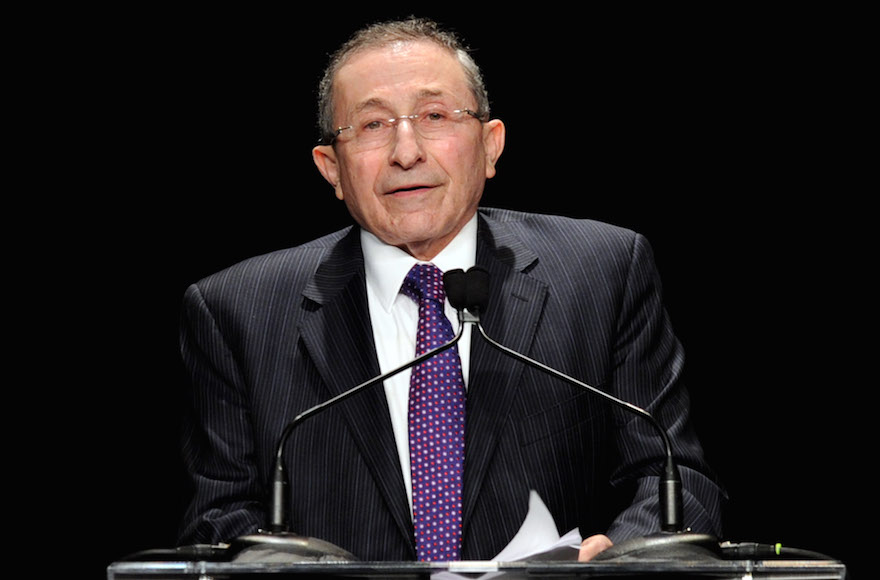
Rabbi Marvin Hier, founder of the Simon Wiesenthal Center, is slated to become the first non-Israeli to light a torch during Israel’s main Independence Day ceremony in Jerusalem.
Hier, who in January delivered a prayer during the inauguration of President Donald Trump in Washington, D.C., is one of three individuals selected for the honor by the Ministry of Culture and Sport, the Calcalist financial supplement of the Yediot Acharonot daily reported Friday.
Culture Minister Miri Regev decided last year to include non-Israeli Jews in the Independence Day torch lighting, saying their participation would symbolize the stake that Jewish people all over the world have in the Jewish state.
This year’s theme for the ceremony is “Jerusalem: the Eternal Capital of the State of Israel and the Jewish People.”
During his 2-minute prayer at the inauguration, Hier recited the Psalm 137 passage reading “If I forget thee, O Jerusalem, may my right hand forget its skill. The doer of all these shall never falter.”
Hier founded the Simon Wiesenthal Center in 1977 as an organization devoted to fighting anti-Semitism, bringing Nazis to justice and promoting tolerance through the Los Angeles-based Museum of Tolerance. Longstanding plans to build another museum in Jerusalem have foundered, in part over objections that is to be located on land that includes part of a historic Muslim cemetery.
Another honoree this year at the ceremony is said to be Amnon Shashua, a computer science professor at the Hebrew University in Jerusalem and co-founder of the Mobileye and OrCam startups.
Yehoram Gaon, a Jerusalem-born singer and actor, reportedly is the third honoree.
The official list of torch lighters is scheduled to be published next week following its final approval by the selection committee, Calcalist reported.
A British woman in her 20s studying in Israel was stabbed to death in Jerusalem allegedly by a Palestinian.
The woman, named by Israel’s envoy to the United Kingdom as Hannah Bladon, died following the Friday attack. She had been taken to the hospital in critical condition after suffering multiple stab wounds aboard the city’s light rail, Israel Radio reported. Police said she was attacked by a 57-year-old man from eastern Jerusalem’s Ras al Amud neighborhood.
Yoram Halevi, commander of the Jerusalem District of the Israel Police, told the radio station that the suspect is mentally ill and has a criminal record for domestic violence. He was apprehended at the scene.
“We know he recently tried to commit suicide,” Halevi said.
Israel’s envoy to the U.K., Marg Regev, condemned the attack on Twitter.
My thoughts are with the family and friends of UK student Hannah Bladon, who was murdered in a senseless act of terror in Jerusalem today.
Following the attack, police increased security in and around the light rail, police spokesman Micky Rosenfeld wrote on Twitter.
Police heightened security measures continue after terrorist knife attack by rasal amud resident. 23yr old woman on light rail was murdered. pic.twitter.com/mHY2fm6ulJ
jThe victim is a citizen of the United Kingdom studying in Israel, according to The Jerusalem Post.
The number of recorded terrorist attacks by Palestinians on Israelis increased last month by 15 percent from the previous month to 119 incidents, the Israel Security Agency, or Shin Bet, said in its monthly report published earlier this week. No one was killed; six were injured.
The 20 attacks recorded in Jerusalem in March constitute a 30 percent increase over the 14 there in February.
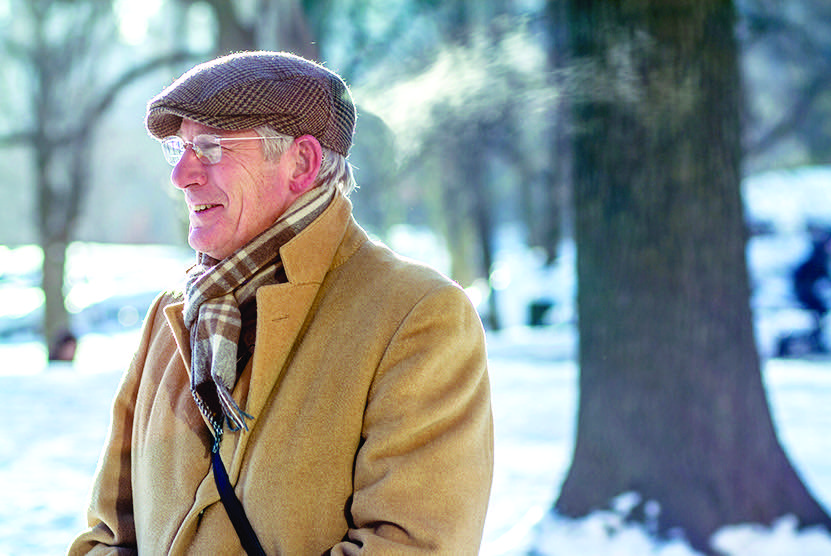
If you recall Richard Gere as the WASP-y hunk in “Pretty Woman,” it takes a mighty leap of the imagination to visualize him as Norman Oppenheimer, a New York shlub and small-time fixer.
But that’s the role he plays — and plays superbly — in “Norman: The Moderate Rise and Tragic Fall of a New York Fixer.”
Almost as unlikely is that the director and writer of “Norman” is Joseph Cedar, making his American movie debut. Though born in New York, his family made aliyah when he was 6 years old, and he has since made his mark as the director of some of the top Israeli movies of the past two decades. Two of his pictures have earned Academy Award nominations, “Beaufort” in 2007 and “Footnote” in 2011.
As Norman, Gere embodies that often annoying, sometimes pathetic and occasionally useful figure who will press his advice and services on you, whether you want them or not. He’ll tell you how to get the best deal at a store, find the best restaurant in town and knows — or pretends to know — the right person to fix your problems with city hall.
An inveterate name-dropper, Norman lives in the hope of attaching himself to an influential figure, whose real or imagined endorsement will earn him legitimacy and respect.
His lucky day arrives when he encounters an Israeli deputy minister of trade (Lior Ashkenazi) in New York, during a low point in his diplomatic career, and insists on buying him an exorbitantly expensive pair of shoes. Three years later, the shoe recipient has become the prime minister of his country and, at a reception, embraces Norman warmly. Suddenly, the fixer is perceived by New York’s Jewish elite as a man of real standing and influence, well worth cultivating.
But, as the full movie title indicates, Norman’s sudden rise is followed by an abrupt fall as he becomes the unwitting foil of a major political scandal.
This reporter first met Cedar, now 48, some 17 years ago in a very modest midtown hotel, when he came to Los Angeles to promote his first Israeli film, “A Time of Favor,” and was figuratively knocking on doors to establish some Hollywood connections. As an observant Modern Orthodox Jew, Cedar was an anomaly among the more hedonistic film colonies in Tel Aviv and Hollywood.
Later, when one of his films placed among the five Oscar finalists in the foreign-language film category, Cedar was asked to participate in the customary advance panel discussion among the five directors who had made the cut. Trouble was that the event was scheduled on a Saturday and Cedar wrestled with the problem of participating without violating Shabbat laws.
He didn’t mind walking a few miles from his hotel to the event venue — nearly unheard of in Los Angeles — but the question was whether he would be allowed to use a microphone during the panel discussion. Cedar phoned his rabbi in Israel and together they found a solution to the knotty problem.
The Journal reunited with the filmmaker again recently — this time he stayed at a fashionable Beverly Hills hotel and was in the company of Gere, still a strikingly handsome figure at 67. There, he considered how he managed the considerable leap from directing Hebrew-language Israeli films, with a necessarily limited international audience, to a major English-language American movie (though with some brief Hebrew conversations).
“In a sense, I was something like Norman and needed someone to open doors for me,” Cedar said.
Gere noted that when Jewish directors fled Nazi Germany and tried to gain a foothold in Hollywood, Charlie Chaplin gave them a leg up. In Cedar’s case, the door opener is Oren Moverman, an Israeli-American producer long established in New York, who also got Gere involved in the project.
The veteran actor of some 60 films, who was raised as a Methodist but now is a Buddhist, said of his role: “I never jumped as far away from who I actually am and from how I would react to the humiliations Norman endured. I have never remotely played a character like him.”
While the “fixer” persona, who attaches himself to someone in power, is certainly not a uniquely Jewish phenomenon, Jews as historically a small minority in host countries were more likely to cling to a more powerful protector, Cedar said, citing in particular the figure of the medieval court Jew.
Yet, there is a universal appeal — or revulsion — to the Norman character.
Gere recalled attending a film festival screening of “Norman” in Miami, at which the actor, asking for a show of hands, found that about 20 percent of the audience was Jewish and 80 percent Latino. Probing further, Gere concluded that “the Latinos got the essence of the Norman character just as clearly as did the Jewish audience.”
Cedar plans to helm at least one more American movie, he said, but Gere vowed that he had no interest in playing another Norman character. “Norman is so far out,” he said. “He is the most unique character I’ve ever met.”
“Norman” opens April 14 at the Arclight Hollywood and The Landmark and on April 21 at Laemmle’s Playhouse 7 in Pasadena and the Town Center in Encino.
Galka Scheyer, circa 1930. Photo courtesy of Norton Simon Museum, Blue Four Galka Scheyer Collection Archives
Artists and patrons of the arts who attended social gatherings in Los Angeles in the years between the two world wars would surely have met a loud, redheaded Jewish woman named Galka Scheyer. The German-born art dealer had a larger-than-life personality, and she harnessed her charisma to sell European modernism to an American audience. Her tireless efforts to promote the work of the so-called “Blue Four” — Lyonel Feininger, Alexei Jawlensky, Paul Klee and Wassily Kandinsky — also helped shape California’s reputation as a flourishing center for modern art.
Examples from Scheyer’s vast personal collection of modern art, along with hand-designed exhibition brochures and catalogues, correspondence and other ephemera, are on display at the Norton Simon Museum in Pasadena through Sept. 25.
“Maven of Modernism: Galka Scheyer in California” includes work by the Blue Four as well as paintings by Alexander Archipenko, László Moholy-Nagy, Pablo Picasso, Peter Krasnow and Kurt Schwitters, photographs by Edward Weston and Imogen Cunningham, and even drawings made by children who had taken Scheyer’s art classes.
She was born Emilie Esther Scheyer in Braunschweig, Germany, in 1889 to a middle-class Jewish family. The free-spirited, energetic Scheyer studied art and English in London, took painting lessons from artist Gustav Lehmann, traveled with him to Italy and studied at the École des Beaux-Arts in Paris, and then worked as a painter in Brussels.
In 1915, Scheyer encountered the work of Russian artist Jawlensky in Switzerland. She was extremely moved by a portrait of his called “The Hunchback.” She resolved to meet him, and soon became his close friend, model and agent, and got him included in a group show in Wiesbaden in 1921. That same year they visited the Bauhaus art school in Weimar, Germany, and Jawlensky introduced her to Feininger, Kandinsky and Klee, all instructors at the avant-garde school.
Her relationship with Jawlensky shaped the rest of her life. She gave up her own career as a fine-art painter to focus on promoting him and other artists. Jawlensky called her “Galka,” the Russian name for a small crow, known to be exceptionally intelligent, energetic and gregarious. She would later write to him in a 1936 letter, “I shall never forget those inspiring days when you initiated me into the sacred world of art. I shall never forget you really did make me what I am today.”
Scheyer convinced the four artists, in 1924, to make her their legal representative in the United States. They shared a common vision about art being a vehicle for a deeper understanding of the self and the world, and adopted the identity of the Blue Four not because of a shared aesthetic style, but largely for the sake of marketing. Scheyer equated the color blue with spirituality and unity. She organized the first American exhibition of their work at a New York gallery in 1925 and the following year traveled to California and began showing their work in major cities.
After the first California show, the San Francisco Examiner dubbed her the “prophetess of modern art.” She met William H. Clapp, the director of the Oakland Art Gallery, and convinced him to make her the gallery’s “European representative,” an unpaid position. She also taught art at the Anna Head School in Berkeley in the 1920s.
Scheyer was a force of nature. During the Great Depression and World War II, she arranged exhibitions, lectures and publications on the four artists’ work and negotiated sales on their behalf. Feininger affectionately called her “Little Tornado.” She befriended Diego Rivera and Frida Kahlo, who helped her stage a Blue Four exhibition in Mexico City in 1931. She also helped other European artists, including Moholy-Nagy, show their work in the United States.
Her success in selling work to L.A.-based modernist collectors Walter and Louise Arensberg fueled hopes of selling to other Hollywood collectors. She befriended such film stars as Marlene Dietrich, Harpo Marx and Greta Garbo, as well as film director and art collector Josef von Sternberg, who co-sponsored four Blue Four shows in L.A. in the 1930s.
The art did not sell itself. After the first Blue Four exhibition in Los Angeles in 1926, one artist remarked: “It reminded me of crawling things — of worms or things mouldering in the ground. Ugh! It was awful.”
Modernist art “was certainly much more avant-garde than the United States was used to,” said Gloria Williams Sander, curator at the Norton Simon Museum. “At that point in the ’20s, and even through the early ’30s, the taste for the day was still towards more realistic art. French Impressionism was very big. Of course, there was the Armory Show [the first large exhibition of modern art in America, held in New York in 1913], and the Dada artists were making inroads on the East Coast. But that was still a little bit of an outlier.
“So someone like Galka, who really understood the merits not only of German modernism but of abstract art — and could discuss those in a way that was digestible and inspiring — was really unique. … She made really great progress on behalf of those artists.”
Among the many important connections Scheyer made during that period were with Austrian-born architects Rudolph Schindler and Richard Neutra. She lived briefly in Schindler’s Kings Road House in West Hollywood in 1931, and in 1933 she commissioned Neutra to build her a concrete-and-glass house in the Hollywood Hills. The house served as an art gallery and meeting place for fellow art enthusiasts.
Scheyer visited Germany in 1932, but cut her trip short when she realized the peril she faced as both a Jewish woman and a promoter of modern art. Back in the States, she wrote letters and sent funds so that her two brothers could get their families out of Germany. They soon followed. Her mother, sadly, took her own life before being deported.
Scheyer’s first impression was not always favorable. The photographer Edward Weston wrote in his diary that “Galka repelled me at the start of our acquaintance” but that he later grew to enjoy her “insight of unusual clarity, and an ability to express herself in words, brilliantly, forcefully, to hit the nail cleanly.” Ceramic artist Beatrice Wood wrote, “When I first met Galka Scheyer I wanted to run. She was short, red-haired, plump, loud voiced — then I took myself to task. … The second time we met, I let go of esthetics and listened. I discovered an intelligent, caring woman and we became good friends.”
As a salesperson, she used her contacts to promote the work of the Blue Four. But she was also an outlier in the art world. She never married or had children, and she was not born to a wealthy family like Peggy Guggenheim.
“On the one hand, what she did was novel and wonderful. She also wore people down. There’s no way around it,” said Sander, the Norton Simon curator. “There were just times when people said, ‘I’ve had enough, I’m not going to buy this work.’ And she was lobbying because she was eager to sell it. And she did feel the responsibility to work on behalf of the four artists.”
When Scheyer died in 1945, she left her collection to UCLA with the same conditions as a 1944 gift of her friend Walter Arensberg’s modern art collection. Arensberg’s donation required UCLA to dedicate a building to his collection within five years; Scheyer additionally wanted the school to publish a catalogue of her collection.
When UCLA reneged on the Arensberg agreement, his collection went to the Philadelphia Museum of Art, while a committee donated Scheyer’s collection of 450 works by the Blue Four and other modern artists to the Pasadena Art Institute, which evolved into the Pasadena Art Museum. The late Norton Simon took over that facility in 1974 and fulfilled Scheyer’s provisions by publishing a catalogue of the collection. The Norton Simon Museum has since shown the work as part of its permanent collection and in several previous exhibitions.
What comes through most in “Maven of Modernism” is the deep friendships Scheyer forged with artists of her time. Maynard Dixon dedicated a pen drawing to Scheyer and called her “Madame Moderne Kunst,” or “Madam Modern Art.” The show includes several portraits of Scheyer. A Peter Krasnow painting depicts her lecturing an audience about modern art. And Edward Hagedorn painted her sitting on a crate, clapping her hands and looking up in rapt attention as a disheveled artist shows her his latest work.
“Maven of Modernism: Galka Scheyer in California” is on display at the Norton Simon Museum in Pasadena through Sept. 25. More information is at https://www.nortonsimon.org.
Most people recognize Albert Einstein as the brilliant German-Jewish physicist responsible for the theory of relativity and the equation E = mc2, but the man behind the science is considerably less well known. The new 10-part National Geographic series “Genius” seeks to remedy that by dramatizing Einstein’s achievements, struggles and relationships against a historical backdrop that spans the seven decades of his life.
Adapted from “Einstein: His Life and Universe” by Walter Isaacson, and executive produced by Brian Grazer, Ron Howard and Gigi Pritzker, the series stars Johnny Flynn and Geoffrey Rush, sharing the role of Albert Einstein. The two actors worked with the same dialect coach and compared notes via Skype to ensure consistency in their portrayals of Einstein in his youth and older years.
National Geographic’s first scripted series, “Genius” was shot on location last year in the Czech Republic. It was originally conceived as a movie, but Pritzker, who had optioned Isaac-son’s bio, spent “many years trying to fit the scope of his life into a movie, and it became very clear that that just wasn’t doable,” she said at a panel discussion in January.
Howard directed the first episode and, speaking on the same panel, said he was eager to direct “world class actors facing challenging material. The suspense comes from the fact that society came so close to not benefiting from Albert Einstein. Sometimes it was his own doing, his own foibles, but very often it was rigid thinking and sometimes bigotry that threatened to prevent the world from having what this remarkable individual had to offer. It’s not just a story of achievement, it’s also a story of struggle.”
That view is made clear from the beginning of the first episode, which opens in June 1922 with the assassination of a Jewish Reichstag minister, establishing just how dangerous times were becoming for German Jews. Einstein was 39 at the time.
“It was important to set the scene of what Germany was like in the 1920s, what kind of world Einstein was living in,” Noah Pink, co-executive producer and writer of the first and fourth episodes, said in a telephone interview. “In 1922, Hitler was a young man and just starting the National Socialist Party, but there were a lot of other right-wing groups that were prevalent at the time and very dangerous. Jews were being blamed for Germany’s defeat in World War I. Einstein was on a hit list.”
From there, focus shifts to the younger scientist, whose nonconformist thinking and rebellious behavior put him at odds with his father and teachers. “He wanted to be a professor, but he pissed off so many people that he couldn’t get hired,” Pink said. “He was forced to take a job as a patent clerk and he was depressed about it, but it was one of the most fruitful periods of his life, scientifically.”
Pink said presenting science in an understandable way was “an everyday challenge” for all of the writers, who relied on the expertise of a physics adviser to the production.
Pink related a story, included in the series, about the time Einstein was asked for his input on a film script about the making of the atomic bomb. “Einstein had a lot of notes. His main concern was that they weren’t getting the science right,” Pink said. “Knowing that story, I — and all the writers — tried to do our best to stay as true as possible to the science.”
Even so, their goal “wasn’t to get everyone to understand the intricacies of relativity, but to grasp what Einstein was going for and how he saw the world differently,” Pink said. “It’s not a science lesson. It was very important to pay homage to his work, but it was equally important to tell a story about a man with all his flaws.”
Einstein’s complicated love life — his marriages and affairs — also plays out in the series. “He didn’t believe in monogamy,” Pink said, noting his surprise at that detail and many others he learned while immersing himself in Isaacson’s source material, biographies and Einstein’s papers and letters, quotes from which were incorporated in the script.
Also used were Einstein’s views on religion and his relationship to Judaism and God, which were “ever-changing,” Pink said.
“His parents were Jewish but not practicing; his dad had a bit of an animosity toward Judaism and religion in general. To rebel against his father, Einstein’s reaction was to become extremely Jewish. He observed the Sabbath and kept kosher as best he could. When he gets to college and begins to read philosophy, he becomes atheist and believes the answer is in science, not spirituality.
“But as he makes his big discoveries, a new kind of spirituality grows in him, because the more he figures out about the universe, the more he realizes it can’t just be a fluke. He had a very human relationship with his religion, and I can certainly sympathize with that,” Pink, who is of Romanian and Polish-Jewish ancestry, added.
“I was always intrigued by his gall and his quirky humor and his brilliance, but after going down this two-year road, I became fascinated by this man who was not only a brilliant scientist but also a brilliant writer, philosopher, musician,” Pink continued. “He was a humanist, an outspoken pacifist, a Zionist. He was in many ways the first international celebrity. He lived through two world wars. He’s an icon, but few people know what he went through, who he was.”
True to its title, the series also explores the concept of genius, which Pink asserted “isn’t just something you’re just born with. Genius has to be cultivated your entire life, and it stems from an innate curiosity about the world and your surroundings. No matter his age, Einstein never stopped looking around him, taking nothing for granted, and asking questions.”
If he could ask Einstein anything, Pink said he’d request “a reading list, ask him advice on how to stay curious, and I’d ask him to explain general relativity, because no matter how hard I study it, it still confounds my brain,” he said, laughing.
“Genius” premieres at 9 p.m. April 25 on National Geographic Channel.
The song, “Lili Marlene,” was one of the most popular ditties of World War II, beloved by Allied and Axis soldiers alike for its tale of a soldier lamenting how war had separated him from his sweetheart.
The lyrics came from a World War I-era poem by the German author Hans Liep, which was set to music by composer Norbert Schulze in 1938.
But the tune struck Hitler’s propaganda chief, Joseph Goebbels, as antiwar, and he promptly banned it from the airwaves. Goebbels changed his mind after a Third Reich radio station in Belgrade, having lost most of its records in a bombing, began playing the song because it was one of the few albums that had survived the shelling. Axis soldiers went wild over the recording, sung by Lale Andersen. The song went on to be played every hour on the hour in Germany — and Allied troops listening to Radio Belgrade also became enamored of the wartime love anthem.
Los Angeles musical theater writer-composer Michael Antin, 78, first heard the tune as a boy on the radio during World War II — specifically, the version that had been later recorded by film star Marlene Dietrich. “ ‘Lili Marlene’ is just a beautiful, wonderful song, and certainly the throaty, heavy voice of Marlene Dietrich riveted me,” Antin said in a telephone interview from San Francisco.
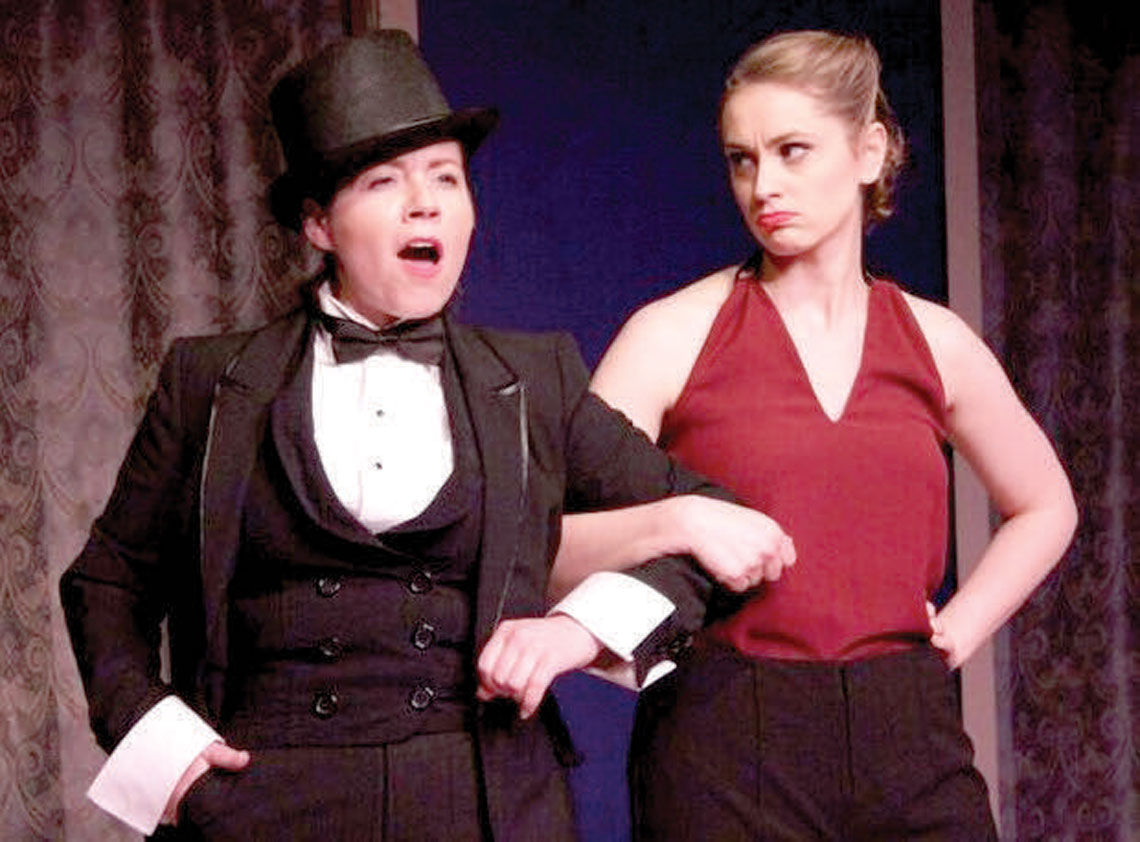
Memories of hearing the tune — which was eventually translated into English — helped inspire Antin’s new musical, “Lili Marlene,” now in its world premiere at the Write Act Repertory at the BrickHouse Theatre in North Hollywood through April 16.
In the show, Antin transforms Anderson into a fictional Jewish cabaret chanteuse, Rosie Penn, who hides her religious identity even as she repeatedly sings “Lili Marlene” on Nazi radio in 1933. At the same time, she romances a non-Jewish count, Willi, who is also forging passports to enable Jews to escape the Reich. His endeavors may ultimately help Rosie flee the country, along with his anti-Nazi niece, Janine, a medical student, and his 14-year-old nephew, Jacob.
As a boy in Beverly Hills, Antin attended Temple Beth Am and later taught confirmation classes at Temple Emanuel. At a young age, he began studying music with his mother, a piano teacher, as well as attending Rodgers and Hammerstein musicals at the Shrine Auditorium.
Antin worked odd jobs to put himself through UCLA, then law school at UC Berkeley. He became a tax attorney and also taught law at universities throughout the country for 45 years, until he retired on March 31, 2008.
A day later, he visited a local piano teacher in his quest to begin composing musical theater even though he had no previous experience. Nevertheless, he went on to write a number of shows, including 2015’s “Renewal,” inspired by a Jewish woman he had known who had struggled to recover from a disfiguring car crash.
Last year, his show “Pillars of New York,” about survivors of the Sept. 11 attacks in 2001, was staged after a visit to the World Trade Center memorial that moved Antin to tears.
“Lili Marlene” began when Antin’s producer, John Lant, suggested that he write a prequel to explore the origins of Jake, a psychologist who was a recurring character in four of the author’s earlier plays.
“Lili Marlene” reveals how Jake was once Jacob, Willi’s nephew, who seeks out a career in mental health, in part, in response to the ordeal his family endured before escaping the Nazis.
“Lili Marlene,” whose music is inspired by that of Richard Rodgers, also draws on the experience of Antin’s wife, Evelyn, who was born in the United States four months after her family’s flight from Germany in the wake of Kristallnacht in 1938.
“I wanted to explore the developing concerns that occurred for people who had foresight,” he said of those prescient enough to run from the Nazis. “I wondered, ‘What’s the psyche to be that kind of a person, and to have that kind of sense? … I also want audiences to understand the thread of freedom and democracy that can come from evil.”
For tickets and information about “Lili Marlene,” call (800) 838-3006, ext. 1, or visit writeactreptheatre.org.