fbpx

March 27, 2017

Netanyahu to Trump: Let’s vanquish ‘militant Islam’

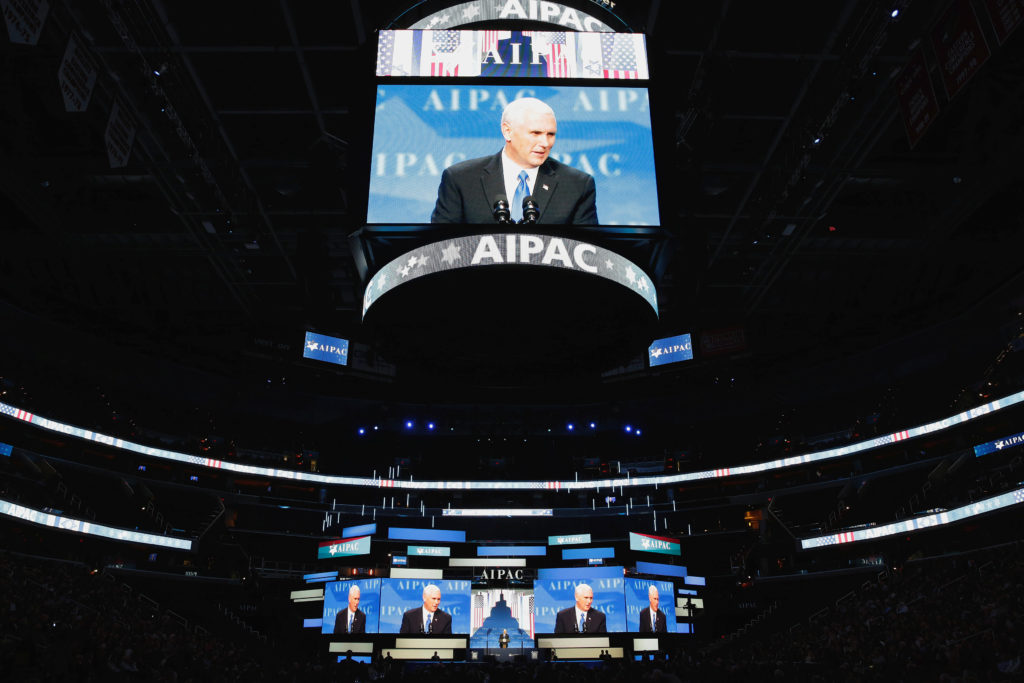
WASHINGTON (JTA) – Echoing the language favored by President Donald Trump, Israeli Prime Minister Benjamin Netanyahu told AIPAC that Israel would work with the United States to defeat the “forces of militant Islam.”

“We must be sure that the forces of militant Islam are defeated,” Netanyahu said in a video address Monday morning to the Israel lobby AIPAC’s annual conference in Washington, D.C.  “I’m confident the United States and Israel will stand together shoulder to shoulder to ensure light triumphs over darkness.”

Trump’s predecessor, Barack Obama, drew criticism from Republicans and Trump for not naming Islam as an element in the threat faced by the United States in the Middle East and domestically. Trump, in turn, has drawn criticism for unnecessarily alienating moderate Muslims for emphasizing Islam in phrases like “radical Islamic terrorism.”

Netanyahu has made clear his preference for Trump over Obama and he referred in his remarks to his meeting with Trump last month in Washington.

“As you know I had an excellent, warm meeting with President Trump,” he said. “I want to thank the president for his strong support for Israel.”

He praised Trump’s envoy to the United Nations, Nikki Haley, for “standing up for what’s right” at the body. The Obama administration, in its final days, for the first time allowed through an anti-settlements resolution on the U.N. Security Council, leading to openly bitter rebukes from Israeli officials.

Netanyahu intertwined the threat Israel perceives from Iran and its potential for acquiring a nuclear weapon with the threat from the Islamic State, or ISIS.

Trump’s focus has been the Islamic threat. Despite his campaign rhetoric deriding the deal Obama reached with Iran trading sanctions relief for a nuclear rollback, he has barely touched the issue as president.

Defeating militant Islam, Netanyahu said at the American Israel Public Affairs Committee gathering, “means confronting Iran’s aggression in the region and around the world. It means utterly vanquishing ISIS.”

Netanyahu sounded amenable to Trump’s bid to revive the Israeli-Palestinian peace process and extend it to a broader peace deal, although he reiterated familiar demands, including that the Palestinian Authority end incitement, stop payments to families of killed or jailed terrorists, and recognize Israel as a Jewish state.

He also extended a “warm” welcome to David Friedman, confirmed last week as ambassador to Israel in a mostly party-line vote. Democrats opposed Friedman, a longtime lawyer to Trump, because of his deep philanthropic investment in the settlements and  his demeaning broadsides against liberal Jews, which he said he regrets.

Netanyahu alluded to Friedman’s declaration last year, when Trump nominated him, that he hoped to serve as ambassador in Jerusalem. Trump, who as a candidate pledged to move the U.S. Embassy to Jerusalem, has retreated from the promise as president and now says he is considering it.

“David, I look forward to welcoming you warmly to Israel and especially to Jerusalem,” Netanyahu said.

Netanyahu to Trump: Let’s vanquish ‘militant Islam’ Read More »

I’m rubber, you’re glue: Iran and Hamas impose sanctions targeting US, Israel

Israel’s archenemies apparently couldn’t wait until April Fool’s Day.

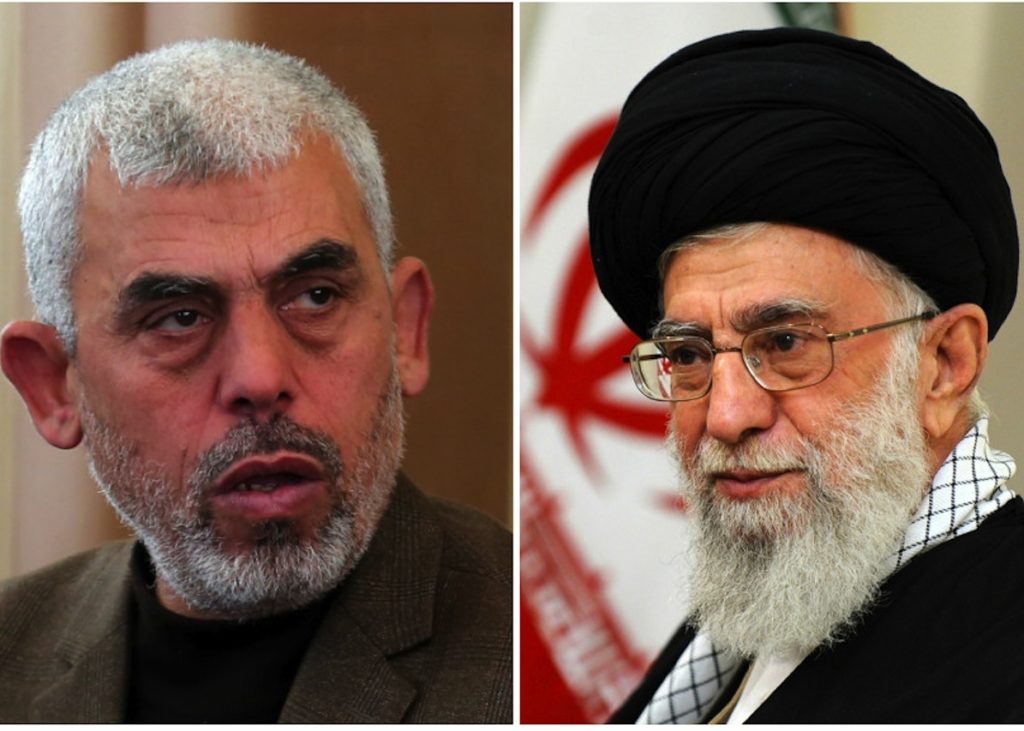
On Sunday, geopolitics got all “hafouch,” or turned upside down, as they say in this country. Iran imposed penalties on U.S. firms for working with Israel, and Hamas closed its border with the Jewish state. Stereotypically, of course, it’s the other way around, with the United States and Israel doing the sanctioning of Iran and Hamas.

According to Iran’s IRNA state news agency, the “reciprocal” sanctions on 15 U.S. companies are for alleged human rights violations and cooperating with Israel. IRNA quoted Iran’s foreign ministry as saying the companies had “flagrantly violated human rights” and cooperated with Israel against the Palestinians.

Iran’s seizure of the companies’ assets and ban on contact is largely symbolic since the companies don’t do business with Iran. Among the targeted firms are Re/Max Real Estate, which Tehran accuses of “buying and settling home in settlements located in the occupied territories.”

Emily Landau, a senior researcher at the Institute for International Security Studies, a leading Israeli think tank, said Iran actually has a long history of using the United States’ tools against it.

“This is well-known Iranian tactic of turning the tables on the U.S.,” she wrote in an email to JTA. “Iran has done it many times before over the past years. They take the same messages that the U.S. sends them, about how Iran must do this or the other, and sends them back in reverse.”

Meanwhile, in a rare move, Hamas shut the Erez crossing, which is how people move between Israel and Gaza, due to the assassination of a senior official in its military wing Friday. Hamas officials have blamed the Israeli intelligence agency Mossad for the killing of one of its top military leaders, who was shot dead by unknown gunmen Friday in Gaza.

“The closure is being implemented as part of the steps taken by Hamas security forces as a result of the crime of the assassination of Mazan Fukha,” the spokesman for the Interior Ministry said in a post on his official Facebook page.

Israel has maintained a blockade of Hamas-run Gaza since 2007, but it grants permits for people to cross through Erez for business or humanitarian reasons. Hamas apparently suspects that collaborators with Israel were involved in the shooting. Israel has not commented.

So far, Hamas has refrained from responding with rockets. Israeli analyst Avi Issacharoff wrote in The Times of Israel Sunday that Hamas may be looking to avoid a new war.

“Yet, for all its rhetoric, Hamas has yet to show any firm evidence of Israeli involvement, a fact that may give the organization the political maneuvering room to avoid a dramatic response that could lead to a full-fledged confrontation,” he wrote.

But he noted the group’s new Gaza chief, Yahya Sinwar, was known to be dangerous and unpredictable when he was head of Hamas’ military wing, and Israel-Hamas tensions can heat up quickly in the summertime.

U.S.-Iran relations have also gotten hotter President Donald Trump took office in January. Twice in as many months the United States has imposed new sanctions on foreign individuals and companies for allegedly supporting Iran’s weapons program. Last month’s sanctions also targeted Iran’s Revolutionary Guards.

In response to a proposal by U.S. lawmakers to go further and brand Iran’s elite Revolutionary Guards a terrorist organization, a senior Iranian lawmaker threatened that his country could do the same to the CIA.

Imitation may be the highest form of flattery, but in international conflict it tends to escalate.

I’m rubber, you’re glue: Iran and Hamas impose sanctions targeting US, Israel Read More »

Notes from AIPAC: The lobby’s greatest battle of all time

AIPAC, whose annual policy conference opened yesterday in Washington, does not always win its battles. I wish it could, but that is not the case. More than thirty years ago, it surrendered to President Ronald Reagan – and an AWACS deal between the US and Saudi Arabia that AIPAC opposed and the president wanted was passed. More recently, it similarly surrendered to President Barack Obama – and the Iran nuclear deal that AIPAC opposed and the president wanted also passed.

In between these two there were other, smaller battles, some won, some lost. There were times of crisis, there were times of triumph. The lobby never rests, its opponents never rest, the Middle East never calms down. If it isn’t Iran, it is Syria; and if it isn’t Syria, it is Hamas, or Egypt, or the Palestinian Authority. But the battle lines are usually clear: on the one hand there’s what AIPAC pushes for – often similar, but not always identical, to what the Israeli government pushes for. On the other hand there is an administration that does not always accept AIPAC’s recipe, supported by organizations and governments for whom the US-Israel alliance is not as important, for whom Israel’s well being is not as important, or for whom what Israel believes to be in its best interest matters little – because they know better.

This year, and this is evident in almost every session I attended at the first day of the AIPAC conference (I’m attending as a speaker, cost covered by the organization), there is a different battle to be waged. It is a battle no less consequential, against a force much more profound than any American administration.

Administrations come and go. Political circumstances change quickly. Coalitions can overcome foes. You twist an arm here, you make a deal there. That’s politics.

But today AIPAC is trying to fight against social trends much stronger than a passing administration, much stronger than itself. It is battling the forces that make America a much more polarized society, a place in which a consensus, or a bipartisan cause, are a rarity. It is battling the forces (these are not always the same forces) that make the American Jewish community much less cohesive and much less likely to come together in support of one cause.

AIPAC is sailing against the wind by insisting on being an organization of “many voices, one mission.” Listen to AIPAC President Lillian Pincus’ address:

“Americans across the country are retreating to ideological corners. Too often we’re divided into us versus them, Democrat versus Republican. Goals are served by creating division, highlighting differences to score political points and advance partisan agendas. My friends, support for Israel is not immune to these divisive efforts. Elements on each side of the aisle are trying to fracture our movement to advance their own agenda, yet we’ve come together to take a declarative and defining stance, we will not allow—frankly, we cannot allow– support for Israel to fall victim to the same divisiveness that overwhelms nearly every other political issue.”

As I was listening to her, and to other statements of this nature later during the first day of deliberations, a nagging thought kept creeping back at me: Is it really in AIPAC’s power to prevent Israel from falling “victim to the same divisiveness that overwhelms nearly every other political issue״?

The hundreds of Jewish protesters outside the convention center made such a goal seem even less within reach. They were loud. They were angry. They did not come to engage or negotiate. They came to disrupt. They claim that AIPAC can’t speak for the community. Is this true? Maybe it is and maybe it isn’t, but what is certain is that the protesters can’t speak for the community either – 18000 delegates attending the policy conference prove that. They can’t represent the protesters – but the protesters surely can’t represent them.

So, in fact, what the protesters are saying is that no one can speak for the community. They are not just challenging AIPAC – they are challenging the idea that someone, anyone, can speak for the American Jewish community on a matter that surely ranks high on the list of Jewish matters. The protesters sail with the wind. They preach for a fractured, polarized, Jewish community. They preach for rage, disruption, resistance. And they are joined by other rebellious voices.

Such is the voice of Molad, an Israeli radical leftist think-tank, whose executive director warned AIPAC yesterday to stop the masquerade: “Either it does not play a role in the political arena, and then is forbidden to interfere in controversial issues… or it has positions on issues such as the Israeli-Palestinian conflict or Iran, and then must stop claiming it is not identified with either one of the camps.” In other words, AIPAC must choose. Either AIPAC says nothing of significance, or it becomes a partisan organization. That is, because today no significant position can be agreeable to people who do not belong to the same political camp.

But clearly, AIPAC and the many delegates who came here to support it have no desire to choose. They have no desire to declare themselves inconsequential, or to marginalize the organization by declaring it a representative of a certain political camp – they have no desire to sail with the wind. Counter to what you might expect or think about this institutional conservative behemoth – AIPAC is now the rebel warrior. While everybody is going in one direction – polarization– AIPAC is trying to go in the other direction. While everybody accepts a new reality – fragmentation– AIPAC is attempting to take a different path.

The question is not whether this battle for bipartisanship and unity will be easy. It cannot be easy. The question is whether this battle is winnable. The question is whether under the current circumstances this battle is worth fighting.

Two years ago, when AIPAC was fighting against the Iran deal, many sober observers of the Washington political scene were arguing that the deal is a done deal and that AIPAC should not climb the tree of resistance. There were even those within the circle of AIPAC supporters and funders who realized that the battle against president Obama was unlikely to succeed. But an argument was made at the time that there is no point in even having AIPAC if it doesn’t wage a battle against the deal. An argument was made at the time that some battles are worth waging no matter the odds of success.

It is not unreasonable to wonder if the battle to have “many voices” and “one mission” falls into the same category. It is not unreasonable to ask how many voices can truly share one mission without having to water down that mission.

Yesterday, I counted eighteen thousand.

 

Notes from AIPAC: The lobby’s greatest battle of all time Read More »