fbpx

March 26, 2017

Hamas closes border between Israel and Gaza

Hamas closed the border crossing between the Gaza Strip and Israel following the assassination of one of its commanders.

The border crossing was closed Sunday in an effort to prevent the assassin or assassins from leaving Gaza. The Rafah border crossing with Egypt also reportedly has been closed by Hamas.

Thousands attended the funeral for Mazan Fukha in Gaza on Saturday, which was attended by Hamas senior official Ismail Haniyeh, Ynet reported.

Fukha was assassinated on Friday night outside of his Gaza home, according to reports. Hamas is blaming Israel’s Mossad for his death. Mourners shouted “revenge” against Israel during the funeral, the AFP news agency reported.

The Israeli side of the Erez crossing, the only place where people cross in and out of Gaza, will remain open. The Kerem Shalom crossing, which is used for goods and humanitarian aid, also will remain open, according to Israeli officials.

Fukha, who Israel says founded Hamas in the West Bank and helped coordinate terror attacks against Israelis, was jailed in Israel after being found responsible for suicide attacks that killed hundreds of Israelis during the second Intifada.

He was released from prison in Israel in 2011, as part of the Gilad Shalit prisoner exchange and ordered deported to Gaza.

Hamas closes border between Israel and Gaza Read More »

Pence touts Trump to AIPAC as defender of Israel and the Jews

Vice President Mike Pence delivered a fierce defense to AIPAC of President Donald Trump as a defender of Israel and the Jewish people.

“He’s a man of action,” Pence said of Trump Sunday, closing out the first day of the annual American Israel Public Affairs Committee policy conference. “For the first time in a long time America has a president who will stand with our allies and stand up to our enemies.”

The line earned warm applause, and Pence suggested that Trump, whose popularity ratings are unusually low for a new president because of recent legislative and legal failures, was popular among the 18,000 AIPAC activists in attendance.

“Thanks to the support of so many in this room President Trump won a historic victory,” he said. “All of you helped elect a president I know will make America great again.” Trump’s campaign slogan earned more applause.

Pence’s assumption of AIPAC support of Trump came amid the lobby’s endeavor to restore its reputation as a bastion of bipartisan support for Israel.

Pence also cast Trump as a defender of Jews, saying he was “never prouder” than when Trump condemned last month’s vandalism at a Jewish cemetery near St. Louis. But Trump’s statement, delivered through the White House, came several days after the vandalism and amidst criticism by many Jewish groups that he hadn’t denounced anti-Semitism earlier or more forcefully. Pence, in contrast, visited the cemetery and assisted in cleaning it up.

Pence, like other speakers at AIPAC, noted the change in rhetoric at the United Nations when it comes to Israel. Nikki Haley, the new envoy to the body whose name when mentioned at this conference earns robust applause, has been outspoken in defending Israel at the body, and helped bring about the withdrawal of a report by a U.N. affiliate likening Israel to an apartheid state.

The Obama administration also defended Israel in multiple U.N. forums, but the relationship ended on a sour note when as one of its final acts in December it allowed through an anti-settlements resolution.

“The United States will no longer allow the United Nations to be used as a forum for invective against Israel,” Pence said.

Pence also said he was looking forward to swearing in as ambassador David Friedman, Trump’s longtime lawyer who was confirmed by a deeply divided Senate, mostly along party lines. Democrats opposed Friedman because of his deep philanthropic investment in the settlement movement and his broadsides against liberal Jews.

On a range of other issues that AIPAC has long sought from successive U.S. presidents, Pence was cautious. Trump, he said, was “giving serious consideration” to moving the U.S. embassy from Tel Aviv to Jerusalem, retreating from Trump’s campaign promise to do so. The Iran nuclear deal reached by Obama, reviled by Republicans, Israel’s government and AIPAC, was “disastrous,” Pence said, but offered no hint Trump would touch it.

Trump also wants to see Israeli-Palestinian peace, Pence said, “and undoubtedly there will have to be compromises,” an allusion to Trump’s asking Israel to slow down settlement building.

Pence touts Trump to AIPAC as defender of Israel and the Jews Read More »

IfNotNow protesters dance, chant outside AIPAC conference

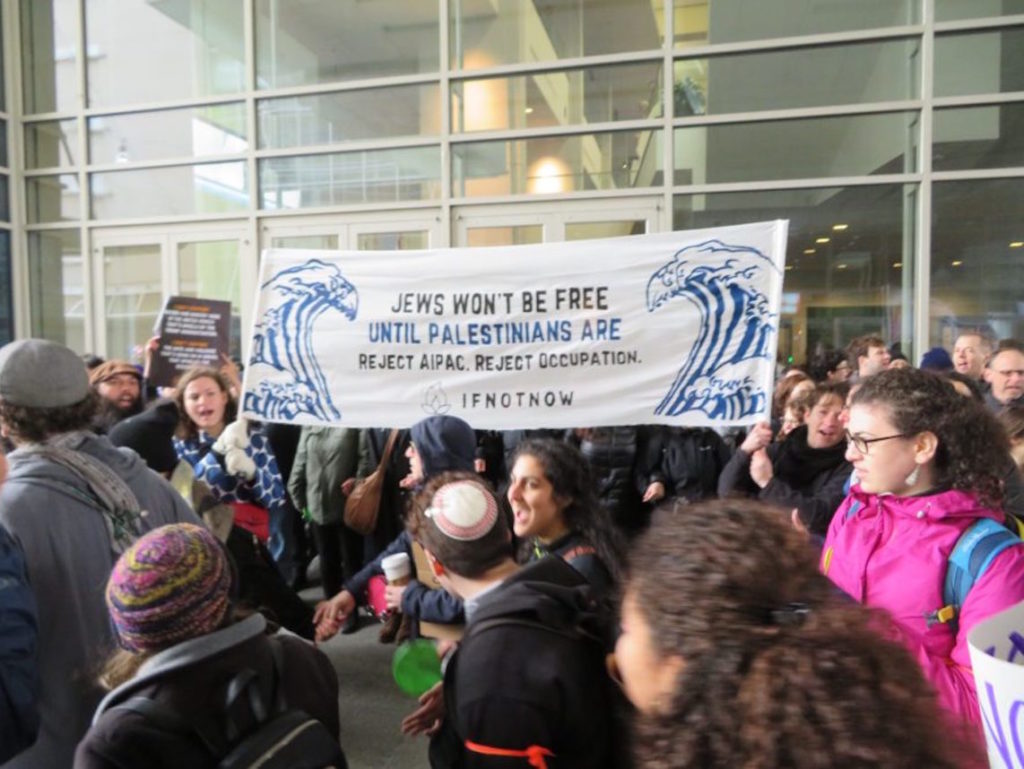
Several hundred protesters coordinated by IfNotNow, a Jewish anti-establishment group, spent hours dancing and chanting outside AIPAC’s annual policy conference.

The placards and chants targeted the American Israel Public Affairs Committee for what the protesters said was its backing for Israel’s occupation of the West Bank and for not speaking out robustly against President Donald Trump.

Protesters bore a banner saying: “Jews won’t be free until Palestinians are, reject AIPAC, reject occupation.”

Police allowed the protesters to reach the Washington Conventions Center’s glass doors. Some AIPAC activists stopped and took pictures of the protesters, as the protesters looked back, some waving and grinning.

“How can we have a sustained Jewish community in this country and a democratic Jewish community in Israel” as long as an occupation persists said Jeremy Zelinger, one of the protesters. “AIPAC does not represent us.”

AIPAC does not formally back the occupation and favors a two-state solution to the Israeli-Palestinian conflict, albeit in relatively muted tones. It blames the Palestinians entirely for the absence of peace talks and does not criticize Israeli policies, including settlement building.

Another theme was AIPAC’s supposed failure to confront the Trump administration on a range of other issues, including its restrictive policies on immigrants and refugees. AIPAC has rarely if ever pronounced on any U.S. government’s policy not having to do with Israel or its interests.

Several protesters bore placards imprinted with the image of Dona Gracia Nasi, the 16th century Jewish entrepreneur who used her wealth to rescue Jews fleeing the inquisition. “Reclaim, reimagine, resist,” the posters said.

A dozen protesters carrying flags of the Jewish Defense League occasionally clashed with the protesters, and police intervened.

AIPAC has drawn 18,000 activists to its policy conference this year, the largest ever. The theme is bipartisan support for Israel, and speakers include Vice President Mike Pence and both parties’ congressional leaders.

IfNotNow protesters dance, chant outside AIPAC conference Read More »

Head of GOP in Israel says ‘self-hating Jew’ Sarah Silverman ‘needs a muzzle’

The leader of Israel’s main Republican group called Sarah Silverman a “self-hating Jew” and said she “needs a muzzle.”

Marc Zell made the comments Saturday night on behalf of the Republicans Overseas Israel Facebook page, which he manages as the group’s co-chairman. The post links to a blog post about a decade-old video clip of the Jewish comedian performing her standup show “Jesus is Magic.”

The Feb. 2 blog post by conservative documentary filmmaker Pat Dollard is titled “Jew Sarah Silverman: “I Hope The Jews Did Kill Christ. I’d Fucking Do It Again In A Second,” and features Silverman delivering a version of that line.

Zell, an attorney who lives in the West Bank settlement Tekoa, said Silverman’s comments “damage” the Jewish community and insult Christians. He said it falls within the mission of Republican Overseas Israel to “call down” public figures like Silverman.

“Republicans Overseas Israel exists in order to not only represent the Republican Party here in Israel but also to represent the Jewish community in Israel to the Republican Party and the millions of Americans who support the Republican Party and our president,” he told JTA Sunday. “I think it’s appropriate to say something about a public figure as widely known as this woman, who during the campaign also had some ‘precious’ views to express about our candidate and our president. People like her need to be called down when they step over the line.”

Silverman — who supported Sen. Bernie Sanders, D-Vt., and then Hillary Clinton, for president during the 2016 election campaign — has been an outspoken critic of Trump. Last March, during the Republican primaries, she appeared on TBS’ “Conan” dressed as Adolf Hitler and complained of her character being “unfavorably” compared to Trump.

Republican Overseas Israel held a get-out-of the-vote campaign in Israel for Trump during the general election, and Trump and Vice President Mike Pence recorded video messages for an event the group held in Jerusalem in October. Zell claimed a record number of Americans in Israel cast absentee ballots, though that was widely disputed.

One of Donald Trump’s most prominent boosters in Israel during the campaign, Zell continues to combatively advocate for and defend the president, along with Israel and the settlements. On the Republicans Overseas Israel Facebook page Thursday, he also deemed the Israeli-American teenager from Asheklon who was arrested last week on suspicion of calling in more than 100 bomb threats to Jewish Community Centers across the United States “The Ultimate Self-Hating Jew.”

Four women had commented on Zell’s Facebook post about Silverman Sunday, all agreeing with its sentiment. One invited Silverman to visit the Hamas-governed Gaza Strip, saying “Your friends are there, you’ll feel really comfortable and soon the rainy season is over so you won’t drown in your bed.” Others called her a “Trash box” and a “pig.”

Zell responded in a comment Sunday: “Better not to even pass her stuff around. I’m hitting delete.” But the post remained up.

Jerusalem-based journalist Noga Tarnopolsky in a tweet called on the Republican Party and the Republican Jewish Coalition to “do something” about Zell, saying of Zell’s Silverman tweet: “This is in your name.”  She also tweeted to the Anti-Defamation League, saying: “Hi & : An online troll is confusing a prominent Jewish woman with a dog. Do something.”

Head of GOP in Israel says ‘self-hating Jew’ Sarah Silverman ‘needs a muzzle’ Read More »

Arkansas legislature passes law prohibiting deals with companies that boycott Israel

The Arkansas state legislature has passed a law that prohibits state agencies from contracting with or investing in companies that boycott Israel.

The law was sent to Arkansas State Gov. William Hutchinson on Friday for his signature.

The bill passed the state House of Representatives on its third reading on Wednesday by a vote of 69 to 3. It had passed the Senate earlier in the month by a vote of 29-0 with one abstention.

The bipartisan legislation to counter the Boycott, Divestment and Sanctions or BDS movement agaisnt Israel was sponsored by state Rep. Jim Dotson and state Sen. Bart Hester.

“Israel and Arkansas are great friends, and I thank the people of Arkansas for supporting this essential relationship, which is based on shared values,” said Josh Block, president and CEO of The Israel Project, in a statement. “By passing this bill today, Arkansans are standing strong against discrimination, and are solidly on the right side of history.”

More than a dozen U.S. states have passed similar legislation.

Arkansas legislature passes law prohibiting deals with companies that boycott Israel Read More »

AIPAC opens conference with appeal to bipartisanship amid polarization

AIPAC launched its annual conference with an appeal to bipartisanship, but Israel’s Ambassador Ron Dermer made clear his government’s preference for the Trump administration over its predecessor.

AIPAC President Lillian Pinkus cast the American Israel Public Affairs Committee, in her opening remarks, as an island of bipartisanship in an increasingly polarized political climate.

“Our nation is embroiled in difficult debates touching on who we are, what we believe, and what values we prioritize,” Pinkus said. “Americans across the country are retreating into ideological corners.”

Dermer, speaking at the same opening plenary, said that for the first time in years there was “no daylight” between Israel and the United States, and commended the Trump administration for “finally” bringing moral clarity to the United Nations.

Pinkus decried those who highlight political divisions to “score political points.”

“Support for Israel is not immune,” she said. “Elements on each side of the aisle are trying to fracture our movement.”

AIPAC has over the last year come under pressure from both the left and the right. Right-wing Republicans say divisions between Israel and the United States under the Obama administration were so profound and have so infected Democrats that Israel’s best path forward now is in an alliance with Republicans.

Liberal pro-Israel groups say President Donald Trump’s policies, particularly his animus toward Muslims and other minorities, and his retreat from endorsing a two-state outcome to the Israeli-Palestinian conflict necessitate attaching the pro-Israel movement to resistance to Trump.

Pinkus’s message was an old one for AIPAC but freshly relevant to the climate: The best way to preserve the U.S.-Israel relationship is to work with both parties.

“We will not allow, frankly cannot allow, support for Israel to fall victim to the same divisiveness that overwhelms” other issues, she said. “We will work harder than ever before to hold the ideological center.”

Dermer also ostensibly pitched bipartisanship, but made it clear his government was relieved at the departure of President Barack Obama and his team.

“Perhaps for the first time in many decades there is no daylight between our two governments,” he said. Dermer may have misspoke, however; the embassy tweeted out the quote as “many years.”

Dermer listed among areas of comity a joint rejection of the Iran nuclear deal reached by Obama, although it is not clear that Trump favors scrapping the deal.

He also twice praised the Trump administration and its U.N. envoy, Nikki Haley, for “finally” bringing moral clarity to the United Nations. Throughout President Barack Obama’s eight years, the United Nations was an arena where both nations worked closely; that was marred, however, in December when as one of its last acts the Obama administration allowed though an anti-settlements resolution.

Dermer praised several Republicans slated to speak at the conference, but only one Democrat: Sen. Robert Menendez, D-N.J., one of only two Democrats to vote last week to confirm David Friedman as ambassador to Israel. Friedman was seen by Democrats as a divisive choice by Trump. A longtime lawyer to the president, he is heavily invested philanthropically in the settlement movement, and he has heaped abusive language on liberal Jews, something he apologized for during confirmation hearings.

AIPAC opens conference with appeal to bipartisanship amid polarization Read More »

A Jubilee Haggadah Marking the 50th Year Since the 1967 War

A new Haggadah has just been published by SISO (“Save Israel – Stop the Occupation”). It is called the Jubilee Haggadah because it marks the 50th year since the 1967 War, a turning point in the history of the modern State of Israel that the writers and editors conjoin with the biblical Jubilee commandment – “You shall proclaim liberty throughout the land for all its inhabitants. It shall be a jubilee for you…” (Leviticus 25:10) – and with the celebration of Passover, the festival of liberty.

The Haggadah is part of a new initiative begun by prominent Israeli individuals and organizations in partnership with Jewish leaders around the world who believe that the prolonged Israeli military occupation poses a very real threat to Israel’s safety and well-being, and undermines the moral and democratic fabric of Israel and its standing in the community of nations. See SISO’s website – https://www.siso.org.il.

Critics will argue that this Haggadah does not provide adequate historical context nor, in the words of one of its contributors, Professor of Jewish History at Ben Gurion University Haviva Pedaya, a “political outline of how to bring about a solution” to the Israeli-Palestinian conflict.

Dr. Pedaya acknowledges:

“Nor is one party alone guilty for the complex situation. In broad visions, the discussion about the concept of the victim and the subjugator is most complex. But those people who ate potato peels on Seder nights, who recited by heart the Haggadah in the concentration camps, like those people who ate the manna in the desert or those slaves whose children drowned in mortar and were built into the pyramids – those people come to us with the demand: turn the face of the brother to the other and to responsibility.”

So many Jews and lovers of the State of Israel have come to accept what seems to be a historical inevitability, that Israel will forever occupy another people. This Haggadah addresses the moral consequences of failing to advocate for the only solution that can best assure Israel’s Jewish and democratic character – a two-states for two peoples resolution of the Israeli-Palestinian conflict.

SISO’s editor and publisher describe the Haggadah in these words:

“Thirty authors, artists, and thinkers from throughout the Jewish world have joined together — in commentary, song, and moral outcry — and proposed contemporary interpretations to the Haggadah.

From Amos Oz to Sarah Silverman, Achinoam Nini to Leon Wieseltier, Anat Hoffman to Carol Gilligan, in this fiftieth year, we are proclaiming liberty throughout this land for all its inhabitants.

The Haggadah is edited by Dr. Tomer Persico. The texts are rich, nuanced and diverse, and together with the original artwork and design (by leading Israeli graphic designer Michal Sahar) make this a beautiful work that invites reflection and conversation.

I am honored to be among the thirty contributors (page 4 – item 1). I offer a few commentaries to evoke the spirit of this Haggadah. The entire text that can be downloaded at nif.org/sisohaggadah:

“We were not born to be people of masters… We are condemned now to rule people who did not want to be ruled by us… The shorter the occupation lasts, the better for us, because an occupation is inevitably a corrupting occupation, and even a liberal and human occupation. I have fears about the kind of seeds we will sow in the near future in the hearts of the occupied. Even more, I have fears about the seeds that will be implanted in the hearts of the occupiers…” (Amos Oz – Davar, August 22, 1967)

“We must care for each other. We must see each other clearly… as equal under God … We must recognize each other’s humanity, aspirations, rights, emotions … at the end of the day, the only way to be saved by God from whatever ‘Egypt’ is enslaving you, is to love your neighbor as you love yourself.” (Achinoam Nini – Noa – Israeli singer and peace activist)

“Now that we have returned to the land by the grace of God, and are privileged to move through all of the land of Israel and to settle in it, we have to protect ourselves and to safeguard our security – but not to base our existence on life by the sword. We are tested by our ability not to rule another people by ‘force,’ but to live here by ‘My spirit.’ In other words, to build a model society. If in Egypt we became foreigners who were denied all rights to existence, liberty, and the land, and in this lay the root of our subjugation, we must not do to others what we ourselves hate. The Palestinian people that lives among us also needs its land, its existence, and its liberty…. Only through a brave conjoining of all the children of Abraham who dwell in this land will God’s blessing to our forefather Abraham, and ‘all of the nations of the earth shall be blessed in him’ come true for us.” (Rabbi Michael Melchior, Jerusalem thinker, activist and former Israeli government minister)

“Of all people, Jews know the bitterness of being oppressed – and not being in our own country. That’s what makes the occupation so ironic. Sometimes it’s hard to tell the difference between right and wrong, the situation is complicated and scary, but I’m guessing oppression will always prove to be on the wrong side of history.” (Sarah Silverman, comedian, and actress)

“The quarrel between Israel and Palestine has been a bleeding wound for decades, a wound that is hemorrhaging and is full of pus. You can’t keep waving a big stick and beating a bleeding wound again and again so as to scare it and make it finally stop being a wound and finally stop bleeding. A wound has to be healed. And there’s a way to gradually heal this wound.” (Amos Oz, January 2017)

I recommend downloading the entire Haggadah and using whatever commentaries you choose during the course of your own Seder.



A Jubilee Haggadah Marking the 50th Year Since the 1967 War Read More »

Sunday Reads: What America stood for, A last chance for Turkish democracy, The current state of Russia’s Jews

US

Tom Malinowski laments how, to the rest of the world, America no longer stands for the values it used stand for:

The global club of autocrats has been crowing about Trump. Sudan’s dictator Omar al Bashir praised him for focusing “on the interests of the American citizen, as opposed to those who talk about democracy, human rights, and transparency.” Iran’s Supreme Leader Ayatollah Khamenei thanked him for showing “America’s true face” by trying to ban Muslim immigration. The Cambodian government justified attacks on journalists by saying Trump, too, recognizes that “news published by [international] media institutions does not reflect the real situation.”

Lee Smith tries to figure how America can beat ISIS:

Secretary Tillerson is right that defeating ISIS should be an American priority and would signal the return of American leadership. However, the battle against the Islamic State is part of a larger regional picture. As Israel’s airstrikes showed, our key Middle East ally is defending against the same forces that the Trump administration may be tempted to think are useful partners in the anti-ISIS campaign… The anti-ISIS campaign cannot succeed without vigilance against Iran and its allies. The Obama administration’s realignment with Iran was wrong and dangerous and also deliberate. With equal deliberation, the Trump White House needs to set a new course.

Israel

Major-General (res.) Amos Yadlin believes Israel should start reconsidering its Syria policy:

the trends taking shape in Syria right now require an update of the Israeli policy. The most significant variable is the Russian military presence and dominance in Syria, alongside Iran’s support, which helped the Syrian regime recover and rebuild its self-confidence. In this context, Israel should clarify its strategic targets again and continuously and thoroughly review the benefit of its moves versus the risk of unwanted escalation. The basic component is establishing and reinforcing the deterrence, and Israel must also make it clear both to Lebanon and to Syria that putting their territory and infrastructure at the disposal of Iran and Hezbollah’s terror infrastructure means serious future damage to the army, regime and national infrastructure of these countries.

Israeli diplomat Ron Prossor praises Britain’s decision to take action against Israel-bashing at the UN:

The UK did vote for two of the five resolutions against Israel and abstained on two more, which is not ideal. But whether prompted by the FCO or by Downing Street, it decided there must be limits to the Council’s hypocrisy, duplicity and dishonesty.

Britain broke ranks with the other European members and voted against a resolution regarding Israel and the Golan Heights. “We cannot accept the perverse message sent out by a Syria Golan resolution that singles out Israel, as Assad continues to slaughter the Syrian people,” said Braithwaite.

Middle East

Dexter Filkins writes about the last chance for Turkish democracy:

What the referendum amounts to, essentially, is an attempt to overturn Turkish democracy, and to rubber-stamp the authoritarian powers that Erdoğan has been pursuing for the past decade. (You won’t hear any criticism of Erdoğan from Europe, by the way. Erdoğan, having agreed last year to hold back the tide of refugees from the Middle East, has the continent’s political leaders over a barrel.)

Bruce Riedel discusses the Saudis’ enthusiasm for Trump:

The US-Saudi partnership dates to 1943 when King Ibn Saud sent his son Prince Faisal to Washington to meet President Franklin Delano Roosevelt in the Oval Office, and two years later the king and FDR met face to face in Egypt. The entente has always enjoyed bipartisan support. Democrats and Republicans have been backers of strong ties to the kingdom. Riyadh would be wise to steer clear of becoming identified with either party in the United States as it navigates the most polarized politics in modern US history.

Jewish World

Mosaic’s monthly essay and the responses to it offers a curious discussion of the current state of the Jews of Russia (the last instalment is by Dovid Margolin):

Almost folklore: in Russia today, there’s an official story, which is heartening and positive, adhered to by the regime and by many Jewish community leaders and activists. And then there’s what might be thought of as a coded story, whispered by some, or perhaps many, of the Jews still remaining in the community’s diminishing population base, and whispered back into their ears by history and by memory.

David Schraub argues that the Israeli kid who placed the bomb threats was an anti-Semite:

If he did this “for the lulz,” he is an anti-Semite.

If he did this because he thought American Jews were soft, liberal, beholden to leftist ideology and insufficiently “pro-Israel,” he is an anti-Semite.

If he did this because he wanted to discredit Donald Trump and the American political right, he is an anti-Semite who also did a grave injustice to President Trump and his supporters.

Sunday Reads: What America stood for, A last chance for Turkish democracy, The current state of Russia’s Jews Read More »