fbpx

March 21, 2017

No need to shame the Federation

This column is a response to a column posted March 17 at jewishjournal.com, “A Deafening Silence from the Jewish Federation,” taking the Los Angeles Jewish Federation to task for not speaking out against certain policies and statements of President Donald Trump. You can join a Facebook discussion on this issue here.

Our local Federation can do no right. When it took a public stand two years ago against the Iran nuclear deal—which many of us considered bad for Israel and America, and still do—it got reamed by local Jews who felt the Federation should not exclude the many Jewish voices who favored the deal.

Although I was against the deal, I had sympathy for that pushback, since politics in general is very divisive and the Federation’s role is to be as unifying and inclusive as possible. The Federation learned its lesson. 

But now that Donald Trump is in the White House, some of those same voices are taking the Federation to task for staying out of politics and keeping quiet. In a joint op-ed in the Journal by four prominent progressive Jews, the Federation is shamed for remaining “deafeningly silent” in the face of the outrageous words and actions from our new president.

This goes against a long local tradition, the authors write, where “Los Angeles has had active Jewish community organizations that often spoke with one voice, took stands, ventured into politically risky territory and helped mark Jews as a force to be reckoned with on the community relations and political scenes.”

But the authors cite no precedent of past Federations taking on a president, or even a political cause. They use the loose term “Jewish leaders” without specifying if those were Federation leaders.

What they do suggest is that if anyone as bad as Trump would have become president over the past forty years, “The non-profit leadership of this community would have been vocal, visible and busy organizing in opposition.” 

If there’s any “statement” the Federation can make, it might be to organize “Open Nights” where different voices of the community would be heard in a civil and open way.

Fair enough, but here’s the problem with that position: I know a lot of Jews in Los Angeles who think Obama was pretty bad, too. They believe Obama increased the racial tensions in our country, did virtually nothing to stop the massacre of 500,000 civilians in Syria and the worst refugee crisis of the century, and tried to turn America into another failed, socialist European state.

Some of those Jews claimed Obama’s policies violated Jewish values, and that it was a Jewish value to oppose him. In fact, had progressive Jews mobilized to oppose Obama during the massacres in Syria, and implored the Federation to speak out in the name of Jewish values against Obama’s Syria policy, they might be getting a better hearing today.

Either way, I have no political dog in this fight. I’ve written columns urging Republicans to “dump” Trump and even wrote a piece calling him worse than a liar. Personally, I enjoy seeing the Trump opposition movement—it shows me our diverse community in action.

That long and noble tradition that the authors write about, of Jews being “active participants in meetings, demonstrations, legislation, community events and forming alliances,” is alive and well. It reminds me of how much I cherish our freedom to protest and hold our leaders accountable, which I never take for granted.

But should that be the role of the Federation at the expense of further dividing our community? I don’t think so.

It’s interesting to note that when the authors try to strengthen their case by showing examples of prominent conservatives who had the guts to take on Trump, they cite three newspaper pundits. These pundits, they write, “all have readers, long-time admirers and fee-generating organizations that they have angered and alienated because of their courage—but they spoke out nevertheless.”

Yes, but speaking out is the core role of a pundit. Pundits don’t have the duty to unify a community or help it heal. Federations do. Our Federation has made its share of mistakes over the years; I just don’t think that aiming for bipartisanship in tremendously divisive times is one of them.

If there’s any “statement” the Federation can make, it might be to organize “Open Nights” where different voices of the community would be heard in a civil and open way. Instead of picking one voice, the Federation would convene multiple voices. Maybe really smart people will find a middle ground that can project Jewish values in a Trumpian world without dividing us any further.

As the Journal’s Esther Kustanowitz wrote on a Facebook post, “It’s easy to emerge as leaders, with a statement to rouse community to action, when everyone agrees. It’s when people disagree—when a community holds different beliefs in tension with each other—that emerging as a community leader gets difficult.”

If you ask me, any leadership move that can bring Jews together under the most divisive and stressful circumstances would be worthy of the highest Jewish value—Trump or no Trump.

No need to shame the Federation Read More »

Senator Susan Collins backs David Friedman

Senator Susan Collins (R-ME) — a moderate Republican who has already voted against one Trump nominee — told Jewish Insider that she is “inclined to support” David Friedman to be US Ambassador to Israel. In a brief interview on Tuesday, the Maine lawmaker explained, “I called Joe (Lieberman) to find out his views and he (Lieberman) speaks very highly of him (Friedman). That certainly is a good endorsement…  I’m inclined to support him.”

During the Senate Foreign Relations vote on March 9, all of the Republican committee members voted in favor of Friedman. However, nine Democrats opposed the New York attorney with Senator Bob Menendez (D-NJ) crossing party lines to join with the GOP. Along with Senator Lindsey Graham (R-SC), former Senator Joe Lieberman introduced Friedman at his hearing and offered strong praise for the President’s nominee.

It appears likely that Friedman will pass the Senate floor if he is able to win over moderate Republican Senators such as Susan Collins. The question remains how much backing he will receive from Democrats. Minority Leader Chuck Schumer (D-NY) has not yet announced his intentions and could play a significant role in swaying fellow Democrats. Last week, when asked by Jewish Insider if he backs Friedman, Schumer noted, “I’m waiting until I see him” and declined to comment further.

On February 16, Lieberman told a symposium at Yeshiva University, “I want to assure you that David Friedman will perform as Ambassador way above expectations.” The former Connecticut Senator is a partner at Friedman’s law firm Kasowitz Benson Torres & Friedman LLP.

Senator Susan Collins backs David Friedman Read More »

Trump fails to ‘shoot Iran’s little boats out of the water’

Speaking at a crowded campaign rally in Pensacola, Florida last September, then Republican nominee Donald Trump issued a stern threat to Tehran. Responding to a recent incident where Iranian ships harassed a US navy patrol, Trump warned, “With Iran, when they circle our beautiful destroyers with their little boats and they make gestures — that they shouldn’t be allowed to make, they will be shot out of the water.”

This post was originally published at JewishInsider.com.

Only months into Trump’s presidency, Iran has continued its provocative actions, south of the Strait of Hormuz. US officials told CBS News earlier this month that Iranian Revolutionary Guard fast boats positioned themselves in front of the USNS Invincible, a move deemed “unsafe” and “unprofessional.”

Nonetheless, the Iranian Revolutionary Guard ships were not “shot out of the water.” Jonathan Schanzer, Vice President for Research at the Foundations for the Defense of Democracies (FDD) told Jewish Insider, “What we are looking at is an evolving Iran policy. I think we are still in the early days.” At the same time, Schanzer emphasized that personnel changes have clearly impacted the Trump administration’s actions. “It can’t be ignored that we’ve seen a changing of the guard over the last two months with the exit of National Security Advisor Michael Flynn and the entrance of H.R. McMaster. We’ve certainly seen tougher rhetoric and an inclination to use sanctions, but I don’t think a policy has fully taken shape yet.”

“We have seen a President who is rather committed in following through on his campaign promises,” Schanzer continued. “This, I think, has been a point of pride for this Administration. I wouldn’t discount the possibility of a US challenge to the Iranians in this regard. The context of Flynn putting Iran on-notice and reportedly having a very robust policy regarding Iran and then his exit shouldn’t be ignored. It’s not to say that there isn’t continuity between Flynn and McMaster but some of this still remains to be seen. All things equal, you are still at the early days of McMaster.”

When asked about Trump’s September declaration and the recent Iranian naval aggression, Michael Makovsky, President of JINSA told Jewish Insider, “That is the difference between campaigning and governing.” Makovsky agreed with Schanzer that Trump’s skeleton National Security team may limit his ability to respond decisively. “We don’t even have an under Secretary of Defense for Policy proposed yet. The issue is to be prepared for what the Iranians could do after that. That takes more planning and I’m just not sure from a personnel standpoint they have enough of the right staff in place yet to do all that planning,” he added.

What could the appropriate response to continued Iranian provocative naval actions? “There could be renewed sanctions against those who are carrying these attacks. We could see a full designation of the IRGC, for example. Not to mention additional sanctions on proxies in the Gulf,” Schanzer explained.Other options include “arming the countries that oppose Iran in the region to empower those who are trying to counter Iran through military means and of course there are kinetic and cyber options as well.”

Makovsky supports a military response. “The key is if they harass our ships, we have to sink them. He’s (Trump) right. We can’t look like we’re afraid of a confrontation. On the contrary, we need to show that we are not afraid and we are fully prepared for one. If the Iranians misbehave, then we’re going to push back. There will be consequences for the Iranians,” he declared.

Trump fails to ‘shoot Iran’s little boats out of the water’ Read More »

Meet the Republican congressman who calls for a settlement freeze

In many ways, Representative Walter Jones (R-NC), is a staunch conservative. He blasted former President Barack Obama’s “burdensome” environmental regulations as “completely out of touch with the American people.” The North Carolina lawmaker vehemently opposed the outgoing administration’s rule mandating that states offer Title X funding for abortion providers including Planned Parenthood. However, his views on the Israeli-Palestinian conflict are far outside the norm for a Republican member of Congress these days.

This post was originally published at JewishInsider.com.

In an interview with Jewish Insider, Jones called for a “moratorium” on Israeli West Bank settlement growth. Jones was one of four Republicans who voted with 76 Democrats against House Resolution 11 in January, a measure that criticized the United Nations Security Council (UNSC) for condemning Israeli settlements at the end of the Obama Administration. While the overwhelming majority of Republican leaders including Speaker Paul Ryan (R-WI) and President Donald Trump assailed the UN for engaging in the Israeli-Palestinian negotiating process, Walter offered a dramatically different response. “I think they (the UN) can be part of a process that could be helpful,” he explained. When discussing America’s role as a mediator, the 74-year-old North Carolina lawmaker noted, “America because of its friendship and relationship with Israel – and I have great respect for Israel – I think it’s going to take more than just one country to put this together.”

Jones was one of only two Republicans to sign onto a letter currently circulating from Representatives Gerry Connolly (D-VI) and David Price (D-NC), which “affirms” the two state solution. In doing so, Jones joined 113 Democrats who back the measure. Explaining his support, Jones noted, “If we just sit back, watch and complain, and nobody is making any effort to get the two sides together, I think it is wrong.” The veteran GOP Congressman cites his Christian faith in motivating his desire to search for peace. In contrast to most lawmakers on both sides of the aisle, Jones repeatedly used the term “Palestine” throughout the interview.

Some pro-Israel organizations have worked tirelessly to unseat Jones given his unorthodox viewpoint as a Republican on the Jewish state. Breitbart called an ad from the Emergency Committee for Israel (ECI) against Jones, which included anti-Israel protesters burning U.S. and Israeli flags while narrating Jones’ Congressional record, “brutal.” The ECI ad also warned that Jones was endorsed by the “anti-Israel group J Street.” In addition to the Israeli-Palestinian crisis, Jones broke with his party in 2005 emphasizing that his vote in favor of the 2003 Iraq War was mistaken, years before candidate Trump made opposition to the war a mainstay of his presidential campaign.

Despite the numerous foreign policy challenges, Jones urged Trump to signal that resolving the Israeli-Palestinian conflict should be “the number one issue” in order for America “to be a facilitator to find peace.” With Trump calling on Israel to “hold back on settlements,” and the President’s Special Assistant Jason Greenblatt meeting this week with Netanyahu, and visiting a West Bank Palestinian refugee camp, Jones may have reason to be more upbeat than usual.

Meet the Republican congressman who calls for a settlement freeze Read More »

When Politics Becomes a Religion

Andrew Sullivan argued recently in New York Magazine that the belief system called “intersectionality” functions as a religion. “It posits a classic orthodoxy,” he writes, and “its version of original sin is the power of some identity groups over others.” He adds that “if you happen to see the world in a different way, you are not just wrong, you are immoral.”

He’s right, and not only about intersectionality. Various orthodoxies now compete for power in political life, each one driven by faith in a particular vision of salvation. Each treats the other as unenlightened at best, sinners at worst. They don’t accept reasoned conclusions based on demonstrable fact if those conclusions contradict their fundamental convictions.

One faction believes in loyalty to one’s own, whether that means their family or ethnic group or hometown or country. For them, it’s delusional – or even a trap – to aspire to solutions that work for everybody. They blame outsiders for their troubles, and they want to be left alone to work things out for themselves. They think that decentralized power produces the fairest, best results.

Another faction believes in technocratic solutions to issues of justice and equality. Turn problems over to experts, they say. Let the most knowledgeable, experienced people figure out what’s best for everybody, including the most vulnerable, and let the government implement it.

Yet another contingent has given up on the system as it exists. They think it’s too broken to be fixed. They imagine a new order that will eliminate social injustice and economic inequality, led by an insurgent figure who embodies their frustration and who cares little for the status quo.

Ultimately it’s all about power – who has it, who wants it.  One group believes in shifting power away from the center and strengthening localities’ ability to determine their own fate. Another trusts the rationality of experts over the opinions of the masses and wants the professionals in charge. A third feels that the spirit of idealism can guide the nation if only the cynical politicians can be swept aside in favor of a people’s movement.

Intersectionalists, a global movement, act as arbiters of morality with the right to silence others. Like Marxists, who profess a commonality among the worldwide proletariat, intersectionalists find common cause among all who are oppressed. Marxists designate “class enemies” in order to legitimize eliminating their opponents; intersectionalists empower themselves to eliminate accused racists, homophobes, and others whom they condemn.

All these factions justify their pursuit of power in the name of justice, as in any religious revolution or political coup you can name. That’s not to judge whether they are right or wrong, self-seeking or sincere. What is striking about all of them is that they are animated by a vision of redemption that expects its faith to effect transformation.

Idealism can certainly transform a society. When a political orthodoxy imposes its faith to bring about heaven on earth, however, the outcome isn’t heaven. It’s hell.


When Politics Becomes a Religion Read More »

Campaign to build baseball stadium in Israel takes off after World Baseball Classic

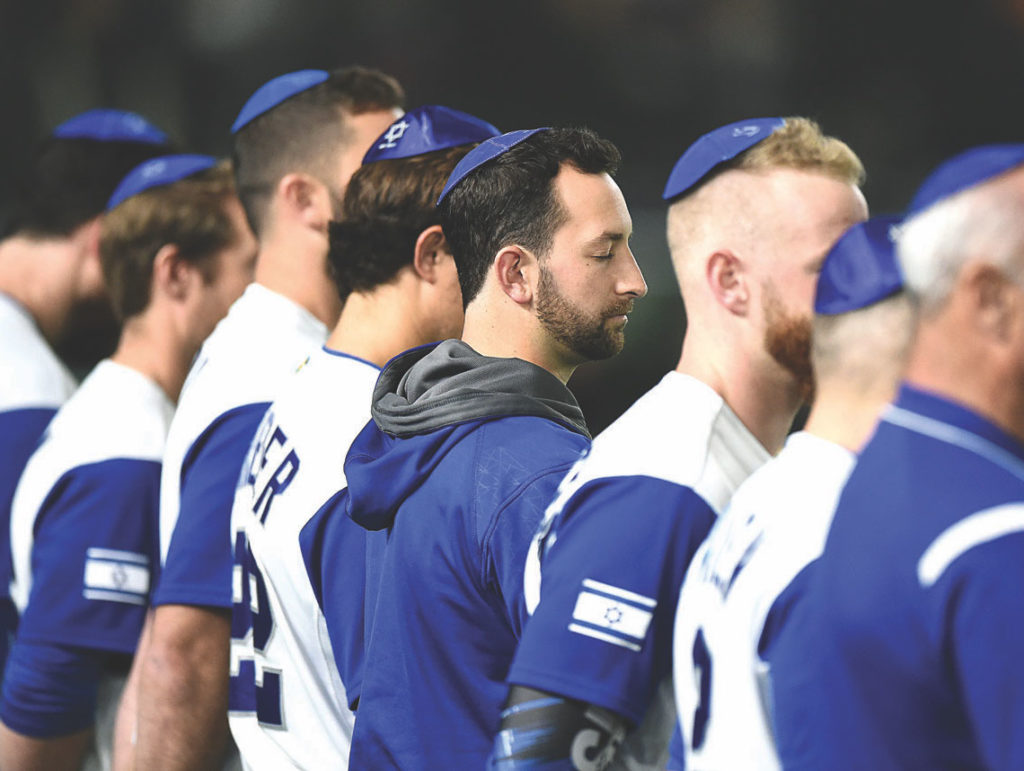
Plans to build the first regulation baseball stadium in Israel have gathered steam in the wake of Team Israel’s surprisingly strong performance in the World Baseball Classic.

Members of Team Israel participated in the groundbreaking for the complex in Beit Shemesh, a city located near Jerusalem with a large ex-patriate American population. Most of the team roster was American Jewish players with major and minor league experience who came in December with their families to visit Israel and meet Israeli fans before representing the country in the international tournament.

It is one of several baseball fields being built in Israel through the Jewish National Fund’s Project Baseball.

Following Team Israel’s three victories in the first round of the World Baseball Classic and its win in the first game of the second round, the Beit Shemesh stadium project has received donations from around the world through a GoFundMe crowdfunding campaign, bringing the total to $11,000 as of Tuesday morning. The goal is $850,000.

The city of Beit Shemesh provided the Israel Association of Baseball with the land for the complex, which will include a regulation-size baseball field for adult play and two smaller fields for youth baseball, batting cages, dugouts, lights and spectator stands.

The Israel Association of Baseball, founded in 1986 by a group of expatriate baseball enthusiasts living in Israel with the goal of promoting and teaching the game of baseball in Israel, has been renting local soccer fields for games and practices. It has about 1,000 participants throughout the country from Little League to adult.

Campaign to build baseball stadium in Israel takes off after World Baseball Classic Read More »

Ivanka Trump scores West Wing office, government security clearances

Ivanka Trump, the Jewish daughter of President Donald Trump, reportedly is working out of a West Wing office and is in the process of receiving a government security clearance.

Ivanka Trump’s office is on the second floor, next to senior adviser Dina Powell, who was promoted recently to a position on the National Security Council, Politico first reported Monday evening. Ivanka Trump also is set to receive government-issued communications devices this week.

Trump and her husband, Jared Kushner, a senior adviser to the president, moved their family to Washington, D.C., when the president took office.

Though Trump does not have an official title and will not draw a salary, she will follow the ethics rules that apply to government employees, Jamie Gorelick, an attorney and ethics adviser for the first daughter, told The Associated Press.

While Trump continues to own her own lifestyle company, which sells clothing, shoes and jewelry, she has turned daily management to the company president and has set up a trust to provide further oversight. She also has barred the business from using her image in advertising to promote the products.

“I will continue to offer my father my candid advice and counsel, as I have for my entire life,” Trump said in a statement while acknowledging that “there is no modern precedent for an adult child of the president.”

Trump had said during the transition that she would not play a formal role in the administration when she moved to Washington. She also said, however, that she would continue to fight for women’s issues, including maternity leave and child care.

On Friday, she participated in a meeting of the president and German Chancellor Angela Merkel with the CEOs of U.S. and German companies to discuss workplace development, sitting beside Merkel during the discussion.

Ivanka Trump scores West Wing office, government security clearances Read More »

President Trump expecting fourth Jewish grandchild, from son Eric and his wife, Lara

President Donald Trump has a fourth Jewish grandchild on the way.

Son Eric Trump and his wife, Lara Yunaska Trump, the Jewish former personal trainer and former CBS producer for “Inside Edition,” announced Monday on Twitter that they are expecting a baby in September.

The baby, who the couple announced is a boy, will be Trump’s ninth grandchild. His daughter Ivanka, who converted to Judaism when she married husband Jared Kushner in 2009, has three young children.

The president tweeted his good wishes to his son and daughter-in-law.

“Congratulations Eric & Lara. Very proud and happy for the two of you!” he wrote.

Ivanka Trump also tweeted her congratulations.

Lara Trump told People magazine that the couple made the announcement at the start of her second trimester because they were afraid the president would give them away.

“Eric’s dad was so excited that we were worried he’d blurt it out at a press conference,” she told the magazine.

Jared Kushner officiated at the couple’s wedding at the Mar-a-Lago Club  in Palm Beach, Florida, in November 2014, which included a crystal-embellished huppah.

President Trump expecting fourth Jewish grandchild, from son Eric and his wife, Lara Read More »

Why every third American Jew supports Trump

Acccording to Gallup, President Donald Trump’s approval rating among US Jews is 31%. That is not very high, but it is also not very low. It is about the same percentage of Jews that voted for Trump. That is to say: the Jews have not changed their minds about Trump. Those who liked him half a year ago, still do. Those who disliked him, still do. They, as Gallup’s Frank Newport and Alyssa Davis put it, “are reacting to Trump along party lines in about the same way as other partisans.” Apparently, we are neither wiser no stupider than other human beings. In this era we are – like them – just “partisans.”

This means that the big scare concerning the Trump-ignited anti-Semitic wave did not impact the views of Jews in America. Those who oppose Trump were easily convinced that the president had a role in inflaming this wave of hateful speech and deeds, while those supporting him either don’t see a “wave” or don’t see any connection between the elected president and the wave.

This also means that Trump’s actions concerning Israel, thus far, have had little impact on his supporters and opponents. Supporters – most of them on the hawkish side – are not yet alarmed by the president’s somewhat bizarre obsession with Middle East peace making (or maybe their concerns with it are balanced by the tough love he has showed the anti-Israel UN Human Rights Council). Opponents – most of them on the dovish side – are not yet swayed by Trump’s investment in the peace process, his apparent intention to tame settlement activity, his refusal to be a cheerleader of Israel’s radical right-wingers.

Just “partisans.” So disappointing, and yet so reassuring. The Jews do not make their political choices in ways different from those of other Americans. They vote for the Democratic Party because they are used to doing it. They are used to doing it – and thus are well trained in explaining why theirs is the better choice. And, of course, it might be the better choice, as more than two thirds of them believe. But it is not the obviously better choice for everybody, as the other close-to-one-third of Jews demonstrate by supporting Trump.

Just “partisans.” And this, of course, complicates the relations within the Jewish community. The more America becomes polarized, the more a dialogue between Trump supporters and Trump opponents seems impossible, the harder it is for Jews of the two partisan camps to find common ground.

You might say: well, there are far more Jews opposing Trump than those supporting him. And this is true, but it is not the whole truth. When one counts all Jews – then yes, many more of them oppose Trump. But the fact that Jews from the groups who support Trump tend to be more active in the Jewish community, and more intensely engaged with Judaism (look at Pew’s numbers and see for yourself), complicates the picture. In Jewish organizations, among voters with strong Jewish consciousness, the pro-Trump and anti-Trump camps become more balanced.

These two camps have specific characteristics and different Jewish instincts. The anti-Trump camp is more universalist, while the other one is more tribal. The Trump camp is more Orthodox, the anti-Trump more progressive. These two camps have different interpretations of what Jewish Americanism means, and they have different readings of Jewish history and values. They have different strategies for dealing with the non-Jewish world.

A few months ago, Yehudah Mirsky published an article in The American Interest that, in my view, did not receive proper attention. Mirsky is a relatively rare Jewish breed: both universalist and tribal (at least, that’s the way I understand his views – Yehuda, you are free to call and correct me). He is, I dare to assume, a Democrat. He seems puzzled, possibly even horrified, by Trump.

He suggests an interesting thesis in the article: That the relations between American Jews and Trump echo past eras of Jewish history: “Trump’s candidacy”, he wrote, “has galvanized American anti-Semites like nothing has in decades, and yet he’s a New Yorker whose daughter converted to Judaism so she could marry, yes, an Orthodox Jew. The significance of this, as I’ve written elsewhere, is that Trumpism and its focus on the Great Leader has thrust Jewish politics back by centuries, to the time when all that mattered was the personal relationship between the sovereign and Jewish merchants with good connections, or in slightly less exalted circumstances between the poritz (the baron) and his transactionally useful Jewish intermediaries (schtadlanim).”

Mirsky does not specifically say this, but connecting the dots is easy: if Jewish-Trump relations are the reincarnation of a Jewish past, it is almost natural for the Jews who feel more comfortable with the Jewish past – Orthodox Jews – to feel comfortable with him. What does he offer them, and other tribal Jews? An alluring option of keeping their separate identity and custom while being protected by a friendly leader. The other option – to be an active and integrated player in the American political arena – is of less appeal to these groups of Trump supporters. It carries the danger of cultural assimilation that accompanies political integration.

And, of course, tribal Jews put more emphasis on Israel than other Jews. Israel – the Jewish State – is a tribal cause. A president who defends Israel, who supports it, for whatever reasons, is a president that the tribe ought to also support. A president that clashes with Israel, opposing its actions, criticizing it for being, well, tribal, is a president that the tribe ought to oppose.

31% of Jews approve of Donald Trump. This doesn’t mean that they are pleased with everything he does. This doesn’t mean that they think of him as the ideal president. This doesn’t means that they do not see his many deficiencies. It means that under the current circumstances they accept his shortcomings in an almost commercial-like exchange: support us and we will support you. Like Trump, these Jews speak the language of businessmen. That’s why he likes them – that’s why they like him.


Why every third American Jew supports Trump Read More »

Chef Michael Solomonov goes ‘In Search of Israeli Cuisine’ in new film

“I thought it was just going to be about falafel and hummus.”

That was the perception of Israeli cuisine that filmmaker Roger Sherman had when he reluctantly decided to accompany his friend, the acclaimed Jewish cookbook writer Joan Nathan, on a food tour of Israel in 2010. But the reality exceeded his expectations.

“I was blown away by what I consider to be the hottest food scene in the world,” Sherman told JTA in a recent interview. “I thought, this is the perfect subject for a film.”

It was. After a successful run on the festival circuit, Sherman’s documentary “In Search of Israeli Cuisine” — which attempts to define and explore what Israeli food actually is — opens March 24 in New York at Lincoln Plaza and the Angelika Film Center. It will open March 31 in Los Angeles, San Francisco and Philadelphia, with other cities to follow.

In general, “we don’t know anything about what goes on in Israel except for conflict,” Sherman said. “This is a portrait of the Israeli people through food.”

Sherman, whose previous documentaries include “Medal of Honor” (2008) and “The Restaurateur” (2010), said he usually avoids having hosts in his films — “I feel they get in the way between the subjects and the viewers” — but he wanted to change up the approach for this documentary.

“Israel is such a complicated place, I needed someone to help translate that situation,” he said.

After a trip from New York to check out Zahav, a Philadelphia restaurant that a friend described as serving the best Israeli food in the U.S., Sherman had the chance to meet the restaurant’s chef and owner, Michael Solomonov.

Sherman knew immediately that Solomonov would make the perfect chef-guide for his film.

“He’s just a really cool guy,” Sherman said.

The feeling was mutual — they agreed then and there to work together on the project.

A James Beard Award winner — that’s the foodie equivalent of an Oscar — Solomonov is also the owner of Philly’s Federal Donuts and Abe Sherman, a restaurant that focuses on Ashkenazi food. Through Zahav, his flagship, Solomonov is often credited for building the popularity of Israeli, Sephardic-style food in America and around the world.

Solomonov’s connection to Israel is deeply personal. He moved from there to Pittsburgh as a child, but returned as a teenager for a short time. His younger brother, David, was killed on Yom Kippur 2003 while serving in the Israeli army.

After the tragedy, Solomonov notes in the film, he became more interested in cooking foods that reflected his Israeli heritage, moving away from his classical European training.

“Attaching myself to the country and the culture and the food are things that have kept me going,” he said.

While Solomonov addresses his relationships with his family and the country in the film — he also shares a story about his grandmother’s bourekas — by and large he serves as an affable tour guide, giving Israel’s food experts and chefs a chance to shine.

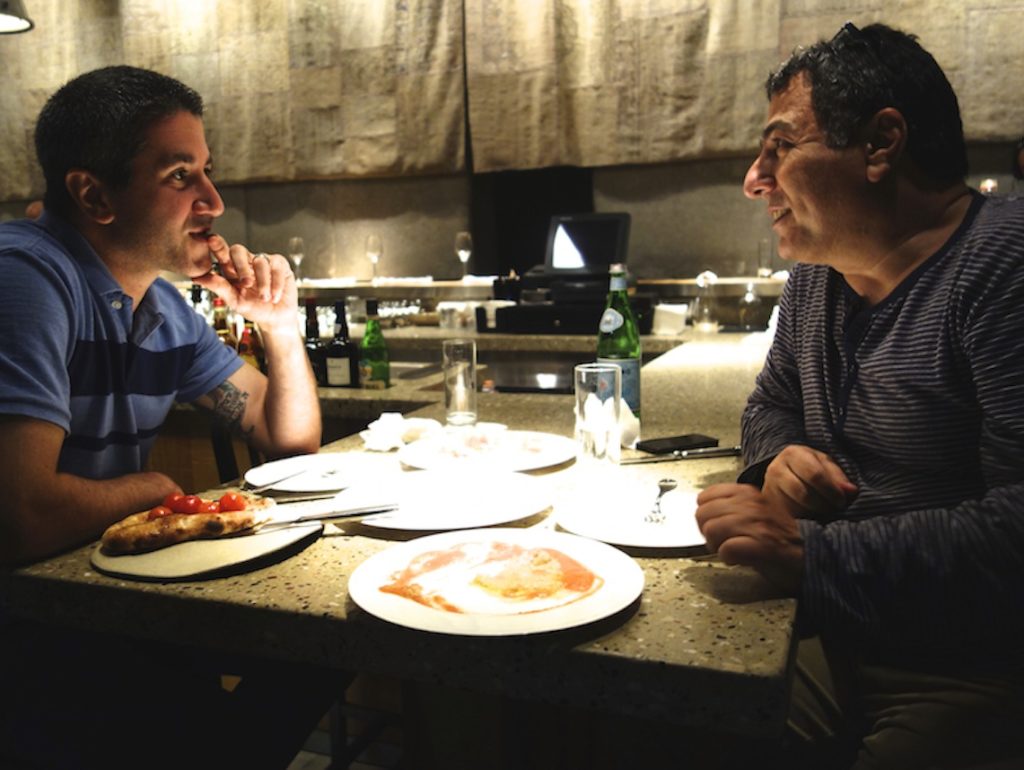
Throughout the documentary, Solomonov dines on Israeli street food, upscale modern Israeli cuisine, Palestinian home cooking and everything in between. He comes across as an excited student of Israeli food, seemingly learning about some for the first time alongside the viewer.

Throughout “In Search of Israeli Cuisine,” Solomonov samples Israeli street food, upscale modern Israeli cuisine, Palestinian home cooking and everything in between. (Florentine Films)

But “In Search of Israeli Cuisine” isn’t your typical travel-and-tasting exploration — it explores tough questions surrounding multiculturalism and pluralism. Solomonov, for his part, lends a sympathetic ear when his subjects tackle complex issues surrounding kashrut, Shabbat and the Israeli-Palestinian conflict.

The film demonstrates that while food is not inherently political, it can reflect larger social issues.

Take the central question of the film: What is Israeli food? The answer doesn’t prove simple.

At its core, Israeli cuisine is a combination of foods from over 100 cultures that have melded in Israel. It’s also something that comes from the land itself, which boasts a rich array of microclimates, and a product of the Palestinian people, who have also lived on the land for ages.

Some of the more poignant moments in the documentary come when Solomonov speaks to Palestinian chefs about the challenges of getting Israeli customers to frequent their restaurants and in working in all-Israeli kitchens.

Husam Abbas, the chef and owner of El Babor, in the Arab-Israeli town of Umm el Fahm, says — in perfect Hebrew — that political events have affected his restaurant.

“The Jews stop coming,” he said. But, Abbas added, “food is peace.”

“If you come to eat with me, and if you come to learn my food, maybe it’s going to bring us all together,” he said.

Solomonov agrees.

“Food can bridge gaps,” he told JTA in a telephone interview. “Especially when the traditional forms of diplomacy are not up to snuff, it’s clear the power food can have … on both sides of the aisle.

“These dishes that we’ve brought through our families and through generations stand for love, not violence. Feeding people is the opposite of alienation. I think future generations of chefs have to use that power. Food transcends the rest of it.”

Since the documentary was filmed in 2013, Solomonov has been back to visit many times. In fact, when he spoke to JTA last week, he was in the middle of running a food tour in Israel that’s tied to the film.

To provide a sense of just how wide an array of foods are “Israeli,” Solomonov expounded on what he ate that day.

“I just ordered a sabich [fried eggplant and hardboiled egg] sandwich at my hotel, which is technically Iraqi,” he said. “Later on tonight we’re going to have striper that was raised in a saltwater pond with a Turkish sunchoke puree. You stumble into those things naturally here.”

Asked whether he’s any closer to defining the amalgamation of cuisines that is Israeli food, Solomonov says he isn’t.

“It’s a convergence of the ancient and modern, since it’s a new country, but the cooking traditions in some cases are over 1,000 years old,” he said. “It’s really about putting all these cuisines together on one plate.

“Modern chefs are embracing Israel and looking at its bounty of cultures, flavors and tastes as influences,” he said. “They’re not going to Europe as much to learn haute cuisine, instead they’re saying they want to stay here and cook Israeli food.”

When prompted, Solomonov said it was hard to narrow down what three foods visitors to Israel should eat — but he did: “You have to have an Israeli hotel breakfast, a bowl of Yemenite soup and some kind of meat and vegetable skewer cooked over charcoal at one of the kebab shops,” he said.

Nonetheless, Solomonov and the film make the case that Israeli food isn’t just about taste — it’s about culture and connection, too. In a poignant scene, Erez Komarovsky, a noted Israeli cookbook author, restaurateur and breadmaker, makes shakshuka — a traditional pepper, tomato and egg dish — with Solomonov. Komarovsky chose that particular dish, he said, because it’s like Israel and its people: “It’s hot and it’s not stuffy.”

“Food is not political,” he added. “It is what is grown on this land by the people who are are living in it. If they are called Palestinians or Israelis, I don’t think the tomato[es] care.”

Chef Michael Solomonov goes ‘In Search of Israeli Cuisine’ in new film Read More »