fbpx

February 28, 2017

Broad-based L.A. Jewish coalition forms to respond to Trump actions

A Los Angeles-based coalition of more than 1,800 self-identified Jews launched this week by releasing a statement that responds to executive actions on immigration and refugees and affirms a commitment to Jewish and American values.

“Frankly, I’ve never seen in my life in L.A. a coalition this broad, that’s come together for this single purpose,” said former L.A. County Supervisor Zev Yaroslavsky, one of six members of the organizing committee at the helm of the new group calling itself Jews United for Democracy and Justice (JUDJ).

The other committee members are former L.A. Congressman Mel Levine, civics scholar and social entrepreneur Shawn Landres, UCLA Jewish history professor David Myers, political consultant Dan Loeterman and attorney Janice Kamenir-Reznik.

On Feb. 28, the six organizers sat down over breakfast in Myers’ Pico-Robertson home, the coalition’s impromptu command center, to explain the group’s goals to a reporter.

“We’re not aspiring to be another Jewish organization in the alphabet soup of Jewish organizations. … We certainly imagine ourselves not displacing, but working alongside other organizations that are engaged in the same kind of work,” Myers said.

The group’s statement of principles doesn’t mention President Donald Trump by name, but addresses a perceived threat to democratic institutions posed by his administration.

“JUDJ is deeply concerned about rising threats to religious tolerance, equal rights, a free and fair press, human dignity, and long-held norms of decency and civil society,” the statement reads. “We will speak out and take action when our shared Jewish values require us to counter those threats.”

It lays out, in broad strokes, values it sees as threatened by the executive branch, including “America is a nation of laws” and “America is a nation of immigrants.”

“There’s an almost daily assault on one or another foundation of our democratic tradition — kind of aerial bombardment,” Myers said. “And I think what we’re saying is that in the midst of the confusion that is sown, we want to be a voice of clarity.”

The coalition came together after a Feb. 5 meeting of Jewish leaders in Myers’ living room, called in response to a Jan. 27 executive order by Trump that restricted admissions of refugees to the United States. After that meeting, members formed five working groups: immigration, long-term strategy, coalition building, lawyers and rabbis.

The statement of principles, first circulated widely on Feb. 24, represents the coalition’s public debut. By Feb. 28, the list of signatories included more than 110 clergy members, 55 current and former elected officials and 270 board officers and senior executives of Jewish communal groups and philanthropies.

The list incorporated members of the board of The Jewish Federation of Greater Los Angeles and the Jewish Community Foundation of Los Angeles, as well as other Jewish membership organizations; elected officials in Sacramento and Washington, D.C.; all three citywide elected officials in Los Angeles, City Attorney Mike Feuer, Controller Ron Galperin and Mayor Eric Garcetti; philanthropists; university professors; and clergy from every major denomination.

The move to establish a new coalition comes as some members of the Jewish community see a lack of organized leadership opposed to Trump’s actions. After Federation President and CEO Jay Sanderson sent a community-wide email that addressed the refugee order without denouncing it, for instance, alumni of Federation’s Rautenberg New Leaders Project wrote a letter expressing their disappointment and requesting that he take a stronger stance.

But members of the JUDJ organizing committee insisted the group wouldn’t compete with Federation or any other Jewish organization, but rather lend political capital to groups that can use it.

“We are not in competition with anybody else,” Levine said. “We’re inclusive and draw people from all of these organizations.”

Levine said one of the primary purposes of the coalition would be to support and join with communities targeted by the administration, naming in particular the Muslim and Hispanic communities. But it also seeks to unite Jews across political and demographic lines in support of democratic values.

“A lot of people in my generation weren’t around for the fights that Zev was around for,” said Loeterman, who is 28. “We weren’t around for the fights that David and Janice and Shawn and Mel were around for. … They see this as kind of our generation’s chance to join with other generations.”

Broad-based L.A. Jewish coalition forms to respond to Trump actions Read More »

For JCCs threatened three times, stockpiling blankets, diapers and resilience

Growing up in a small town in Georgia, Harriet Shirley may have had more exposure to Jews and anti-Semitism than the rest of her fellow Christians. She had Jewish acquaintances, read Holocaust nonfiction as a teen and later visited concentration camps on a trip to Europe.

But she was still dumbfounded when the Gordon Jewish Community Center in Nashville, Tennessee, where she worked as the health and wellness director, received three separate bomb threats since Jan. 9. Shirley had assumed anti-Semitic violence was a thing of the past — a notion her Jewish co-workers did not share.

“Honestly, it makes me angry,” she said. “It also makes me sad. I recognize that a lot of my co-workers have had to live with this stuff their whole lives. It just makes me sad.

“It’s so unfortunate and so stupid that this kind of hatred against any group still exists. We really ought to be past this.”

Since the beginning of 2017, nearly 100 bomb threats have been made to more than 70 JCCs and Jewish day schools across the United States. For most, the threat is a one-time event. But the Nashville JCC and two others — in Birmingham, Alabama, and Wilmington, Delaware — each have endured three.

All three were hit on Jan. 18, when at least 30 JCCs across the country were victimized. Nashville and Birmingham were part of the first wave on Jan. 9, and Birmingham and Wilmington were hit in the last one on Monday. All the calls in five waves of threats have been hoaxes.

The JCCs report that members are still entering the doors. But for staff, the repeated threats have been a shocking and exhausting experience that at times has made everyday work a challenge.

“It’s trying, it’s stressful, it’s everything the people behind these telephone threats want to happen,” said Seth Katzen, CEO of the Jewish Federation of Delaware, which shares a building with the Wilmington JCC. “But we stay vigilant, we stay on task, we follow protocol, we follow procedure. I’m sure it’s on the back of people’s minds, but we’re a resilient community. We will not let this get to us.”

In all three facilities, nearly all the members have stayed despite the bomb threats. In Nashville, only one of 1,600 members has dropped their membership due to the threats. In Birmingham, two of 200 preschoolers have left the school. Katzen said to the best of his knowledge, none of the more than 100 students had left the Wilmington JCC’s preschool.

Leslie Sax, executive director of the Nashville JCC, attributed its high retention rate to its security procedures, which were first formulated following the 9/11 attacks in 2001. The building is removed from a busy area, and a guard is always present near the preschool. In addition, Sax has sent emails out to members following each of the five waves of JCC bomb threats, whether or not her facility was targeted.

“We always struggle: Are we too secure for friendliness?” Sax said. “It’s that balancing act we all have to do. We want to be welcoming, but we also want to be secure.”

Even as the JCC has tried to maintain its routine, Sax has noticed people making adjustments to deal with the threat of an evacuation. The JCC has stockpiled diapers and formula for preschoolers, as well as blankets for swimmers. Some swimmers now leave their car keys near the pool instead of in the locker room. And to stay in contact with the media, Sax has learned to take her phone charger with her in case she needs to exit the building.

“To go for a fire drill, you know to leave the building and congregate,” Sax said. “But when you don’t know if you’re going to be able to go back in the building, you think about what exactly are we going to need to bring?”

All three of the most-targeted JCCs are in relatively small Jewish communities. But neither Sax nor Betzy Lynch, executive director of the Levite JCC in Birmingham, feels that they’ve been targeted due to their size.

“I’m going to make the assessment that it’s probably coincidental,” Lynch said. “I don’t know if there’s any rhyme or reason to why people are chosen or how they’re chosen. Maybe it’s just random and we got the short straw multiple times.”

Lynch said the community’s intimate feel has been an advantage in dealing with the threats. Birmingham’s Muslims, whose mosque recently received death threats, have also reached out, organizing a recent interfaith prayer rally together with the Jewish community.

“This community is incredibly resilient,” Lynch said. “The outpouring of support we’ve had from the general community as well has been phenomenal. Birmingham is an incredibly generous and philanthropic and faithful community.”

Shirley, the Nashville health director, said she continues to be shocked by the threats. In the meantime, she’s tried to use them to teach her 14-year-old twins about the experience of being a minority in the United States.

“[I’m] trying to explain to them that even though we don’t really recognize it, our heritage, our family group, is one of privilege in a way,” she said. “We’re not part of any of those groups that’s the focus of hatred.”

For JCCs threatened three times, stockpiling blankets, diapers and resilience Read More »

Honoring tolerance is not a judgement call. It is an imperative.

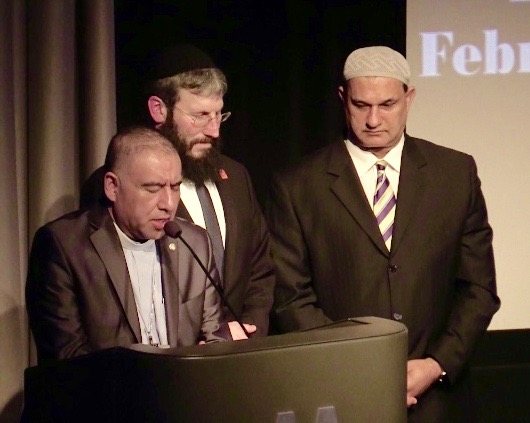
On February 21, 2017 a Bishop, a Rabbi and a Muslim faith leader gathered together at the Museum of Tolerance of the Simon Wiesenthal Center in Los Angeles. Joined by over 250 guests representing their respective communities as well as other faith communities and elected officials and diplomats, the three spiritual leaders were honored with the Interfaith Tolerance Awards presented by Nasimi Aghayev, Consul General of the Republic of Azerbaijan in Los Angeles.

The first part of the evening was committed to the honorees, recognized by the Consul General of Azerbaijan for their outstanding commitment to tolerance and inclusivity – the qualities and values at the heart of Azerbaijan’s success with interfaith peace. Awards and congratulatory speeches were delivered to Mahomed Akbar Khan of the King Fahd Mosque, Bishop Juan Carlos Mendez of the Churches in Action, and Rabbi Yonah Bookstein of Pico Shul and Shabbat Tent. The three leaders are, on the surface, quite different, yet each stands out for their impressive records of innovative and uniquely open minded approaches to outreach, engagement, and crossing the aisle to connect and improve the lives of many, many people. The evening was unique in and of itself – as the first Interfaith Tolerance Awards, and the first time such an event has been hosted at the Museum of Tolerance.

The awards ceremony was followed by the premiere screening of “Running from the Darkness”, a documentary on the Khojaly Massacre, a tragedy that occurred in 1992, when 613 innocent and unarmed Azerbaijani men, women and children were murdered by Armenian soldiers. Running From the Darkness was produced by California based nonprofit JConnect and One Wish Project, both Jewish-led ventures, and is the first U.S.-made documentary on the Khojaly Massacre. It is also the first Khojaly documentary that includes the testimony of an Armenian – a human rights activist.

Khojaly carries tremendous meaning; as a tragedy, a point of connection, and also a lesson on the power of perseverance in the face of unimaginable adversity. Despite the deplorable acts committed against Azerbaijan, the nation has never strayed from the deeply ingrained philosophy and policy of interfaith and interethnic tolerance that has positioned Azerbaijan above the regional fray for so many years. This commitment applies and has been tested by the most extreme events, like Khojaly. Despite the tragedies like Khojaly and the ongoing occupation of around 20% of Azerbaijan’s sovereign territory by Armenia, over 30,000 Armenians continue to live in Azerbaijan’s capital Baku and other cities under total protection and equality, and Baku boasts a grand Armenian Church, protected by the government and respected by the community.  

The awards ceremony, the honorees and the documentary that followed share a unique connection. The Khojaly Massacre has become a touchstone for Jewish, Christian and Muslim faith leaders, and one that has brought these otherwise often isolated communities together. Over the last several years, the same faith leaders honored at February 21’s awards have held joint memorial services for the victims and survivors of Khojaly, and in the process, have awakened a sense of shared loss and shared space between many varied faiths. This began with a memorial for Khojaly in 2015, held at the newly formed Pico Shul, led by Rabbi Yonah Bookstein, one of the evening’s honorees. At this inaugural multifaith memorial service, Rabbi Yonah prayed for the Muslim victims and survivors, and his congregation learned about the lesser known tragedy in great and personal detail. The following year, the King Fahad Mosque hosted the memorial for Khojaly, and Bishop Mendez, Rabbi Yonah and Mahomed Khan all came together to pray as one. Over the years, all three of the leaders have formed a unique bond that ties them to their combined commitment to peace and tolerance.

Through these memorials, diverse groups of spiritual people have set an example of how one community can step up and make a significant difference with and for another, and build something powerful in the wake of loss and destruction. As Board President of the non-profit that was instrumental in making the film a reality, Josh Kaplan told the audience “that is why this documentary you are about to see fits so well into what we are here tonight to celebrate, because we must constantly possess a desire to inform ourselves about the tragedies of hatred and the healing nature of kindness.”

When the ceremony ended, I read the news at home about the Muslim community in St. Louis, and how by Tuesday, they had already raised over $50,000 to repair a local Jewish cemetery, where over 150 graves had been desecrated the night before. I couldn’t help but feel a sense of connection to what had  taken place at the Museum of Tolerance that evening; both glaring reminders of the power in our kindness and generosity of spirit. As Bishop Mendez quoted from the Christian Bible at the close of his award acceptance speech that night: “Do onto others as you would have them do unto you.” An age-old concept that, as proven by these leaders and events, has immeasurable repurposing potential.

Rabbi Israel Barouk was ordained at Yeshivat Or Elchonon. Originally from Jerusalem and based in Los Angeles, Rabbi Barouk works with leaders and communities across the globe to study, understand and engage with how “positive multiculturalism” serves as a powerful mechanism toward peace.

Honoring tolerance is not a judgement call. It is an imperative. Read More »

EDITORIAL INDEPENDENCE POLICY

We subscribe to standards of editorial independence adopted by the Institute for Nonprofit News:

Our organization retains full authority over editorial content to protect the best journalistic and business interests of our organization. We maintain a firewall between news coverage decisions and sources of all revenue. Acceptance of financial support does not constitute implied or actual endorsement of donors or their products, services or opinions.

We accept gifts, grants and sponsorships from individuals and organizations for the general support of our activities, but our news judgments are made independently and not on the basis of donor support.

Our organization may consider donations to support the coverage of particular topics, but our organization maintains editorial control of the coverage. We will cede no right of review or influence of editorial content, nor of unauthorized distribution of editorial content.

Our organization will make public all donors who give a total of $1,000 or more per year, unless specific exemptions based on security concerns are sought.

EDITORIAL INDEPENDENCE POLICY Read More »

Trump reportedly said JCC threats may be trying to ‘make others look bad’

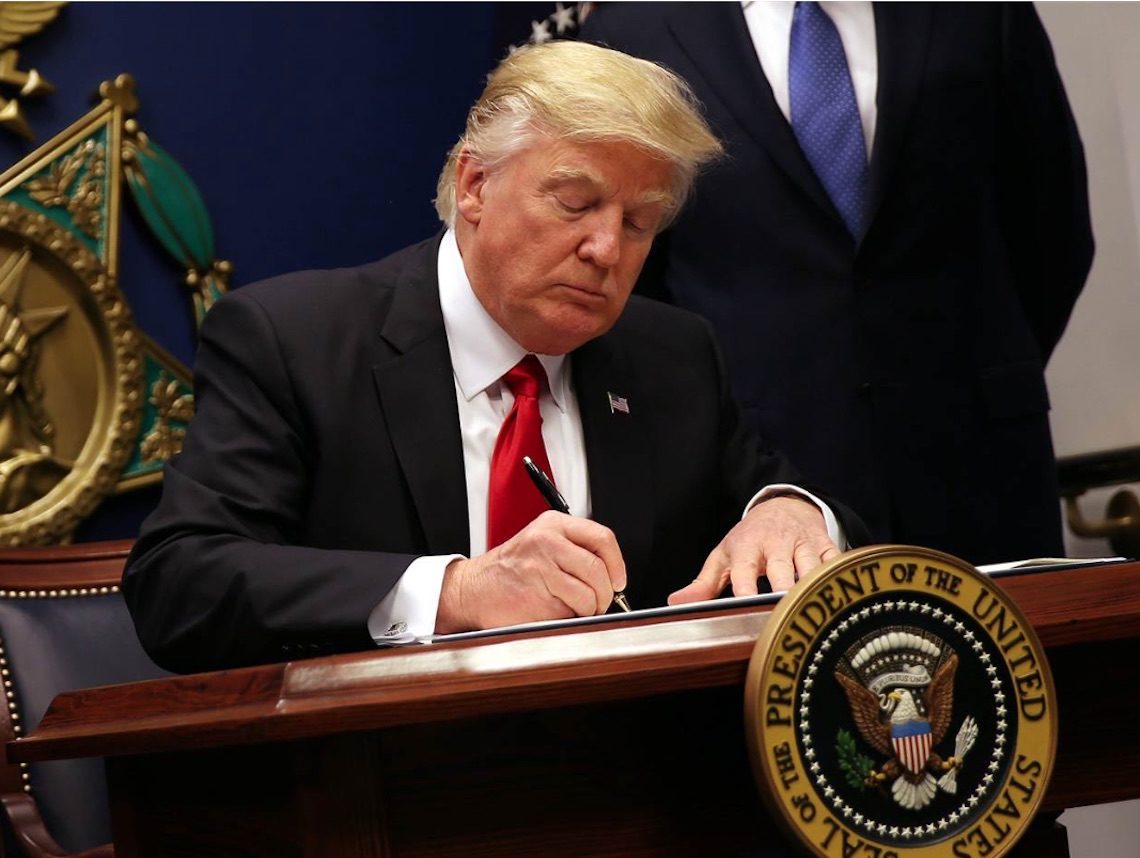
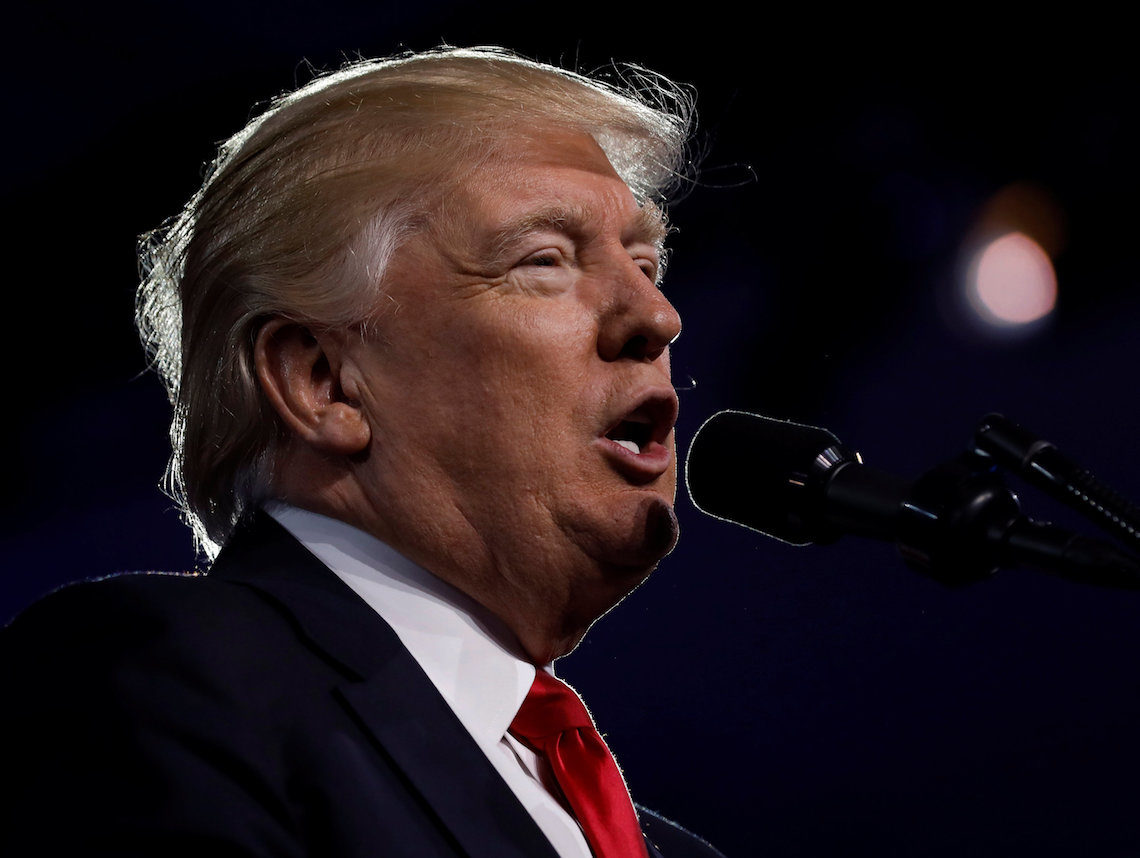
President Donald Trump reportedly said that a wave of threats against Jewish communal institutions may be a false flag.

Pennsylvania Attorney General Josh Shapiro, who is Jewish and a Democrat, described a meeting of state attorney generals and Trump on Tuesday to BuzzFeed.

Trump called the wave of bomb threats in recent weeks forcing the evacuation of nearly 100 Jewish community centers and other institutions countrywide as “reprehensible,” Shapiro said, but added: “Sometimes it’s the reverse, to make people – or to make others – look bad.”

Shapiro said Trump said it was “the reverse” two or three times but did not clarify what he meant.

Earlier the same day Anthony Scaramucci, a top adviser to the Trump transition team who is under consideration for a White House job, advanced a similar argument on Twitter, saying the threats may be aimed at harming Trump.

“It’s not yet clear who the #JCC offenders are,” Scaramucci said. “Don’t forget @TheDemocrats effort to incite violence at Trump rallies.”

There were several incidents of violence at Trump campaign rallies during last year’s election, but no evidence linking the offenders to an organized Democratic Party effort.

Trump reportedly said JCC threats may be trying to ‘make others look bad’ Read More »

This is Ruth Bader Ginsburg’s workout. Spoiler alert: It’s ridiculously hard.

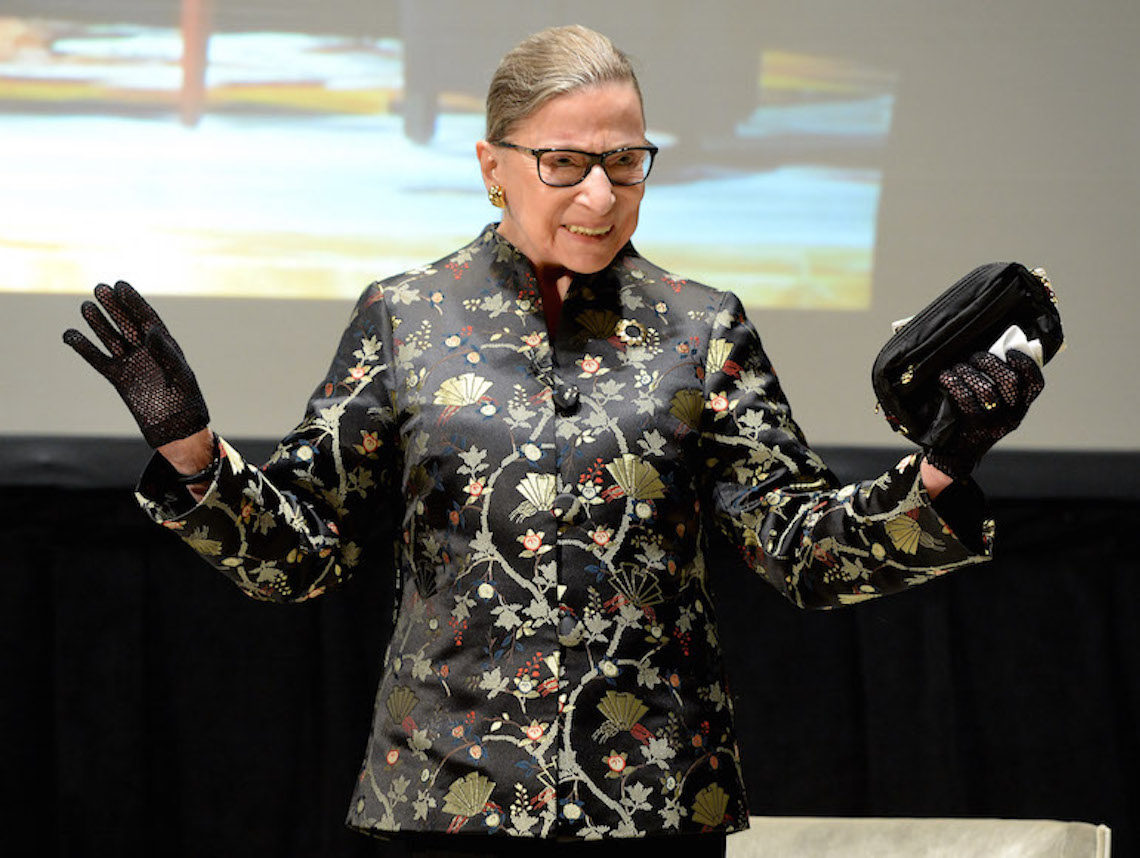
Ruth Bader Ginsburg isn’t getting any younger. As the Jewish Supreme Court justice comes up on her 84th birthday next month, many of her fans are praying that she lives through the Trump presidency.

It isn’t hard to tell how Ginsburg herself feels about the current political situation. In an interview with the BBC last week, she avoided mentioning President Trump by name — as she did last July, when she was harshly criticized for lambasting the former real estate magnate before the election — but said that the U.S. is not “experiencing the best of times” right now. She also said she is worried about the freedom of the press, argued that the current Congress is “not working” and praised the recent Women’s March on Washington.

But she has already been a darling for a long time among liberals — who have recently started begging her to eat more kale and keep track of her bone density so that she might have a better chance of staying on the court for at least the next four years.

There is one thing that should calm these nervous RBG supporters: Twice a week, she completes a grueling, all-body workout devised by a former army reserves sergeant.

On Monday, Politico’s Ben Schreckinger published a first-hand account of what Ginsburg’s workout feels like. He met with Ginsburg’s personal trainer, Bryant Johnson — who also trains the court’s other Jewish justices, Stephen Breyer and Elena Kagan — and completed the Ginsburg workout in an excruciating 90-minute session.

“I’m no athlete, but I’m young and reasonably fit. I thought the workout would be pattycake, but it was much harder than I expected,” Schreckinger wrote.

Below is an outline of all the exercises Schreckinger mentions in his article. It may not make you wise enough to decipher a federal court case, but it will likely make you stronger. (Although, if you complete it while watching “PBS NewsHour,” like Johnson says Ginsburg does, you may have a pretty good grasp of current events.)

The RBG workout

(All exercises include three sets of 10-13 repetitions)

  • – 5 minutes on the elliptical
  • – Stretches
  • – Machine bench press (Ginsburg, who is 5’1” and thin, presses 70 pounds)
  • – Leg curl machine
  • – Leg press machine
  • – Chest fly machine
  • – Lat pull down machine
  • – Seated rows
  • – Standing rows
  • – One-legged squats
  • – Push-ups (Ginsburg started doing them against the wall, but progressed to doing them on her knees and now with straight legs)
  • – Standard plank (30 seconds)
  • – Sideways planks (30 seconds on each side)
  • – Hip abduction exercises
  • – Squats against exercise ball and wall
  • – Dumbbell curls against exercise ball and wall
  • – Platform step-ups
  • – Squats on an upside-down bosu
  • – Medicine ball tosses while standing up off of a bench and sitting back down

This is Ruth Bader Ginsburg’s workout. Spoiler alert: It’s ridiculously hard. Read More »

Prof. Steven Cohen: Help Trump do a mitzvah

With President Donald Trump’s unpredictable approach towards the Middle East, Steven Cohen, Professor of Jewish Social Policy at HUC-JIR, urged progressive Jews to maintain a nuanced response in responding to the new administration in the scenario that Trump actually pursues a two-state solution. “If a bad person wants to do good things. You help him do any Mitzvah (good deed),” Cohen told Jewish Insider at the J Street National Conference in Washington, D.C. “The next day you reproach him for doing averos (sins). I would hope that my ultra liberal friends would support any effort that would really move us towards a two-state solution because it is a matter of pikuach nefesh, saving lives. We need a Palestinian state in order to save Jewish lives among other good reasons.”

[This story originally appeared on jewishinsider.com]

Alan Solow, former Chairman of the Conference of Presidents of Major American Jewish Organizations and a national co-chair of the 2012 Obama reelection campaign, also called for a diplomatic response regarding Trump’s more ambiguous approach to the two-state solution. “In this current status of five or six weeks into this presidency, it’s important to try to give the Administration some room to find its way to try and to work with the administration and encourage them to work with Israelis and the Israeli government,” he told Jewish Insider. “Therefore, I would say, outward criticism on those issues, if I were in leadership would be premature at this point.”

Solow further stressed that Jewish American organizations should adopt a more measured approach in general in dealing with the Trump Administration. “It depends on what the issue is. I don’t think that Jewish leadership can abandon fundamental values which drive their organizations and remain silent when those values are challenged,” Solow noted referencing the White House’s decision to not mention Jews in its Holocaust Remembrance Day Statement or its slow response to the rise in anti-Semitism. “It is impossible for [the ADL] not to speak on that and have any self respect and perform their role.”

Nonetheless, when addressing domestic policies – such as immigration – that are not directly connected with the Jewish community, Solow said, one should not expect every Jewish organization to speak out on that issue not related to their cause. “For other organizations, which have never acted in areas of immigration, it’s not so important for those organizations and it’s not a dereliction of their duties to not speak out on those issues,” he emphasized. “I don’t expect every Jewish organization which I support to speak out on the immigration issue.”

Prof. Steven Cohen: Help Trump do a mitzvah Read More »

Anti-Semitic incidents rise 16 percent in Berlin

With a new report noting a rise in anti-Semitic incidents in Berlin, Jewish leaders in the German capital renewed their call for a federal commissioner to deal with the problem.

The Berlin-based Research and Information Office on Anti-Semitism, founded in 2015, reported Monday that the number of anti-Semitic incidents in the city has risen by 16 percent in 2016 over the previous year. Most incidents were nonviolent but nonetheless threatening.

According to the report, a total of 470 anti-Semitic incidents were reported in Berlin in 2016, including seven physical attacks.

A permanent federal commissioner would help ensure that the government does not drop the ball on fighting anti-Jewish hate, Deidre Berger, head of the American Jewish Committee office in Berlin, said in a statement Monday.

She said people tell her they are increasingly fearful to be recognized as Jews in public. In many cases, Berger said, authors of threats hide behind the anonymity of the internet, creating a general atmosphere of angst.

That hate must be countered whatever its source, Josef Schuster, head of the Central Council of Jews in Germany, said in a recent address to the State Parliament in Lower Saxony.

Schuster, who also has called for the establishment of a federal commissioner, said it was more important than ever for civil society and political leaders to oppose anti-Semitism and right-wing extremism, especially since the German Supreme Court recently decided it did not have enough evidence to ban a notorious far-right extremist political party.

“Initiatives against the far right need our ideological and financial support,” and anti-Jewish sentiments among Muslims must also be countered with vigor, Schuster told state legislators, while emphasizing that “the Jewish community rejects all forms of anti-Islam hate.”

The report also noted 18 verbal threats and 53 cases of damage to Jewish-owned property or Holocaust memorial sites, as well as 382 cases of harmful behavior. Of the last item, 152 were cases of internet threats against Jews or Jewish institutions. Another 150 cases of anti-Semitic propaganda, graffiti and threatening letters were reported.

There were no cases of extreme violence reported to the anti-Semitism office last year.

Anti-Semitic incidents rise 16 percent in Berlin Read More »

Philadelphia labor unions offer to repair, secure vandalized Jewish cemetery

Two Philadelphia unions said they will provide free services to help repair and secure the city’s vandalized Mount Carmel Cemetery.

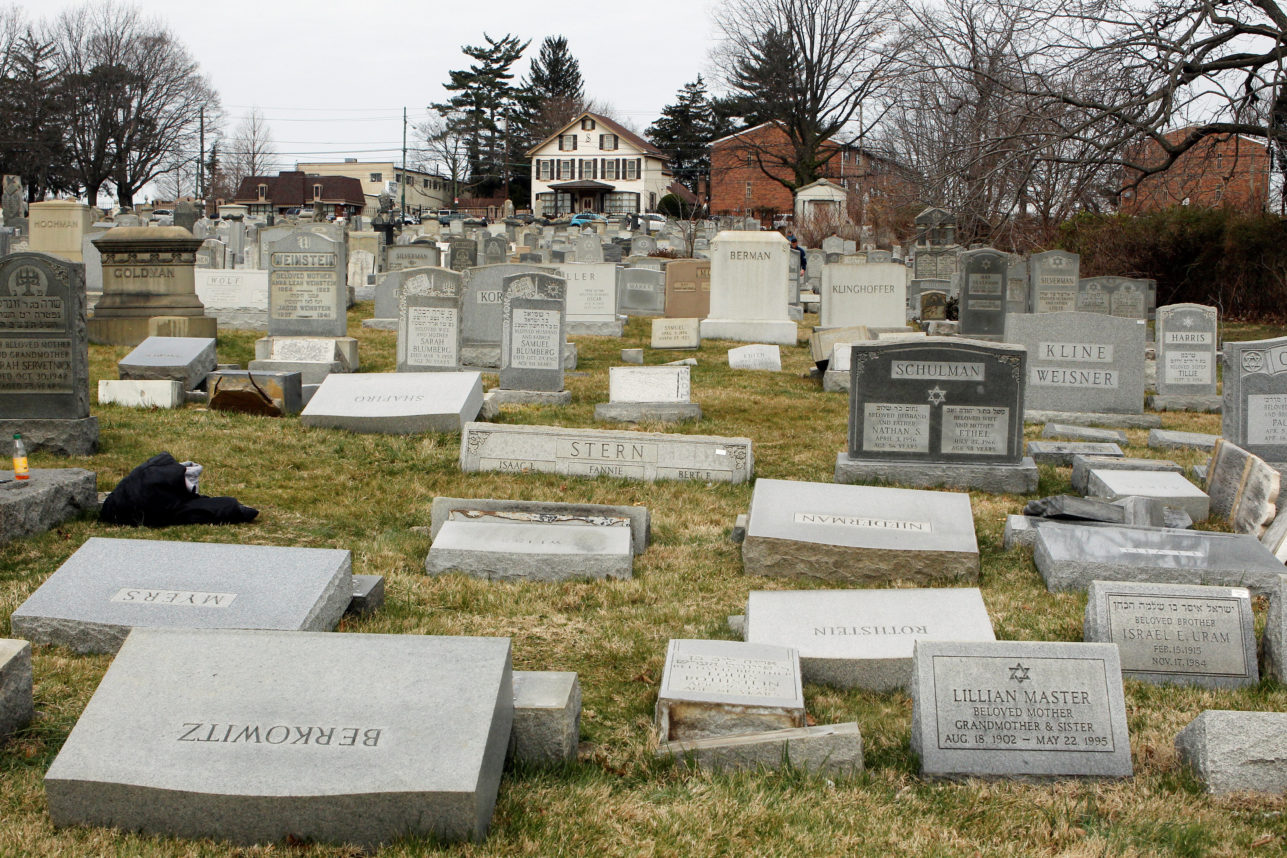
More than 100 gravestones were toppled and damaged at the Jewish cemetery in the Wissinoming section. The vandalism was discovered Sunday.

Bobby Henon, a Philadelphia City Council member with union ties who represents the Wissinoming neighborhood, tweeted Monday evening that the Philadelphia Building and Construction Trades Council offered to replace the toppled headstones and that the International Brotherhood of Electrical Workers Union Local 98 offered to install additional lighting and security cameras.

https://twitter.com/BobbyHenon/status/836295542875566080

Labor leader John Dougherty of the Philadelphia Building and Construction Trades Council told reporters that the vandalism is a “cowardly act of anti-Semitism that cannot be tolerated.” His workers also offered to re-sod and clean the cemetery grounds.

Meanwhile, a Gofundme campaign for the Philadelphia cemetery launched by a private citizen, Raphael Caroline, 31, in the hours after the vandalism was discovered has raised nearly $20,000 in 24 hours, double its original goal.

The Jewish Federation of Philadelphia announced that a volunteer cleanup of the cemetery will begin at noon Tuesday and run every day from noon to 4 p.m.

The federation said it will begin cleaning up the cemetery Tuesday and asked for volunteers.

“Representatives from the Jewish Federation will be on hand as well as up to 50 people per hour cleaning and working to help restore this important Philadelphia landmark,” the federation said in a statement.

In response to the vandalism, the National Museum of American Jewish History, which is located in Philadelphia, has initiated a project to preserve the stories of the people who are buried there. The museum has called on those who have relatives or friends buried at Mount Carmel Cemetery to share a photo of the person, and one of the headstone, if possible, and a personal story of up to 150 words. They can be posted at http://MtCarmelStories.tumblr.com or emailed to curatorial@nmajh.org.

The project is also open to those whose families were affected by the desecration that occurred last week at the Chesed Shel Emeth Cemetery in the St. Louis area.

“We would like those who did this to understand that these are not victimless crimes,” said Ivy Barsky, the museum’s CEO, and Gwen Goodman, its director. “The individuals buried at Mt. Carmel were human beings with names, stories, and families. They contributed to the world while they were here and continue to do so through the loved ones they left behind. We honor their memories.”

Philadelphia labor unions offer to repair, secure vandalized Jewish cemetery Read More »

Jews supporting torched Tampa mosque $18 at a time

The Muslim man who started a crowdfunding page to help repair a mosque in Tampa damaged in an arson attack realized that many of the donors were Jewish after noticing the gifts came in multiples of 18.

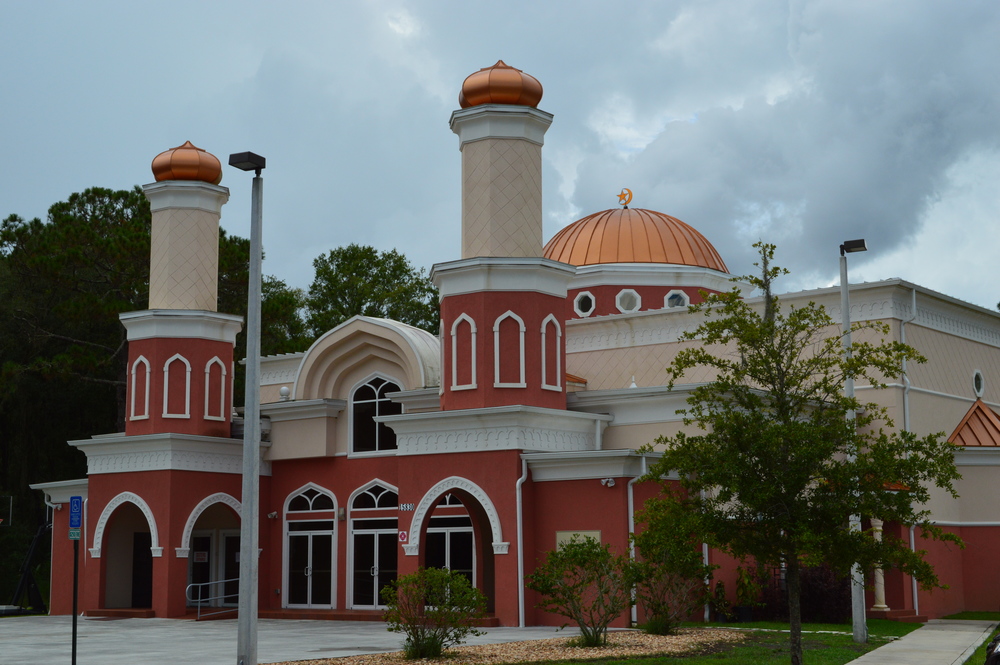
Adeel Karim set up the Stand With New Tampa Muslims Against Hate crowdfunding page on the Launchgood website on Feb. 24, the day of the attack in the wee hours of the morning. The fire was put out quickly, but the sprinkler system caused a great deal of water damage.

Karim’s campaign raised nearly $60,000 in less than a week, surpassing its $40,000 goal.

“I couldn’t understand why people were donating in what seemed like weird amounts to the cause. There are sums of 18, 36, 72.00 dollars etc. then I figured out after clicking on the names Avi, Cohen, Gold-stein, Rubin, Fisher…. Jews donate in multiples of 18 as a form of what is called “Chai”. It wishes the recipient a long life,” Karim wrote Monday in a Facebook post.

“You learn something new every day. The Jewish faith has shown up in force to support our New Tampa Islamic community. I’m floored,” the post continued. It concluded with the hashtag #chaidelieverd.

The Islamic Society of New Tampa mosque hosts interfaith events.

A quote on its website reads: “Let us not forget that we are all members of the same human fraternity; our differences are meant to be embraced; our diversity should become our strength if we wholeheartedly commit ourselves to get to know each other because, as Allah has made clear, we are all descendants of one man and one woman.”

Earlier this month, a crowdfunding campaign launched by two Muslim Americans raised over $100,000 for a vandalized Jewish cemetery outside of St. Louis.

Jews supporting torched Tampa mosque $18 at a time Read More »