Israel’s Iron Dome missile defense system successfully completed tests of an upgraded system using some American-made components.
Israel’s Defense Ministry announced the successful tests on Wednesday. They included live fire tests, according to the announcement.
In the past two weeks Iron Dome has intercepted rockets fired on southern Israel — from the Sinai Peninsula on the resort town of Eilat, and on the Eshkol Region, which borders the Gaza Strip.
The Tamir interceptor missiles used by the Iron Dome to engage and destroy incoming rockets were made with components manufactured by the U.S. defense contractor Raytheon, which collaborates with Israel’s state-owned Rafael Advanced Defense Systems Ltd.
In his Beverly Hills office recently, producer David Permut — a Hollywood veteran with a dash of P.T. Barnum — recounted colorful stories from his long career.
Back when he was 21, he said, he was startled to find himself at the Academy Awards with a movie that Permut and his first mentor, producer Bill Sargent, shot in one take for $60,000 in 1975. Their film was a live performance of James Whitmore’s one-man show, “Give ’em Hell, Harry!” about President Harry Truman, and the monologue not only grossed $11.5 million at the box office, but also earned an Oscar nomination for Whitmore.
Now, with more than 40 films and TV projects under his belt, including the movies “Face/Off” and “Dragnet,” Permut has again earned an Oscar nod, this time for serving as a producer on Mel Gibson’s World War II epic, “Hacksaw Ridge.”The drama has received six Academy Award nominations, including nods for director and best picture.
Based on a true story, the film stars Andrew Garfield as Desmond Doss, a Seventh-day Adventist who refused to carry a weapon while serving as a combat medic during World War II — but who nevertheless rescued an estimated 75 of his comrades during the bloody Battle of Okinawa. In 1945, Doss became the first conscientious objector ever to receive the Medal of Honor.
Over the decades, Hollywood icons such as Darryl Zanuck came calling on the veteran to purchase the film rights to his story, but Doss (who died in 2006 at 87) consistently declined. “He was a very humble and modest man, and he never felt comfortable with the idea of a movie,” Permut said. “He didn’t want to exploit his story.”
Permut persevered for 16 years to make the film, and finally succeeded in getting Doss’ permission with the help of his fellow producer, Terry Benedict, a Seventh-day Adventist who had first met Doss at a church summer camp and went on to make a documentary about the hero.
“Being a producer means being impervious to rejection,” Permut said.
Permut has been in love with Hollywood since he was a boy in Los Angeles, when, he said, he “studied the trade papers like the Talmud.”He was thrilled to discover stars such as Buddy Hackett in synagogue with him at Temple Israel of Hollywood.
Katharine Hepburn, Fred Astaire and Elvis Presley lived in Permut’s neighborhood in Holmby Hills, and he had friends whose parents worked in Hollywood. So at 15, he set up a canvas director’s chair at Sunset Boulevard and Ladera Drive and began selling his own maps to the stars.The price was negotiable, but Permut’s pockets soon overflowed with cash.
When residents circulated petitions to oust Permut and two elderly women who also hawked star maps in the area, Permut hired a personal injury attorney who had previously represented him when his electric blanket had caught on fire. Permut made a black-and-white movie of one of his colleagues getting arrested, which made the lead story on the NBC news. Eventually, Permut’s case went all the way to the Supreme Court of California, which ruled in his favor.
In the meantime, Permut had met Sargent, a redheaded Irish-American from Oklahoma, who claimed he was going to reunite the Beatles. Permut was skeptical when he met the producer at his office, which turned out to be a utility closet with a couple of folding chairs in a musty building in Beverly Hills. “He told me had made millions in the 1960s,” Permut said. Sargent described outlandish tales of producing “Hamlet” with Richard Burton and the first live concert film with such greats as James Brown and the Rolling Stones.
“I didn’t really believe this guy in the closet had had all that success,” Permut recalled. “But then I went to the library and researched him, and it turned out that he had.”
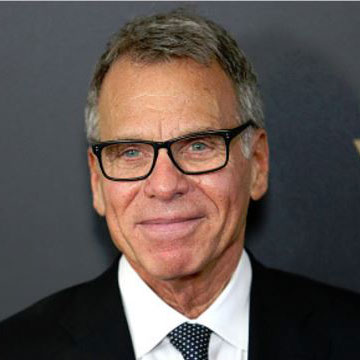
David Permut
After a project the two men were working on couldn’t get financed, Sargent disappeared for a time, only to resurface in 1975, when he whisked Permut off in a white Rolls Royce to his luxurious suite at the Beverly Wilshire Hotel. Their ensuing projects included a taping of“Richard Pryor: Live in Concert,” which cost three-quarters of a million dollars but brought in more than $30 million at the box office.
Some years later, Permut was channel surfing one night when he happened to see an old rerun of TV’s “Dragnet.” “I was laughing, because it was such a heavy-handed, procedural drama,” he said. The same evening, he saw actor Dan Aykroyd in a “Saturday Night Live” skit parodying that show. “I got the idea that you could maybe translate this old television series into a feature film as a comedy,” Permut said.
Soon thereafter, he and Aykroyd walked into an office at Universal and pitched the film by singing the opening notes to the show’s theme song. The project immediately sold. “It was the shortest pitch in film history,” Permut said.The movie went on to become one of the top grossing films of 1987. “So that was my first big narrative picture and paved the way for all of the other movies,” he said.
The producer was on the set of his film “Double Take” in 2001 when he first heard about Desmond Doss from the movie’s stunt coordinator. “But I didn’t believe it,” he said. “I thought, a combat medic doesn’t go to the front lines with no weaponry. … And then of course I found out that it was true.
“As a producer, I’m always thinking about how you can sell a movie,” added Permut, now the head of his own company, Permut Presentations. “What’s the hook? How do you make a World War II movie that’s distinctly different from the great war movies of our past, whether it be ‘Saving Private Ryan’ or‘The Thin Red Line?’ And I thought that a man who never touches a gun on the front lines of World War II — that was a gold nugget of an idea.”
One production company eventually offered to sign on, with the condition that the film would be rated PG-13. But Permut and another of the film’s producers, Bill Mechanic, declined. “We decided that we didn’t want to homogenize it to conform to that rating, because one of the thematics of the movie is the horrors of war,” Permut said. “So we got the project back and took it to Mel Gibson [in 2014].We thought Mel would relate to the story of this heroic individual … and also would put the audience viscerally on the battlefield.”
Gibson had already put innocent characters through gruesome ordeals in films such as “The Passion of the Christ.” But he hadn’t made a film since 2006’s “Apocalypto,” partly because he had become a pariah in Hollywood after his anti-Semitic, drunken tirade against a Jewish police officer in July of that year.
Was Permut troubled by news of Gibson’s statements at the time? “I don’t think anybody would not have been disturbed hearing remarks like that,” he said. “But I heard that everyone who’s ever worked with Mel say that … they love him, they revere him, whether it’s Jodie Foster or [director] Richard Donner.
“I never make a decision about somebody until I get to know them,” he added. “Then I met with Mel, and I loved his passion, his vision, his creativity. I thought I was the luckiest guy in the world to be in business with him. There was nothing off limits we didn’t talk about.”
Permut now attributes Gibson’s anti-Semitic slurs to his alcoholism and a “personal crisis” at the time. “But he’s not the person people accuse him of being because of the incidents of his past,” Permut said.
Although “Hacksaw Ridge” has been in large part well reviewed, some critics have noted the irony inherent in a film about a pacifist that also is filled with blood and gore, including exploding human bodies and rats feasting on soldiers’ flesh. The New Yorker went so far as to declare, in a headline, that the movie is “religious pomp laced with pornographic violence.”
In response, Permut said, “I lost an uncle in the Pacific during World War II, but I don’t know the horrors of war because I’ve never been there. The closest I’m going to get is through a movie like ‘Hacksaw Ridge’ showing me … and what Desmond did despite all that.
“You know, it was bashert that the film took so long to get made … because it was meant to be that our paths crossed with Mel Gibson’s,” he added. “I’m proud that it’s also been a personal journey for Mel. He’s on solid ground now; he’s been sober for 10 years, he has a great relationship and a new baby. It was incredible when we screened the movie at the Academy and we received a standing ovation. I’m really happy for Mel and I think he deserves it.”
On Yom Kippur, while contemplating our mortality, we ask “Who shall live, and who shall die?” Expanding on that question, the Academy Award-nominated documentary short “Extremis” wants us also to consider: Who shall die without heroic measures?
The film, moving along as if to the whoosh of a ventilator and the beep of a heart monitor at only 24 minutes, manages to take us, beat by beat, through the end-of-life decisions of several patients in the intensive care unit of Highland Hospital in Oakland.
For those who already have lived this documentary with a beloved family member or friend, the film explores a familiar territory of the life-and-death decisions that we make for ourselves and for others, and how, through our perceptions of human suffering, dignity and spirituality, we come to them. But for those who have yet to travel to these rooms of too-white walls, it presents a roadmap of the challenges ahead, the clarity we must find in the often chaotic ICU environment to reach a peaceful, dignified death.
Our behind-the-camera guide to this moral quandary is Dan Krauss, a Berkeley filmmaker and lecturer in UC Berkeley’s Graduate School of Journalism, whose previous films have explored such issues assuicide (“The Death of Kevin Carter”) and the moral dilemma of a solider (“The Kill Team”) who knows his platoon has killed innocent civilians.
In “Extremis,” Krauss documents, through a nonjudgmental point of view, how two families and their loved ones — Selena, who has suffered severe brain damage, and Donna, a woman with severe myotonic dystrophy, muscle degeneration — decide on a course of action.
“I’m a 44-year-old guy with two young kids and a happy life. Why would I spend three months in the ICU with people who are nearing end-of-life?” Krauss said in an interview with the Journal, wrestling with the question of why he felt compelled to pursue the project. “Death is a subject that I am not comfortable with,” he admitted. “Artists, people who do creative work, often are addressing their own fears in their work, and we have to force ourselves to march in the direction of our fear.”
A Jew who doesn’t see himself as person of great spirituality, Krauss said that at the outset of the project he had very little awareness of the decision-making in an ICU.
But as he began to acclimate to that environment, “I did witness moments of quiet beauty, and I started to appreciate the ICU as a place where faith and science collide in a fascinating way,” he said.
Along with those moments in the ICU, Krauss said he was struck “by the burden that was placed on the medical staff,” including the times when he witnessed Dr. Jessica Zitter being “very frank with families about the likelihood of their loved one recovering.” Yet, “very often,” he added, “those families were grateful to have someone give it to them straight and not sugarcoat it.”
Giving bad news, knowing when and how to say it, were not skills Zitter obtained at med school. “We are not taught that communication of bad news is a skill like any other, like intubating a patient or putting in a big catheter,” she told the Journal. “We practice those skills over and over again, but we don’t practice the skills of communication, which I would argue are the most important of all.”
Zitter, who is shown counseling the families of Selena and Donna about the use of a ventilator, comes from an extended family of surgeons and emergency room doctors. She originally trained as a pulmonary and critical care physician, then became interested in palliative care, she said, as a result of the “moral distress” that she experienced as an ICU doctor in a hospital in New Jersey.
Working in the ICU, she “started out as very gung-ho,” she said. “I wanted to save every life that was to be saved. I wanted to prolong every heartbeat.
“I started to see the unintended effect that I had never imagined — that by prolonging the life of people who were dying, we really cause a lot of unnecessary suffering.”
Zitter has a book coming out titled “Extreme Measures: Finding a Better Path to the End of Life.” Discussing her views on modern bio-ethics, she said she believes that it is “completely acceptable ethically to withdraw life-promoting treatments from somebody if it’s in concert with their preferences to allow a natural death.” It’s a view that receives some pushback in the film, as when she explores the option of taking Selena off a respirator. Selena’s daughter, who is hoping for a miraculous recovery, responds: “It would feel like murder.”
A Conservative Jew who also likes to attend a Modern Orthodox shul in Oakland, Zitter said she understands that her point of view about taking terminally ill patients off life-sustaining equipment is at odds with traditional halachah.
“You would think palliative care is a natural fit with Judaism, but in the way we think about death halachically, you cannot disconnect something that is keeping someone alive,” she said. With the rapid emergence of technology, Zitter feels that Jews need to catch up halachically. “We need a responsa,” she said, referring to a rabbinic answer to a difficult question.
As the first short to be distributed as an original film on Netflix, according to Krauss, “Extremis” is reaching a worldwide audience. It has already been translated into several dozen languages. As a result, he has received many requests from the medical community to use it as a training film. “It’s a wonderful feeling,” he said.
The romantic musical “La La Land,” with its dreamy Technicolor dance sequences set against a glittering Los Angeles, has won over audiences and seems on its way to winning multiple Oscars — it’s already grabbed a record-tying 14 nominations. But six years ago when producers Fred Berger and Jordan Horowitz became involved in the project, the film seemed like a long shot.
Berger and Horowitz met director Damien Chazelle in 2011, two years after he released his first feature, “Guy and Madeline on a Park Bench,” which he made mostly while an undergraduate at Harvard with a budget of $60,000. It premiered at the Tribeca Film Festival and got strong reviews but had almost no box-office impact. Even so, Chazelle was invited to participate in Focus Features’ first Story Camp, a workshop for emerging filmmakers. The three met at Hugo’s in West Hollywood.
“Damien pitched us on doing an original Los Angeles-set musical that was both a throwback to the MGM-style musicals but also referenced the Jacques Demy French musicals,” Horowitz said. “And we said, ‘Great, let’s do it.’ He just came with such a clear-eyed and confident vision and ambition for this film he wanted to make.”
Marc Platt, a veteran film producer, signed on. But before Chazelle could tackle a film as ambitious as “La La Land,” he had to make something that would get attention. The result was “Whiplash,” a 2014 film about an aspiring jazz drummer trying to impress his abusive instructor. Chazelle based it on his own experiences in a competitive high school jazz band and has admitted it was made out of frustration while trying to get “La La Land” off the ground. It was the opening film at the Sundance Film Festival and did surprisingly well at the box office. It also received three Oscars. Its success helped Chazelle win the financial support of Lionsgate to back “La La Land.”
“My favorite exercise is showing people this rip reel [equivalent to a demo] that Damien cut together about 5 1/2 years ago, which is a collection of all the tonal references and visual references set to the music that Justin Hurwitz, our composer, had composed at the time,” Berger said. “People almost start tearing up when they see this rip reel, having been now familiar with the film, because it’s so staggeringly close in vision and tone and scale and scope.”
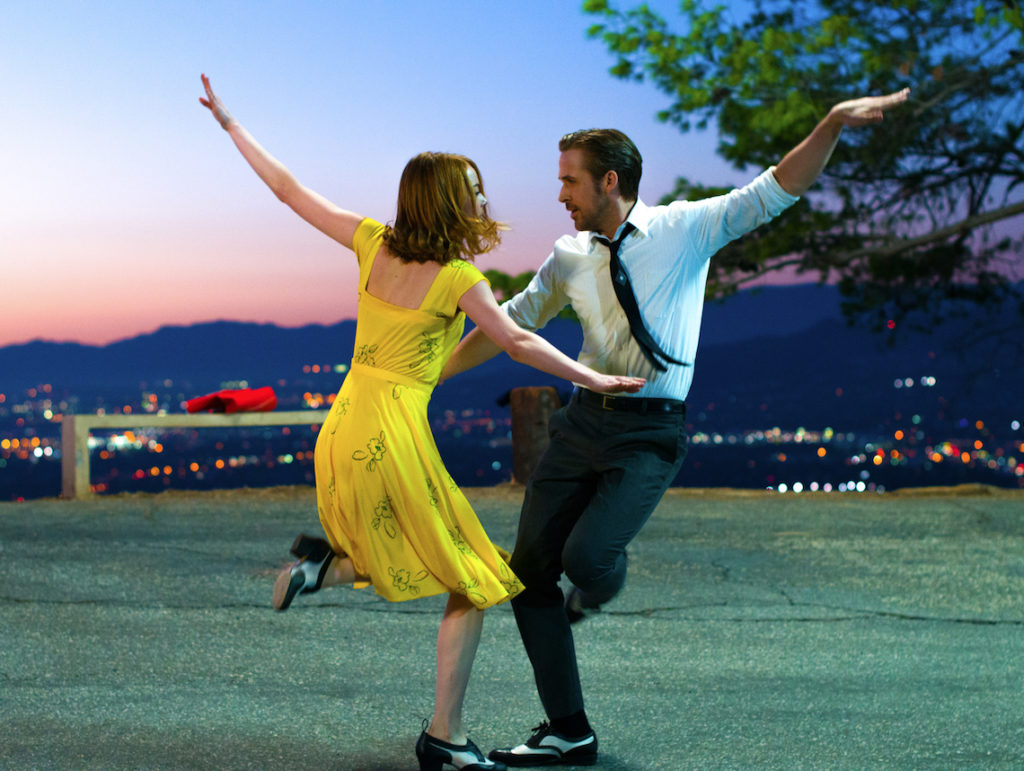
Ryan Gosling and Emma Stone in “La La Land.” Photo by Dale Robinette
The role of a producer can be confusing, and it often refers to someone who raises the money to get the film made. But, Berger says, “a true producer is involved in every aspect and helps both protect the vision and the filmmaker and also push every element further to its most ambitious ends. And in this case, I think we were as immersive in the process as producers can be.”
Berger, 35, and Horowitz, 36, share a similar career trajectory. Both grew up in Westchester, N.Y., and even played for Jewish temple league basketball teams. They moved to New York around the same time to work in the film industry, then relocated to L.A. at nearly the same time. While they each have several independent film credits, “La La Land” is by far the most successful film either has produced.
“La La Land” stars Emma Stone, as a struggling actress named Mia, and Ryan Gosling, as Seb a jazz pianist who dreams of opening his own club. From the earliest days, Berger says, Chazelle and the team envisioned those actors playing the parts.
“It was always Ryan Gosling and Emma Stone in our heads,” Berger said. “And it was always an impossibility that we would get them, also in our heads, because they were just so perfect that we never let ourselves believe they would do this film. So we were always looking for who were the best replicas of them.”
Fred Berger. Photo by Kimberley French
In 2014, as “Whiplash” was on the awards circuit, Chazelle met the two stars separately. As it happened, both Gosling and Stone were fans of old musicals and had always wanted to be in a musical. They replaced two younger stars, Miles Teller (of “Whiplash”) and Emma Watson, who had initially been cast but were dropped before rehearsals began.
“If you sit with Damien in a room, there will be a moment where your eyes go wide because there’s an articulateness that is just extraordinary and kind of unparalleled in my experience, that gets you as excited about whatever he’s talking about, no matter how esoteric or obscure,” Horowitz said. “It’s just so rooted in a sincere passion for cinema that you just want to go on that ride with him no matter what.”
“La La Land” opens with a dazzling song and dance number, “Another Day of Sun,” on a freeway overpass during a traffic jam near downtown Los Angeles. It required 30 dancers, 100 extras, at least 60 cars and six months of planning. It was carefully rehearsed in the parking lot of their production office in Atwater Village, with Chazelle shooting the scene on his iPhone.
Jordan Horowitz
“It was a rush, but it’s one of the most challenging and yet exhilarating shoot days of our entire careers,” Berger said. “We’d been living with that scene for six years. Before there was a script, the first question we asked ourselves is how do we get people to fall in love with L.A., this city that everyone thinks they hate. And we decided we had to lean into the clichés and notify people that we were in on the joke, and understood that there was traffic and no seasons and insular people dreaming of stardom, right off the bat.”
Another iconic scene in the film is Stone and Gosling’s first dance duet, a tap sequence set at dusk on a hilltop in Griffith Park, with the twinkling lights of the Valley in the background. It needed to be a single six-minute take, and the crew had two days to get it right.
“I just remember after the take that we wound up using in the film, there was this moment after they walk off screen at the end … there’s this amazing cheer from the whole crew. And every time in the movie that I see that sequence, I expect to hear the crew cheering when they walk out of frame,” Horowitz said.
While “La La Land” garnered many accolades and positive reviews, it has also received some backlash. Critics complained that Gosling and Stone are not highly trained singers or dancers. Further, this was a year in which issues of race took center stage, with prominent African-American films such as “Moonlight,” “Fences” and “Hidden Figures” winning awards and acclaim. While musician John Legend plays a supporting role in “La La Land” and is among the film’s executive producers, reviewers criticized the idea of Gosling playing a white guy trying to save jazz music, especially after last year’s #OscarsSoWhite campaign criticized the lack of diversity in Hollywood.
The opening number from “La La Land” takes place on an L.A. freeway overpass. Photo by Dale Robinette
Berger and Horowitz said they consider themselves fans of the films competing against “La La Land” and have become close to many of their filmmakers, producers and actors.
“It’s a bit sad when it feels like people have to choose one or the other, because that’s not the nature of why we made these things,” Berger said. “Nothing makes us happier than reading a scathing review of the film. I love an honest critique of the movie. There’s no movie that has 100 percent adulation. So we’re happy for people to dislike the movie on its own terms.”
“La La Land” is an introspective film with an undercurrent of loss and sadness but is also joyful and escapist. During a difficult political climate, its lack of social critique could either help or hurt.
“I think for me, right now, given this moment that we’re in, it’s really important to create and champion work that inspires that kind of joy and hope and empathy and for people to dream bigger,” Horowitz said.
“La La Land” is in theaters now. The Academy Awards ceremony will take place Feb. 26 at the Dolby Theatre in Hollywood.
Anti-Semitism has become the new “it” word. I see it everywhere. The Jewish news media, Jewish organizations, commentators, friends, rabbis — everyone seems to be up in arms about the apparent “resurgence of anti-Semitism in America.”
Why am I having trouble jumping on this bandwagon of hysteria?
It’s not because I’m indifferent to ugly episodes like phone threats against Jewish groups or Jewish graves being desecrated.And it’s not because the liberal Jewish community seems to go especially crazy when the anti-Semitism looks like it’s coming from the right.
Rather, my problem with the hysteria is that it covers up an essential truth: No country has been better or safer for the Jews than America.
Jews have thrived in a free society where everyone is equal under the law. We have given back to America every ounce of our gratitude. We have contributed in all fields, from entertainment, science and spirituality to academia, social activism and the economy. In the process, we have made ourselves liked and respected. It’s not a coincidence that, according to the latest Pew Research Center study, Jews are the most liked religious group in America.
So, here’s the question: If we’re the most liked group in America, why are we not acting like it? Why is our body language so insecure?
Given our long history of persecution, we have every reason to be ultrasensitive to any sign of Jew-hatred. The problem is that in this new media landscape we’re in, these signs can often look overwhelming. Any coward can slap a swastika on the side of a synagogue and take over the national conversation.
I’m not downplaying Jew-hatred. It’s real and it’s evil. We know there will always be people who will find a reason to hate Jews. The real question is: How much power do we want to give them?
If you ask me, here’s the message these Jew-haters need to hear: You lost, folks. The Jews have made it in America. We love our country, and America loves us right back. You guys are the sorry exceptions. We will fight you tooth and nail, but we won’t give you the publicity you crave.
Any coward canslap a swastika on the side of a synagogue and take over the national conversation.
Let’s also fess up to the elephant in the room: Bad news is good for business. Headlines that shout “Anti-Semitism” energize our whole ecosystem — the media, the donors, the pundits, the political activists, the synagogues, the federation boardrooms, everyone who feeds off the drama of bad news. This is human nature.
Conversely, it’s a lot more difficult to find drama in good news. How do we elevate the heroic story of the Jews in America, the incredible progress we have made and the significant contributions we continue to make?
If we dig a little deeper, though, we will see that celebrating the good news can also be a way of fighting anti-Semitism. By projecting a more positive vision of the American Jewish experience, by focusing on how people love us and not just on how they hate us, we combat anti-Semitism with a large dose of pro-Semitism. It’s a direct hit.
You know my theory of who has encouraged Jewish love as much as anyone? Jewish comedians. Over the past century, no one has brought more laughs to America. Our comics poked fun at themselves, at Jews, at everyone. Their irreverence was a sign of strength and confidence.
We can’t afford to lose that winning image. Jewish culture in general has so thoroughly infiltrated American culture that it’s often hard to tell the difference between the two. This intimacy between the two cultures is partly what feeds the positive affection for Jews in the first place.
By all means, let’s stay vigilant and let’s fight the hatred, but let’s not give this hatred iconic status. Let’s tone down the “sky is falling” body language and fight the haters from a position of strength and security, not fear.
As former Israeli ambassador to the United States and current Deputy Minister for Diplomacy Michael Oren said recently in a Times of Israel (TOI) interview, “Too much emphasis is put on what people say, not on what they do.” In his meetings with bipartisan congressional delegations from the U.S., Oren, according to TOI, is often told “it is less important that hate crimes are condemned and more important that they are stopped. The question is what is done operatively to combat and prevent them.”
In other words, when you’re dealing with cowards who crave attention, fighting quietly may be more effective than screaming publicly.
David Suissa is president of TRIBE Media Corp./Jewish Journal and can be reached at davids@jewishjournal.com.