
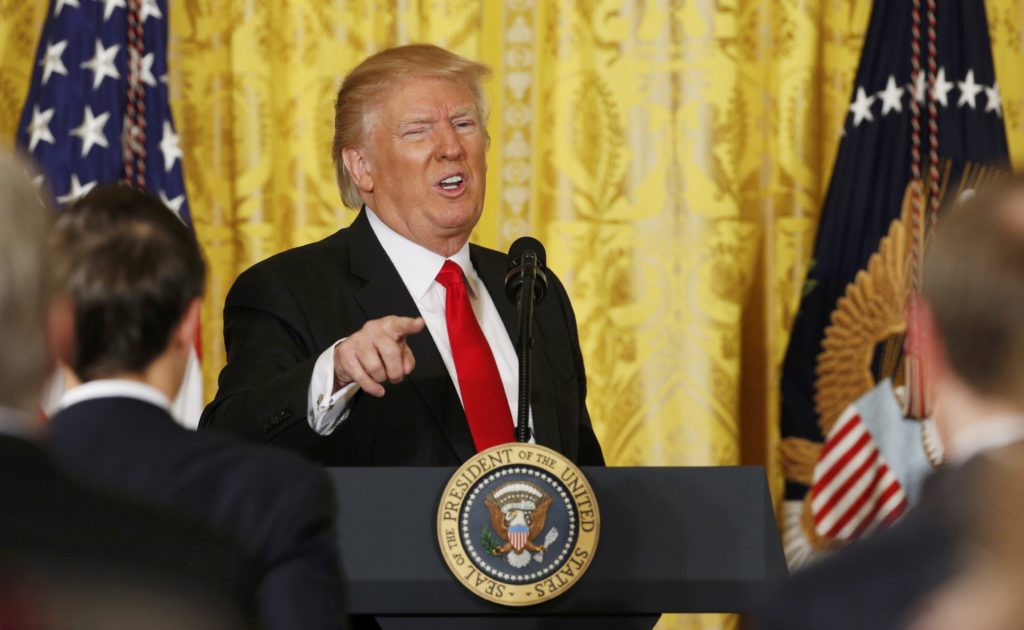
‘Quiet! Quiet! quiet!’ was not necessarily the wrong response to a question about Trump and anti-Semitism
1.
Anti-Semitism is an old and sticky phenomenon. It rises and subsides, but never disappears. In the U.S. today it seems to be on the rise, and that is scary. Jews in America have got used to living without having to think much about anti-Semitism. And if they did, it was usually because of their concern for Jews elsewhere, those who suffer in places like France or Belgium.
Understanding the sources of anti-Semitism is not easy. Collecting data with which to determine whether the level of anti-Semitism is rising is also trickier than you might think. Is there really a rise in anti-Semitic incidents, or merely a rise in awareness to anti-Semitic incidents? Are we witnessing a dangerous wave of hatred, or merely becoming more sensitive? Is it anti-Semitism that is rising, or maybe it is the general atmosphere in America that has become less tolerant towards everybody (Jews included, but not singled out for any special treatment)?
Consider this: just a few days ago, a new study from PEW found, and not for the first time, that “Americans express warm feelings toward Jews, with half of U.S. adults rating them at 67 degrees or higher on the 0-to-100 scale. Four-in-ten Americans rate Jews in the middle of the thermometer, between 34 and 66, and only about one-in-ten express feelings that fall at 33 degrees or cooler.”
So Jews are still highly popular in a largely Christian America. But they also feel that something bad is happening as they see a cemetery in St. Louis desecrated, as their institutions get bomb threats, and as newspapers tell them a story about a “shocking rise of antisemitism” (as do some of their organizations).
How would we know?
Since there is no institutional action against Jews in America – nor do we expect any such thing – the only way to know is to patiently gather data and compare it responsibly to the data we have from previous years. And note: this data is often problematic. It is problematic because it is based on reports by institutions and individuals, whose tendency to report every incident rises when public awareness rises. It is problematic because you don’t always know what constitutes anti-Semitism, and interpretations of incidents and trends vary.
Take, for example, the case of a Jewish student supportive of Israel who finds herself having to confront an anti-Israel protester that accuses her of many things. The protester tells her that she supports an illegal and immoral occupation, he tells her that she condones racial cleansing, he tells her that she should be ashamed of her support of a colonialist regime, he tells her that she is hurting American interests and is guilty of dual loyalty.
Are these anti-Semitic allegations? All of them? Some of them? Where does one draw the line by which to distinguish legitimate political criticism from illegitimate anti-Semitism? Does the line only take into account the words used, or maybe also the tone, the posture, the level of aggressiveness, the implicit threat?
Or take, for example, the case of a city in which the level of bigotry rises. Black people hear more slurs, Asian people get more nasty responses when they need something, Hispanic people are suspected by every passing policeman of being illegal immigrants, and Jews also get a less-than-hospitable treatment. Is this a rise in anti-Semitism that merits special attention – or a rise in something from which Jews suffer along with many others and hence merits a different kind of attention?
And what if the rise in hostility towards these Jews in this town full of bigotry happens in parallel to a vigorous effort by Jewish institutions to defend and assist their fellow Black, Hispanic, and Asian citizens. That is: what if the Jews get a taste of anti-Semitism as a result of their high visibility amongst those who are fighting to change this town’s culture? Is this also anti-Semitism in the regular sense, or maybe it is the natural (if ugly and reprehensible) response of people who rightly view the town’s Jews as their political and cultural rivals?
3.
President Trump was clearly annoyed when he was asked a few days ago about anti-Semitic
Incidents. His response to the question was uncalled for – brutal and disrespectful. But I must say that I have a certain sympathy for his annoyance. Clearly, in the case of reporter Jake Turx from Ami magazine there was no attempt to blame Trump for the rise in anti-Semitism. But Trump knows that in many other cases that is exactly the point: to make him responsible for anti-Semitism, to portray him as a leader tolerant of anti-Semitism, to argue that he condones and benefits from anti-Semitism.
In fact, Turx, who asked the question that prompted Trump’s wild attack, understands this too. “It is very unfair what’s been done to him,” he said. “I understand why he’s so defensive. I’m with him when it comes to being outraged about him being charged with this anti-Semitism.” In Trump’s view, a lot of the growing level of talk about anti-Semitism is no more than a political strategy to destroy his credibility. When some campuses became a hostile environment for Jewish students because of vile attacks from the left, the Jewish establishment did not rush to blame President Obama and his confrontational approach toward Israel for it. But now, when vile attacks on Jews seem to come also from the right, many more Jewish leaders are ready to point a finger at the White House.
Well, a Jewish leader currently visiting Israel told me yesterday, “but Trump is responsible in more than one way for the rise in anti-Semitism.”
Maybe. It is not easy to prove that he is, or to argue that he isn’t. But three things should be kept in mind when such allegations are made:
A. Make sure your hands are clean. That is, make sure you aren’t blaming Trump for anti-Semitism because you generally dislike his politics, but rather because you are convinced beyond doubt that he is indeed responsible for something as serious as a rise in anti-Semitism.
B. Make sure the rise is real and not imaginary. And by raising the profile of this phenomenon try not to contribute to an atmosphere that makes anti-Semitism seem common and almost normal.
C. Ask yourself: is pointing a finger at Trump helpful in any way? If it is not helpful, maybe a better tactic ought to be found.
4.
President Trump’s angry response to a friendly reporter’s question was not necessarily the wrong response.
Sure, it was wrong because no president should speak the way Trump speaks, and no president should be as vulgar as Trump is.
But it was also the right response: it shows that Trump cares, that he does not accept lightly the implied allegation that he is, in some way, friendly towards anti-Semitism.
The fact that Trump cares about such allegations means that Trump sees anti-Semitism as evil. It means that Trump refuses to be portrayed as someone aiding and abetting evil. Yesterday, the White House denounced those who threaten Jewish centers. “Hatred and hate-motivated violence of any kind have no place in a country founded on the promise of individual freedom. The President has made it abundantly clear that these actions are unacceptable,” said White House Deputy Press Secretary Lindsay Walters. Trump’s Jewish daughter Ivanka tweeted: “America is a nation built on the principle of religious tolerance. We must protect our houses of worship & religious centers. #JCC”. (Update: President Trump addressed the anti-Semitism incidents himself earlier today.)


