Omri Casspi, the first Israeli to play in the National Basketball Association, was traded to the New Orleans Pelicans from the Sacramento Kings.
The deal announced Monday was part of a blockbuster five-player trade that had All-Star center DeMarcus Cousins and Casspi heading to New Orleans, ESPN reported Sunday. Sacramento receives Buddy Hield, a first-round draft pick in 2016, as well as Tyreke Evans, Langston Galloway, a 2017 first-round pick and a 2017 second-round pick, according to the report.
Casspi joined the Kings in 2009 and played there for two years, when he was traded to the Cleveland Cavaliers, where he played for two years, spending much of his time on the bench. He spent a year with the Houston Rockets and then was traded to the Pelicans, who put him on waivers, where he was again picked up by the Kings.
Casspi played with the championship Maccabi Tel Aviv team in Israel before making himself available for the 2008 NBA draft.
The 6-foot-9 Casspi has been playing about 19 minutes per game this season, averaging 5.9 points and 4.1 rebounds. New Orleans hosted the All-Star Game over the weekend.
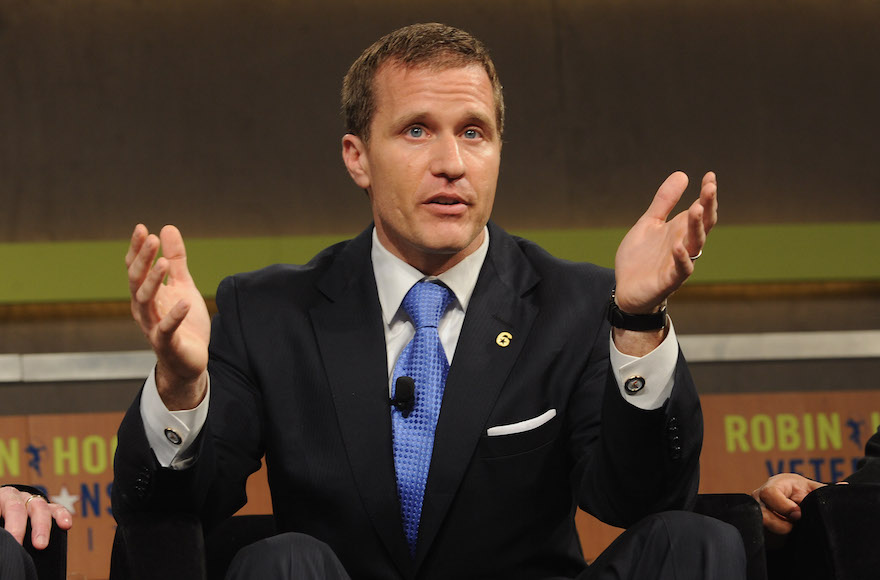
The Jewish governor of Missouri, Eric Greitens, said he will volunteer to help repair a St. Louis-area Jewish cemetery where at least 170 gravestones were toppled over the weekend.
Meanwhile, two Muslim activists have launched a crowdfunding campaign to raise $20,000 for repairs. The launchgood drive started by Linda Sarsour and Tarek El-Messidi had brought more than $45,000 as of Tuesday evening.
They said any remaining funds after the cemetery is restored will go to fixes for other vandalized Jewish centers.
“Through this campaign, we hope to send a united message from the Jewish and Muslim communities that there is no place for this type of hate, desecration, and violence in America,” the activists wrote. “We pray that this restores a sense of security and peace to the Jewish-American community who has undoubtedly been shaken by this event”
Greitens in a news release Tuesday cited the concept of “tikkun olam,” or repair of the world, and asked helpers to bring rakes, garbage bags, wash rags and more cleaning supplies.
“My team and I will be there tomorrow, and I’d invite you to join us,” he said.
The governor had previously condemned the vandalism on the Chesed Shel Emeth cemetery in University City and called on people to “fight acts of intolerance and hate.”
“Disgusted to hear about the senseless act of desecration at the cemetery in University City. We must fight acts of intolerance and hate,” Greitens wrote in a tweet Monday evening after the vandalism was discovered.
Disgusted to hear about the senseless act of desecration at the cemetery in University City. We must fight acts of intolerance and hate.
The attack on the cemetery took place sometime between Friday night and Monday morning, when the damage was discovered.
Chesed Shel Emeth Cemetery Executive Director Anita Feigenbaum told The New York Times that between 170 and 200 headstones were toppled, with some being broken and damaged.
The headstones are in the cemetery’s oldest section, dating from the late 1800s to the mid-1900s, she told the Times.
“I just am quite shocked — it affects so many people, so many families, so many generations,” Feigenbaum told the newspaper. “This cemetery was opened in 1893.”
In an interview with the Huffington Post, Lt. Fredrick Lemons of the University City Police Department declined to classify the vandalism as a hate crime.
“Right now, everything is under investigation,” Lemons said. “We’re looking into all possible leads.” The police are reviewing cemetery surveillance cameras, according to the report.
Greitens, a former Navy SEAL whose military awards include the Bronze Star, was elected the first Jewish governor of Missouri in November.
In a post on Facebook he called the vandalism a “despicable act of what appears to be anti-Semitic vandalism.”
“We do not yet know who is responsible, but we do know this: this vandalism was a cowardly act. And we also know that, together, we can meet cowardice with courage,” he wrote. “Anyone who would seek to divide us through an act of desecration will find instead that they unite us in shared determination. From their pitiful act of ugliness, we can emerge even more powerful in our faith.”
Immediately following the announcement of the vandalism, the Chesed Shel Emeth Society, which owns the cemetery, posted a message on Facebook informing families with relatives buried there that it is “assessing the locations and damage and will post names that are affected as soon as we are able. Many monuments are facing down and we won’t be able to read the names and see if there is any damage until we lift the stones.”
In an update Tuesday afternoon, the society said a local monument company had begun to replace the monuments on their bases. It said it would try to have a comprehensive list of the toppled monuments posted by Wednesday.
A local church, the All Nations Church, launched an appeal to help repair the damage caused by the vandals. The church said on its website that it would match up to $500 in donations to the cemetery.
“Destruction of Jewish headstones is a painful act of anti-Semitism,” said Nancy Lisker, director of the American Jewish Congress in St. Louis. “We feel the pain of the families whose grave sites of loved ones were desecrated and look to the authorities to apprehend and bring to justice those responsible for this heinous act.”
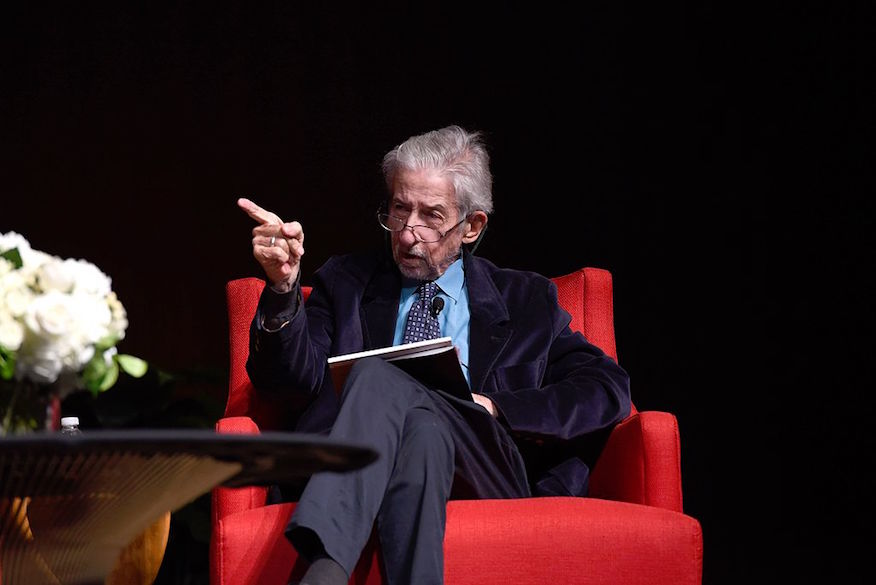
It was part memorial, part movement rally, part testimonial, part reunion. Most of the thousand or so gathered this past Sunday afternoon at UCLA’s Royce Hall were grey( not greying) boomers, though a younger cohort also showed. The sense of satisfaction in recalling a life of consequence, together with others who’d been there, was palpable. And there was this surprising occurrence: In an almost three hour event, during which a dozen plus speakers ( bold face names among them) held forth, each tethered to the port side of American politics, not once was the name of the current president mentioned.
The omission wasn’t an evasion; it was testimony to the man we came to remember and what he was about. On Sunday “Keep your eyes on the prize” was a watchword, for few had done it better than he.
Happily mingling in this congregation of joy: Onetime gang members (whose lives he had rescued and rearranged); his former students (ditto on the rearranged lives, maybe the same for the rescuing part); film and theatre people; academics and writers; political activists, including comrades from the Sixties and the California State Legislature, both; his family; and lots and lots of friends from many walks. He had changed the lives of most present– such was the power and personality of Tom Hayden
There was humor and irony (Hayden had both in spades), eloquence and tears. Those who spoke, led by his wife, Barbara Williams, covered the waterfront of a remarkable life: Tom Hayden’s achievements as “a radical American reformer” (in the words of his friend, Steve Wasserman); his contrarian nature, seen early on from Detroit and Ann Arbor days; his relentlessness and prescience, from his work in Georgia to Newark, Chicago to California; overall, his giftedness and singular voice –all evoked with admiration and affection.
Those who didn’t know him didn’t really get it, but Hayden, though often accused of arrogance, didn’t put on airs. Quite the contrary: His way, for example, was to “slink around low to the ground, leprechaun-like”, as his former wife Jane Fonda lovingly put it. We laughed; we all knew that walk of Hayden’s (which I always thought of as the walk of a wary, James Dean-like, outsider). Mostly, we felt fortunate for having known him.
I, for one, have long been intrigued by Tom Hayden’s friendship with the late Senator Robert F. Kennedy, towards the end of Bobby’s life. (Hayden, teary- eyed, joined a small honor guard watching over RFK’s casket at St. Patrick’s Cathedral, at midnight before the next day’s funeral.)
Bobby Kennedy Jr. shed light on the relationship. He told the Royce Hall crowd that his father liked Hayden a lot, seeing in him a kindred Irish spirit. Perhaps most important–this is 1967-68, remember, when the US was waging war in Vietnam while cracking down on dissent at home–Kennedy Jr. noted that Hayden sought to persuade those who would listen that a nation behaving like an imperial power abroad, would not have true democracy at home. Bobby Kennedy was listening (and so too was Martin Luther King Jr.)
Renowned as his Sixties and Seventies exploits were, Tom Hayden was not a man of the past. He was an urgent, though gentle, warrior for his causes, some ongoing, others to emerge—either way, Hayden, eyes ahead, was usually ahead of the crowd, which would eventually catch on.
Which is why, while we were gathered to memorialize him and his time is now gone, this was– and is– Tom Hayden’s moment.
For here we are, an imperious American administration in full tilt, and a Sixties- style movement of popular resistance aborning.
While the resistance is both more and less than a Sixties-like movement, one would guess it will prove large and broad- based, and will shape politics (electoral, included) for a decade or more.
This is so much what Hayden was about, especially in his last years. He agitated and organized, even during the Obama presidency, for a coalition of the many and the diverse for a sharing of the promise of America. When Trump began to rise in 2015, Hayden, always geared up, fearing the worse, geared up higher. He literally spent himself for the cause, as he tended to do.
Though he knew presidents and princes, Tom Hayden ultimately was a man of the streets — the kind of open streets where American democracy best thrives. Now is Tom Hayden’s moment–and it always was.
A final word: Hayden wasn’t a hater. A popular movement that succumbs to hate will soon enough see its promise in pieces and its time gone. Much as Tom Hayden would thrill to the voices of protest today, I suspect he’d counsel a degree of caution that the moment might last and democracy endure.
John Moscowitz is rabbi emeritus, Holy Blossom Temple, Toronto. The author of “Evolution of an Unorthodox Rabbi” (Dundurn Press, 2015), he’s writing a memoir of his activist days when Tom Hayden was his teacher.
he heads of Egypt and Jordan said a solution to the Israeli-Palestinian conflict must be based on having two states.
President Abdel Fattah al-Sisi of Egypt and King Abdullah of Jordan met Tuesday in Cairo.
“The two sides discussed future movements to break the gridlock within the Middle East peace process, especially with U.S. President Donald Trump’s administration taking power,” read a statement issued after the meeting.
“They also discussed mutual coordination to reach a two-state solution and establish a Palestinian state based on the June 4, 1967 borders with East Jerusalem as a capital which is a national constant that cannot be given up.”
The leaders also reportedly discussed Jerusalem and the maintenance of the status quo on the Temple Mount.
The meeting came days after the Israeli daily Haaretz first published a report revealing that one year ago, then-U.S. Secretary of State John Kerry presented a plan for a regional peace initiative to Israeli Prime Minister Benjamin Netanyahu at a secret meeting in Aqaba that included Abdullah and al-Sisi.
The deal would have included recognition of Israel as a Jewish state and a renewal of talks with the Palestinians with the support of the Arab countries.
The meeting also comes after last week’s meeting in Washington, D.C., between Netanyahu and Trump, in which Trump did not commit to a two-state solution in a break from U.S. policy from the early 2000s.
HIAS was established 135 years ago to protect Jewish refugees who were fleeing the pogroms of Czarist Russia. Today, we remain true to our original mission of refugee protection. We are helping people who have fled their countries because their lives were in jeopardy due to who they are or what they believe.
When there are refugees who are Jewish, HIAS is still there to make sure they receive help. In the past year, HIAS brought Jews from Iran, the Middle East, Ukraine, and other parts of the former Soviet Union to safety and freedom in the United States.
Yet, some in our community continue to ask, why are we helping refugees fleeing genocide, even when they are not Jewish? Thankfully, the Torah provides us with a clear answer.
Our most sacred text delivers a universal message about Jewish commitment to human rights and refugee protection. We read 36 times about the commandment to love the stranger as ourselves, for we know the heart of a stranger, as we were once strangers in the land of Egypt.
Assisting refugees of all faiths and ethnicities is not just a fulfillment of the values imbued by our holiest scripture, it’s a recognition of our people’s own Exodus experiences. The American Jewish community’s very existence is rooted in the windows of time when the United States opened its doors to refugees. Remaining silent while others seek the same opportunity to live in safety would be morally reprehensible.
With the largest number of refugees and displaced persons in recorded history, our mission is as relevant as ever—because of our roots. That is the only reason HIAS does what it does. Not for profit, but out of love and a commitment to our Jewish-American values.
Yes, HIAS (along with eight other mostly faith-based agencies) does receive government funding to subsidize these efforts, but we do not make a profit. HIAS’ local resettlement sites receive $2,075 per refugee with which we must pay our staff and overhead while providing the refugee with transportation, a fully furnished apartment for three months, a kitchen stocked with food, English lessons and cultural orientation, a cash allowance, assistance with school enrollment, and job placement services. There is no profit; we rely heavily on local volunteers and private donations.
We will not stand on the sidelines as Muslim refugees are turned away just for being Muslim, just as we could not stand idly by when the U.S. turned away Jewish refugees fleeing Europe during the 1930s and 40s. When we say, “Never again,” we mean never again for everyone.
We cannot protect ourselves by being only for ourselves. We can only protect ourselves by protecting and implementing universal principles of human rights. If we acted only when Jewish refugees were in danger, as opposed to constantly advocating for the protection of all refugees, it wouldn’t only wrong, it would be a rejection of our refugee roots.
Mark Hetfield is the President and CEO of HIAS, the global Jewish nonprofit that protects refugees.
Pressed to explain his false claim that something terrible had happened in Sweden last week, President Donald Trump traced the canard back to the reporting of Ami Horowitz, a gonzo Jewish-American filmmaker who spoke about Sweden’s problem with Muslim immigrants on Fox News.
On Saturday, during a campaign-style speech in Florida on border security and immigrants, Trump urged listeners to “look at what’s happening last night in Sweden,” leading to widespread puzzlement and mockery from Swedes who said no terrorist attack had taken place there the previous day or even recently.
Karl Bildt, a former prime minister of Sweden, wondered on Twitter what Trump “is smoking,” and the Aftonbladet paper ran a daily roundup from Friday featuring nothing more sinister than a small northern avalanche.
Later Saturday afternoon, Trump indicated that the only thing that happened Friday is that he caught Horowitz talking about Sweden on Fox News.
My statement as to what's happening in Sweden was in reference to a story that was broadcast on @FoxNews concerning immigrants & Sweden.
The president’s reference was arguably a breakthrough for Horowitz, focusing rare international attention on Sweden’s immigrant crime debate, which Horowitz has spent considerable — and controversial — efforts investigating.
In his Fox News interview Horowitz, a former investment banker turned activist with a camera, claimed violent crime by refugees was out of control in Sweden and that the government there is covering up reports of rape to protect “vulnerable” migrants.
Coming amid a polarizing debate about the millions of immigrants arriving in Europe from the war-torn Middle East and Africa, the comments by Trump touched off a discussion about the president’s shaky handle on the facts.
But, Horowitz told JTA, it also “put a spotlight on the main issue: Sweden’s problems with immigration and crime. Which is positive.”
Horowitz has also reported on what he and others call Sweden’s “no-go zones” – areas that are densely populated by mostly Muslim immigrants from Africa and the Middle East that many native Swedes, and Jews especially, avoid for fear of harassment and robbery.
A 43-year-old father of two, Horowitz last year went filming in a no-go zone in the Stockholm neighborhood of Husby, where he recorded an alleged assault on himself by several Arab speakers who objected to his filming on the street.
“My crew ran off when they approached, but since I was miked we have the first few seconds of the attack,” Horowitz, a Los Angeles native who lives in New York, told the Daily Mail. “They repeatedly punched, kicked and choked me as a number of bystanders watched. Eventually they dragged me into a building, which at the time I assumed was to finish me off.” Horowitz ultimately was released.
On Monday, violence erupted in another no-go zone, Rinkeby, where locals torched several cars after police arrested a man there, the Dagens Nyheter daily reported.
Horowitz, a vocal critic of Trump during the campaign, describes himself as “at times conservative, at other times liberal.” He said the incident in Husby was not his first close call while making films that offer a hard look at liberal causes or defend Israel.
In 2016, he took an 11-hour road trip in the West Bank to counter claims that Israeli security forces restrict movement there. At a crossing point into Israel, an adrenaline-filled Horowitz was filmed throwing rocks back at Palestinians who hurled them at him and others waiting to enter.
In 2009, while filming a prickly documentary about the U.N. double standard on Israel and other issues, he traveled to war-torn Cote D’Ivoire to investigate incidents in which U.N. soldiers opened fire on unarmed demonstrators. In the same film, Horowitz seized the microphone at the controversial 2009 Durban Review Conference in Geneva, telling attendees that they should be “embarrassed and ashamed” by their anti-Israel bias. The incident was also captured on tape by JTA.
And in 2015, he sailed with Syrian immigrants infiltrating Europe across the Aegean Sea, reporting that he saw an ISIS recruiter attempting to recruit some of the would-be newcomers.
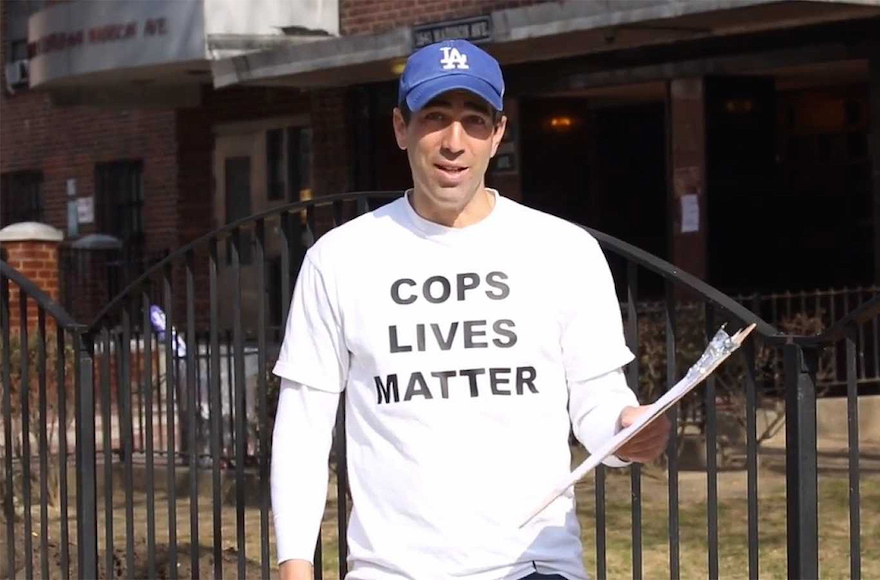
In 2014, he filmed the reactions of students at the University of California, Berkeley, as he variously waved Israeli and ISIS flags on campus; students are shown ignoring the ISIS flag but reacting angrily to Israel’s. In another film he asked New Yorkers to sign a petition titled “Cops’ Lives Matter.”
Initially, Horowitz’s no-go experience in Sweden generated little attention in the country, where “mainstream media tend to not report the ethnicity of perpetrators of crimes,” according to an employee of the Swedish Migration Board who spoke to JTA on Tuesday on condition of anonymity for fear of being fired.
But Trump’s remarks focused intense attention in Sweden to the link between crime rates in the country of 9 million and its admittance since 2013 of more than 300,000 asylum seekers mainly from Muslim countries.
Sweden had been one of the most welcoming nations in Europe to refugees, but in 2016 drastically cut back on asylum quotas. The government said it was over housing issues.
Some have cited Sweden to defend Trump’s executive order limiting immigration from seven predominantly Muslim countries. Some regard Sweden as an inspiring role model for its efforts to resettle asylum seekers. But others see it as a failed experiment, and say it has contributed to an unprecedented rise in the popularity of far-right anti-Islam parties that are riding a wave of discontent over the arrival of unskilled immigrants at a time of economic stagnation.
As for Sweden’s 20,000 Swedish Jews, they have seen an explosion of hate crimes against members of their community in recent years. Dozens of incidents are documented annually in Malmo alone, a southern city with only 1,000 Jews where a third of the population of 300,000 are Muslims.
Trump’s remark also exposed Horowitz to criticism for his gonzo style of journalism, which owes more to Michael Moore and “The Daily Show” than CNN. In the past he has filmed interviews without permission, provoked onlookers’ reactions with outrageous stunts and edited footage to ridicule interviewees. Horowitz defends his methodology as accurate, though he admits it is “confrontational and provocative.”
On Monday, two police officers he interviewed for his Sweden documentary, in which Horowitz claimed Muslims are overrepresented among perpetrators of criminal activity, said he edited their answers manipulatively. Horowitz denied the charge and attributed their reactions to pressure from their superiors.
In an op-ed published Tuesday by the Svenska Dagbladet, Linda Nordlund, a former chairwoman of the Liberal Youth of Sweden, criticized Horowitz for relying on anonymous sources in asserting that a majority of women waiting at a police station were there to report rape. She said Horowitz “is known for his xenophobic views” and that his report is “full of inaccurate statistics and innuendo.”
But in that same op-ed, Lund also said that Trump’s “false claims” and Horowitz’s “fake news” eclipse a necessary discussion on real problems – including the undisputed overrepresentation of foreigners in criminal activity. Authorities in Sweden do not publish precise data on the nationality or ethnicity of perpetrators, which the media also squelch.
Lund also noted an increase in sexual harassment in public swimming pools, though she wrote that Horowitz’s claims that rape is increasing are false.
Still, while there was a dip in the number of reported rapes in 2015, the average has risen in Sweden by 18 percent in the years 2011-2016 to an average of 6,341 cases annually, compared to 5,260 cases in the years 2006-2010, according to the Swedish National Council for Crime Prevention. (Some attribute that to a change in the types of acts that can be classified as rape.)
“There’s been a lot of discussions about statistics, a lot of back and forth,” Horowitz said of the effects of his reporting in Sweden. “There’s a lot of disinformation but on the whole, this overdue discussion is a good thing for Sweden and Europe.”
The Simon Wiesenthal Center called on U.S. Attorney General Jeff Sessions to set up a task force to catch the callers who have made false bomb threats to Jewish community centers across the country.
In its statement issued Tuesday, the Jewish human rights NGO said it also called on President Donald Trump to outline his administration’s plan to combat what the center called “surging anti-Semitism.”
The statement said the center appreciated “the efforts made by law enforcement to protect people of all faiths,” but added that “given the current circumstances,” it was urging Session to create the task force “with the assignment of identifying and capturing the culprit or culprits who seek to terrorize American Jewry through their threats.”
“The multi-pronged threats of anti-Semitism today demand concerted action,” Rabbis Marvin Hier and Abraham Cooper, dean and associate dean, respectively, of the center, said in the statement. “We look to President Trump to take a leadership role in addressing the problem of anti-Semitism and hate in America head-on in a speech at a time and place of his choosing.
“We need lead leadership from the top to effectively combat the hate.”
Trump on Tuesday morning condemned anti-Semitism, calling it “horrible” and saying it “has to stop.”
Jewish groups and political leaders have called on Trump to speak out against anti-Semitism, especially after four waves of bomb threats called in to dozens of JCCs in the past five weeks.
The JCC Association of North America said that since Jan. 9, there have been 69 bomb threat incidents at 54 JCCs in 27 states and one Canadian province. All were hoaxes but forced the evacuation of many of the buildings.
An Israeli soldier who shot a downed Palestinian terrorist was sentenced to 18 months in prison.
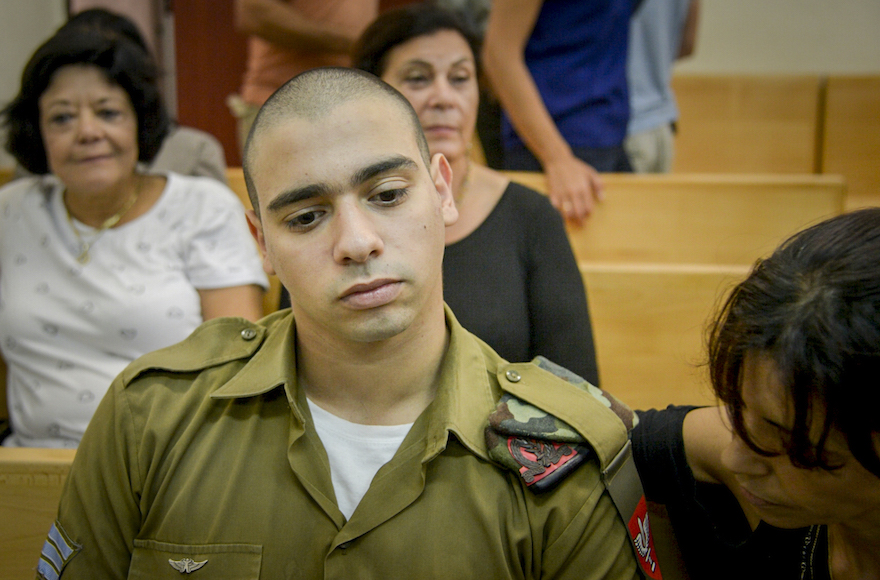
Elor Azaria, 20, who was convicted of manslaughter last month in an Israeli military court, was sentenced Tuesday by a panel of three judges at the Israel Defense Forces headquarters in Tel Aviv. Azaria also was demoted one rank, to private from sergeant, and was given a 12-month suspended sentence.
Military prosecutors had asked for a sentence of three to five years.
Azaria’s attorney said he will appeal the sentence, and also is appealing the verdict. He will request that Azaria be free until the end of the appeals. Prosecutors have called for Azaria to enter prison as early as Sunday.
About 100 people demonstrated outside of the IDF headquarters, called the Kiriya, during the sentencing. Among their chants: “The people of Israel do not abandon soldiers” and “We’ve come to take Elor.” The soldier’s father, Charlie, thanked the protesters and urged them to remain calm.
“All of the soldiers here are our sons. So I request everyone show restraint,” he said.
In their sentencing decision, the judges stressed that the severity of the incident was mitigated by the fact that it took place in an active combat situation. This was a key component of the defense’s case.
The judges also found, however, that Azaria’s actions did “harm to societal values” and said that Azaria violated the Israeli army’s rules of engagement and values. They also criticized the army for not taking better care of the soldier’s family and the defense minister for his interference in the case.
Azaria, a medic in the elite Kfir Brigade, came on the scene following a Palestinian stabbing attack on soldiers in Hebron in the West Bank on March 24, 2016.
One assailant was killed, and Abdel Fattah al-Sharif was injured. Minutes later, while Sharif was lying on the ground, Azaria shot him in the head in a shooting that was captured on video by a local resident for the Israeli human rights NGO B’Tselem. Azaria was arrested the same day and indicted nearly a month later. Autopsy reports showed that the shots by Azaria killed Sharif.
Prior to shooting Sharif, Azaria had cared for a stabbed soldier.
The case has been controversial in Israel, with some on the political right calling for solidarity with Azaria and others, including military leaders, suggesting such calls reflect a national crisis of ethics.
Following the announcement of the verdict, several right-wing lawmakers called for Azaria to be pardoned.
“Israel’s security demands he be pardoned,” Jewish Home party head Naftali Bennett said in a statement. “Elor was sent to protect Israelis at the height of a wave of Palestinian terror attacks. He cannot go to jail or we will all pay the price.”
Sari Bashi, Israel and Palestine advocacy director at Human Rights Watch, said in a statement, however: “Sending Elor Azaria to prison for his crime sends an important message about reigning in excessive use of force. But senior Israeli officials should also repudiate the shoot-to-kill rhetoric that too many of them have promoted, even when there is no imminent threat of death. Pardoning Azaria or reducing his punishment would only encourage impunity for unlawfully taking the life of another person.”
A Muslim civil rights and advocacy organization has offered a $5,000 reward for information leading to the arrest and conviction of the person or persons who made false bomb threats to Jewish community centers.
The Council on American-Islamic Relations, or CAIR, made the offer Monday, hours after bomb threats were called in to 11 JCCs across the country, leading most of them to evacuate their buildings while police and FBI searched for explosives.
The threats — the fourth wave in about five weeks — targeted JCCs in Birmingham, Cleveland, Chicago, St. Paul, Tampa, Albuquerque, Houston, Milwaukee, Nashville and Buffalo.
“It is the duty of American Muslims to offer support to the Jewish community and any minority group targeted in the recent spike in hate crimes nationwide,” CAIR’s national executive director, Nihad Awad, said in a statement. “We hope this reward will aid in the swift apprehension and prosecution of the perpetrators.”
Awad noted the “tremendous level of support” offered to Muslim Americans by the Jewish community when Muslims have been targeted by hate in recent months.
President Donald Trump denounced anti-Semitism a day after bomb threats were made to 11 Jewish community centers across the country and a large-scale cemetery was vandalized in the St. Louis area.
Under pressure to condemn anti-Semitism in the wake of what has been called an uptick in incidents since he was elected, Trump told MSNBC on Tuesday morning, “Anti-Semitism is horrible and it’s going to stop, and it has to stop.”
The president made the remarks at the National Museum of African-American History and Culture in Washington, D.C., after taking a tour. His daughter Ivanka was with him on the tour; a day earlier she had called for the protection of religious institutions in a tweet using the hashtag #JCC.
Asked by reporter Craig Melvin if his statement meant he was denouncing anti-Semitism “once and for all,” Trump replied: “Of course, and I do it whenever I get the chance to do it.”
Last week, Trump was asked during a news conference about the prior JCC bomb threats and what the government’s response would be to “an uptick in anti-Semitism.” Although the reporter did not suggest Trump was anti-Semitic, the president answered by denying he is an anti-Semite and called the question “insulting.” He ordered the reporter to sit dowm, and did not answer the question.
Jewish groups and political leaders have called on Trump to speak out against anti-Semitism, especially after four waves of bomb threats called in to dozens of JCCs across the country in the past five weeks. After yesterday’s bomb threat hoaxes were reported, officials at various Jewish groups, including the American Jewish Committee, the Anti-Defamation League and the Zionist Organization of America, issued remarks urging the president to make a personal condemnation of anti-Semitism.
Trump later told Melvin in a one-on-one interview about the racial divide in America that the tour was “a meaningful reminder of why we have to fight bigotry, intolerance and hatred in all of its very ugly forms. The anti-Semitic threats targeting our Jewish community and our Jewish community centers are horrible, are painful and they are a reminder of the work that still must be done to root out hate and prejudice and evil.”
On Tuesday morning, Trump’s opponent in the 2016 election, Hillary Clinton, called on Trump to condemn anti-Semitism.
“JCC threats, cemetery desecration & online attacks are so troubling & they need to be stopped. Everyone must speak out, starting w/ @POTUS,” she tweeted.
JCC threats, cemetery desecration & online attacks are so troubling & they need to be stopped. Everyone must speak out, starting w/ @POTUS.