I
If only they had
stopped and asked for directions.
Less than forty years.
II
Tough choice: Succumb to
approaching Egyptians or
walk into the sea.
III
Walls of water, and
a cloud pillar protects us
from the swords behind.
IV
Egyptians think the
space between water walls is
for them too. It’s not.
V
One of our oldest
traditions began in the
desert – complaining.
VI
Manna encased in
layers morning dew. A
sandwich from Heaven.
VII
If your parents said
not to talk to rocks, you should
refer them to God.
Los Angeles poet Rick Lupert created a the Poetry Super Highway (an online publication and resource for poets), and hosted the Cobalt Cafe weekly poetry reading for almost 21 years. He’s authored 20 collections of poetry, including “I’m a Jew, Are You” (Jewish themed poems) and “Feeding Holy Cats” (Poetry written while a staff member on the first Birthright Israel trip), and most recently “Donut Famine” (Rothco Press, December 2016) and edited the anthologies “Ekphrastia Gone Wild”, “A Poet’s Haggadah”, and “The Night Goes on All Night.” He writes the daily web comic “Cat and Banana” with fellow Los Angeles poet Brendan Constantine. He’s widely published and reads his poetry wherever they let him.
Our guest this week is Rabbi Rachel Timoner, Senior Rabbi of the Beth Elohim congregation in Brooklyn. Rabbi Timoner grew up in Miami, Florida, received a B.A. from Yale University, and received s’micha from Hebrew Union College-Jewish Institute of Religion in 2009, where she was a Wexner Graduate Fellow. From 2009 to 2015, Rabbi Timoner served as Associate Rabbi of Leo Baeck Temple in Los Angeles. During this period she also served as a leader of Reform CA, a state-wide movement of more than 120 rabbis and many lay leaders to serve as a powerful voice for social justice in California, winning protection for 1.5 million undocumented immigrants and more than a billion dollars in affordable housing. From 1998 to 2004, she was a facilitator and consultant in organizational development and strategic planning. Prior to that, Rabbi Timoner raised funds to rebuild the San Francisco Women’s Building, a community center for low-income women; worked to mitigate the impact of welfare reform in California; worked in San Francisco City Hall for Supervisor Harry Britt; and founded two leadership programs and a peer hotline for lesbian, gay, bisexual, and transgendered youth.
This week’s Torah portion – Parashat Beshalach (Exodus 13:17-17:16) – features the people of Israel being led out of Egypt by pillars of cloud and fire, the dramatic parting of the Red Sea, the song of Miriam, the bread from heaven, Moses hitting the rock, and Israel’s war with Amalek. Our discussion focuses on the fearful moment the people of Israel experience when the Egyptian army are closing in on them and on the deep effect this moment has on their liberation process.
This Sunday is the birthday of the iconic 16th American President and it turns out that Abraham Lincoln was in fact a pretty good friend of the Jews (at a time when it wasn’t necessarily so popular to befriend the “Hebrews”).
Abraham Jonas, who the president himself described as his “most valued friend”, was first to advise Lincoln to run for president. Issachar Zacherie, foot-doctor and spy, alleviated many a pains on Lincoln’s feet but also helped the president secure his second election. These, and many others, are a testament to the important relationship between Lincoln and the American Jewish community.
In celebration of Lincoln’s 208th birthday, Two Nice Jewish Boys visited the Giv’at Ram campus of the Hebrew University for a special episode with Professor Jonathan Sarna. Professor Sarna’s newest book “Lincoln and the Jews” is a fascinating biography examining the former president’s close ties with the Jews of his time. The historical narrative is accompanied by Benjamin Shapell’s vast and gripping collection of rare documents and photographs which really transport the reader in a way that few historical non-fiction books manage to do.
Tune into our latest episode to hear about all this and more.
Last Friday night, my rabbi got all political on me.
It came as something of a shock. I know Rabbi Naomi Levy really well — we’ve been married 25 years. During that time, I’ve heard Naomi give at least 1,000 sermons. Not one took an overt stand on a hot political issue or candidate. She would call for understanding between Israel and her neighbors, for instance, but the words “two-state solution” never escaped her lips.
It’s not that she hasn’t always had passionate and astute political opinions. I know. We talk.
But inside the sanctuary, her focus always has been on helping people grow spiritually, to find their life path through faith, tradition, learning and community. When she calls for social action, it is of the nonpartisan sort: feed the homeless, plant trees, engage with other faith communities. Her sermons move people to tears, laughter and introspection, not to petitions.
“That’s what people come to shul for,” she always told me. “That’s who I am.”
She also understood that politics could easily divide a congregation, or alienate some members. Both when she was the senior rabbi at Mishkon Tephilo in Venice, and after she founded Nashuva, an outreach congregation based in Brentwood, she wanted everyone to feel welcome and accepted. If people wanted a pundit, they could watch cable.
So imagine my surprise this past Friday night: The usual standing-room-only crowd, some 400 people, packed inside Brentwood Presbyterian Church, where Nashuva holds its services. Naomi began her sermon as she often does, with something true, funny and personal.
“I’m a neurotic Jew from Brooklyn,” she said. “I’m scared of so many things. I’m scared of heights. I’m scared of snakes. After my bout with skin cancer, I’m scared of the sun.” Then she asked, “But you know what I’m not scared of?”
Voices from the congregation responded, “No, what?”
“Muslims,” she said. “I’m not scared of Muslims.”
There was a momentary pause. We didn’t see it coming. It took a split second to clock the punch. The rabbi was speaking out, loud and proud.
And all at once, applause. A loud, long spontaneous ovation.
Listen to Rabbi Naomi Levy’s sermon:
Naomi went on to hammer away at President Donald Trump’s executive order banning immigrants from seven Muslim-majority countries, and all refugees from Syria. She spoke of her own mother, Ruth, who arrived from Poland at age 6. The rest of Ruth’s large extended family — aunts, uncles, cousins — all were murdered in the Holocaust.
Naomi urged her congregation to fight the ban and to oppose the administration’s efforts to demonize Muslims. When she finished, the applause went on for a while. One couple did get up and walk out — maybe they had to use the restroom?
Why now? I asked Naomi. Why is this issue the first one you chose for making a strong political stance?
“I had no choice,” she said. “Welcoming the stranger is at the core of what it is to be Jewish.”
Of course, I agree. As an American, I know our country’s success is tied directly to immigration. As a Jew, I know how our country’s open doors literally saved our lives. And I know how many more Jews would be alive today — helping make America even greater — if the voices of fear and hate hadn’t all but closed the door to Jewish immigration after 1924. Those same forces tried to shut out Iranian Jews in 1979, and Soviet Jews in 1989, but thankfully they failed.
There is something in this immigration ban that is particularly noxious and motivating. It’s why Jewish organizations ranging from Yeshiva University to the Reform movement have taken stands. Why leaders who don’t ordinarily bring politics to the pulpit, like Valley Beth Shalom’s Rabbi Ed Feinstein and Stephen Wise Temple’s Rabbi Yoshi Zweiback, have spoken out. Why many disparate parts of a very diverse, fractured community are fighting it together.
That unity makes the silence of some leaders and institutions even more apparent.
Without naming names, it’s all too clear that many rabbis and leaders who deeply oppose the cruel, hateful and self-defeating order cannot publicly say so, for fear of alienating some supporters. Some worry it will tear congregations or boards apart along partisan lines. Or, they worry about upsetting large donors.
I don’t envy any rabbi or community leader this choice. There are costs to speaking out, and those of us who don’t have to pay shouldn’t be so quick to expect others to foot the bill. Their silence in any case should not be an excuse for our inaction.
At the same time, there is a cost to not taking a public stand. How dare we do any less than we would want others to do for us? History will record who stood by and let the doors slam shut, and who, even if they failed, tried to jam them back open.
I’m proud of my rabbi, my wife. I hope to be proud of us all.
ROB ESHMAN is publisher and editor-in-chief of TRIBE Media Corp./Jewish Journal. Email him at robe@jewishjournal.com. You can follow him on Instagram and Twitter @foodaism and @RobEshman.
You may recall that some weeks back I described a new feature of the Expired and Inspired blog; the option to submit a question that would be researched and written up. This is the first response to such a question.
The Question Asked
The question for this blog came up in several ways. It has been a part of the ongoing discussion concerning who should/could be included in a Chevrah Kadisha team, and how a Chevrah Kadisha team might/should deal with encountering a transgender meit/ah. The answer to that issue is not yet fully clear, nor is there universal agreement.
It is fairly widely understood that the traditional practice has been that men could only prepare men for burial, while women could prepare either women or men (in an ‘emergency’). This practice has been used to choose to have teams of women as the Chevrah Kadisha in some instances, for example in times of war, when no men were available, or, more recently, for the preparation of some transgender persons.
The question that is being considered here is not about the transgender concern (I mention that only because that was the context in which the question came up), but simply, how did it come to be that women could serve on/as the Chevrah Kadisha team for men?
Credit where credit is due
I turned to our volunteer researcher, Isaac Pollak, a student of the Gamliel Institute, and a long time, very experienced member of several Chevrah Kadisha teams, who has also studied and participated on Chevrah Kadisha teams worldwide. Thanks and appreciation to him for his efforts on this question.
Please note: I am summarizing Isaac’s work; I have done my best, but it is quite possible that I have misunderstood or misstated something, so if there are any errors, I have introduced them – don’t blame Isaac, it is my fault. — JB
Answer
It turns out that there isn’t a great deal of information that supports the custom that women may perform a Taharah for men.
The earliest basic text found to start with is Chapter 12:10 of Evel Rabbati (first part of minor tractate Semachot), which reads:
“A man may shroud and gird the corpse of a man, but not that of a woman. A woman may shroud and gird the corpse of a man or of a woman.
A man may attend another man suffering from intestinal illness, but not a woman. A woman may attend a man or a woman suffering from intestinal illness.”
Other later textual sources such as the Tur (Jacob ben Asher, Arba’ah Turei), the Shulchan Aruch (Joseph Caro, Code of Jewish Law), Nachalat Yaakov (Yaakov ben Binyamin Aharon, on Rashi’s Commentary on the Torah), and the Taz (David Halevi Segal, Turei Zahav) build on this position, and all state that the reason that a man cannot shroud women is because a man has a tendency to have immediate prurient thoughts upon the sight of a woman’s body, whereas a woman does not.
More, the subsequent responsa literature seems to all repeat the same thing, with no additional information.
Conclusion
The finding is that the early source, Evel Rabbati 12:10, continues to be the basis upon which this allowance of women to prepare men stands, and the only additions after this text are apparently assertions of the (we might think questionable) reason for the allowance.
We can speculate that this was at one time arrived at as a practical answer: I can imagine that in a time of war, when most men were away for extended periods for work or travel, when there were restrictions on the gathering of men in groups, or for other reasons; there may have been times when only women would have been available to perform the essential mitzvot around Taharah, whether the deceased was male or female.
That might have given rise to pressure to find a way for women to be permitted to do this task for men instead of men doing it. Women would have been engaged, even though this could be seen as fulfilling a time-bound mitzvah (one to be completed as soon as possible, and preferably within a day to permit speedy burial); a category of mitzvot for which women are generally not obligated, and some say prohibited, in halachic thought.
This is a fascinating question. We don’t have a complete answer, but the underlying ‘why’ is most intriguing.
If you know any more about this question, please feel free to be in touch or submit an article for the blog.
Do You Have a Question?
And if you have a question you would like us to look into, please send it to me at j.blair@jewish-funerals.org.
Rabbi Joe Blair serves two small congregations in the central Shenandoah Valley of Virginia, is an adjunct faculty member in the Department of Philosophy and Religion at Bridgewater College, and serves as webmaster and coordinator for Jewish Values Online. He studied at, and was one of the first group of graduates from the Gamliel Institute. He serves as a staff and board member of Kavod v’Nichum, and as a faculty member and Dean of Administration for the Gamliel Institute. He is the editor of the Kavod v’Nichum’s blog, Expired and Inspired, which appears on the L.A. Jewish Journal blogs website. He is involved in several Chevrot Kadisha.
Rabbi Joe Blair
______________
TASTE OF GAMLIEL
From Here to Eternity: Jewish Views on Sickness and Dying.
In 2017, Kavod v’Nichum and the Gamliel Institute are again sponsoring a six part “Taste of Gamliel” webinar. This year’s topic is From Here to Eternity: Jewish Views on Sickness and Dying.
Each 90 minute session is presented by a different scholar. Taste of Gamliel gives participants a “Taste” of the Gamliel Institute’s web-based series of courses. The Gamliel Institute is the leadership training arm of Kavod v’Nichum. The Gamliel Institute offers five on-line core courses, each 12 weeks in length, that deal with the various aspects of Jewish ritual around sickness, death, funerals, burial and mourning. Participants come from all over the United States, Canada, Central and South America, with a few Israelis and British students on occasion.
Upcoming Taste of Gamliel Webinars are on February 19, March 19, April 23, May 21, and June 25. Learn from the comfort of your own home or office.
The Taste sessions are done in a webinar format, where the teacher and students can see each other’s live video feeds. The sessions are moderated, ask participants to raise their virtual hands to ask questions, and call on and unmute participants when appropriate. We’ve been teaching using this model for seven years (more than 250 session). We use Zoom, a particularly friendly tool.
Webinar sessions are free, with a suggested minimum donation of $36 for all six sessions. Online sessions are 90 minutes. Sessions begin at 5 PM PST; 8 PM EST.
Those registered will be sent the information on how to connect to the sessions. Those registered will also reveive access to recordings of all six sessions.
You will receive an automated acknowledgement of registration. Information and technology assistance is available after you register. Those who are registered are sent an email ahead of each webinar with log on instructions and information.
You can view a recording of the sessions after each session, so even if you need to miss one (or more), you can still hear the presentation.
More info – Call us at 410-733-3700
Attend as many of these presentations as are of interest to you. Each session is about 90 minutes in duration. As always, there will be time for questions and discussions at the end of each program.
The entire series is free, but we ask that you make a donation of $36 or more to help us defray the costs of providing this series. That works out to $6 for each session – truly a bargain for the valuable information and world class teachers that present it.
Click the link to register and for more information. We’ll send you the directions to join the webinar no less than 12 hours before the session.
Suggestions for future topics are welcome.
________________________
GAMLIEL INSTITUTE COURSES
LOOKING FORWARD:
UPCOMING COURSE
Gamliel Institute will be offering course 4, Nechama [Comfort], online, evenings in the Spring on Tuesdays (and three Thursdays – the day of the week will change in those weeks with Jewish holidays during this course). The date of classes will be from March 28 to June 13 2017. Please note: due to holidays, classes will meet on Thursdays on April 13th, April 20th, and June 1st. There will be an orientation session on Monday, March 27th, 2017.
COURSE PREVIEW
If you are not sure if the Nechama course is for you, plan to attend the free one-time online PREVIEW of Nechama session planned for Monday evening March 6th, 2017 at 8-9:30 pm EDST. The instructors will offer highlights from the material that the course covers, and let you know what the course includes. You can RSVP to info@Jewish-Funerals.org or call 410-733-3700.
You can register for any Gamliel Institute courses online at jewish-funerals.org/gamreg. A full description of all of the courses is found there.
Looking ahead, hold June 18-20, 2017 for the 15th annual Kavod v’Nchum Chevrah Kadisha and Jewish Cemetery Conference.
15th Annual North American Chevrah Kadisha and Jewish Cemetery Conference
At Congregation Rodef Sholom in San Rafael, California June 18-20, 2017
Registration is now open. Advance prices are good through the end of February. Group discounts are available.
The conference program will include plenaries and workshops focused on Taharah, Shmirah, Chevrah Kadisha organizing, community education, gender issues, cemeteries, text study and more.
The conference is on Sunday from noon until 10pm, on Monday from 7am to 10pm, and on Tuesday from 7am to 1pm. In addition to Sunday brunch, we provide six Kosher meals as part of your full conference registration. There are many direct flights to San Francisco and Oakland, with numerous options for ground transportation to the conference site.
We have negotiated a great hotel rate with Embassy Suites by Hilton. Please don’t wait to make your reservations. We also have home hospitality options. Contact us for information or to request home hospitality. 410-733-3700 info@jewish-funerals.org
____________________
DONATIONS:
Donations are always needed and most welcome. Donations support the work of Kavod v’Nichum and the Gamliel Institute, helping us to bring you the conference, offer community trainings, provide scholarships to students, refurbish and update course materials, expand our teaching, support programs such as Taste of Gamliel, provide and add to online resources, encourage and support communities in establishing, training, and improving their Chevrah Kadisha, and assist with many other programs and activities.
You can donate online at http://jewish-funerals.org/gamliel-institute-financial-support or by snail mail to: either Kavod v’Nichum, or to The Gamliel Institute, c/o David Zinner, Executive Director, Kavod v’Nichum, 8112 Sea Water Path, Columbia, MD 21045. Kavod v’Nichum [and the Gamliel Institute] is a recognized and registered 501(c)(3) organizations, and donations may be tax-deductible to the full extent provided by law. Call 410-733-3700 if you have any questions or want to know more about supporting Kavod v’Nichum or the Gamliel Institute.
If you would like to receive the Kavod v’Nichum Newsletter by email, or be added to the Kavod v’Nichum Chevrah Kadisha & Jewish Cemetery email discussion list, please be in touch and let us know at info@jewish-funerals.org.
You can also be sent an email link to the Expired And Inspired blog each week by sending a message requesting to be added to the distribution list to j.blair@jewish-funerals.org.
Be sure to check out the Kavod V’Nichum website at www.jewish-funerals.org, and for information on the Gamliel Institute and student work in this field also visit the Gamliel.Institute website.
If you have an idea for an entry you would like to submit to this blog, please be in touch. Email J.blair@jewish-funerals.org. We are always interested in original materials that would be of interest to our readers, relating to the broad topics surrounding the continuum of Jewish preparation, planning, rituals, rites, customs, practices, activities, and celebrations approaching the end of life, at the time of death, during the funeral, in the grief and mourning process, and in comforting those dying and those mourning, as well as the actions and work of those who address those needs, including those serving in Bikkur Cholim, Caring Committees, the Chevrah Kadisha, Shomrim, funeral providers, funeral homes and mortuaries, and operators and maintainers of cemeteries.
Jewish groups welcomed a federal appeals court ruling upholding a stay on President Donald Trump’s ban on the entry of refugees and of travelers from seven Muslim-majority countries.
“We applaud the Ninth Circuit’s ruling, and hope that it sends an important message to the nation and the world that the United States is a nation that does not exclude people based on their faith and welcomes those seeking refuge,” the Anti-Defamation League said in a statement it posted on Twitter just minutes after the court ruled on Thursday.
The tweet noted that the ADL had joined an amicus brief in the legal action originally brought by the State of Washington against the ban.
The unanimous decision of the Ninth Circuit panel of three judges was a narrow one, upholding last week’s decision by a federal court in Seattle to stay the ban pending further consideration of its legality.
Also commending the ruling was the American Jewish Committee. “We welcome the 9th Circuit ruling–an important moment for U.S. democracy and values,” it said on Twitter.
We welcome the 9th Circuit ruling–an important moment for U.S. democracy and values https://t.co/AKh4SocWMq
HIAS, the Jewish group advocating on behalf of immigrants and refugees, tweeted links to the decision. It also has joined an amicus brief against the ban, in Maryland.
One of the HIAS tweets was a reminder that its battle against the ban is not over; Trump’s ban may yet be upheld by the courts.
“We will continue fighting Pres. Trump’s executive order until we’ve re-secured the American tradition of #WelcomingRefugees to our shores,” it said.
We will continue fighting Pres. Trump’s executive order until we've re-secured the American tradition of #WelcomingRefugees to our shores.
HIAS is spearheading rallies on behalf of refugees to take place in nearly a dozen states this Sunday. A focus will be Trump’s executive order. Also backing the rallies are the ADL, the American Jewish World Service, the National Council of Jewish Women, and the rabbinical associations of the Conservative, Reform and Reconstructionist movements.
The Anne Frank Center for Mutual Respect called the court’s ruling “a victory for American freedom over Presidential tyranny.”
“The court has sided with refugees who thirst for hope over a president who yearns to hate,” the center said in a statement.
Trump appeared ready to take his case to reinstate the ban pending further legal review to the Supreme Court. “SEE YOU IN COURT, THE SECURITY OF OUR NATION IS AT STAKE!” he said on Twitter.
SEE YOU IN COURT, THE SECURITY OF OUR NATION IS AT STAKE!
Neither Trump nor his team has explained what imminent danger cannot withstand the temporary stay on his order, issued about a week after he assumed office last month; no terrorist committing a crime on U.S. soil has hailed from any of the seven nations listed in the ban.
Sen. Chuck Schumer, D-N.Y., the minority leader in the Senate, called on Trump to give up on the executive order.
“President Trump ought to see the writing on the wall, abandon proposal, roll up his sleeves and come up with a real, bipartisan plan to keep us safe,” he said on Twitter.
Pres Trump ought to see the writing on the wall, abandon proposal, roll up his sleeves & come up w/ a real, bipartisan plan to keep us safe.
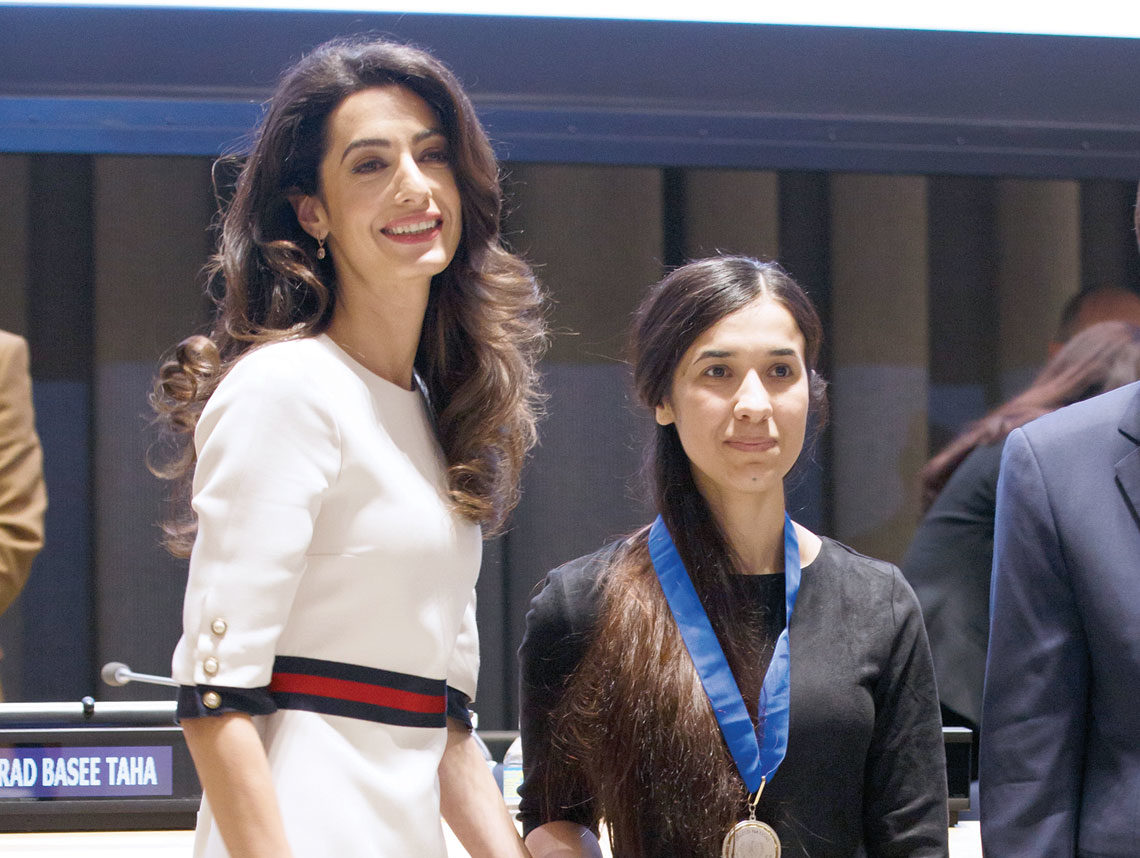
Nadia Murad Basee, a 23-year-old Yazidi woman, is sitting in an elegant living room high up on the Wilshire corridor, staring out the window. Her ebony hair hangs to one side of her face, falling over her shoulder like a blanket. As she turns her head, about to speak, her eyes appear glassy, as if on the verge of tears. But her expression is vacant.
More than two years ago, Islamic State of Iraq and Syria (ISIS) fighters invaded Murad’s village of Kocho in northern Iraq and began a siege that devastated her life and decimated the Yazidi population. Murad was barely 20 when she was separated from her family — a mother, eight brothers and three sisters (her father died when she was 10) — and then abducted and sold into sexual slavery.
She remembers the sound of the firing squad that murdered six of her brothers and her mother, and the nightmarish months that followed when she was bought and sold like chattel, beaten and sexually assaulted daily.
“The total number of men that raped me was 12, and I will never forget their faces,” she said during a visit to Los Angeles last November.
And yet, Murad considers herself one of the lucky ones. Thousands of Yazidis were massacred on the spot, and an estimated 3,200 Yazidi women still languish in sexual slavery. Since regaining her freedom, Murad has launched a global campaign to raise awareness of the Yazidi genocide and draw attention to the plight of those still in captivity. Over the past year, she has testified before the United Nations alongside her lawyer, Amal Clooney, and was named a U.N. goodwill ambassador for human trafficking. Last October, she received the Vaclav Havel Human Rights Prize, and, for a time, was considered a candidate for the Nobel Peace Prize. Time magazine named her one of the world’s most influential people.
But none of those honors has brought her joy; her focus is on rescuing her people and bringing ISIS to justice for its crimes. As she recounts the details of her story through a translator, her trauma is evident.
At times, she stares ahead blankly, avoiding eye contact. And during parts when she is overcome, tears streaming down her face, she barely seems to notice. She is so far away — her heart, her imagination, everything she loved still in Sinjar, the center of the Yazidi population in Iraq.
“My life before Aug. 3 [2014] was only life inside the small village,” she said of Kocho, with a population estimated at 2,000. “I didn’t even know other parts of Iraq.”
Murad grew up in a family of farmers that eked out a modest living tending sheep. They were so poor, her parents couldn’t afford to send her siblings to school, so her brothers wound up serving in the Iraqi and Kurdish militaries. By the time Murad came of age, though, their economic situation had improved and she was able to enroll in classes. She recently had completed her 11th year of schooling when ISIS stormed into town.
After Kurdish Peshmerga forces who were protecting the area retreated, Sinjar was left defenseless. According to a report issued by the Office of the United Nations High Commissioner for Human Rights, most villages in the Sinjar region were completely emptied within 72 hours of the siege, with the exception of Kocho. For nearly two weeks, villagers like Murad and her family huddled together in their homes awaiting rescue, even as they heard rumors of mass executions.
Before ISIS cut off the local cellphone tower, Murad’s family reached out to everyone they knew, begging for help. They could smell the stench of rotting corpses wafting from the countryside. “We told [everyone we could] that they will kill the men and take the women and the children,” Murad recalled. But help never came.
The family considered escaping, but with three pregnant women in the house, it would have been too arduous a journey. The night before the family was captured, they considered taking their own lives. “My brother said, ‘I know they will kill us and they will take the women and children. Perhaps I should kill you and then kill myself because I do not want to see you taken,’ ” Murad said.
The next day, the family was rounded up and sent to the local school, where male and females were separated promptly. Men and boys ages 12 and older were given the choice to convert to Islam or die. Hundreds of Kocho men were subsequently beheaded or shot. Girls ages 9 and older were transferred to holding sites in larger cities, where they were sold as sex slaves. Depending on their youth, virginity and beauty, girls could fetch prices from $200 to $1,500, and were often sold back and forth among ISIS fighter-owners.
When Murad arrived at a holding site in Mosul, the women and girls were instructed to wash. After being abused during transport, many knew there was more to come. “The first place they took us was the shower, the bathroom, and there was blood on the walls,” Murad said. “Women tried to commit suicide.”
Murad testified at the U.N. that the first fighter who tried to buy her was a “huge man, like a monster.” She pleaded with him to let her go. “I cried out — I said, ‘I’m too young, you’re huge!’ But he hit me, kicked me, beat me.”
A smaller man, the first of a dozen captors, bought her, forced her to dress up, wear makeup and then raped her at will. When she tried to escape, he locked her in a room with a number other fighters, who gang raped Murad until she was unconscious.
None of this violence is arbitrary. It is a deliberate, organized system designed to annihilate dignity, hope and prevent future population growth.
“When ISIS is held accountable, when my people are protected, when the women are freed and my people live with dignity, I will Be happy then.” — Nadia Murad Basee
In describing the way rape is used as a mechanism of genocide, the U.N. report emphasizes the assault on human dignity. “The sexual violence being committed by ISIS against Yazidi women and girls, and the serious physical and mental harm it engenders, is a clear step in the process of destruction of the … group — destruction of the spirit, of the will to live, and of life itself.”
The Islamic State’s use of sexual slavery is uniquely insidious because it ensures women are doubly victimized — by their gender and their religion. In the case of the Yazidis, the organized sexual violence occurred on such a massive scale, women and girls as young as 9 years old were subjected to “multiple — sometimes hundreds — of rapes by their various fighter-owners.” The combination of physical and sexual violence with psychological trauma “rises to the level of torture” — a war crime — according to the U.N. report, and is ultimately designed to prevent future birth of the Yazidi population. When sexual desire is vanquished, so is a group’s future.
The challenge of proving and prosecuting the Yazidi genocide will fall to Clooney, who faces the daunting task of creating precedent for it within the international justice system. At present, the International Criminal Court is the only tribunal that could hold ISIS accountable, but neither Syria nor Iraq are party to the league of nations invested in it. When an attempt to issue a special referral was made by the U.N. Security Council, Russia and China vetoed it.
“This is a clear case of genocide, and genocide that’s gone completely unaddressed and ignored,” Clooney told NBC last fall. “I can’t imagine anything worse being done by one human to another.”
During her visit to Los Angeles, Murad met with members of the Israeli humanitarian organization IsraAID, which currently is providing disaster relief and psychosocial support to Yazidi survivors in Greece, Iraq and Germany, where Murad is based, along with other refugees of the Syrian war.
“The typical response we get from Syrian refugees is that they’re shocked to see Israelis and Jews working with them, and it takes a while to build trust,” Yotam Polizer, co-CEO of IsraAID said. “But with the Yazidis, it was the opposite. They came to us and said, ‘We want to work with the Jews.’ ”
According to Polizer, the Yazidi advocacy organization Yazda reached out to the Israelis because they wanted to learn how to document their genocide as efficiently as Jews documented the Holocaust. “They came to us and said, ‘We need mentorship. We want to learn from the Jewish experience how you were able to rebuild your communities after the Holocaust, rebuild your peoplehood, and build strong advocacy around the world.’ ”
Over the past year, IsraAID has worked with Yazda to help train Yazidis to collect survivor testimonies. “We’re helping them build their own Yad Vashem,” Polizer said.
While much of the world remains indifferent to Yazidi suffering, Polizer said the Jews have a responsibility to help. “There’s a very special connection between Yazidis and Jews,” he said. “We’re both religious minorities in the Middle East; we’ve both suffered from a lot of atrocities throughout history, and according to the Yazidis, [when there were still] Jews in Iraq, they had a strong connection to the Jewish community there. They are big fans of the Jewish people and the Jewish faith, which is kind of unique in that neighborhood. There’s a feeling of shared destiny.”
And yet, Polizer lamented, “I don’t feel like we’re doing enough. With all that’s happening in the Middle East, the Syrian crisis, and with everything going on in the U.S., the Yazidis have been suffering from the worst persecution you can imagine and they’ve been sort of left behind.”
Murad was fortunate enough to escape her captors, but her people remain trapped by an intractable conflict. To counteract the international community’s silence, Murad is determined to broadcast her story in forums around the globe. The more she speaks out, the more ISIS threatens her life. The stakes are impossibly high. “I don’t know if Yazidis will continue to exist as a people or not,” she said.
Worn down by so much sorrow and loss, Murad is a young woman who seems old already. Her skin is marked by the acceleration of time that comes with too much tragedy too soon.
“When ISIS is held accountable, when my people are protected, when the women are freed and my people live with dignity, I will be happy then,” she said defiantly.
But the terrible truth of the matter is that for now, “the path to accountability remains blocked,” according to the U.N. report. “The genocide of the Yazidis is on-going.”
How to help
LEARN more about the plight of the Yazidis by reading reports from the United Nations, Amnesty International or other news articles.
CALL or write your elected representatives to request that they act on behalf of the Yazidis.
DONATE to organizations working to assist Yazidis through advocacy and direct aid, listed below:
To headline readers and TV news watchers, the Middle East is a region constantly roiled by conflicts, with nonstop fighting between nations and among their militant factions.
But if the movies, particularly those submitted by 85 countries for Oscar recognition, are an indication of popular tastes and concerns, then the Israel-Arab standoff and other hot and cold wars are all but ignored by the region’s filmmakers.
Checking out this year’s Academy Award entries from Israel, Lebanon, Palestine, Saudi Arabia, Egypt and Jordan, all but one forgo nationalistic bravado or hostile propaganda in favor of themes familiar to most Hollywood fans.
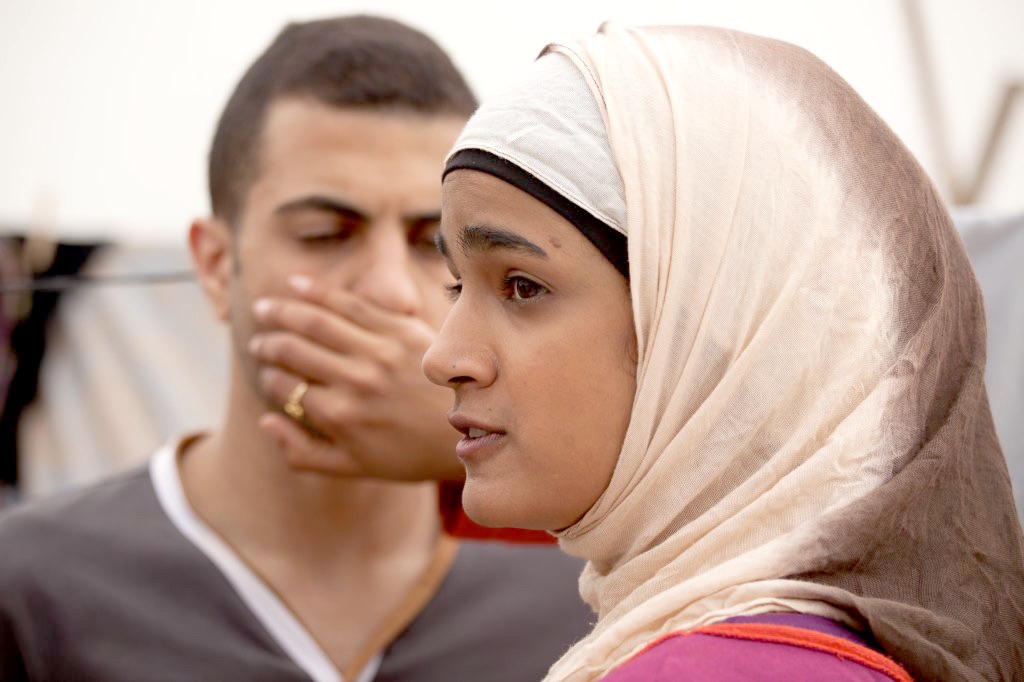
Israeli filmmakers have rarely struck any military poses in the past but have frequently come up with highly critical portraits of their own society. By contrast, this year’s entry “Sand Storm,” is a sympathetic and sharply observed picture of a Bedouin community in the Negev in the midst of generational changes. All the picture’s dialogue is in in Arabic.
Lebanon’s entry, “Very Big Shot,” takes a satirical look at the country’s politics and endless infighting. The comedy is about a small-time Beirut drug dealer who tries to pull off one big coup by posing as an important film producer.
The Palestinian entry, “The Idol,” is a variant on the venerable Hollywood storyline of “A Star Is Born,” but with a local twist. Director Hany Abu-Assad based the picture on the true story of Mohammed Assaf, raised in Gaza, who fulfills his burning ambition to travel to Cairo and compete in the top-rated TV show “Arab Idol.” He wins, becomes a singing sensation and a symbol of hope for his fellow Palestinians.
Abu-Assad’s earlier movie, “Paradise Now,” triggered a heated debate in 2005 about whether the originating entity should be listed as Palestinian Authority, Palestinian Territories or Palestine. Since then, all sides seem to have tired of the controversy and “The Idol” is credited simply to “Palestine.”
One rarely thinks of Saudi Arabia in terms of romantic comedy, but “Barakah Meets Barakah” sets a precedent. In a kingdom where unchaperoned contact between the genders is prohibited, the attempt by a young civil servant to meet up with a girl takes on a Chaplinesque flavor. However, as in the case of Israel’s “Sand Storm,” on a deeper level, the Saudi picture explores the clash between traditional values and the modern world.
The grimmest entry is Egypt’s “Clash,” centering on the 2013 Cairo riots, triggered by confrontations between the military government and followers of the Muslim Brotherhood. The action is seen mainly from the perspective of various Cairo residents, crammed inside a police paddy wagon.
Among all of Israel’s neighbors, only Jordan’s “3000 Nights” has a pronounced anti-Israel slant in the story of an arrested Palestinian woman having her baby in an Israeli prison.
One caveat in viewing these movies is that an American outsider might overlook some of the clues to more fervent nationalistic emotions boiling beneath the innocent-sounding themes. This holds particularly true for “The Idol” and director Abu-Assad, who earned Oscar nominations with two of his previous films, “Paradise Now” and “Omar,” both focusing directly on Israeli-Palestinian confrontations.
In a phone interview, Abu-Assad observed, “To the Palestinians, particularly those living in Gaza, the victory of one of their own in the ‘Arab Idol’ show became a symbol of hope and pride.
“For 60 to 70 years, their lives have been characterized by defeats. Suddenly they had a voice to sing and speak for them.”
The directors and casts of these six films from the Middle East have at least one emotion in common: their disappointment in being eliminated from the Oscar race by the selection committee.
The ultimate winners will be crowned at the Feb. 26 ceremony at the Dolby Theatre in Hollywood.
Experience Shabbat, Egyptian-style, with Sephardic Temple Young Professionals and Jews Indigenous to the Middle East and North Africa (JIMENA). Guest speaker Larry Clumeck will discuss Jewish life in Egypt. Authentic Egyptian food will be served (kosher dietary laws observed). This event is intended for Jewish professionals ages 21 to 39. 7 p.m. $30. Tickets available at eventbrite.com. Sephardic Temple Tifereth Israel, 10500 Wilshire Blvd., Los Angeles. jimena.org.
SARAH SCHULMAN
Sarah Schulman will discuss and sign her book “Conflict Is Not Abuse: Overstating Harm, Community Responsibility and the Duty of Repair.” From intimate relationships to global politics, Schulman observes the differences between conflict and abuse. She reveals how punishment replaces self-criticism, and shows why difference is so often used to justify cruelty and shunning. The controversial book illuminates contemporary and historical issues of personal, racial and geo-political differences in a world of injustice, exclusion and punishment. 7 p.m. Free. Book Soup, 8818 Sunset Blvd., West Hollywood. (310) 659-3110. booksoup.com.
ISRAELI KABBALAT SHABBAT
Start davening! Young adults are invited to enjoy traditional Jewish-Israeli cuisine and Israeli music. Bring friends or come and make new ones. This event is intended for young adults, ages 21 to 35. Alcohol will be served. 7:30 p.m. $14. Tickets available at eventbrite.com. Address, in Tarzana, provided upon RSVP.
SHABBAT SHIRA: “THE SHABBAT OF SONG”
Celebrate the “Shabbat of Song” with a special service featuring the world premiere of Michael Isaacson’s “Ladorot Habaim” (“For Generations to Come”) and the voices of six congregations: Stephen Wise Temple, Leo Baeck Temple, Temple Akiba, Temple Judea, Temple Emanuel of Beverly Hills and University Synagogue. Rabbi Yoshi Zweiback and Rabbi Jonathan Aaron will narrate the evening of music that will include numerous local cantors. Featuring guest speaker Rabbi Michael Marmur, provost of Hebrew Union College-Jewish Institute of Religion. 7:30 p.m. Free. Stephen Wise Temple, 15500 Stephen S. Wise Drive, Los Angeles. (310) 476-8561. wisela.org.
“RULES OF THE GAME”
Acclaimed Tunisian-American choreographer Jonah Bokaer will frame three works during this program, including “Rules of the Game,” his latest piece. “Rules of the Game” was inspired by Luigi Pirandello’s play “Il Giuoco Delle Parti” and features an international cast of eight dancers, incorporating dance, art and music. Bokaer collaborated with artist and architect Daniel Arsham for “Rules of the Game,” as well as the other two works, “Recess” and “Why Patterns.” They also worked with composer Pharrell Williams. 8 p.m. Tickets start at $29. Royce Hall, 340 Royce Drive, Los Angeles. (310) 825-2101. cap.ucla.edu.
SAT | FEB 11
FEIT FAMILY SHABBAT LIVE
Cornell William Brooks, president and CEO of the National Association for the Advancement of Colored People (NAACP), will speak about the current political climate and thoughts about the future. Featuring Rabbi David Wolpe, Craig Taubman and Cantor Marcus Feldman. 10:45 a.m. Sinai Temple, 10400 Wilshire Blvd., Los Angeles. (310) 474-1518. sinaitemple.org.
CELEBRATE TU B’SHEVAT
Celebrate the holiday that’s the “New Year for Trees.” The service will be led mostly in English and feature fruits and other foods from Israel. Noon. Free. Mishkon Tephilo, 206 Main St., Venice. mishkon.org.
SUN | FEB 12
“SUPER SUNDAY”
Join in a day of community fundraising. Sign up at jewishla.org/supersunday. 9 a.m. Free. The Jewish Federation of Greater Los Angeles, 6505 Wilshire Blvd., Los Angeles. (323) 761-8000. jewishla.org.
FAMILY SEARCH LIBRARY
Learn about your family heritage from experienced Jewish Genealogical Society of the Conejo Vallley and Ventura County members and Family Search Library volunteers. They can help you utilize resources including databases such as Ancestry.com. FindMyPast, Fold3.com, MyHeritage (library edition), ProQuest Obituaries, World Vital Records and more. There also are Jewish microfilms of Eastern Europe resources and others. Bring your research documents and a flash drive if you want to download electronic images. 1 p.m. Free for JGSCV members; $25 annual membership at the door. Los Angeles Family History Library, 10741 Santa Monica Blvd., Los Angeles. (818) 889-6616. jgscv.org.
“GREAT AMERICAN SONGBOOK & ALL THAT JAZZ”
Come enjoy “The Great American Songbook & All That Jazz on Film” with jazz historian and archivist Mark Cantor. Celebrate the musical genius of the 20th century’s most influential singers, bands and musicians during an afternoon filled with electrifying screen performances by Ella Fitzgerald, Billie Holiday, Sarah Vaughan, Louis Armstrong, Frank Sinatra, Peggy Lee, Mel Torme and more. Presented by American Jewish University’s Whizin Center as part of the Dortort Program for the Performing Arts. 4 p.m. $15. American Jewish University, Familian Campus, 15600 Mulholland Drive, Los Angeles. (310) 440-1572. wcce.aju.edu.
FRITZ COLEMAN: “DEFYING GRAVITY”
Fritz Coleman. Photo courtesy of NBC4
Help continue to improve the quality of life for women, children and families who struggle to safeguard their rights and freedoms by enjoyinga night of comedy with Coleman, the local weathercaster who has won four Los Angeles Area Emmy awards for his comedy specials. Proceeds benefit the National Council of Jewish Women-LA(NCJW). (The organization will get credit only for advance ticket sales.) 18 and older only. Two-drink minimum. 7 p.m. $15. Ice House Comedy Club, 38 N. Mentor Ave., Pasadena. (626) 577-1894. icehousecomedy.com.
KEIKO MATSUI FEATURING CARLY ROBYN GREEN
Internationally acclaimed and celebrated pianist, composer and humanitarian Keiko Matsui will take the stage with modern adult-contemporary and smooth jazz artist and songwriter Carly Robyn Green. 7 p.m. $24. Tickets available at tikly.co/events/1779. The Rose, Paseo Colorado, 245 E. Green St., Pasadena.
TUES | FEB 14
“SONGS OF LOVE”
Cantor Kenny Ellis will perform a mix of comedy and music in honor of Holocaust survivor Clara Knopfler. This is the second in a series of three organized events to celebrate Knopfler’s 90th birthday and raise money for the Clara Knopfler Jewish Leadership Scholarship at Cal Lutheran. The scholarship provides support to Jewish student leaders. 6 p.m. $36 donation suggested for the Clara Knopfler Jewish Leadership Scholarship. Lundring Events Center, 60 W. Olsen Road, Thousand Oaks. (805) 493-3512. callutheran.edu.
WED | FEB 15
“TRUMP AND IRAN: WHAT COMES NEXT?”
Join American Jewish Committee (AJC) and Stephen Wise Temple for a panel discussion and Q-and-A evaluating the Iran nuclear deal as the one-year anniversary of its implementation approaches. The panel also will analyze the choices that the Trump administration faces about Tehran, how sanctions relief is affecting Iran’s economy, what Tehran is doing to expand its reach from Syria to Yemen, and the status of human rights in Iran. The panel members will include former Congressman Howard Berman; Heather Williams, senior analyst at Rand and former national intelligence officer on Iran; and Andrew Apostolou, former Iran director at Freedom House and foreign policy analyst. The program will be moderated by Jason Isaacson, AJC associate executive director for policy. Light snacks and refreshments will be served. 6:30 p.m. Free. Stephen Wise Temple Sanctuary, 15500 Stephen S. Wise Drive, Los Angeles. (310) 282-8080. ajc.org.
STATE OF CYBERHATE
Speakers Brittan Heller, the Anti-Defamation League’s (ADL) first director of technology and society, and Robert Kang, cybersecurity counsel and lecturer, will discuss what role we can play in fighting the spread of hate online. Sponsored by the ADL’s Asian Jewish Initiative and NextGen community. There will be a happy hour after the program. 7 p.m. Free. RSVP (required) to la@adl.org; no walk-ins. Google, 340 Main St., Venice. (310) 446-4232. la.adl.org/events.
THURS | FEB 16
“FRIED CHICKEN & LATKES”
Actress and comedian Rain Pryor, daughter of comic legend Richard Pryor, will open her new solo play “Fried Chicken & Latkes.” Pryor grew up African-American and Jewish in Beverly Hills and has lived a fascinating life filled with pain, poignancy, purpose and lots of laughter. Her unique background led to many adventures that she will share in the course of her show. Directed by Eve Brandstein. 8 p.m. $40. Tickets available at eventbrite.com. Jewish Women’s Theatre, 2912 Colorado Blvd., No. 102, Santa Monica. (310) 315-1400. jewishwomenstheatre.org.
NINET TAYEB ALBUM RELEASE SHOW
Ninet Tayeb is an acclaimed singer, songwriter and actress — and household name in Israel. On the verge of her fifth album, which will be the first to be released in the United States, Tayeb reveals herself as an artist filled with resilience, determination and vulnerability. She won “Israeli Idol,” launching her to instant fame. Her debut album took less than a day to go platinum and yielded five No. 1 singles, and she starred in a long-running TV series based on her life. 7 p.m. $10.50. Tickets available at ticketfly.com. Echoplex, 1154 Glendale Blvd., Los Angeles. theecho.com.
In any standard World War II movie, it is safe to assume that the Germans will be the beastly villains who vent their sadistic fury on the hapless — or heroic — citizens of Nazi-occupied countries.
And if a poll on the nicest nation in Europe were taken at the end of World War II, it is likely that Denmark would rank at the top and Germany at or near the bottom.
“Land of Mine,” Denmark’s nominee in the Oscar race for foreign-language film, shatters the mold.
During the nearly five years after Hitler’s invasion of Denmark, German sappers seeded the Scandinavian country’s west coast with some 2 million land mines in anticipation of an eventual Allied invasion, which never happened.
With the Nazis defeated in 1945, the reconstituted Danish army decided to clear the beaches, forcing German prisoners of war to do the dangerous job. The POWs comprised a wide range of ages, but in the film, it falls to a group of 14 teenagers to do the job. The young soldiers, between 15 and 18, were drafted in Hitler’s last, desperate stand of the war.
Their overseer is Danish Sgt. Carl Rasmussen (Roland Moller), who sees his assignment as a chance to get even with the detested Germans for their wartime rule, which was relatively mild until 1943, when the Danes rescued some 7,200 of the country’s 8,000 Jews by ferrying them to neutral Sweden and safety.
Rasmussen locks up his charges at night, lets them go hungry for days at a time, and cares not a whit that the untrained German youngsters are regularly blown up while trying to defuse the mines, buried only a few inches deep. (The film’s Danish title translates as “Under the Sand,” which gets lost in the English title’s rather heavy-handed play on words.)
In one nail-biting scene, the young POWs are made to walk, arms linked, across a still mine-infested beach.
When the sergeant’s attitude toward his charges gradually softens — he even steals some bread from the commissary for them — he is upbraided by his commanding officer.
Martin Zandvliet, the highly regarded Danish director and screenwriter, acknowledges that he received some hate mail after the film was released in his country. However, at 46, he and most of his fellow citizens were born well after the war and can view it at some emotional distance.
During a phone interview, Zandvliet described two aspects of his film as drawing some general observations on human nature and in re-examining the attitudes of his countrymen during the Nazi occupation.
One facet of the film is the enduring nature of national hatred, even in a country like Denmark, which “pictures itself as a happy country,” he said. How do we deal with such hatred, pervasive throughout the world, he asked, how do we find a way to talk to one another?
Zandvliet shows no reluctance in questioning some of the laudatory beliefs about his country’s role during World War II.
In almost any recollection of the Holocaust, one of the few bright spots is the rescue of 7,200 of Denmark’s Jews, who escaped the Nazi clutches when they were ferried out of the country by Danish underground fighters and fishermen. The director lauds the risks taken by many Danes in this clandestine operation, but notes that quite a few Jews had to hand over considerable amounts of money for their rescues.
Overall, he observed, the Danes, as fellow “Aryans,” were treated better by the Nazis than the people of any other occupied country. But on the whole, Zandvliet said, his countrymen didn’t really “turn against the Germans until they started losing the war.”
To illustrate the endurance of national hatreds, Zandvliet looked further back into history. The Danes, he said, had never forgiven the Germans for the outcome of an 1864 war, when the Prussians incorporated some Danish territory as the spoils of victory.
One other conclusion from his film, he observed, is that “when adults go to war, it’s often the kids who pay the price. … Of course, you can’t compare this to the 6 million who perished in the Holocaust,” but in the case of the young German soldiers depicted in the film, “we have to remember that they were only 9 to 11 years old when World War II started.”
In general, “Land of Mine” has been well received in Denmark, despite the few hate mails, Zandvliet said, adding, “On the whole, Danes seemed to understand what I was trying to say.”
“Land of Mine” opens Feb. 10 at the Royal Theatre in West Los Angeles and Feb. 17 at Playhouse 7 in Pasadena and Town Center 5 in Encino.