fbpx

April 25, 2016

Britain’s Labour Party suspends member for saying Israel uses Holocaust as moneymaker

As part of its crackdown on anti-Semitism, Britain’s Labour Party suspended the party membership of a columnist from Ireland who apparently said Israel was using the Holocaust to receive money.

John McAuliffe, an international member of the British party, was suspended this week after allegedly posting on Facebook a message in which he described the genocide as “the most useful political tool of the Zionist government in Israel to establish a financial racket in the West, whereby Israel receives an unlimited sum for the duration of its existence,” The Jewish News reported Monday.

The newspaper learned of the suspension of McAuliffe, a columnist at Digital Journal and the Cambridge Globalist, by a Labour spokesperson.

It is the latest in a string of punitive measures against members who have made anti-Semitic hate speech.

Jeremy Corbyn, who was elected Labour’s chair in September, on April 11 told the BBC that anyone making anti-Semitic statements “is auto-excluded from the party.” The policy was announced amid intense media scrutiny of Labour in connection with several incidents of hate speech against Jews, which critics trace back to Corbyn’s past support for enemies of Israel, including Hamas and Hezbollah. He has called activists for both anti-Semitic terrorist groups his “friends.”

One of the six cases of anti-Semitism exposed within Labour since March involved Vicki Kirby, a party activist who suggested on social media that Adolf Hitler might be a “Zionist god” and that Jews have “big noses.” She was suspended. In another, Aysegul Gurbuz, a London-area politician, was suspended and later resigned after her Twitter account was found to feature praise for Hitler and for Iran’s plans to “wipe Israel off the map.”

Jonathan Arkush, the president of Britain Board of Jewish Deputies, said these cases, perceived inaction by Corbyn, and his failure to distance himself from Hamas and Hezbollah mean that most British Jews distrust Labour.

In his Facebook post, McAuliffe wrote: “The large level of poverty in Israel among Holocaust survivors shows they don’t care about the emotional impact they are trying to generate. It is about money and military technology. This further paints a clearer picture of the divide between Zionism and Judaism, and their incompatibility.”

The Jewish Labour Movement in the United Kingdom has put forward a proposal to change Labour rules to make it easier to permanently exclude those who express anti-Semitic or Islamophobic sentiment.

Labour is investigating claims of anti-Semitism at its Oxford University branch.

Britain’s Labour Party suspends member for saying Israel uses Holocaust as moneymaker Read More »
About

Robin is a suburban mom of two teenage boys. Between volunteering at school, schlepping to soccer and baseball games and pulling off two bar mitzvahs in less than two years, she also helps cares for her aging parents and widowed father in law. In her spare time, she plays the role of a freelance journalist. In her past life, she was an editor at a major women’s magazine, an editorial director for a web-development company and an editor at a really small community newspaper. 

About Read More »

Women of the Wall eschew priestly blessing at Western Wall holiday services

The Women of the Wall group held Passover holiday prayers at the Western Wall, but did not hold a priestly blessing ceremony, after being banned by Israel’s attorney general.

Some 200 women arrived at the Western Wall on buses from throughout the country to hold the Shacharit, or morning, prayers, and Mussaf, or additional, prayers for Passover on Sunday morning, the first day of the intermediate days of the holiday in Israel. During the consecutive services held in the women’s section of the Western Wall plaza, the women read the priestly blessing, but did not raise their hands and make the traditional symbol nor cover their heads with their talitot.

On Thursday, Israel’s Attorney General Avichai Mendelblit ruled that holding a female version of the priestly blessing ceremony violated a law enforcing “local customs” at religious sites in Israel.

His decision followed a meeting with police, prosecutors, the legal adviser of the Religious Services Ministry and the rabbi of the Western Wall, Shmuel Rabinowitz.

In announcing the ceremony, to be held at the Western Wall’s women’s section, Women of the Wall had declared it “the first of its kind.” Tens of thousands of Jews flock to the Western Wall to receive the blessing from kohanim, or descendants of ancient Israel’s priestly caste, during the intermediate days of Passover.

Transportation for Women of the Wall participants to and from cities throughout Israel was provided by a grant from the Susan Bay Nimoy and Leonard Nimoy Estate, according to the Women of the Wall. Participants also received a Priestly Blessing pin commemorating the prayer. The pin was derived from the hand symbol employed in Star Trek by Mr. Spock, a role played by Jewish actor Leonard Nimoy. Nimoy made the blessing, “Live long and prosper,” using the hand motion of the kohanim, an international symbol.

The women who participated in the service Sunday morning were required to stand in a specially cordoned-off area of the women’s section, under heavy police guard. They were not allowed to read from a Torah scroll during the service. The group also charged in a statement that a police officer videotaped the service to make sure no women raised their hands in the air to perform the priestly blessing.

“Women of the Wall believe that even though the Priestly Blessing is an unusual custom at the Wall, in due time, it will become local custom. We believe that the nature of local custom changes as time passes- in the past, wearing a tallit, blowing a shofar, and lighting a Chanukah candle were all considered contrary to local custom, and it is through our persistence that these are now local custom,” the group said in a statement issued Sunday following the service.

In a statement release Sunday, the office of the rabbi of the Western Wall called the women’s service a “provocation,” and “expressed regret” that the group gathered for a service despite the attorney general’s ruling.

“This act proves that they cannot be trusted on any agreement reached with them,” the statement said, referring to the recent agreement to build an egalitarian prayer section of the Western Wall.

The statement called on the public to attend the planned public mass priestly blessing ceremony on Monday morning.

Women of the Wall eschew priestly blessing at Western Wall holiday services Read More »

Istanbul bomber did not deliberately target Israelis, investigation finds

A suicide bomber who killed three Israelis in an attack in Istanbul did not target the Israeli tour group, Israel’s Counter-Terrorism Bureau has determined.

The attacker, who detonated himself on March 19 as the Israeli tour group left a restaurant in the major Turkish city, was attempting to disrupt tourism in general to Turkey, the bureau announced Sunday after a month-long investigation, the Associated Press reported. An Iranian national also was killed in the explosion.  Two of the Israeli victims also held American citizenship.

Turkish media reported a day after the attack that the bomber followed the Israeli culinary tour group from their hotel to the restaurant, and waited until they were leaving the restaurant to detonate his explosives.

The bomber was identified as a Turkish citizen, Mehmet Ozturk, who was affiliated with the Islamic State. He reportedly spent two years in Syria before returning to Turkey illegally.

Following the attack, Israel’s Counter-Terrorism Bureau, which is part of the Prime Minister’s Office issued a travel warning calling on Israelis not to travel to Turkey. That warning remains in place.

Istanbul bomber did not deliberately target Israelis, investigation finds Read More »

NYU graduate student union approves BDS resolution

The graduate student union at New York University voted to approve a motion to support a Boycott, Divestment and Sanctions resolution against Israel.

The resolution was approved by two-thirds of the 600 union members who voted on Friday, according to reports citing the Graduate Student Organizing Committee. The committee represents more than 2,000 graduate teaching and research assistants at the university.

The resolution called on the union and its parent union, the United Auto Workers, to divest from Israeli companies. It also calls on NYU to close its program at Tel Aviv University, which it alleges violates the NYU non-discrimination policy. Fifty-seven percent of the voting union members also took a personal pledge to boycott Israeli government and academic institutions.

The resolution calls for the boycott to remain in place “until Israel complies with international law and ends the military occupation, dismantles the wall, recognizes the rights of Palestinian citizens to full equality, and respects the right of return of Palestinian refugees and exiles.”

NYU spokesman John Beckman told Capital News New York that: “NYU has a long-standing position opposing boycotts of Israeli academics and institutions. This vote is at odds with NYU’s policy on this matter, it is at odds with the principles of academic freedom and the free exchange of ideas, and it is even at odds with the position of their own parent union, the UAW.”

The United Auto Workers International in January struck down a boycott resolution against Israel passed by the University of California Student Workers Union, UAW Local 2865, which represents more than 13,000 teaching assistants, tutors and other student workers in the UC system.

NYU graduate student union approves BDS resolution Read More »

Passover dessert: Pistachio and tart cherry chewy cookies

Passover is a Jewish holiday celebrating freedom. The initial meal (the seder) and the way you eat for a week offer a small part of the ancient Israelites’ experience as they journeyed from slavery in Egypt to the complexity of freedom. Breads, cooked on the run during their flight, didn’t have sufficient time to rise. The result? Matzo.

Every year, for the first few days of Passover, matzo seems somehow so new. A fat shmear of Temp-Tee ultra-whipped cream cheese and a tart and fruity jelly on top. Or soaked and fried into a matzo brei (a French-toast-like dish) crunchy with sugar and cinnamon. These are the foods of memory to me.

But the problem is that Passover is a weeklong festival. And when it comes to cooking and eating, it is a very long week indeed. Matzo is eaten all the time. I mean ALL the time. It’s in every food, every dish, every treat and in every course. It’s ground into breading, pulverized into cake flour, crushed into farfel and layered into mini “lasagnas.”

Matzo fatigue and the dreaded matzo-pation set in. Desperation takes over by around day four. But frankly, what bothers me the most is when matzo invades desserts. Folks often cook more on Passover than all year long, often pulling out heritage recipes. Even I, a modernist, will cook up a heritage dish or two along with my flights of imagination and globally influenced dishes.

When it comes to desserts, though, many holiday cooks reach for box mixes. Virtually none taste good. These mixes are often packed with processed ingredients and artificial flavors. As a professional cook and culinary instructor — and honestly, a person with taste buds — I don’t make them and I don’t buy them.

If I want heritage desserts, I buy Passover chocolates. That does the trick.

But making desserts at home? What can you do that tastes great and is still Passover-worthy? Matzo in desserts always makes itself known in taste and texture — and I don’t mean that in a nice way whatsoever. No matter how you cut it (pun intended, sorry), matzo desserts are definitely not what I want in order to make a holiday more special.

My advice? If you can put the time and effort into cooking desserts, fear not. Here is a solution.

Delicious Passover desserts

Offer up some treats that are deliciously Passover-ready AND matzo-free and grain-free. Try a Pavlova, a macaroon, a flourless chocolate cake, ice cream, chestnut-flour crepes, custards, crème brûlée or nut paste-based cookies.

A world of matzo-free desserts awaits you.

Pistachio and Tart Cherry Chewy Cookies

Prep time: 15 minutes

Cook time: 15 minutes

Total time: 30 minutes

Yield: 24 cookies

Ingredients

  • 14 ounces pistachio paste, King Arthur or another all-natural brand preferred
  • 1 cup (200 grams) sugar
  • 2 large egg whites
  • 1/4 teaspoon ground cardamom
  • Scraped seeds of 1 vanilla bean pod
  • 1 cup dried tart cherries
  • 1/2 cup pistachios, lightly crushed


Directions

1. Preheat oven to 350 F. Line 2 baking sheets with parchment paper.

2. In the bowl of a standing mixer fitted with a paddle attachment, mix the pistachio paste until it resembles big cookie crumbs, 20 to 30 seconds. Add the sugar and mix thoroughly. Add the egg whites, cardamom and vanilla. Mix until completely smooth, 3 to 4 minutes. Stir in the tart cherries.

3. Drop 2 teaspoons of batter per cookie on the sheet, leaving 1 1/2 to 2 inches between the cookies. Sprinkle the pistachios over the top of the cookies.

4. Bake until light brown but still soft, 12 to 13 minutes. (The cookies will firm up considerably as they cool). Store at in an airtight container at room temperature for up to 4 days.

Passover dessert: Pistachio and tart cherry chewy cookies Read More »

There’s no place like home, even in the Chernobyl disaster zone

Some people found life away from home so unbearable they decided to return, even when home was the site of the world's worst nuclear disaster.

Maria Lozbin was one of tens of thousands of people to be evacuated from their homes after the Chernobyl accident in April 1986, but returned with her family six years ago, to live off the land inside a 30 km (19 mile) exclusion zone where the risk of radiation poisoning remains.

A 69-year-old with a ready laugh and a green shawl wrapped round her, Lobzin said the village to which she had been evacuated was full of drunks and drug addicts.

The house into which she was moved was so shoddily constructed, with a huge crack running from the roof to the basement, that she was afraid of being killed or maimed by a falling object.

“Living there was like waiting for death,” she said.

Now she lives with her son and his family back in Chernobyl, in a zone that can only be reached by crossing a checkpoint and where guides accompany curious tourists with radiation meters.

By contrast, a deathly silence hangs over the nearby abandoned town of Prypyat, where a rusting fairground wheel, and a kindergarten with toys, dolls and small beds are a grim testimony to the scale and speed of the disaster.

Lozbin keeps chickens, geese and ducks, grows potatoes and tomatoes, and goes foraging for mushrooms in nearby woods.

“There is no radiation here. I'm not afraid of anything,” she said. “And when it's time for me to die, it won't happen because of radiation.”

BIRD SONG

Tuesday marks the 30th anniversary of the Chernobyl disaster in then-Soviet Ukraine, caused by a botched safety test in the fourth reactor of the atomic plant that sent clouds of nuclear material across much of Europe.

The disaster and the government's handling of it — the evacuation order only came 36 hours after the accident — highlighted the shortcomings of the Soviet system with its unaccountable bureaucrats and entrenched culture of secrecy.

Mikhail Gorbachev has since said he considered Chernobyl one of the main nails in the coffin of the Soviet Union which eventually collapsed in 1991.

The accident killed 31 right away and forced tens of thousands to flee. The final death toll of those killed by radiation-related illnesses such as cancer is subject to debate.

A Greenpeace report ahead of the anniversary cites a Belarusian study estimating the total cancer deaths from the disaster at 115,000, in contrast to the World Health Organisation's estimate of 9,000.

The Greenpeace study also said people living in the area continue to eat and drink foods with dangerously high radiation levels.

In particular, “the 30 km exclusion zone around the Chernobyl reactor remains highly contaminated and unsuitable to live in,” it said.

But that matters little to Lozbin, one of around 160 people estimated to have returned to the zone. “What's there to be afraid of?” said Maria's daughter-in-law Oleksandra Lozbin.

“I don't want to go to Kiev. Why would I leave such nature? Where could you hear cuckoos? Where could you hear the nightingale?”

Oleksandra's husband, who grew up in a village 7 km away, started coming to Chernobyl in short bursts starting in 2008 and the family settled back there permanently in 2010.

“My husband had wanted to come back to his homeland all his life,” she said. “He came back when it was all closed here, when it was prohibited to come here. He crossed through barbed wire.”

Oleksandra said police initially tried to force them to leave, but the family refused.

Oleksandra hopes to inspire others to move back. To remind people what life was like before the accident, the family has created a makeshift museum in a house across the street with objects collected from nearby abandoned cottages.

There are books, a doll in a cot, a rusty wheel, an abacus, and a black-and-white photo of two people. One day, she hopes, someone might see it and recognize their great-grandparents.

“We decided to save the history of Chernobyl,” she said. “We hope that people will come back here and will live here, and their children and grandchildren will see what life was like here, in what kind of cots people were raised here, in what kind of boxes people stored their personal belongings and books.”

On a bench lies a Soviet newspaper from Jan. 24 1986, four months before the disaster. The front page headline reads: “No to nuclear testing”.

There’s no place like home, even in the Chernobyl disaster zone Read More »

Congress to Germany: Provide more funding for Holocaust survivors

A bipartisan group of Congress members introduced a resolution calling on the German government to provide additional financial aid to Holocaust survivors in their waning years.

The resolution, which was introduced in the House and the Senate on Friday, aims to ensure “that all Holocaust victims live with dignity, comfort, and security in their remaining years.” It calls on Germany “to reaffirm its commitment to this goal through a financial commitment to comprehensively address the unique health and welfare needs of vulnerable Holocaust victims, including home care and other medically prescribed needs.”

Reps. Ted Deutch, D-Fla., and Ileana Ros-Lehtinen, R-Fla., and Sens. Bill Nelson, D-Fla., and Susan Collins, R-Maine, sponsored the resolution, which cites Germany’s “moral and historical responsibility” to the survivors.

According to the resolution, there are about 100,000 Holocaust survivors living in the United States today, as well as about 500,000 in the rest of the world, and they all have increasing health and welfare needs that require assistance.

The resolution comes following an exchange of correspondence between members of Congress and the German Finance Ministry last December in which representatives of the German government acknowledged that “recent experience has shown that the care financed by the German government to date is insufficient” and that “it is imperative to expand these assistance measures quickly given the advanced age of many of the affected persons.”

The German government is engaged in a new round of negotiations with the Conference on Jewish Material Claims Against German, known as the Claims Conference, to address these funding gaps.

The resolution was introduced two days before President Barack Obama arrived on Sunday for a visit to Germany, which also is a week before Yom Hashoah, or Holocaust Remembrance Day, on May 5.

Congress to Germany: Provide more funding for Holocaust survivors Read More »

Orthodox parents of LGBT children seek communities that care

When my husband and I married, neither of us fully appreciated the role community would play in our family’s life. It proved to be a most crucial component in creating and forging a Jewish household and in passing on our traditions. A life lived according to halachah (Jewish law), needs a community. In Orthodox families, kids grow up seeing themselves as part of a much larger whole.

As our children grew up, we were comfortably ensconced in our shul. Then, about 18 years ago, our younger daughter told me she was gay. She was in her last year of college and in a relationship with a young woman who was also from an observant home. Trembling in my arms, she begged me not to tell her father, and tearfully asked if I wanted her out of our home. She had packed her bags and was prepared to leave.

I calmed her as best I could, and tried to push away the questions, fears and thoughts swirling through my own head. Initially I kept her news from my husband, as she had requested, and cast about for someone I could turn to for advice. In 1998, I knew that Orthodox parents of gay children were marginalized. I didn’t want that to happen to my daughter and our family. Who could I talk to?

When I finally shared the news with my husband, we both agreed the answer was obvious: nobody! My friends? How would they react? How would I tell them, and what would they say? Would they still be our friends? I could imagine each one thanking God that it wasn’t her child. The rabbi? A crazy idea.

Even today, according to a first-ever survey conducted by Eshel, Orthodox parents of LGBT children report that only 9 percent go to their rabbi first for guidance — an astonishingly low number and sad statistic for a group whose members routinely seek counsel from their spiritual leader.

Several years earlier our older son became seriously ill. It was then we saw the strength of community. There were days we arrived at his bedside in the ICU to find community members saying tehillim (psalms) for him and his recovery.  We were constantly surrounded by friends and family. Somehow we made it through the terror of it all. We received absolute love and support from the entire community.

That wasn’t the case when our daughter came out.

Those early years were lonely. We did not know another Orthodox family who was in the same situation. Admittedly, that isolation was self-imposed, which is still true today for most parents before they come out.

Carrying this secret can lead to feelings of loss of community and a sense of chaos. We experience bouts of endless questioning, worries and tears. But on the outside we remain silent — as do our communities. Three out of four parents of LGBT children told Eshel that their rabbis, day school administrators and other communal leaders do not speak about “it.”

Silence and rejection might have been acceptable in the past, but not now. Rabbis must learn how to minister to all of their congregants, including their LGBT members and their families. Every congregation, day school or community has families who are dealing with this issue. Our leaders must convey their readiness to engage in conversations and be educated so they can offer support and resources.

For our children the rejection is all too real. The Eshel parent survey reveals that 60 percent of our children have left the Orthodox community or no longer attend any shul. For traditional parents, synagogue and community rejection can be the most painful part of the coming-out process. When the community no longer makes space for your child, ­what is there to belong to and why?

But change is coming. Eshel, an organization with a mission to create community and acceptance for LGBT Jews and their families in Orthodox communities, holds an annual parent retreat. This year’s retreat, from May 13 to 15 in Copake, New York, features the theme Community. Through Eshel events, phone support groups and the annual retreat, parents with LGBT children can have a community.

Eventually we did tell our rabbi about our daughter. We were not seeking approval nor guidance; with the help of time we were beyond that. We did not ask for advice, and none was offered. To his credit he has become more knowledgeable and open. Recently he spoke about the topic to the entire shul.

Like 70 percent of parents surveyed, my husband and I are cautiously optimistic about the future for ongoing change in Orthodoxy.

Change takes time. Our rabbi has embraced what seems to be an attitudinal shift. We know of communities that are welcoming, respectful and inclusive. And we know there are rabbis and communities who are beginning the learning process. As Orthodox parents, we appreciate the complexity of the issue, perhaps more profoundly than even the most learned in our communities.

We understand that we cannot rewrite Leviticus 18:22, but we can reconsider its implications. We can work to change our community’s attitudes.  This change can only begin to happen with the courage of our leaders. The conversation must begin in our shuls and schools. All of our children, LGBT or straight, deserve to be respected. After all, aren’t we are all created “b’tzelem elokim,” in God’s image?

The writer is a mother and grandmother and member of Eshel’s parents’ group.  For more information about Eshel or the upcoming parent retreat, please visit www.eshelonline.org.

Orthodox parents of LGBT children seek communities that care Read More »

How my grandmother’s chutzpah helped Sugihara rescue thousands of Jews

The story of Chiune Sugihara – the Japanese consul in Kovno, Lithuania, who disobeyed his government’s orders in 1940 and issued transit visas through Japan to thousands of Jews seeking to flee war-torn Europe — wasn’t widely known until 1985, when Yad Vashem, Israel’s Holocaust memorial authority, honored him as one of the Righteous Among the Nations.

But I grew up hearing Sugihara’s story because he saved my father’s life. My father, the attorney Nathan Lewin, is a Sugihara survivor.

I also have a family connection to something that few others have known until very recently — the answer to a long unsolved mystery surrounding Sugihara’s rescue of an estimated 6,000 Jews.

Why did the Dutch consul in Kovno, Jan Zwartendijk, begin issuing the “Curaçao visas” – the Dutch endorsements that appeared to permit travel to the island of Curacao, Holland’s territory off South America upon which Sugihara relied when issuing visas? Why did Zwartendijk begin writing in Jewish passports that a visa was not needed to travel to Curaçao?

The answer: my late grandmother. Peppy Sternheim Lewin, the recipient of the first Curacao visa, is the “missing link” in the story.

My grandmother was a Dutch citizen, raised and educated in Amsterdam. After she married my grandfather, Dr. Isaac Lewin, she moved to his home country, Poland. When the Nazi army invaded Poland in September 1939, my grandmother’s parents and her brother were visiting her in Lodz, my father’s birthplace. My great-grandfather promptly flew back to Amsterdam to take care of his business. He later perished at Auschwitz.

My grandmother’s mother, Rachel Sternheim, and her brother, Leo Sternheim, were smuggled with my grandparents and my father, who was then 3 years old, over the border into Lithuania.

In Lithuania, my grandmother sought help from the Dutch diplomats because her mother and brother were Dutch citizens and because she had been a Dutch citizen prior to marrying my grandfather. She initially asked Zwartendijk, who was in Kovno, if he could issue her a visa to the Dutch East Indies, which included Java and Sumatra. He refused. So she wrote to the Dutch ambassador in Riga, L.P.J. de Decker. He also turned down her request for a visa to Java or Sumatra.

Refusing to be discouraged, my grandmother, who was then in Vilna – a short trip from Kovno — wrote to de Decker again and asked him whether there was any way he could possibly help her family because it included Dutch citizens. The ambassador replied that the Dutch West Indies, including Curacao and Surinam, were available destinations where no visa was needed. The governor of Curacao could authorize entry to anyone arriving there.

My grandmother again wrote to de Decker asking whether he could note the Curacao or Surinam exception in her still-valid Polish passport. She asked the envoy to omit the additional note that permission of the governor of Curacao was required. After all, she pointed out, she really did not plan to go to Curacao or Surinam.

“Send me your passport,”de Decker replied. So she did.

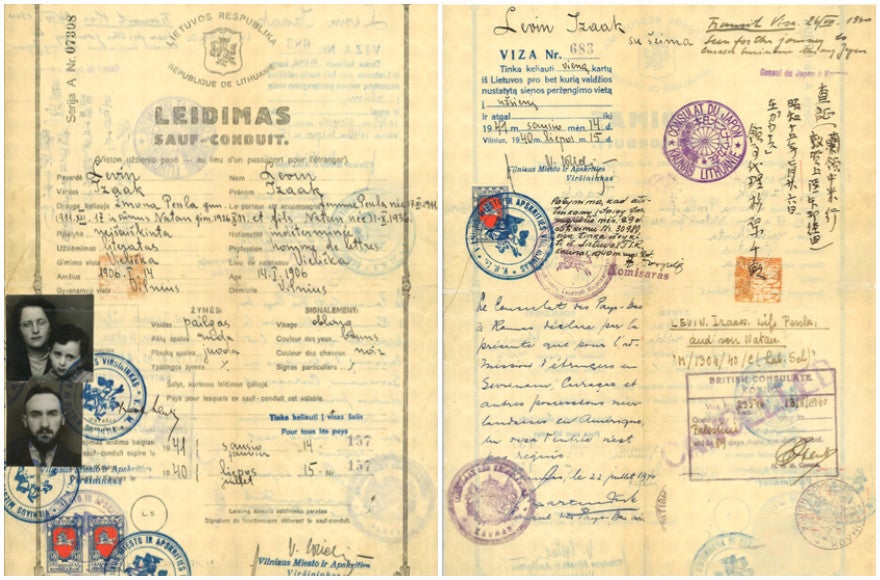
 The endorsements of Chiune Sugihara – the Japanese Consul in Kovno, Lithuania – and the Dutch Consul in Kovno, Jan Zwartendijk, appear on  a Ledimas, or travel document, that allowed Isaak Lewin and his family to escape Lithuania in 1940. Washington attorney Nathan Lewin is the three-year-old boy in the arms of his mother, Peppy Sternheim Lewin. (Photo courtesy of Alyza D. Lewin)  The endorsements of Chiune Sugihara and Jan Zwartendijk, the Japanese and Dutch consuls, respectively, in Kovno, Lithuania, appear on the Leidimas, or travel document, that allowed Isaac Lewin and his family to escape Lithuania in 1940. Nathan Lewin, now a prominent attorney, is the 4-year-old boy in the arms of his mother, Peppy Sternheim Lewin. Photo courtesy of Alyza D. Lewin

On July 11, 1940, de Decker wrote in her passport in French, “The Consulate of the Netherlands, Riga, hereby declares that for the admission into Surinam, Curacao, and other possessions of the Netherlands in the Americas, no entry visa is required.”

My grandmother then showed Zwartendijk what the Dutch ambassador had written in her passport and asked him to copy it onto my grandparents’ Leidimas – the temporary travel document they had been issued by the Latvian government after the existence of Poland was officially nullified by the Nazi invasion. On July 22, 1940, Zwartendijk agreed and wrote de Decker’s notation on my grandparents’ travel papers. That is how my grandparents and my father received the very first Curacao visa.

Relying on Zwartendijk’s notation, Sugihara agreed to give my grandparents (and my grandmother’s mother and brother, who were still Dutch citizens) transit visas through Japan on their purported trip to Curacao. Sugihara issued their visas on July 26, 1940. The Japanese consul kept a list of the names of the individuals to whom he issued visas. My great-grandmother, Rachel Sternheim, is No. 16 on the list; my grandfather, whose Leidimas included my grandmother and my father, is No. 17, and my great-uncle, Levi (Leo) Sternheim, received Sugihara’s 18th visa.

The number of visas Sugihara issued jumped exponentially on July 29, 1940, when hundreds of Jews who had escaped to Vilna learned of my grandmother’s successful effort. They crowded outside the Japanese consulate in Kovno (Kaunas in Lithuanian) hoping Sugihara would issue them a visa. Sugihara worked around the clock for a month, issuing 2,139 visas, including to whole families. These enabled the refugees to take the trans-Siberian railroad from Moscow to Vladivostok, and then travel by boat from Russia to Japan, supposedly en route to Curacao.

The story of Sugihara and his rescue is told in a feature film, “Persona Non Grata,” that had its premiere in October and is now making the rounds at Jewish film festivals across the country. It screened recently at the Washington Jewish Film Festival and was shown again in Washington, D.C., last month as part of CineMatsuri, the Japanese Film Festival in the Nation’s Capital. Although my grandmother’s role is one of the unsolved mysteries in the film, my father was asked to share his mother’s tale after a CineMatsuri screening.

There are perhaps 100,000 descendants of Sugihara survivors alive today. It is humbling to think that it was my grandmother’s initiative and perseverance that opened up this travel route to safety for so many.

Alyza D. Lewin is a partner at the Washington, D.C., firm of Lewin & Lewin, LLP, where she practices law together with her father.

How my grandmother’s chutzpah helped Sugihara rescue thousands of Jews Read More »