fbpx

March 8, 2016

American tourist killed, up to 10 people injured in Jaffa attack

An American tourist was killed and as many as 10 people were wounded in a stabbing attack at and near the Jaffa port in the Tel Aviv area.

The Tuesday evening attack came less than two hours after terror attacks in Jerusalem and central Israel left a haredi Orthodox man and two Israeli Border Police officers seriously injured.

In the Jaffa attack, four of the injured are reported to be in serious condition and four others in moderate condition, according to Israel’s Channel 2. The attack lasted about 20 minutes in three locations.

The man killed was later identified by police as a U.S. tourist, 29, though no other details were immediately released. The tourist’s wife was among those seriously injured, Ynet reported.  A pregnant woman, an Israeli-Arab and a Palestinian in Israel illegally were among the injured, Channel 2 reported.

Police said the assailant was “neutralized.” He was later identified by the Palestinian Maan news agency and then by police as a 22-year-old man from the Palestinian city of Qalqilya in the northern West Bank.

At the time of the attack, U.S. Vice President Joe Biden was located less than two miles away at the Peres Center for Peace. He is in Israel on a two-day trip.

At the entrance to the Jaffa port, on its heavily trafficked promenade, the assailant stabbed two people before attacking others as he moved southward, including near the Dolphinarium Club on the border with Tel Aviv, according to reports.

The Tel Aviv-Jaffa municipality vowed to step up security in the wake of the attack.

American tourist killed, up to 10 people injured in Jaffa attack Read More »

Why I can’t vote for Donald Trump

As a well-identified Republican in the Los Angeles Jewish community, for weeks and months on end I have repeatedly been asked the same question by Democratic friends and colleagues, and I usually sense it coming by the person’s shifting body language: “So, would you vote for Donald Trump?” My diplomatic but evasive response came to be, “It depends on who is running against him.” But I never thought it would really come down to that. Now it appears likely.

For me, it’s time to publicly change my previous answer before it’s too late : Yes, I would Dump Trump. If it came down to the choice between Hillary Clinton (another terribly flawed candidate) and him, I would either not vote at all or support a third-party conservative candidate, if that were an option. Sometimes, regrettably, taking the least bad choice is the best option.

Trump’s outrageous statements and behavior are well worn by now: His disparagement of one ethnic group after the other; his making fun of the disabled; his admiration for Vladimir Putin; his belittling of one person after the other, from Sen. John McCain to Fox News’ Megyn Kelly to former governor and presidential candidate Jeb Bush and on and on. Remember his prank of reading Sen. Lindsey Graham’s cellphone number to a crowd? Is this befitting of a president? First he “shlonged” Hillary Clinton, and then he insisted on talking about his own in a nationally televised debate. Mr. Trump: The American presidency isn’t some vulgar reality show.

Trump currently claims to be a Republican, but Republican after Republican are disowning him. His views are certainly not consistently conservative. Using eminent domain for personal interests certainly isn’t. The problem is that no one knows what he consistently believes. His views shift in the wind from day to day or minute to minute. One minute, he would order the military to torture people, the next minute, he wouldn’t. One minute, George W. Bush lied us into war, the next day, he didn’t. How can someone who is so erratic be elected to represent a major political party, let alone be trusted with the codes to unleash the arsenal of the nuclear triad, the meaning of which he was unaware of a short time ago?

As a Jew and the son of a Holocaust survivor, what scares me about Trump is his treatment of people as groups, using negative stereotypes to stir up the emotions of uneducated and disaffected people, and appealing to the worst instincts of people. He disparages minorities before he says he “loves” some of them. For now, it’s Mexicans, Muslims, the Chinese. Jews, after all, are the ultimate minority. During the Diaspora, Jews spread out and shifted from country to country, based on acceptance by the majority in the countries to which they migrated. During World War II, we all know what happened when Jews found the doors shut. While I am not arguing for uncontrolled migration, the demonization of people seeking shelter or a better life is not compatible with our history.

One of Trump’s ex-wives alleges he kept a copy of Hitler’s speeches at his bedside. I have no idea if this is true, but the fact that she thought people would find it credible is disturbing. I haven’t heard that come up in even the bitterest divorces. Trump’s failure to immediately disavow the KKK makes you wonder.

Furthermore, Jews don’t demean women. Woman are revered. Modern synagogues treat the matriarchs as we do the patriarchs, honoring them in daily prayers. Shavuot celebrates Ruth, and Purim, Esther. Jewish adults don’t make fun of a woman’s menses.

On Israel, Trump seems uninformed and naive. Being an even-handed broker between a Democratic ally and Hamas is ridiculous. The fact that he approaches diplomacy as he would a business deal (which for him often ended in bankruptcy) is foolishness. Trump’s defense of his bona fides on Israel is that he once marched in an Israel Day parade. This is reminiscent of the fact that he gets foreign policy advice from watching “the shows.” There is no substance here.

I am writing this from Paris. A friend of mine told me people in the tolerant Republique de France are shocked that so many Americans would be supporting Trump for president. Americans? They have managed to marginalize Marie Le Pen in France amid all the xenophobia but Trump is winning in America? Il n’est pas possible. A few days ago, I was in London with my daughter. A friend of hers who works in the financial district told me that Trump is a hotter topic of conversation among her colleagues than “Brexit” (Great Britain leaving the European Union). “Europe depends on America,” she told me. “Europe is scared.”

Twenty-eight years ago, my wife persuaded me to join the Republican Party because it was more aligned with most of my core political beliefs. My wife and I were frequently challenged and chastised about our conversion by Westside friends, so-called “liberals,” who charged us with greed, sexism, racism, homophobia and misogyny. Having become well versed in the writings and speeches of Irving Kristol, Norman Podhoretz, George Gilder, William Buckley and Ronald Reagan, we had no problem arguing successfully for conservative values based on sound, intellectual arguments. We occasionally changed minds, especially in the early 2000s, as George W. Bush, 9/11, and the Second Intifada produced a wave of “9/11 Republicans,” Jews who were willing to follow facts and abandon old beliefs and emotions.

In 2016, I am still a conservative, a constitutionalist and a Republican. However, I cannot defend Donald Trump on any political or intellectual grounds. He presents a challenge to much of what I believe in and is a potential danger to the United States and our friends and allies. For these reasons, I am adding my voice to a chorus of other Republican leaders in affirming that I cannot vote for Donald Trump, and will use all of my energies to defeat him.


Joel Geiderman is the California Chairman of the Republican Jewish Coalition and the former Vice Chairman of the United States Holocaust Museum, appointed by George W. Bush. His views do not necessarily reflect the views of any organization or individual with which or whom he is currently or was formerly affiliated.

Why I can’t vote for Donald Trump Read More »

Wiesenthal center explains silence on Trump

The Simon Wiesenthal Center is pushing back against public criticism that it has remained silenced in the face of Donald Trump’s recent comments and actions. The same incidents that prompted the Anti-Defamation League (ADL) to come out with forceful statements of condemnations regarding Mr. Trump in recent weeks.

“In the face of Trumps eight months of racism, misogyny, neo-fascism, calls for violence et.al. What exactly has the SWC done? Virtually nothing,” Scott Goldstein, a Los Angeles-based film director who used to work for the Wiesenthal Center, wrote in The Huffington Post on Monday.

Goldstein created most of the core multi-media exhibits for the Simon Wiesenthal Center’s Los Angeles Museum of Tolerance and New York Tolerance Center. He also produced and directed the documentary “Holocaust” for the New York Tolerance Center.

Goldstein suggested that the organization is covering up for Trump since its chairman, Larry Mizel, is also on the Board of Directors of the Republican Jewish Coalition.

“I beg you, do something,” Goldstein concluded his post. “For the sake of decency, for the sake of carrying out your own mission statement, for the sake of the nation we love, do something loud and strong. Publicly and unequivocally condemn Donald Trump’s bigotry and hatred.”

Reached for comment, the Simon Wiesenthal Center expressed disappointment that Goldstein chose to single them out “to create the impression that we support a particular candidate.” In a lengthy statement shared exclusively with Jewish Insider, they pointed to a quote by Rabbi Marvin Hier, the founder and dean of the Simon Wiesenthal Center, in the Jewish Week last week, in which he urged Trump to denounce the endorsement of David Duke. The Human Rights NGO also issued a statement condemning Trump’s Muslim ban a few months ago.

According to the SWC, “Every four years during presidential campaigns, the Simon Wiesenthal Center, which never endorses candidates for any political office, receives numerous requests from members of the public to react to statements made by various politicians who they believe have crossed the line. In the long history of the Center, we have never failed to criticize both Democrats and Republicans as far back as Jesse Jackson’s “Hymie Town” comment and Ronald Reagan for his Bitburg visit.”

Goldstein, according to the organization, sent a barrage of emails about Donald Trump and has refused to accept the explanation that the Center, as well as other human rights organizations, can’t be in a position to respond to every remark made by a politician every single day. “We are disappointed that Mr. Goldstein, who has done fine work for the Center in the past, singled us out to create the impression that we support a particular candidate,” the statement read. “Nothing can be further from the truth and Mr. Goldstein knows it. We are left to wonder whether his attack has more to do with the fact that he is angry that we have not engaged his services for our new projects.”

Wiesenthal center explains silence on Trump Read More »

A simple solution to the Obama-Netanyahu problem

Things seemed to be going so well between President Barack Obama and Israeli Prime Minister Benjamin Netanyahu.

Then, one meeting falls through and it sounds like the Iran deal days again.

According to the White House, the Israeli prime minister was ready to turn up for a meeting with Obama next week ahead of the America Israel Public Affairs Committee’s annual conference — until he wasn’t, and then he let the media blame Obama for not wanting to see him.

According to Netanyahu’s office, the prime minister was never likely to come to Washington, D.C., and the White House knew this.

So how Obama learned Netanyahu wasn’t coming is in dispute. But both sides agree that the Israeli media was wrong in its reporting that Netanyahu had been denied a meeting with the president.

“Reports that we were not able to accommodate the Prime Minister’s schedule are false,” National Security Council spokesman Ned Price said Monday.

“On Monday news reports suggested that the PM would not be traveling to Washington and erroneously stated that the President was unwilling to meet with the PM,” the Prime Minister’s Office said the same day.

Assuming neither side is happy about the reports — and it’s hard to see why they would be — the problem is clear: a lack of communication.

Nathan Diament, the director of the Orthodox Union’s office pleaded Tuesday in a statement, “It’s terribly disappointing that, after President Obama and Prime Minister Netanyahu tried to ‘move on’ from the tensions over the Iran nuclear deal, and had a professional meeting last fall, they – or at least their staffs – are slipping back into the soap opera pattern of miscommunication and media slights.”

The good news is the solution is also clear: communication.

Obama’s going to be out of town visiting Cuba during the AIPAC conference? Netanyahu’s not sure he wants to get dragged into the politics of the America presidential campaign? No problem. Just pick up the phone.

All you need is two officials who get along and who take each other’s calls. This is not a novel idea. It’s been a longstanding tradition between Israel and the United States. But numerous officials have told me that it has not been the case since the end of Obama’s first term, when national security advisers Tom Donilon and Yaakov Amidror got along famously and were each other’s point men.

Who would’ve thought Obama’s first term would become the good old days in U.S.-Israel relations?

A simple solution to the Obama-Netanyahu problem Read More »

Israelis grapple with Pew finding of support for Arab expulsion

In a survey that spanned politics, religion and interfaith relations, one statistic stood out: nearly half of Israel’s Jews support expelling the country’s Arabs.

The Pew Research Center’s study of Israelis’ attitudes, which had its findings released Tuesday, had asked respondents whether they agreed that “Arabs should be expelled or transferred from Israel.” Forty-eight percent of Israeli Jews agreed, while 46 percent did not. Among self-described right-wing Jews, 72 percent agreed, along with 71 percent of religious Zionists.

The figure was inconsistent with the findings of previous studies and provoked strong reactions in a country that sees its Arab minority as proof of its commitment to democratic values and respect for diversity. It has also shined a spotlight on what has been seen previously as a fringe proposal. No party in the Israeli Knesset advocates mass population transfer, and it has never been seriously discussed as a solution to the Israeli-Palestinian conflict.

“The idea that the State of Israel could be a democracy only for its Jewish citizens is unconscionable and we must find a way to address this,” Israeli President Reuven Rivlin said at a meeting with officials of the Washington-based Pew center. “I believe that also our democratic values are born out of our Jewish faith, a love for the stranger and equality before the law.”

Rivlin called on the public to engage in “soul-searching and moral reflection.”

But Alan Cooperman, the Pew study’s lead author, says support for expulsion comports with other data points in the survey. Cooperman pointed to survey findings that nearly four out of five Israeli Jews say Israel should give preferential treatment to Jews, 60 percent of Israeli Jews believe God gave the land to them, and that majorities of religious Zionists and Charedi Orthodox also feel Jewish law should be the law of the state.

“You see it really makes sense,” he said. “Support is strongest among [religious Zionists], very high among settlers.”

Analysts say Jewish animosity toward Israeli Arabs has been exacerbated by the recent wave of Palestinian terror attacks and a government response that some consider inflammatory. Rawnak Natour, the co-director of Sikkuy, a nonprofit that works toward Arab-Jewish coexistence, pointed to Prime Minister Benjamin Netanyahu’s speech decrying “two nations within Israel” following a January terror attack in Tel Aviv.

“I think there’s a feeling of fear here that’s strengthened by the political echelon,” Natour said. “There’s a lack of familiarity of the other side.”

The Pew finding on expulsion is significantly higher than other recent polls that have sought to measure Israeli attitudes toward coexistence. The 2015 Israel Democracy Index, a survey published annually by the Israel Democracy Institute, found 37.5 percent support for the government merely encouraging Arab emigration.

A 2015 poll by Haifa University Professor Sammy Smooha found that six in 10 Israeli Jews felt “it would be good for Arabs and Jews to always live together in Israel.” That survey also found 32 percent of respondents in favor of encouraging Arabs to leave Israel in exchange for compensation.

Israeli pollsters have laid blame on the question itself, calling it vague and misleading. Is the question about Israeli Arabs, West Bank Palestinians or both? When would this expulsion occur, and under what conditions? Would the Arab refugees be compensated?

“It was asked in a very unclear way,” said Tamar Hermann, academic director of IDI’s Guttman Center for Surveys. “If we didn’t get a majority on a more cautious and less aggressive version [of the question], what happened here? I would say take it with a grain of salt.”

The statistic is a sign not only of extremism but also of polarization in Israeli society, says Steven M. Cohen, a sociology professor at New York’s Hebrew Union College-Jewish Institute of Religion who consulted on the Pew study. Regardless of the exact level of support, he called the figure a “warning sign” for Israeli and Jewish leaders.

“There’s a lot of support for this notion that God gave this land to me — not to them, to me,” Cohen said at a panel discussion of the survey Tuesday in Tel Aviv. “Is there a context in which it seems the authorities are trying to diminish the place of minorities in this country? Is that happening? If that’s happening, then this question becomes very critical.”

Israelis grapple with Pew finding of support for Arab expulsion Read More »

Non-Jewish activists link arms with Hungarian Jews in ‘symbols war’

Hungarian officials likely anticipated some Jewish opposition to their decision to erect a monument in Budapest to a Holocaust-era lawmaker who promoted anti-Semitic legislation.

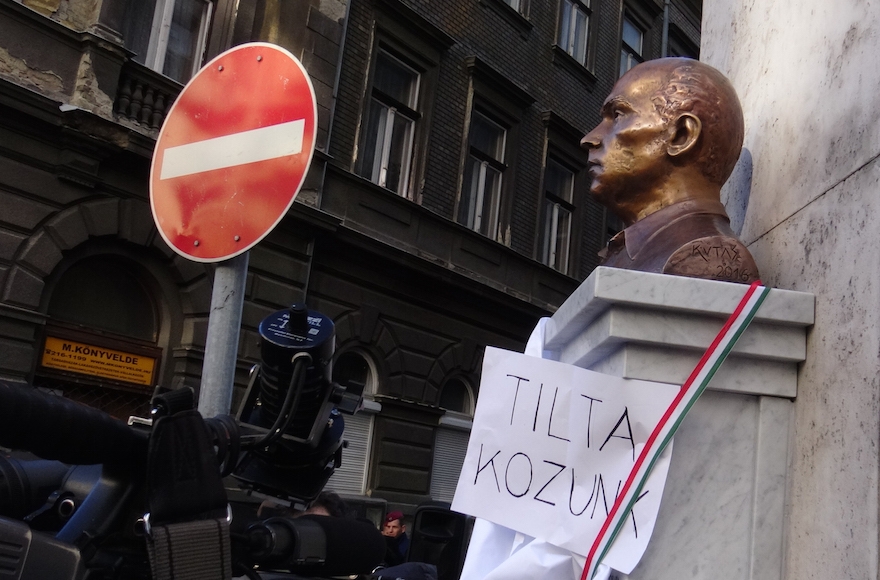
What they probably didn’t expect was that the Feb. 24 unveiling of a bust honoring Gyorgy Donath would attract a protest of mostly non-Jewish Hungarians. The protest would lead to the statue’s indefinite removal over vandalism concerns.

Hungary’s Jews have been fighting what one leading rabbi has called “the symbols war” against the government for years over the public veneration of Holocaust-era figures who promoted anti-Semitic laws. But the mostly non-Jewish protest, in which participants carried EU symbols and chanted anti-fascist slogans, was taken as a sign that the effort is winning allies beyond the Jewish community.

Hungarian Jews launched the monument battle in 2014, when a statue seen as minimizing Hungarian complicity during the Holocaust was unveiled in Budapest’s Freedom Square. The monument, which depicted an angel (understood to represent Hungary) attacked by an eagle (understood to represent Germany), was vigorously opposed by the Hungarian Jewish umbrella group Mazsihisz, which briefly suspended its ties with the government after its unveiling.

“It began with Jewish community activities but has spread beyond to a protest front with members of many affiliations,” said Adam Csillag, a filmmaker who has documented the protest since that unveiling.

That protest movement, which comprises a loose coalition of Christians, liberal political activists and Hungarian Jews, scored its first victory last year when Prime Minister Viktor Orban scrapped a plan to erect a statue of Balint Homan, another Holocaust-era politician who prompted anti-Semitic laws. The Faith Church, a Pentecostal body with 70,000 members, provided approximately half the 700 protesters who gathered at a site 30 miles west of Budapest in December to protest the Homan statue, which was canceled following an international outcry.

A statue of Gyorgy Donath in Budapest, Feb. 24, 2016. (Adam Csillag)A statue of Gyorgy Donath in Budapest, Feb. 24, 2016. Photo by Adam Csillag

“Every time an anti-Semitic figure is honored, there is a significant resistance from the civil society, and the members of Faith Church often take part in these protests as anti-Semitism is contradictory to our moral values and faith,” said Daniel Kocsor, a 20-year-old church activist.

The symbols war comes at a time of rising nationalist fervor in Hungary driven by several factors: economic crises, opposition to EU interference in the country’s affairs, growing Russian assertiveness and the recent arrival on Hungary’s borders of hundreds of thousands of Muslim migrants from the Middle East. Wary of losing support to the far-right Jobbik party, Orban’s ruling Fidesz party has cracked down on liberal activist groups and increased efforts to celebrate figures like Donath and Honan, who are considered patriotic by the right.

Both wartime politicians supported legislation in the 1940s that targeted Jews. Homan, who served as culture minister, authored a law to limit the number of Jewish university students. Donath argued for a measure to bar any sexual relationship between a Jew and a non-Jew.

They died at the hands of communists and have been embraced by the far right as nationalist symbols of communist oppression. But critics of the government believe the effort to portray them as freedom fighters is merely a thin veil intended to obscure their virulent anti-Semitism.

Homan is “a marginal figure,” Kocsor said. “So the point of the monument … is to send a message because he’s a racist and an anti-Semite. That’s outrageous.”

Other partners to the anti-government coalition include Kovacs’ group Living Memorial, which started in the wake of the Freedom Square protest and now meets in the square twice a week to display alternative commemorations featuring Holocaust-themed artwork. Also participating is Dialogue for Hungary, a small opposition political party that took part in the Donath protest.

“There’s a nostalgia toward the good old Hungary” of the 1940s, historian Eva Balogh said. “It’s scaring a lot of people and driving them into action.”

Non-Jewish activists link arms with Hungarian Jews in ‘symbols war’ Read More »

“A person’s a person: Supporting all, no matter how small.”

The essay below was inspired by a discussion that occurred at a Haskalah Salon in a West Hollywood home.  Haskalah is an association of young professionals and alumni who support Hebrew Union College – Jewish Institute of Religion.

One state, two state(s), red state, blue state.  

2015 was a challenging year for Reform Jews.  In congregations across America we wrestled with global issues such as the Iran Deal and Israeli elections and more local ones such as Black Lives Matter and “the Donald”.  And by the end of the year, not everyone was left whole. 

Though perceived as a liberal bloc, Reform Jews in fact run the gamut.  As a result, rabbis self-censored, congregations grew divided, and individual congregants left their synagogues over disagreements with their clergy – over what they said, or perhaps, what they chose not to say.  No doubt 2016 will bring more challenges, from the predictable — Election 2016 — to the unforeseen. 

Therefore, are there any issues we can address in the congregational setting?  And if so, how can we acknowledge the diversity of opinion among Reform Jews, while at the same time maintaining tenets central to the Movement?

Returning to some words that Dr. Seuss actually wrote – in Horton Hears a Who! –  the author offers some guidance.  The elephant Horton in the parable discovers the microscopic community of Whosville and responds to the Mayor’s plea to protect them from harm.  To the chagrin of Horton, the other animals who are unable to see this tiny population ridicule the elephant and instead inflict more harm on the Whos.  Not until a small shirker belts out a loud “Yopp!” do the other animals become convinced of the Whos’ existence and vow to help Horton protect this community.

At its conclusion, all finally believe: “A person's a person, no matter how small.”  Sound familiar? 

In some ways, it invokes Torah (Gen 1:26), as God said, “Let us make a human in our image, after our likeness.”  From B’Tzelem Elohim ((בצלם אלוהים – that humans are in God’s image – emanates the concepts of equality and universal human rights.  After all, all persons no matter how small are in God’s image. 

B’Tzelem Elohim is central to the Statement of Principles for Reform Judaism, adopted at the 1999 Pittsburgh Convention, Central Conference of American Rabbis.  From this concept it was declared: 

We are obligated to pursue (tzedek), justice and righteousness, and to narrow the gap between the affluent and the poor, to act against discrimination and oppression, to pursue peace, to welcome the stranger, to protect the earth's biodiversity and natural resources, and to redeem those in physical, economic and spiritual bondage. In so doing, we reaffirm social action and social justice as a central prophetic focus of traditional Reform Jewish belief and practice.

This statement goes beyond words, compelling us to pursue social action.  And it follows a notable track record that includes contributions from American Jews of many shades and stripes.  American Jews helped found and fund some of the most important civil rights organizations, including the National Association for the Advancement of Colored People (NAACP) and the Southern Christian Leadership Conference (SCLC).  And it wasn’t just organization and dollars, nor was it limited to our lay leaders such as co-founder of the NAACP, Dr. Henry Moscovitz.  There also were Rabbis involved.   

In 1964, in response to a letter from Dr. Martin Luther King, Jr. that was read at a meeting of the Central Conference of American Rabbis in Atlantic City, Reform Rabbis – including Rabbi Richard Levy of HUC-JIR and Rabbi Jerrold Goldstein – descended on St. Augustine, Florida, where they were abused by local police and jailed overnight.  One year later, in one of the most famous images from the decade, Rabbi Abraham Joshua Heschel linked arms with Dr. Martin Luther King in his March on Selma. 

The idea of B’Tzelem Elohim need not be limited to one movement or one era. 

We may not see the evidence of institutional racism, but Black Americans surely experience it in inner cities where they suffer from brutal police tactics and in prisons where they endure long sentences, often resulting from discriminatory drug sentencing laws.  But ask any African American about “driving while black” and they will recount tale after tale of being pulled over for no real infraction.  Institutional racism has been made real to all of us as we watch young African Americans murdered by police in multiple cities across the U.S.

We may not personally hire the undocumented workers who tend our lawns, clean our stores, and pick our fruit, but they perform work that American citizens are unwilling to do. Yet the undocumented immigrants face threats of deportation and frightening new rhetoric from today’s politicians. We see fear-mongering rather than policy to help ease the situation and bring immigrants toward a pathway to citizenship and legal status.   

And we may not personally know transgender Americans that were born with gender dysphoria, but transmen and women regularly confront on-going bullying, hatred and misunderstanding.  The transgender community has disproportionate rates of suicide and lack dignity in public places and protection from discrimination.

These are just a few of the issues that we should address as Reform Jews, even if it makes some of us congregants uncomfortable.  When we are uncomfortable or out of stasis we can seek to correct, repair and heal.  And as religious leaders, we must look inward and acknowledge the diversity of opinion in our congregations and create space for dialogue.  By recognizing and showing consideration to all our members, we are in a way paying respects to B’Tzelem Elohim.  

It won’t be easy this balancing act; between looking inward and outward, between taking a position and recognizing the opposition, and between speaking and taking action.  But we must never lose sight: if we all are in God’s image and if we embrace concept of Tikkun Olam (תיקון עולם) – repairing the world – we also must consider and protect those who are not like us, those like the Whos, whom we do not know or, perhaps, may not even see.  

Matthew Louchheim is the founding co-Chair of Haskalah, the young associates of Hebrew Union College – Jewish Institute of Religion. Rabbi Denise L. Eger is the founding rabbi of Congregation Kol Ami, West Hollywood's Reform Synagogue, and the President of the Central Conference of American Rabbis. 

“A person’s a person: Supporting all, no matter how small.” Read More »

Vanderbilt U. business student killed in mass stabbing in Tel Aviv

A 29-year-old American business school student was killed in a stabbing attack in the Jaffa area of Tel Aviv.

Taylor Force, a student at the Vanderbilt University Owen Graduate School of Management, was on a school trip to Israel when he was killed Tuesday evening, the university said. As many as 10 people were wounded in the attack at and near the Jaffa Port, Force’s wife seriously, Ynet reported.

Force and other Owen school students had gone to Israel to learn about the high-tech industry there. No one else on the trip was hurt, the university said.

The Jaffa attack came less than two hours after terror attacks in Jerusalem and central Israel left a Charedi Orthodox man and two Israeli Border Police officers seriously injured.

Four of the injured are reported to be in serious condition and four others in moderate condition, according to Israel’s Channel 2. The attack lasted about 20 minutes in three locations.

Police said the assailant was “neutralized.” He was later identified by the Palestinian Maan news agency and then by police as a 22-year-old man from the Palestinian city of Qalqilya in the northern West Bank. Haaretz named him as Bashar Masalha.

At the time of the attack, U.S. Vice President Joe Biden was less than 2 miles away meeting with former Israeli President Shimon Peres at the Peres Center for Peace. He is in Israel on a two-day trip.

At the entrance to the Jaffa port, the assailant stabbed two people before running up the promenade, including to near the Dolphinarium Club, according to reports. The port is a popular seaside shopping and dining center for Israelis and tourists in Jaffa, the predominately Arab area of south Tel Aviv.

The Tel Aviv-Jaffa municipality vowed to step up security in the wake of the attack.

Vanderbilt U. business student killed in mass stabbing in Tel Aviv Read More »

The Threat of “Trump-l’œil” to America Democracy

Trompe-l'œil is French for the “deceive the eye” techniques in which painters use realistic images to create an optical illusion.

It originated in high art, but has migrated all the way down to the level of cartoons. For example, Wile E. Coyote paints a fake tunnel on a rock wall, which the Road Runner nevertheless races through. Then the coyote tries to do the same, but crashes into the rock.

I would argue The Donald has mastered the art of the political Trump-l’œil. He takes real issues like illegal immigration and trade deficits and transforms them into make-believe dramas in which he promises to slay (without explaining how) the foreign dragons threatening America from without and within.

Recently, Senator Marco Rubio has tried to expose Trump as a “con man.” Rubio uses authentic documentation including the example of phony Trump University. Unfortunately, Trump has avoided a major hit. Like the Road Runner, he appears to drive right through the brick wall. No doubt, he really skirts it in a cloud of dust to deceive the voters. Unfortunately, Rubio pursuing Trump runs into the real wall, with disastrous results for his campaign.

Trump’s mastery of sleight-of-hand is fully on display in his new use of a Hitler-style “Trump salute” to pledge the loyalty of his rally supporters. Initial reactions are that this is another fatal tell in which Trump can’t help but reveal his authoritarian and fascistic tendencies. Of course, observers—especially Jewish observers—like retired ADL head Abe Foxman, who survived the Holocaust as an infant—react with horror and indignation.

But behind the scenes, Trump is manipulating appearances. Far from a spontaneous expression of his felt need to imitate Nuremberg theatrics, Trump’s pledge-and-salute are just ambiguous enough to cause Commentary’s Jonathan S. Tobin, usually an astute observer, to question whether the spectacle was truly Nazi-like. Did the audience members really offer the stiff-arm salute? Or was it more like they were pledging allegiance to the flag, public school fashion?

In actuality, the salute is just the latest example of Trump’s use of outrageous words and gestures to monopolize the news cycle by a hybrid of “bad boy” antics and seemingly brave defiance of political correctness. In addition, he puts his opponents and critics off balance, leading them to do and say things against him that may be entirely true, but which Trump and his supporters can mock as ridiculous or hysterical.

Such antics will cost him the votes of some respectable people, but they will also win the support of voters consumed by angry nihilism against the so-called “Establishment,” while frightening or intimidating some otherwise decent people into silence.

Trump is a demagogue. But that’s not the greatest concern. To coin a phrase, “one man’s demagogue is another man’s politician.” The fundamental problem is that Trump is indeed also an authoritarian with fascist tendencies—and a very clever one. If you remember the film, Mephisto, he is not the Fuhrer or Himmler, but the devilish theatrical magician and manipulator who stage manages their rise to power.

The Threat of “Trump-l’œil” to America Democracy Read More »

At least 10 Israelis stabbed in Tel Aviv

This story has been updated here: American tourist killed, up to 10 people injured in Jaffa attack


UPDATE 9:33 a.m.: According to IDF Twitter feed 1 person is dead and 9 injured in attack.

At least 10 Israelis were stabbed in the popular Jaffa port area of Tel Aviv on Tuesday, Israeli authorities said.

The Magen David Adom ambulance service said five of them were severely wounded.

Police said the attacker, whom they did not identify, had been “neutralized”.

Three Palestinian assailants were killed earlier on Tuesday after attacking Israelis.

At least 10 Israelis stabbed in Tel Aviv Read More »