fbpx

October 30, 2013

Retaliatory Israel strike hits Gaza rocket launchers

Israeli air strikes hit two concealed rocket launchers in the northern Gaza Strip in retaliation for rocket fire from Gaza on southern Israel.

The Israeli military confirmed direct hits on the targeted launchers the morning of Oct. 28, several hours after two rockets were fired at Ashkelon and surrounding communities.
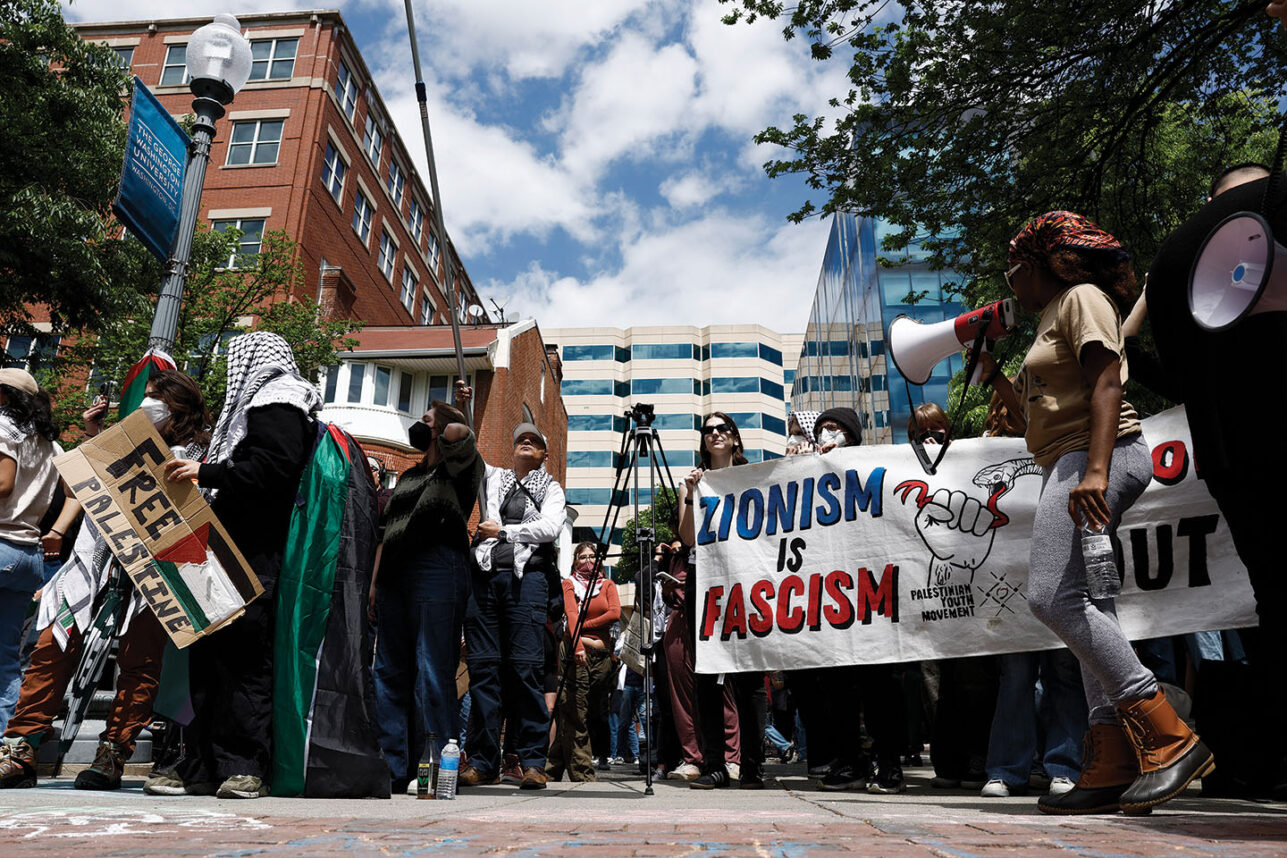

One of the rockets was intercepted by the Iron Dome missile defense system above Ashkelon, according to the Israel Defense Forces (IDF). A second landed in an open area near Ashkelon. The Color Red warning siren sounded in the area moments before the rocket struck.

The rocket attacks came hours after Israel released the names of 26 Palestinian prisoners set to be freed Oct. 29 as part of the ongoing peace talks with the Palestinian Authority. Five of the prisoners set to be released are from Gaza.

On Oct. 27, two mortars fired from Gaza landed in Israel near the border fence.

“Hamas must take responsibility for these actions or pay the price for inaction,” IDF spokesman Lt. Col. Peter Lerner said in a statement.

Retaliatory Israel strike hits Gaza rocket launchers Read More »

The Jewish Little Big Man Demographic Phenomenon?

U.S. Jewish and American Indian self-identities are elastic.

6.7 million Jews in the U.S of 2012, a Pew Research estimate, rather than 5.3 million Jews based on earlier national Jewish population surveys? Well, I shouldn’t be so down on myself for putting my faith in the total U.S. Jewish population estimates derived from the Jewish community-funded National Jewish Population surveys of the last forty years. If the 1957 U.S. Current Population Survey was accurately portraying the 1957 American Jewish population, as the current 2012 Pew Jewish study argues, the American Jewish population has increased 15 percent in the 55 years from 1957 to 2012. 

Most learned analysts had predicted that the U.S. Jewish population would not experience significant growth.  As J.J. Goldberg recently pointed out:

The lead technical advisor on the 1990 national Jewish population survey, the distinguished Brown University sociologist Sidney Goldstein, wrote in the 1992 American Jewish Year Book that with low birthrate, aging, high intermarriage and few intermarried couples raising Jewish children, “there seems little prospect that the total core Jewish population of the United States will rise above 5.5 million.” 

Sidney Goldstein, being an expert on Jewish migration, left out the migration component of population change and probably for good reason. In 1990 the brunt of significant Jewish  international migration to the U.S. from the Soviet Union and to a much smaller numerically significant extent Iran, Israel, and the rest of the world’s remaining tiny Jewish Post World War II communities was largely over.

So, if trends of Jewish birth, death, in-migration, in-marriage and in-conversion, don’t mathematically lead from the 1957 Jewish population to the Jewish population found by the 2012 Pew survey on U.S. Jews, what might have happened?

An unexpected bump in the American Indian population in the 1980 U.S. census may be instructive. Dustin Hoffman’s picaresque schlemiel 1970 role in the Revisionist Western Little Big Man initiated a series of cinematic sympathetic historical portrayals of American Indians including Billy Jack (1971), and The Outlaw Josey Wales(1976), These movies are credited with increasing the sense of American Indian self-identification and likely resulted in the count of American Indians in the 1980 census being over 70 per cent larger than the 1970 census count.

The Pew study found 94% of U.S. Jews (including 97% of Jews by religion and 83% ofJews of no religion) say they are proud to be Jewish.  It’s arguable that American Jews have undergone a Little Big Man demographic phenomenon in the past half century.  Many have commented on the growing attraction of Jewish and being Jewish in popular culture.

It seems that even when Jewish ancestry parents chose not to raise their children as Jewish societal inputs supplant their neglect or intentions in the latest cohort of children who have grown to adulthood. as J.J. Goldberg points out:

The 1990 survey found that close to half of all Jews getting married at the time were marrying non-Jews, and only 28 percent of interfaith couples said they were raising their children as Jews. This led to another panic. Today, a generation later, Pew has caught up with those children, who are now adults. Whatever their parents intended, almost half identify unambiguously as Jews — about 23 percent by religion and 23 percent without. It seems the ones who were “raised as Jews” became Jews by religion. The rest adopted their parents’ skepticism along with their heritage

The prestige of having a Jewish linkage in contemporary America, whether by marriage, relation or birth may have expanded the pool of self-defined Jews in to an extent that it has overcome the limitations of natural increase, international migration and religious in-conversion.
 

Pini Herman, PhD. specializes in demographics, big data and predictive analysis, has served as Asst. Research Professor at the University of Southern California Dept. of Geography,  Adjunct Lecturer at the USC School of Social Work,  Research Director at the Jewish Federation of Greater Los Angeles following Bruce Phillips, PhD. in that position and is a past President of the Movable Minyan a lay-lead independent congregation in the 3rd Street area. Currently he is a principal of Phillips and Herman Demographic Research. To email Pini: pini00003@gmail.com To follow Pini on Twitter:


Please Answer the Following ANONYMOUS Survey of Things of Interest to You:


Subscribe to be notified of new Demographic Duo blogs

* indicates required

The Jewish Little Big Man Demographic Phenomenon? Read More »

2 authors, 2 takes on Jewish humor and theology

Jewish humor and Jewish theology share something in common. I can think of any number of jokes whose punch lines say something profound about God (“Work with me here — buy a ticket!”). And we need only consult the Torah to discover how the matriarch Sarah responded when God revealed that she would bear a child in advanced old age: “Sarah laughed …” (Genesis 18:12).

The point is made by Ruth R. Wisse, professor of Yiddish and comparative literature at Harvard, in “No Joke: Making Jewish Humor” (Princeton University Press, $24.95), a rare work of cultural scholarship that is also laugh-out-loud-funny. “Jewish humor rolls cheerfully off the tongue,” she quips, “like French cuisine and Turkish baths.” She quotes no less an authority on the workings of the human mind than Sigmund Freud on the Jewish genius for jokes: “I do not know whether there are many other instances of a people making fun to such a degree of its own character.”

“No Joke,” in other words, is full of jokes. Wisse declares her intention “to offer a descriptive map of some of the centers where Jewish humor thrived and where it still prospers,” and she insists that pondering (and laughing at) these jokes reveals something vital and important about Jewish identity: “I cheerfully confess that theories about humor interest me less than the evidence they offer of folk creativity,” she writes; “jokes offer the only surviving form of ‘folklore’ that is not protectable by copyright.”

She traces the distinctive folk culture of Eastern Europe, which she calls “an incubator of modern Jewish humor,” to such traditions as the Purim skit and the antics of the masters of ceremonies at weddings. She traces these influences into the work of Sholem Aleichem, although she points out that once the Jews of the Diaspora abandoned Yiddish, “they could no more understand the intricacies of his humor than could any Gentile.” But she also considers less familiar sources, including both the modernizers who embraced the Haskalah and the traditionalists of Hasidism: “We may not customarily associate Hasidic ecstasy with laughter, but we should consider how, like ecstasy, laughter too overcomes indignities through an altered state of mind.”

As deep as these roots go, the art of Jewish comedy still flourishes, as anyone who turns on a television knows well. “Jewish humor remains, as it has always been, merely one of many possible responses to the anomalous experience of the Jews,” Wisse concludes. “But as long as it does remain one of those responses, suppliers will arise to meet the demand.” And she shows how more recent exemplars, ranging from the Marx Brothers to Larry David to the Broadway hit “Old Jews Telling Jokes,” fit into the rich tapestry of Jewish humor.


Ruth R. Wisse will discuss and sign copies of “No Joke: Making Jewish Humor” at Stephen S. Wise Temple on Nov. 19 at 7:30 p.m. For tickets and information, visit the Stephen S. Wise Web site at ” target=”_blank”>http://wcce.aju.edu/default.aspx?id=10462.


Jonathan Kirsch, author and publishing attorney, is the book editor of the Jewish Journal. His new book is “The Short, Strange Life of Herschel Grynszpan: A Boy Avenger, a Nazi Diplomat and a Murder in Paris” (Liveright).

2 authors, 2 takes on Jewish humor and theology Read More »

Wounded Syrians find care in Israel that is no longer available at home

Last February, nearly two years into the civil war still tearing across Syria, a group of seven wounded Syrians dragged themselves to the Israeli border, where they were picked up by the Israel Defense Forces (IDF) and rushed to the nearest hospital.

It was the first public rescue of Syrians within Israel, and reporters flocked to the Ziv Medical Center in Safed, a 40-minute drive from the Syrian border. Facing a wall of microphones, hospital director Dr. Oscar Embon dodged questions about whether the patients, all men, were fighting for or against Syrian President Bashar Assad.

“We treat patients regardless of religion, race, nationality and give the best care we can provide,” Embon told CNN.

The media blitz soon died down, but the mission kept growing. Dozens more Syrians mysteriously made their way into Israel, and three more Israeli hospitals, each with different specialties, volunteered to take in the Syrian patients, while the IDF also set up its own field hospital along the border for emergency care.

“They know where to bring the wounded now, just from ear to mouth,” said Peter Lerner, IDF spokesman for international media. “We haven’t made any public announcement about it, but they keep coming to the same places of access. It seems to be an unwritten agreement: If you need help, you know where to come.”

[Related: Dr. Alexander Lerner, head of the orthopedic department at Ziv Medical Center, with a picture made for him by an 8-year-old Syrian patient. Photo by Simone Wilson

Among the Syrians being treated in Israel is a 15-year-old boy who lost his leg and almost lost his arm, had it not been saved by doctors at Ziv. The boy was riding in a tractor, helping deliver water to neighboring villages in Syria, when the tractor rolled over a land mine. When he woke up, he was in Israel. (The hospital will not release the boy’s name, to ensure his safety in both Israel and Syria.)

“I was surprised, and a little afraid,” the boy said in Arabic, as his social worker translated. “But when I saw people speaking Arabic, I was more relaxed.”

This 15-year-old, one of almost 20 Syrians currently hospitalized at Ziv, shares a room with two other boys — a chubby-cheeked 14-year-old whose arms and legs broke when a bomb sent him flying off the roof of his house, and a third teen who was blinded and lost a hand in another blast. White gauze fills both this patient’s eye sockets. (“I’m not sure he really understands what is happening,” Gil Maor, a spokesman for the hospital, said of the boy who lost his eyesight.)

Their hospital room opens to a balcony with a dazzling, panoramic view of the Sea of Galilee, a longtime point of geographical contention between Israel and Syria.

“I always heard that Israel was the enemy,” the 15-year-old said. “But there are a lot of good things that they give me here.”

On the morning of Oct. 21, the boys’ hospital room was crammed with nurses, social workers and press supervisors. Curious community members brought plastic bags full of snacks to the door — Israeli favorites like peanut-butter-flavored Bamba puffs and Quadratini biscuits — and tried to pop their heads in for a peek. Guarding the room and doing his best to keep the visitors at bay in the hallway, a gangly IDF soldier who didn’t look much older than the Syrian boys inside made repeated calls to his superiors, seeking approval for each new person to enter the room and each Syrian patient to be interviewed. A photographer for the Israeli newspaper Ha’aretz spent 20 minutes setting the boys up in different poses around the room, always with their faces tilted slightly away so as not to reveal their identities. 

By noon, the boys all looked exhausted. “I miss my family; I miss my friends, and I miss my teachers. I miss taking the school photo,” the 14-year-old in the middle bed said, before softly requesting that he be excused from the interview. He made a sideways chopping motion with his hands and rolled over, directing his gaze out the window toward Syria.

Offering (illegal) care, as needed

The border between Israel and Syria is guarded closely by the IDF, and a new high-security fence between the two enemy countries is now 90 percent complete. However, the IDF’s official policy is to accept any wounded Syrian who can make it to the border (oftentimes with the help of an accompanying party).

“We are facilitating urgent medical aid to any Syrians who have reached the fence,” IDF spokesman Lerner said.

Some patients remain unconscious through the journey. And when they wake up in enemy territory, according to Israeli hospital staff, their faces often brim with fear.

“They’re very frightened,” said Dr. Eyal Sela, head of the ear, nose and throat department at the Western Galilee Medical Center in the far-north beach town of Nahariya. “They don’t understand what we’re saying when we talk in front of them — the whole situation is unfamiliar ground. You see it in their eyes.”

But after a week or two, Sela said, “You see that the trust is building up. They learn our faces.”

And as word of the Israeli aid operation spreads within Syria, that initial round of shock is fading.

Fares, a Christian Arab social worker at Ziv Medical Center who chooses to keep his surname out of the press, is the first face Syrian patients see upon their arrival at the hospital. During their stay in Israel, Fares also becomes the familiar face that coaches the patients through treatment, all the way up to their day of discharge.

He said patients have told him his name is circulating in Syria. 

“Some come back from the same village where they told them that I was here,” Fares said. “[New arrivals] say to me, ‘Yes, they told us about you.’ ”

Sela, a facial reconstruction specialist, said he has formed very close bonds with a few of his patients. The doctor is especially fond of his very first case, a “very intelligent” agriculture student who was rushed to the Western Galilee Medical Center with a severe gunshot wound stretching from his jaw through to his lungs.

“He grew up thinking that Israel was bad and that we kill each other here,” Sela said of the patient. “Then suddenly he sees Arabs and Jews are working together as doctors, as nurses. He couldn’t figure out what was going on. He thought it was a show.”

Watching the young man’s perceptions change, Sela said, made the doctor feel, for the first time, like a sort of diplomat.

“It’s not just the medicine — you touch people, and you change people, and you change people’s perspective of you,” Sela said. “And you’re not a monster, as they saw you before.”

But while some Syrians’ personal feelings about Israel may shift after receiving life-saving treatment in the Jewish nation, they must keep the treatment a secret upon returning home. Setting foot on Israeli soil is illegal under Syrian law, and widely frowned upon, besides.

So, when IDF medics send patients back across the Syrian border, they make sure no Hebrew lettering nor Israeli logos are printed anywhere on the patients’ medical equipment or tags.  In some cases — according to Sara Paperin, international liaison at the Western Galilee Medical Center — Syrians have even been sent home with forged discharge papers, made to look like they were printed at a Syrian hospital. (Paperin stressed that the Western Galilee Medical Center played no part in creating these false documents, and that all Syrian patients who come through the hospital are released to the IDF with accurate discharge papers.)

The 15-year-old at Ziv Medical Center who lost his leg in a land-mine explosion said people in Syria would be angry if they learned he went to Israel. “I prefer not to tell them,” he said.

Russian-Israeli surgeon Dr. Alexander Lerner, head of the orthopedic department at the hospital and a leading expert on limb salvation and elongation, is now in the process of building the boy a prosthetic leg. “Next week, I hope he’ll start walking,” he said. “I plan to return him to Syria on both legs.”

With more attention, more patients

The Golan Heights — the 700 square miles of disputed farmland that connects Israel to Syria — is a historically gray area surging with tension between the two countries. On Google Maps, the region is double-outlined by a tangle of dotted lines, with no clear border between Israel and Syria — illustrating almost a century of back-and-forth land grabs. To this day, a special force of United Nations workers, called the United Nations Disengagement Observer Force (UNDOF), patrols the area to keep peace. (According to a UNDOF report from March, Syrian officials accused UNDOF personnel of collaborating with the IDF to “transport across the ceasefire line of injured persons to the Israeli-occupied Golan and back.”)

“There have never been any diplomatic relations between Israel and Syria,” Foreign Ministry spokesman Yigal Palmor said. “It is legally considered an enemy state.” 

Meanwhile, the other four countries that touch borders with Syria — Jordan, Turkey, Lebanon and Iraq — have collectively absorbed more than 2 million Syrian refugees since the civil war broke out, with another 125,000 fleeing to Egypt.

“Refugees tend to go to places where they speak the same language, where they have the same culture,” the IDF’s Lerner said. “So many Syrians have been told that Israel is the arch-enemy of Syria. Why would they come here?”

The only Syrian refugees that Israel has offered to take in are Palestinians — former refugees of the Israel-Palestine conflict who fled to Syria in a time of peace. But had they taken Israel up on its offer, those Palestinian refugees would have been confined to the occupied West Bank and forced to give up their refugee status, which would cut their access to U.N. aid and their hopes for a “right of return” to Israel proper.

Israel’s small Druze community, leftover from Syrian rule of the Golan Heights, has also been pressuring the Israeli government to provide refuge to their brethren on the other side of the fence. Israeli authorities have yet to issue a public response.

“There is no change in our policy as far as the border is concerned,” Lerner said. “No Syrians can pass through.”

The Syrian civil war and refugee crisis have put Israel in an awkward position, as the conflict between Syria and Israel long predates that between the Free Syrian Army and the Assad regime. However, because the Syrian rebels have temporarily set aside their beef with Israel to focus on toppling the oppressive government in their own country, the Israeli medical community has spotted an opportunity to try to plant some seeds of Israeli humanity inside Syria.

Doctors Without Borders, the premier medical aid organization operating in Syria and in surrounding refugee camps, recently urged “all states and non-state actors involved in the Syrian conflict” to devote the same urgent attention to Syria’s medical crisis as to the infamous chemical weapons attack in August that killed some 1,500 Syrians.

“The medical system — like the rest of Syrian society — has been under siege during the conflict and is no longer capable of responding to the acute and chronic medical needs of the Syrian population,” a September report from Doctors Without Borders said. The organization has also warned that health care for refugees in Jordan, Lebanon and Iraq is crumbling under extreme demand.

Israel, on its own terms, has answered that plea.

Whereas stretched-thin hospitals inside Syria are depleted of medical supplies and often targeted by the Syrian military, Israeli hospitals just over the border are able to provide patients with a full team of professionals, from medical clowns to psychiatrists, and cutting-edge treatments they might not receive elsewhere.

As the director of Ziv Medical Center, Dr. Oscar Embon said he would never turn away a patient. “I’m glad I have the opportunity to exercise my values, which is to treat everyone regardless of religion, race — whatever. For me, it’s the natural thing to do.” Photo by Simone Wilson

One of Sela’s current patients lost his entire jaw in an explosion. “It’s totally gone,” the doctor said. “A grenade or something just took it off — the lower lip, the chin, the floor of the mouth and half of the tongue.” So the hospital has ordered a special plate from the United States and plans to reconstruct the patient’s jaw in full.

And over in Safed, Dr. Alexander Lerner at Ziv Medical Center is known for avoiding amputation at all costs. 

A few months ago, an 8-year-old Syrian girl named Aya arrived at Ziv Medical Center with her mother. The woman and child had survived a bombing together, and one of Aya’s legs was almost completely blown off. But through a painstaking process of “temporary acute shortening and temporary angulation” to keep the leg alive, then “gradual realignment” to restore it to its full length, Lerner was able to salvage the limb.

“When it was her first time walking in the department, all the Israeli patients looked at her and started clapping,” Lerner said in a thick Russian accent. “I’ve seen very many interesting situations, but it’s the first time I’ve seen this kind of applause for a small girl walking.”

Aya boarded the IDF ambulance for Syria about a month ago, but she’s become something of a legend at Ziv. Above Lerner’s desk is a picture of a vase of flowers that the young survivor made for him, along with an inscription that she asked her nurse to write in Hebrew: “Dear Dr. Lerner,” it reads, “Thank you for your care. God will be with you and he will guard you.”

Israel has a rare chance to provide world-class health care to a war-torn neighbor, hospital director Embon said. “We try to save limbs. This is the modern thing to do — the right thing to do. The Red Cross is used to amputations. You just cut it, put in a suture, and you can release the patient in two days. And probably if you don’t have the means, this is the right thing to do. But the Red Cross was surprised to see that we are trying to save limbs and doing a lot more modern surgeries.”

Syrian hospitals seem to be catching wind. Two men in their 20s under Sela’s care at the Western Galilee Medical Center told the Jewish Journal that they were transferred to Israel by a hospital in Syria, somewhat against their wishes. And another two patients recently arrived at Ziv with doctor’s notes — one blood-splattered — written in Arabic, pinned to their clothing. One of the men was suffering from a bullet wound through his chest and shrapnel in his diaphragm.

“There was no possibility to suture his liver, and pressure bandaging was applied to his stomach,” his note read. “Please do what is required and thank you in advance.”

Said Embon, director of Ziv Medical Center: “As a physician, I believe in the universality of health care and medicine. And as an Israeli, I believe that we should have peace — and if we are contributing to changing how our neighbors see us, maybe we can bring peace to the area one day earlier.”

One year into the Syrian civil war, Israeli public-affairs consultant Lenny Ben-David hinted at the potential impact of such an operation in an op-ed for the Times of Israel.

“If there’s a tiny chance for coexistence with the post-Assad government of Syria and if Syria doesn’t shatter into ethnic satrapies,” he wrote, “a life-saving medical facility along the Israel-Syrian border may be a good place to start a coexistence process.”

According to the IDF, the medical aid program for Syrians in Israel didn’t begin until early 2013, simply because up to that point, no wounded Syrians had turned to Israel for help. But earlier this year, the IDF said, violence within Syria began to spread to villages near the Israeli border — thus driving Syrians to seek treatment at the fence.

Slowly but reliably, global press outlets picked up on the unlikely story.

“In March, only the director of the hospital and maybe the physicians that were interacting with the Syrian patients knew about it,” said Paperin, international liaison at the Western Galilee Medical Center. “I got involved in June — and since then, that’s really all we’ve been handling here.” Before the influx of Syrians, Paperin’s job consisted mainly of overseeing medical tourism, a booming million-dollar industry in Israel. Now, the young Chicago native is responsible for overseeing a constant rotation of Syrian war casualties — and introducing them to dozens of journalists eager to interview the survivors in a rare cocoon of safety.  

At first, Israeli reporters began visiting Syrian patients at a slow trickle, Paperin said. But in August, a big New York Times piece on young Syrian children being treated at the Western Galilee Medical Center “was really the big burst in the dam. All of a sudden, within a few days of it being published, a tsunami of reporters showed up.”

Maor, a spokesman for Ziv Medical Center, said the same: “We had times where there were three or four media crews here the whole week.”

With the spike in press coverage came more waves of wounded Syrians.

The IDF has since set up a well-oiled distribution system for Syrian patients who make it to the border: Those with less-serious injuries are patched up by mobile IDF medical teams along the border, or treated at the IDF field hospital, and returned to Syria. Those with serious wounds to the torso and limbs are transferred to Ziv Medical Center in nearby Safed. Those with serious head injuries are driven a couple of hours west to the Western Galilee Medical Center in Nahariya. And the most critical patients — only 20 so far — are transferred to the Rambam Medical Center in Haifa.

One woman taken to Rambam, for example, had a piece of shrapnel removed from inside her heart.

“This is the path that all Syrian patients come through,” said Paperin, leading a reporter down a long hall at the Western Galilee Medical Center, its walls painted a calming eggshell and turquoise, and into the hospital’s shock room.

“The connection between the hospital and the IDF starts like this: They pick up the phone and they say, ‘We’re transporting X number of patients — we’ll be there soon,’ ” Paperin said. “But there’s no information about age, or gender, or injury. So the first step is always in preparing the shock room for resuscitation.” From there, patients head to the ICU and — once they’re stabilized — to the hospital ward that best suits their injuries.

The hasbara challenge

From the start, Israel’s normally pushy hasbara (public relations) detail has seemed unsure of how to handle the Syrian issue. The same muddled elements of the Syrian civil war that complicate larger international aid efforts — including the risk of funding terrorist groups mixed in with the rebels — have proven even more complex for Israel, a grave enemy both of Assad and terrorist factions in the region.

A hurried and blood-stained doctor’s note arrived from Syria with one unconscious patient, outlining his injuries and what little treatment he had already received. Photo by Simone Wilson

In September, the IDF permitted a single newspaper, conservative Israeli daily Yediot Aharonot, to speak to the head of the IDF field hospital, Dr. Ofer Merin.

When the Jewish Journal requested access to the hospital and an interview with Merin, a lieutenant at the IDF spokesperson’s office wrote in an e-mail: “At this point, the medical treatment center (as well as staff, patients, etc.) is not open to media coverage.” She later added that the Yediot piece “caused significant internal controversy” within the IDF.

New York Times reporter Isabel Kershner, likewise, told the Jewish Daily Forward in an interview that she faced a ton of pushback from the IDF while writing her piece on Syrian children in Israeli hospitals. 

Israel’s hasbara jitters may originate from a fear of looking like the country is taking sides in the conflict, after the great pains that the prime minister’s office has taken not to get involved. 

Various Arabic-language news outlets throughout the Middle East have accused Israel of indirectly supporting the rebels through medical rehabilitation: Pointed headlines have included “Israeli hospital treats 17 rebel militants” and “Free Syrian Army wounded being treated in Israeli hospitals.” And Egyptian outlet Egy Press wrote last month that Ziv Medical Center in Safed had become “the first resort of the terrorist factions in Syria to receive treatment and rehabilitation before returning to complete their terrorism on Syrian territory.”

An anonymous patient who said he was part of the Free Syrian Army told France 24: “The [Syrian rebel] fighters take the patients without carrying weapons. They put us on a particular spot where the Israeli army can see us. Then the Israelis come and take us. To be honest, I was shocked that Israel took us in.”

The strongly worded French article suggested that Israel’s humanitarian effort could be its stealthy way of intervening against Assad. 

And the speculation is not unfounded: No Syrian patient at an Israeli hospital has ever claimed allegiance to the Assad regime in an interview with the press. And while plenty of wounded women and children have passed through Israel, the majority of patients are still men. (Seventy-seven percent of the patients at Ziv Medical Center, for instance, have been males over the age of 18.)

Israeli officials appear equal parts proud and paranoid. Press supervisors at the hospitals hosting Syrians are eager to show reporters around but steer them away from political questions and only allow them access to certain patients. Throughout these tours, the spokespeople stress that they do not ask — and do not care — if patients were fighting in the war, nor which side they were fighting on.

Media outlets are asked not to print Syrian patients’ names or identities. Not only will this put them at risk of persecution inside Syria for seeking Israeli care, Maor said, but the community surrounding the hospital — a mix of mainly Muslim and Christian Arabs, Jewish Israelis and Druze — have charged opinions about, and even allegiances to, the two camps in Syria.

Inevitably, given the deep roots of the Israeli-Syrian conflict and the greater Israeli-Arab conflict in the Middle East, there is still much public skepticism surrounding the operation. One Lebanese news site accused Israel of “exploiting this matter in the media, in order to promote the image of humanity about them.”

But, in general, the Western media has embraced the Israeli initiative as pure. 

It’s one of the few positive Israeli news events that the Israeli Foreign Ministry has not helped promote at all — perhaps making it that much more attractive to reporters.

“Do we really have to be concerned about our image when we’re giving therapy to children who would be left to die?” Paperin asked. “From this hospital’s standpoint, you can’t make Israel the villain when that’s all we’re doing.”

Merin, commander of the IDF field hospital, told Yediot Aharonot: “I realize that we’re not changing the Middle East here,” he said, “but maybe we can make a small difference in how we are perceived, and that’s certainly worth something.”

However, the Israeli government has been reluctant to pay the price of the good press and goodwill. Hospital officials told the Jewish Journal that the Ministry of Health and the Ministry of Defense are still arguing over who will back the Syrians’ hospital bills, which have so far amounted to a combined $5.5 million, according to hospital estimates.

When asked about the dispute, Defense Ministry spokeswoman Myriam Nahon said only: “No comment.” And the spokesperson’s office for the Health Ministry responded: “The issue will be discussed soon with the director general of the prime minister’s office.”

(Those are just the costs that Israeli hospitals can temporarily absorb. Extra hardware for wounded Syrians, such as prosthetic limbs and wheelchairs, which must be paid for upfront, are purchased through private funds hosted by each hospital. Donations can be made to Ziv Medical Center and the Western Galilee Medical Center at ziv.org.il and wgh.org.il, respectively. )

Israeli news station Channel 2 witnessed similar hesitation from the Israeli government last year while accompanying a private Israeli aid mission to Syrian refugee camps along the Syria-Jordan border. Aid workers brought a letter from medical-tourism officials, offering a pro-bono eye surgery for a Syrian man that would help him see again. But soon after, Channel 2 reported, the Israeli Ministry of Interior rescinded the offer.

“That’s Israel: One hand extended, the other blocks the way,” said a Channel 2 reporter, who tagged along on the mission.

Later in the broadcast, one Israeli aid worker explained: “When we come to help [Syrian refugees], I look at them and think, ‘If there was war between us now, I’d aim my rifle at him, ready to fire.’ He’d kill me or I’d kill him. For now, I extend my hand to help him. As time goes on, will we shake hands or will we keep fighting? You don’t know what will happen. Do I make him healthy now so later he can take up his weapon against me?”

For Embon, director of Ziv Medical Center, in a humanitarian crisis like the one unfolding in Syria, those questions become irrelevant. 

“I am aware that not all the patients we treat are loving us and changing their minds [about Israel],” the hospital director said. 

“This is not a thing we do because we want to change them. We do this because we know that we have to do it — this is our job.”

Wounded Syrians find care in Israel that is no longer available at home Read More »

More Oy Gay Coming Soon!

Hey All!

Wanted to let you know that we haven't forgotten about you.  

There have been many changes at the Jewish Journal Online, and especially for the “Oy Gay” blog, so posts have not been consistent for the past year or so.  However, I am happy to say that I look forward to blogging for you all again more regularly, starting November 2013. 

In the meanwhile, have a safe and fun Halloween.  It is pretty gay, afterall. 'Twas thinking to myself about the forthcoming Halloween tomorrow when I started to think about how queer this “holiday” really is.  

I did some internet searching and stumbled upon ” target=”_blank”>West Hollywood Halloween Carnaval (which attracts up to 500,000 revelers), as having origins in historic San Francisco.  More importantly, these parties have also helped to bring Queerness into a more public forum, whether the attendees are LGBT or not, and have also brought to the forefront a more expressively open generation of adults over time. 

Nicholas Rogers, author of Halloween: From Pagan Ritual to Party Night, points out that while Halloween is enjoyed by everyone, “it has been the Gay community that has most flamboyantly exploited Halloween's potential as a transgressive festival, as one that operates outside or on the margins of orthodox time, space, and hierarchy. Indeed, it is the Gay community that has been arguably most responsible for Halloween's adult rejuvenation.”

With that said, Halloween can be a time of excess and debauchery. As enlightening of an experience as that may be for some as, say, being a heterosexual male expressing himself in a dress and wig, or a normally vanilla female dom-ing it up for the evening, no one likes to babysit [their 21+ friends] on Halloween…  

So, make sure, whatever you do, wherever you end up celebrating on October 31st, you make it fun and remember, Safety Third! 

See you next month…

More Oy Gay Coming Soon! Read More »

Syria to Israel: the road less traveled

Along the Israeli highway that snakes up through the Golan Heights toward Syria sits the Kiryat Shmona central bus station, a herding ground and grazing spot for Israel Defense Forces (IDF) soldiers on their way to the Syrian and Lebanese borders. On Oct. 27, one such soldier — dressed in army pants and an undershirt and fresh off the IDF’s medical operation at the fence with Syria — put in his order at the Best Burger kiosk. He struck up a conversation with a journalist passing through, and, on condition of anonymity, spoke about darting along the border with teams of IDF medics, providing emergency care to wounded Syrians.

When the IDF detects one or more war casualties approaching the new high-tech fence Israel built this year to keep out the flying parts of Syria’s civil war, “We open little passageways so they can come through,” the soldier said.

“We’re not allowed to cross the fence into Syria,” he said. “It’s a very gray area. And we can’t do it at night, because it’s too dangerous.”

Once the wounded are inside Israel, a temporary medical station is set up at the site of entry, and a handful of IDF doctors rush out to operate. From there, depending on the severity of the patients’ wounds, they are either released back to Syria, transferred to the IDF field hospital or transported via IDF ambulance to one of three medical centers in Israel providing more long-term care.

Working so intimately with a longtime foe of Israel has been strange, the soldier said. “It’s hard, because they were raised to hate us. And it doesn’t help that we don’t speak the same language,” he said. “But they sometimes learn to like us — that’s the good thing that comes out of it.”

When asked about the kind of injuries he’s seen in the field, the soldier shifted his eyes downward toward the Best Burger condiment bar and tightened his jaw. “It’s not pretty,” he said.

The most common injuries coming from the Syrian battlefield and into Israeli hands are bullet wounds (often multiple), blast wounds and crush wounds. Some patients, including small children, have been shot through the head by snipers; some are covered in hundreds of raw gashes from clouds of shrapnel; some arrive with parts of their limbs or torsos gouged out from close-proximity bombings, almost like giant shark bites. They’re some of the worst cases that IDF medics and Israeli doctors have ever seen, but not an altogether new class of injury: “Unfortunately, in Israel, we have some experience with military trauma, due to chronic ongoing Mideast conflict, local wars and terror attacks,” said Dr. Alexander Lerner at Ziv Medical Center, author of “Armed Conflict Injuries to the Extremities.”

At the northernmost point of the Golan Heights, in what used to be Syria but is now Israel, the small Druze village of Majdal Shams spills down the base of Mount Hermon. The view from here is of a shrubby yellow valley, dotted with Syrian border towns situated just a few kilometers to the east. After dusk falls, residents can hear pops of gunfire and the rumbling of exploding bombs in the nearby towns. And a few minutes outside Majdal Shams, at a lookout atop the rocky remains of a Syrian rampart from a past war with Israel, some of them gather to anxiously watch the civil war play out among their neighbors — including many Druze relatives, from which the Israeli-Druze were separated when Israel and Syria cut up the Golan Heights.  

Near the lookout, a Syrian national flag flies above the town of Quneitra, an indication that it is held by the regime of Syrian President Bashar Assad. But in recent days, journalists inside Syria have reported that the rebels are closing in on Quneitra — making for a new round of bloody war casualties right next to Israel. 

Counter-intuitively, however, injured Syrians cannot sneak into Israel through the official Quneitra border crossing, which Israeli-Druze students use to pass to and from their Damascus universities under the supervision of the International Red Cross.

Despite the intense standoff a few kilometers away, the crossing was quiet on Sunday — so quiet that one could hear the wind whip through the large Israeli flag flying over the gate. A soft-spoken young IDF guard who was sitting and playing his guitar at the crossing — and who wished to remain anonymous — said that Syrians cannot seek medical help through this easy entry point because its Syrian gate is controlled by Assad, who has an interest in keeping the rebels from patching their wounds. (The rebels seized the Syrian side of the Quneitra border crossing for a few hours on one day in June, but Assad’s forces quickly beat them back.)

Instead, wounded Syrians must reach one of the secretly designated pickup points along the fence — silent knowledge among the IDF, the rebels and international aid groups in the area — in order to receive life-saving treatment in Israel, before crossing back over the rocky Golan Heights terrain and into the war zone.

Syria to Israel: the road less traveled Read More »

Obituaries

Sam Abdulaziz died Oct. 11 at 74. Survived by wife Joyce; daughter Debbie (Kyle) Duns; son Mike (Michele); 4 grandchildren; sister Blanche Murad. Mount Sinai

Joseph Adleman died Oct. 8 at 79. Survived by wife Jonie; daughter Lisa (Charles) Oxman; son David; 3 grandchildren; sister Sybil (Martin) Sage. Hillside

Ronald Amaro died Oct. 5 at 75. Survived by wife Elaine; daughters Terri (Paul) Anderson, Susan Hardlund; sons Douglas (Caren), Michael (Mary Kay); 13 grandchildren; 1 great-grandchild. Hillside

Melvin Avedon died Oct. 8 at 87. Survived by wife Ronnie; son Joshua; stepdaughter Nancy (Jason) Cornwell, Ilene Krischer; stepson John (Nickie) Kaufman; 7 grandchildren. Home of Peace

Daniel Blatt died Oct. 9 at 76. Survived by wife Marti Blumenthal; daughters Jessica (Gregory) Ezor, Chelsea; 1 grandchild; sister Ruth (Irwin) Merkatz; brother Philip (Paula Breen). Mount Sinai

Joyce Braun died Oct. 7 at 71. Survived by husband Jerold; daughter Beth; son Alan (Lora); 2 grandchildren. Hillside

Celia Burnsweig died Oct. 9 at 92. Survived by daughters Karen Hayden, Nancy; son Paul; 4 grandchildren. Hillside

David Calhoun died Oct. 13 at 69. Survived by brother Ronald. Neptune Society

Rebecca Codron died Sept. 28 at 87. Survived by husband Ray; daughters Jacqueline (Jack) Elliot, Rodell (Jerry) Jackson, Vickie (Gerry Cohen) Niemi, Suzanne Tracy; 9 grandchildren; 14 great-grandchildren; brother Victor Comerchero. Malinow & Silverman

George DeRoy died. Survived by wife Muriel; daughter Kathy; son Craig (Loren); 4 granchildren; cousin John (Doreen). Hillside

Michael Dinin died Oct. 12 at 66. Survived by wife Glennie; daughter Rena (Mark) Katrikh; son Joel (Sarah); 2 grandchildren; sister Miriam (Jerry) Sisk. 

Sidney Eisenberg died Oct. 8 at 87. Survived by wife Caroline; daughter Marilyn; son Robert; 1 grandchild; brother Jack. Mount Sinai

David Fiske died Oct. 8 at 91. Survived by wife Ruth; daughter Susan (Wayne) Gradman; sons Bill (Lucy), Bob, Steve; 9 grandchildren. Mount Sinai

Leslie Fox died Oct. 6 at 98. Survived by daughter Beri (Steven) Soroko; son Mitch (Debra); 4 grandchildren. Malinow & Silverman

Lucille Garrett died Oct. 9 at 74. Survived by husband Don Krug; daughter Sheree (Joel) Rosenberg; son Steven; 5 grandchildren. Mount Sinai

Gloria Gilbert died Oct. 7 at 71. Survived by daughter Terri Abramson. Hillside 

Sidney Glasser died Sept. 24 at 89. Survived by wife Shirley; daughters Dorie (Jonathan) Woolf, Leslie; sons David (Jan), Gary (Myrian); 6 grandchildren; brothers Harold, Irving. Malinow & Silverman

Cheryl Golden died Oct. 6 at 54. Survived by father Gerald; brother Melvin. Malinow & Silverman

Sophie Hamburger died Oct. 10 at 94. Survived by daughter Paula (Robert) Schlesinger; sons Ben (Sandra), Sidney; 7 grandchildren; 4 great-grandchildren. Mount Sinai

Harold Hollender died Oct. 9 at 68. Survived by brother Frank. Mount Sinai

Albert Jason died Oct. 5 at 94. Survived by wife Colleen; stepdaughter Susan Ross; 5 grandchildren; 4 great-grandchildren. Mount Sinai

Jacob Karasik died Oct. 6 at 99. Survived by wife Sofia; daughter Natalie; sons Gregory (Lesa), Louis (Laura); 11 grandchildren. Mount Sinai

Amelia Klein died Oct. 5 at 89. Survived by daughter Janet Clancy; son Leonard; 1 grandchild; brother Alvin Deutsch. Mount Sinai

Sherman Liebo died Oct. 4 at 88. Survived by wife Evelyn Hirschson; daughters Joanne (Larry) Coval, Carla (Alejandro); son Tony; 7 grandchildren; sisters Doris Azis, Sue (Walter) Noon. Mount Sinai

Sidney Mandel died Oct. 3 at 90. Survived by daughter Debra Bertram; son Daniel. Malinow & Silverman

Sharon Marsh died Oct. 4 at 58. Survived by husband Lon; mother Sheila. Sholom Chapels

Donald Michelson died Oct. 10 at 96. Survived by wife Barbara. Hillside

Ralph Montview died Oct. 5 at 82. Sholom Chapels

Seymour Moreno died Oct. 4 at 83. Survived by wife Bethlaine; daughter Suzanne (Michael) Berke; son Stan (Brenda); 6 grandchildren; 2 great-grandchildren. Malinow & Silverman

Errolyn Perkins died Oct. 9 at 75. Survived by daughter Michele (Warren Schummer); son Stephen (Cindy); 1 grandchild; sister Joanne Cohen. Mount Sinai

Joan Plotin died Oct. 11 at 79. Survived by daughters Stephanie (Kristin) Anayah, Jessica; 2 grandchildren. Hillside

Edith Rose died Oct. 1 at 81. Survived by sister Celia Mestman. Malinow & Silverman

Norma Roselinsky died Oct. 6 at 92. Survived by daughters Frances (Tim) Browne, Andrea; son Larry; 3 grandchildren; 1 great-grandchild. Mount Sinai

David Schnall died Oct. 7 at 97. Survived by son Stephen. Hillside

Donald Seidman died Oct. 4 at 88. Survived by wife Millie; daughters Kathy, Laura (Maria), Nance (Julian), Sandy (Chester); son Drew; 4 grandchildren; 5 nieces; 2 nephews.

Charlene Simpson died Oct. 10 at 77. Survived by sons Bill (Holly) Veach, Bob (Anna) Veach; 7 grandchildren; 1 great-grandchild. Malinow & Silverman

Jeffrey Stern died Oct. 11 at 52. Survived by wife Alison; daughter Madeleine Maker; son Noah; sisters Elizabeth, Libby; brother Benjamin. Mount Sinai

George Tigner died Oct. 4 at 87. Survived by daughter Caren (Paul) Hansen; son David (Pat); 1 grandchild. Hillside

Miryam Uzan died Oct. 8 at 78. Survived by husband Lazare; daughter Orly (Erwin) Cittock; son Avner (Lyndra); 4 grandchildren; brothers Victor Barzilia, Henry, Moshe. Hillside

Sylvia Wachtel died Oct. 8 at 87. Survived by daughter Marilyn; sons Harry, Steve; 1 grandchild. Groman Eden

Nancy Weissman died Oct. 8 at 60. Survived by mother Syma; sister Sharon (Charles) Gutman-Lightner, Tamar (Bruce) Jacobs; brother David (Diane). Hillside

Don Winett died Oct. 10 at 62. Survived by sister Stacy; brother Ken. Hillside

Phil Zimmerman died Oct. 5 at 89. Survived by daughter Jill. Malinow & Silverman

Ann Zussman died Oct. 9 at 87. Survived by daughter Janet; son Marc (Tammy); 7 grandchildren. Hillside

Obituaries Read More »

Obituaries: Sam Goetz

The Los Angeles Jewish community lost one of its most prominent advocates for education and tolerance, Dr. Sam Goetz z”l, who died at the age of 85 last week. Sam was a Holocaust survivor who devoted his boundless intelligence and energies to teaching about his own life experience as a means of inculcating awareness of the dangers of intolerance and hatred in his own day. 

To the many who knew and admired him, Sam had a rare mix of qualities: indefatigable, intensely passionate, deeply ethical, fastidiously precise and uncommonly knowledgeable about the history of the Nazi genocidal assault on Jews. Sam was a trained optometrist, but he consumed every new book or article — thousands in total — about the Holocaust, frequently engaging with scholars about arcane historical matters. Not content to leave that knowledge to rarefied academics, Sam made it his life mission to bring it to the wider world. He lectured to hundreds of students and teachers every year, demonstrating a unique ability to reach each of them at their own level of understanding. And he wrote a memoir, “I Never Saw My Face” (2011), which offers a deeply personal and affecting lens on the Holocaust. 

Samek Goetz was born in 1928 in Tarnow, Poland, about 50 miles east of Krakow. He was raised along with his brother, Bernard, in a middle-class family engaged in the fur trade. He attended a local Jewish school, though his formal education ended in fifth grade when Germany entered Poland, in September 1939. He lived under increasingly difficult conditions in Tarnow until he was deported in September 1943 to the Krakow-Plaszow concentration camp. From there he was sent to Gross Rosen and then to Ebensee, undergoing harrowing travails at each turn but somehow managing to survive. Upon liberation, on May 6, 1945, he weighed 80 pounds. 

His path to rehabilitation took him, a month later, to a displaced persons camp in Italy. It was there that he met a young Viennese Jewish girl, Gerti, whom he would later marry (and who would go on to earn a doctorate at USC in German literature). They made their way separately to the United States in 1949, with Sam stopping in New York before rejoining Gerti in Los Angeles in 1950. They were married that year, and their children, Joe and Genie, were born in 1953 and 1961. Meanwhile, Sam enrolled at Los Angeles City College before transferring to UCLA, where he took his first degree in public health. He then went on to USC where he received his doctor of optometry degree. 

From an early point in his American life, Sam became involved in Holocaust education. In 1962, he joined the “1939” Club, the well-known organization of Holocaust survivors in Southern California; three years later, he was elected president, and his name would be forever identified with that organization. One of his greatest achievements was his work in establishing a chair in Holocaust studies at his beloved alma mater, UCLA, one of the first of its kind in the world. Sam worked closely with the first permanent incumbent of the chair, the distinguished Holocaust historian Saul Friedländer, to raise the visibility and stature of the field. He also labored actively to raise money for generations of doctoral students in the field, who remember his unfailing support and encouragement. In addition, he was deeply involved in the work of the Anti-Defamation League, the United States Holocaust Memorial Museum, the Los Angeles Museum of the Holocaust and the UCLA Center for Jewish Studies, among many others. 

Perhaps the most remarkable thing about Sam Goetz was his indomitable spirit. Not only did he survive the Holocaust, he survived with an unbroken sense of dignity, mission and kindness. Indeed, Sam altogether lacked what one of the most famous sons of his native Tarnow, the great historian Salo Baron, called the “lachrymose” or tearful approach to the Jewish past. He studied and taught what had happened to him and his fellow European Jews in order to assure that younger generations never know the darkness he faced.

Sam Goetz is survived by his wife, Gerti, children Joseph and Eugenia (Genie), and nine grandchildren. May his memory be for a blessing.

David N. Myers teaches Jewish history at UCLA and was a friend of Sam Goetz

Obituaries: Sam Goetz Read More »

Strippers, rackets and salons — the Jews of Sunset

The legendary Sunset Strip, traversing nearly 100 years of Los Angeles history, winds it way past three famous, even infamous, enterprises along its 1.7-mile length: the gangland offices of Mickey Cohen; the hotel of Alla Nazimova, a bisexual Jewish silent film star; and the nightclub of Alice Schiller, a Jewish woman whom The New York Times called in her obituary the “The Impresaria of Striptease.”

The Sunset Strip hugs the Hollywood Hills and was an unincorporated area of Los Angeles County until 1984, when it became part of the City of West Hollywood. Still a center of nightlife entertainment, it had a reputation for prohibition boozing and gaming long before the sharp-dressing Cohen decided to set up shop there in the 1940s.

In fact, according to Tere Tereba, author of “Mickey Cohen,” a biography that tells his story from the underworld point of view, the present-day Strip, with its and high-end clubs, hotels and restaurants, owes much to the exploits of Cohen and his former boss, Benjamin “Bugsy” Siegel.

Cohen moved from Brooklyn, where he was born, to Boyle Heights in 1915, at age 3. As a child, he sold newspapers, had little schooling —Tereba writes that he was illiterate until age 30 — and as a teenager started boxing.

As a teen he also contracted gonorrhea, which Tereba says might explain Cohen’s compulsion later in life to wash his hands several times an hour — he was terrified of germs — and change his clothes several times a day.

After a stint in Cleveland, where Cohen was introduced to mobsters, he returned to Los Angeles to lead a series of armed robberies and fell into the criminal organization of Bugsy Siegel.

When Siegel was assassinated in Beverly Hills in 1947, Cohen took over for him and opened a front at 8804 Sunset Blvd. for his racketeering enterprises — gambling, extortion, “anything to make a buck” was his credo.

“There were three storefronts, Michael’s Exclusive Haberdashery, Courtley’s Exclusive Jewelry and Al Pignola’s tailor shop,” Tereba said. “Cohen had a personal bulletproof room, and in another he installed his own wire tapper,” she added.

From his headquarters, he controlled not only the clubs, but the rackets he took over after Siegel’s demise.

Despite the precautions, in 1948, gunmen broke in, and though Cohen narrowly escaped, one of his bodyguards was killed.

“They controlled the sheriff’s department,” Tereba said, in explaining, in part, how Cohen only did time, like Al Capone, for federal tax evasion.

“He could read what your weaknesses were,” Tereba said.

“Cohen was culturally a Jew, and proud to be a Jew,” Tereba said. In her book, she relates that in the late 1940s, after being approached about the “situation in Palestine” by screenwriter Ben Hecht, Cohen organized a benefit for the Irgun — Israel’s national military organization — at Slapsie Maxie’s, a nightclub that figures prominently in “Gangster Squad,” a film about an elite police squad that tried to break up Cohen’s gang.

Sharp-dressing Mickey Cohen collected guns, circa 1958.

Moving the strip into an era of a more classy, yet still provocative form of entertainment, were Orthodox-raised Alice Schiller, and her husband, Harry, who together opened the Pink Pussy-Cat nightclub in 1961.

Located at 7969 Santa Monica Blvd., the burlesque club promised a “purrr-fect evening,” with a “stage full of the most exciting girls in the world.”

An evening’s entertainment in the all-pink club consisted of watching exotic female dancers with stage names — given to them by Alice — like Fran Sinatra, and Peeler Lawford, stripping down to the barest of legalities.

In fact, the club even sold a “Strippers Kit,” consisting of a pink G-string, two pink felt bosom bonnets and a sparkling navel jewel.

During the day, the couple used the club for educational purposes — opening a College of Striptease that, in 1961, even jiggled its way to the attention of Time magazine.

For a $100 enrollment fee, the college, run by Sally Marr, mother of comedian Lenny Bruce, offered a curriculum of “The History and Theory of the Striptease,” “The Psychology of Inhibitions,” “Applied Sensual Communication” and “Dynamic Mammary, Navel and Pelvis Rotation.”

Alla Nazimova in the Garden of Alla. Courtesy of  Marc Wanamaker/Bison Archives

According to Alice Schiller’s obituary in The New York Times — she died at 95 in 2009 — the club was a “favorite watering hole of the Rat Pack.” With its respectable environment, and Alice’s classy presentation, “It was one of a few clubs that after World War II [that] redefined what striptease was,” according to Rachel Shteir, author of “Striptease: The Untold History of the Girlie Show,” as quoted in the Times.

But long before Alice Schiller was supplying dancers with exotic names, another Jewish woman, the silent screen star Alla Nazimova, created an exotic lifestyle at her home on Sunset, which she dubbed the Garden of Alla.

Born Miriam Edez Adelaida Leventon in 1879 in Yalta, Crimea, she moved with her family to New York in 1905. In 1918, according to Gavin Lambert’s biography “Nazimova,” the renamed actress already had starred on Broadway in several of Ibsen’s plays and signed a contract with Metro Pictures making her the highest-paid actress in silent films.

That same year, she moved to Hollywood, and from her earnings, Nazimova soon spent $65,000 on a California Spanish house at 8080 Sunset Blvd., near Havenhurst Drive.

“It was rural area with citrus groves,” said Marc Wanamaker, historian for the Hollywood Heritage Museum and a film consultant.

Nazimova built a swimming pool and remodeled the house into a classic movie star’s showplace, where lavish Hollywood parties were frequently held.

Concealing from the public her relationships with women, Lambert alleges, by Gavin, Nazimova, who had been married once in Russia,  in Los Angeles maintained a “marriage” of convenience, sharing her house with the actor Charles Bryant.

She surrounded herself with actors — including Rudolph Valentino — and designers. “Her salon created art films that were experimental and progressive,” said Wanamaker, who is the nephew of actor and director Sam Wanamaker. “Nazimova was a pioneer of the cinema,” he said.

In 1927, after suffering several box-office disasters, Nazimova, who was also a producer, used her surrounding property to build a complex of 25 separate Spanish-style villas, which she now named — adding an “h” — the Garden of Allah. (A year earlier, across Sunset, Fred Horowitz, a Jewish developer, and his architect brother-in-law, Arnold A. Weitzman, had begun construction on the legendary Chateau Marmont hotel.) F. Scott Fitzgerald lived in one of Nazimova’s villas for a time, as did humorist Robert Benchley, Dorothy Parker and George S. Kaufman. For his film “Sunset Boulevard,” the German-Jewish immigrant director Billy Wilder “found inspiration there,” Wanamaker said.

In 1928, as the result of mismanagement by a couple whom she had entrusted with the complex’s development, Nazimova was forced to sell it to William Hay, a wealthy real estate developer. The deal allowed Nazimova to continue to live there.

Torn down in 1959, the Garden of Allah was replaced by the Lytton Savings and Loan and a strip mall. Wanamaker mourns the loss of this piece of history. Now, a new twin tower mixed-use development is slated to be built on the site.

A model of the Garden of Allah — one that Wanamaker thinks Bart Lytton commissioned to be displayed in his Hollywood museum, which was once located under Lytton Savings — was turned up by David Meyers, a West Hollywood hair stylist and property manager.

“It was in bad shape, all covered with dust,” said Meyers, who found it years ago when he worked in the strip mall built on the Garden of Allah site. “I want to sell it to someone who will display it publicly,” Meyers said.

“The developer should buy the model and incorporate it into the site,” Wanamaker prodded an interviewer.

Strippers, rackets and salons — the Jews of Sunset Read More »

Teva, CEO Jeremy Levin part ways

Teva Pharmaceuticals said its president and CEO, Jeremy Levin, has stepped down.

Levin reportedly resigned Wednesday, effective immediately, after 18 months on the job due to major differences with Teva’s chairman, Miami billionaire Phillip Frost, and the board of the world’s largest generic drug manufacturer.

But Levin told Israel’s Channel 10, “I did not resign. I did not choose to leave the company.”

Teva, which is based in Petach Tikvah, announced two weeks ago that it was cutting 5,000 jobs. Its board appointed chief financial officer Eyal Desheh as Levin’s interim replacement and has set up a search committee to find a permanent successor.

Levin was overseeing the company’s reorganization in preparation for the expiration of patents protecting its multiple sclerosis drug Copaxone, which will open it up to more competition on its best-selling product.

Among the employees worldwide set to be let go were 800 in Israel, which caused recriminations from the Israeli government and Histadrut labor union. Israel said it had supported Teva with subsidies and tax breaks, and the union insisted that the layoffs be spread out over time, which Levin agreed to against the board’s wishes.Teva, CEO Jeremy Levin part ways

Teva, CEO Jeremy Levin part ways Read More »