fbpx

August 14, 2013

Hooters to Bob Filner: Respect women

Hooters restaurants all around San Diego have banned disgraced mayor Bob Filner from their premises.

Apparently Filner’s alleged tendency to invite his female subordinates to work without their panties was too much for the restaurant chain that invites (requires?) its waitresses to flaunt other assets. But evidently, the chain wants to judge women not by the length of their booty shorts, but by the content of their character.

A sign posted in four different Hooters locations around the city announces that Filner will not be served in those establishments. “We believe women should be treated with respect,” the sign reads.

Hooters is hardly a natural bearer of the feminist mantle. Their uniforms consist of a tight tank top and a pair of electric orange booty shorts, and their logo is an owl with a lewd stare. But San Diego Hooters locations consider the move a stand for the “beautiful, talented” women in their franchise, according to Melissa Fry, director of marketing for HootWinc, the West Coast Hooters franchise.

Amazingly, the sign was created by Glenn Beck and publicized on his Monday night show. Fry noted that posting the signs is “not a political move.”

Filner, 70, is fighting to keep his job amid allegations by 14 women that he sexually harassed them. Shrugging off calls that he step down, Filner checked himself in for two weeks of “intensive therapy,” which he completed last week and returned to office.

Hooters to Bob Filner: Respect women Read More »

Islamist movement Hamas moving closer to Iran

This story originally appeared on themedialine.org.

The Islamist Hamas movement has sharply criticized the Palestinian Authority for resuming peace talks with Israel, saying that President Mahmoud Abbas is giving in to American pressure. The criticism comes as Hamas moves toward a rapprochement with Iran, despite differences over Syria.

“The (Israeli-Palestinian) negotiations will not lead to anything — it’s just wasting time,” Hamas deputy foreign minister Ghazi Hamad told The Media Line. “Israeli is trying to use the talks as an umbrella to continue its aggressive measures against the Palestinian people, especially in the West Bank and Jerusalem.”

Hamad said that in the days prior to the resumption of talks, Israel announced plans to build thousands of homes in areas that Israel captured in 1967.

“It is just a silly game,” Hamad said. “There are talks and negotiations but no outcome and no results. What we see on the ground is just the facts of the occupation: more settlements, more barriers, more checkpoints, more arrests, and more confiscation of land.”

Hamas, which controls the densely populated Gaza Strip, and Fatah, in charge of the West Bank, have been trying to hold “reconciliation talks” for several years to find a way to hold long-overdue Palestinian elections. The two factions signed an agreement in March 2011 that has yet to be completed or implemented to any degree at all. The “reconciliation talks” were supposed to resume the same day that the Israeli — Palestinian negotiations got under way, but were cancelled over the differences of opinion between the two rival camps.

“Reconciliation wasn’t on the horizon anyhow,” Ghassan Khatib, a former Palestinian spokesman and current professor at Bir Zeit University told The Media Line. “The effect on both sides will depend on the future of the talks. If they will show progress, this will empower Fatah and weaken Hamas. If they fail, it will help Hamas and weaken Fatah.”

Khatib said that he, like many Palestinians, is not optimistic that the negotiations will produce a breakthrough. The Israelis and Palestinians remain far apart on many issues, including final borders, Jewish “settlements” and the so-called “right of return” for Palestinians who left what is now Israel in 1948.  

“I’m not optimistic the talks will lead to anything,” Khatib said. “The Americans want them, and the parties cannot afford to say no to the Americans.  But the Americans can’t afford to make them productive,” he said, hinting the US must pressure Israel to make more concessions.

Hamas has been facing a growing financial crisis since Egypt began dismantling Gaza’s “tunnel economy” by sealing scores of underground tunnels through which nearly everything imaginable from weapons to food staples and even vehicles were brought in from the Sinai Peninsula. Hamas, which is considered a terrorist organization by the US and Israel, had also been using the tunnels to bring large sums of money into Gaza. It also levied taxes on goods coming through the subterranean routes. Sealing the tunnels is part of the Egyptian military’s campaign against Jihadists and terrorists in the Sinai.  

Ideologically, Hamas is an offshoot of the Muslim Brotherhood and has always been close to that movement in Egypt. Under former Egyptian President Mohamed Morsi, Hamas saw its influence in Egypt growing. Last month when Morsi was ousted and the Egyptian army appointed a caretaker government, Hamas lost its ally atop the largest Arab nation, now ruled by those with little love for Hamas.

Tension is also rife in Hamas’ relationship with Iran over the Gaza-based group’s support for Syrian rebels fighting to overthrow President Bashar Al-Assad, a client of the Islamic Republic. While Shi’ite-majorit Iran, and its primary ally, Lebanon-based Hizbullah, have been supporting Assad in the Syrian civil war, Sunni Hamas has supported the Sunni rebels against the Shi’ite Hizbullah, and the Alawite (a break-off from Shi’ism) Assad.

Despite the tension, Hamas and Iran seem to be moving toward rapprochement. Hamas needs the money Iran can offer, as well as its political support.

“We are not jumping from this country to that country according to our mood,” Hamas official Ghazi Hamad said. “We are a Palestinian national movement and we are not in the pocket of any regime. If Iran is willing to support our people, okay. We are not interested in cutting off the relationship with Iran and we think we can overcome this crisis.”

Islamist movement Hamas moving closer to Iran Read More »

Hezbollah says it struck Israeli troops in Lebanon

Hezbollah leader Sayyed Hassan Nasrallah claimed responsibility on Wednesday for explosions which wounded four Israeli soldiers who infiltrated into southern Lebanon last week.

Nasrallah told Beirut-based Al-Mayadeen television that Hezbollah fighters planted bombs in an area they knew in advance Israeli soldiers would pass through, and detonated one of them when a first group of special forces reached the area.

A second bomb was triggered when Israeli reinforcements arrived on the scene, Nasrallah said, giving the group's first account of an incident about which Israeli military officials have given few details.

The Lebanese army said last week the Israeli soldiers had crossed 400 meters into Lebanese territory when the blasts occurred. An Israeli spokesman said only that four soldiers were wounded during “an activity near the border.”

“This was a controlled and deliberate operation,” Nasrallah said of the explosions. “It was not accidental, and was not (caused by) a landmine left behind by the Israeli occupation.”

Nasrallah did not say how the Hezbollah fighters knew in advance of the Israeli incursion, but said the group “will not accept these territorial violations” into Lebanon.

The border between Israel and Lebanon has been largely quiet since Israel and Hezbollah fought a month-long war in 2006.

Reporting by Dominic Evans; Editing by Alison Williams

Hezbollah says it struck Israeli troops in Lebanon Read More »

Poem: Return to the Stone of Losses

for Rachel Tzivia Back, U. of Minnesota Symposium
on Jewish American Poetry, Feb. 17, 2013

We stood as she instructed around the stone of losses,
declared what we had found
and waited for other Jews to claim it.

Centuries inspected us: had we fallen
out of their pockets?
Were our voices theirs?

God said, I’ve lost and claim you all.
We insisted — it’s the job of poets and lost-and-founds —
that we couldn’t give ourselves up

unless God got more specific.


Joy Ladin is Gottesman Professor of English at Yeshiva University and the author of six books of poetry. Her memoir, “Through the Door of Life:  A Jewish Journey Between Genders,” was a finalist for a 2012 National Jewish Book Award, and a Forward Fives winner.

Poem: Return to the Stone of Losses Read More »

Invites: Snail or E-mail?

My bat mitzvah invitation had bright purple embossed text on a hot- pink card with my name enlarged in decorative script at the top and daisies adorning the bottom.

Twenty-plus years later, I remember eagerly waiting for my friends to receive the invitations and running home weeks later to check the mailbox for the return of the RSVP envelopes. Secured in a scrapbook, the invitation is a treasured memento.

Today, a rising trend in simcha invites is changing — for some — the run to the mailbox has become a dash for the e-mail inbox and the card stock mementos are now computer printouts. No longer for holiday parties and happy hours only, electronic invitations are becoming an acceptable way to announce major lifecycle events, including b’nai mitzvah celebrations and weddings.

When Jason Horowitz, a marketing executive in New York, and his partner, Carl, were planning their wedding, electronic invitations became the solution for one major concern: They were short on time.

With more than 200 invitations to send, the couple didn’t want to sacrifice style for haste. Paperless Post, a Web site launched by a 20-something brother-and-sister team in 2008, was the perfect answer.

Paperless Post invitations are sent by e-mail (or through a social networking site, such as Facebook or Twitter) with an image of an envelope appearing on screen. The invitation itself can be designed with the assistance of graphic designers or selected from existing templates. 

Premium invitations are paid for by purchasing “coins” — the smallest package of 25 costs $5. A premium invite costs one to five coins, with additional charges for an envelope, logo and more.

Margery Klausner, an attorney in Southfield, Mich., used an electronic invitation as a follow-up to the paper invitation for her son Nathan’s bar mitzvah. Klausner used the image of the paper invitation for the electronic version.

While all local guests and family members received both the paper and electronic invitations, she exclusively sent electronic invitations to guests whom she “wanted to include but wasn’t 100 percent sure that they could come, like those [living] in Israel.”

One of the main advantages to using the electronic invitations was the quick arrival of the responses, Klausner said. Two hours after hitting the send button on her computer, “I received 57 RSVPs,” she said. Additionally, Klausner was able to track the guests who didn’t open the e-mail and contact them directly to find out if there was a problem.

Since Paperless Post launched, co-founder James Hirschfeld said, more than 10,000 b’nai mitzvah and 40,000 wedding invitations have been sent over the site.

Calligraphers and engravers shouldn’t worry too much, however. Traditional paper invitations are still very much in vogue, according to Wendy Katzen, a Washington-area event planner. 

For Melissa Kanter, the paper invitations for the upcoming b’not mitzvah of her twin daughters, Emily and Rachel, will “set the tone for the affair.”

“It’s an accessory, like the bracelet to the outfit. It pulls the whole thing together,” said Kanter, an occupational therapist in Short Hills, N.J.

The invitation will reflect the personalities of her daughters, said Kanter, who worked with a graphic designer. The RSVPs will be with a response card — not directed to an e-mail address — and she’ll create a special postage stamp for the invitations and cards. After the affair, the invitation will be framed in a shadow box and used to make gifts for the girls: jewelry boxes and pillows.

“I’d rather have the tradition” of a paper invitation, Kanter said. “It will be a keepsake that I’ll put in their baby book.”

Katzen says that in planning a lifecycle event, it’s important to keep in mind that guest lists are often multigenerational and you want to take care not to insult anyone.

“There are still [people] who think a BlackBerry is a fruit,” she said. “You want to keep those guests in the loop, too.”

That wasn’t an issue for Horowitz — even his guests in their 80s had e-mail addresses.

Days before the wedding, he sent a message through the site clarifying the start time of the ceremony. The flexibility of an electronic invitation made it much easier, he said, “Otherwise I would have had to make a hundred phone calls.”

With a guest list of more than 1,500, Rabbi Batya Steinlauf — whose husband, Gil, is the rabbi at Adas Israel Congregation in Washington — also went the electronic route for her son Noah’s bar mitzvah. The entire congregation was invited to the bar mitzvah and subsequent Kiddush lunch. 

“Can you imagine sending out 1,500 paper invitations?” Steinlauf asked. “It saved a fortune and saved many trees. There’s no question — I can’t imagine another way to have done this.”

Invites: Snail or E-mail? Read More »

Our rightful place: Parashat Ki Teitze (Deuteronomy 21:10-25:19)

“If you should see your friend’s ox or sheep straying, don’t ignore them. Instead return them to your friend. But if your friend is not close by, or you don’t know the owner, bring it to your home and hold onto it until the owner finds you, and then return it to them” (Deuteronomy 22:1-2).

Often the Torah will teach us a law whose idea we may have come up with ourselves. In other words, a law that just makes sense. These mitzvot are referred to as Mishpatim. God is reminding us of something. It makes sense that if we want to live in a society where people respect one another, we should be careful with each other’s property and actually look out for their property as if it were our own. 

It is certainly important for Torah to provide us with a guide to decency. Yet, if the Torah is merely reminding us of something that makes sense, and something that we could have figured out ourselves, perhaps the Torah is also trying to convey to us something else. When the Torah exhorts us to respect one another’s property, creating a system of integrity of ownership and trust, it is offering us something so much deeper.

The Ben Ish Chai, Rabbi Yosef Haim of Baghdad (1838-1908), was one of the most brilliant kabbalists and halachic authorities in the 19th century. He explained that a person who has sinned is like an object that has fallen from the upper realms of heaven and must be returned to its rightful owner, to its rightful place. When what falls is not an object, but a person, a soul that has literally become lost, either the angels or God must return the item. Had people been created from the lower realm of heaven, these souls would have been closer to the angel’s realm than God’s. The angels are beings of complete perfection. By adhering to absolute strict truth, they would have concluded that a person who has sinned must pay the ultimate price. As the Torah says, “A soul that has sinned, it shall die” (Ezekiel 18:20). However, God created people’s souls from a much higher realm, above the realm of angels.  

When a person is lost, it turns out that it is God who is closest to them. God must return the soul to its rightful place. This is fortuitous because God’s way of returning is full of compassion. God doesn’t say that a person who has strayed from the holy path of Torah shall die. God doesn’t want the sinner dead. Instead, God wants that person to return to a path of a holy life.  

The same compassion elicited by returning a lost object is the same divine compassion that allows God to return a lost soul to its place. 

During these days leading up to Rosh Hashanah and Yom Kippur, we owe it to ourselves to help God restore our soul to its rightful place. Through treating ourselves and others compassionately and embarking on a path of spiritual growth, we can help maintain a close relationship with God. 


Yonah Bookstein is the executive rabbi of JConnect and founded Jewlicious Festivals (jewliciousfestival.com) in 2005 as a gathering place for young Jews of Southern California. Rabbi Bookstein is also the author of “Prayers for Israel” and conducts seminars internationally about solving the problems affecting young Jewish adults.

Our rightful place: Parashat Ki Teitze (Deuteronomy 21:10-25:19) Read More »

MKI: Mending kids in need

There was a 3 percent chance that the mole on 16-year-old Jacob Rubio’s forehead, which he had had since birth, might turn cancerous. When his mother, Juliann Castillo, noticed some lumps in it, she grew worried and requested a surgery to have it removed.

But Medi-Cal considered the procedure cosmetic and denied it, and Castillo, who is on disability, could not afford to pay for it herself, she said.

Then, on July 20, Jacob received the surgery he needed at no cost, thanks to a collaboration between the Burbank-based nonprofit Mending Kids International (MKI) and Cedars-Sinai. He was one of 18 children who benefited from surgeons who volunteered their time and $50,000 in donations for supplies.

Called a “hometown mission,” because it took place in the United States — MKI usually transports doctors abroad — this event served both domestic and international patients. MKI flew kids in from El Salvador, Ethiopia, Ghana, Guatemala and Kenya to undergo procedures at Cedars. 

MKI Executive Director Marchelle Sellers said the organization, which provides surgeries to children worldwide and has in the past brought foreign children to Cedars for treatment, had been questioned in the past about not helping kids in the United States who also need help.

“When we started looking around, we realized that was true. Kids were falling through the cracks,” she said. 

It’s hard to deny the need, even for some families who have insurance. One family helped by the inaugural hometown mission was unable to pay the $5,000 deductible required before their insurance would cover a procedure.

Children from other countries generally are referred to the program by parents, missionaries or visiting medical professionals. During their time in the Los Angeles area, the children stayed with host families who accompanied them to appointments and cared for them before and after their procedures, which were either cosmetic or urological.

Jacob and his mother, who live in Bell Gardens in Los Angeles County, were driven to the surgery and necessary appointments by an MKI sponsor, who helped them through the entire surgical process.

Dr. David Kulber, director of Cedars’ Center for Plastic and Reconstructive Surgery and a volunteer with the hometown mission, said the event was partly to give MKI donors a chance to see the organization in action. He called his work with MKI and other charitable foundations “the most gratifying thing I have done as a physician.”

Kulber said one of the biggest challenges is gaining the trust of children from other countries who may be experiencing culture shock after coming to the United States to receive their surgeries. 

“That’s the real challenge … to get them to trust you,” he said. “It’s really about building trust with the child.

“The beauty of medicine is we all speak the same language: It’s about the human body and how to fix it. … [This] trumps any other cultural differences we may have.”

Kulber belongs to Valley Beth Shalom in Encino and believes that his Jewish background has affected his medical philosophy.

“Treating everyone equally without any prejudice is a lot of what Judaism is about,” he said.

Although MKI provides all kinds of surgeries, including cardiac and craniofacial, the July 20 event focused on cosmetic and urological outpatient procedures. Performing these surgeries in the context of MKI can present challenges. 

Dr. Andrew Freedman, director of pediatric urology at Cedars, said many urological procedures traditionally depend on having access to a catheter. If those will not be available to children when they return to other countries, then he must arrange for their drainage to be different. 

“You’re relying on people who work in a very different system. … We can’t put them in a situation where, if something goes wrong, they will get really sick right away.” 

Freedman said he is grateful that MKI is generally “very sensitive” to follow-up issues and he looks forward to more such missions in the future.

“Helping complete strangers from the other side of the world … is very consistent with your Jewish values,” he said. “We hope this becomes a recurring event.”

The procedures may be cosmetic, but many of them will have enormous impacts on children’s lives. One patient could not move an arm because of contractures from burn scars. One boy, who is returning for his second surgery with MKI, had tumors removed from his hands so that he could regain some use of his fingers. 

The tumors and lumps removed from patients often were uncomfortable rather than dangerous, but as in Jacob’s case, the lumps must be removed and biopsied to know for sure.

Addelyn Del Cid, a 6-month-old dressed in pink and sparkling dot earrings, was brought by her family to remove a lump on her leg. Follow-up tests determined that she has a rare condition that currently poses no threat. The family said they would have been unable to afford the procedure otherwise.

The benefits of an MKI procedure can transcend the medical results. 

“We have a boy coming in who has a mass growing on [his] ear, but he is going into kindergarten. … His mom is just desperate for someone to remove it so he does not have to face a childhood of bullying,” MKI’s Sellers said. “Literally an hour in the operating room is the difference between having a normal childhood and one that would be filled with constant teasing.”

Such was the case with Jacob.

“He got bullied a lot,” his mother said, remembering classmates and even family members taunting him about his birthmark.

Castillo is glad that she will not have to spend her entire life worrying that her son might be sick — the biopsy found that Jacob’s mole was benign.

“I am just grateful and blessed we [had] this opportunity,” Castillo said.

MKI: Mending kids in need Read More »

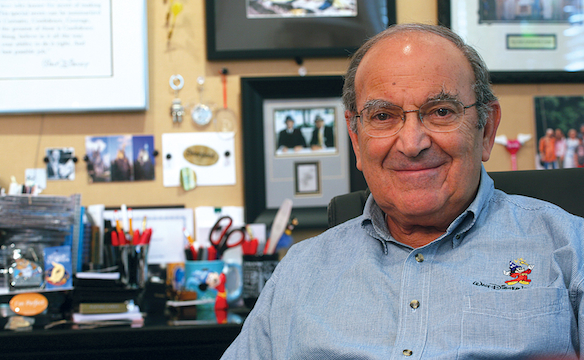
Marty Sklar: Disney legend, mensch

In 2001, Martin (Marty) Sklar, now 79, was officially recognized as a “Disney Legend” — The Walt Disney Co.’s version of the Hall of Fame. In 2009, another exclusive distinction was bestowed on the low-key leader who had for decades guided Walt Disney Imagineering (WDI), the group that designs and constructs Disney’s theme parks and resorts worldwide: On his final day before retiring, Sklar was honored with a window dedicated to him on Disneyland’s Main Street.

Sklar, who is Jewish and grew up in Southern California, recently chatted with the Journal about his years at Disney and about some personal memories of Walt himself — including the widely disseminated rumor that Disney was anti-Semitic.

The story began in the spring of 1955, toward the end of Sklar’s junior year at UCLA, when he applied for a program that sent about a dozen students to India every summer.

“The whole idea was to show America in a different light from the way it was shown in the media,” Sklar said. “So they picked students who were from a variety of religious backgrounds, and two of them were always Jewish. I was in the running, but in the end, I wasn’t chosen.”

Although Sklar was disappointed, he was buoyed when he was tapped to become — for his upcoming senior year — editor-in-chief of the Daily Bruin, then, as now, the campus newspaper.

It was because he was in charge of the Bruin — and because he wasn’t in India — that Sklar got the opportunity that would change his life and set the trajectory of his career.

“It was June 1955,” Sklar said, “a month before Disneyland was set to open. I received a call to come in for an interview at Disney, with the head of marketing. It turns out that they wanted to put out a tabloid newspaper to be sold at Disneyland’s Main Street, so they hired me to do that.

“Finishing every park — since then, I’ve been involved with all of them — is chaos, especially at the end. But Disneyland in Anaheim was the first one, so it was even crazier because it had never been done before. … Here we were, two weeks before Disneyland was scheduled to open, and it was total chaos.

“It was at that time that I was called in to have a meeting with Walt, the Walt Disney, to present my concept for the tabloid. Remember: I was 21; I’d never worked professionally, still a student at UCLA. … I was plainly scared as hell. If it was no good, I was out the door; they’d find some professional to do it.

“But Walt liked what I presented, and that was the start of my 54 years at Disney. … If you have a turning point in life, that was mine.

“I’ll tell you what I learned from that meeting,” Sklar continued. “First, I was shocked that Walt had time for this little thing: a 10-cent tabloid to be sold on Main Street. But, like with everything he did, there was always enormous attention to detail.

“And second, for Walt, Main Street was a real town. And every town, at the early part of the 20th century, had its own newspaper. So Disneyland, at that time, without its own newspaper, was not a complete story. That was what I learned: It’s the details that make the Disney parks work, that attention to detail. And you have to make it a complete story, which means striving to be accurate about whatever story you’re telling, down to the smallest details.”

During his first few years at Disney, still in his 20s, Sklar wrote a film about Epcot, the international-themed park adjacent to Disney World in Orlando, Fla. The film was titled “Experimental Prototype for a Community of Tomorrow.”

“That was probably the most interesting experience I had with Walt,” Sklar said, “because it required me to spend several meetings in his office, just the two of us, and I still have pages of notes from one of those meetings. When I look back on it, I can see that he wrote the script of that film. I put the words on paper, but it was really his thoughts.

“He was so clear — so absolutely crystal-clear — about what he intended. And the big thing, and I have it on about three different pages of my notes, he kept repeating: ‘I want to meet the needs of people. I want to meet the needs of people …’ It just permeates everything that Disney does.”

Putting Sklar’s Disney lessons, lore and anecdotes inside the covers of a book has been one of his projects since his retirement in 2009. And now, the Disney imprint has just released “Dream It! Do It! My Half-Century Creating Disney’s Magic Kingdom.”

Sklar said one reason he wrote the book was to “debunk” many myths about Walt Disney, “including the one that he was supposed to have been anti-Semitic. … I never saw a shred of anti-Semitism in him,” Sklar said.

“I’ll tell you a story. During the High Holy Days, Walt tried to call me, and when I came back, I called his office and said to Tommie Wilck, his secretary, ‘What did Walt tell you when you told him I was celebrating Yom Kippur?’ She said that Walt told her, ‘Well, that’s where he should be, with his family.’

“So it’s a bunch of bull, but you know, I can see where it came from,” Sklar said. “Walt was from the Midwest, he wasn’t used to being around Jews. And then he came out here, [where] most of the people in the entertainment business were Jews, so he was the guy out in the cornfield; he was different, and I think that’s where it came from. It never came from anything he said. Not ever.”

The offices of the Imagineers are located on Disney’s Glendale campus, a nondescript industrial area with no animation-themed architecture or nostalgia-infused sculpture. You can drive through it without even realizing you’re on a Disney campus. In recent years, however, this area has been spiffed up somewhat, although it still consists largely of blocky, single-story warehouses.

The Glendale campus’ bland exterior, however, lies in contrast to the inventive work carried out inside, especially by WDI, which Sklar led for decades and continues to inspire. In a way, Sklar himself is similar to the Glendale campus: He cloaks his (literally) groundbreaking creativity within a self-effacing exterior. When Sklar became a Disney Legend, Roy E. Disney, Walt’s nephew, was quoted in the Los Angeles Times as saying that Sklar “is not interested in getting credit for anything … [yet] he has influenced everything we’ve ever done.”

In “Dream It! Do It!” Sklar writes about his final years at Disney, when he had the job of “ambassador,” teaching and preaching “Mickey’s Commandments,” which included Sklar’s rules for “leadership” and “followership.” Clearly, Sklar learned the first two commandments from Walt himself: “1. Know your audience,” and 2. “Wear your guests’ shoes.”

Occasionally, in these commandments — as if with a sly wink — Sklar’s Jewish roots emerge. For example: “Take time to teach — mentors are mensches.”

Indeed, during his years as Disney ambassador, Sklar expanded Mickey’s Commandments from 10, to 20, to 30, and eventually to 40. In his book — poking fun, perhaps, at his own low-key image — Sklar sends apologies “to God and Moses, who somehow managed to stop at 10.”

When asked about that, Sklar laughed. “Compared to me, Moses was a piker,” he said.

Marty Sklar: Disney legend, mensch Read More »

Two journalists killed in Cairo violence

Two journalists were killed in Cairo on Wednesday as Egyptian forces crushed protests by thousands of supporters of the deposed president, shooting scores of people dead.

Television cameraman Mick Deane, 61, worked for Britain's Sky News. Habiba Ahmed Abd Elaziz, 26, reported for the Dubai-based news weekly Xpress.

Troops opened fire on demonstrators who had staged a sit-in for the past six weeks to demand the reinstatement of the Islamist president, Mohamed Mursi.

Deane was shot as he covered the operation. He had worked for the BSkyB-owned Sky News for 15 years, based in Washington and then Jerusalem. He was married with two sons.

“The loss of a much-loved colleague will be deeply felt across Sky News. Our thoughts and prayers are with his wife and family,” John Ryley, head of Sky News, said in a statement.

Abd Elaziz, an Egyptian, had been on leave when she was shot dead, according to Xpress's sister publication Gulf News.

“It's hard to believe she's gone. She was passionate about her work and had a promising career ahead,” Xpress deputy editor Mazhar Farooqui was quoted as saying.

A Reuters photographer was shot in the foot while covering the violence. Asmaa Waguih was receiving treatment for the bullet wound.

“We have the utmost respect for all the journalists who put themselves in harm's way to bring us the news, video and pictures we see every day. At Reuters, safety is our highest priority and we take every precaution we can to ensure it,” said Stephen Adler, Reuters Editor in Chief.

Editing by Matthew Tostevin; Editing by Kevin Liffey

Two journalists killed in Cairo violence Read More »