fbpx

November 20, 2012

When Reiner met Moses

In the beginning, there was comedy.

“Have you heard the one about two Jewish ladies sitting around in a restaurant, and the waiter comes up and says, ‘Is there anything all right?’” the multi-hyphenate filmmaker Rob Reiner asks the moment we sit down in a glass-enclosed cove adjacent to his private office on Sunset Boulevard. 

Actually, I tell him, I’ve heard the other one, about the two gentiles who meet on the street — one says, ‘How are you?’ The other says, ‘Fine.’ ”

He laughs, in recognition.

Jokes about the Jewish penchant for kvetching are a Reiner favorite. In fact, I first heard the latter joke from Reiner Senior, aka Carl, earlier this year. The like-father-like-son comes as a relief, since I had read that Reiner Junior told Bill Maher he has no religious affiliation. “An un-Jewish Reiner?” I thought. That’s like Madonna without a cone-bra.

When I mention this to Reiner, he responds with a curious mix of what I can only describe as spiritual secularism. 

“I believe we all have a search that we go thorough,” he says. Though he illustrates this in a peculiar way: “I believe Jesus was a man. He was not a God. He was a man, a Jewish man. And if you believe that Jesus was a Jewish man, and that, for whatever reasons — he didn’t know who his father was, he was feeling empty — he went looking to find something, and he went into the wilderness and he came back and he preached ‘love thy neighbor,’ ‘do unto others,’ and the fact that he arrived at those deep philosophical beliefs was because he went through a process of doing the work.”

Reiner equates this with how math teachers require students to “show their work.” And though one could counter that religion, too, encourages responsibility, Reiner camps himself in with a growing number of secularists who see religion as proscriptive and extreme. “Organized religion, generally speaking, has a way of taking away that search, that thought process,” he says. 

Boy, would he have a field day with Talmud.

For the director of Hollywood classics such as “When Harry Met Sally …,” “The Princess Bride,” “A Few Good Men” and “This Is Spinal Tap,” Jewishness courses through the blood and the brain, but not necessarily via the Bible. 

Reiner grew up in an Italian-Jewish neighborhood in the Bronx, where he said he never experienced any kind of anti-Semitism. “Growing up, the show business atmosphere shielded me from a lot of that,” he says. But despite his untroubled childhood, the history of Jewish persecution looms large. His worldview, for example, is largely organized around ideas of self-preservation and survival. And he understands his role as a storyteller as a response to Jewish history.

“Humor is a way of letting your emotions out, of unburdening yourself from the angst that goes on inside of you as a result of having been persecuted,” he says. “And Jewish people have been so burdened for such a long time that it gives birth to great innovation, a desire to succeed, to survive. And because Jews were [exiled from their] homeland, they had to survive by intelligence and wits.”

Despite his distancing from Judaism, almost every value he claims to hold comes — admittedly, even proudly — directly from the Jews. But he finds himself more closely aligned with the ideas that Israeli Prime Minister Benjamin Netanyahu’s father, Benzion, (to say nothing of Adolf Hitler) popularized in his work, in that he sees Jews as a race. “There are traditions and customs that have nothing to do with religion, but have to do with you as a person,” Reiner says. For example: “Jewish people have always stressed education; there is a high level of intellectualism among Jews — look at Freud, Einstein, Salk. When you talk about such a small group of people in the world and to have such a massive impact on society — whether it’s in economics or the arts, medicine, science — it’s extraordinary!”

His unmitigated awe at Jewish exceptionalism prompts me to tell him he sounds like my mother. He is undeterred. “I think it has to do with fighting back, this desire to succeed; because we’ve been persecuted.” 

The cool thing about Reiner is that he’s taken his feelings about Jewish exceptionalism, of chosen-ness, and channeled them into Jewish responsibility. A renowned and respected political activist, he supports causes ranging from early childhood education to the environment to gay rights. Through the nonprofit Parents’ Action for Children, which he co-founded with his wife, Michele, he championed the 1998 ballot measure California Children and Families Initiative, which proposed levying a tax on tobacco to pay for developmental programs for preschool children. Reiner got so many Hollywood heavyweights to support the measure — including Dustin Hoffman, Nicole Kidman, Steven Spielberg and David Geffen — that it prompted the San Francisco Chronicle to quip that the campaign had “more silver screen glitter than Glinda the Good Witch’s magic wand.” The proposition passed.

Another success came in 2003, when he led an effort to save California’s Ahmanson Ranch and Ballona Wetlands from commercial development. The swath of land just west of the San Fernando Valley was a famed movie location, including for the film “Gone With the Wind.” Reiner also lobbied heavily, albeit unsuccessfully, to defeat Proposition 8, the 2008 ballot measure banning same-sex marriage in California. His activism prompted the group California Watch, a subsidiary of the nonpartisan Center for Investigative Reporting, to name him one of the top 100 political donors in California. According to its Web site, Reiner ranked 17th among California’s big givers (just below T. Boone Pickens Jr., the energy and oil magnate from Texas); he gave nearly $3.5 million to political campaigns between 2001 and 2011, at least half of which went exclusively to ballot measures.

“It’s just ingrained,” he says of his activism. “It’s not like I feel I have to do it; it feels like it’s just part of me. I was raised to have a larger sphere of concern for others. It’s in the DNA of being Jewish to feel put upon and to feel burdened, and it’s in our DNA to want to unburden others.”

I ask him if he believes in God.

 “I don’t believe in the religious view of God,” he says. “My personal belief is that all living things are interconnected in some way and that when we die, there is energy, and we all become part of some cosmic consciousness. A cosmic soup!”

Oddly enough, that could also describe his political philosophy, which is more or less about preserving the integrity of all creation. Reiner believes every person should have access to health care and education (“It’s a right, not a privilege”), and that the environment deserves the same stewardship and protection. A staunch Democrat, he explains his party loyalty simply: “The Democrats have always espoused: ‘Everybody gets help.’ ”

Although Hollywood is notably generous with causes, Reiner tends to steep himself in the things he cares about, both financially and physically. “Doing good requires more than just being a celebrity,” he says. “For me it[’s] actually taking on another job.” He counts his father and writer/producer Norman Lear as his role models, both Hollywood icons.

Only at the end of our conversation do I realize I barely asked him anything about the movies. And I read somewhere that he was quoted as saying that no matter what he does in life, he’ll never top being Meathead, the son-in-law in “All in the Family.” Does it annoy him that he could engage in so much other important work, but all anyone wants to talk about are his movies? 

“I love making movies,” he says. “I love entertaining people. You get a lot of pleasure in helping people, but you also get a lot of pleasure in knowing you’ve given somebody pleasure.”

Weeks after we talk, his assistant e-mails to tell me Reiner left town to begin work — as an actor — on Martin Scorsese’s latest film, “The Wolf of Wall Street,” in which he will play a Long Island stockbroker who chooses prison time over cooperating with a securities fraud case. Oh, and his character also happens to be Leonardo DiCaprio’s father. But like Reiner said about the neighborhood where he grew up: “Jews and Italians are almost interchangeable.”

When Reiner met Moses Read More »

The Disability Inclusion Initiative: The sound of the breaking dam

A conference on inclusion of people with disabilities may mark the beginning of a new era in Jewish communal attitudes.

For years, it has fallen to the parents of children with intellectual, physical, learning, social and other disabilities and differences to battle the institutions of the organized Jewish community for “a place at the table” for their children in Jewish day schools, synagogues and summer camps. Almost every parent of a child with a significant disability can tell of the heartbreak of rejection of their children by the community, or, at the very least, the heroic battles that they had to wage to enable their child to lay claim to some component of their Jewish identity. Adults with disabilities can tell stories about the lack of appreciation of the community’s role in allowing them access, physical and social, to the community as it is often mistakenly deemed “too expensive” or put in the back of the line of our community’s priorities. 

But given that fully 20 percent of Americans overall have a disability and that Jews have additional disabilities because of genetic differences and choices to have children later in life, which can lead to autism and Down syndrome, there is an epidemic of Jewish children with disabilities who must be included in our Jewish institutions. Ensuring that Jews with disabilities have a seat at our table is vital not only for recognizing the image of God within each person, but also to Jewish survival. 

Thankfully, the drive for acceptance of people with disabilities from the grass roots is beginning to be complemented by a growing awakening in the Jewish community’s leadership ranks. On Nov. 14, The Jewish Federation of North America hosted Opening Abraham’s Tent: The Disability Inclusion Initiative as an adjunct conference at the conclusion of this year’s General Assembly meeting in Baltimore. The practical program, developed to share “best inclusion practices,” was attended by more than 130 community and lay leaders from across the country and across the religious spectrum. The program was sponsored jointly by The Jewish Federation of North America (JFNA), Jewish Funders Network (JFN), Jewish Foundation for Group Homes and the Mizrahi Family Foundation. The event also welcomed the arrival of an important free online resource book created by the JFN (see Jfunders.org/disabilityguide). 

The keynote speaker was Gov. Jack Markell (D-Del.), chair of the National Governors’ Association (NGA) and who is also active in Jewish life. Each NGA chair picks an issue of the year, and Markell has chosen the issue of helping people with disabilities get jobs, inspiring his fellow governors to bring people with disabilities into the work force by focusing on their abilities rather than their disabilities. At the conference, Markell challenged Federations and other Jewish groups to “walk the walk” and be even more inclusive, not only in whom they serve and which organizations they fund, but also in their professional hiring.

JFNA leadership, including CEO Jerry Silverman, whose hallmark is commitment to full “big tent” Jewish institutions, agreed that ending the shortages of accommodations available at many Jewish institutions for people with disabilities needs to change and that funding decisions need to reflect that commitment. He even agreed that JFNA needs to prioritize the hiring of people with disabilities so that their voices are heard loudly, directly and personally.

Los Angeles is a step ahead of the country in part because of the HaMercaz Jewish special needs collaborative, funded by the Los Angeles Jewish Federation. It is a model of how Jewish organizations can work together to help families impacted by developmental disabilities and other special needs. L.A.’s recent Special Needs Study Mission to Israel was the first group of parents, professionals and young adult stakeholders to visit Israel for the express purpose of visiting innovative young adult vocational and residential programs. Other collaborative efforts, such as the Bet Tzedek Transitions Project, are looking at the new phenomenon of aging adults with developmental disabilities. Los Angeles also has some schools, synagogues and camps that have created either inclusive or self-contained special-needs programs for children, teens and young adults.

Although the need for more programming exists even on America’s “progressive coast,” Elaine Hall from Vista Del Mar and The Miracle Project represented the Los Angeles special-needs community at Opening Abraham’s Tent. She shared the good works of Nes Gadol, Vista’s religious education and Jewish Life programs for families with special needs, and announced receiving a recent grant from L.A.’s Jewish Community Foundation to enhance community inclusion in local synagogues and JCC’s, but she also commented on how L.A. lags in housing and jobs. She said she is hopeful that the new merging of Etta Israel and Ohel will remedy the lack of housing opportunities and that the Shalom Institute’s commitment to creating jobs for young adults with special needs will stimulate Los Angeles in these areas. Hall noted the importance of gatherings such as Opening Abraham’s Tent to provide necessary connections to and collaborations with others so that we each don’t need to “reinvent the wheel.”

Perhaps the moment is arriving when the grass-roots efforts of numerous parents of children and adults with disabilities (all of whom can be exhausted from the personal and financial stress from disabilities) are being reciprocated by efforts of the Jewish community’s leadership. With the impetus coming from above and below, the next few years may witness
a major change in the Jewish community’s embrace and celebration of the contribution that people with disabilities
can make to the future of the Jewish people.

The Disability Inclusion Initiative: The sound of the breaking dam Read More »

Israelis killed, Gaza shakes as Clinton seeks truce

Israeli air strikes shook the Gaza Strip and Gazan rockets struck across the border as U.S. Secretary of State Hillary Clinton held talks in Jerusalem in the early hours of Wednesday, seeking a truce that can hold back Israel's ground troops.

Hamas, the Islamist movement controlling Gaza, and Egypt, whose new, Islamist government is trying to broker a truce, had floated hopes for a ceasefire by late Tuesday; but by the time Clinton met Israeli Prime Minister Benjamin Netanyahu it was clear there would be more argument, and more violence, first.

Hamas leaders in Cairo accused the Jewish state of failing to respond to proposals and said an announcement on holding fire would not come before daylight on Wednesday. Israel Radio quoted an Israeli official saying a truce was held up due to “a last-minute delay in the understandings between Hamas and Israel”.

An initial halt to attacks may, however, not see the sides stand their forces down from battle stations immediately; Clinton, who flies to Cairo to see Egyptian President Mohamed Morsi later on Wednesday, spoke of a deal “in the days ahead”.

As she arrived in Israel after nightfall, Israel was stepping up its bombardment. Artillery shells and missiles fired from naval gunboats offshore slammed into the territory and air strikes came at a frequency of about one every 10 minutes.

After seven days of hostilities that have killed over 130 Palestinians and five Israelis, two of these on Tuesday, both sides are looking for more than a return to the sporadic calm that has prevailed across the blockaded enclave since Israel ended a much bloodier air and ground offensive four years ago.

ELECTION

Netanyahu, who faces an election in two months that he is, for now, favoured to win, told Clinton he wanted a “long-term” solution. Failing that, Netanyahu made clear, he stood ready to step up the military campaign to silence Hamas's rockets.

Hamas for its part is exploring the opportunities that last year's Arab Spring has given it to enjoy favour from the new Islamist governments of states once ruled by U.S. proteges, and from Sunni Gulf powers keen to woo it away from Shi'ite Iran. It has used longer-range missiles, some sent by Tehran, and hopes to eclipse Western-backed Palestinian Authority President Mahmoud Abbas.

Hamas has spoken of an easing of Israel's blockade on the 25-mile slice of Mediterranean coast that is home to 1.7 million people. It may count on some sympathy from Morsi, though Egypt's first freely elected leader, whose Muslim Brotherhood inspired Hamas's founders, has been careful to stick by the 1979 peace deal with Israel struck by Cairo's former military rulers.

Clinton, who broke off from an Asian tour with President Barack Obama and assured Netanyahu of “rock-solid” U.S. support for Israel's security, spoke of seeking a “durable outcome” and of Egypt's “responsibility” for promoting peace.

She repeated international calls for the kind of lasting, negotiated, comprehensive Israeli-Palestinian settlement that has eluded the two peoples for decades – something neither of the two warring parties seems seriously to be anticipating.

“In the days ahead, the United States will work with our partners here in Israel and across the region toward an outcome that bolsters security for the people of Israel, improves conditions for the people of Gaza and moves toward a comprehensive peace for all people of the region,” Clinton said.

“It is essential to de-escalate the situation in Gaza. The rocket attacks from terrorist organisations inside Gaza on Israeli cities and towns must end and a broader calm restored.

“The goal must be a durable outcome that promotes regional stability and advances the security and legitimate aspirations of Israelis and Palestinians alike.”

“SELF-DEFENCE”

Netanyahu, who has appeared in no immediate rush to repeat the invasion of winter 2008-09 in which over 1,400 Palestinians died, said: “If there is a possibility of achieving a long-term solution to this problem with diplomatic means, we prefer that.

“But if not, I'm sure you understand that Israel will have to take whatever action is necessary to defend its people.”

As Israeli aircraft have carried out hundreds of strikes on rocket stores, launchpads and suspected Hamas command posts since assassinating the head of its military wing a week ago, tens of thousands of Israeli soldiers have been preparing tanks and infantry units for a possible invasion.

During the night, explosions again rocked the city of Gaza and other parts of the Strip, while rockets from the enclave, some essentially home-made, others Iranian-designed and smuggled through tunnels from Egypt, landed in southern Israel.

One reached as far as Rishon Lezion, near Tel Aviv, on Tuesday, the latest to jar Israel's metropolis, long untroubled by Hamas attacks. Another rocket fell close to Jerusalem, the holy city claimed by both sides in the conflict.

Medical officials in Gaza said 31 Palestinians were killed on Tuesday. An Israeli soldier and a civilian died when rockets exploded near the Gaza frontier, police and the army said.

Gaza medical officials say 138 people have died in Israeli strikes, mostly civilians, including 34 children. In all, five Israelis have died, including three civilians killed last week.

AMMUNITION STORES

Obama, whose relations with the hawkish Netanyahu have long been strained, has said he wants a diplomatic solution, rather than a possible Israeli ground operation in the densely populated territory, home to 1.7 million Palestinians.

Israel's military on Tuesday targeted more than 130 sites in Gaza, including ammunition stores and the Gaza headquarters of the National Islamic Bank. Israeli police said more than 150 rockets had been fired from Gaza by the evening.

“No country would tolerate rocket attacks against its cities and against its civilians,” Netanyahu said with U.N. Secretary-General Ban Ki-moon, who arrived in Jerusalem from talks in Cairo, at his side. “Israel cannot tolerate such attacks.”

Critics have accused Israel of using disproportionate force that has killed civilians. Israel accuses Hamas of putting Gaza's people in harm's way by siting rockets among them.

Media groups have criticised attacks on Gaza media facilities. On Tuesday, three local journalists died in air strikes on their vehicles.

A building housing AFP's bureau was bombed. The French news agency said its staff were unhurt. Israel's military said it had been targeting a Hamas intelligence centre in the tower.

Hamas executed six Palestinians accused of spying for Israel, who a security source quoted by Hamas Aqsa radio said had been “caught red-handed” with “filming equipment to take footage of positions”. The radio said they had been shot.

Militants on a motorcycle dragged the body of one of the men through the streets.

A delegation of nine Arab ministers, led by the Egyptian foreign minister, visited Gaza in a further signal of heightened Arab solidarity with the Palestinians.

Israelis killed, Gaza shakes as Clinton seeks truce Read More »

Iranian Jews and Muslims unite over Rita

It is not often nowadays that you find Jews and Muslims coming together to celebrate anything — especially when Israel is involved. The recent outbreak of violence in the Middle East makes such a harmonious scenario seem even more of a remote possibility.

Yet this supposed fantasy became reality on Nov. 12, when Michael Oren, Israeli ambassador to the United States, hosted nearly 70 prominent Iranian-American Jews and Muslims at his home in a secluded and upscale neighborhood in Washington, D.C. 

This historic private event recalled the perhaps forgotten centuries-long friendship between the Jewish people and the people of Iran by highlighting not diplomats, but a musical artist who need use only one name: Rita. 

The Iranian-Israeli pop singing superstar Rita Jahanforuz, honored during the event, was offered as the perfect example for Oren’s argument that Israelis have nothing against the people and culture of Iran and only seek to support efforts to oppose an oppressive regime.

Well-known guests — ranging from CNN anchor Wolf Blitzer to former Bush administration Secretary of Homeland Security Michael Chertoff to Iranian-Jewish former Beverly Hills Mayor Jimmy Delshad — listened as Rita energized the room with her singing.

Wearing a long, simple but elegant black dress, Rita sang a few Israeli songs as well as “Shah-Doomad,” or “King of Grooms,” a song popularly sung at Persian weddings. She spoke in Farsi to the cheering guests — and expressed her tremendous pride for her Iranian cultural identity. 

“For me it is amazing to hear your responses in Persian to me about my music. I am just not used to it because my audiences are mostly in Israel,” Rita said. 

Her band played a host of instruments, including a solo performance of the Iranian tar, a three-stringed, long-necked lute-type instrument. In the end, all of the guests — Iranian and American, Muslim and Jewish — joined Rita by singing, dancing and delighting with her. 

Both Oren and guests gave high praise to Rita for acting as a goodwill ambassador from Israel toward the people of Iran. No doubt her latest album, “All My Joys,” sung entirely in Farsi, has served as her best tool for reaching out to fans in Iran. 

Despite Western and all other music being outlawed by the current regime in Iran, thousands of fans there have downloaded Rita’s songs or bought bootleg versions of her CD. Rita mentioned one particular fan from Iran who sent her a recent e-mail stating that he so enjoyed her music that he was “willing to endure 30 years in prison and receive 70 lashes from the current Iranian regime in order to attend one of her concerts in Israel.” Rita also said she is looking forward to the day when she will perform for her fans at live concerts in a free Iran.

The substantial impact of Rita’s message of peace was illustrated by her ability to bring Jews and Muslims together in friendship at Oren’s home. Guests that night chanted her name in unison, demanding that she continue singing even after her performance was completed. Oren even joined the band briefly, playing an Iranian version of the bongo. 

For Iranian Jews, the evening was a reason to be proud. They spoke to one another of how important it was that Oren had honored one of their own at this private gathering, and they felt special that Israel was now officially recognizing the substantial cultural accomplishments of an Iranian Jew. 

For the others in the audience, it stoked curiosity. Many asked about how many Jews of Iranian background live in Israel or the United States, how many Jews still live in Iran, or why Jews have remained in Iran despite the difficult situation for them there.

Rita serves as an ambassador of goodwill from Israel not only because she speaks and sings in Farsi, but because she represents the Iranian segment of Israeli society that embraces its cultural heritage from Iran and would one day like to renew relations with individuals in its former homeland. Her music, and its message of peace, provides a nonpolitical way to counter the Iranian regime’s repeated calls for Israel’s destruction.

Such cultural connections run deep. Even though there are currently high tensions in the Middle East over Iran’s nuclear weapons program, the majority of non-Jewish Iranians living in the United States and Europe, and countless others living in Iran, harbor no ill will toward Israel or the Jewish people. Likewise, countless Jews and Muslims of Iranian heritage living in the United States have maintained strong friendships that predate the 1979 Iranian revolution, because of their common language and the common culture they share. 

Rita, who was born in Iran in 1962 and immigrated with her family to Israel in 1970, represents a segment of the Iranian community in Israel that never witnessed firsthand the Iranian revolution, and yet still feels a strong sense of nostalgia for Iran and Iranian culture. 

The nostalgia Iranian Jews have for Iranian culture also stems from the significant tolerance and prosperity they enjoyed while living under the Pahlavi dynasty for more than 50 years. For nearly 30 years before 1979, Iran and Israel also enjoyed indirect political relations as well as prosperous economic relations under the regime of the late shah of Iran. 

It is perhaps ironic how a Jewish person like Rita is today keeping Iranian music and songs alive with her albums and performances, considering the fact that for centuries many Jews in Iran were musicians who kept the country’s music alive, despite the national Islamic prohibition against Muslims listening to or performing music in Iran. 

And it was refreshing for many guests to see an Israeli official like Oren personally reaching out to non-Jewish Iranians, as well, in order to express the Jewish people’s longstanding friendship with the people of Iran, which dates back to the age of Iran’s first king, Cyrus the Great. 

“We as Israelis and Jews are here tonight to emphasize the fact that there is a 2,500-year friendship with the people of Iran, and despite the animosity that the regime in Iran has for Israel, we look forward to the day when we can renew our friendship in freedom with the people of Iran,” Oren said. 

Perhaps one day soon, an event like the one at Oren’s home will no longer be unique but, rather, commonplace. More important, cultural and music events such as the one recently organized by the Israeli ambassador give many of us living in the free world hope that despite conflicts in the world, Jews and Muslims can come together in harmony and celebrate their commonalities.

To view photos and videos from Rita’s recent performance at the home of Michael Oren, please visit Karmel Melamed’s blog: jewishjournal.com/iranianamericanjews.

Iranian Jews and Muslims unite over Rita Read More »

PartyWorks Interactive Eric Elkaim’s party line

In a world of cutthroat businesses, Eric Elkaim still believes the “more you give, the more you receive.”

As the founder of Los Angeles-based party vendor PartyWorks Interactive, which rents out premium rides, games, entertainment and attractions to companies and individuals hosting special events, Elkaim has put that conviction into practice for nearly 20 years. 

Some of Elkaim’s high-profile clients include Vans Shoes, Virgin Airlines and Six Flags theme parks, as well as venues such as the Rose Bowl and Santa Anita Park. PartyWorks provides inflatable rides, sports courts, stages, live bands, arcade games, rock-climbing walls and much more for everything from corporate parties to conventions to premieres. Ditto for families throwing large-scale bar or bat mitzvahs. 

When PartyWorks isn’t supplying equipment to lavish events, the company is often working pro-bono for organizations that don’t have the resources of PartyWorks’ big-name clients. 

Foothill Unity Center, a Monrovia community organization that distributes food and provides services to very low-income families, is one of the recipients of Elkaim’s generosity. 

Throughout the year, the organization sponsors community events, including a Thanksgiving food distribution, a holiday food drive and a back-to-school drive. Thousands of people attend these events, and PartyWorks helps Foothill Unity make these events fun and exciting for attendees, donating tables, staging, lighting, giant menorahs, oversized chairs for Santa, and dance floors. 

PartyWorks also provides supplies and services that are less flashy, but just as important, such as a bouncer to help with line control as well as air-conditioning units. 

“Money’s not everything, and to seek a smile and give something at no cost, something they can’t afford, is an amazing feeling,” said Elkaim, 49.

Elkaim has been donating party and event supplies to Foothill Unity for more than 15 years and he never asks for compensation, “just because it’s a good cause.” He calls Foothill Unity one of the most important organizations that he assists, but there are many others. 

Elkaim’s PartyWorks began as a single popcorn-making machine. He founded the company in 1989 after years spent as a teenage performer around Los Angeles, working as a magician who incorporated comedy into his act during gigs at the Magic Castle, a nightclub for magicians and magic enthusiasts. Soon the people booking him asked if he could hire another magician to join him. 

Sure, he said. He could do that. 

Soon they were asking if he could bring along a face painter or a clown. Again, he said that he could.

Before he knew it, people were calling Elkaim to book entertainment for their events, including carnival booths and rides. He purchased his first popcorn machine and hasn’t looked back since.

A resident of Glendora, he isn’t your typical corporate head. In many ways, he still behaves like an entertainer. In fact, his professional title at PartyWorks is “director of all things outrageous!” 

True to his roots, Elkaim combines comedy with his professional life. In 2010, when he organized Mitzvahs and More, a bar mitzvah trade show that the Jewish Journal sponsored, he had radio station KLOS 95.5 FM air a humorous and Jewy plug for the event:

“At…the world’s largest bar and bat mitzvah expo, you’ll learn everything you need to know in order to party until you plotz.”

But perhaps more important to him than having fun is developing relationships — not just because these relationships are good business but because they come in handy for giving back to the community. 

Elkaim said he is particularly interested in helping soldiers and children. That is why PartyWorks donates resources to Soldiers’ Angels, which provides aid and comfort to members of the U.S. military, veterans and their families. 

In 2008, Elkaim used his connections in the entertainment industry to bring popular alternative rock band Angels and Airwaves to perform at a party that Soldiers’ Angels threw for wounded American soldiers who were recovering at the Brooke Army Medical Center in San Antonio. And motivated by research that shows that playing guitar can help wounded soldiers suffering from post-traumatic stress disorder improve their memory, he worked with Gibson guitars to provide free instruments to wounded warriors.

Echoes of Hope, which provides assistance to at-risk and emancipated foster youth, is another beneficiary of PartyWorks’ goodwill. Founded by retired Los Angeles Kings hockey player Luc Robitaille, the nonprofit hosts annual celebrity no-limit Texas Hold’em tournaments to raise money and awareness for the plight of the youths it serves. Elkaim happily donates poker tables and other casino supplies to these tournaments. 

Other acts of generosity are more spontaneous. Sometimes, community organizations and nonprofits hosting events call to inquire how much it would cost to rent certain party equipment, and Elkaim simply offers it for free. 

A lot of his desire to be altruistic comes from being Jewish, he said. 

As he has gotten older, he said, “I started to believe in the Jewish way of thinking in giving anonymously. A true giver is somebody who doesn’t give to get their name on stuff as a sponsor. We do it because we want to.”

PartyWorks Interactive Eric Elkaim’s party line Read More »

Richard Sandler: A philanthropic life

In 2007, when philanthropist Stanley Gold was asked to become board chair of The Jewish Federation of Greater Los Angeles, he knew he would need an effective partner to accomplish the reinvention of Federation he envisioned. 
Gold met with Richard Sandler, executive vice president of the Milken Family Foundation, and though the two men had known each other only in passing before, and though Sandler wasn’t yet actively involved in Federation, Gold knew he had his guy. They agreed that the old model of “give because it’s Federation” was dying, that they needed to reinvigorate both its lay and its professional leadership and that Federation needed to find new ways to connect with the community and its donors to say relevant in the 21st century.

And Gold saw in Sandler not only the know-how, but also the steady demeanor to offset his own more strident style. 

“I am more confrontational, and Richard is more collaborative,” said Gold, president and CEO of Shamrock Holdings and Federation chair from 2008 to 2009. “And if you look at our terms together, in the beginning we needed to be confrontational to break the logjam and to turn things around, and in the end we needed collaboration to rebuild.”

Gold, with Sandler as vice chair, shook things up during his tenure — he restructured both how money is collected and how it is allocated and hired a new president and CEO in Jay Sanderson, whom many viewed as an unconventional choice because his success was with Jewish Television Network and not the Federation system. Sandler, who took over as chair in 2010, has expanded and solidified the changes Gold set in motion, but in a thoughtful, vision-driven manner that has earned him a reputation as a leader who is not only supremely effective, but also kind.

Last year, the board voted to amend Federation’s bylaws to allow Sandler to serve two consecutive two-year terms. At 64, Sandler is now about to complete the first year of his second term.

“Richard came in at time when there had been a lot of upheaval,” Sanderson said. “There was a new executive, the board has been pared down from 145 to 45, and a lot of the agencies in the community were angry or felt disconnected from Federation. Just by Richard being in the room, and being in conversation, he helped turn things around.” 

Sanderson said he trusts no one in the Jewish community more than Sandler. 

“I’ve never met anyone like Richard. He’s thoughtful; he can consider all points of view, but when necessary he’s decisive,” Sanderson said. 

Sandler, a native-born Angeleno and attorney, is fit with smile lines set deep into his face. His even drawl, perhaps a hint of his father’s Oklahoma upbringing, gives an air of reliability when he serves as the public face of the organization.

Sanderson asserts that Sandler has made Federation more Jewish, while also affirming its role as an effective force locally and nationally, and upping the institution’s professionalism. He has reached out to young people and begun a deliberate transformation of how Federation connects to its donors and constituents. 

These changes are all in service of Sandler’s overriding mission: To help Jews choose to be Jewish.

Sandler said he is dismayed by how many Jews are opting out of Jewish lives, because he understands the meaningfulness Jewish connection can offer.

“I believe that our value system teaches us responsibility to make this world better, to give back, to do the best you can do while you are here,” Sandler said. “And those are values that come from the Torah, and that is what drives me in doing this job. I believe we have to take those values and teach them to our children, so they can decide who they are and where they are going.” 

He believes Federation is best situated to leverage community resources to create as many pathways as possible to Jewish meaning. When he talks to donors or to constituents, he is not just selling Federation, but his commitment to his passion for the Jewish mission.


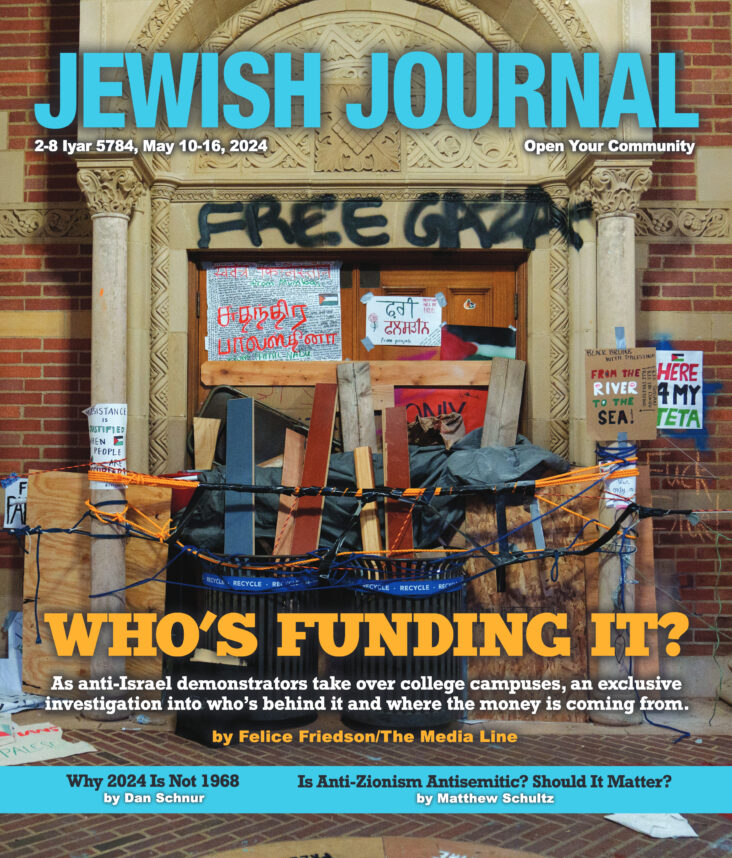
Richard Sandler’s role with the Milken Family Foundation includes visiting Jewish day schools as part of the Jewish Educator Awards. Photo courtesy of Richard Sandler

“It isn’t about Federation is the only way to go; it’s about Jewish continuity is the only way to go,” said Julie Platt, chair of the Federation’s strategic initiative on Ensuring the Jewish Future. “So he is willing to use his leverage and to partner with whoever it is who will move forward his mission to have more people choose Jewish.” 

Sandler spends between 10 and 40 hours a week on Federation business. He lives in Brentwood with Ellen, his wife of 42 years, and the two have dinner together every night. He works out regularly and plays golf on the weekends. He talks to his three children every day, and spends time with his three grandchildren. 

Sandler’s father, Raymond, was the son of Latvian immigrants who came to Oklahoma when his father was 6. 

“My grandfather was a very devout Orthodox Jew who studied every day, but he taught my father that it was more important to live by Jewish values than to follow all the ritual requirements of Judaism, because he felt in the United States you might not be able to do all of that,” said Sandler, the second of four brothers.

Sandler’s parents moved to the San Fernando Valley in 1950, where his father was a founder of Valley Beth Shalom in Encino, which Sandler still attends and where he served as board chair before turning his focus to Federation. His parents were involved in Federation and American Jewish University (then University of Judaism), and Richard Sandler is on the board of that institution as well. 

He also supports the University of California, Berkeley Foundation, the Los Angeles Philharmonic and is a strong backer of Aish HaTorah, an Orthodox outreach organization that he believes is highly effective in bringing Jewish values and inspiration to people previously untouched by Judaism.

Sandler’s mother, Helen, ran a backyard camp for neighborhood kids for years. Among those children were two boys, Lowell and Michael Milken. Lowell and Richard met in first grade at Hesby Street Elementary School, and they continued together through Portola Junior High, Birmingham High School, UC Berkeley and UCLA Law School. 

After partnering with his father in a law firm for 10 years, in 1983 Sandler formed a financial consultancy service that primarily advised Lowell and Michael Milken in their investments. In 1986, Sandler was suddenly thrust into the position of being a white-collar criminal defense attorney when Michael Milken was charged with insider trading and securities fraud. 

Eventually, Michael Milken pleaded guilty, but Sandler said he does not believe he ever committed a federal crime.

“I grew up believing that if our government was investigating something, there must be a good reason for it, and at the end of the day they were seeking truth and fairness and justice. I came to learn that that is not true at all,” Sandler said recently. 

Sandler said he saw young prosecutors who wanted to boost their careers and scared colleagues who gave in to their pressure. 

“A lot of people I knew were put into positions they never thought they would be in in their entire lives — including myself. It was interesting to see those people who just did the right thing and told the truth, and those people who were trying to protect themselves and didn’t necessarily do the right thing.”

Today, Sandler runs day-to-day operations at the Milken Family Foundation, which supports Jewish, medical and educational initiatives. He also sits on the boards of the other nonprofits and for-profits that operate out of the Milkens’ building on Fourth Street in Santa Monica, and he is a partner in Maron and Sandler, a small law firm.

Lowell Milken said he admires his close friend’s integrity and ability to bring people together.

“I always value his guidance. We’ve been through some of the most satisfying and productive times, and we’ve been through some of the most difficult and challenging times, and his loyalty and advice has always been incredibly valuable throughout. When you find yourself in challenging circumstances, he is ultimately the person you would want to stand side-by-side with,” Milken said.

Sandler said his involvement with the investigation helped him develop a levelheaded determination that has served him well at Federation.

“It made me understand what is really important and what loyalty means,” Sandler said. When issues erupt at Federation, Sandler is known for keeping his cool. “I know what real aggravation is, and this isn’t it. These are all people who care about something, and that is a good thing. Then it’s just a question of how do we get people to channel that energy in a positive way.”

Sandler tapped into that equanimity early on in his tenure at Federation, when he made clear to lay leaders that it is the professionals who run the organization, and lay leaders must support that work. 

“In the past, lay leaders would be the driving force, and staff were more administrators than partners,” said Lori Tessel, senior vice president of major gifts at Federation.

Tessel said, Sandler has been “an ambassador” for staff. He often attends working meetings and knows her staff and committee members by name. 

“I don’t think I’ve ever served under someone who has been so clearly appreciative of what I’m doing,” said Platt, a volunteer.

Some lay leaders initially felt shunted by Sandler’s emphasis on professionalism, but Sandler smoothed the transition by responding to every phone call and e-mail and took countless meetings with lay leaders of all levels to explain the changes, according to Sharon Janks, campaign co-chair.

Sandler required lay leaders to bring professionals on fundraising calls — a system Janks says gets more information, and provides more connection, to donors.

“The donor sees that we care enough about their gift, that we want to educate them and make them feel good about what they give to Federation,” Janks said. 

This year the campaign hopes to raise $50 million and is about 75 percent of the way there, she said.

New donors are being cultivated, and long-time donors are being turned on to whole new areas of activity to invest in. It’s all part of Sandler’s approach of building a connection that goes beyond the once-a-year solicitation.

“Because, at the end of the day, this is an awesome responsibility. If the Federation is as important as I say it is — and I believe it is — and if we’re bringing in more than $40 million in community money, we’re responsible for that. That is a lot of responsibility. But it’s a good responsibility.”

Richard Sandler: A philanthropic life Read More »

Joe Sherwood: Honoring good police work

It started with the morning paper. Every day, when Joe Sherwood read the news, he was struck by an imbalance he saw in law-enforcement reporting. 

“Anytime there was a bad cop, it would be front-page news,” recalled Sherwood, 95. “They never talked about all the good police work they were doing. I said to my wife one day, ‘Gee, there must be a bunch of good guys out there, too, and we could really do something if we give an award to the ones who fight hate crimes.’ ”

So the Sherwood family partnered with the Anti-Defamation League (ADL) and in 1996 launched the Helene and Joseph Sherwood Prize for Combating Hate. The award is presented annually to a handful of law enforcement personnel who have gone “above and beyond the call of duty” to fight bigotry and racially motivated violence, said Howard Sherwood, Joe’s son. 

It’s a collaboration that reinforces ADL’s already strong relationship with Southern California’s crime-fighting agencies while shining a spotlight on “the folks in the trenches — cops on the street, prosecutors in the courtroom — who do something extraordinary,” added Amanda Susskind, ADL’s Pacific Southwest regional director. “We think it’s very important for people to hear the positive news about our law enforcement partners. They are heroes among us who go unrecognized every day.”

For Joe Sherwood, the prize is just one highlight in a lengthy résumé of giving that spans much of his near-century of life — and that acts as a bonding agent among four generations of his family.

“I’ve always believed in philanthropy,” said Joe, who established the Sherwood Family Foundation, a charitable fund, with his late wife, Helene. “We want the next generations to understand how important charity is.”

In a bright office at the Culver City headquarters of his family’s business, Daniel’s Jewelers, Joe and his sons, Howard and Larry Sherwood, reflect on a legacy of generosity that his great-grandchildren are now starting to emulate. Tall, with tufts of white hair over his ears, Joe smiles when he recounts the places where his family has contributed: A Place Called Home, a youth safe-haven in South Los Angeles; the Children’s Defense Fund; UNICEF; Jewish Family Service of Los Angeles; The Jewish Federation of Greater Los Angeles; and, of course, ADL.

“My grandfather is truly remarkable. He is very conscious of the value of a dollar,” said Laurie Bahar, Howard’s daughter and Joe’s granddaughter, who is president of the Sherwood Family Foundation. “My grandparents always instilled in all of us, from early on, the importance of generosity and sharing with the community. They inspired me to follow in their footsteps in every way.”

Born in Denver in 1917, Joe moved with his family to Los Angeles early in his life, and he attended Fairfax High School amid the Great Depression. “Nobody had any money in those days,” he recalled. “A nickel was important.”

His father, who’d gone into the jewelry business, died while Joe was still a teenager — but not before influencing Joe’s career path. Joe was hired at a jewelry company downtown and sold jewelry and watches for 17 years. 

In 1954, he bought a bankrupt jewelry store in Bell Gardens. The area was home to poor migrant workers who had come to California to escape the Dust Bowl in the 1930s. Nearby bean fields offered a source of employment. “They used to come in without a shirt on, with no shoes on,” Joe recalled. “Anytime anybody asked me for anything, I just believed in giving, in helping other people. I’d never turn anybody down.”

Joe and Helene let customers buy goods on credit and befriended the locals. Word got around that they dealt fairly with clients, and the business flourished. As their company grew, so did the Sherwoods’ charitable donations. “Between the two of us, anytime we could give something, we would do it,” Joe recalled.

Daniel’s Jewelers now has 61 locations in Southern California. Larry’s son, David Sherwood, is the company’s CEO. 

Joe still goes to the office at least once a week. And although his hearing is declining (he jokes that his favorite word is “what?”), his passion for philanthropy hasn’t dimmed.

“He finds a cause, or he finds someone in need, and he finds a place where he thinks his contribution could make a difference,” said Howard, a member of ADL’s national advisory committee. “He has always talked about how important it is to be there for others.”

With the Sherwood Prize, Joe hopes to show law enforcement officers that the larger community is there for them. Except for a hiatus from 2000 to 2003, the prize has been awarded annually for 17 years. Next year’s honors will be given at the Skirball Cultural Center on March 12, which happens to be Joe’s 96th birthday.

Each year, officers from San Diego to San Luis Obispo are nominated. Four to six prize winners are selected by a panel consisting of local police chiefs, sheriffs and other law-enforcement officials, along with members of the Sherwood family. Honorees receive a plaque and a decorative medal at a celebratory luncheon among their families and peers. 

Past prize winners include a detective who created an educational course on radical Islam, a deputy sheriff who brought together African American and Latino residents to ease racial tensions in Compton, a police sergeant who advocated for the LGBT community at UCLA, and several multi-agency task forces that have investigated and prosecuted some of the region’s most notorious gangs.

The prize “has created an avenue for law enforcement officers who are committed to improving human relations to be honored for their dedication to making a difference in their communities,” said Long Beach Chief of Police Jim McDonnell, who sits on the prize selection panel and also serves as chair of the ADL’s law enforcement advisory board. 

The ADL, which runs hate-crime training sessions with thousands of law enforcement personnel each year, appreciates the Sherwoods’ initiative, Susskind said. “Joe doesn’t want his name on a building; he just wants others to follow his example,” she said. “He is one in a million, and we’re all extremely grateful.”

He is already a role model for his great-grandchildren. Ethan Bahar, 15, has taken part in student council since fourth grade and tutors with KOREH LA. “A lot of that comes from seeing him be a leader,” he said.

For his part, Joe doesn’t like to laud his own achievements. He prefers to talk about those of Sherwood Prize honorees.

“The great reward for me, in giving these prizes, is the opportunity to meet so many good guys. They have done so much for their communities — not for recognition. They just do the right thing at the right time. Just to shake hands with them and say thank you is so important to me,” he said. 

“If God said to me, ‘What did you ever do,’ I might say this is the thing I’m most proud of: We rewarded people who went out of their way to do good for other people.”

Joe Sherwood: Honoring good police work Read More »

Rallies across U.S. supporting Israel’s right to defend itself

Israel solidarity rallies are scheduled for New York and venues across the United States.

Meanwhile, on Sunday in Los Angeles, some 1,400 demonstrators voiced their support for Israel's right to defend itself and its ramped-up operation against escalated rocket attacks on its South from the Gaza Strip.

In New York, hundreds of pro-Israel demonstrators are expected to rally across from the Israeli Consulate in downtown Manhattan on Tuesday afternoon in an event sponsored by Jewish organizations from across the political spectrum.

Also in New York, in suburban Westchester County, a rally was scheduled for Tuesday evening at Temple Israel Center in White Plains. U.S. Reps. Nita Lowey, Nan Hayworth and Eliot Engel are scheduled to attend.

Other rallies were scheduled Tuesday in Atlanta, Chicago, Denver, Seattle and West Hartford, Conn.

At the Los Angeles rally, the demonstrators gathered outside the Westwood Federal Building in West Los Angeles to voice their support for Israel at a rally organized by pro-Israel organizations StandWithUs, the Israeli-Leadership Council and the Zionist Organization of America-Western Region.

“We are here to protest the necessity of peace, the danger of those who would seek to destroy us and our determination to live both in strength and with justice and with peace,” Rabbi David Wolpe of Sinai Temple told the crowd.

Some 100 pro-Palestinian counter-demonstrators carried signs that read “Let Gaza Live: Free Palestine,” “Stop U.S. Aid to Israel,” and “It’s not a war. In Palestine, it’s genocide.”

In Boston, some 1,000 pro-Israel demonstrators rallied Monday night in an event organized by synagogues, schools and Jewish nonprofit organizations, including the Combined Jewish Philanthropies, the Jewish Community Relations Council of Greater Boston, J Street, the Anti-Defamation League and AIPAC.

The Boston rally “is a statement to our sisters and brothers and cousins in Israel that we’re supportive and we feel your pain,” Rabbi David Lerner of Temple Emunah in Lexington, Mass., told The Jerusalem Post.

Meanwhile, lay and professional leaders from The Jewish Federations of North America arrived in Israel on Nov. 18 for a two-day emergency solidarity mission.

The leaders from New York, Chicago, Boston, New Jersey, Cleveland, Miami, Los Angeles, Washington, Minneapolis and Birmingham, Ala., visited southern Israeli cities under fire, including Ashkelon, Sderot and Beersheva, offering solidarity with the residents and examining areas of need.

“The ongoing crisis being faced by the people of Israel, particularly those in the South, will not be fought by the Jewish state alone,” Michael Siegal, JFNA's incoming chair, said upon arriving in Jerusalem. “We are here to express our firm solidarity and to say that as always, when Israel is in need, we are here.”

The JNFA already has committed $5 million in assistance to the Jewish Agency's Israel Terror Relief Fund for the immediate needs of the people living under fire.

Organizations representing Orthodox Judaism — the Rabbinical Council of America, the Orthodox Union and the National Council of Young Israel — on Monday called on “all Jews to increase their Torah study as spiritual support and merit for those Israeli soldiers and civilians on the front line of battle.”

The RCA instructed its members to hold special classes and lectures in their communities on Wednesday and Thursday “dedicated to the support of the IDF and the State of Israel.”

“In the merit of our increased study of Torah, may we merit the promise recorded in the Talmud, Sotah 21a, that the study of Torah protects and rescues those who engage in it,” said a statement from the three organizations.

Rallies across U.S. supporting Israel’s right to defend itself Read More »

Seven days into Pillar of Defence- which news websites tell you the truth?

It's been seven days now since operation Pillar of Defense got the green light. For seven days, missiles have been fired at both Israel and Gaza, and people have been suffering from both physical and mental injuries. Honestly, nothing's really changed in the last seven days. The IDF is still trying to target terrorists, and Hamas is still firing on schools and residential areas while operating within civilian areas so that they could make it seem as if Israel is targeting civilians as well. Palestinians and Israelis are still under fire, and the IDF still battles terrorism. True, every day that goes by, more houses are being destroyed, more schools are being hit and more people get hurt. But all in all, there hasn't been a significant change in the situation. On the second day of the operation“> article summarized the operation, presenting interviews with Palestinians and love reports from the reporter in Gaza, as opposed to quotes from Israeli officials. Now you tell me: if you read a description of a wrecked Gaza and of  “children pulled from the rubble after one airstrike in Gaza”, brought to you by a professional reporter who witnesses it all first handwho’s side would you be on?. This reporter later interviews innocent Palestinian civilians who say how impossible life is under IDF attacks. After all of this, you read a quote by an Israeli official saying that one million Israelis are under attack. No quotes from Israeli civilians and certainly no description of what their life is like under Hamas rockets. When reading an article like that, which you believe is balanced, because is it what it claims to be, what is the image that will come to mind? Where would your sympathy go? I am not saying Palestinians don't suffer from this operation. I know they do and I think people should know and acknolwledge that. But this is NOT a war between the Israeli military and Palestinian civilians. In this story, there are two armies and two groups of innocent civilians. Both sides are being hurt. CNN failed to present that destruction is happening on both sides, that the IDF constantly warns Palestinians of upcoming attacks and that the Hamas couldn't care less.


Later, the very same CNN shows a “>photo album named: “Israel, Palestinians in deadly clashes.”  This photo album presents images of wounded Palestinians (mainly small children, of course), and of Israeli missiles hitting buildings in Gaza. It shows Palestinians cry for help, holding infants, and Palestinians being rescued from rubble. Few images show Palestinian youth throwing rocks at Israeli soldiers and Israelis running for shelter with smiles on their faces. More photos of Israel are of the Iron Dome system successfully defending Israel. Now you tell me, what would you think if you had no idea what is going on, and you'd look at this photo album? On the Palestinian side- pain, tears, and stones as the only weapon against the strong Israeli army (no Hamas terrorists in the pictures, by the way). On the Israeli side- strong defense and confidence.


I'll be the first to admit- there are more Palestinian casualties than Israeli ones. This is due to Hamas' hiding places along with Israel's sophisticated defense system. However, this does not mean that Iron Dome is successful in blocking every single missile fired to Israel. Just yesterday, a school was directly hit by one of Hamas' rockets. People in Israel are living in terror. Children spend their days hiding from missiles instead of playing Hide and Seek, and running in fright to the sound of alarms instead of playing Tag. No children should have this kind of childhood and the world should be made aware of it. Israel is not immune. Rockets are not being fired back automatically when reaching city centers and schools in Israel. For some reason, CBS sure makes it look that way.


Like everyone else, NBC also couldn't resist reporting on the rise of the death toll in Gaza. As I mentioned before- this is a juicy story. Death attracts more readers than life in fear. However, I must say that NBC's report is rather balanced. One of the Seven days into Pillar of Defence- which news websites tell you the truth? Read More »

Hamas winning? Wish I knew

There's a chance that a cease-fire will soon be agreed upon by Israel and Hamas. But before you do like everyone else and jump to conclusions as to who's winning and who's losing in this round of violence – consider the following paragraphs from the story I wrote for the Jewish Journal's print edition:

Israelis got a glimpse last week of the damage Hamas can inflict on Israel. Its citizens discovered that Tel Aviv and Jerusalem are indeed within the reach of its rockets. That Hamas' threats are no joke. But they still don’t know why it all began. What was the calculus behind Hamas’ decision to allow and abet this growing harassment of Israeli civilians? What was the logic behind it – assuming there is some such logic? What was Hamas trying to achieve?

Not quite knowing what Hamas was trying to achieve is a problem for all those trying to asses Hamas’ ability to actually meet its goals. Of course, it is possible that Hamas was just miscalculating its way into this week of skirmishes; it is possible that its leaders did not quite understand that Israel is reaching boiling point. However, there are also other possibilities to be considered. Maybe Hamas needed the fight. Maybe it needed to reassert its presence as a player who can make things complicated for all parties a moment before the Palestinian Authority, headed by Mahmoud Abbas, was going to the UN to get the coveted seat of an almost-official member. Maybe it was trying to send a message to a disappointing Egyptian government that hadn’t yet proven to be the ally that Hamas expected it to be.

Hamas winning? Wish I knew Read More »