fbpx

September 2, 1999

Lessons From ‘My Jewtor’

We’re about the same age and, from a distance, it almost looks like we could be sisters. But that’s where the similarities end between Melissa and me.

Melissa is what I call “My Jewtor,” a woman assigned to me by a local rabbi to tutor me about Judaism. For months now, I’ve been showing up at her apartment to sit at her kitchen table, and in the parlance of the Orthodox, “learn together” — although I sometimes wonder if she has much to learn from me.

“What would you like to talk about?” she asked me in our first phone conversation, her small voice barely audible. Some devious part of me wanted to play “Stump the Jewtor.”

“Life. What’s it all about?” I asked.

“Sure,” she replied. “No problem.”

No problem? I had a good feeling about her right from the start. This is the kind of stuff religious people traffic in every day, I thought. They can discuss the meaning of life the way we secular types can talk about the weather. No problem.

During our first meeting, we dove right into the big questions: why we’re here, how to know if God exists, how to live, why bad things happen to good people, the purpose of pain. My head felt like it was going to explode.

Being Jewish is an important part of my identity, but observing Jewish laws is peripheral to my life. For Melissa, it is her core. She wears a sheitl, covers every part of her body, prays over everything from waking up to eating and spends most of her free time either teaching or learning all things Jewish. She wouldn’t dream of going out dancing, doesn’t see the point of most movies and doesn’t even own a television set.

My Jewtor is consumed with how to be a better person and how to improve her relationship with God. I’m not sure I believe in God at all, a fact that made the blood drain from her face and tears well up in her eyes when I told her.

The only time Melissa looked more upset was when I told her that I was dating a non-Jew.

“How do you feel about that?” she asked, as though I had just told her my dog died.

“Fine,” I replied.

“We’ll talk about that next time,” she said. We never did.

There are certainly times when I’ve felt judged by my Jewtor. Though she has never said as much, I know she disapproves of many of the things I do. Still, I go back. Busy, tired, over-scheduled, I drag myself to her apartment and struggle over everything from the difference between the Mishnah and the Talmud to the philosophy behind family purity laws and the concept of Shabbat.

On Purim, I was dashing out the door late for work when she called and asked if she could stop by. She couldn’t have been more out of place in my ramshackle neighborhood, gingerly approaching my door in her perfectly tailored suit, black flats and simple gold earrings. She handed me a basket of food, as is the Purim custom, she explained, and drove off.

My co-workers were confounded by the little straw basket on my desk that day, filled with home-baked zucchini bread, rice and vegetables, fruit and even bottled water wrapped in foil.

“It’s from my Jewtor,” I explained. “It’s a Purim thing. You’re supposed to give a basket containing at least two different kinds of foods to someone.”

“I wish I had a Jewtor,” they sighed.

The idea that someone would be so generous and want nothing in return touched me and haunted me and confused me. I keep that straw basket on my desk to this day. When I asked why there were more than two types of food in my gift, Melissa replied that there’s a law in Judaism not only to follow the rules but to do more whenever possible.

Just after Purim, a guy asked if I could give him a jump, standing frustrated by his broken-down car. I had just enough time to grab my coffee and get to work, so I declined. The guilt got to me while I waited in line, and I turned around and went back to help the man. The incredibly minor good deed stayed with me longer than a latte buzz. It’s a facile point, but it feels good to do good. Melissa reminds me of that.

She also reminds me that there’s more than one way to succeed in life, which is nice when you feel like a big failure. Career success is so secondary in Melissa’s world, and some days that’s a nice paradigm to brush up against. All that matters to her is how closely we can follow divine teachings.

I spend a lot of time wondering who’s happier — Melissa, with her long-sleeved sweaters on hot days and her intricate, time-consuming laws to follow, or me, with my freedom and accompanying ever-present questions about what this is all for.

I don’t know. I just know that there’s more than one way to be a good person, more than one way to be a good Jew and only one thing to do when a guy needs a jump.


Teresa Strasser is a twentysomething contributing writer for The Jewish Journal.

Lessons From ‘My Jewtor’ Read More »

Relief Is in Sight

A middle-aged man climbed up to the cabin of a crane and drew the operator’s attention to a small suitcase on top of a pile of rubble left by last month’s killer earthquake in Turkey.

“Can you get it for me?” he pleaded. “Please, it’s very important.”

The huge arm of the crane pulled it out of the ruins with perfect precision. The man, Aydin Yilmaz, in his early 50s, opened the suitcase, pulled out a photo album, pointed at the pictures and said: “That’s my family. They are all there, underneath.”

He pointed quietly at the huge pile of rubble that had buried his wife and two children.

Stories like Yilmaz’s are commonplace in Adapazari, a town east of Istanbul and one of the six areas hardest hit by the earthquake that killed an estimated 14,000 people.

Now, with winter approaching, the focus is on making sure that international support, including aid from Israel and Jewish communities worldwide, reaches the estimated 600,000 people left homeless.

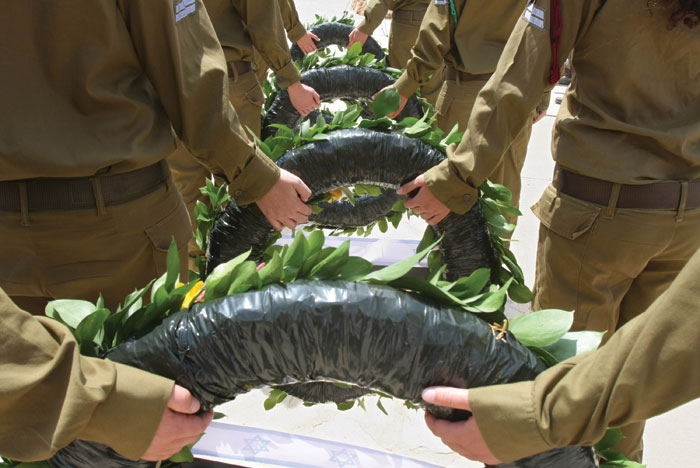
The Israel Defense Force has deployed a field hospital at the entrance to Adapazari. A number of tents supply the local population with advanced medical equipment, including X-ray facilities, laboratories and children’s and orthopedic wards. Israeli surgeons conducted emergency operations — and one baby delivery — in the rooms of an adjacent government office.

In addition, Israel has sent Turkey about 1,000 tons of agricultural products, frozen vegetables, water, milk and new and used clothing, all of which had been collected in Israel.

The Israeli relief delegation numbered some 500 rescuers, medical staff and other experts, including the IDF’s elite rescue unit, which had gained experience in rescue operations in Lebanon and places of natural disaster in many parts of the world.

Relief Is in Sight Read More »

Hitler’s Olympics

The 1936 Olympics were grand spectacles both as sports and propaganda events, whose political ramifications are given full exposure in a striking exhibit, organized by the U.S. Holocaust Memorial Museum, at San Diego’s Hall of Champions.

The games were awarded to a then-democratic Germany in 1931, but after Adolf Hitler came to power two years later, he turned the Berlin Olympics into a showpiece of Nazi discipline and Aryan prowess.

As an 11-year-old sports nut, I managed to sneak into the Olympic stadium, and still ringing in my ears are the chants by German fans (whatever the official master race party line) of “Jesse Owens, Jesse Owens, Jesse Owens, U.S.A,” hailing the great black sprinter.

But the athletic competitions are only a minor part of the exhibit, which puts the “Nazi Olympics” into the context of its time, both the immediate past and the horrifying future.

In the United States, a vigorous debate raged between those advocating a boycott of the games, led by Irish Judge Jeremiah Mahoney, and those insisting on American participation. The latter faction was led by Avery Brundage, head of the American Olympic Committee, who viewed the boycott as a “Jewish-Communist conspiracy.”

Hitler’s Olympics Read More »

Valley Torah Breaks New Ground

Valley Torah High School, the only Jewish high school located in the San Fernando Valley, is getting a new home. Faculty, staff and students along with their families gathered Aug. 29 to celebrate the ground-breaking for the new boy’s division on Chandler Boulevard, which organizers hope will be open to receive students in February 2000.

At the Sunday morning ceremony, school leaders thanked those who made the new school possible, including the Jewish Community Foundation, which provided a $40,000 grant. Organizers expect the final cost of gutting and rebuilding the new property for the boy’s division and renovations on the old property for the girl’s division to reach $3.5 million.

The school project began about three years ago when it became clear the flourishing Jewish student community would soon outgrow its present facilities, a boys’ school at 12003 Riverside Drive and a girls’ school that has been held on property owned by Temple Beth Hillel, a Reform congregation in Valley Village. Enrollment at VTHS stands at 110 girls and 130 boys, with about 30 new students expected to be added to each division for the coming school year.

Students at Valley Torah learn both secular and religious subjects. Many graduates of the boy’s school spend a year of yeshivah study in Israel before going on to Ivy League schools or local colleges.

“We’ve had graduates of Harvard, Yale, UCLA and USC,” Valley Torah president Cary Samuels said.

The new boys’ division will include six classrooms, biology and chemistry laboratories, a computer lab, three libraries, a beis midrash and a dining hall. The girls’ division, which will move to the old boys’ school, will receive extensive renovations “to make it a nicer, more genteel place for the girls,” Samuels said.

Student Alia Kay, 16, said she hopes that will include a gymnasium.

“Maybe we’ll get our own basketball court,” the young athlete said.

Kay transferred last year to Valley Torah from a yeshivah in the city.

“At Valley Torah, it feels like much more of a family environment,” she said. “The teachers really care about you and the education is great.”

While some teen-agers travel from the city or even further to attend Valley Torah, the majority come from the growing North Hollywood Orthodox community, most notably from Emek Hebrew Academy.

“This event is important because until now, the school has been somewhat hidden,” said Rabbi Aron Tendler of Shaarey Zedek Congregation, located just up the street from the new site. “Now we will have a prominent edifice to broadcast the study of Torah, the importance of Torah. This should become truly the focal point of our community.”

Valley Torah Breaks New Ground Read More »