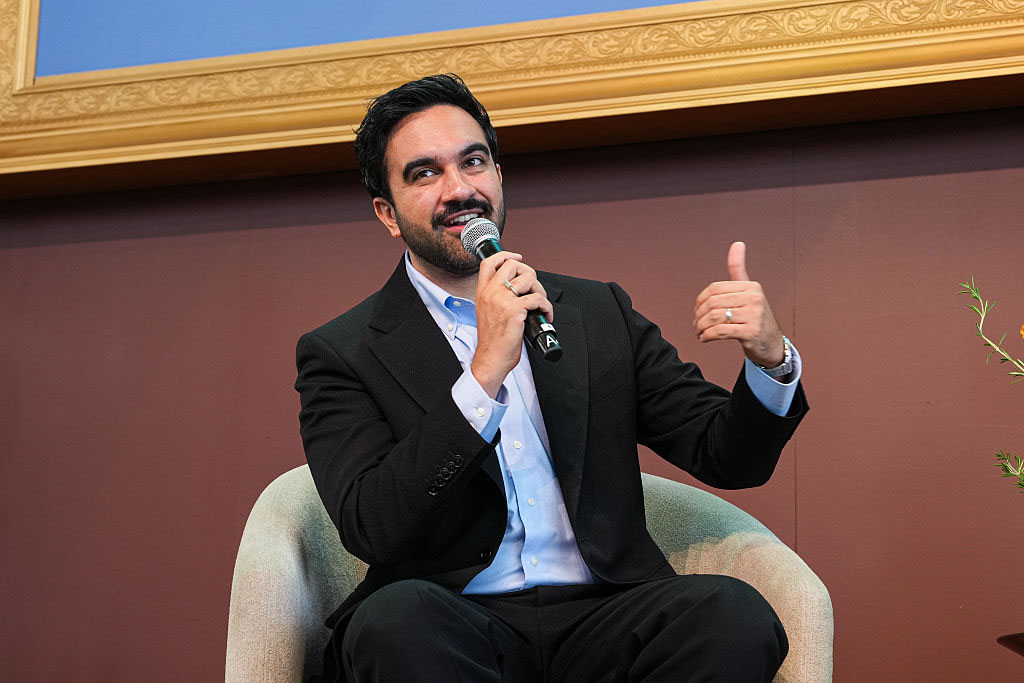
Avi Avital plays the mandolin sitting center stage in a hard-back chair. He curls into himself, his face turned downward, and nestles the small stringed instrument on his lap. His intense concentration draws a listener in, whether he’s performing a piece composed by mandolin virtuoso Yasuo Kuwahara or by Israeli composer Avner Dorman.
Avital received a 2010 Grammy nomination for his recording of Dorman’s haunting “Mandolin Concerto” for solo mandolin and string orchestra in the category of best solo performance with orchestra. He will be performing, along with two other young Israeli virtuosos — violinist Asi Matathias and pianist Victor Stanislavsky — on May 22 at the Beverly Wilshire Hotel. The concert and reception are part of a fundraising event for the America-Israel Cultural Foundation (AICF).
Avital, 32, said he approached many institutions and organizations when he was starting out, asking —unsuccessfully — for help to further his education and build a career. Then he went to the America-Israel Cultural Foundation. “I said, ‘Hi, I’m Avi. I play the mandolin. Can you help me?’ And they said, ‘Sure.’ ”
The organization offered him a grant, allowing him to study in Italy, enter international competitions and buy instruments.
“That opened a lot of doors for me,” Avital said, speaking by phone from Berlin, where he is living now. “The AICF is essential for every Israeli musician. There’s probably not one Israeli musician who was not part of the AICF family at some stage of their musical lives.”
Now the organization is helping Avital release an all-Bach CD, already recorded, that includes two of the composer’s harpsichord concertos, arranged for mandolin by Avital.
David Homan, executive director of the AICF, called Avital extremely charismatic. “He’s a rock star of the mandolin,” Homan said. “He’s on tour at least half the year and makes a full living as a performing mandolin player. Because of Avi, the mandolin is beginning to be seen as a valid solo instrument.”
Homan, also 32, proudly reeled off a list of some of the esteemed artists the AICF has supported — Daniel Barenboim, Itzhak Perlman, Pinchas Zukerman, and Gil and Orli Shaham, along with younger Israeli performers like violinist Matathias and pianists Inon Barnatan, Benjamin Hochman, Shai Wosner and Stanislavsky. And that’s just the short list.
“Among the younger generation, these pianists are in line to become the next Joseph Kalichstein or Yefim Bronfman,” Homan said. “Ask any member of the Israel Philharmonic or ask Yefim Bronfman: What was the most influential thing that happened in your career when you were growing up? The AICF is the answer every time for every major Israeli classical musician. It isn’t, ‘Here are five of the top 20 pianists.’ It’s 20 of 20.”
Avital’s “romance with the mandolin,” as he put it, began at age 7 in Be’er Sheva. His parents, who immigrated to Israel from Morocco in the 1960s, were not musicians. But music, he said, was always present in the house, and there was singing in synagogue on Friday nights.
There was also a mandolin youth orchestra, and, at the local music academy, Avital was taught by a world-class violinist who had just emigrated from a Soviet-bloc country. “There was no job for a violinist,” Avital said, “so he was asked if he could teach the mandolin. Because the mandolin is tuned like a violin, he began to teach it, but with a violinist’s mentality. It was kind of strange. We played the great violin repertoire with him, including Bach’s ‘Chaconne.’ ”
Despite the youth orchestra, Avital said he felt isolated from the mandolin world in Be’er Sheva. “I was 7, and I couldn’t just go on YouTube and find out how other people played the mandolin. My reality was the mandolin orchestra. Luckily, it was a very high level, but when I arrived in Italy, everybody played Vivaldi concertos.”
Avital said his unusual training has had advantages and disadvantages.
“On the one hand, I had to catch up with all the traditional repertoire and original pieces from the Baroque era,” he said. “On the other, my advantage was that I never saw the mandolin as a limited instrument.”
Audiences are often surprised after his concerts, he said. “Usually, when they hear the word ‘mandolin,’ they don’t know what to imagine. Some remember a grandfather playing in an orchestra, or hearing an amateur perform folk songs from Italy. But it’s refreshing when you hear a mandolin playing classical music. The sound is so sweet and familiar, yet new to the ears. It has the right combination, and it’s why people immediately connect to it.”
For his part, Avital connects deeply to the universal qualities of Bach’s music. “Whether you play his work on organ, piano, harpsichord, accordion or mandolin, you instantly recognize that this is Bach, and it’s always touching. It goes beyond the instrument. That’s why I’ve been playing him my entire career.”
But, he said, he quickly realized that arranging Bach for mandolin isn’t enough to build a big career, and that the repertoire for new mandolin pieces is still relatively small. So at least once a year, he commissions a new work for his instrument.
“I came to the conclusion I have to create new repertoire that responds to the development the mandolin has made in the last 300 years,” Avital said, “and that brings the most out of the instrument and myself as musician and performer. Dorman did that, so that’s why the piece got all this amazing recognition and success.”
Although based in Berlin, Avital maintains his ties to Israel. “I just played in Lucerne with the Israel Camerata,” he said. “All the rehearsals were in Israel. It was a good excuse to go back.”
Rick Schultz writes about music for the Los Angeles Times and other publications.