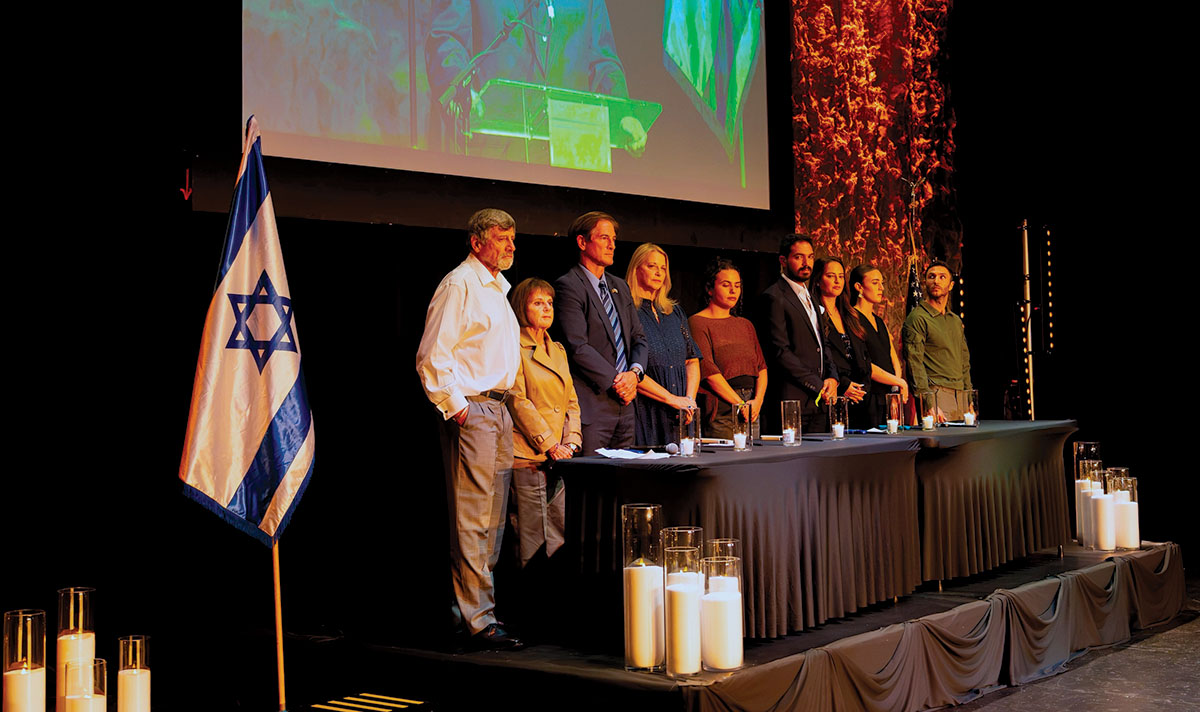
“I’m a nonprofessional dreamer,” said singer/composer/producer Craig Taubman, who is in the midst of staging his sixth annual “Let My People Sing,” a 24-hour festival taking place March 11 and 12 at Sinai Temple in West Los Angeles. The event features Jewish performers from around the world and includes music, dance, food and a host of activities.
“‘Let My People Sing’ sprang from a dream six years ago,” Taubman explained. “Six months before Passover, when I came up with an idea — what better way to celebrate the holiday than with music, dance and art, from a variety of different cultures? — I brought the idea to Rabbi David Wolpe, who said, ‘Let’s go for it,’ and the festival was born.”
This year’s celebration is called “Ashkenafard,” symbolizing the diverse cultural strains that make up the worldwide Jewish community, Taubman said. “The idea behind this festival is to say, ‘What’s the best of the [Persian] community? What’s the best of the Israeli community? What’s the best of the Ashkenazi community and the older as well as the younger community? Let’s put it all in one big tent, in one place, and celebrate the best that we all have to offer each other.’ ”
Taubman’s aim is exemplified by a highlight of the festival, the Charoset Cook-off, part of the activity dubbed Oneg Ashkenafard. “Each culture makes charoset differently because of where the people were born,” he said. “There’s Israeli charoset; there’s Yemenite charoset; there’s American charoset, there’s Manischewitz, and on and on. We’re going to have the Charoset Cook-off, for which Whole Foods donated a ton of nuts and berries and wine, apples, etc. Kids and parents have the opportunity to make charoset, and then the rabbi’s going to test it and decide which charoset is the winner.”
To carry the underlying concept of unity amid diversity even further, the slogan for the event is “reuniting the Diaspora,” referring to the dispersal of the Jews among various lands after the destruction of the Temple.
“Maybe it’s time we got back together. Two thousand years ago, we were dispersed from one central location. Some of our people went to Eastern Europe, some went to Western Europe, some stayed in the Middle East and they went on to become either Persians or Israelis. Two hundred fifty years ago, they became Americans. Some lived in France, some in Germany. Each culture has something unique that it gave to the Jewish people, and the Jewish people gave something back to that culture,” Taubman said.
“This particular festival is saying, ‘Let’s celebrate what we all share, the unique thing that we have in our tradition that we got from our birth country, but we’re now in America, and let’s celebrate that,’ ” he added.
“We have the Israeli tradition and the Persian-Farsi community. … We have a Ladino artist; we have an Orthodox Jewish man, Yisrael Campbell, a comedian who converted from Catholicism and now is an Orthodox rabbi,” Taubman said.
There will also be a free 90-minute yoga session taught by instructor Eric Paskel and accompanied by the acoustic rhythms of singer Todd Herzog.
While the nonmusical activities will be conducted in English, the musical programs boast an array of languages, such as Persian, Arabic, English, Hebrew, Polish, Russian, Ladino, Yiddish and Spanish.
The festival will kick off at Sinai Temple’s Friday night service, conducted by Wolpe. He and Taubman will share the stage with Canadian singer Aviva Chernick and Yale Strom’s klezmer band, Hot Pstromi. One of Saturday’s programs, Concert Ashkenafard, will showcase Chernick and other musicians of worldwide renown.
“Culture and art truly do have the ability to transform people’s minds and experiences,” Taubman said. “We are known so much as a people of the book, the Jewish people, but, in truth, we were artists long before we were scholars. The Temple celebration was a grand celebration. The sacrifices were grand celebrations.
“I think that we’re a people of art and culture and spirituality, and that’s what this festival is trying to bring to the people of Los Angeles or whoever sees it, whether they be Jewish or not.”
Let My People Sing: Ashkenafard — Friday, March 11, 2011 and Saturday, March 12, 2011 at Sinai Temple, 10400 Wilshire Blvd., Los Angeles, CA 90024. For more information and to purchase tickets, visit letmypeoplesing.com.