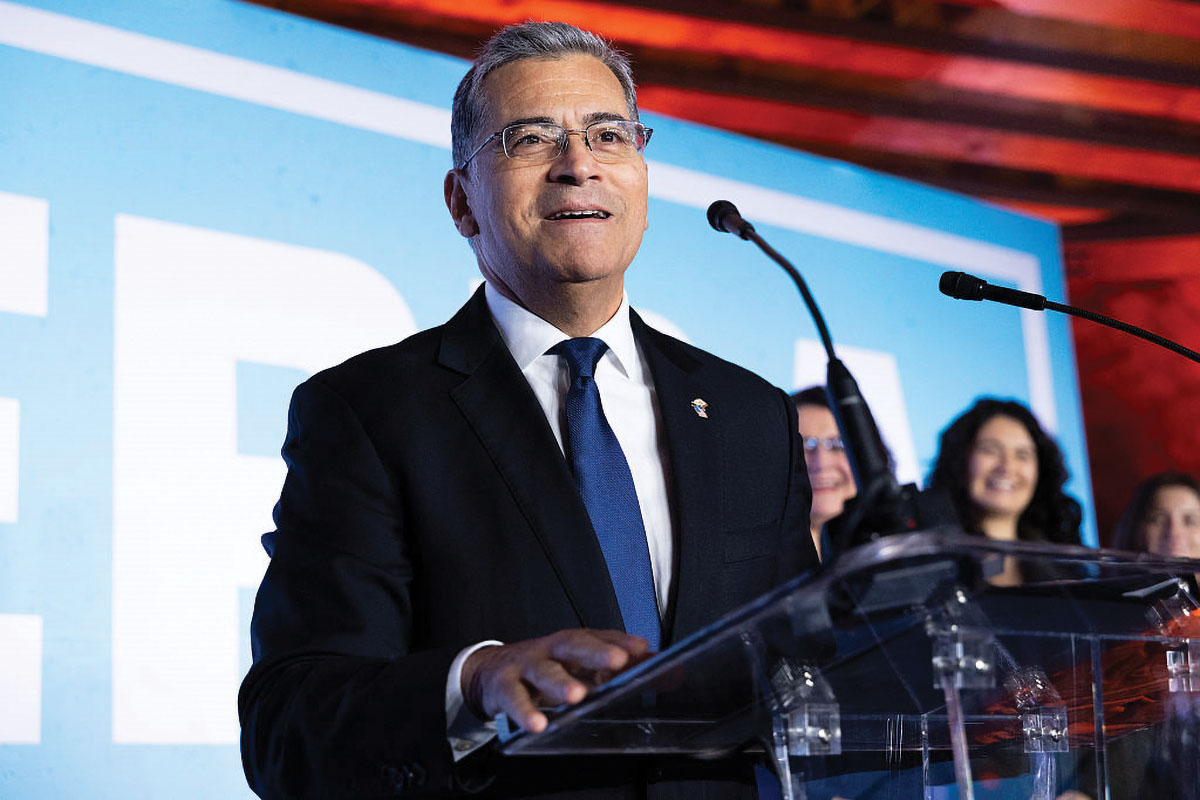
An estimated 2,000 people gathered on May 1 for Los Angeles’ annual commemoration of Holocaust Remembrance Day in Pan Pacific Park. The crowd, which included octogenarians in wheelchairs, infants in strollers and people of all ages in between, listened to speeches from elected officials and community leaders who exhorted them to remember the murder of millions of innocent European Jews during World War II, which ended 66 years ago.
Los Angeles Mayor Antonio Villaraigosa was among those who addressed the mostly Jewish crowd. “I believe I have a responsibility to bear witness, just as you do,” he said.
Many of the speakers referred to the ever-shrinking numbers of survivors in attendance, noting that in the coming decade, most of those who survived the attempted genocide of the Jews by the Nazis will be gone.
Ida Haberman, 87, said that as a survivor, she feels very strongly about the need for the annual event. “I’m happy that they’re still doing it, and I’m happy that they’re still coming, because we’re old people already,” she said.
The program, which has been held in various locations during its 30-year history, settled in its current location opposite the Los Angeles Holocaust Monument in Pan Pacific Park about 14 years ago. For the first time this year, attendees could walk directly from the commemoration ceremony to tour the new home of the Los Angeles Museum of the Holocaust, a 50-year-old museum whose first purpose-built building opened beside the monument in October 2010.
Photos by Jonah Lowenfeld. Story continues after the jump.
Among the hundreds who wandered through the subterranean halls of the museum was Ralph Hackman, 86, who survived for nearly three years in the Auschwitz-Birkenau death camp. He stood beside a touch-screen display that told the history of another death camp, Treblinka, in words and illuminated photographs.
More than 870,000 Jews were killed at Treblinka, including Hackman’s mother and father.
“I was determined,” Hackman said, explaining how he managed to survive in Auschwitz-Birkenau. “I wanted to be a hero for my family. Unfortunately, I came back and I didn’t find anybody.”
This year’s commemoration marked the last time that Israeli Consul General Jacob Dayan, who wraps up his four-year stint in Los Angeles this summer, would address this gathering.
Protected from the afternoon sun by a large blue-and-white-striped tent, which was ringed by Israeli flags, Dayan said that upon his return to Israel, his 18-year-old daughter would be enlisting in the Israel Defense Forces. Her service, he said, will help to make Israel a haven for Jews around the world. “The Jewish State of Israel is the eternal insurance policy of the Jewish people,” Dayan said.
At one point during his speech, Dayan invited consular staff members from other countries in attendance to stand up. The crowd applauded as representatives of Austria, Croatia, France, Germany, Hungary, Japan, Mexico, Norway, the Philippines, Romania and Turkey stood.
“If you believe in human dignity, if you believe that people were born equal, if you believe that you should do your utmost to prevent another Holocaust from happening, you have to stand up against evil,” Dayan said.
Saying that they need to prevent “future Hitlers, and Ahmadinejad, from destroying people and other nations,” Dayan urged his fellow consular staff members to speak up. “Silence is not an option again,” he said.