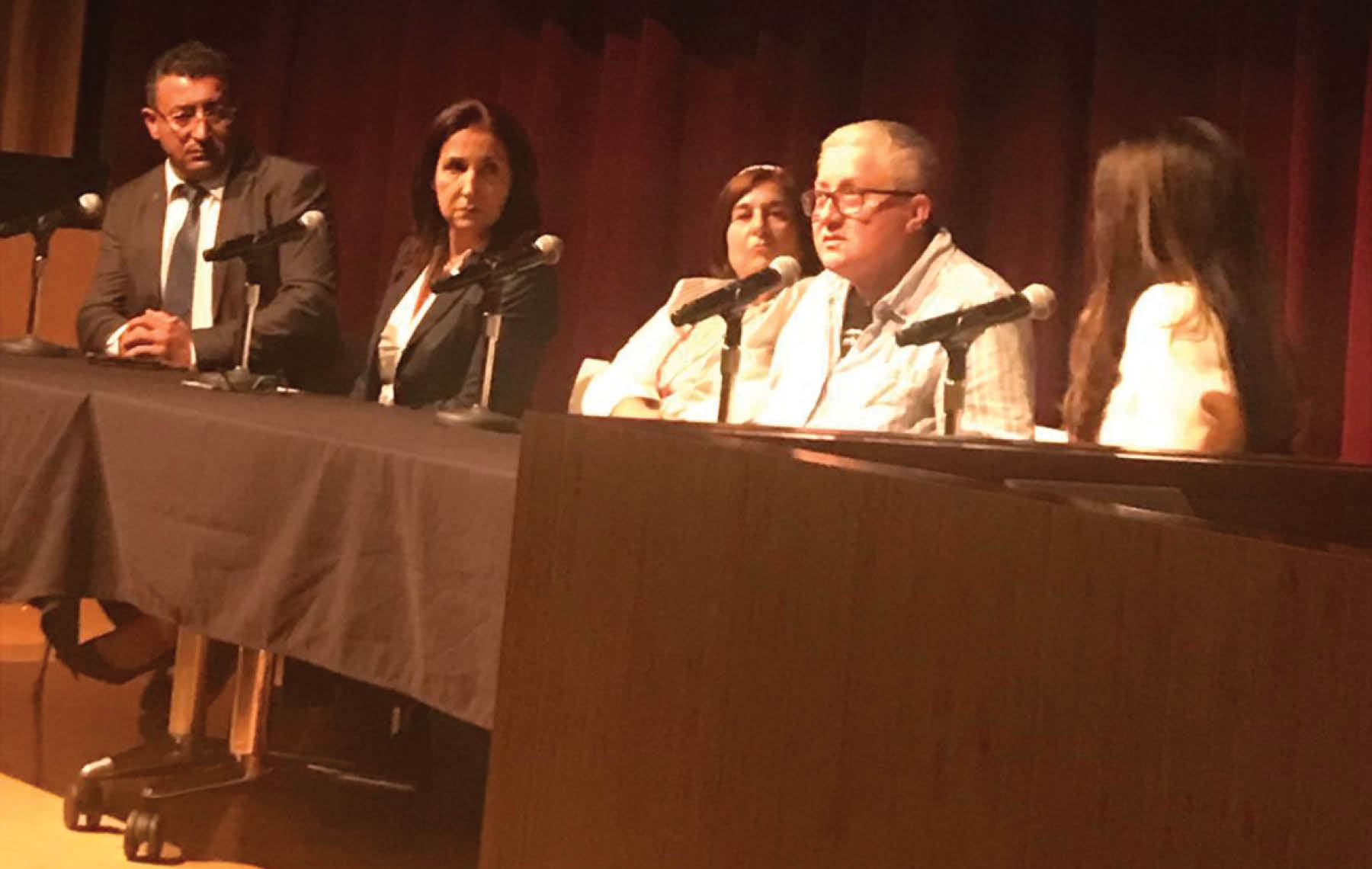
On May 7, two days before Yom Ha’atzmaut — Israel’s Independence Day — the West Hollywood City Council hosted a screening of the 1997 documentary “The Long Way Home,” followed by a panel discussion.
Close to 100 people packed the City Council chambers to watch the film, narrated by Morgan Freeman and produced by Moriah Films, a division of the Simon Wiesenthal Center.
The movie features Jewish refugees from the Holocaust explaining how their plight was largely ignored in the aftermath of World War II. The film also documents the creation of the State of Israel and how Clark Clifford, an adviser to then-President Harry Truman, convinced Truman to support the establishment of the Jewish state.
After the screening, panel participants Mendi Safadi of the Safadi Center for International Diplomacy, Research, Human Rights and Public Relations, Rabbi Denise Eger of Congregation Kol Ami, Hebrew Union College professor Yaffa Weisman and Zohreh Mizrahi of the Iranian American Jewish Federation discussed why Israel is important to them.
“Israel continues to play an important role in the life of the Jewish people and the Jewish community,” Eger said, explaining that Israel is “the spiritual place of birth for the Jewish people.” She added it’s “important for us to understand the truth rather than the lies put forth [under] this roof about the creation of the State of Israel,” a reference to the city council’s screening of the anti-Israel film “1948: Creation and Catastrophe” on April 16.
Mizrahi said the ayatollahs “hijacked” Iran in 1979, turning the Iranian government into “the spokespeople for the Palestinians” and “going as far as threatening to wipe out Israel.” Despite this, “Iranian people and Israel have always been friends,” Mizrahi said. “Israel has been our moral compass all these years [and] we need to reciprocate all the goodness that has been done to us and for us.”
Yaffa Weisman said she believes the BDS movement has permeated college campuses because “when you’re young, you want to be a rebellious progressive and you fall prey to empty slogans that we learn to regret as we get older.”
Journalist and moderator Lisa Daftari, asked the panelists their thoughts on the boycott, divestment and sanctions (BDS) movement. Weisman, who grew up in Israel, said the movement is “hateful” because it seeks “to delegitimize the existence of the State of Israel.” She added it has also been detrimental to Palestinians, saying, “BDS was so successful with [its boycott against Israeli manufacturer] SodaStream that they closed the plant in the West Bank and 1,500 Palestinians lost their jobs.”
Weisman added she believes the BDS movement has permeated college campuses because “when you’re young, you want to be a rebellious progressive and you fall prey to empty slogans that we learn to regret as we get older.”
Eger argued that the roots of the Israel-Palestinian conflict began in 1948, when the Arabs “rejected the creation of two states. To never recognize the legitimacy of the State of Israel is not rooted in recent times but the BDS movement is rooted in that notion not to just force Israel into a particular position but to actually create an Israel-free zone,” Eger said.
She cited the “from the river to the sea, Palestine will be free” chants, arguing that the “river” is the Jordan River and the “sea” is the Mediterranean Sea, with the entirety of Israel between the two.
Mizrahi added that the BDS movement manipulates the “emotional side of individuals who prefer to be the underdog.”
On the issue of Iran and whether United States policy will rein in the Iranian government’s activities, Mirazhi said, “The current U.S. administration seems to be acting consistently with the promises that it made during the campaign that Iran has to curb its funding of terror groups.”
Eger added, “Israel is the target in many ways of [Iran’s] terror,” stating that Iran has established “air forces and missile bases now lined up against the State of Israel” in Syria and funnels money to Hamas in the Gaza Strip and Hezbollah in Lebanon.
Responding to an audience member’s question about their feelings on anti-Zionist Jews, Weisman said her “inclination [is] to sit down and have a dialogue” with them. Eger said she would tell anti-Zionist Jews that the story of Israel “is the history of our people. For the Jewish people that are anti-Israel and claim to be anti-Zionist, the truth is Zionist is that movement that is the aspiration of our people,” Eger said. “Zionism is that opportunity for us to tell our story.”