
The concept of fake news started in part as a way to help people convey conspiratorial stories, such as Hillary Clinton running a child sex slave ring out of a pizzeria.
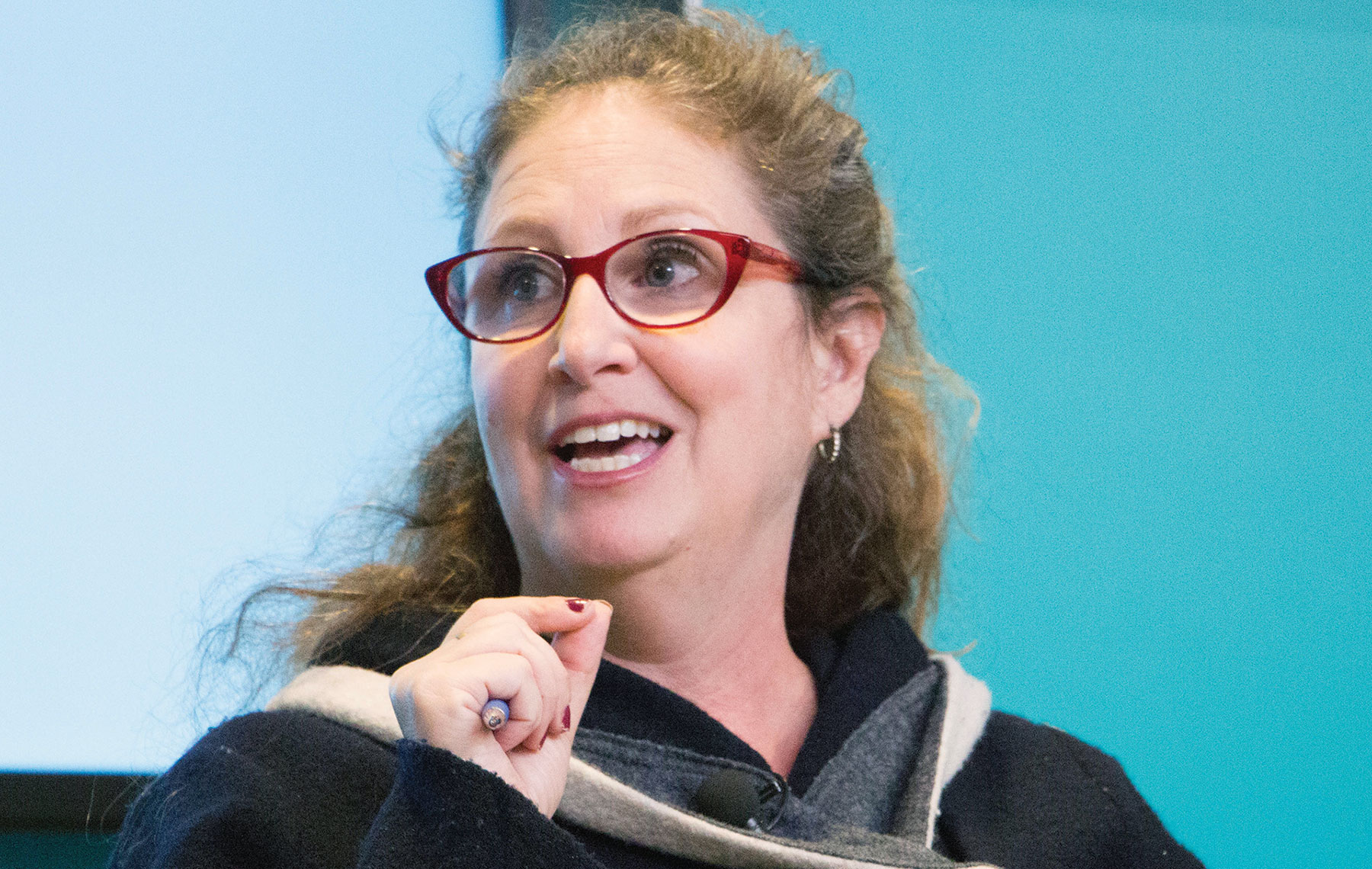
That’s how Slate Senior Editor Dahlia Lithwick introduced her take on the etymology of fake news during a recent symposium titled, “These Truths We Hold: Judaism in an Age of Truthiness.”
Speaking at a three-day symposium earlier this month at Stephen Wise Temple hosted by Hebrew Union College-Jewish Institute of Religion (HUC-JIR), Lithwick said over the past two years, “Donald Trump very adeptly co-opted those two words to mean any news critical of him.”
“If you follow the sort of etymology of this fake news, it starts with the ‘good people’ at Infowars, it is pushed out by Sarah Huckabee Sanders, the White House press secretary — who, ostensibly, to be clear, works for the government, works for us — [and] it is immediately pulled up by [internet] bots,” she said.
Lithwick talked about the Nov. 7 White House press conference, after which CNN correspondent Jim Acosta had his press credentials revoked by the Trump administration as Sanders released a video that had been edited to depict Acosta “karate chopping” a White House intern’s arm.
The sequence of events was illustrative of everything wrong about Trump’s relationship with truth, Lithwick said. “There were millions of Americans who agreed that what we all saw, what happened in real time in front of our eyes, did not happen,” she said. “There is a reason that [George] Orwell quote, about believing something that is not true as a cornerstone of authoritarianism, has been affixed to this. The White House claimed something utterly different than what we saw with our eyes.”
In her nearly 30-minute indictment of the president, Lithwick also attributed blame to journalists for creating confusion over real and fictitious reporting, specifically the “conflation of news and opinion, and that’s been going on for years,” and a revenue model that “rewards clicks and drama, and rewards grandstanding and showboating” over quality journalism.
“Truth cannot be determined first and foremost only by those in power.”
— Dahlia Lithwick
She said people are responsible for holding their leaders accountable. “Truth cannot be determined first and foremost only by those in power,” she said.
Also appearing at the event, Rabbi Rachel Adler, the David Ellenson professor of modern Jewish thought at HUC-JIR, said stories, more than truth, have the capacity to move people. She cited the news coverage of the Oct. 27 Tree of Life synagogue shooting in Pittsburgh. The most effective reporting featured the personal stories of the victims, Adler said during a presentation titled, “The Torah, Our Chavruta: Re/Constructing Truth in Sacred Text.”
Christine Hayes, the Weis professor of religious studies in classical Judaica at Yale University, delivered a talk titled, “The ‘Truth’ About Torah.” She said people should look to Torah for more than proscriptive text on how to lead their lives. “There is more to Torah than some static, immutable truth,” she said.
Benjamin Sommer, a professor of Bible studies at the Jewish Theological Seminary, built on Hayes’ sentiment. During his talk, “Can the Torah Still Be a Source of Truth?” he said the Bible, with its many self-contradictions, shows that even work considered to be divine truth presents more than one the truth.
Attendees included Sarah Benor, professor of contemporary Jewish studies at HUC-JIR. During a break, Benor said she was impressed with Sommer’s characterization of the Torah as “proto-rabbinic literature,” a text containing a multitude of voices, as opposed to one absolute truth. It “blew my mind,” she said.

































