For Israel, the Jewish year 5770 was characterized by ups and downs in relations with the United States, a virtual stalemate in Middle East peacemaking and growing international alienation.
Last November, after months of intense U.S. pressure, Prime Minister Benjamin Netanyahu declared a temporary freeze on new construction building in West Bank settlements—a move designed to create conditions for a renewal of peace talks with the Palestinians. But the freeze was only for 10 months, did not include some 3,000 units already started and did not apply to construction in eastern Jerusalem.
The Palestinians, convinced that President Obama would exert even heavier pressure on Israel on the core issues of dispute—borders, Jerusalem, Palestinian refugees and the nature of a future Palestinian state—without their having to negotiate, highlighted the lacunae and rejected calls to return to the peace table.
As a compromise, special U.S. peace envoy George Mitchell proposed indirect negotiations under U.S. auspices. By early March, both sides had agreed to “proximity talks,” with Mitchell shuttling between Jerusalem and Ramallah. U.S. Vice President Joe Biden traveled to the region to announce the breakthrough, but during his visit an Israeli Interior Ministry planning committee approved plans for 1,600 new housing units in Ramat Shlomo, a Jewish neighborhood in Jerusalem on the east side of the pre-1967 border—what most of the world still considers the West Bank.
The move prompted the Palestinians to retract their agreement to participate in proximity talks and infuriated the Obama administration. U.S. officials blamed Israel for what they saw as a deliberate slight calculated to torpedo their peace efforts.
In an angry 43-minute telephone conversation, U.S. Secretary of State Hillary Clinton reprimanded Netanyahu, insisting that Israel freeze the Ramat Shlomo project and agree to discuss all the core issues in the proximity talks. Netanyahu explained that the planning committee’s announcement had taken his government by surprise as much as it had the Americans, made it clear that there would be no building in Ramat Shlomo for at least two years, and agreed to put the core issues on the table.
Parallel to the U.S.-led peacemaking endeavor, the Palestinians stepped up unilateral efforts to create a framework for statehood, focusing on law and order, economic viability and institution building. Palestinian Authority Prime Minister Salam Fayyad made no secret of his intention to have “a well-functioning state in just about every facet of activity” by mid-2011, irrespective of whether any peace agreement with Israel had been reached.
After weeks of bickering, the proximity talks finally were launched in early May, after the Palestinians received the go-ahead from the Arab League. Neither side expected to achieve much. It seemed both had agreed primarily to engage to avoid American censure.
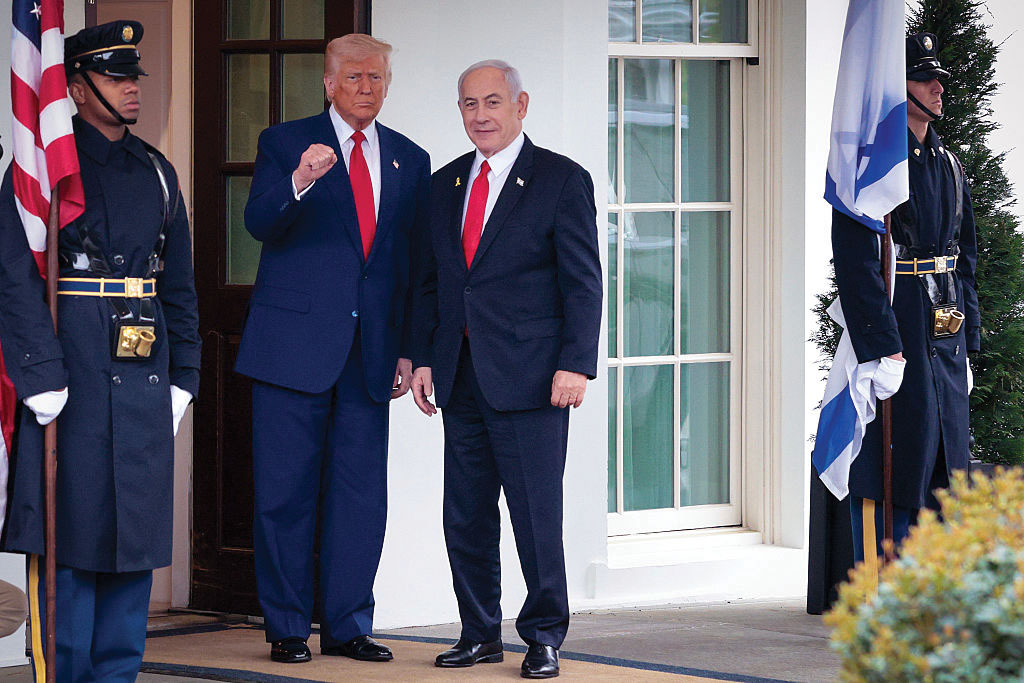
With ties strained between Washington and Jerusalem, Obama invited Netanyahu to the White House for a meeting that was to patch up the strains in the relationship and provide a positive image in contrast with an earlier, low-profile meeting in March that included no public component or photo op.
The meeting was delayed several weeks due to Israel’s commando raid aboard a Gaza-bound aid flotilla from Turkey on May 31. But when the two leaders finally met on July 6, the two projected a public display of warmth. The meeting resulted in no new pressure on Israel. Rather, the Americans exhorted the Palestinians to move from proximity talks, which were not making headway, to direct negotiations between the parties—the position favored by Israel.
The meeting also cleared up earlier tensions over Israel’s presumed nuclear weapons’ program. In late May, the United States had backed the final communique of a monthlong Nuclear Non-Proliferation Treaty Review Conference calling for a nuclear-free Middle East and calling specifically on Israel to sign the NPT.
In their meeting, Obama assured Netanyahu that despite his long-term vision of a world free of nuclear weapons, the United States would continue to back Israel’s policy of nuclear ambiguity under which Israel does not confirm or deny possession of nuclear weapons or sign the NPT.
Although Israel and the United States were in agreement that Iran must not be allowed to develop nuclear weapons, Israel was skeptical about the international community’s will to take significant action to prevent it. In mid-February, the chairman of the U.S. joint chiefs of staff, Adm. Mike Mullen, came to Israel to underline Washington’s opposition to a pre-emptive Israeli strike on Iran.
“I worry a great deal about the unintended consequences” of an attack against Iran, Mullen said. The prospect of an Israeli strike, however, significantly diminished following the adoption in early June of new, tougher sanctions against Iran by the U.N. Security Council.
Perhaps the year’s most prominent development was a major erosion of Israel’s international standing. The downward trend began with the Goldstone report on the Gaza war, released in September 2009, which accused Israel of possible “war crimes” and “crimes against humanity” in its war with Hamas in Gaza in December 2008 and January 2009.
Although the report was widely dismissed as biased and deeply flawed, the damage to Israel’s image was devastating, and critics of Israel used the Goldstone report to hammer away at its reputation.