

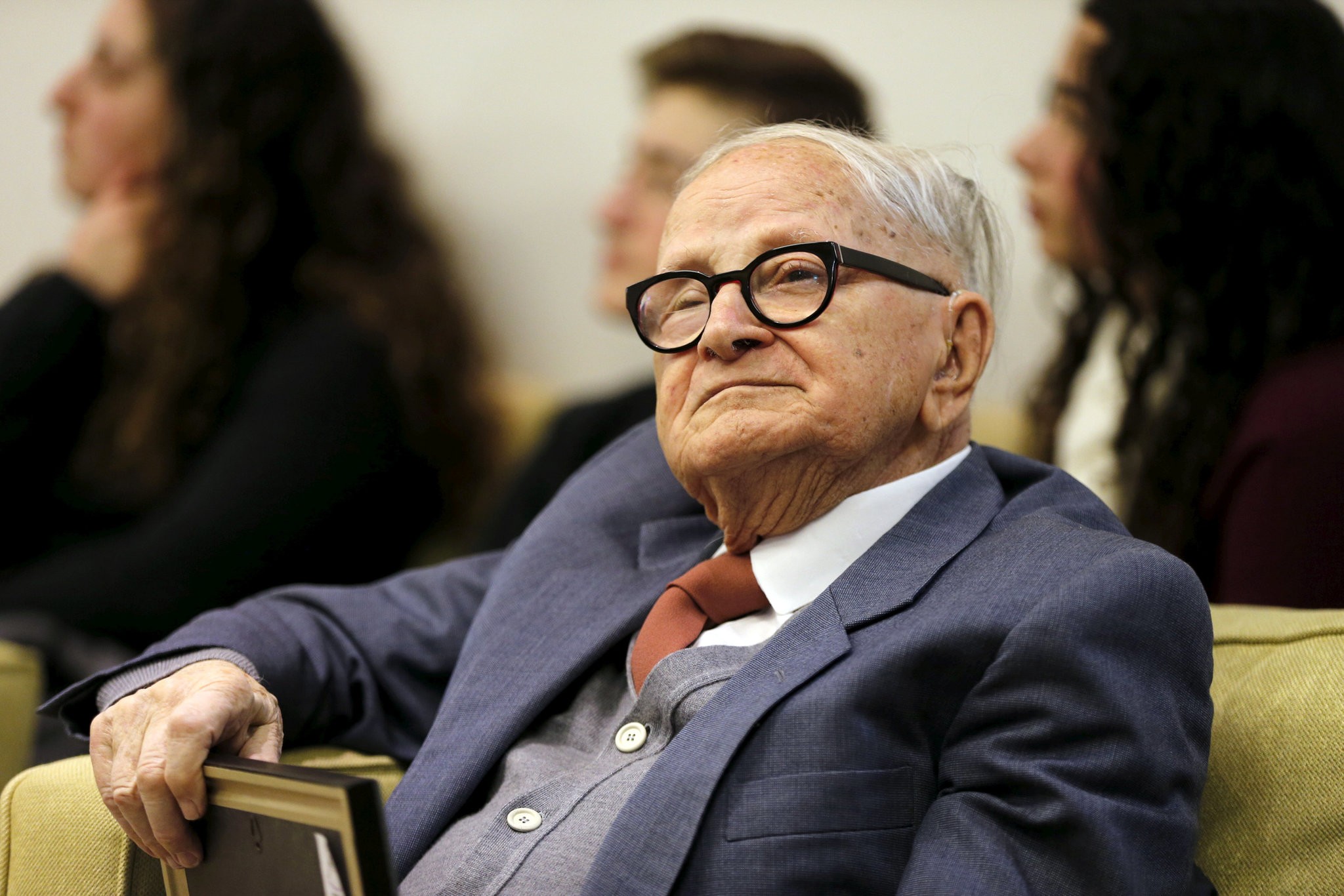
Rafi Eitan, the Israeli spy and politician whom Prime Minister Benjamin Netanyahu eulogized as “among the heroes of the intelligence services of the State of Israel,” died March 23 in Tel Aviv. He was 92.
Eitan’s exploits read like something out of a John Le Carré novel. He was part of the team that in 1960 captured Nazi SS official Adolf Eichmann in Argentina and smuggled him to Israel, where he was tried, found guilty of crimes against humanity and executed in 1962; assassinated the Palestinian terrorists who massacred Israeli athletes at the 1972 Munich Olympics; and helped plan the 1981 bombing of the Osirak nuclear reactor in Iraq. He was also the handler of Jonathan Jay Pollard, the American Navy intelligence analyst who in 1987 pled guilty to passing more than 1,000 secret documents to Israel.
Eitan was born Nov. 23, 1926, in Ein Harod in the British Mandate of Palestine. His parents, Noach and Yehudit, were Russian Zionists. Before he was even a bar mitzvah, he joined the Haganah and was eventually promoted to the elite Palmach branch. He was twice wounded during the War of Independence, but not before he became legendary for crawling through sewers to bomb a British installation at Mount Carmel. After the war, Eitan studied at the London School of Economics and returned to Israel as operations chief at Shin Bet, served as the chief liaison between Shin Bet and Mossad, and later as Mossad’s deputy operations chief.
In 1968, Eitan was suspected as being the prime mover of what came to be known as the Apollo Affair. Posing as a chemist, he was given a tour of an American nuclear fuel plant outside of Pittsburgh, where 200 pounds of enriched uranium went missing, eventually ending up in Israel. The case was never solved.
Eitan retired from intelligence work in 1972, but in 1978, Israeli Prime Minister Menachem Begin asked him to join his government as an adviser on terrorism. Following the Pollard scandal in 1985, Eitan left the government and led the state-owned Israel Chemicals Corporation until retiring in 1993.
After leaving intelligence, Eitan became an entrepreneur, acquiring companies in the Caribbean and South America. Among the projects he developed was a Holocaust Memorial built in Havana, Cuba.
In 2006, he turned to politics, running for Knesset as a member of Gil, a party representing Israeli pensioners. It made a surprisingly strong showing in that year’s election, and Eitan was named Minister of Pensioner’s Affairs, a position he held until 2009, when Gil did not attract enough votes to hold its seats.
An avid sculptor, Eitan produced over 100 pieces, but he remained committed to counter-terrorism, telling Haaretz in 2010, “In principle, when there is a war on terror, you conduct it without principles. You simply fight it.”
































