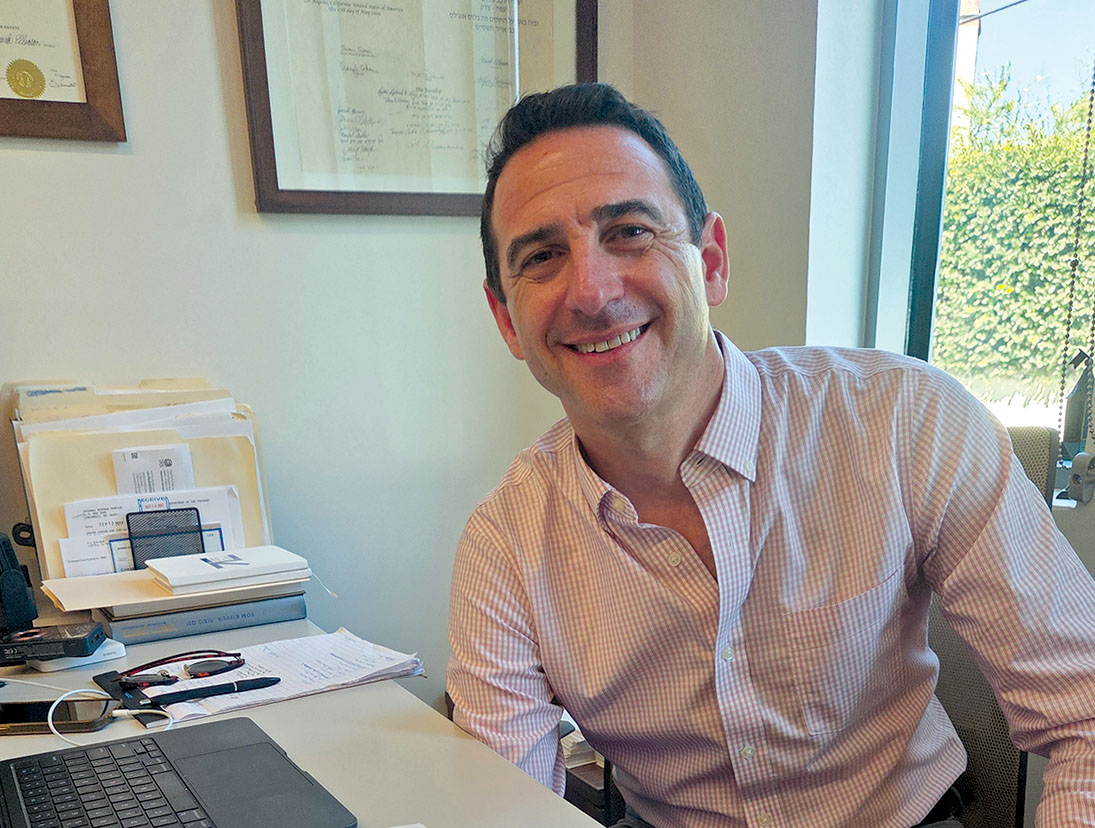
As the Fingerhut professor of education at American Jewish University and president of Synagogue 3000 — a program designed to rethink Jewish synagogue practices and goals — Ron Wolfson has long been looking for answers to some of life’s most complex questions. At the same time, he has remained, at his core, a teacher. And a teacher, he said “always starts with a question.”
“The Seven Questions You’re Asked in Heaven” (Jewish Lights Publishing), his ninth book, allegedly challenges readers to consider questions that could be asked upon arrival in heaven — or wherever the soul embarks when the body leaves the earthly world. Despite the premise, Wolfson said, the book’s suggestions and stories are really about living and reflecting today.
“It really is the question of ‘how do you think you’re going to look back at your life and make an assessment of what you did with your time on Earth?’” Wolfson said. “The book is not about heaven at all. The book is about life on this Earth.”
The premise, he said, was inspired by a quote from the fourth-century talmudic scholar Rava: “At the hour you enter [heaven] for judgment, they will ask you … Did you deal honestly with people in your business practices?”
Rava poses six ultimate questions, which Wolfson condensed and simplified into five: Were you honest? Did you leave a legacy? Did you set time to study? Did you have hope in your heart? Did you get your priorities straight?
Wolfson added two more questions, from the 19th-century German Orthodox Rabbi Samson Raphael Hirsch and the early Chasidic sage Rabbi Zusya, respectively: Did you enjoy this world? Were you the best you could be?
Wolfson set out to extrapolate the questions’ meanings. “My interest,” he said, “was in exploring what the questions really are trying to get at.”
The book intersperses Judaic teachings with stories of Wolfson’s own personal experiences, including encounters with relatives and friends, as well as strangers. Through these stories, he encourages readers to examine and assess their own lives.
One such story deals with a couple, Leia and Dwight Smith, who left their high-powered jobs to live in and run a shelter that provides hot meals every day to more than 120 of Santa Ana’s homeless population.
The Smiths are “a couple who decided long ago not to have their own children. Instead, they devote their lives to the hundreds of people who come through the Isaiah House each week,” he writes.
When he set out to address Rava’s second question, “Did you busy yourself with procreation?” (which he rephrased as “Did you leave a legacy?”), Wolfson was careful to incorporate a range of stories, such as the Smiths’, taking into account the challenges his readers might face.
“I knew right away that was going to be a difficult question, because 10 percent of the population can’t have children,” he said. However, the examples and context he gives explain different ways to leave legacies, evident even in the book’s dedication: “For my ancestors, From your descendant.”
With the High Holy Days fast approaching, Wolfson said he hopes people find the book relevant.
He doesn’t pretend to have an inside track on the afterlife: “I don’t know what’s going to happen, but the idea that you can reflect back on your life even before you’re gone, is my goal as an educator.”
“Ronnie’s genius is in the way he speaks to people,” said Rabbi Ed Feinstein, senior rabbi of Valley Beth Shalom in Encino and a friend and neighbor of the author. “Normally we think of people who are really smart, really wise, really deep, as speaking in an idiom which is above our heads. … Ronnie’s genius is to speak to you in a language which makes you realize your own inner wisdom, and this book is a great example of that.”
Wolfson began teaching in 1974, while a graduate student at American Jewish University. He has yet to stop teaching, or learning, which speaks to one of the book’s fundamental premises, which he summarizes as: “Rava just wants you to have an appointment to learn.”
Wolfson strives to live by example, learning and growing every day; that is a goal his daughter, Havi Wolfson Hall, said he lives up to. “He’s always a student,” she said. “He learns from every experience.”