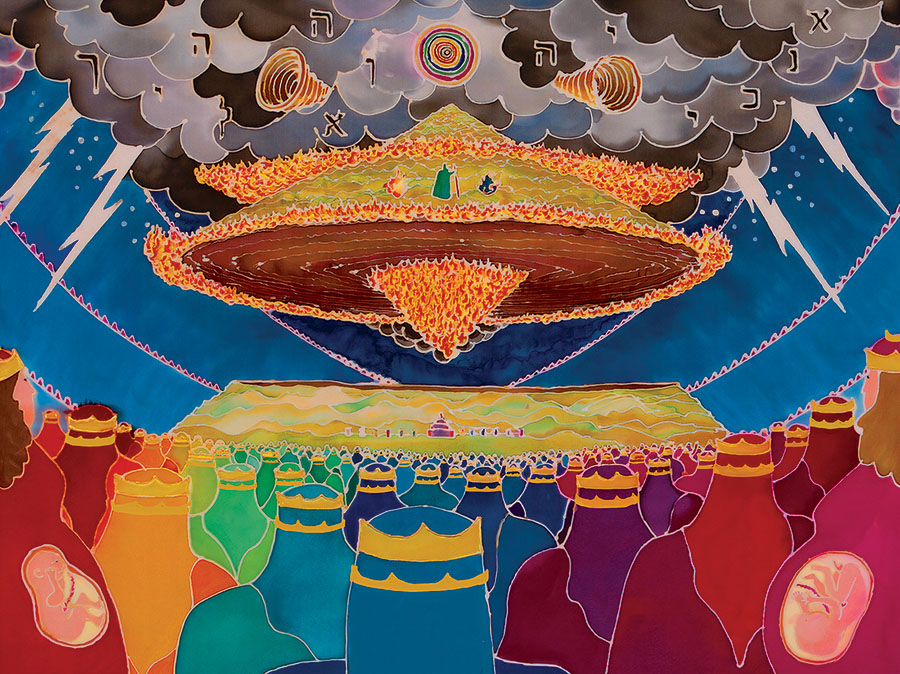
Pillar of Prayer
Thoughts on Torah Portion Noah 2016 (adapted from 2015)
This week’s Torah portion, Noah, has a verse that has become a foundation for the spiritual and mystical approach to prayer. In Genesis 6:16, we find God saying to Noah, “Make a tzohar (light) for the tevah (ark). The Hebrew word “tzohar” has two basic interpretations in the Talmud: “radiant gemstone” and “skylight”, but they both mean “a source of light.”
Here is where things get interesting. The Hebrew word for “ark” “tevah” has various meanings. Basically, “tevah” means “container”. A “tevah” can mean a mailbox. A “tevah” is what Moses’ mother put him in when she saved him from Pharaoh’s decree to kill all the male children.
Fascinatingly, this Hebrew word for container also means “word”, in the sense of a written word – a written form that “contains” meaning. (There are three Hebrew words for the English word “word” – “davar” which means “a matter”, “milah” which means a spoken word, and “tevah” which means a written word.)
Jewish commentators have creatively mistranslated the word “tevah” in Genesis 6:16, that refers to Noah’s “tevah” (ark), as “word”, and we can read this verse this way:
“Make a light (skylight, or gemstone) for the word.”
Through this creative mistranslation, the command to Noah to make a light for the ark becomes a direction for prayer and study, to make a light to shine down into the word.
As this skylight/radiant gemstone shines light down into the word, one discovers the inner life of the word. The great Rabbi Israel ben Eliezer, the Baal Shem Tov (1698-1760) taught that this passage in Genesis refers to the spiritual dimension of liturgy, the words of the prayer book. In a long and detailed commentary to this passage, a profound teaching was constructed. This teaching, based on this verse in Genesis, came to be called “Amud Ha-Tefilah” “The Pillar of Prayer.”
The Besht teaches (“Besht is an acronym for “Baal Shem Tov”) that when one places the aperture (or radiant gemstone) of consciousness into a word of the prayer book (or Torah study for that matter) one perceives “worlds, souls and divinity.” The letters, the pronunciation of a word of the prayer book or the Bible, are a vessel that holds an inner depth.
We have all had this experience when we study literature or poetry. A line we read suddenly stops us, forces us to consider. A light goes on.
In thinking about Noah’s tevah floating on a resurgent sea that has suddenly regained its primeval fury, this line of Joseph Conrad’s that I recently came across (in William Finnegan’s book, Barbarian Days: A Surfing Life) came to mind.
The ocean has the conscienceless temper of a savage autocrat spoiled by much adulation. (Joseph Conrad, The Mirror of the Sea)
Poetry and literature (and theater and cinema) do this: we suddenly are able to see things as we have not seen them before. Meanings, awaiting in the soul, suddenly churn up from the depths.
This seems perhaps incredible to one who has not studied the liturgy as poetry, that these holy books comprise a series of openings into deep realms of the soul, even mystical realms. These realms are discovered when we illuminate them with the skylight, the radiant gemstone, of our own focused consciousness.
I have thought carefully about how to teach this inner path, and I realize that much preparatory work is required. I think that one must first have some experience in a contemplative practice so that one can map out the terrain of the inner life. One must be able to traverse from the realms of Higher Self down into the Archetypal Soul, and points in between. This practice is often called “hitbonenut” “contemplation.” We have to be able to create that skylight, that radiant gemstone, of consciousness, to illuminate the hidden chambers of holy words.
And we must – and here my heart becomes a bit heavy – we must study, take the time to enter into the holy books like a spelunker. It is dark in there, and the work is tough, and maybe boring, but then you detect that the atmosphere has changed – and you look up —
Shabbat Shalom
Rabbi Mordecai Finley